The Transistor at 75, and the Raytheon CK722 (Pete’s First Transistor)

https://www.eejournal.com/article/the-transistor-at-75-the-first-makers-part-1/

Part 4 is especially interesting to us because of the N6QW-CK722 connection:

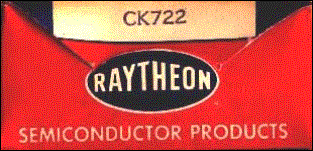
Raytheon: Raytheon started making vacuum tubes in 1922. During World War II, the company made magnetron tubes and radar systems. Raytheon started making germanium-based semiconductor diodes in the 1940s and, just months after BTL announced the development of the transistor in late 1947, started making its own point-contact transistors using germanium salvaged from Sylvania diodes. After attending the 1952 BTL transistor symposium and licensing the alloy junction transistor patents from GE, the company quickly started making germanium transistors including one of the most famous transistors of that generation, the CK722, which was simply a rejected commercial CK718 transistor with downgraded specs for the hobby market. (Jack Ward has created an entire museum around the Raytheon CK722 PNP transistor.) Raytheon exited the semiconductor business in 1962.

Here are all of our blog posts on the CK722:

https://soldersmoke.blogspot.com/search?q=CK722

Here is our post on Pete Juliano’s CK722:

https://soldersmoke.blogspot.com/2015/03/pete-juliano-homebrwing-with.html


The Infinite Impedance Envelope Detector (done with an FET)

Recently a fellow ham claimed that “envelope detection” doesn’t really exist, and that the standard “rectification and filtering” explanation of how envelope detectors work (going back to Terman and beyond) is wrong. But here is a good demonstration of the envelope detection of an AM signal. It uses an infinite impedance detector built around an FET. As Baltic Lab notes in the video above, the action is essentially the same as what happens with a vacuum tube: The device is biased at cut-off. The negative portion of the ENVELOPE is discarded. The positive portion of the ENVELOPE is passed through the device and filtered. What remains is the audio — the same audio frequency that modulated the carrier. ENVELOPE DETECTION.

I was thinking about how fortunate we were that this form of detection was possible. Fessenden used what were in effect diode detectors to envelope detect very early transmissions of radiotelephony. If simple envelope detection via rectification had not been possible, radiotelephony might not have been invented as early as it was.

“The Electrical Experimenter” — A Treasure Trove of Inspiration

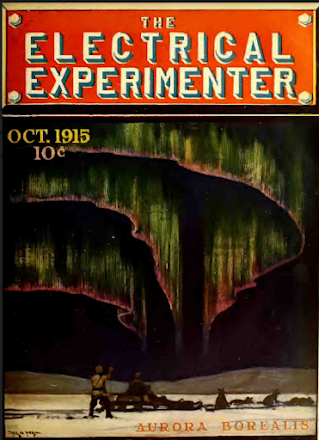
Oh this is really phenomenal. Nick “the Vic” M0NTV is on the mend from some routine surgery. While mending he found this 1915 issue of Hugo Gernsback’s “The Electrical Experimenter.” I just spent a few minutes quickly going through it and I can see that this is a treasure trove that could keep us — the modern day electrical experimenters — busy for a long time.

— We see Signor Marconi in Italian military uniform (I never saw that before).

— There is mention of successful DX reception of the station in Arlington Va. (just down the road from me).

— There is a an article about the radio station of T.O.M — Hiram Percy Maxim.

— There are detailed maps of Mars, complete with the canals.

And there is a lot more.

Above all, I think what stands out from this magazine is the homebrew spirit, the notion that we can and should build our rigs ourselves, and seek to understand them.

Below is the whole magazine. Please take a look and use the comment section below to point us to passages of interest to the electrical experimenters of today.

Thanks Nick. Your e-mail came during a discouraging period filled with a few “tales of woe.” The magazine really lifted my spirits.

Here it is:

http://soldersmoke.com/EE-1915-10.pdf

A Blast from the Past: TR on Homebrewing (sort of)

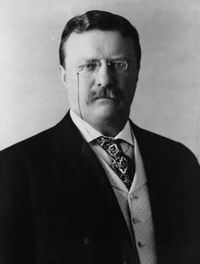
Theodore Roosevelt

“It is not the critic who counts; not the ham who points out how the homebrewer stumbles, or where the builder of rigs could have built them better. The credit belongs to the ham who is actually at the workbench, whose hands are scarred by solder and metal and glue; who strives valiantly; who errs, whose amp oscillates again and again, because there is no effort without error and shortcoming; but who does actually strive to build his rigs; who knows great enthusiasms, the great devotions; who spends himself in a worthy cause; who at the best knows in the end the triumph of homebrew achievement, and who at the worst, if he fails, at least fails while daring greatly, so that his place shall never be with those cold and timid operators who neither know victory nor defeat.”

Some Direct Conversion Receiver History

Here is the article by Wes Hayward and Dick Bingham that started it all:

https://worldradiohistory.com/Archive-DX/QST/60s/QST-1968-11.pdf

page 15

Here’s a discussion by Wes of the original project:

https://www.n5dux.com/ham/files/pdf/Direct%20Conversion%20Receivers%20History%20-%20W7ZOI.pdf

Here is an article about DC receiver in phasing rigs by Gary Breed K9AY:

https://worldradiohistory.com/Archive-DX/QST/80s/QST-1988-01.pdf

page 16

Roy Lewallen W7EL’s Optimized transceiver (with a direct conversion receiver):

https://worldradiohistory.com/Archive-DX/QST/80s/QST-1980-08.pdf

page 14

Jerry KI4IO on Building a DC Receiver

https://groups.io/g/qrptech/message/17

Michael Black wrote on March 5, 2014 at 3:54 PM

Isn’t it a bit dated?

When “direct conversion” receivers came along in 1968 (the concept existed before, just not the name), it was to build simple receivers. They took over from regens (which of course for the purpose of CW and SSB, were “direct conversion”), and kind of bumped simple superheterodyne receivers out of the magazines.

And they were easy to build, so long as the meaning of the dots were standard, but good performance was elusive. Endless articles about better mixers or more front end selectivity, and still the same basic results The Heathkit HW-7 comes along, and endless mods to that, but still no perfection.

Slowly the move was back to simple superhets, especially with some of the early seventies ICs intended for radio, and then ladder filters came along (actually they came early at least by 1974 from the UK and/or France, but while they got mention in North America early-ish, it took some years before the KVG filters were pushed aside and ladder filters got the spotlight).

And then wham, in the mid-eighties someone caught on. The problem with direct conversion receivers wasn’t the mixer (well not once it was a balanced mixer) or lack of front-end selectivity, it was the matter of properly terminating the mixer. The problems that had been there all along were gone. And direct conversion receivers started their climb to being complicated receivers.

I guess it was that receiver by Gary Breed in QST circa 1986 with diode balanced mixers and termination that changed things. A new concept, but not really, I remember an article in QST in 1974 where a DBM diode mixer for VHF was properly terminated, and yet the concept went no further until a decade later.

Actually, I think there is a tiny bit about mixer termination in “Solid State Design for the Radio Amateur” but it never went so far as to say “this is what we need”.

Or perhaps that tiny transceiver by Roy Llewellyn in QST was the first, I cant’ remember. It certainly used a diode mixer with termination for the receiver.

And that set the stage for Rick Campbell’s various receivers, all counting on termination of the mixer.

The ideas can often be there, but not applied because technology doesn’t allow it yet, or just not looking that far beyond this month’s construction article.

Michael

Did Marconi Cross the Atlantic with a Coherer? No.

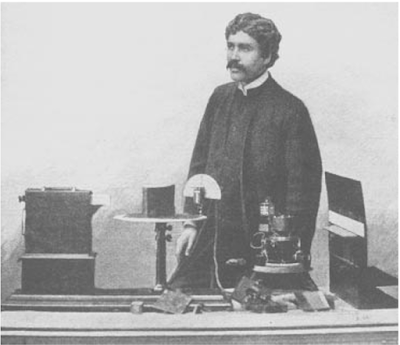
Jagadish Chandra Bose

A while back I posted the re-mastered version of the excellent “Secret Live of Machines” episode on radio. Among other amazing things, Tim and Rex build a spark radio transmitter and a receiver that uses a coherer and a tapper. They even set up a demonstration and sent signals from the pier to the shore. Very cool.

I shared this with George WB5OYP of the Vienna Wireless Society because he had been looking carefully at the gear that Marconi allegedly used to make that first transatlantic contact. George wondered if Marconi could have really done this with a coherer as his detector; he was — for good reason — skeptical. Could a glass tube filled with metal filings really detect radio waves sent from across the mighty Atlantic?

Marconi claimed that he did it with a coherer as the detector:

On December 12, 1901, Marconi attempted to send the first radio signals across the Atlantic Ocean, in spite of predictions that the radio waves would be lost as the earth curved over that long distance. He set up a specially designed wireless receiver in Newfoundland, Canada, using a coherer (a glass tube filled with iron filings) to conduct radio waves, and balloons to lift the antenna as high as possible. The signals were sent in Morse code from Poldhu, Cornwall, in England. Marconi later wrote about the experience:

“Shortly before midday I placed the single earphone to my ear and started listening. The receiver on the table before me was very crude — a few coils and condensers and a coherer — no valves, no amplifiers, not even a crystal. But I was at last on the point of putting the correctness of all my beliefs to test. The answer came at 12: 30 when I heard, faintly but distinctly, pip-pip-pip. I handed the phone to Kemp: “Can you hear anything?” I asked. “Yes,” he said. “The letter S.” He could hear it. I knew then that all my anticipations had been justified. The electric waves sent out into space from Poldhu had traversed the Atlantic — the distance, enormous as it seemed then, of 1,700 miles — unimpeded by the curvature of the earth. The result meant much more to me than the mere successful realization of an experiment. As Sir Oliver Lodge has stated, it was an epoch in history. I now felt for the first time absolutely certain that the day would come when mankind would be able to send messages without wires not only across the Atlantic but between the farthermost ends of the earth.”

https://www.pbs.org/wgbh/aso/databank/entries/dt01ma.html

————————————-

I mentioned this in SolderSmoke Podcast #242. This resulted in a very interesting message from Steve AB4I:

The reason that I am writing is to comment on the coherer and Marconi’s transatlantic test. One of my research interests in my doctoral studies was the development and evolution of early radio detectors. Marconi did not use a coherer for the successful transatlantic tests, but secretly used a detector and telephone receiver that had been invented by the Indian polymath Jagadish Chandra Bose of Calcutta. Bose’s iron-mercury-iron detector was sensitive to a wide range of wavelengths and he used the detector in his 60-GHz millimeter wave and experiments. Bose presented his results to the Royal Society in London in 1899 and his paper was published in the Proceedings of the Royal Society the same year. Marconi came by the mysterious mercury coherer detector through a friend in the Italian Navy who constructed the device from Bose’s paper in the Proceedings in an effort to improve the performance of the Marconi equipment aboard . The Bose detector was superior to anything that Marconi had and was key to the success of the transatlantic tests and for Marconi’s subsequent successes. Marconi then filed a patent for the detector in his own name in 1902, even though it was not his invention.

A lot of nasty business went on in the early days of wireless. The scandal around the “Italian Navy coherer” raged for years, but eventually the role of Bose was revealed. The popular view of Marconi as radio inventor extraordinaire is idealistic, because he did not actually invent anything, but he was very good at dragging laboratory hardware into the real world to serve practical ends. In every case, crucial parts of Marconi’s patents were stolen or copied from other sources and successfully defended through aggressive litigation, deep financial backing, and extensive public relations through advertising and newspaper interviews. Marconi absolutely deserves recognition for his successes in the development of practical wireless communications although he is not noted for his ethics. Marconi’s reputation is a bit tarnished nowadays, but that of Jagadish Chandra Bose has blossomed and he is now acknowledged for his epochal work that was fully a half-century before his time.

As for the coherer, we still do not have a full understanding of how the thing actually works. The cohesion effect of small particles clumping together in the presence of a static charge has been known from antiquity as evidenced by dust bunnies under beds through the ages. There were coherer-like lightning arrestors used on telegraph lines just after the American Civil War and in 1879 David Hughes found that a carbon microphone with loose contacts could detect arcing in nearby equipment and from considerable distances too. He was told that the phenomenon was nothing new and he just missed the discovery of radio waves. Thanks to some monumentally bad advice we now speak of Hertzian Waves instead of Hughian Waves. Branly made a detailed study of resistance changes in metal particles and is generally acknowledged as the inventor of the coherer detector. Oliver Lodge coined the name ‘coherer’ and demonstrated the detection of Hertzian waves in 1894 a few months after Hertz’s death. Lodge wrote a tribute to Hertz, which was to inspire the young Marconi to begin his own experiments with Hertzian waves.

——————————–

Hack-A-Day looked at all this back in 2016:

Here are the key passages: One improvement invented by Bose in 1899 was the iron-mercury-iron coherer, with a pool of mercury in a small metal cup. A film of insulating oil covered the mercury, and an iron disc penetrated the oil but did not make contact with the liquid mercury. RF energy would break down the insulating oil and conduct, with the advantage of not needing a decoherer to reset the system.

Bose’s improved coherer design would miraculously appear in Marconi’s transatlantic wireless receiver two years later. The circumstances are somewhat shady – Marconi’s story about how he came up with the design varied over time, and there were reports that Bose’s circuit designs were stolen from a London hotel room while he was presenting his work. In any case, Bose was not interested in commercializing his invention, which Marconi would go on to patent himself.

—————————————
Here is a lot more background on Dr. Bose:

http://www.cse.iitm.ac.in/~murthy/sirjcbose.pdf

—————————-

I think the more we learn about Marconi, the less admirable he seems.

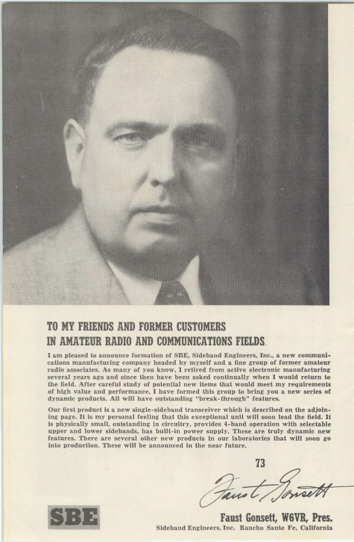
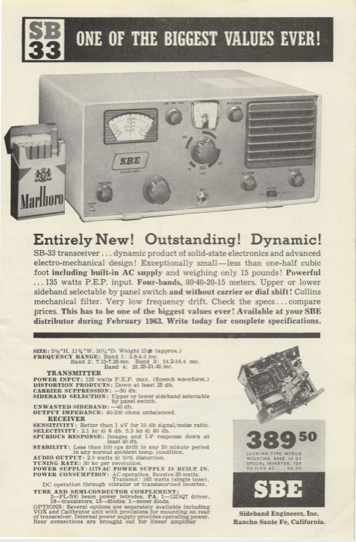
Faust Gonsett and the SB-33 in 1963

Click on the images for better views
When this ad appeared in 73 Magazine in February 1963 I was 4 years old, living on Manhattan Island. Pete N6QW was in the Navy, heading to Midway Island.

Pete writes:

——————-
This ad has a tremendous impact on the foundations of our hobby. The SBE-33 was pure genius in its design and implementation.
  1. It is a hybrid rig using Germanium transistors –the transistor was only 15 years old
  2. The Mechanical band switching showed the strong use of mechanical assemblies
  3. The small size was simply amazing
  4. The Bi-lateral circuitry predates any Bitx circuits.
  5. The urban legend was that a team of illuminati were involved in its design (Don Stoner is one name that pops up)
  6. The Japanese were a quick study and the FTdx100 in 1967 is a result, only better.
  7. Many are still around in shacks. I have three

Gonset was well known for innovative designs – the Gooney Box is another example. Look at all of his compact mobile equipment.

The next point – the final owner of SBE was Raytheon thusly the next generation of SDR Radio Equipment for the US Air Force can trace its pedigree to the SBE-33.

This was the appliance box of 1963. I saw my 1st SBE-33 (August 1963) when likely you were in the 2nd Grade and I was headed off to Midway island.

———————–

I have an SBE-33 that N6QW sent me. Thanks again Pete!

Also, I’d like to note that W6VR had a very cool name. Faust Gonsett. I just sounds like the name of a real radio guy. Google says this of the given name Faust:

“Faust as a boy’s name is of Latin origin, and the meaning of Faust is ‘fortunate, enjoying good luck.’ Indeed.

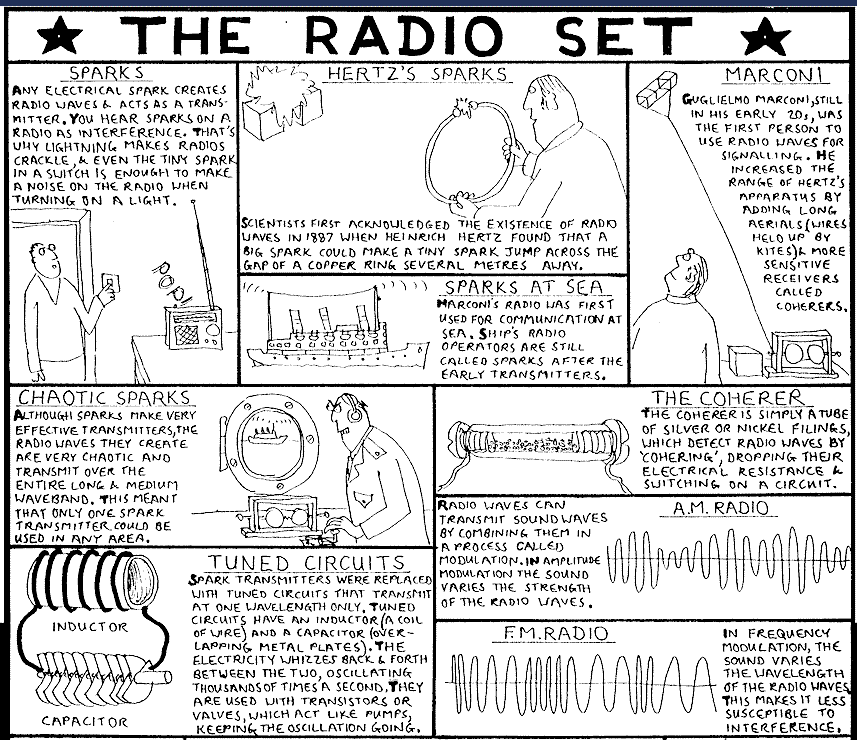
Tim Hunkin’s “The Radio Set” Drawing, and The Secret Life of the Radio (Remastered)

Click on the image for a better view. Click here for the whole drawing:

I really liked this, and there is a lot more like it on the site of Tim Hunkin, the fellow who made all the great Secret Life of Machines shows. His site: https://www.secretlifeofmachines.com/index.shtml

They remastered the show about radios. It is worth watching:

Thanks Tim!

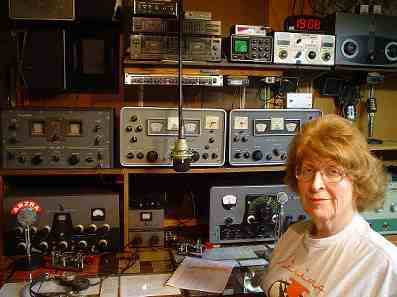
Hammarlund and Homebrew Heroine: Janis AB2RA, HQ-100 Filter Cap Question

I was searching for Hammarlund HQ-100 wisdom when Google pointed me to the Electric Radio articles of Janis AB2RA. They were in ER #380 and #381 (February and March 2021). Lots of good stuff in there.

This morning I happened upon a 2014 SolderSmoke blog post (as you do) about my Tuna Tin 2. Turns out that Janis was my first contact with this rig. And she too was running a homebrew rig. TRGHS.

I continue to work on my HQ-100. The AC hum is getting worse so I have ordered a replacement capacitor can from Hayseed Hamfest. But I was a bit confused about which cap to order. Hayseed has two caps listed for the HQ-100 — one (it seems) for the early model of this receiver and one for later models. Is that right? Did Hammarlund update the power supply to add filter capacitors? Take a look:


Dean KK4DAS is getting ready to work on his dad’s HQ-170A. He too will find lots of wisdom and tribal knowledge on Janis’s wonderful web site.

Her main page: http://www.wireless-girl.com/ (with a vast amount of technical info available through the links on the upper left side of this page)

About Janis: http://www.wireless-girl.com/AboutMe.html

Thanks Janis!

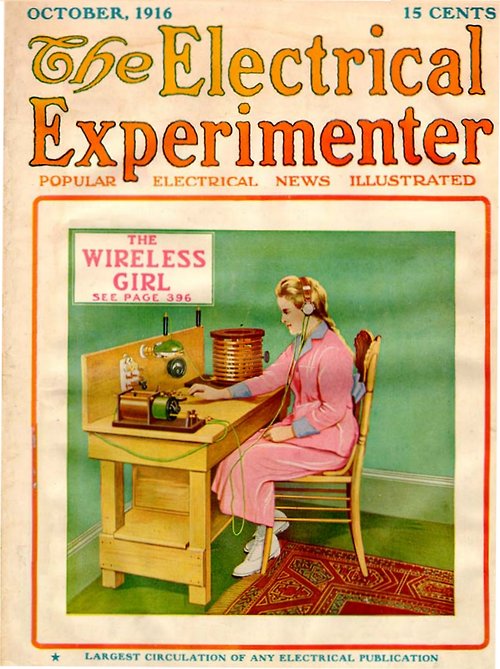
The Original Wireless Girl

SolderSmoke Podcast #238 — SolderSmoke Shack South, Cycle 25, Chiquita Banana Radio, RCA, HQ-100, Mate Mighty Midget, Sony SWL RX , Mailbag

SolderSmoke Podcast #238 is available: http://soldersmoke.com/soldersmoke238.mp3

TRAVELOGUE:

Cathartic decluttering: Bill preparing for future winter travel to Dominican Republic. Will build SolderSmoke Shack South. Dividing everything up: Rigs, parts, tools, supplies, antennas, test gear. Everything.

OUR SPONSOR: Parts Candy.
https://www.ebay.com/usr/partscandy Premium quality test leads! Hand cut, hand crimped, hand soldered, these will become your new favorite test leads GUARANTEED!

PETE’S BENCH:

— Cycle 25 better? – Out here on the left coast – it is not evident
— Chiquita Banana and the US Navy in early ‘wireless” operations. Why RCA was created by the US Navy in 1919.
— Update on the MAX2870 –someone has written the code to make it work with the Raspberry Pi and the QUISK SDR software
— Field Day prep

SHAMELESS COMMERCE DIVISION:
Bill needs your help:
— Please watch his YouTube videos. The longer the better! Success based on hours watched. Great to have on while you are working in the shack. Just go to YouTube and search for the SolderSmoke channel. Or: SolderSmoke – YouTube
— Please put links to the SolderSmoke blog on your websites and blogs.
— How to USE the SolderSmoke Blog: Propagation, shopping, other sites…
— Please put comments under the articles on the SolderSmoke blog. We like comments and dialogue.

BILL’S BENCH:

— Repair of the Sony ICF SW1 shortwave receiver. Bad electrolytics. Number Station receiving device?
— HQ-100 Q-Multiplier. BFO Switch. AVC. Noise Limiter limitations. Dave K8WPE: Old Radio Lessons.
— MMMRX: Detector circuit. Alignment. Muting. On the air (40 AM with DX-100)

MAILBAG:

— Bob Crane W8SX — Great interviews at FDIM. On the SolderSmoke Blog. Thanks Bob!
— Dave Bamford W2DAB — Stickers on the Upper East Side of Manhattan. FB Dave!
— Farhan VU2ESE: LADPAC software now available through W7ZOI’ site.
— Lex PH2LB: Stickers in a Netherlands pub.
— Dave K8WPE Michigan Mighty Mite links. Old Smoke idea. On the SolderSmoke blog.
— Rich WB4TLM was in the electronics class of CF Rockey W9SCH. FB.
— Dean KK4DAS Working on his dad’s HQ-170A. VWS maker group on mixers.
— Grayson KJ7UM — Mixology article in ER.
— Pete Eaton — Farhan’s new analog rig: Daylight again! Standby for more info from Farhan.
— Will KI4POV New HB Al Fresco single conversion superhet. FB.
— Alvin N5VZH. Shep’s “I Libertine.” Yes. I laughed, I cried, It changed me.
— Chuck KF8TI. Mr. Wizard!
— Steve N8NM on the mend after some routine maintenance.
— Ben AB4EN is listening and likes the podcast — Thanks Ben.

May 1939 QST


The Story of Television (Sarnoff’s Version) — 1956 Film

Of course, this has to be taken with a huge grain of salt. “General” Sarnoff sits there and claims that Vladimir Zworkyin “invented” electronic television. But Philo Farnsworth really did that. Zworykin’s claim to invention has about as much validity as Sarnoff’s claim to having been a General!

But still, there is a lot of interesting info amidst the RCA propaganda. Again, it is really striking how far they had come before WWII put things on hold for four years.

Looking at the World Through a 1 inch Cathode Ray Tube (the RCA 913) (videos)

Joh DL6ID sent me the above video. We have been e-mailing each other about the W9YEI Television Receiver built in 1939 or so. We have kind of concluded that the builder used an RCA 913 tube as the CRT. This was an oscilloscope tube and was often described as looking like a metal 6L6 with a tiny screen on top. This is kind of neat — like using something from the old days to peer into the new world of video.

We wondered about the image persistence of this tube. Fortunately for us, we found several YouTube videos showing recent builds or repairs of oscilloscopes with RCA 913 tubes.

Of course, Mr. Carlson has a video on one of these devices (and — as expected — has another in his junk box. Mr. Carlson has at least two of everything.)

Here are a few other videos showing RCA 913 tubes in action.


https://www.youtube.com/watch?v=TJF22Ra2kIM (Summertime…. And the Livin’ is Easy)

Here’s a nice video from Tektronix on CRTs:

1942 (?) RCA Film on Tubes, Radio, Research, and Television

Here is a very interesting video from RCA. It was released in 1942, but it looks to me as if it was produced BEFORE the Pearl Harbor attack and the U.S. entry into World War II. There is no mention of the war nor of RCA’s support for the war effort. All films like this that were produced during the war have a lot of material about how the company was contributing to the war effort. So I think this is really a pre-war film.

Early in the film they link the origins of RCA Labs to a decrepit “radio shack” at Riverhead, Long Island (NY) in 1919. Here is some background on this:
and

In this film we see Vladimir Zworykin (boo, hiss) of TV fame (no mention of poor Philo Farnsworth), and we also see Harold Beverage, the creator of the antenna that bears his name. There is what must have been one of the first “electronic clocks.”

At the end, the segment on television is really interesting. It is amazing how far they had gone with TV before the war.

Conclusions About W9YEI’s Early (1940?) Homebrew Television Receiver

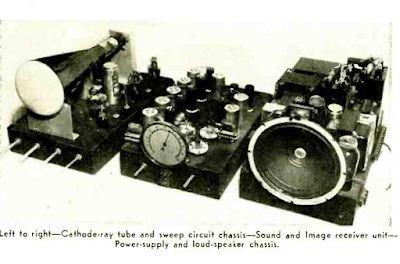
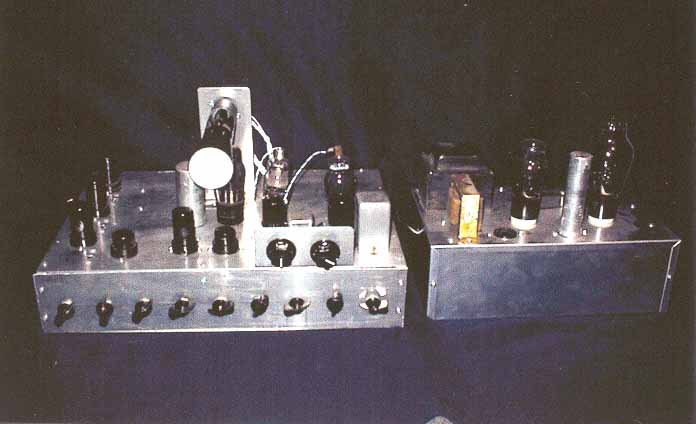
It may have looked something like this. Recent build of the Scozarri receiver by Jack Neitz

Joh DL6ID and I have been exchanging e-mails in which we compare notes on the early homebrew television receiver of Johnny Anderson W9YEI. In 1973 on WOR New York, Jean Shepherd described a very memorable demonstration of TV conducted some three decades earlier by Anderson for teenage friends in Hammond, Indiana. Shep provided a lot of detail, but some of his recollections seemed a bit off; Shep was known for exaggerating or changing details to make a story better.

We have arrived at some conclusions about this project (but if anyone has more info, please let us know):

DID ANDERSON ACTUALLY BUILD A TV RECEIVER?

Yes, he did. This was a homebrew project, not a kit build and not the use of a receiver built and loaned for test purposes by the transmitting station. Anderson was an accomplished homebrewer whose basement, according to Shep, was filled with devices he had built. A QSL card sent by him in 1938 shows him using a “9 tube superhet” as a receiver. Shep describes Johnny — over a period of perhaps six months — gathering components in Chicago’s electronics parts market, and building something in his basement. That sure sounds like a real homebrew project. A TV receiver kit was available, but it was very expensive, and Shep would have immediately denounced it as a non-homebrew project. Anderson homebrewed the receiver.

WHY DID HE DO THIS?

Why would a ham build a TV receiver at a time in which there were only a few experimental transmitters on the air, and no possibility of using the receiver to “work” other amateur stations? We tend to think of TV as a post-war commercial phenomenon. But in fact there was a lot of “buzz” about TV in the 1930s. Magazines were filled with TV articles, and with ads for courses that promised to prepare people for what seemed to many to be “the next big thing.” The World’s Fair in Chicago in 1933 and 1934 featured a demonstration of television — Anderson, who lived in a close-in Chicago suburb, may have seen this demonstration. Television must have seemed like a do-able but difficult technical challenge, and would have attracted the interest of an advanced homebrewer like Anderson.

WHEN DID ANDERSON BUILD THE RECEIVER?

Shepherd describes a demonstration of TV in which Anderson tuned into experimental transmissions of WBKB in Chicago. WBKB’s experimental transmitter W9XBK did not go on the air until August 1940. And Anderson told Shep that he had been calling in reception reports for a month or six weeks. That would push the date of the demonstration to September 1940 at the earliest. In September 1940 Anderson was 22 years old, and Shep was 19. (Here is one area in which Shep’s recall is questionable — he claims that the event took place when he — Shep — was 16 or 17. In fact he was older, but having the protagonists a bit younger made the story more intriguing.) If we assume that it took Anderson six months or so to build the receiver, that would push the start date of Anderson’s build to around March 1940.

There was another experimental station on the air in Chicago: Zenith Corporation had W9XZV doing experimental transmissions starting on February 2, 1939. If Anderson had built the receiver a bit earlier, he could have been tuning into W9XVZ before W9XBK went on the air. But I think it was more likely that he started building in early 1940. I get the feeling that the Scozzari articles of October/November 1939 influenced his build.

WHAT PUBLICATIONS GUIDED ANDERSON?

Shep, in extolling Anderson’s advanced, self-taught knowledge of electronics tells us that Anderson was at his young age already reading the IRE Journal, the monthly publication of the Institute of Radio Engineers. Joh DL6ID notes that Shep said that this publication was being sent to Anderson, indicating that he had some form of subscription. He may have also had access to back-issues in a Chicago library. Anderson was a serious consumer of technical material.

The IRE Journal had many articles about television, but they were highly theoretical. Typical of this was the December 1933 issue. Anderson probably also benefitted from more practical, build-related articles that appeared in publications like QST, Shortwave and Television, and Radio and Television.

In December 1937 QST began a series of articles on television my Marshall Wilder.

In March 1938 CW Palmer launched a series of build articles on TV receivers in the Gernsback magazine “Shortwave and Television.” See photo below.

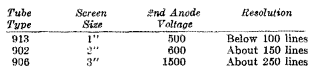
In October 1938 QST started a series of practical build articles on TV by J.B. Sherman. This series provided circuit details on how to use three different sizes of RCA oscilloscope CRTs, including the small 1 inch 913 tube.

In December 1938 QST continued with the television theme, presenting the first in a series of build articles by C.C. Schumard.

In October 1939 Peter Scozzari launched a good series of build articles in Radio and Television magazine. See photo below.

WHAT CATHODE RAY TUBE DID HE USE?

Many of the publications of the era carried projects using 2 or 3 inch CRTs. But it appears that Anderson had a smaller, 1 inch oscilloscope CRT in his project. In his 1973 broadcast, Shep repeatedly called the CRT “tiny” and refers to it as a 1 inch tube. Shep said the image produced was green, indicating a tube built for oscilloscopes. He may have used a 1 inch RCA 913 CRT Tube. See the Sherman article in the October 1938 QST.

THE DEATH OF ROSS HULL

In the middle of all this, on September 13, 1938 radio pioneer Ross Hull was electrocuted while working on his homebrew television receiver.

The Palmer Receiver
The Scozzari receiver — Power supply on separate chassis

Previous SolderSmoke Daily News posts about this project:

TV Homebrew 84 years ago — Tracking Down W9YEI’s 1939 Television Receiver — The CRT He Probably Used — Please Help Find More Info

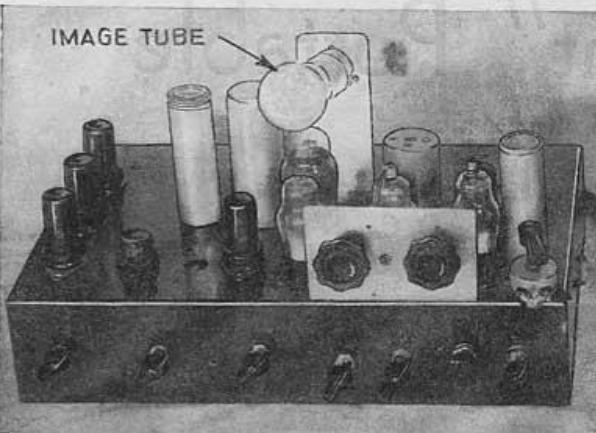
A recent Hack-A-Day article about early television receivers got me thinking about the receiver built by young Johnny Anderson in 1939 and described by Jean Shepherd on WOR in 1973. In the 1973 program (skip to the 18 minute mark), Shep gives a good description of the device. It sounded a lot like the receiver from Peter Scozzari’s October 1939 “Radio and Television” article: Shep described a big chassis with angled pieces of aluminum one of which had a tube socket brazed onto it. Anderson may have bult the power supply on the same chassis as the receiver. Shep said that a 1 inch CRT was in this socket. Tellingly, he described the picture as being green in color.

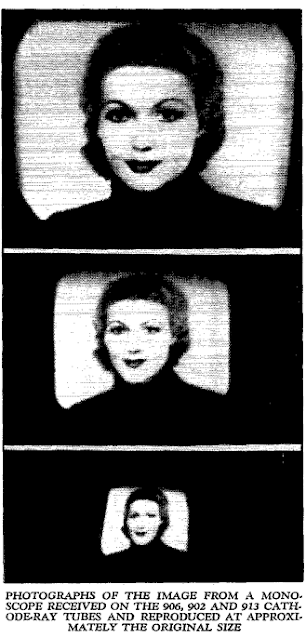
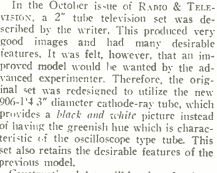
Peter Scozzari wrote that oscilloscope tubes produced a “greenish hue.” One month after his first article, in November 1939 Peter Scozzari published another article in which he changed the CRT to to a tube that would produce a black and white (not green) pictures. See below for the part of the article that describes the shift to the larger black and white tube. This supports the idea that Anderson was using a tube built for oscilloscopes. The picture above shows what images from the three sizes of RCA oscilloscope tubes would have looked like (absent the green hue — this was a black and white magazine). I find them kind of eerie, considering that the person in the picture was probably born more than 100 years ago. And in that bottom picture we see an image (absent the green hue) very similar to what Shep saw in 1939, and described so vividly in 1973.

Scozzari’s receiver started out with a 2 inch tube, then a month later, he went with a 3 inch tube. But Johnny Anderson may have only had the 1 inch tube described by Shep. The Sherman QST article provided circuit details for all three sizes of RCA tubes. This information would have been very useful to Johnny Anderson. So my guess is that when Shep saw TV for the first time in 1939 in Johnny Anderson’s basement workshop, he was looking into an RCA 1 inch 913 CRT.

Here’s a great EDN article on the 1 inch CRTs available in the 1930s:

Here’s a fellow who recently built a TV receiver using an RCA 902:
Here’s the YouTube video of his 902-based receiver in action:
Previous SolderSmoke blog posts on this topic:

This is all pretty amazing: We are gathering details on a television receiver built some 84 years ago by a teenager in a basement in Hammond, Indiana.

Does anyone out there have more information on what Anderson built? Can anyone dig up more information on this? Any more info on Peter Scozzari? Anyone have info on Jack Neitz of California (he recently built the Scozzari TV receiver)?

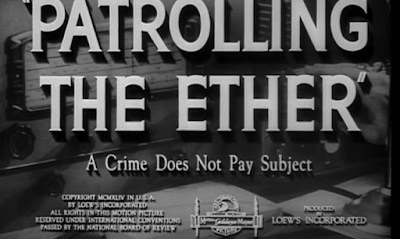
“Patrolling the Ether” WWII Video on Radio Direction Finding Efforts

I heard about this video while trying to track down information on John Stanley Anderson’s 1939 television receiver. “Patrolling the Ether” is kind of hard to find. It is not really on YouTube. But there is a good BARC Vimeo video about WWII RDF efforts that includes at the end the full “Patrolling the Ether” video.

Here it is:

https://vimeo.com/415926991

Thanks to BARC and to Brian Harrison for putting this together.

In the video, they discuss the invention of the Panadaptor by Dr. Marcel Wallace F3HM during World War II. I set up a very crude Panadaptor using Wallace’s principals:

https://soldersmoke.blogspot.com/2019/05/diy-waterfall-quick-and-easy-panadaptor.html


Early Television, Jean Shepherd, Homebrewing, and Hack-A-Day

It may have been something like this 1947 receiver. But with a smaller CRT.

Hack-A-Day has an article about early (1930s) television. I was immediately reminded of a January 1973 Jean Shepherd show on WOR New York in which Shep talks about a kid in his neighborhood who built a very early television receiver. You can skip to about the 18 minute mark for the homebrew radio and television stuff.

In the 1973 show, Shep identifies the builder as John Anderson. The Flicklives web site lists the hams who lived around Shep in Hammond Indiana. Among them is John Stanley Anderson W9YEI. That’s him.

Shep was born in 1921 and in the show he says this all took place when he was 16 or 17. So that would place these events around 1938. We see that on February 2, 1939 W9XZV — the experimental station of Zenith Chicago — went on the air with television. In August 1940 W9XBK, the experimental TV station of WBKB Chicago went on the air. That station was the one Johnny Anderson used to demonstrate TV to Shep and other friends.

Once again, Shep really captures the spirit of homebrew radio and the way it really captivates teenagers. He also explains — very well I think — the difference between true homebrew radio and kit building.

I really wish we had more details or pictures of W9YEI’s TV receiver. I tried looking in the IRE Journal, but I couldn’t find anything. Anyone have more info on this receiver or ham homebrew TV projects from the late 1930s?

EXCELSIOR! 73 Bill

https://hackaday.com/2022/04/10/retrotechtacular-a-diy-television-for-very-early-adopters/

https://soldersmoke.blogspot.com/2008/07/best-jean-shepherd-ham-radio-episode.html

http://www.flicklives.com/index.php?pg=318

https://www.earlytelevision.org/w9xbk.html