Faraday’s Shack and the First Transformer

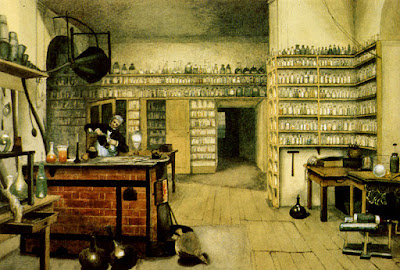
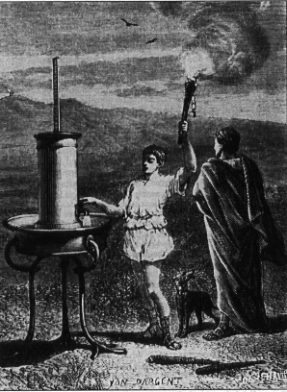
In London, Billy and I visited Faraday’s workshop in the Royal Institution. Poor Michael set up shop in the servants’ quarters in the basement. The shop is still down there (behind glass and well-preserved now). The painting above depicts Faraday at work in his shack.

On display was the very first electrical transformer. And guess what guys: It was a toroid! Here is a picture of it:

I found one of Faraday’s drawings of the toroidal transformer and its windings. It looks a lot like the drawings of Doug DeMaw! I’ll scan it and post it tomorrow. Off to work now.

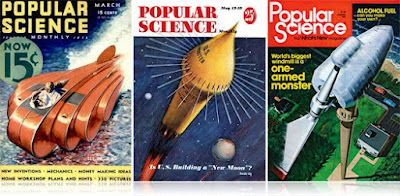
Pop Sci! 137 years of Popular Science. Free. Online.

I know I promised more about Faraday today, but I think Michael would agree that this story should take precedence. Niels, PA1DSP, reports that ALL 137 YEARS of Popular Science issues have been made available FREE ON-LINE. This is Billy’s favorite magazine. Amazing. We’re all going to have to quit hour jobs to have more time for this kind of thing! Three cheers for the publisher and for the boys at Google for making this possible. Here it is:
http://www.popsci.com/archives

At the Royal Institution

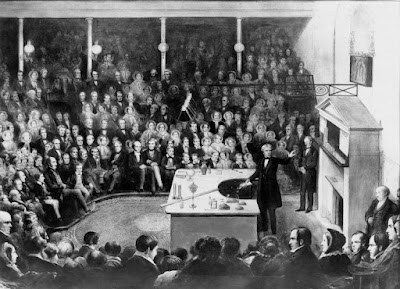
The Royal Institution in London is one of the world’s most important scientific organizations. In the picture above, Michael Faraday delivers one of the famous “Christmas Lectures.”

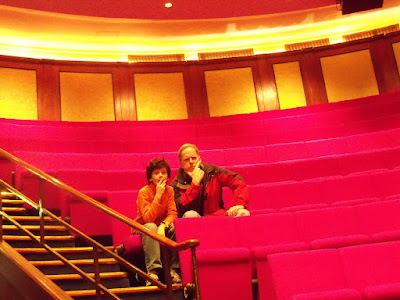
Billy and I visited the RI a couple of weeks ago and got to sit in the famous theater.

I even got to stand at the famous desk on which so much new science was presented to the world. More on the RI (and Michael Faraday) tomorrow.

Marconi’s House in London

In London, the places where famous people lived are marked with Blue Plaques. I knew that Marconi’s name was on the list, but I had never actually seen his plaque. When we were up in London last month we were staying in Marconi’s old neighbourhood (Bayswater) so and Billy and I decided to take a look. Video by Billy.

This house is mentioned in the book Thunderstruck by Eric Larson and in Peter Jensen’s wonderful Early Radio. Marconi lived here as a young man. His mother took him to London in order to get patent protection for his wireless invention. The way in which Marconi’s mom watched out for her son’s intellectual property rights reminds me of the way Bill Gates’ dad watched out for his.

Marconi’s arrival in the UK was a bit difficult. British customs officers were apparently very suspicious of the strange device being brought in by the young Italian. One book hinted that they might have thought that Marconi was involved in some plot to kill Queen Victoria. During the inspection serious damage was done to Marconi’s rig.

Dover update: Falling from tree, B2 inheritance?, HB variometer

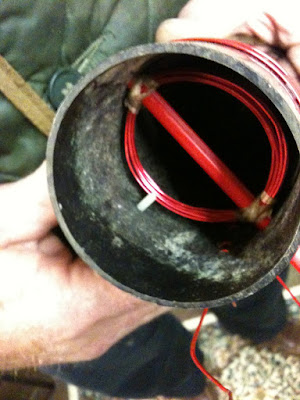
That’s me (the new boy in the workshop) at the key of Ian G3ROO’s B2 spy set. Beautiful rig. You will all, I’m sure, understand Nigel M0NDE’s question to Ian (see below). The Dover variometer project is very interesting (picture at the bottom). Thanks Nigel! (Try to keep Ian at ground level, OK?)

Hi Bill, a Dover construction club update:
Ian was cutting down some trees in the garden this weekend, and took a tumble. As he fell I asked him if I could be left the B2, I can’t tell you exactly what he said but you can imagine. Fortunately he was not injured as the ground was soft with all the rain we have had. The B2 remains in the museum for now.
The black hole has taken the variometer from us forever so a new one was made Thursday night at club. You got the blame tonight for anything that was not in its proper place when sought, the new boy in the workshop always takes the blame!
A length of plastic drain pipe was selected. A coil of about ten turns was wound around a large capacitor as a former and tied off with beeswaxed rafia then mounted onto a plastic rod. The plastic rod had a hacksaw slot put in it lengthwise to facilitate the copper wire exiting the plastic pipe. The plastic pipe was drilled and squeezed and the coil inserted into the pipe. The rod was held in place by friction fit brass washers. Two coils were wound around the plastic pipe,in similar directions. The wire is just tensioned by being passed though holes and threaded in and out of the pipe at each end. A plastic screw allows the inner coil to move through just 180 degrees. The first test showed two inductance ranges were possible 6-12 micro Henries and 12 to 21 mH. We will add additional coils up the pipe to give 21 to 30, 30 to 40 etc. A ten meter fishing rod will form the vertical element, with this variometer and switched coils providing the tuning. The experiment continues next Thursday night.

73 de Nigel Evans M0NDE QTH Dover

KPH: Maritime Radio History

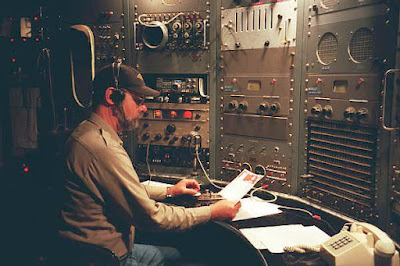
That’s OM Dick Dillman at the controls of maritime radio station KPH in Bolinas, California. Bob, W8SX, sent me an mp3 recording of a show that Dick did for public radio station KWMR. It is about the magic of radio, and about the efforts of Dick and his friends to preserve an important element of radio history. You will also hear about spy stations, the Linconshire poacher, SKY KING and much more. You guys will like this program. It will fit nicely in those iPods and mp3 players:

http://www.g4aqg.sussex.ac.uk/IRT.mp3

More info on station KPH can be found here:

http://radiosquirrels.net/gallery/show?keyword=kphhistory

DXing with Crystal Sets

Mike Tuggle has an excellent article on this subject in the Antique Wireless Association’s on-line archives of the “Old Timer’s Bulletin. ” Here’s the link:
http://www.antiquewireless.org/otb/dxxtal.htm
The link for the Antique Wireless archive (another treasure trove for us) is:
http://www.antiquewireless.org/otb/archive.htm

Christmas Greetings from Lunar Orbit

I always liked the last, very inclusive line in Colonel Borman’s 1968 Christmas Eve message.

“Wired” magazine also made note of the important Christmas Eve radio message (1906) from Reginald Fessenden: the very first “phone” transmission. Fessenden himself played the violin (“Oh Holy Night”).

Merry Christmas from Rome! 73 Bill

Crossing the Pond to KZ1H

We were out the Sabine Hills this weekend and on Sunday afternoon I go on 20 CW with my trusty HW8. I made just one contact, but it was a GOOD one. KZ1H pulled me out of the noise and we had a very nice chat. My fist was not at its best, because it was COLD in those hills — I’m arranging now to move the shack off the front porch and into the heated (I hope!) library.
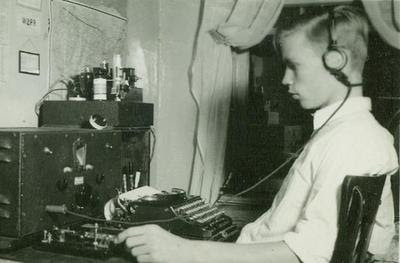
Anyway, from the courteous way in which he persisted in copying my QRP signal, I knew that OM George, KZ1H, was a FB ham. Sure enough, when I plugged his call into Google this morning, I was taken to a site with the above picture of George in his younger days. Note the bug and the mill, and the homebrew transmitter. Here is George’s story:

I grew up in Corona, Queens, NYC. I became interested in radio at the age of ten or so. My father bought an “Eilen” and I was introduced to Morse code. I met many hams around town (W2HDK, W2KAP, W2APT, W2KCD, W2JGV?). They were all very cordial and happy to show off their rigs.

In April of 1939 (age 14), I took my test at the FCC office at 641 Washington St, Downtown NYC and became W2MDE. My father bought me a Hammarlund Comet Pro (plug-in coils with shield cans). I built an oscillator/ transmitter using a type 59 tube.

I was invited to join the W2USA radio club at the 1939 NY World’s Fair. W2KU was the Chief Op and my boss. We handled a lot of traffic for the fair visitors and kept the station on the air during the winter when the fair closed between summer sessions.

At 16, I graduated from high school and went to work for a large patent law office as a clerk. From there I went to work for Hazeltine in Little Neck, NY. I thought I might faint when I saw that my first check at Hazeltine was signed by Jack Binns, the radio operator who was the subject of the book “SOS to the Rescue”.

At 17, I was made chief inspector of Hazeltine’s first war-time production line and worked along side of Frank Hinners.

When I turned 18, Mr. Bailey of the ARRL became head of the Bureau of Scientific Research and Development in Washington, DC. He invited me to become a member of the Army Intelligence Service when I was drafted, which I accepted.

After the war, I attended the Cooper Union School of Art in NYC. I worked for PAA, Grace Lines, Andrea, Sperry Gyroscope, Varian Corp, and Global Systems. Much of my career has been in microwaves. I have been retired for 20 years and am still active on the bands. My present call is KZ1H.

I have been married to my wife Mildred for 53 years. We have three daughters, Jean, Janet and Diane.

Mars calling… SO LISTEN UP!

George, K8VU, alerted me to this wonderful blog that presents interesting bits of correspondence: http://www.lettersofnote.com/ This telegram from the Secretary of the Navy caught my eye. There is also a letter from Galileo, complete with diagrams of Jupiter’s moons (his diagrams look just the ones I draw today). Also, check out the letter from Oppenheimer recommending Richard Feynman for a job at UCAL Berkeley: Feynman is described as being “a second Dirac, only this time human.” (Poor Dirac. He was once having dinner with a close friend. In an effort make conversation, the friend asked, “Have you been to the threater lately?” Long pause, then the response: “Why do you ask?” )

On Top Band at Age 12 and 1/4!

Gil sent me a link to the wonderful site of W8JI. The OM got his start by removing plates from the tuning cap of an All-American 5 broadcast receiver. Heart warming stuff for knack victims. Be sure to visit his Boatanchor page — check out his DX-60. Doesn’t that rig look a little bit TOO good? Are those regulation knobs? Or have they been juiced up a bit? (Mine don’t sparkle quite so much.)
http://www.w8ji.com/160_history.htm

An amazing radio history book – FREE!


Robert, WP4PQV, sent us some links to a treasure trove of U.S. Navy electronics publications that have been placed on-line. My initial perusal of the collection took me to History of Communications in the U.S. Navy by Capt. Howeth. Here is one gem from this amazing book:

Emperor Tiberius ruled Rome from the island of Capri for 10 years, around 37 A.D., transmitting his orders by means of the heliograph.3 This indicates that the Romans, at this time, used some form of telegraphic code in the transmission of information.

Here is the link:
http://earlyradiohistory.us/1963hw.htm

The 1946 Navy Manual “Introduction to Radio Equipment” (and links to other books) can be found here:
http://hnsa.org/doc/radio/index.htm

Ham Monitored Apollo 11 Lunar Transmissions

July 1969. OM Larry Baysinger built a corner reflector (design sketch above) and used it to receive — direct from the lunar surface — the transmissions of Neil Armstrong and Buzz Aldrin. He appears to have been the only amateur in the world to have done this. Knack to the Max! Well done Larry! Very cool.
More details (including recordings) here:
http://www.jefferson.kctcs.edu/observatory/apollo11/

Spy Radio: “The Looking Glass War”

Dave in Ireland alerted me to some interesting radio content in the John LeCarre spy novel “The Looking Glass War.” (I think presenting this excerpt is allowable under “fair use.”) Dave reports that the radio they are working on is the one pictured above. It is a British B2, SOE Type 3. The instructor obviously has the Knack, but the student seems a bit shaky.

—– The Looking Glass War: —–
(Fred Leiser is the agent, Johnson is the radio expert who is also mentioned to be Ham op)
‘You know the set then?’ Johnson asked.
‘The B2.’
‘OK. Official title, Type three, Mark two: runs on AC or a six-volt car battery, but you’ll be using the mains, right? They’ve queried the current where you’re going and it’s AC. Your mains consumption with this set is fifty-seven watts on transmit and twenty-five on receive. So if you do end up somewhere and they’ve only got DC, you’re going to have to borrow a battery, right?’
Leiser did not laugh.
‘Your mains lead is provided with adaptors for all continental sockets.’
‘I know.’
Leiser watched Johnson prepare the set for operation. First he linked the transmitter and receiver to the power pack by means of six-pin plugs, adjusting the twin claws on the terminals; having plugged in the set and turned it on, he joined the miniature Morse key to the transmitter and the earphones to the receiver.
‘That’s a smaller key than we had in the war,’ Leiser objected. ‘I tried it last night. My fingers kept slipping.’
Johnson shook his head.
‘Sorry, Fred; same size.’ He winked. ‘Perhaps your finger’s grown.’
‘All right, come on.’
Now he extracted from the spares box, a coil of multi-stranded wire, plastic covered, attaching one end to the aerial terminals. ‘Most of your crystals will be around the three megacycle mark, so you may not have to change your coil – get a nice stretch on your aerial and you’ll be a hundred per cent Fred; specially at night. Now watch the tuning. You’ve connected up your aerial, earth, key headphones and power pack. Look at your signal plan and see what frequency you’re on; dish out the corresponding crystal, right?’ He held up a small capsule of black Bakelite, guided the pins into the double socket – ‘Shoving the male ends into the doodahs, like so. All right so far, Fred? Not hurrying you, am I?’
‘I’m watching. Don’t keep asking.’
‘Now turn the crystal selector dial to “fundamental all crystals”, and adjust your wave band to match your frequency. If you’re on three and a half megs you want the wave-band knob on three to four, like so. Now insert your plug-in coil either way round, Fred; you’ve got a nice overlap there.’
Leiser’s head was supported in his hand as he tried desperately to remember the sequence of movements which once had come so naturally to him. Johnson proceeded with the method of a man born to his trade. His voice was soft and easy, very patient, his hands moving instinctively from one dial to another with perfect familiarity. All the time the monologue continued:
‘TRS switch on T for tune’; put your anode tuning and aerial matching on ten; now you can switch on your power pack, right?’ he pointed to the meter window. ‘You should get the three hundred reading, nearly enough, Fred. Now I’m ready to have a go: I shove my meter selector on three and twiddle the PA tuning till I get maximum meter reading; now I put her on six —-‘
‘What’s PA?’
‘Power Amplifier, Fred: didn’t you know that?’
‘Go on.’
‘Now I move the anode tuning knob till I get my minimum value – here you are! She’s a hundred with the knob on two, right? Now push your TRS over to S – S for send, Fred – and you’re ready to tune the aerial. Here – press the key. That’s right, see? You get a bigger reading because you’re putting power into the aerial, follow it?’
Silently he performed the brief ritual of tuning the aerial until the meter obediently dipped to the final reading.
‘And Bob’s your uncle!’ he declared triumphantly.

‘Now it’s Fred’s turn...’

The D-104 — A Completely Respectable Piece of Ham Radio Gear

Recently we have received some comments along the lines of, “Hey Bill, what’s that chrome CB-lookin’ mic doin’ in your shack?” Having come into ham radio during the great Amateur vs. Citizen Band wars of the 1970s, naturally I was quite stung. Fortunately, an old magazine soon arrived with a photo (above) that should end forever any speculation about the D-104 being somehow “CB.” The picture above is from the January 1952 issue of “The Shortwave Magazine” from the UK. G3ZI, L.S. Woollatt, is shown with his very fine station. With the exception of his two main receivers, all of this OM’s gear was homebrew. Racks and racks of FB HB gear. If a chrome lollipop was OK with G3ZI, well, then I think that settles it.

AA1TJ’s Nifty Fifties Pixie

Once again great things are happening in the underground lab of Michael, AA1TJ. Michael has temporarily put aside his work on Iron Pyrite-based receivers, and is now working the world with 50’s era point contact transistors. I can feel the enthusiasm, even all the way over here in Rome. I particularly liked Michael’s description of the QSO in which the other guy heard his backwave. Backwave is the very small signal that is sometimes put out when the key of simple transmitter is up. For example, the oscillator on my old VXO-controlled 6 watter (from “QRP Classics”) ran all the time — I just keyed the amplifiers. Sometimes guys would report hearing some of the RF from the oscillator even when the key was up. (By the way, the term backwave reminds me of a word used sometime by Billy and Maria: backwash. As in, “No Maria, you can’t have a sip of my soda — you always leave backwash!”)

In his e-mails, Michael mentions that the physics of the point contact devices are a bit of a mystery for him. I recall that the book “Crystal Fire” by Riordan and Hoddeson had some pretty good info on how these early transistors worked.

Here are some excerpts from Michael’s e-mails on this project:

I haven’t had time to document this pyrite/tunnel diode receiver on account of a phone call that I had two weeks ago from Jack Ward at the Transistor Musuem. Jack approached me with an idea to recreate the first ham radio contacts using transistors. Of course, the point-contact transistors involved are now pretty rare items. No problem for a fellow with a transistor museum though!
Jack kindly sent me a couple of Western Electric, 2N110 “relics.” I had some initial trouble with “squegging,” and I wasn’t able to produce oscillation above 380kHz. To read a recent tale of one fellow’s trouble trying to tame the 2N110, please see
I especially liked where he wrote, “I did seriously consider giving up at this stage and taking up heavy drinking.” ;o)
However, I located an old textbook that discussed circuit design theory using point-contact transistors (the physics of these devices are still clouded in mystery). What I learned made all the difference. A few more hours at the bench and I had an 80m transmitter putting out 10mW.
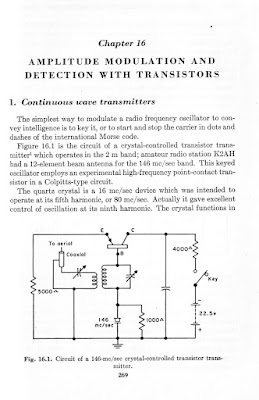
The story gets better though, Ned. A circuit briefly described in another old book really caught my attention. It was pretty much the same circuit as was used by George Rose, K2AH, in his first transistor QSO. Only, a circuit (designed by G3IEE) showed a pair of headphones in dotted lines, next to the collector resistor. The text merely said
“As indicated, the circuit also functions as an oscillating detector type of receivere for local continuous wave operations whith head phones plugged into the collector circuit instead of resistor R3. Good reception and break-in operation were obtained.”
That got my blood moving! Positive results came right away on the bench. The received signals were every bit as strong as with my Reggie and the Cub Scout heterodyne (what I started calling, “Chester,” after the name of the mine where the pyrite was found).
I had my first QSO last week using Jack’s point-contact transistor (made in 1956) in the transceiver designed by G3EII (in 1954). Jim, W1PID, was my first contact. Since then I’ve made over a dozen QSO’s with five different stations.
FYI, I’ll paste a message below that I sent to Jack Ward this weekend. One thing I forgot to add is that W1VZR copied my 10mW signal on his Cake Pan regenerative receiver over in Maine last week. Aside from my three QSO’s with VE3DJX at a distance of 319 miles, the other notable results to-date were hearing both W1DFU and W1PID – in the course of separate QSOs – when they dropped down to an output power of 100mW.
Again, I haven’t had a chance to post much on my web site, but I do have the current schematic up, and you can see both K2AH and G3IEE’s circuits in scans from the old transistor book. G3IEE’s circuit is shown in Figure 16.2 in the second jpeg image.
One more thing, Ned. I hooked up this past week with G3JNB. Victor was one of the fellows (he was only 21 at the time) working with Tony, G3IEE, back in 1954 to make the first-ever, UK ham radio QSOs using transistors. Victor has already posted an envelope containing copies of his log, the QSL card from G3IEE and the original, 1954, Wireless World article describing their results. In the course of our Skype video call last week, Victor held up to the camera the RAF telegraph key that he used for his QSO with Tony. Pretty neat, eh?
I’ve got to get back to work here. Congratulations on getting your Reggie up and running, Ned. I look forward to seeing the photos and I’d surely like to hear about any contacts you make with it. Speaking of which, I have some photos of Jim, W1FMR’s beautifully constructed Reggie that I’ve been meaning to post on my web page. Once I get around to it would you mind if I include one of your photos as well?
Best wishes,
Mike, AA1TJ
Hi Jack,

Yes, I had great fun with our little 2N110’s this past week. Of of now, I’ve had well over a dozen radio contacts with five different stations. I used 10mW of output power to make these contacts. The distances shown are all “as the crow flies.”

W1PID, Sanbornton, NH, 67miles; lowest power used on his end 100mW
VE3DJX, Smith Falls, Onatario, 319 miles; 10watts on his end
W1DFU, Wallingford, VT, 42 miles; his lowest power was 100mW
W1VZR, Limerick, ME, 100 miles; 40w

Pete, the last fellow listed, heard the 2N110 while it was running as a “beacon” with a continuously looped Morse code message. Having received my call-sign he located my email address and shot off a reception report. I saw his message pop up on my computer and quickly looked up his telephone number. He was still at his radio when he picked up the phone. I found him pretty excited as my signal strength had sharply risen in the last few minutes. He asked if there was a problem with my keying circuit as he could still hear a faint tone on my frequency when my transmitter should have been silent. “Ha!” sez I, “You’re hearing a 100 microwatt back-wave radiation!” The distance separating us divided by the 100uW power is equivalent to 1 million miles per watt; a very impressive figure!

One more station answered my CQ this past week from near Hartford, CT. However, I can’t recall his call sign and I’m currently at work but my logbook is at home. My output power was up to 17mW during that contact; on account of a temporary change that I made to the circuit. However, pushing the transistor to that power level reduced the quality of the keying, and so I returned to 10mW following that contact (earlier, I’d reported that my output power was 12mW, but a more careful measurement indicated that I was only putting out 10mW).

You might have noticed that I’ve posted the schematic to my web site. However, I expect the circuit will change over the next week, or so, as I still want to tinker with the keying circuit. By all reports my signal is good but it has just a touch of keying “chirp.” Chirp is what hams call a variation in the received signal tone when the telegraph key is first depressed. Again, I expect to have that sorted out before long.

Yes, it was a real pleasure talking with Victor, G3JNB. FYI, I’ll send you copies of all the documents that he provides. He said that he’s including some original data sheets for point contact transistors that he’s held on to these past 55 years. I’ll keep copies and send the originals to you.

I asked Victor if he’d like me to build a duplicate radio for him using the second 2N110 that you sent me. I think he was thrilled to hear my offer. Don’t you think it would wonderful if he, of all people, managed to make a contact using a reproduction of the point-contact transmitter that he and Tony, G3IEE, used in those pioneering days?

The order of business next week is to finalize the circuit design and begin building two identical circuits into permanent radios. Of course, I’ll take time off, now and then, to try and make more contacts. I’m already astonished that it was possible to span a distance of 319 miles (not once, but thrice!) using your ancient transistor relic.

Acting on your suggestion, I looked up the other fellows mentioned in K2AH’s article. It turns out that Tommy Thomas, W2UK, was quite a radio pioneer on VHF.

http://www.infoage.org/html/p-43W2uk.html

Unfortunately, I’ve learned that he passed away not so long ago. The call signs of the other two fellows are not currently in the FCC database (I suspect because they are gone as well). A quick search on the Internet turned up nothing on them.

Victor, G3JNB, remarked that he believes that he is the only one left of his original group of transistor enthusiasts. Doubtless, one reason is that he was only 21 years-old at the time of the experiments with G3IEE.

Victor reports that Tony, G3IEE, worked as an engineer for Mullard. I guess that explains where his transistors came from. Victor used a standard vacuum tube transmitter for his first contact with Tony, but sometime later he built his own one-transistor transmitter following Tony’s design. Victor says that he used it to make one or two contacts across town before he put it on the shelf. Again, I’ll be very interested to see the photocopy of his station log from that period.

One more thing, Jack. I’m fortunate to count George, G3RJV as a pal-o-mine. George is a recently retired Anglican vicar, but he also founded the GQRP; what began as a society of UK amateurs interested in low power operation. Since then, it has become something of an international institution. I had a message of congratulations this week from George; saying that he’s keeping a watchful eye on our project. In return, I inquired if George might be able to put me in contact with folk that might help shed light on what was going on at that time (transistor-wise) in the rest of “Hamdom”. That is, I’d like to assemble a folder on the topic of “first transistor QRP QSOs” for Japan, Western and Eastern Europe, Australia, etc.. I’ll keep you apprised of any news.

That’s all from here, Jack. Once again, I’d like to express my thanks to you for including me in your project. It’s already been great fun and a real pleasure to meet some wonderful people.

Kind regards,
Mike, AA1TJ
AA1TJ’s Point Contact Contacts

I was very glad to see that Mike, AA1TJ, is back in his underground shack and once again pushing the limits of QRP technology. This may be one of his greatest QRP-capers:

Gents,

It was one of those rare days on the bench where everything I touched
turned, if not to gold, at to least silver. At the end of my last shop
session on Friday I could only get Jack Ward’s point contact
transistor to oscillate as high as 385kHz. And that was without a
load. I brushed up on the theory over the weekend and set upon the
circuit today after lunch with a vengeance.

Better yet, over the weekend I found a wonderful circuit in a
transistor handbook dating from 1956. This circuit first appeared in
“Wireless World” in may of 1954 (“160 Metre Transistor Transmitter”).
At first glace, the circuit looks identical to George Rose, K2AH’s
historic circuit. However, Mr. Cockle (don’t yet know his call sign)
shows a dotted transformer and headphones next to the collector bias
transistor. He’d figured out the point contact oscillator could double
as a direct conversion receiver! A 1954 vintage “Pixie,” only
simpler! The key to it all is the signal tank in the base circuit.
That is to say, the transmitter output power is picked off the base
circuit tank. It sounds daft, but bear in mind the circuit has more in
common with a tunnel diode oscillator than it does a feedback
oscillator that most of us are familiar with.

I’ll cut to the chase as I want to get back on the air ASAP. The
Western Electric point-contact transistor is sending 12mW up the
transmission line. The same circuit is working FB as a receiver with
full break-in and 800Hz RIT offset. I put it on the air at 2234 this
evening. At 2247 K1IQI answered my CQ. He first sent a “QRZ?” so I
repeated my call several times. He came right back with my call and
gave me a 219 report from Monson, MA. Unfortunately, QSB wiped out my
next transmission. He returned with an apology, wished us better luck
next time and then he was gone. Close but no cigar!

I’m headed back to the shack once I send this message. I’m rock-bound
on 3533.6kHz. I’ll be calling CQ and listening until 0300, or so.

Right, here I go.

73/72,
Mike, AA1TJ

REAL Hams Make Their Own Crystals….

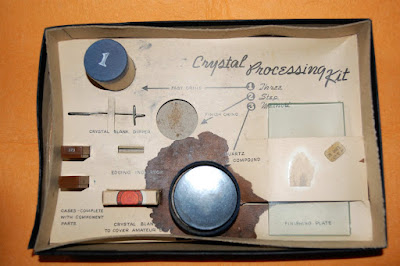
Bill: You say you buy your crystals from the electronics store? Real homebrewers grind their own crystals. See attachments. Russ

After reading this I was feeling like a complete APPLIANCE OPERATOR. But wait a second Russ — that’s a KIT! Real homebrewers don’t need KITS to make their own crystals! And remember, you are talking to a guy who has used iron pyrite and a phosphor bronze to detect radio waves. That means I have homebrewed my own DIODES! 😉

Thanks for the cool pictures Russ. Those were the days…