Who Invented the Transistor?

http://www.beatriceco.com/bti/porticus/bell/belllabs_transistor1.html

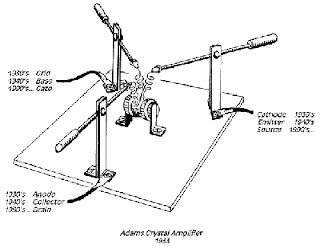
I dunno…. Roswell? Really? But I find myself attracted to anything that involves the use of iron pyrite and cats’ whiskers in radio. Mike, KL7R, sent me a bunch of fools gold from Alaska and it turned out to be better than galena as a detector.

Our book: “SolderSmoke — Global Adventures in Wireless Electronics” http://soldersmoke.com/book.htm Our coffee mugs, T-Shirts, bumper stickers: http://www.cafepress.com/SolderSmoke Our Book Store: http://astore.amazon.com/contracross-20

Tour of WLW 500,000 Watt Transmitter (video)

Well, you know that you are really in the high power big leagues when your transmitter requires a cooling pond, and you have to put on welding goggles before you examine your tubes! I especially liked the bit about how they built the transmitter BUILDING from the packing materials used to ship the transmitter (my operating desk is made from a box used to ship my HT-37!).

This is all really amazing. They built this thing less than ten years after the initial launch of commercial broadcast radio in the U.S.

Thanks a lot to Randy for doing this video and to the guys who gave the really excellent tour.

My apologies to the QRP purists who I know will have been deeply disturbed by this presentation.

Our book: “SolderSmoke — Global Adventures in Wireless Electronics” http://soldersmoke.com/book.htm Our coffee mugs, T-Shirts, bumper stickers: http://www.cafepress.com/SolderSmoke Our Book Store: http://astore.amazon.com/contracross-20

French Knack: F8ATA, F8KE, F8CKH, and K3DY

Hello Bill, It has been a while! I don’t know if you remember but I emailed you back in September 2010, introducing myself as a fellow amateur listening to your podcasts. I had just moved from France and received back then my FCC vanity callsign K3DY.

It took me a while to get my ham shack back together but finally I was on the bands again! Recently, I started re reading your book, very inspirational. Since my very first license (as F8CKH) at 16, my interests have always been into the design / homebrew as well as QRP & CW. Why on earth would a teenager do that? I think I have the knack. My motto is: “Don’t turn it on, take it apart!!!”.

Anyway, it has been a lot of fun to work on some various projects (the one in progress now is a LC meter using a LCD display and a PIC 16F627). It took longer than expected to get to that point as I had to work on a PIC programmer interface as well as refresh my C language programming skills! I recently discovered that mouser is offering some nice project enclosures. In the past, my finished products were kind of “ugly” (to the average Joe not us of course!) so I am trying to work on that.

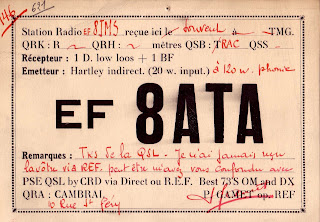
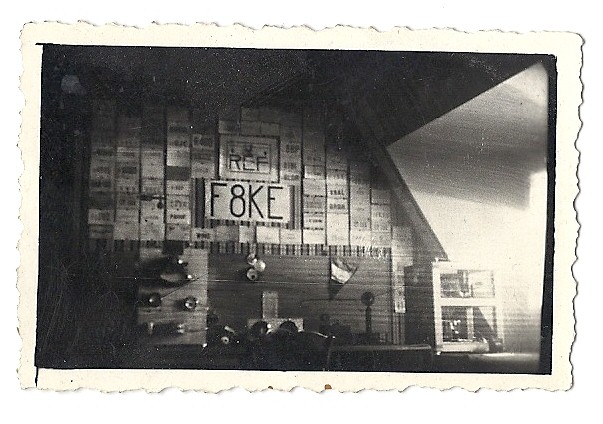
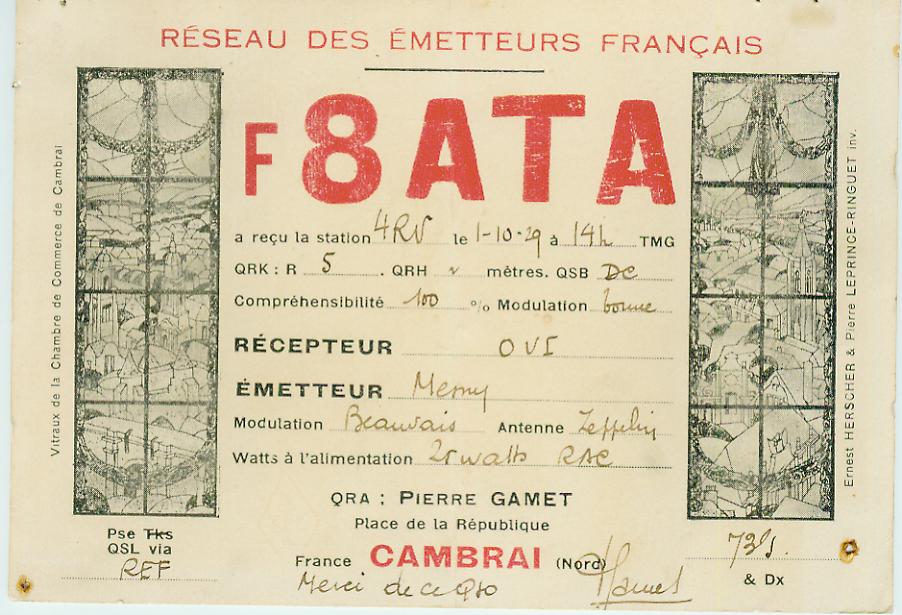
Oh also, last time I emailed you, I talked about my grand father EF8ETA, F8ATA then F8KE in the late 20s and how seeing his electronic lab and radios when I was 7 or 8 inevitably changed my life! After all this, I – had – to get my license and get involved! My father, also a ham, emailed me a picture of F8KE’s shack in 1929/1930. My grand father was at the time 19 years old. Also attached to the email are two scans of his QSL cards dated as well 1929 or so. He was using a classic design for the era, based on a Hartley Oscillator. I am trying to imagine how it was to get the knowledge back then on how to build a station (TX, RX, antenna) but also how to get the parts! When people now complain that they can’t finish up a homebrew project because they can’t find a FT50-3 core, well they should think of how it must have been almost 100 years ago.

Have a great weekend! 73, K3DY Antoine

Our book: “SolderSmoke — Global Adventures in Wireless Electronics” http://soldersmoke.com/book.htm Our coffee mugs, T-Shirts, bumper stickers: http://www.cafepress.com/SolderSmoke Our Book Store: http://astore.amazon.com/contracross-20

The Southern Appalachian Radio Museum

Chris, KD4PBJ, of SMT Solutions, sent us a thumb drive with pictures and videos of his visit to the Southern Appalachian Radio Museum. What a great collection of radios! I saw many old friends on those shelves.

There is a lot of radio history in that museum, and much of it is conveyed by the photos and videos that Chris took. Here they are, all 111 files:

https://picasaweb.google.com/116927941005026017464/SARM#

The museum is in Asheville, N.C. http://www.saradiomuseum.org

Thanks Chris. And thanks to the curators of this fine museum.

Our book: “SolderSmoke — Global Adventures in Wireless Electronics” http://soldersmoke.com/book.htm Our coffee mugs, T-Shirts, bumper stickers: http://www.cafepress.com/SolderSmoke Our Book Store: http://astore.amazon.com/contracross-20

Angelo’s ATR-4

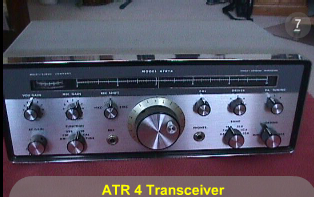
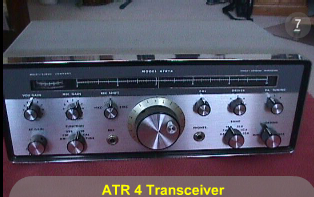
On Monday I was talking to Angelo, W8ERN, on 17 meters. He told me about an SSB transceiver that he had designed for ELMAC, the ATR-4. Take a look at that beauty. The amazing thing is the year in which Angelo created this rig: 1959! Wow, talk about being ahead of its time! Sadly, ELMAC decided not to produce it, and only a few prototypes exist. It is 80-10 meters, SSB and CW featuring a crystal filter. It is a transistor-tube hybrid with a pair of 6146’s in the final. Nice job Angelo.

Our book: “SolderSmoke — Global Adventures in Wireless Electronics” http://soldersmoke.com/book.htm Our coffee mugs, T-Shirts, bumper stickers: http://www.cafepress.com/SolderSmoke Our Book Store: http://astore.amazon.com/contracross-20

Angelo’s ATR-4

On Monday I was talking to Angelo, W8ERN, on 17 meters. He told me about an SSB transceiver that he had designed for ELMAC, the ATR-4. Take a look at that beauty. The amazing thing is the year in which Angelo created this rig: 1959! Wow, talk about being ahead of its time! Sadly, ELMAC decided not to produce it, and only a few prototypes exist. It is 80-10 meters, SSB and CW featuring a crystal filter. It is a transistor-tube hybrid with a pair of 6146’s in the final. Nice job Angelo.

Our book: “SolderSmoke — Global Adventures in Wireless Electronics” http://soldersmoke.com/book.htm Our coffee mugs, T-Shirts, bumper stickers: http://www.cafepress.com/SolderSmoke Our Book Store: http://astore.amazon.com/contracross-20

Sibeband Inversion: 9 MHz, 5 MHz, and the ARRL Handbook

The 2006 ARRL Handbook had it right. Jeremiah went back and took a look:


Bill:


I have a comment about the question of the LSB/USB convention mentioned in the most recent SolderSmoke podcast and the follow up blog post:

I checked the 2006 Handbook and there is a sidebar (page 9.27) explaining the 5/9 MHz connection with the Lower/Upper Sideband convention in use today. It explains that there was a popular rig that used a 5 MHz VFO and a 9 MHZ IF that were mixed to create the 75/20 meter RF signals. This is certainly a reasonable method, but would not result in the inversion. The article then goes on to explain, however, that other rigs used a 5 MHz tunable IF and a 9 MHz local oscillator which would indeed result in sideband inversion and thus the convention we use today.

73,
Jeremiah, KB0OFF

Our book: “SolderSmoke — Global Adventures in Wireless Electronics” http://soldersmoke.com/book.htm Our coffee mugs, T-Shirts, bumper stickers: http://www.cafepress.com/SolderSmoke Our Book Store: http://astore.amazon.com/contracross-20

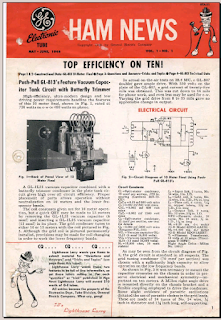
GE Ham News — All of Them! (1946-1963)

Walter, AJ4UM, alerted us to this. Here’s yet another treasure trove of ham radio literature. I’m going to have to retire just to make time to read all the stuff that is coming on line!
http://n4trb.com/AmateurRadio/GE_HamNews/ge_ham_news.htm

Our book: “SolderSmoke — Global Adventures in Wireless Electronics” http://soldersmoke.com/book.htm Our coffee mugs, T-Shirts, bumper stickers: http://www.cafepress.com/SolderSmoke Our Book Store: http://astore.amazon.com/contracross-20

Evil Mad Scientist Builds a Heathkit

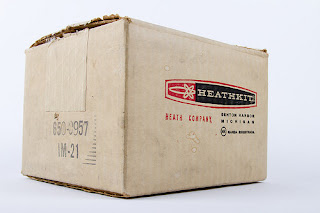
You guys will get a kick out of this: An old unbuilt Heathkit is discovered, and is then put together by “Evil Mad Scientist.” EMS obviously loves electronics, but is clearly of the digital/IC generation: “The tubes are gorgeous! Their exteriors are glass with electrodes extending from the bottom!” Wow.

The Evil Mad Sci guy fears that the solder provided by Heath will have “gone bad over time” and says that he will use “more modern solder.” Hold your horses Frankenstein! Don’t you dare put that Heathkit together with lead-free solder! That could tear a hole in the fabric of space time! Also, I dunno about the idea of putting all the components on the lugs and rotary switch terminals first, with all the soldering coming later. The boys at Benton Harbor wouldn’t have liked that. And you might want to gradually bring the voltage up on that big electrolytic cap up using a variac. Which brings to mind some needed advice: BE CAREFUL! You have moved out of the realm of 12 V DC. That old Heathkit could zap you good!

http://www.evilmadscientist.com/article.php/heathkit-part1


Thanks to Mike Butts for alerting us to this.

Our book: “SolderSmoke — Global Adventures in Wireless Electronics” http://soldersmoke.com/book.htm Our coffee mugs, T-Shirts, bumper stickers: http://www.cafepress.com/SolderSmoke Our Book Store: http://astore.amazon.com/contracross-20

USB/LSB Urban Legend DEBUNKED!

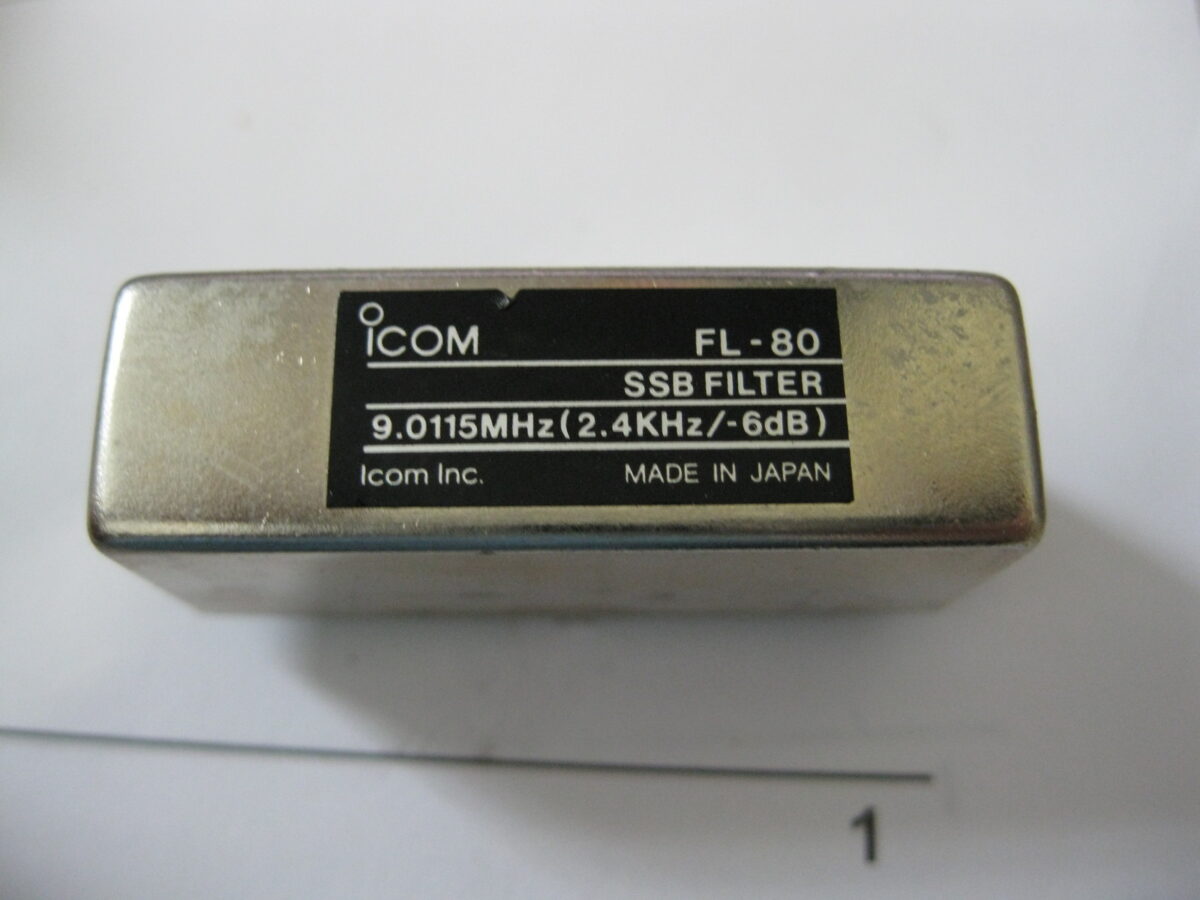
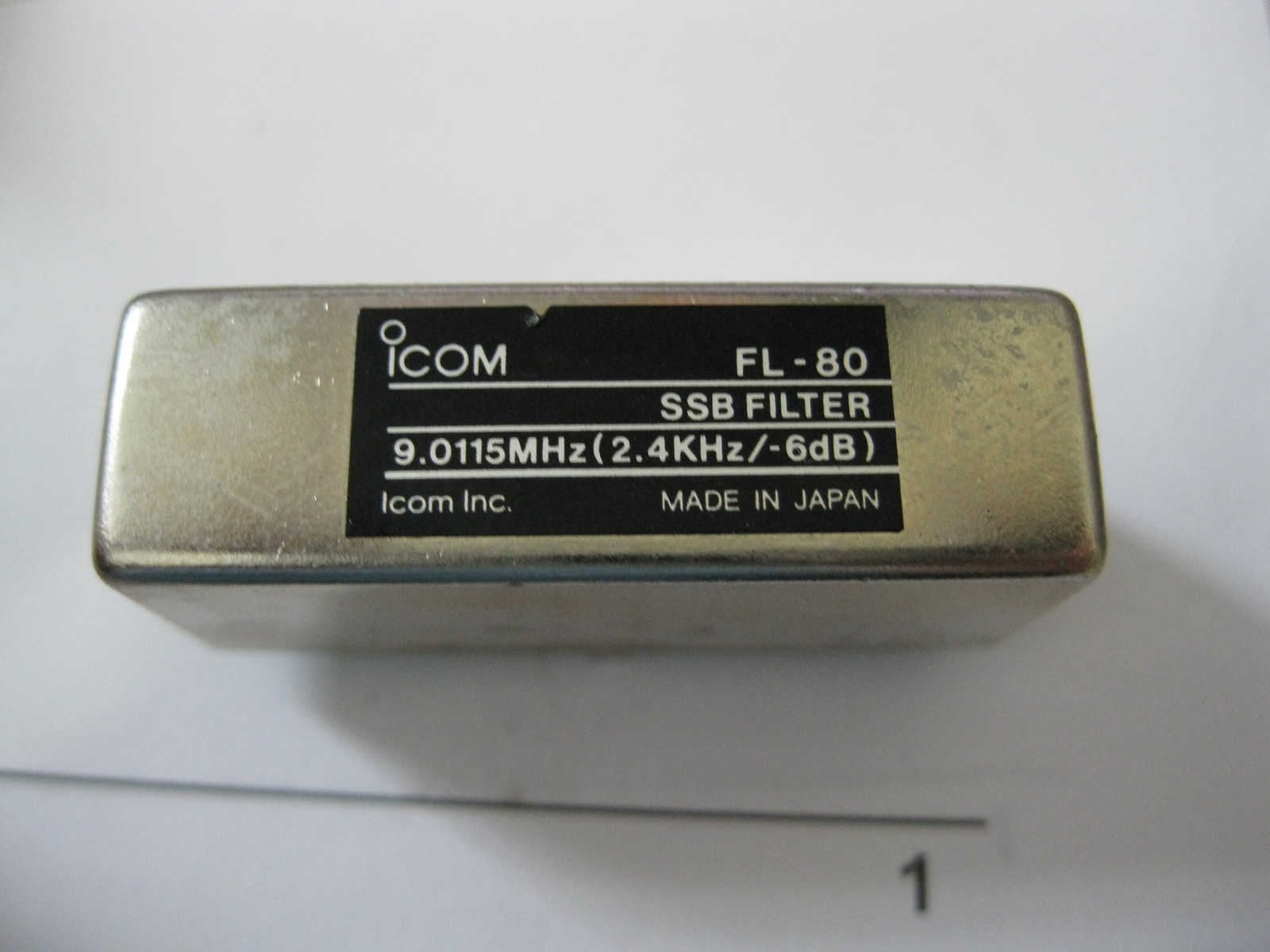
Astute aficionados (like Steve –Snort Rosin — Smith) immediately recognized that I was talking rubbish when, in SolderSmoke 143, I said that the current LSB/USB convention on the HF bands has its origins in the FACT (not!) that when using a 9 MHz filter and a 5 MHz VFO, with a single carrier oscillator crystal you can very conveniently get USB on 20 and LSB on 75, supposedly because of “sideband inversion” that takes place when you switch from the sum product of the second mixer (20 meters) to the difference product (75 meters). I got out paper and pen and quickly discovered that Steve was right. No sideband inversion with this scheme.

I was susceptible to this urban legend because when I was building my 17 meter SSB rig out in the Azores, I used a 5.174 MHz filter from an old Swan 240. I started out with a VXO running around 12.9 MHz, obviously using the sum output from that second mixer. Later, I decided to move the VXO up to around 23.3 MHz and take the difference product. Here I DID get a sideband inversion, and I had to go back to the carrier oscillator and change the crystal so as to get LSB coming out of the filter. When this 5.173 MHz LSB went to the second mixer, the sideband inversion took place and –Viola!– 17 meter USB resulted.


The key factor here of course is that the VFO freq was now ABOVE the filter freq.


In the podcast I said that I “learned” about the alleged origins of the LSB/USB convention from the 2006 ARRL handbook. I had read it very quickly while in the local library. I don’t think they would have gotten this wrong. It was probably my quick reading of the article that caused the rubbish talk.


Maybe it was this: Could it have been that in the early days of SSB, guys were using a 5 MHz FILTER with 9MHz VFOs? Maybe from old Command Set surplus gear? With the VFO above the filter freq you would get the sideband inversion that I was babbling about, right? Or might this have been the result of the phasing method of sideband generation popular back in the day?

Our book: “SolderSmoke — Global Adventures in Wireless Electronics” http://soldersmoke.com/book.htm Our coffee mugs, T-Shirts, bumper stickers: http://www.cafepress.com/SolderSmoke Our Book Store: http://astore.amazon.com/contracross-20

SolderSmoke Lexicographer

Mike, AA1TJ, is the QRPoet Laureate, but I think we can now officially name Steve Silverman, KB3SII, our official SolderLexicographer:

Hi Bill

Here is an interesting possible explanation for the term LID:

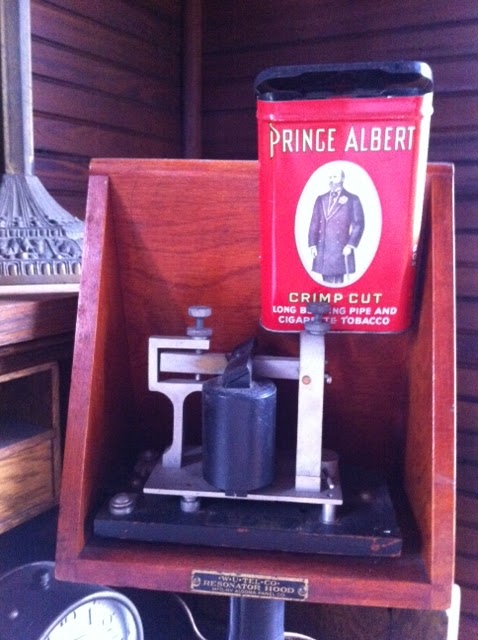
‘It’s a term that goes back to land based telegraphers, before radio was even used. Some say it has to do with placement of a tobacco can or lid to enhance hearing the telegraph sounder. Such things were apparently trademarks of the poorer ops.’

So there you, using a tobacco can sounder “hearing aid” defined you as a LID, as in using the lid of the can to tune your RIT. But in telegraph location with lots of QRM, such as in a major telegraph office or along side of a noisy train track, the lids enabled an operator to distinguish his sounder from the background clicks and clacks. The Car Talk guys would love this explanation.

73

Steve

KB3SII

Our book: “SolderSmoke — Global Adventures in Wireless Electronics” http://soldersmoke.com/book.htm Our coffee mugs, T-Shirts, bumper stickers: http://www.cafepress.com/SolderSmoke Our Book Store: http://astore.amazon.com/contracross-20

The Idea Factory

Hello Bill,


I think you will like a new tech history book about Bell Labs. The name of the book is The Idea Factory and the author is Jon Gertner.

Here’s a neat example of what’s in the book from page 85:

“Atoms within semiconductors bond easily with a number of other elements. Scaff and his colleagues knew that when they cut n-type silicon (atomic number 14) into smaller pieces on a power saw, for instance, they could smell something they were sure was phosphorus (atomic number 15). None of the measurement equipment could pick up the taint, but their noses could.”

How cool is that? The book is full of this kinda of stuff and it details the early lives of those involved in Bell Labs…..anyway I find Idea Factory a page turner and I think you will enjoy it.

Another “abstract” from page 38:

“The young Bell Labs recruits had other things in common. Almost all had grown up with a peculiar desire to know more about the stars or the telephone lines or (most often) the radio, especially their makeshift wireless sets. Almost all of them had put one together themselves, and in turn had discovered how sound could be pulled from the air.”


73
Herb/WR9H

Our book: “SolderSmoke — Global Adventures in Wireless Electronics” http://soldersmoke.com/book.htm Our coffee mugs, T-Shirts, bumper stickers: http://www.cafepress.com/SolderSmoke Our Book Store: http://astore.amazon.com/contracross-20

Marconi Archive

Brian, G0NSL, alerted us to this very interesting archive on Marconi:

http://markpadfield.com/marconicalling/museum/html/archivehome.html

Our book: “SolderSmoke — Global Adventures in Wireless Electronics” http://soldersmoke.com/book.htm Our coffee mugs, T-Shirts, bumper stickers: http://www.cafepress.com/SolderSmoke Our Book Store: http://astore.amazon.com/contracross-20

A Rare Tour of the HP Garage

Kim, VK5FJ, sent this to us. Amazing pictures. Inspiring! Look at that work bench. Note the ARRL antenna book.

http://dvice.com/archives/2012/03/rare-tour-of-th.php#25


Our book: “SolderSmoke — Global Adventures in Wireless Electronics”http://soldersmoke.com/book.htmOur coffee mugs, T-Shirts, bumper stickers: http://www.cafepress.com/SolderSmokeOur Book Store: http://astore.amazon.com/contracross-20
Ade Weiss’s New Book

Big news on the QRP/homebrew literature front. One of the titans of the genre, Ade Weiss, has released another amazing book about our hobby. I really enjoyed Ade’s first history of QRP, and, because it covers a more recent period (1968-1981), I think this new this one is even more interesting. I took a portion of it with me on the train yesterday (and will be doing the same for the rest of the week!) The book is a wonderful technical history. It is filled with interesting stories and with very illuminating schematics and technical discussions. Ade takes us through the exciting early days transistor transmitters and direct conversion receivers. There is a lot of discussion of the commercial rigs that we’ve come to know and love — lots of HW8s and Argonauts. And Ade has made it all available as a free download! Thanks Ade!

http;//www.QRPdxPropagationAntennas.com

ADE WEISS’S NEW HISTORY BOOK — PDF DOWNLOAD:

http;//www.QRPdxPropagationAntennas.com

THE FIVE-WATT QRP MOVEMENT IN THE US, 1968-1981
by Adrian Weiss W0RSP (ex-K8EEG),
author of
JOY OF QRP: STRATEGY FOR SUCCESS
HISTORY OF QRP IN THE US, 1924-60
IONOSPHERIC PROPAGATION, TRANSMISSION LINES, AND ANTENNAS FOR THE QRP DX’R
The Milliwatt: National Journal of QRPp

TABLE OF CONTENTS

Part 1. K6JSS and the 100-watt QRP ARCI …………………………………………. 1

Part 2. QRP/8 Newsletter, QRPP CORNER Column, and THE MILLIWATT:
The Beginning of the Five-Watt QRP Movement in the US … 3

Part 3. The QRP World Outside the 100-watt QRP ARCI ……………………. 22

Part 4. The QRP Takeover of the 100-watt QRP ARCI. ……………………….85

THE MILLIWATT QRPp DXCC and MILLIWATT DXCC Trophy List……….105

Adrian Weiss W0RSP’s Bibliography: Selected Technical Articles. 109

EPILOGUE: W0RSP Retro-ARRL-DX-Contest 2/18-19, 2012 Log, PIX….111

***************

IF you are interested in where our niche in the hobby came from, and would

like to read about the developments in technology caused by the transistor

and IC, and see many then-new but still-used circuits, and learn the

history of the commercial evolution of QRP gear from Ten-Tec, MFJ,

Heathkit and others, then this book is for you!

It is 115 PAGES in length in PDF FORMAT–

FREE!!! DOWNLOAD (32MEGS, ~ minute +/-) FROM:

www.QRPdxPropagationAntennas.com

———————————————–

Our coffee mugs, T-Shirts, bumper stickers: http://www.cafepress.com/SolderSmokeOur Book Store: http://astore.amazon.com/contracross-20
The Father of the CK722 (and RadioShack!)

Steve Smith of SolderSmoke’s West Coast bureau sent us the link to this article about a very interesting guy who made enormous contributions to the radio art. Three cheers for Norman Krim!
http://tinyurl.com/7qsdq22

Our book: “SolderSmoke — Global Adventures in Wireless Electronics”http://soldersmoke.com/book.htmOur coffee mugs, T-Shirts, bumper stickers: http://www.cafepress.com/SolderSmokeOur Book Store: http://astore.amazon.com/contracross-20
Warning! QRPers May Find This Disturbing!

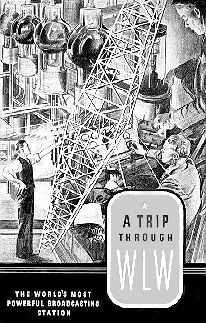
Greg, KC2DWF, sent me this link to a really great web site about the AM broadcast station WLW (aka “The Nation’s Station”). Brace yourselves guys, for we are now moving out of QRP land: The exciter on this baby is 50 kilowatts! The modulator could produce 400 kilowatts of AUDIO! The article is very well written, obviously done by an aficionado of high power RF. There are some great lines in there. Here is a sample:

This brings up the real fun part of 1934 AM broadcasting – NO LIMITERS! WLW, like any big-time station at the time, gave the Full Monty: 100 per cent modulation. Now, radio textbooks always have cute little pictures of sine waves at 100%, but people don’t talk in sine waves. They don’t beat drums, play hillbilly music, or yodel in sine waves. If the studio asked the big rig for some outrageously asymmetrical upward modulation barely crossing zero at all, the DC-sucking beast said FEED ME and obliged – briefly. Voltmeters dipped at the power company, antenna current went haywire, cows felt funny tingles in odd places, and various shotgun-loud bangs and sparks filled the transmitter building.

Have fun, but don’t get any QRO ideas…

Here’s the link to the article:
http://www.ominous-valve.com/wlw.html

More info and pictures here:
http://www.oldradio.com/archives/stations/cinc/wlwpix.htm

Our book: “SolderSmoke — Global Adventures in Wireless Electronics”
http://soldersmoke.com/book.htmOur coffee mugs, T-Shirts, bumper stickers: http://www.cafepress.com/SolderSmokeOur Book Store: http://astore.amazon.com/contracross-20
Helliwell and the Whistlers

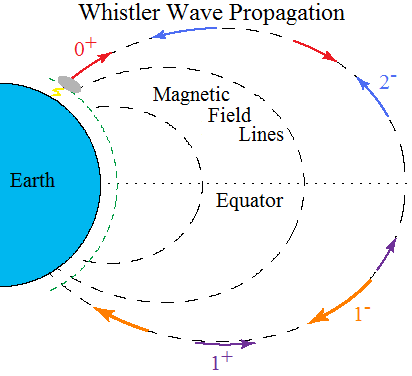
Paul, W2IOG, alerted me to the passing of Robert Helliwell, one of the discoverers of the “whistlers” and an expert on VLF phenomena and the magnetosphere. Paul met him and tells me that he was a real gentleman. His obit is fascinating:

http://news.stanford.edu/news/2011/may/robert-helliwell-obit-052011.html


Our book: “SolderSmoke — Global Adventures in Wireless Electronics”http://soldersmoke.com/book.htmOur coffee mugs, T-Shirts, bumper stickers: http://www.cafepress.com/SolderSmokeOur Book Store: http://astore.amazon.com/contracross-20
Secret Listeners — The Voluntary Interceptors

Jim, AL7RV, and several others sent me the link to this really interesting video about the British radio amateurs in WWII. Real “stiff upper lip” spirit in this video. Musn’t grumble! Great stuff from Great Britain: http://www.eafa.org.uk/catalogue/5108

That regen receiver they showed looks a lot like the beast that I brought back from the UK with me. Once again, I am hearing the siren song of the diabolical regens….

Progress continues on my Indian-ized Azorean DSB transceiver (with JBOT amp). I now have the amp nicely stabilized (thank God!). Now I just need to get the output from the balanced mod close to the 1 mW PEP level needed by the amp. Should be done soon. And my cold seems to be going away, so maybe I’ll be able to share my tales of JBOT derring-do in a podcast this weekend.

Our book: “SolderSmoke — Global Adventures in Wireless Electronics”http://soldersmoke.com/book.htmOur coffee mugs, T-Shirts, bumper stickers: http://www.cafepress.com/SolderSmokeOur Book Store: http://astore.amazon.com/contracross-20