
Category: QRP
OzarkCon is Coming Up — April 1-2
German Mighty Mite works Venice on 40 (video)
In spite of being a bit off frequency, sTef, DL1FDF (aka VY1QRP) has been inducted into the Color Burst Liberation Army. Congratulations sTef! Normally we would requite operation on 3.579 MHz, but sTef has been granted special dispensation because 1) he doesn’t have a 3.579 MHz rock, 2) our stock of this crystal has been depleted, and 3) he actually made a contact with this rig, working II3ICZ in Venice. FB sTef. If anyone has a color burst crystal for sTef, please let us know.
sTef writes:
I would like to say „Thanks” to both of you for your ongoing inspirations in soldering and homebrewing. After 15 years out of ham radio it were you two guys who got me back into the world of -> SOLDERSMOKE. Thanks for that.And belive me been away for 15 years and now getting back into it feels a sometimes a little bit too “digital“ …. ARDUINO or NOT TO ARDUINO ? This is the question….
Anyway…
So what could be more sophisticating than having a MMM ready on the work bench and answering a CQ call on 40m with that thing and be heard.
Yes, the first QSO today with my MMM was for you both.
I worked the Italian Radio Station II3ICZ. I was 559 into Venice with 0.5 watts from the MMM into my full-size triple leg for 40m.
AA1TJ — On the Air with a Tuning Fork Transmitter using the 2,212th Harmonic and Olive Oil Cooling
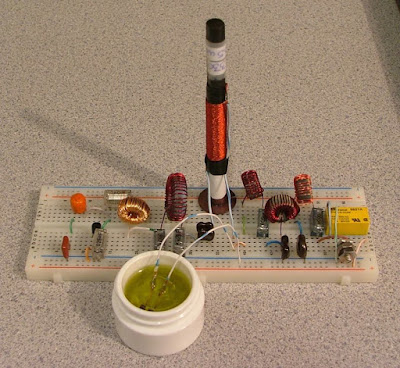
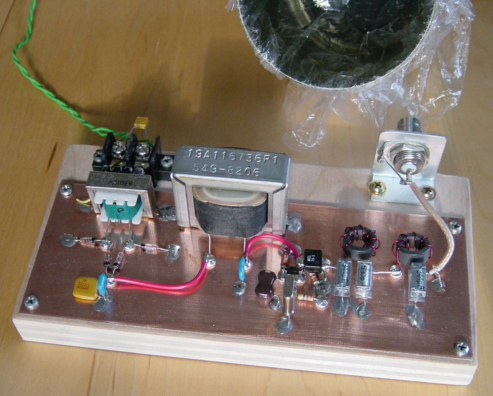
The saturable magnetic frequency septupler. The tiny computer memory core is submerged in olive oil (Italian…naturalmente).
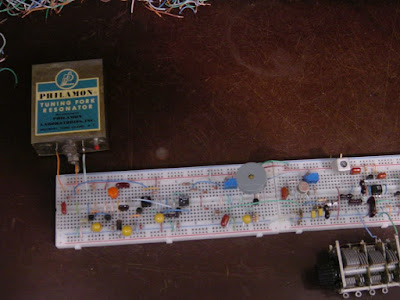
Not a very good picture, but here’s the 1600Hz tuning-fork, fork oscillator, SRD pulse generator, PLL S/H phase-detector (diode gate), differential amplifier D.C. amplifier, and part of the 500kHz VCO.
The Wizard (AA1TJ) reports from the Hobbit Hole:
I was pleased to have made the first contact with my tuning-fork transmitter this evening. My contact, N1QLL, runs a pretty B&B on the Maine seacoast, midway between Bar Harbor and Cutler. Jerry was operating a solar-powered QRP station. I found a follow-up email from him when I came up to the house for dinner. He’s asking for a better explanation of my set-up. I can’t wait to tell him about the passive frequency septupler made from an East German computer memory core, heat-sinked in a thimble of olive oil.
My signal was also logged by a number of automated “Reverse Beacon Network” receivers (image attached) located in Ohio, North and South Carolina, Virginia and Pennsylvania…not bad for 90mW on 80m. Please note that my operating frequencies, 3,528.0 and 3,539.2kHz, are the 2,205 and 2,212th harmonics, respectively, of my 1,600Hz tuning-fork frequency reference.
FYI: the third attached image illustrates the block-diagram and tuning-fork reference oscillator circuitry for three common-wavelength AM broadcast transmitters operating in Berlin, Stettin and Magdeburg, Germany from 1928 through the mid 30’s. A central 2,000Hz tuning-fork generated reference carrier was transmitted by landline to transmitters in the aforementioned cities whereupon the 529th harmonic was generated, amplified and broadcast at 1,058kHz. The equipment was designed by the Berlin-based firm, C. Lorenz A.G.. The fourth image details Lorenz’ technique of frequency multiplication via saturable magnetic iron-core inductors. My septupler operates in an identical fashion.
A very pleasant day… 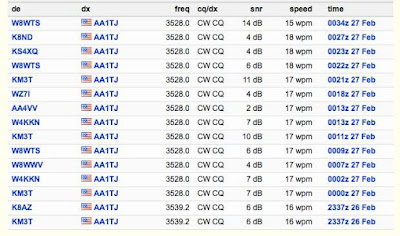
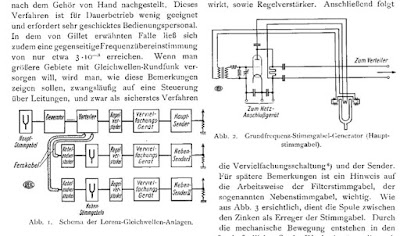
FYI: the third attached image illustrates the block-diagram and tuning-fork reference oscillator circuitry for three common-wavelength AM broadcast transmitters operating in Berlin, Stettin and Magdeburg, Germany from 1928 through the mid 30’s. A central 2,000Hz tuning-fork generated reference carrier was transmitted by landline to transmitters in the aforementioned cities whereupon the 529th harmonic was generated, amplified and broadcast at 1,058kHz. The equipment was designed by the Berlin-based firm, C. Lorenz A.G.. The fourth image details Lorenz’ technique of frequency multiplication via saturable magnetic iron-core inductors. My septupler operates in an identical fashion.
A very pleasant day…
Mike points out that this is a work in progress. He hopes to cross the pond (the Atlantic!) soon. Here is a update from Mike:
A nasty cold has delayed work on the 20 meter implementation, although some of the time I’ve spent crashed on the sofa was put to use redesigning the loop filter network. I think yesterday might have been my “hump” day so I’m looking forward to getting in some quality bench-time over the weekend.
By the way, my PLL-based transmitter frequency stabilizing circuit has much in common with a garden-variety frequency-synthesizer. Obviously, the tuning-fork frequency reference is the main point of departure. My sampling phase detector, for example, was old hat by the mid-1960’s. Nevertheless, this has been a fun project.
“QSO Today” Podcast Interview with Michael Rainey AA1TJ
Eric 4Z1UG has a really great interview with Michael AA1TJ:
I listened to it as I aligned my HQ-100 receiver and worked on a digital frequency readout for the old receiver. The interview was the perfect accompaniment for such a project. Inspirational stuff. Lots of great info on QRPp and homebrewing. Mike talks about some of his more famous rigs including the voice-powered New England Code Talker (pictured above).
I loved the story of Michael carting his DX-100 home in a wagon. And I really sympathized when he described the harsh reaction of the phone operator to his early efforts at voice modulation.
Strongly recommended! You won’t be disappointed. Great interview. Thanks to Eric and Mike.
Michael’s Log: AA1TJ Has FIVE Contacts with the Unijunction Transistor at 1-2 milliwatts
Michael writes:
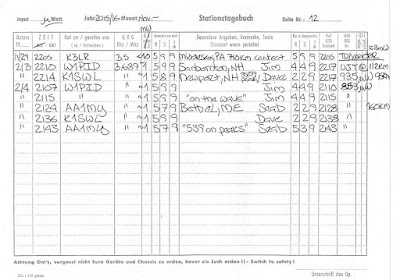
Dear Friends, The UJT transmitter circuit was improved considerably today. The power output has increased to 1.48mW and the start-up “whoosh” is now far less objectionable. It’s currently running in beacon-mode at 3687.8kHz. I’ll resume “CQing” as soon as I’ve returned from an hour’s walk in the woods. I hoping to work K1QO among others. 73, Mike
Added five QSOs today. Seabury/AA1MY is in Maine…exactly 100 miles from my doorstep. It’s wild to think that we made a one-hundred mile radio contact on a unijunction.
A Probable First: First Ever Radio Contact Using Unijunction Transistor as the Transmitter
AA1TJ writes:
I spent most of a week working to raise the RF output power from my unijunction transmitter to nearly 1mW. I was rewarded this evening with two contacts.
Jim/W1PID exchanged (599/449) signal reports with me from Sanbornton, NH (112km) at 2210z!
Dave/K1SWL did the same (589/229) from Newport, NH (95km) some four minutes later!
I should think these were the first-ever radio contacts made using a unijunction transistor as the transmitter.
FYI: my receiver was comprised of a single 1N34a germanium diode mixer followed by a single 2N35 germanium transistor audio amplifier. Great signals on this end.
Wikipedia on Unijunction Transistors: https://en.wikipedia.org/wiki/Unijunction_transistor
AA1TJ’s 150 Microwatts Heard at 112 Kilometers — “To Boldly Go Where no Unijunction Has Gone Before.”

AA1TJ reports:
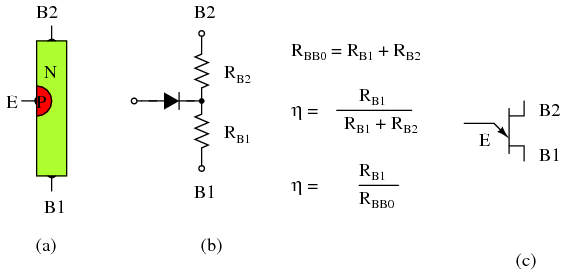
Breaking news from W1PID… “Mike! I just copied the beacon. I got ‘VVV de AA1TJ 150 uw’ and it faded out. 2146Z on 3551.95MHz” That’s it! Jim copied a message produced by a lowly unijunction at a distance of 112km. How’s that for cool! In a nutshell… the unijunction runs as an R-C relaxation oscillator at ~500kHz. A quartz crystal at the emitter frequency-locks the sawtooth waveform to 507kHz. The 7th harmonic is admitted to the antenna via a bandpass filter. The RF output to DC input conversion efficiency is all of 0.1%. Heat-sink? Check! Mission statement:
“…to boldly go where no unijunction has gone before.” Cheers,
Mike, AA1TJ
I think the really cool thing is that EM waves are once again flying out of the Vermont Hobbit Hole, propelled into space by the poet laureate of QRP.
QST de AA1TJ — Please listen for Mike’s Microwatts!
QST de AA1TJ…
I’ve a 150uW transmitter built from a single unijunction transistor currently running as a beacon on 3552kHz. If my New England amateur radio pals would be so kind as take a listen for it I’d be most appreciative!
G3ZPF’s Knack Story: Debunking Tech Fairy Tales, Surviving Nixie Tubes and Ferric Oxide

Bill:
I‘m finding the book very entertaining, and am currently about halfway
through it. Like you there were a few electronic ‘fairy tales’ that I
was suckered into and I was pleased to see your debunking of them. My
professional training was structural engineering so anything electronic
I picked up along the road, and was thus an easy mark for misdirection.
I still remember the first time I realized that teachers sometimes don’t
understand what they’re teaching, but just repeating what they were
told. At age 11 we were using a thin tube with a slug of mercury and was
told that at -273c the air under the mercury would have zero volume. I
knew it was BS, but was too young to know why. A decade later I worked
it out for myself, by accident really, and I still feel slightly
resentful about being misled. Turns out that -273c is a ‘convenience’
(aka a fudge factor) which makes the combined gas law work :-p
The first electronic fairy tale I encountered was “the feed impedance of
a half-wave dipole is 72 ohms”. Taught to me while studying for the UK
radio exam, and trotted out repeatedly in the RSGB magazine.
This magically mutated into 50 ohms when the Japanese rigs started to appear,
which made me a tad suspicious, and when my very young self finally
scraped enough cash together for the ARRL handbook I spotted the graph
showing variation of feed impedance with height.
I was devastated. I remember wondering why all the old guys at the club
(who I spent most Sunday mornings listening to on 160m AM as an SWL)
didn’t know this.
In that instant I saw that all my hours of climbing up & down ladders;
cutting and pruning my very low dipoles to get 50ohms (bear in mind how
changeable and usually awful the UK weather is) had been utterly pointless.
From that point on I used doublets + open wire feeder. Up the ladders
just once and all tuning done in the shack in a comfy chair with a coffee
in one hand using a PROPER balanced ATU, not some shonky single ended
thing with a balun on the back.
Of course I found out about saturating balun cores the painful way (a
T200 core stays very hot for a very long time), and accidentally
discovered the current balun (which I called the idle-mans balun) at a
time when nobody distinguished between a voltage balun and a current one.
I took my inspiration from the ‘coax round a ferrite ring’ method of
stopping TV coax braid from conducting my RF into the TV. Fast forward
20 years and current baluns are the way to go. Its tough being a visionary.
I remember spending a weeks wages (back in the 70’s) on a Fairchild
9H59DO prescaler chip for my TTL freq counter. Like you I hate chassis
bashing and the counter only went in a box after I’d had so many jolts
off the 150v rail to the nixie tubes I figured it was box-it or die 🙂
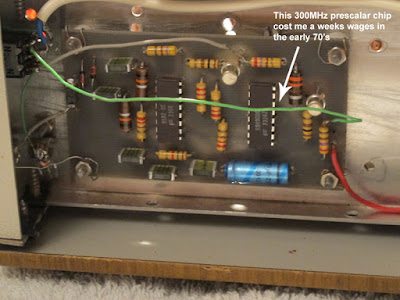
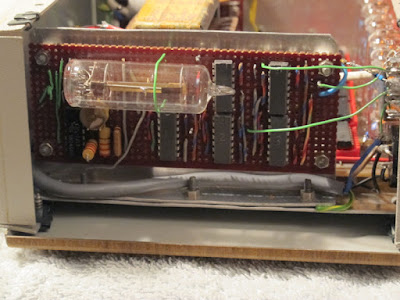
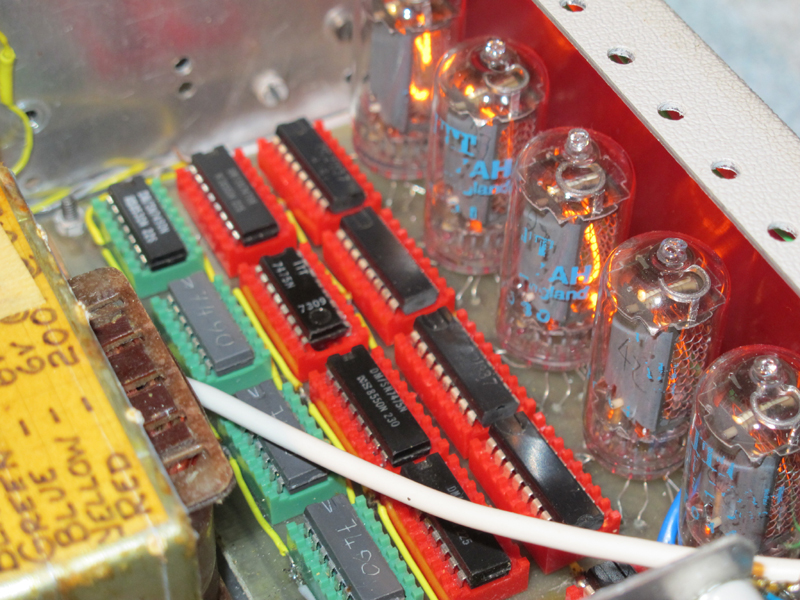
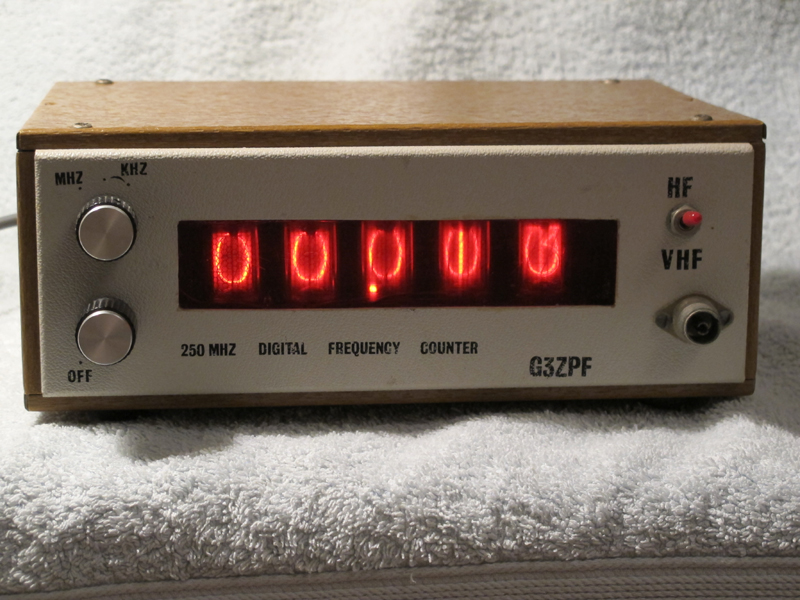
The circuit of the counter was ‘designed’ by me lifting the simplest
version of each part of the circuit from dozens of peoples designs &
just hoping it worked. By the time I’d finished I had learned enough to
know I was lucky it did work….and what a mess spilled Ferric oxide
makes on a pale grey bedroom carpet.
When GQRP first started up a bunch of us locals used to have a 10m net.
Primarily for ragchews but also to give the newly licensed types at the
club their first ever CW QSO on air. We were all sufficiently enthused
to build a 2w xtal controlled 10m CW TX. Using a 2n3819 in the PA & 2w
meant the matching was easy to 50 ohms.
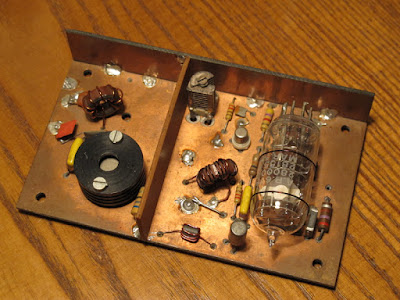
We were all within a few miles of each other so 599+, so one guy built a
half-watt version. Still 599.
I decided to go for it. Grabbed my sig genny off the shelf. It had a 50
ohm output. Lightbulb moment. Set it to 1microvolt outputans keyed the
aerial with it. 539 all round, albeit with some chirp and drift. Well, it
was a valve sig genny.
1uV across 50ohms is qrpppppp. Thats when I realised the million miles
per watt is no challenge at all when radiating extremely low powers over
short distances.
Might be harder today though. Back then we could hear the receiver
noise floor on 10m. Not much chance of that now.
But I confess I was always far more interested in operating than
building. Never had the luxury of a workshop. Always tucked into the
corner of a bedroom. If I couldn’t hold it in one hand and drill it with
the other it couldn’t happen.
I remember hearing that Kennedy had been shot at the instant it
happened. I was on 20m listening to a pair of USA hams rag-chewing and
they both had the TV on. I rushed downstairs to tell my parents who told
me I was talking nonsense “or it would have been on the news”. Took a
couple of hours for it to appear on our TV news.
I used to love chatting to the USA novices on 15m CW back in the late
70’s. Some of those guys were real pros. You could hear them coming back
to your CQ while screwing the trimmers on their xtals to get co-channel.
I still treasure a letter I have from one youngster. It was his first
QSO outside the USA. He tells how his mom got so excited she ran into
the road telling all the neighbours her lad was talking to England.
…..yes the one in Europe 🙂
Life seems a lot more cynical these days.
Even to this day I find the concept of my voice turning into electrons
which throw themselves into space and sometimes hit another piece of wire
in another country and reproduce my voice genuinely ‘magical’. Sadly my
grandkids don’t ‘get it’. They’re happy with Skype, facetime, and TXT.
The closest they came to interest was the eldest grandson (at age 10)
saying “grandad, can I have that telegraph key when you’re dead?”.
Sensing my surprise he added “I’m not interested in morse, but it looks
kinda cool”. Now he’s 20. Bought his first apartment, and his first BMW.
Making his way in the world and glued to his iPhone.
It would be kinda nice to get back onto 160m AM, but sadly the
electrical ‘crud’ levels in the UK are S9+ down there 🙁
I spent 30 years in front of a TS930, which was able to produce proper
AM because where most rigs had one xtal filter it had pairs of them. You
slide the filters over one another to get narrower passbands for CW and
if you slide them past each other you can gget DSB or AM.
Thanks for taking the time to write your book. You’ve lived a very
varied and interesting life. I wrote a SciFi novel back in 1980 but at
that time there was only one scifi agent in the UK and she didnt like
it. Maybe I’ll get it onto kindle one day.
I was expecting a lot of free time in retirement, but between the 3
grandkids and my 94 yr old mom I have less time than when I was working.
But despite the dodgy knees and eyesight its the best job ever 🙂
Regards,
David G3ZPF
www.g3zpf.raota.org
www.raota.org
Brazilian Minimalism: The Curruira Transmitter

Miguel PY2OHH is the Wizard of Sao Paulo. This morning I was looking at his wonderful web site and came across this little rig. It seems a bit simpler than our beloved Michigan Mighty Mite. And the folks down in Brazil had several of these on the air and made contacts with them. FB. Miguel hints they may turn this rig into a transceiver.
Here is the Curruira:

The rig is named for this little bird:

Peter Parker’s New QRP Book
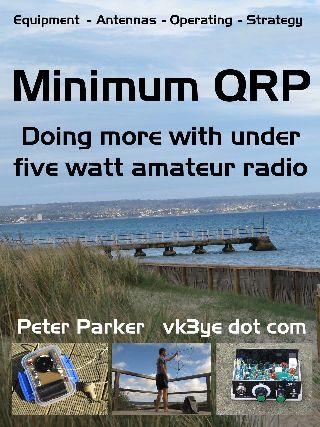
The wizard of Melbourne Beach, Peter Parker VK3YE, has written a book about QRP. Check it out here.
Peter is a true QRP guru. His Beach 40 transceiver is shaking the ether from locations around the world. I am really glad that he put that Melbourne dock on the cover. That dock has been the test site for many of Peter’s amazing creations. The railing has supported many great antennas. So many wonderful YouTube videos have been recorded there. There really should be a plaque or something…
Peter’s book is available as an e-book from Amazon. Details on how you can get it are here”
http://home.alphalink.com.au/~parkerp/miniqrp.htm
Thanks Peter for this important addition to the QRP literature.
W1JSB’s Very Cool Portable Rigs — RadioSet-Go!
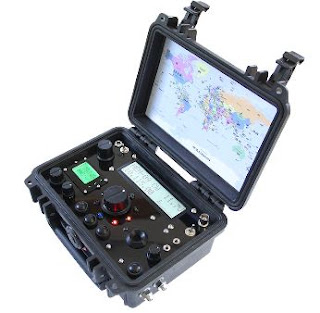
Brad Smith alerted me to this. Very cool. Hanz W1JSB is churning out some amazing trail-friendly rigs. I really like the tinted-translucent front panel.
Here is the site for Hanz’s company: http://radioset-go.com/
Here is his YouTube Channel: https://www.youtube.com/user/w1jsb/videos
Our book: “SolderSmoke — Global Adventures in Wireless Electronics” http://soldersmoke.com/book.htm Our coffee mugs, T-Shirts, bumper stickers: http://www.cafepress.com/SolderSmoke Our Book Store: http://astore.amazon.com/contracross-20
The 1Watter
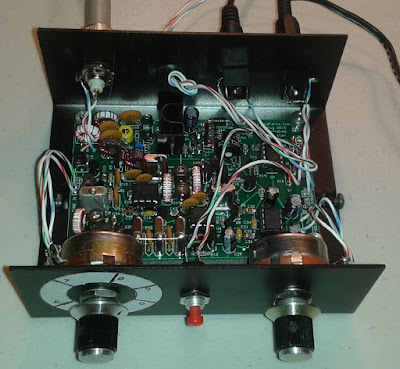
There are currently only 2 in the universe. And they have been talking to each other. Soon there will be more. Many more.
http://www.kitsandparts.com/1watter.php
http://www.1watters.com/
http://www.k7qo.net/onewatter.html
Chuck Adams explains (via the qrp-tech mailing list):
Aug 3 at 7:07 PM
Gang,
I and Diz have been playing on 20m with 1W.
OK, I’ve been playing. Diz has been working night
and day.
He has a kit coming out in two weeks or so. Don’t rush
him.
I and Diz have been playing on 20m with 1W.
OK, I’ve been playing. Diz has been working night
and day.
He has a kit coming out in two weeks or so. Don’t rush
him.
He has S/N 0001 and I have S/N 0002. These are the
only two 1Ws in the Universe. Yesterday (local time)
but 0000UTC today, I went to the lab to put a WWV
atomic clock above the desk for logging purposes.
I turned on the rig to listen while I put the screw into
the side of the shelf to hang the clock on. No warmup
drift. I’m tuned to 14.059MHz, the freq both Diz I start
out on and low and behold I hear him calling CQ. I pound
the paddle to call him and he went back to AF5XF in NTX.
Darn.
At 0031UTC I call him and I get a 229 and later a 339 and
he was a 539 here in AZ. So all the 1Ws in the Universe
have talked to each other. 🙂 The race is on, when and if
you get one to work us all. Or work us with the rig of your
choice and the power level of your choice….
Our book: “SolderSmoke — Global Adventures in Wireless Electronics” http://soldersmoke.com/book.htm Our coffee mugs, T-Shirts, bumper stickers: http://www.cafepress.com/SolderSmoke Our Book Store: http://astore.amazon.com/contracross-20
Pete Juliano, N6QW, Inducted into the QRP Hall of Fame


Reliable sources in Dayton, Ohio and in the United Kingdom report that Pete Juliano, N6QW, has been inducted into the
QRP Hall of Fame.
Wow, that’s great news!
Richly deserved!
Congratulations Pete!
Our book: “SolderSmoke — Global Adventures in Wireless Electronics” http://soldersmoke.com/book.htm Our coffee mugs, T-Shirts, bumper stickers: http://www.cafepress.com/SolderSmoke Our Book Store: http://astore.amazon.com/contracross-20
A Thatched Roof, Some Palm Trees, A Dipole, and a Homebrew Rig

Look at the drawing above. That is the banner logo of Rod Newkirk’s column in QST magazine. For many years Rod regaled us with exciting reports on the activities of intrepid foreign radio amateurs, transmitting from exotic locations using ingeniously devised homebrew radio equipment. Look at the picture on the left side. See the palm trees? See the thatched roof shack with the dipole antenna? Well, that’s pretty close to what it was like for me out on the Samana Peninsula in the Dominican Republic last month.
I set up the station under the thatched roof in this picture:

The red pins mark the spot:
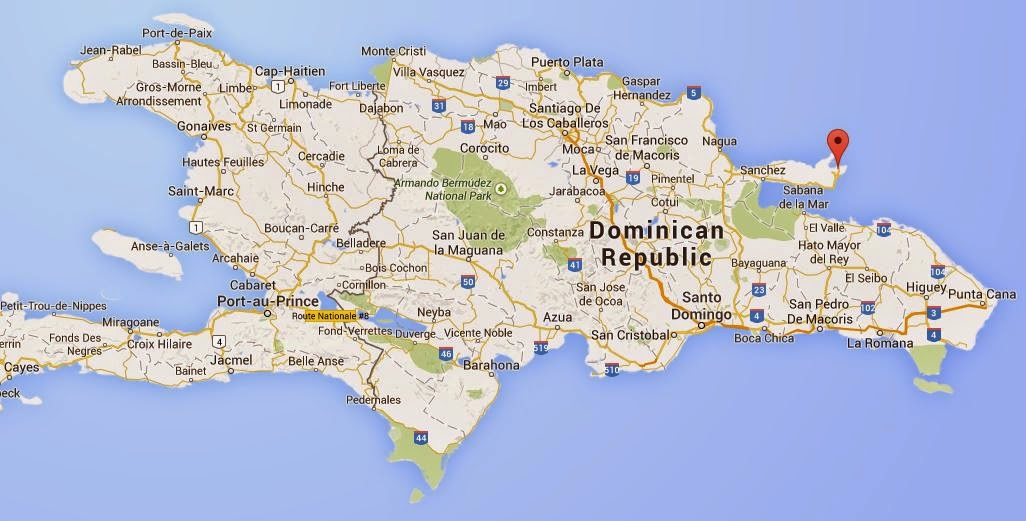
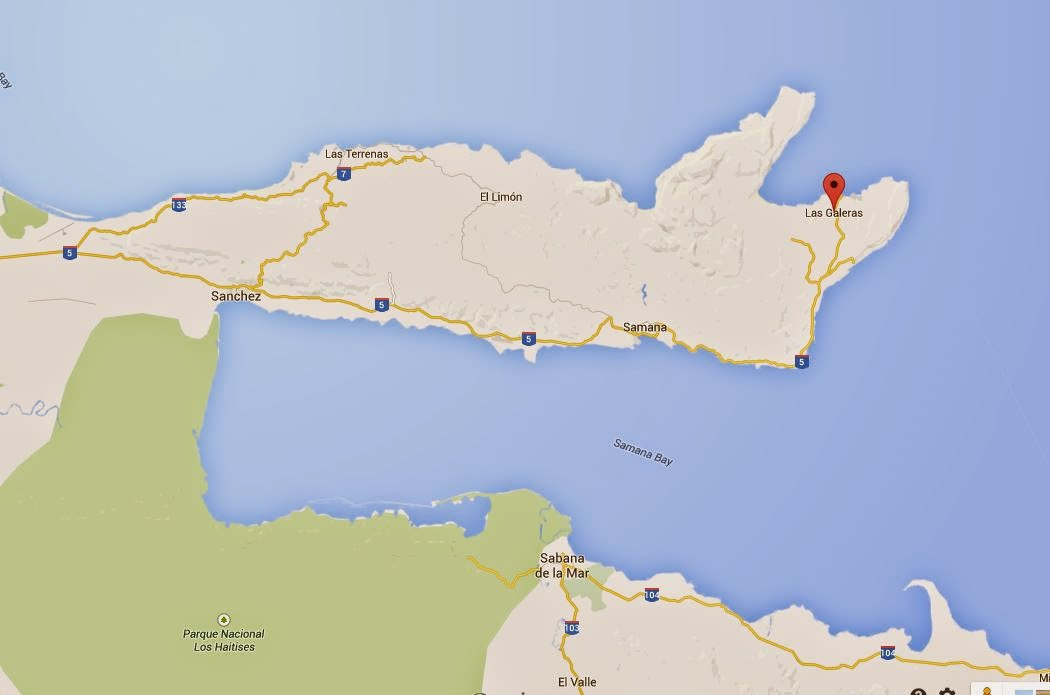
Here I am, tuning the rig while looking across Bahia Rincon:

The rig was my Azores-built, oft-modified, NE602-based, ceramic resonator DSB transceiver with a recently added India-designed BITX IRF510 RF amplifier chain. A little article I wrote about the ceramic resonator VXO was featured in SPRAT 127. My antenna was a half wave dipole strung up in the thatched roof. Power came from 10 AA Batteries. So this was the Double A, Double Sideband, Dipole DX-pedition.
I had given some thought to building an SSB rig for this trip, but because of the efforts of Peter Parker, VK3YE, I felt compelled to take a DOUBLE Sideband rig with me to the beach.
Here is an old (2006) video on the rig. The power amplifier has been significantly modified:
Here is some more information on the rig, including a schematic for the receiver and the SPRAT article on the Variable Ceramic Oscillator:
http://www.gadgeteer.us/PORTABLE.html
Here is the log book for my contacts.
17 DECEMBER 2014
W1JPR PAUL MT. DESERT ISLAND MAINE
8P6AE (BARBADOS) COULD BARELY HEAR ME, BUT GOOD QSO
18 DECEMBER 2014
N4USA DAVE IN FLOYD, VA. FAIRS NET. (KK4WW.COM)
KE4UGF DON ALSO FAIRS, NICE GUYS. FUN CONTACTS!
KA4ROG ROGER NORTH OF ORLANDO
19 DECEMBER 2014
WB2HPV GUIDO TALKING TO ITALIANS EVERY MORNING FROM WAYNE NJ. HE HAD TROUBLE HEARING ME.
CONDITIONS SEEMED POOR, BUT I WAS HEARING AUSTRALIAN STATIONS
W8GEO GEORGE IN THE INTERCON NET. HEARD ME. ALSO ON INTERCON: KA4AOQ AND 6Y5MP (JAMAICA) ALSO HEARD ME.
N4PD PAUL
W3JXY/4 NAT IN KEY WEST
N1FM TOM, NORTH OF MIAMI SOLID QSO.
KM4MA PAUL IN ORLANDO WITH MARITIME MOBILE NET.
20 DECEMBER 2014
NA2LF LLOYD IN NY
WB8YWR JIM IN DALLAS
KM4MA.
W1AW/3 IN MARYLAND (TOOK ME A WHILE TO GET HIM)
21 DECEMBER 2014 NICE 4 WAY SPANISH LANGUAGE QSO:
KI4PZE MIGUEL
CO8OT JUAN IN SANTIAGO DE CUBA
WA4RME RAFA IN CHARLESTON S.C.
C08KB MARCO IN CUBA
Here is a short video showing the station and the location. Note the little birds (Golondrinas or Swallows) flying by. They nest in the thatched roof. They often got confused and flew inside the house. Billy and Maria rescued many of them. Whales breed in this bay in January and February. There are also manatees. It is really a beautiful place.
There were obviously other attractions (!) so I didn’t spend a lot of time on the radio — just a half hour or so every now and then. But it was really very satisfying to carry this little homebrew device with me, set it up in this amazing place, and use it to send my voice across mountains and hundreds of miles of ocean. I built this rig in the Azores and have used it in the UK, France, Italy and the Dominican Republic. It contains circuits devised by members of the British QRP club and by my friend Farhan in India. The ceramic resonator circuit is something I cooked up on my own. The microphone is from my old Sony Walkman and the pen that serves as its support is from that wonderful magazine “Electric Radio.” In short, there is a lot of soul in this little machine. And it was a lot of fun to take it to the beach.
Thanks to Elisa for finding us this wonderful place. And to Rod Newkirk and QST for the DX inspiration.
Thanks to Elisa for finding us this wonderful place. And to Rod Newkirk and QST for the DX inspiration.
Our book: “SolderSmoke — Global Adventures in Wireless Electronics” http://soldersmoke.com/book.htm Our coffee mugs, T-Shirts, bumper stickers: http://www.cafepress.com/SolderSmoke Our Book Store: http://astore.amazon.com/contracross-20
Some Colorburst QRP Encouragement from ND6T
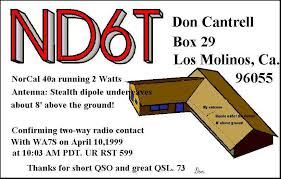
Don ND6T has been helping us come up with a good simple low pass filter for the MMM (Steve Smith and the FCC insist). At the end of one of his e-mails, he shared this QRP Colorburst gem:
Be prepared to be occasionally amazed. Back in the late 70’s I worked all over the western U.S. with under 1/2 watt. Regularly. Even a QSO with a UA0 (Siberia) with under 1 milliwatt, he having answered my CQ! I was seeing if I could “get out” using a single “D” cell flashlight battery that was too weak for the flashlight. All using a colorburst crystal. Oh, and a dipole 100′ high stretched over a creek.
73/72,
Don ND6T
Our book: “SolderSmoke — Global Adventures in Wireless Electronics” http://soldersmoke.com/book.htm Our coffee mugs, T-Shirts, bumper stickers: http://www.cafepress.com/SolderSmoke Our Book Store: http://astore.amazon.com/contracross-20
Midwest Mighty Mite from KK0S
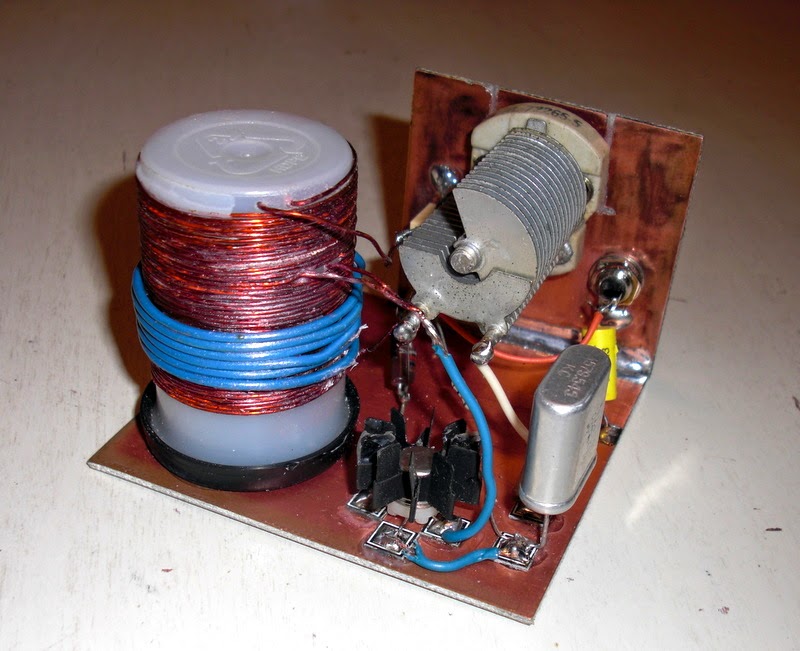
Wow, beautiful job Bruce. I was hoping that a check of the Reverse Beacon Network would reveal that someone had heard you, but no joy. Keep at it. You may become the first CLA member in this round to make a contact.
Bill –
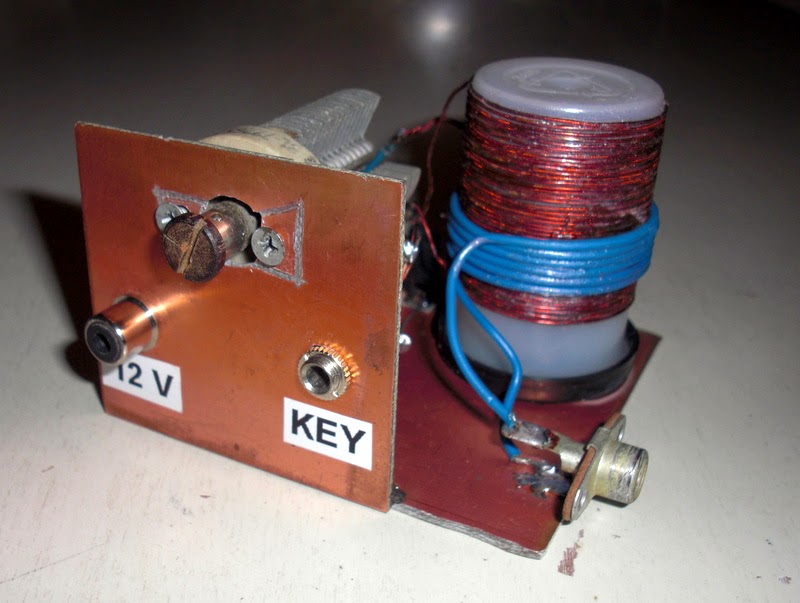
Hello from the Midwest chapter of the CLA. Here’s pix of my just completed Michigan Mighty Mite. Nothing was purchased specifically for this project. It was put together using only parts already on hand. The only previously unused parts were the front panel sockets and one resistor. The rig uses a 2N2219A transistor salvaged from a junked industrial control board and a color burst crystal that actually first oscillated in a tube-type color TV some 40 years ago. Loading into my ground-mounted vertical, this MMM seems to be most stable at a draw of 87ma at 12.6 volts. The arithmetic seems to work out at somewhere around 650mw into the ether. I called for about half an hour around 2300Z, but got no takers… it was still pretty early for 80m and I had an extremely high local noise level. The rig seems to run about 1khz high. I’ll give it another go this weekend.
72 – Bruce – KK0S.
Our book: “SolderSmoke — Global Adventures in Wireless Electronics” http://soldersmoke.com/book.htm Our coffee mugs, T-Shirts, bumper stickers: http://www.cafepress.com/SolderSmoke Our Book Store: http://astore.amazon.com/contracross-20
Swedish Mighty Mite

A thing of beauty! Check out the key!

What a great diagram. Schematic included!
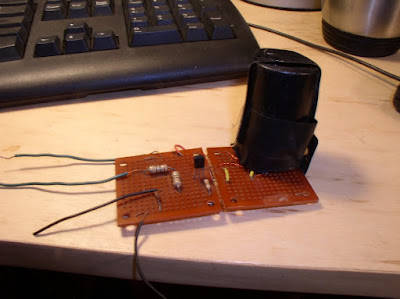
Remnants of mine
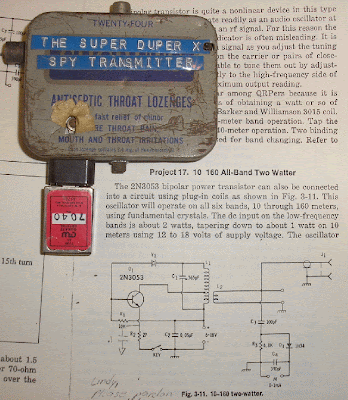
Steve “Snort Rosin” Smith’s
More on all this:
Our book: “SolderSmoke — Global Adventures in Wireless Electronics” http://soldersmoke.com/book.htm Our coffee mugs, T-Shirts, bumper stickers: http://www.cafepress.com/SolderSmoke Our Book Store: http://astore.amazon.com/contracross-20
AA1TJ Crosses the Pond with 10 milliwatts
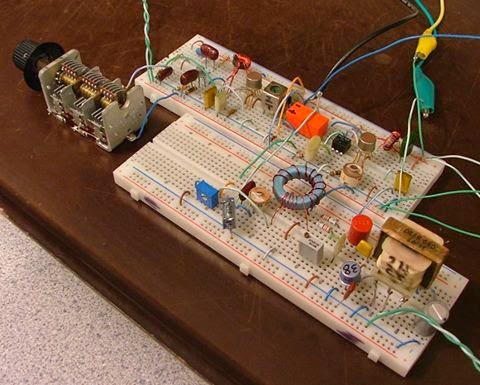
From a Facebook Post by Mike, AA1TJ:
Made 7 contacts with this tiny transceiver on 20m CW today with an RF output power of 10milliWatts. Five were stations in Georgia (GA QSO Party). The 6th was a regular QSO with a guy in Mississippi.
I answered a DX station calling CQ at 2230Z. Hearing nothing in response, I sent my call sign a half-dozen times anyway. More silence. As I was reaching for the knob to QSY he suddenly returned my call! …Carlos, CT1BQH northeast of Lisbon, Portugal (that’s him in the second photo). I was only 329 on his end but we kept it going for three minutes!
FYI: the transmitter (top circuit board) begins with a 3.58MHz ceramic resonator VXO (a 2N706 from the early 60’s). That drives a push-push frequency doubler built around another 1960’s-vintage, 2N2644 (obsolete stock from atop Mt. Mansfield, kindly given to me by Rich at Vermont Public Television). On receive, the 7MHz energy is routed via a DPDT relay (the orange rectangle) to the sub-harmonic (Polyakov) mixer located on the lower board. One stage of AF amplification is provided by a 2N333 that came off the GE assembly line in November of 1958. The DPDT relay is keyed directly. On transmit the 7MHz energy feeds a second push-push frequency doubler to produce 10mW at 14MHz (all spurs -35dBc, or less, with only the output resonator). The relay also switches the antenna between the transmitter and receiver.
Gosh, that was fun!
Gosh, that was fun!
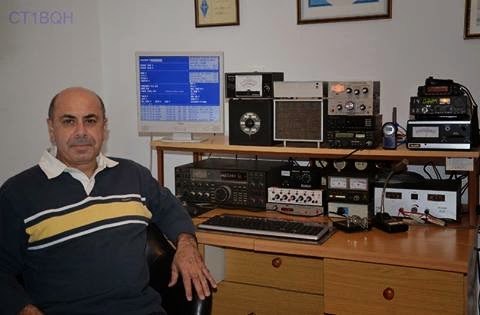
CT1BQH
Our book: “SolderSmoke — Global Adventures in Wireless Electronics” http://soldersmoke.com/book.htm Our coffee mugs, T-Shirts, bumper stickers: http://www.cafepress.com/SolderSmoke Our Book Store: http://astore.amazon.com/contracross-20