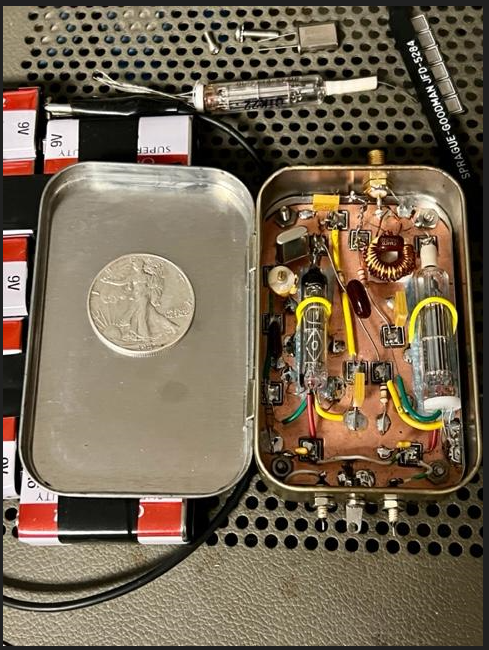
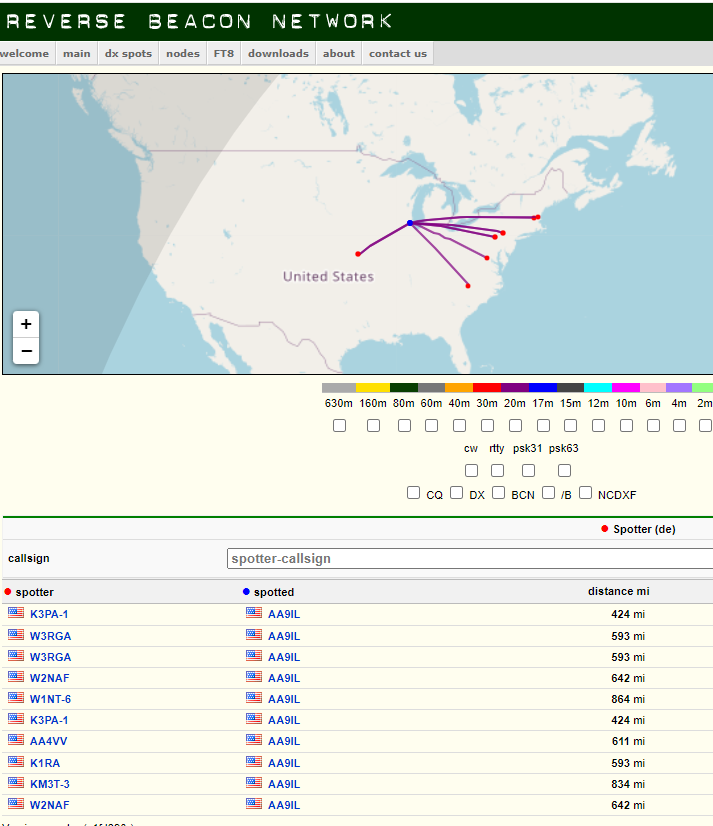
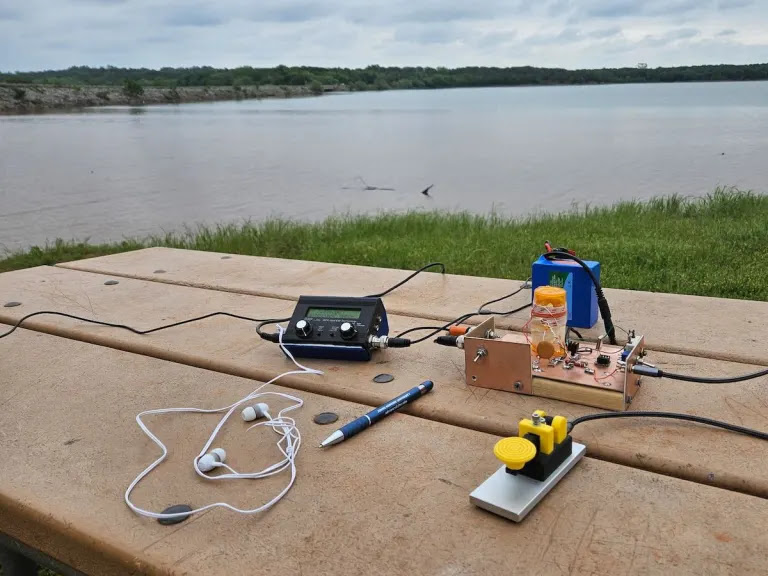
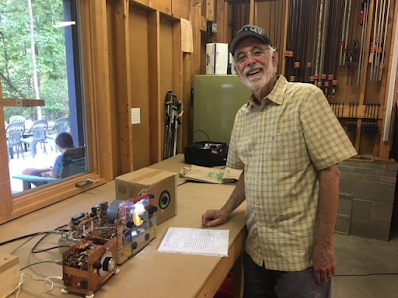
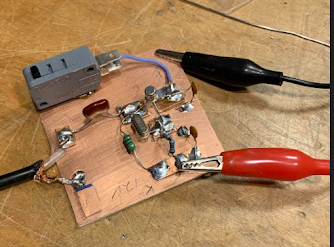
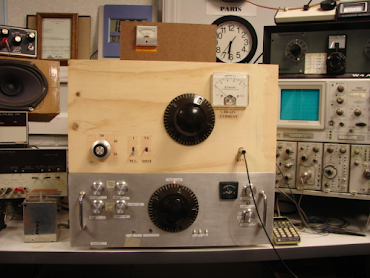
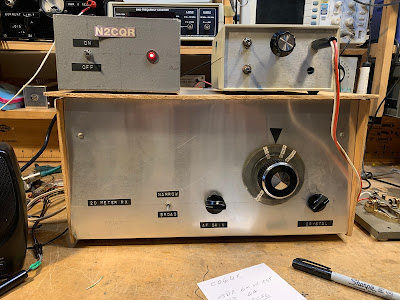
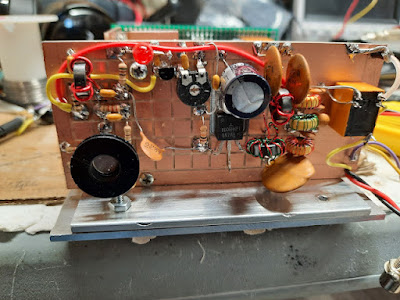
I have just built an tested a 20 meter “Sputnik” transmitter. It uses two Soviet era “rod” tubes and is fixed tuned to 14.060 MHz. I was able to compress the design to fit in an Altoids tin. The plate tuning capacitor was replaced with a fixed capacitor value closest to the variable for peak power out. Plate voltage is 90 volts and I key both the oscillator and PA via the B+ line. Power output is around 200mW and my first test transmission from the Chicago area was picked up 864 miles away on the east coast via the Reverse Beacon Network. It was definitely Joy of Oscillation and Joy of Transmission!
73, Mike
AA9IL
EN52
—————-
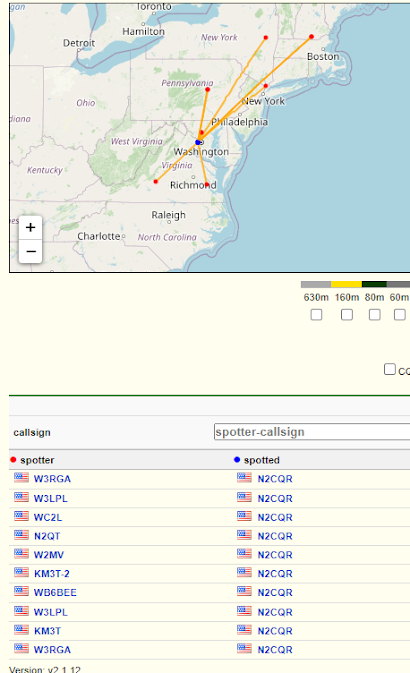
Mike’s rig has been heard by many Reverse Beacon Network stations:
——————
November 29, 2023
Bill:
I started a QSO with AC2C in Ellicott, MD who responded to my CQ but the band dropped (20m)
But that’s a good start and I’ll keep at it! So, yay!
73 Mike
——————-
Here are some earlier blog post on rigs using Soviet rod tubes:
A recent comment on the blog put me back in contact with an old friend of SolderSmoke: Paul VK3HN. Paul is an amazing homebrewer — it was great to hear from him. He sent along this video of a portable Summit on the Air activation from the Melbourne Australia area. Paul managed to contact Ignacio EA2BD in Spain. Ignacio was also running low power with a portable set up. The remarkable thing is that we have video from both sides of the contact. FB! Thanks to Paul and Ignacio.
Here we have a Michigan Mighty Mite being modified for AM in Romania, with input from Hungary, and inspiration from Melbourne, Australia (Peter Parker VK3YE). With a very nice shout-out to SolderSmoke.
I really like Ciprian’s emphasis on having fun with the electronics.
Sam WN5C built a Michigan Mighty Mite and then went the extra mile by putting it on the air from a field location. And what a great name this location has for a QRP operation: Lake Thunderbird.
Sam wrote up his experiences for K4SWL’s QRPer blog:
Below is a picture of the rig. NOTE THE LOW-PASS FILTER. FB OM. We wouldn’t want that rig tearing up the electromagnetic spectrum.
Looking ahead, Sam writes:
Next step is a DC receiver (maybe the high school receiver?) and then a more substantial transmitter married together, I think. This is all incredibly fun.
It was great to hear George’s voice again. I was a big fan of his “Chat with the Designers” podcast. And it was great to see that Pete Eaton WB9FLW (an old friend of SolderSmoke) was also involved in this presentation.
At FDIM George was talking about Coherent CW. Now, my views on CW have been made quite clear, but I am going to deliberately avoid snide comments about how Coherent CW might be a contradiction in terms. Thank you. I think this is something that Pete N6QW and I can agree on.
Nevertheless, this is all technically interesting. This reminds me of what happens with WSPR. But I wasn’t quite sure what George was getting at with his discussion of the phase of the incoming signal — I can see the need to get the receivers’ narrow filter exactly on the transmitting station’s frequency, but why the phase?
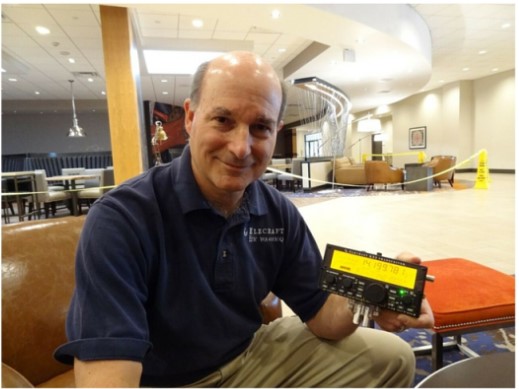
It was really cool that our correspondent at FDIM caught up with Eric Schwartz WA6HHQ of Elecraft. Some highlights from the interview:
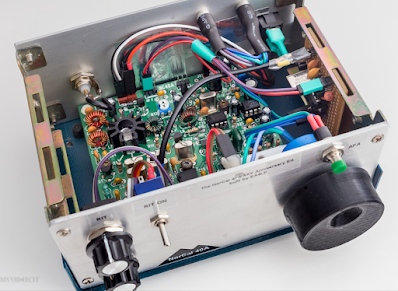
— Eric met Wayne Burdick through the NORCAL 40 (Wayne had designed it, and Eric was writing articles about it). That was a very influential rig — it was the basis for a book and a CALTECH course by David Rutledge.
— Elecraft has a strong QRP element in its DNA.
— The K2 is “Heathkit style” and offers the builder the opportunity to understand the rig at the component level.
— Eric says that using something you built yourself is worth at least 10db.
It is time to put aside (again!) all of the heated ideological arguments about the power level that defines “low power.” Just sit back and enjoy this wonderful trip down QRP memory lane.
40673! TT2! And G3RJV’s PW Severn – indeed, bow your heads!
Wow, the Ten Tec Power Mite (or Might!) — I still want one. Same for the Argonaut — what a great name (sounds like a “magic carpet), and with SSB to boot! I want to join the Argonaut cult!
I have both the HW-7 and HW-8 (the HW-8 is heading to the Dominican Republic). This video makes me want to fire up the HW-7. Maybe on 40.
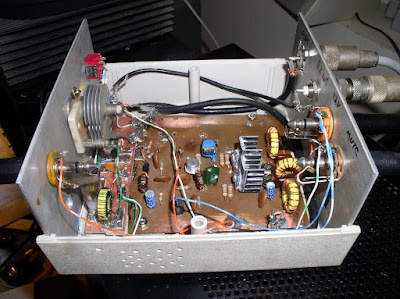
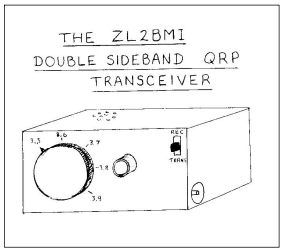
Continuing our search for information the Cuban “Jaguey” DSB rig, Trevor Woods pointed me to Dick Pascoe’s QRP column in the (below) July 1998 issue of Ham Radio Today. I think the first SPRAT article about Eric Sears’ ZL2BMI DSB rig was in SPRAT 83 in the summer of 1995. This fits well with the sequence described below by Arnie Coro CO2KK.
I am still looking for a schematic and pictures of the Jaguey rig: If you can help in this, please let me know.
We’ve been giving out prizes for the first team to complete each stage. I wanted to give one of the teams a little oscillator that could b heard with their receiver. So this morning, using a 7040 crystal from the AF4K (SK) company, I threw together a one transistor oscillator. It has just 8 parts, including the key:
I had a low pass filter in the antenna tuner. The antenna was a low-to-the-ground 40 meter dipole. The transmitter was putting out around 100 milliwatts.
N2CQR’s Ten Minute Transmitter
The Reverse Beacon Network showed that I was getting out quite well:
Then I thought, wait a second, let’s make a contact with the prototype high-school direct conversion receiver.
With the receiver hooked up, I again called CQ on 40 CW. BOOM! Very quickly Alan W4AMV in Raleigh NC came back to my call. Wow! That’s 222 miles. And a quick check of QRZ.com revealed that Alan is a homebrewer. Then Google reminded me that his work has been featured on the SolderSmoke blog. TRGHS.
I was so excited during this contact that I almost forgot to film it. But I did manage to get some short clips of the QSO in progress. You have to listen carefully, but you can hear our calls in there while Alan is transmitting (listen for the lower tone):
UPDATE (Feb 27 2023): I asked Alan about the rig he was using: “A PLL EXCITER DRIVING A PAIR OF FETS PUSH PULL ABT 50 w to an inverted L at 55 feet. The Rx a single conversion 9 MHz IF and it is connected to an active antenna in the trees out in the woods abt 25 feet up. Uses an automotive whip antenna about 3 feet long. “
Alan’s Rig
This little contact is a reminder of the fun that can come from using simple, homebrew, QRP gear. It is really amazing that the very first contact with this receiver was with another homebrew station. This all reminds Dean and me of something we have been telling the students: the little DC receiver they are building is not a toy — it is capable of being used in real, long-distance contacts.
Walter KA4KXX in Orlando has been a prolific builder of rigs for many years, and has been a great friend of SolderSmoke: Here are some of the SolderSmoke podcasts and blog posts in which Walter’s solder melting was mentioned: https://soldersmoke.blogspot.com/search?q=KA4KXX
As we approach the end of our current stay in the Dominican Republic, I could not miss out on the chance to work Walter with his homebrew rigs. Even though the space weather was stormy, and my dipole was droopy, we arranged to meet up on the high end of the 20 meter CW band this morning. See the results in the video above. A solid QSO with Walter. He says it is HB2HB, but truth be told I was on a uBITX that was built more by Farhan than by me. But this was a great contact. Walter started with a 50W rig, then switched to his 3 watt rig with a DC receiver. FB
Here is the e-mail I received from Walter after the QSO:
Dear Bill:
Many thanks for the great video, and when
you return to Virginia look for your mailman
to bring a postcard from me!
Just after your phone call this morning I scanned
the band from 14.025 to 14.300 and heard only one
SSB QSO at 14.347, and even now I only hear
a half dozen SSB signals, so that makes what
we did even more amazing.
The first photo below is my 3.5 watt NE602 direct conversion
rig which is about 2 years old. The transmit signal is created
by putting a 3 MHz VFO signal into an NE602 mixer with an
11 MHz crystal, so the rig can receive CW and SSB from
14.025 to 14.300 and can transmit CW anywhere in that range
with good frequency stability.
The bottom photo is my new full break-in CW 50W rig which
I just put on the air about a week ago and is still in the finalization stage.
I am not yet happy with it, but then again I am more particular
now than I used to be. It is really a trans-receiver with a single
conversion superhet receiver at the bottom of the board using
an NE602 pair with a 3-crystal 4 MHz 900 Hz bandwidth filter,
and a single 10.080 crystal VFO which is tuned with a polyvaricon
for operating between 14.061 and 14.068 MHz.
At the top is the VXO transmit section using a pair of 14.070
crystals pulled down into the operating range. This signal
is buffered and amplified to about 500 mW which is all that
the MRF101 RF Power Amplifier needs. Visible behind the
board is an AC-powered 24 VDC switching power supply which
is connected in series with the 12 VDC battery to
power the final stage with about 36 VDC. The main 12 VDC is
provided by a bench power supply which is not in the photo.
In both rigs the morse code key is the microswitch
at the lower right corner. (Way more handy and elegant
than your key, I might say?)
This morning each of these rigs was connected to its own
end fed half wave antenna, one in my backyard
and the other on the side of my house. My antenna analyzer
shows them to be essentially equal, but my 50W rig does
not like one of them at all.
Making our international homebrew-to-homebrew contact
today was a terrific ham radio experience, so thanks for all
I’m not exactly sure why I pulled this old rig off the shelf, but I’ll write up what I did — I often use this blog as a kind of notebook. I can look back and easily see what I did on my last encounter with the rig.
This rig is getting a bit long in the tooth: The receiver is built with 40673 Dual-Gate MOSFETs, an some of the transistor cans have gotten rusty. The frequency readout on the receiver is the top of a coffee can fitted onto the reduction drive behind the tuning knob from a Drake 2-B (not MY 2B!).
Here are two 2013 videos that I did on this receiver:
— I put the crystal filter back in CW mode. I had widened it so that I could listen to 20 meter SSB, but I decided to go back to its original configuration. When I built the receiver in 1987, I didn’t characterize the crystals — I just used the capacitor values that Doug DeMaw had in his article. I pretty much did that again this time, just putting caps that are close in value to what Doug had. DeMaw used color burst crystals at 3.579 MHz. So I guess this would be a GREAT receiver for the Color Burst Liberation Army!
— I used My Antuino (thanks Farhan!) to check the passband. Here is what it looks like. I just put the Antuino across the 10k resistors on either side of the input and output transformers. The coil cores had become very loose — I just tried put them in the right place. I may need to put some wax in there to allow them to better stay in place. I think they could have used toroids instead — that would have been easier. One of the transformer connections was open — they don’t work well that way, once I fixed that, the passband looks like this:
— Each of the horizontal divisions is 500 Hz. The passband is not pretty, but it is OK, and I didn’t feel like doing too much work on this to get it in better shape.
— The filter peak was a bit lower in frequency than expected. I found that trimmer cap C3 in series with the BFO crystal would not allow me to lower its frequency sufficiently. So I moved C3 to a position in parallel with the crystal. With this mod, I could get the BFO frequency to 3578.69. This produces a 690 Hz tone when the received signal is at the peak of the IF passband. Opposite sideband rejection is quite good.
March 2013 Rebuild of the VXO 6 watter
— I didn’t have to do any real work on the transmitter. The RF amplifier in the transmitter had served for a time as the RF amp in by 17 meter DSB rig (I had added a bias circuit, which I removed when I put the amplifier back in Class C). Some time ago I rebuilt the oscillator circuit (which had been literally cut off the board when I used the amplifier in the DSB rig).
— I did have to reconfigure the muting circuit — the T/R switch in the transmitter switches the antenna and also — through a two wire circuit — cuts off 12 V DC to the transmitter when in receive mode.
— For sidetone I just put a small piezo buzzer through a 1k resistor between 12 V DC and the key line.
It all worked fine — I talked to three stations on the high end of the 20 meter CW band.
November 4, 2013 Special hour-long interview with Peter Parker, VK3YE — Early experiences with radio — CW — DSB Gear — Simple gear, and gear that is TOO simple — VXOs, Super VXOs and Ceramic Resonators — Building receivers — Chips vs. Discrete — Making the leap to SSB — The Knob-less wonder and the BITX — No need for a sophisticated workshop — Advice for new phone QRPers
Thank you so much to you all… and thank you SolderSmoke for always writing about my learning in homebrew gear. I did finally got my license… just waiting for the paperwork to arrive. But now I’m finally YO6DXE ( DX Explorer lol ). I did found my issue with the power… it seems that it’s from the cheap BD139 that doesn’t seem to work as expected. I get about 500mW with a 2n2222. So I ended up making another version of the transmitter that I’m really happy about. 73 to you all DE YO6DXE.
Very cool that SPRAT had a Double Sideband (DSB) transmitter article in its current issue (#191 Summer 2022). The author is DSB guru Eric Sears ZL2BMI,creator of the famous ZL2BMI DSB QRP transceiver.
I think DSB is a great way to break into homebrewing for phone. Building a DSB transmitter is a LOT easier than building an SSB rig. The DSB transmitter can then be converted into a DSB/Direct Conversion transceiver.
When I first listened to Bob Crane’s interview at FDIM with Keith Whites, I thought of the book “The Electronics of Radio” out of CalTech by David Rutledge. Keith Whites told me that the difference between his effort at University of Kentucky was that Rutledge’s course was designed for freshmen at Cal Tech, while White’s course was aimed at Juniors and Seniors.
I told Keith Whites that I had struggled to understand the Gilbert Cell and the NE602, the device that lies at the heart of the rig used in both courses: The NE-602 Gilbert Cell Mixer used in Wayne Burdick’s NORCAL 40A. Here is how I came to understand the device: https://soldersmoke.blogspot.com/2021/11/how-to-understand-ne-602-and-gilbert.html
The video above shows Adam’s tiny Pixie in action in the California desert. His rig is about the size of a postage stamp and weighs about 2.6 grams. FB Adam.
Adam did a lot better with his Pixie than I did with my far larger and more complicated SST transceiver. He also did better than I did on 40 when I was using my ET-2 (two FET) transceiver.
I liked how Adam recorded in the field the CW from his rig, I also liked his key (!) and his EFHW antenna and “tuner.” Adam’s ability to cope with no CW sidetone was also admirable.
Rich WB4TLM spotted my bog posts about famed QRPer C.F. Rockey W9SCH. He followed up by sending me a link to the WB4TLM blog. It is a lot of fun. It describes his troubles in school and his subsequent participation in The Rock’s electronics class.
Rich’s blog has some great inspirational quotes for ham radio homebrewers. He is now teaching at Full Sail University. Their fabrication lab has a motto: “Dream it — Make it.” And in a quote that made me think of my good friend Pete Juliano, Rich tells his internet-jaded students, “I’ve been there…done that… I can get you there faster.” FB OM.
I’ve recently finished most of the circuitry on the 17-12 meter dual band SSB transceiver. I have had contacts with it on 17 meters, but until yesterday morning (March 22, 2022) I had not had any contacts on 12 meters. This morning I talked to Paul EA5JZ in Valencia, Spain. I was running the 17-12 rig barefoot at about 5 watts with the final being one RD06HHT FET. The antenna was my 75 meter doublet fed with window line — I had to modify the tuner to get it to work on 24.9 MHz. It was very cool to have my first 12 meter contact be QRP, HB and with Spain.
There is a LOT of soul in this new rig. Here is a partial list of contributors:
— Overall BITX design: Farhan VU2ESE
— Termination Insensitive Amplifiers (TIA): Wes Hayward W7ZOI and Bob Kopski K3NHI.
— TIA boards from Todd K7TFC
— ASK-1 Mixer from Armand WA1UQO
— VFO design parameters from Joe Carr K4IPV (SK)
— VFO stability ideas from Frank Harris K0IYE and Mike Murphy WU2D.
— HT-37 Tuning Capacitor bought from e-bay at suggestion of Pete Juliano N6QW.
— Pine board base of the rig: Frank Jones (SK) W6AJF’s preferred building technique.
— DTC Band-Pass filter circuits from Han Summers G0UPL.
— Low pass filter values from G-QRP web site.
— Idea of using RD06HHT instead of IRF-510 in the final: Pete Juliano
— Heat sink from Chris KD4PBJ
— Trifilar Toroids used in many places from Farhan VU2ESE.