Transit of Mercury, 11 November 2019, and a Transit of Venus and Some Sunspots from 2012

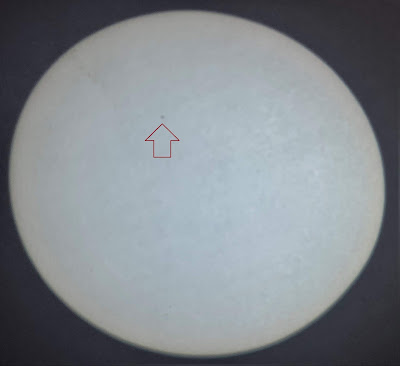
Above: Transit of Mercury, November 11, 2019 as I saw it from Northern Virginia using a 4.5 inch reflector with image projected onto a white paper. Elisa took the picture with her I-phone. Arrow shows Mercury. I almost missed it — Billy texted from college to remind me of the big event.

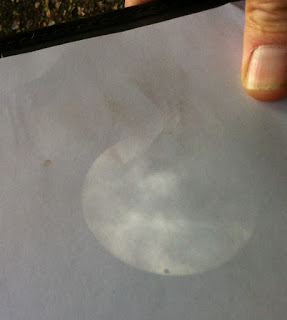
Above: Transit of Venus June 6, 2012 as seen from Northern Virginia. Billy (age 13) took the picture with his I-phone 4. Venus is much bigger, much closer and much easier to see. Near the bottom edge of the solar disc.
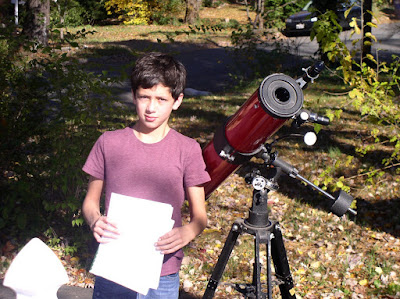
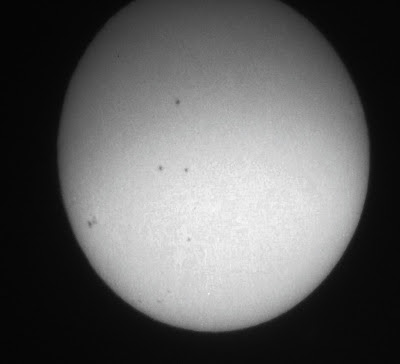
Above; Billy on November 12, 2011 with the 4.5 inch Tasco Reflector that was used on BOTH the Venus and Mercury transits (we projected the image on paper). On this day we were using our newfound solar photography expertise to take a picture of sunspots (our picture below).

Ah, those were the days! Many spots back then. None now.

Minimalist Masochism at Solar Minima — But More Contacts with the ET-2

Dylan Thoams

“Rage, rage against the dying of the light”

I thought of that line from Dylan Thomas’s poem when I read on G3XBM’s web site that we are kind of at the very bottom of the solar cycle. Roger wrote on 22 October: “Solar flux is 64 and the SSN 0. A=5 and K=0. As far as I am aware this is the lowest solar flux this solar minimum.”

I also thought of this as I pounded brass (Indian brass!) in an effort to make a few more contacts with my ET-2 two transistor rig. Obviously venturing forth on 40 meters with just TWO transistors (one for transmit and one for receive) and crystal control AT SOLAR MINIMA is not for the faint of heart. It is almost a Dylan-esque act of defiance.

I have had to resort to pleas for help on the DX Summit, the SolderSmoke blog, and the SKCC Schedule page. Fortunately for me, the brotherhood has sprung to my support.

W1PID (who gave me contact #3) also gave me contact #4 on 21 October.

W4KAC in Hickory NC was contact #5. This was on 22 October. This was the only marginal contact so far. He was running 5 W into an end fed half wave.

Yesterday was a big day for the ET-2. I had two solid contacts:

#6 was N2VGA in New York UPDATE: Larry N2VGA confirmed by e-mail that this was a “random” contact — not the result of my on-line pleas for assistance. He just heard my CQ and responded. FB.

#7 was K4CML in Newport News, Va. He switched to QRP himself at 2.5 watts for a nice 2X QRP contact.

Looking at my Rigol ‘scope, I now think I’m putting out about 150 milliwatts. Not bad for a single J310. I may have to invest in a heat sink.

40 seems most cooperative in the morning (around 0930 local) and again in the afternoon (around 1630 local).

Thanks to all who have helped. I will try to make a few more.
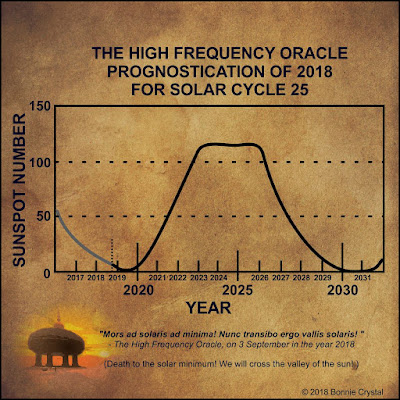
Solar Cycle 25 — The High Frequency Oracle Has Spoken (THFOHS!)

Not quite as authoritative as a spoken message from the The Radio Gods themselves (as in TRGHS), but the HF Oracle seems to be well connected. Time to start planning for Moxons and Hex Beams!

Read the full poetic report from the Oracle here:

https://forums.qrz.com/index.php?threads/the-hf-oracle-prognostication-for-solar-cycle-25.626433/

Understanding Antenna Directivity — Help from Canada

I am in the process of repairing my beloved 17 meter fishing-pole Moxon. It was taken out of service by the last Nor’easter of the winter. This repair has caused me to review the theory behind antenna directivity. I find there is a lot of “hand waving” in the explanations of how directivity happens: “You put a reflector element next to the antenna. And it REFLECTS!” You are left wondering how that reflection happens.

The Royal Canadian Air Force made a video that does a pretty good job of explaining how the reflector reflects. See above. Thanks Canada!

While we are talking about antennas, I wanted to alert readers to a really nice antenna modeling program that is available for free. It is called 4nec2. You can find it here:
http://www.qsl.net/4nec2/ There is a bit of a learning curve, and I am still climbing it, but I can see how this software would be very useful. It has an optimization feature that runs the antenna through many versions and tells you how to optimize for F/B, gain, SWR, or whatever you want to prioritize.

I have discovered that my Moxon was resonant below the 17 meter band. In other words, the antenna elements were too big. About 3.6% too big according to my calculations. This may be the result of my using insulated wire for the antenna elements. Apparently the MOXGEN software assumes the use of uninsulated wire. I’m thinking that an easy way to deal with this would be to use the frequency 3.6% above my target frequency and then use the dimensions given my the MOXGEN program. Any thoughts on this plan?

What a shame that Cebik’s web sites have all disappeared.

Listening for Your Own Signals on the Long Long Long Path

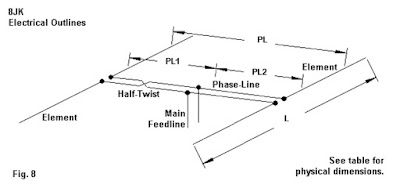
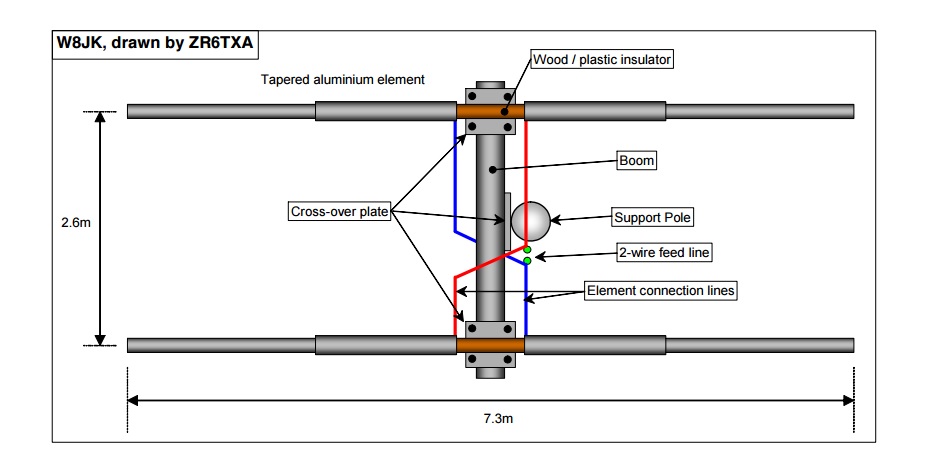
I heard some guys talking about this on 40 SSB last night. A very cool use of the bidirectional pattern of the W8JK beam.
From: http://qrznow.com/the-w8jk-is-a-famous-and-effective-dx-antenna/

Round-the-world paths The bi-directional nature of this antenna makes it possible to discover open round-the-world paths, something not possible with a normal beam antenna. The technique used by Kraus is to rotate the beam slowly, sending short Morse code dots, with a full-break-in or QSK transceiver. The delay time for the signal to return is about one seventh of a second, so there is plenty of time for your transceiver to switch to receive mode. When you have found and peaked an open round-the-world path, call CQ, and you may be rewarded with DX anywhere along the path. Also, the question of Long-path and Short-path does not arise – you are transmitting on both paths at once, giving you a greater chance of catching the other station’s beam direction….

The NAA VLF Station (NOT QRP!) and Brad’s Receiver

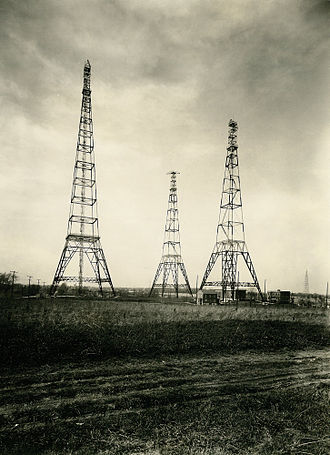
NAA Towers — Arlington Va. 1913
Brad WA8WDQ wrote to us about a VLF (24 kHz) his receiver project (see below). This led to some Googling about the VLF station NAA. Wow, there is some important radio history associated with that call sign. The station’s original location was just a few miles from I where I live now. From Wikipedia (https://en.wikipedia.org/wiki/VLF_Transmitter_Cutler):

The station began operations in 1913 as a radio telegraphy station call sign NAA in Arlington, Virginia, at a facility next to Fort Myer. Although its broadcasts occasionally included band concerts and speeches, it was most famous for its nightly time signals. The three towers known then as “The Three Sisters” stood 600 feet, 450 feet and 200 feet (183, 137, and 61 m) above the ground. The site was referred to as “Radio”, Virginia. The towers were the second largest man-made structure in the world behind only the Eiffel Tower. The word “Radio” was first used instead of “Wireless,” in the name of this Naval Communications facility. The First Trans-Atlantic voice communication was made between this station and the Eiffel Tower in 1915. The Nation set its clocks by the signal and listened for its broadcast weather reports. The Towers were dismantled in 1941 as a menace to aircraft approaching the new Washington National Airport. The towers stand today at United States Naval Academy in Maryland, on the edge of the Chesapeake Bay.

Be sure to read about the de-icing system for the antenna. It uses more power than the actual transmitter!

From Brad:

Bill, Pete,
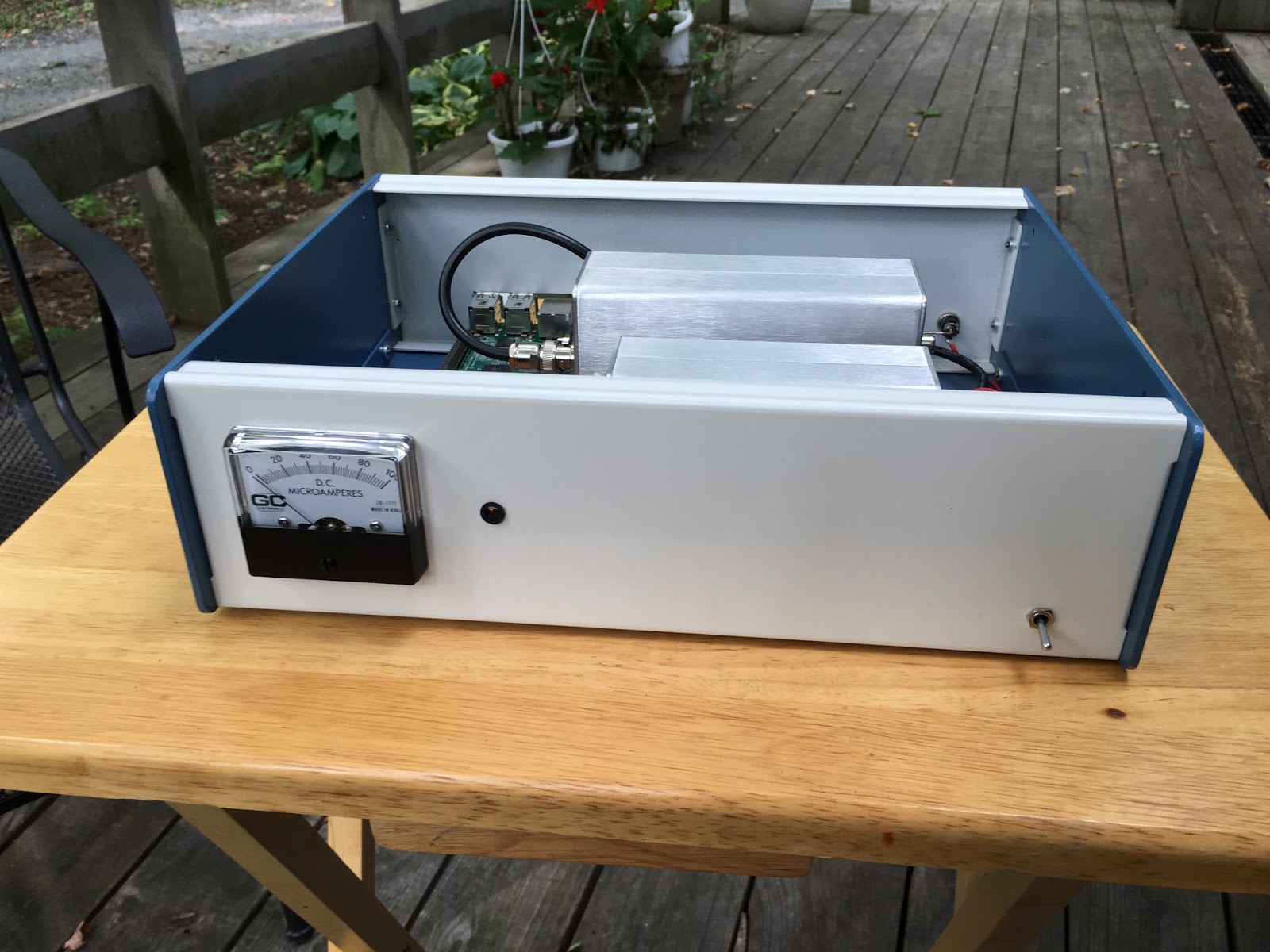
Here’s the current status of the 24 KHz NAA SID receiver. All the major sub-assemblies are mounted in the chassis and power is hooked up. For convenience, I’ve been using the PowerWerx USBbuddy switching DC-DC converter to supply +5V power to the Raspberry Pi from the +12V input. I’ve found them extremely RF quiet, clean and stable; capable of supplying 3A though this project will only need about 1.5A @ +5V. At this point, I’m just waiting for Adafruit to send the A/D chip I’ll wire up to the Pi on that empty protoboard just under the meter. Speaking of the meter, it’s not really needed as the Pi records and broadcasts over Wi-Fi the received signal level. However, I like my projects to have some sort of physical human interface so I added the signal level meter and an LED for SID event alarms :).
As previously mentioned, my bench test of the receiver using my signal generator was successful. Once everything is wired, I’ll do an actual on-air signal test receiving NAA.
Brad WA8WDQ

Radio New Zealand Booming in on 7245 AM

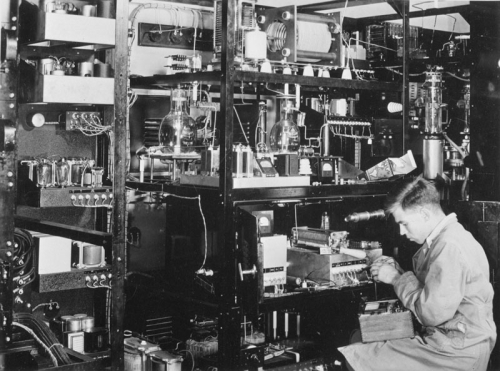
The day is off to a good start here at SolderSmoke HQ, with Radio New Zealand booming in on my homebrew Mate for the Mighty Midget receiver. I was listening from around 0900 to 1030 UTC on 7245 kHz. Once again we see that The Radio Gods favor homebrew receivers. Gray line propagation also played a role.

Above we see a technician at work at RNZ in 1945. More historic photos here:
http://www.pcc.govt.nz/About-Porirua/Porirua-s-heritage/Porirua-s-suburbs/Titahi-Bay/Historic-site–Radio-New-Zealand-Transmission-Station

Spectacular Solar Weather

This amazing picture was taken last night at the Bharati Indian Base Station in the Larsemann Hills of Antarctica. The researchers there report that the aurora was so bright that it cast shadows.
Yesterday I was having a nice 40 meter SSB contact with N3TDE. Rich is 179 miles away, in Pennsylvania. At 1650 UTC, his signal very suddenly dropped into the noise.

The purple lines along the bottom of the chart below probably explains both the aurora and the abrupt end of my 40 meter contact.


GOES X-Ray flux plot

Listening to New Zealand on the Barbados RX via the Gray Line (40 meter CW)

John:
For the last couple of mornings you have been coming in quite strong on 40 meters around dawn here. Attached is a short video from today. I am listening with a homebrew superhet receiver:
73 Bill N2CQR
Hi Bill,
Thanks for sending the video clip.
It’s really made my day!
I’ve sometimes wonder what I sound like at DX now I know.
The IC7410 sounds quite respectable and the sending is reasonably decipherable.
Interesting about the receiver.
The signal seems to stand out well from the noise.
Really well done. But then that’s what ham radio is all about.
We all enjoy radio and we all like to enjoy the various aspects to the hobby.
Modes, antennas ,QRP whatever.
It’s great fun.
It would be good to have a QSO. perhaps some time soon?
Thanks again,
Very Best 73,
John ZL1ALA

1936 Shortwave Listener QSL card

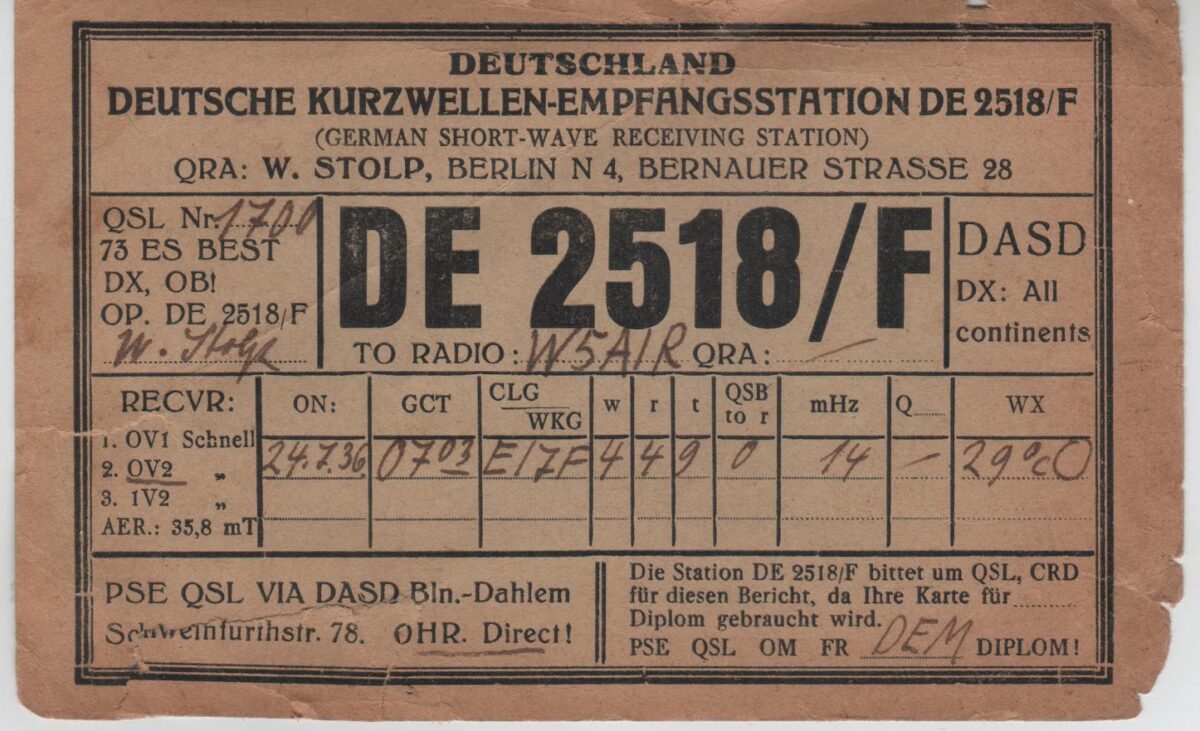
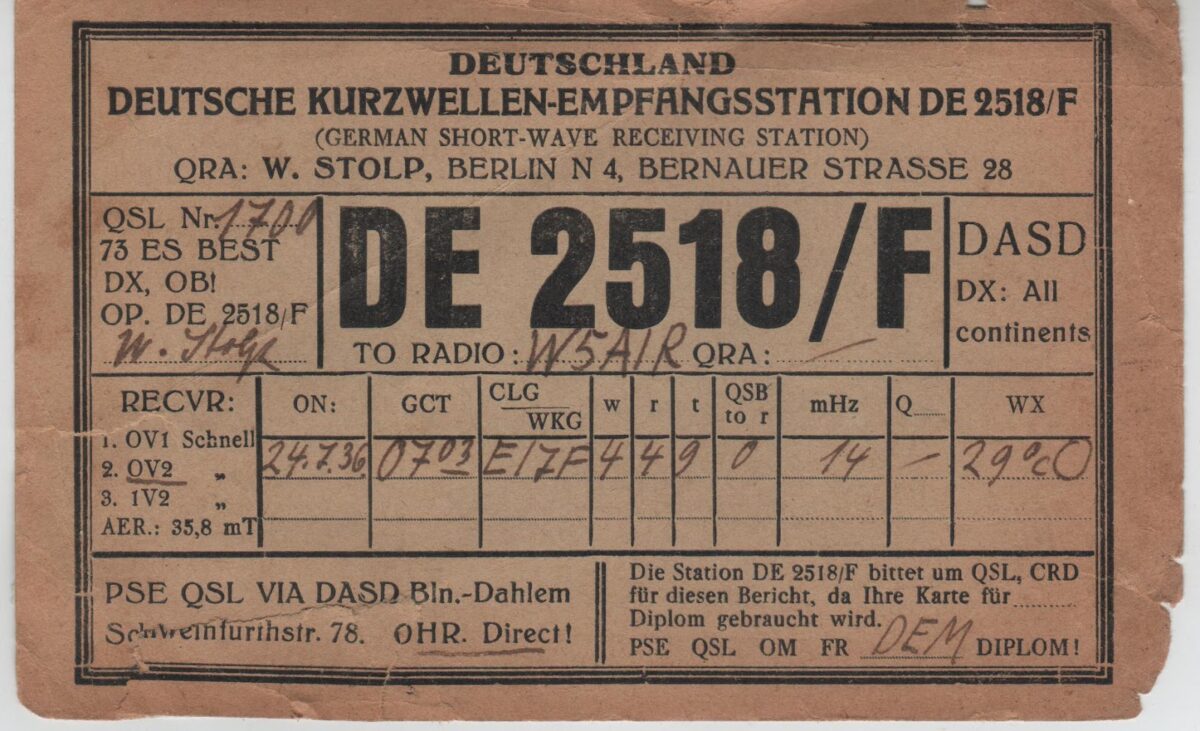
I found this today while rummaging around in the shack. It is starting to fall apart so I figured I better digitize it before it turns into dust.

July 24, 1936. 7 am in Central Germany. 29.0 degrees Centigrade. Clear skies? German Shortwave Receiving Station DE 2518/F monitored W5AIR’s contact with Irish station EI7F on 20 meter CW. The receiver was an OV2 Schnell tube (almost certainly a regen) fed by a 38.5 meter long antenna.

Conditions must have been pretty good — they were approaching the peak of sunspot cycle 17.

In 1954 W5AIR was assigned to Garold D. Sears. He was probably the operator.

1936 Shortwave Listener QSL card

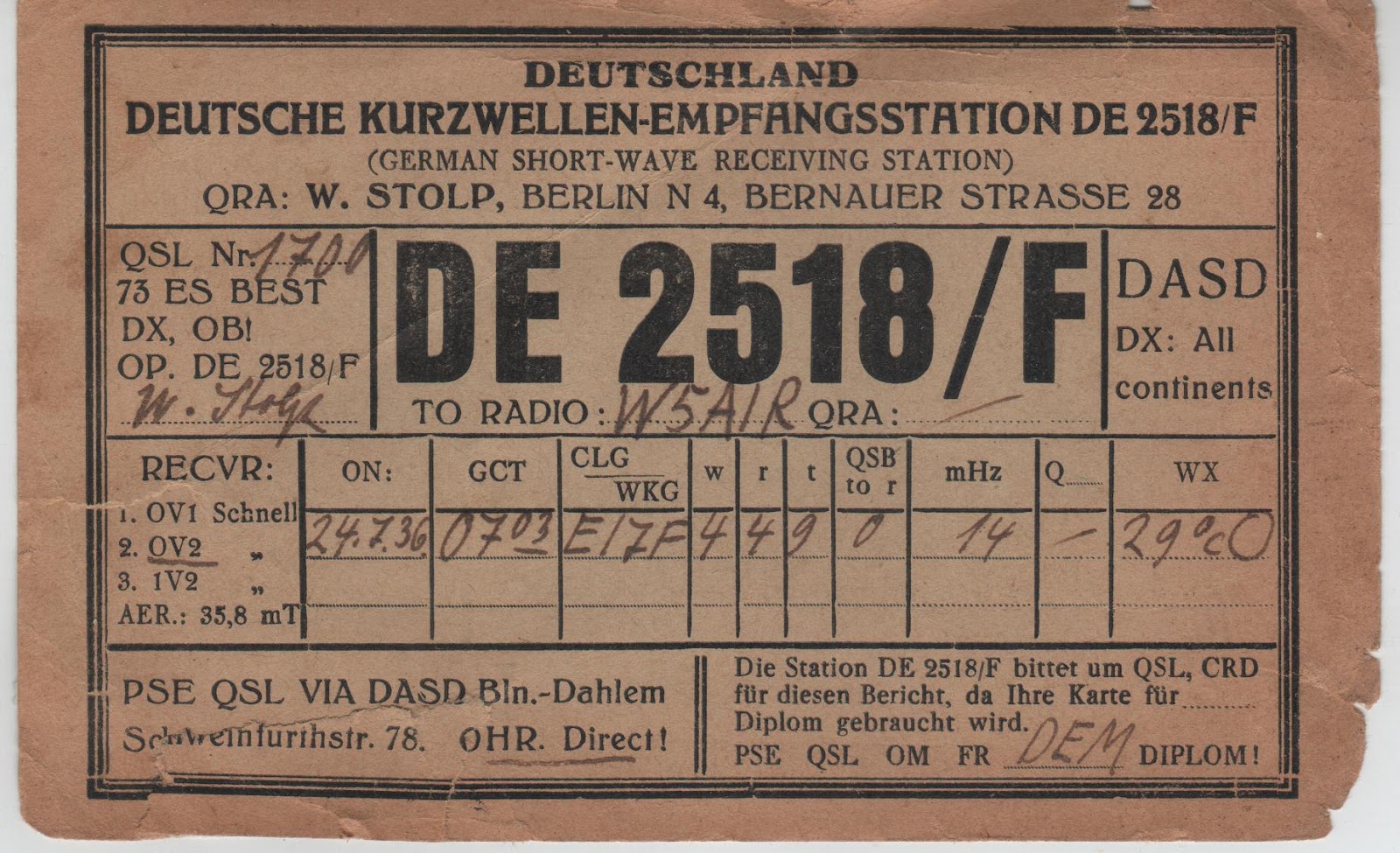
I found this today while rummaging around in the shack. It is starting to fall apart so I figured I better digitize it before it turns into dust.

July 24, 1936. 7 am in Central Germany. 29.0 degrees Centigrade. Clear skies? German Shortwave Receiving Station DE 2518/F monitored W5AIR’s contact with Irish station EI7F on 20 meter CW. The receiver was an OV2 Schnell tube (almost certainly a regen) fed by a 38.5 meter long antenna.

Conditions must have been pretty good — they were approaching the peak of sunspot cycle 17.

In 1954 W5AIR was assigned to Garold D. Sears. He was probably the operator.

SolderSmoke Podcast #174:Belthorn III, BITX20(-40), Parasites, Test Gear, Hamfest, SPRAT, Flares, BITX History

SolderSmoke Podcast #174 is available:

http://soldersmoke.com/soldersmoke174.mp3

March 28, 2015

Happy Arduino Day!
Pete’s Belthorn III Transceiver (with cool color display)
Bill’s BITX 20 (that used to be a BITX20/40)
AD9850 DDS added to Barebones Superhet
Jean Shepherd on Parasitic Oscillations, Obsession, and Madness
Simple Test Gear for the Homebrewer
Digital Oscilloscopes and their amazing capabilities
Dongles and other great stuff in SPRAT 162
The BIG St. Patrick’s Day Solar Flare
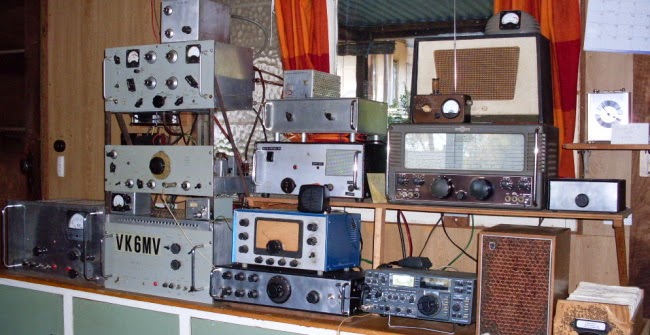
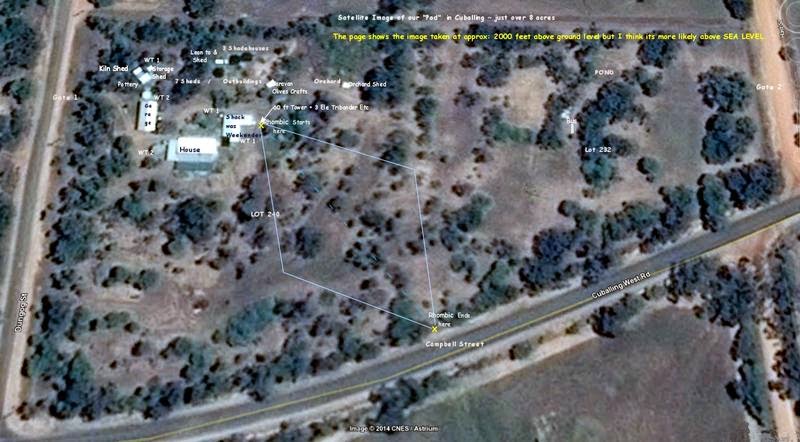
VK6MV’s Amazing Rhombic (+)
VK7XX (Dos Equis!)
A Bit of BITX History
Pete going KX3 QRO

Our book: “SolderSmoke — Global Adventures in Wireless Electronics” http://soldersmoke.com/book.htm Our coffee mugs, T-Shirts, bumper stickers: http://www.cafepress.com/SolderSmoke Our Book Store: http://astore.amazon.com/contracross-20

Working VK6 Homebrew During the Big Solar Flare

There I was. 0900 UTC (0 Dark Thirty local), the morning after the big March 17 St. Patrick’s Day Coronal Mass Ejection Impact. Solar Flux Index: 116. A Index: 117! I’d never seen the A Index that high. When I got home from work on March 17, I had turned on the BITX 20 and heard nothing but white noise. No signals. Nada. Zilch. So the following morning my expectations for 20 were quite low. I tuned across the whole band, again hearing nothing. But wait… there was one signal. And he was calling CQ. With an Australian accent. VK6MV! The only signal on the band. I called him with my recently fixed BITX20 (with .12 kW amp) and a dipole. No problem. We had a nice contact.
A look at Roy’s QRZ page shows that he is a fellow homebrewer. Clearly, the radio gods were making a statement here.

Our book: “SolderSmoke — Global Adventures in Wireless Electronics” http://soldersmoke.com/book.htm Our coffee mugs, T-Shirts, bumper stickers: http://www.cafepress.com/SolderSmoke Our Book Store: http://astore.amazon.com/contracross-20

Interesting Propagation Web Site

CONUS HF BAND CONDX
1/22/15 — 10:45:00 GMT — REPORT # 1289
160 80 40 30 20 15 10

I think this is a really interesting and useful way to gather and present information on propagation conditions. Check it out. The “instructions” page gives some background info on the technique used.

http://www.bandconditions.com/

The author, Biz, K5BIZ seems like a very FB ham: http://www.qrz.com/db/K5BIZ

Our book: “SolderSmoke — Global Adventures in Wireless Electronics” http://soldersmoke.com/book.htm Our coffee mugs, T-Shirts, bumper stickers: http://www.cafepress.com/SolderSmoke Our Book Store: http://astore.amazon.com/contracross-20

Radio China International Echo Mystery SOLVED!

For the past month or so I have been wondering about a strange echo that I’ve been hearing on the 31 meter transmissions of Radio China International. I first noticed it on my “Kings Speech” regen receiver. Then I heard it again on my “Off the Shelf” regen.

For a while I thought that what I was hearing was a propagation effect: Perhaps the very strong RCI relay station in Quivican,Cuba was sending north a signal so strong that it was travelling around the earth along the grey line and coming back to me about .133 seconds after the original reception.

This sounded plausible (and it does happen sometimes). But there were reasons for skepticism: Why wasn’t anyone else hearing this? Why wasn’t the effect showing up on signals from Radio Havana Cuba?

Pete Juliano had suggested that perhaps I was getting signals from TWO different RCI transmitters. I had quickly checked the RCI schedule and didn’t see them transmitting on the same frequency at the same time from multiple transmitters, so I kind of put that idea aside. Hey, the round-the-world idea was just more appealing!

But then I remembered something strange about the echo: It seemed to disappear when I tuned close to the center frequency of the RCI signal, but then appeared when I tuned off to one side. Hmm…. That was an important clue.

I’ve long been wary of regen receivers and for a while suspected that I was dealing with some weird regen effect. Regen and Echo seem to go together, right? Well, as it turns out, no. But I was right about this being an effect of the nature of my receiver…

Last night I was listening to RCI English service at around 0030 UTC on 9570 kHz. Nice clear signal. No echo.

At 0100 UTC the program changed, and the echo started. A very strong echo.

I went to the RCI schedule. Here I found the answer:

At 0030 they were transmitting from their relay station in Cerrik, Albania on 9570 kHz.
At 0010 they switched programs, frequencies and transmitters. At 0100 Cerrik shut down, but the Quivican, Cuba relay came on on 9580 kHz. At the same time the RCI transmitter in Kasi Sabagh in far-off exotic Western China, in Xinjiang, fired up on 9535 kHz. Both transmitters were carrying the RCI English service.

You see, my little regens are not very selective, and the RCI transmissions are quite strong. So if I have my receiver tuned to around 9560 kHz, I’ll be hearing BOTH the signal from Cuba AND the signal from Xinjiang. That would explain the echo.

To try to confirm this, last night I fired up my old Hammarlund HQ-100 receiver to see if I could discern the two different signals. I could. And the echo appeared when I tuned BETWEEN the two. You can hear this in the video above.

There is one remaining question here: Is the echo caused by the RADIO path difference between the two transmitters? Or are we just seeing the effect of the programming being transmitted at slightly different times, perhaps with this delay caused by INTERNET latency? Anyone know how RCI gets its signals from its Beijing studio to its distant transmitters? I calculate that the path difference is about 10,000 km. With c at 300,000 km/second, that would yield an echo of only about .03 seconds. The echo we are hearing sounds longer than that, so I suspect we are hearing a difference in studio-transmitter transmission time. What say the SWL RF gurus?

BTW: I think the same phenomenon may explain the echo on Brother Stair’s “Overcomer” signal. I see that starting at 2200 UTC he is on BOTH 7570 kHz and 7730 kHz from RMI transmitters in Florida. Perhaps they are not synched up.

I think this is all very cool. Think about it: Here I am, sitting in Virginia in 2014, listening to the Albanian, Cuban, and Xinjiang relay stations of Radio China International on a receiver first built by some guy in England during the 1930s. And I’m trying to figure out if the echo I hear is caused by the limits imposed by the speed of light and the size of the earth, or by the time it takes packets to move through sub-oceanic fiber optic cables.

Our book: “SolderSmoke — Global Adventures in Wireless Electronics” http://soldersmoke.com/book.htm Our coffee mugs, T-Shirts, bumper stickers: http://www.cafepress.com/SolderSmoke Our Book Store: http://astore.amazon.com/contracross-20

Long Delayed Echo on Radio China International

Several people have e-mailed me suggesting that the weird echo I have been hearing on shortwave broadcast stations is in fact one of the fabled “Long Delayed Echoes” that radio amateurs have been hearing intermittently since about 1927. I was skeptical at first, but — at least in the case of the Radio China signal — I think LDE caused by the signal going around the globe several times does explain what I’ve heard. Each trip would add a delay of about .133 seconds, and that seems to match what we hear in my recording:

http://soldersmoke.blogspot.com/2014/08/strange-echo-on-china-radio.html

Compare that with what K9FIK recorded on 10 meter SSB (thanks Stephen!):

http://swling.com/blog/2013/10/hearing-the-speed-of-light-dx-double-echo/
(you can listen to the audio on this one).

It sounds very similar.

If this is in fact LDE, I’m lucky — this is pretty rare. And it is a eerie that I first heard it on on Regen receiver from the 1920s! Above is a picture of the regen used to study the FIRST LDEs. See: http://folk.uio.no/sverre/LDE/

Our book: “SolderSmoke — Global Adventures in Wireless Electronics” http://soldersmoke.com/book.htm Our coffee mugs, T-Shirts, bumper stickers: http://www.cafepress.com/SolderSmoke Our Book Store: http://astore.amazon.com/contracross-20

SolderSmoke Podcast #165 Arduinos!


SolderSmoke Podcast #165 is available:

http://soldersmoke.com/soldersmoke165.mp3

September 13, 2014

Workbench Update: Bill’s “Off the Shelf” Regen, Pete’s Boatanchors
Mysterious Echos on Shortwave Signals. Solve the Mystery. Please.
Microcontrollers — What they can do for you.
Small world: As a kid, Pete was neighbor of “Digital Dial” N3ZI
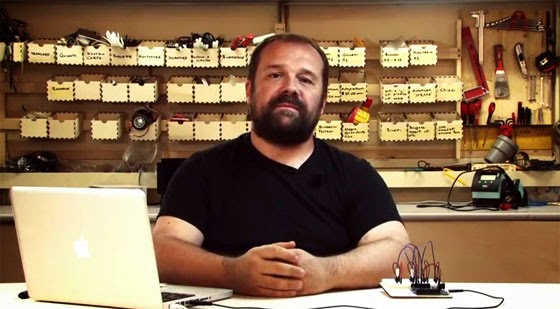
NEWS FLASH: Arduino creator Massimo Banzi was a ham!
Born in a bar, cheaper than pizza: The Italian origins of Arduino
Arduino CW generators
No coding skills needed
Arduino + AD9850 = Signal Generator or VFO
Arduinos in the Minma
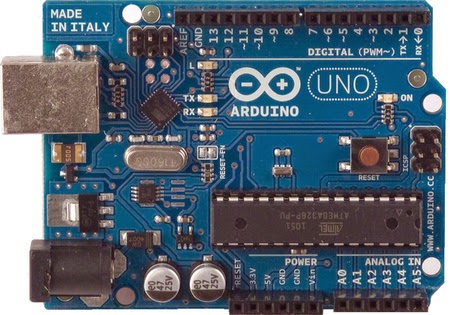
What the heck is a Shield?
SolderSmoke Mailbag


Our book: “SolderSmoke — Global Adventures in Wireless Electronics” http://soldersmoke.com/book.htm Our coffee mugs, T-Shirts, bumper stickers: http://www.cafepress.com/SolderSmoke Our Book Store: http://astore.amazon.com/contracross-20