NanoVNA, Millen Dip Meter, Kilo-Megacycles, and Measuring the Speed of Light (Video)

Yesterday my NanoVNA arrived. This morning I was looking for info on how to use it and I found this really wonderful video from Joe Smith.

Wow. Joe gives a really useful intro to the capabilities of this amazing little device. He even reaches back in time and compares NanoVNA results with those obtained by a Millen Grid Dip Meter. He pulls out of his junk box an attenuator that is so old that it is marked in “Kilo-Megacycles.” (Shouldn’t we revive terms like that?)

Joe also gives us a taste of what it is like to live and work in the GHz range. He warns us never to touch the SMA connectors on our NanoVNAs (too late Joe). And — get this — he uses a torque wrench to connect the little SMA coax connectors to the NanoVNA. I’m not kidding. A torque wrench. Joe connects surface mount capacitors and inductors that have their values specified not only in picofarads and microhenries, but also at the specific frequency at which they were measured.

My understanding of the Smith Chart was greatly improved by watching Joe’s video.

Icing on the cake: Joe wraps up the video by using the NanoVNA to MEASURE THE SPEED OF LIGHT. Great stuff. Thanks Joe.

Here is Joe Smith’s YouTube channel:
https://www.youtube.com/channel/UCsK99WXk9VhcghnAauTBsbg

Now I have to get the software to use the NanoVNA with my computer.

Applied Science — Electrical Impedance Tutorials

Part 1 appears above, Part 2 is below.

Ben Krasnow has a KNACK for explaining technical things. I liked his videos on impedance. At the end of the second video, he said he’d do a third one that would focus on impedance in coaxial cables. But I couldn’t find it on his channel. I hope it was made — this is very interesting and useful.

Ben’s YouTube channel is here: https://www.youtube.com/user/bkraz333

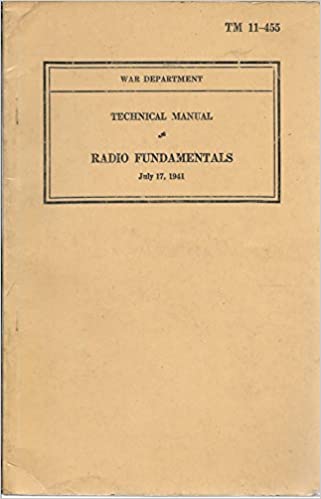
Technical Manual 11-455 — Radio Fundamentals — July 17, 1941

This is an illuminating little book. It was published by the U.S. War Department on July 17, 1941, less than five months before Pearl Harbor. Far from being dated, this book contains a lot of great explanations of — as the title indicates — the fundamentals of radio. I turned to it this morning for a little refresher on the physics of regenerative feedback.

You can get your own paper copy here:


Or here:


Or you can read a slightly more recent edition (1944!) online (free) here:


Please let me know if you find this book useful.

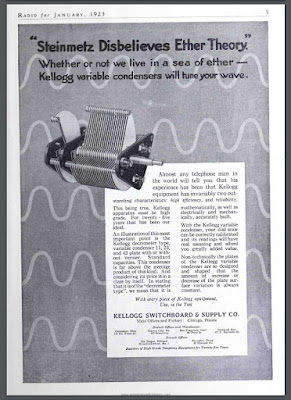
These Variable Capacitors Work — Ether or No Ether!

Amazing that the arguments about the presence or absence of a luminiferous ether made its way into parts advertisements in a radio magazine. This is from Radio for January 1923. (About 18 months before my dad was born.)

BTW that capacitor looks very nice, and would almost certainly still work. I have caps like that in my junk box. The shape of the blades helps address one of Pete Juliano’s complaints about analog oscillators — the inconsistent spacing of frequencies on the dial.

Thanks to the K9YA Telegram for posting this.

“The Bit Player” A New Movie on Claude Shannon

The Bit Player Trailer from IEEE Information Theory Society on Vimeo.

Thanks to Bob KD4EBM for alerting us to this. As Bob put it, Shannon definitely had The Knack. Check out the trailer (above) for this new movie. It looks like the IEEE is still working on the release plan for the film. Does anyone have info on this?

More info on the film here: https://thebitplayer.com/

Four years ago we reported on a video about Shannon: https://soldersmoke.blogspot.com/2015/09/claude-shannon-had-knack-video.html

Thanks Bob!

Nobel Prize winner Joe Taylor, K1JT, Talks to a Radio Club

Really great to see this session with Nobel Prize winner Joe Taylor, K1JT.
I liked his comments on his use of his retirement office at Princeton, University.
I also liked his slide on how far below the noise level you can go with various modes.
And then there was his reminder to 1) RTFM and 2) be sure to check the EME delay box so that your software will get the timing right when working earth-moon-earth.

“Pulsars keep good time.”

New Rock Video By Astrophysicist and Queen lead-guitarist Dr. Brian May


We don’t carry many music videos on this blog, but this one definitely belongs here. We’ve mentioned Brian May several times: Lead guitarist in the rock group Queen. PhD Astrophysicist.

I didn’t know that he went to work as a full member of the New Horizons (Pluto and beyond) mission.

The video is definitely for us — it features a lot of antennas. And it includes the computer-generated voice of Stephen Hawkings.

Read more about Brian’s careers and about his latest adventure here:

https://www.space.com/42875-brian-may-new-horizons-song-ultima-thule-flyby.html

New Horizons principal investigator Alan Stern poses with astrophysicist and Queen lead guitarist Brian May on Dec. 31, 2018 at Johns Hopkins' Applied Physics Laboratory in Maryland just before New Horizons flew by Ultima Thule.
New Horizons principal investigator Alan Stern poses with astrophysicist and Queen lead guitarist Brian May on Dec. 31, 2018 at Johns Hopkins’ Applied Physics Laboratory in Maryland just before New Horizons flew by Ultima Thule.

Credit: NASA/Bill Ingalls

The CHIME Radio Telescope and Fast Radio Bursts

The new Canadian radio telescope is very interesting. It has a great name for a radio telescope: CHIME

And it it always nice to come across a reference to the Parkes Radio Telescope.

More info here:

https://www.theregister.co.uk/2018/08/03/fast_radio_burst/

And here:

https://en.wikipedia.org/wiki/Fast_radio_burst

Good luck on getting a QSL from the FRB station.

ANOTHER Nobel Prize Winner with THE KNACK

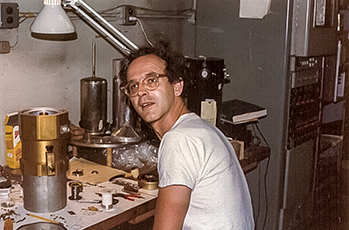
When I heard that the guys who ran the LIGO gravitation wave experiment won this year’s Nobel Prize for physics, something told me that at least one of those involved in this historic detection of weak distant signals would have THE KNACK. It did not take me long to confirm this. Rainer Weiss (above) definitely has had the THE KNACK all his life. And what an interesting life it is. Check it out:
http://www.sciencemag.org/news/2016/08/meet-college-dropout-who-invented-gravitational-wave-detector

Knackish excerpts:

The family soon had to flee again, when U.K. Prime Minister Neville Chamberlain signed an accord ceding parts of Czechoslovakia to Germany. They heard the news on the night of 30 September 1938, while on vacation in the Tatra Mountains in Slovakia. As Chamberlain’s address blared from the hotel’s massive radio, 6-year-old Rainer stared in fascination at the glowing array of vacuum tubes inside the cabinet. The hotel emptied overnight as people fled to Prague.

As a teenager, Weiss developed two passions: classical music and electronics. Snapping up army surplus parts, he repaired radios out of his bedroom. He even made a deal with the local toughs: If they left him alone as he lugged radios to and from the subway, he’d fix theirs for free. “They would steal things and I would have to fix them,” he says. “It wasn’t a good deal.”

Weiss was drawn to tinkering partly as a reaction to his family’s cerebral atmosphere. “This is a German-refugee kid with very self-consciously cultured parents, and he’s rebelling against them by doing things with his hands,” Benjamin says. “But he’s surely not rejecting doing things with his head.”

He applied to MIT to study electrical engineering so that he could solve a problem in hi-fi—how to suppress the hiss made by the shellac records of the day. But electrical engineering courses disappointed him, as they focused more on power plants than on hi-fi. So Weiss switched to physics—the major that had, he says, the fewest requirements.

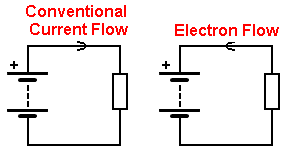
Which way does current REALLY flow?

I’ve talked on the podcast about launching a worldwide campaign to require the reversal of ALL those little arrows on the symbols for transistors and diodes. You see, they are saying that electricity flows from the positive to the negative. Engineers apparently got that idea from Ben Franklin, and they are sticking with it. It is time for a change! Reverse the arrows! Down with CCF! Viva Electron Flow! Let’s tell the truth!

This morning Bob Crane W8SX sent me this very interesting article on this topic from Nuts and Volts:

http://www.nutsvolts.com/magazine/article/which-way-does-current-really-flow?utm_source=Newsletter+%2332&utm_campaign=Newsletter+%2332&utm_medium=email

The article describes very well the origins of this controversy. (There were one or two scary moments in which I thought the author was getting ready to tell us that positive ions can move through wires and transistors (NO!) but he pulled back from the brink and clarified that he was talking about ion flow in electro-chemical batteries. Whew, that was scary!)

But here’s a question for the philosophers and historians of electronics: When physicists decided to label the electron as “negative” this was an arbitrary choice, right? They could have just as easily decided to call it “positive” with the protons being called “negative” right? In this case all the arrows in our diagrams would not be in need of reversal, right?

Gravitational Waves, A GREAT VIDEO, Phasing, and Joe Taylor K1JT

Wow, you really have to spend 20 minutes and watch the video (above). It is really well done. I loved it. I give it FIVE SOLDERING IRONS!

And big news today! They did it! Gravitational waves finally detected. Here is a good New York Times article that includes a recording of the signal, a nice NYT video that has a good explanation (with phasing!) of how lasers are used in the massive detectors, and mention of Joe Taylor, K1JT, whose Nobel Prize winning work contributed to this great discovery.

http://www.nytimes.com/2016/02/12/science/ligo-gravitational-waves-black-holes-einstein.html?partner=rss&emc=rss&_r=0

A VERY Quiet Shack, 4850 Feet Below the Surface

Michael Rainey’s underground shack in Vermont is undeniably cool, but these folks have REALLY gone deep. They are almost a mile down, blocking out that nasty cosmic ray QRN, building sensitive detectors to QSO with some extremely elusive DX: DARK MATTER.

SEE IF YOU CAN SPOT THE TEK ‘SCOPE.

Wonderful video. Thanks to Ira Flatow and Science Friday.

Knack Story: Rupert Goodwins — SolderSmoke in the Old Smoke (London)

Rupert with some sort of SDR rig

In addition to having a very cool name, Rupert Goodwins, G6HVY, is a for-real tech guru:

I was delighted when Rupert posted some sage advice about how to deal with my recalcitrant amplifier. He managed to include a reference to Mr. Spock in his message, helpfully noting that some of these amp problems would challenge the Vulcan’s logical powers. That made me feel better. I sent a few words of thanks to Rupert and got back this really great “Knack Story”:
Hi Bill,
Well, all I have on HF amp instability is anecdote and half-remembered theory. But I do like the sort of challenges that building RF on the bench brings up – a problem worthy of one’s attention proves its worth by fighting back!
I’ve enjoyed Soldersmoke (or should I say Soddersmoke) for years now, and even if I haven’t bought the T-shirt, have bought your book. I first inhaled the demon fumes when I was barely into double digits, and the addiction kicked in hard – I fixed my first radio, a valve (tube!) FM 1950s broadcast receiver using a soldering iron that was actually one of my father’s wooden-handled screwdrivers heated on the gas ring of the cooker in the kitchen. My parents were mystified but supportive…
London is indeed a hard place to play radio. But that makes it doubly pleasurable when it works: it rather feels like you’re operating under cover, a special forces op sneaking the signal out under the noses of the regime. I once had a birthday picnic on Hampstead Heath where I brought my SOTA beam and fishing-pole mast: the local constabulary turned up and were also mystified but not quite so supportive… “What if everyone did it?” they asked. “Oh, if only…” I thought but did not say.
I do hope you can pacify your errant amp. Sometimes these things can be fixed by brainpower, sometimes by just mucking around until they get bored before you do. But normally I find that I’ve learned a lot when the problem’s solved. RF isn’t black magic, it’s a gateway into another world that’s marvellous and enthralling, but ours to know. I read a really good paper by Freeman Dyson, where he said that Maxwell invented modern physics, because his equations were the first to show that the real world of how things work is both beyond our natural experience, but accessible through thought and logic. The real entrancing thing about radio is that it proves this – we can talk across the world by translating our knowledge into a tiny handful of otherwise inert bits and pieces that tap into something utterly beyond our senses. And it’s open to anyone who cares enough to try.
How cool is that? (I had to go and find that Dyson paper again – here it is, if you’re interested: http://www.damtp.cam.ac.uk/user/tong/em/dyson.pdf )
(I also have an unshakeable and unhelpful addiction for obscure but interesting radios, as my QRZ page confesses. And things I helped design and build when I was an engineer are now in the NSA and Bletchley Park cryptologic museum collections. That, as they say, is quite another story…)
Anyway, thanks again for emailing – I’m thrilled to hear from you, and perhaps, who knows, one day we may make contact the way God and Maxwell intended – via QRP on a lively band while dodging the noise and bouncing our photons off the Heaviside Layers.

Best 73s,
Rupert, G6HVY
————————
Rupert’s QRZ.com page contains additional evidence of his Knack affliction and International Brotherhood of Electronic Wizards membership:
Other equipment here includes a Wireless Sets No 19 Mk III, an R1155, a Barlow Wadley XCR-30, an ICR-73, some PMR stuff on 4 metres, some old CB kit (shhhh!) and other obscurities. I like kit that has something different about it the 19 set, for example, is of course famous for its wartime role, but it was also the very first transceiver. The XCR-30 is really interesting, not only for being a high tech product of 60s apartheid South Africa (so a morally complex thing to own), but for having a very esoteric design that provides 0-31MHz coverage without bandswitching, very high stability and accuracy (you can generally pre-tune an AM broadcast station anywhere on the bands from the dial and be within 1KHz on switch-on, and all from a handful of transistors. There are stories to tell about all of my radios.
Started in radio when I was too young to get my ticket, so was forced – forced, I tell you – onto CB radio, in the days when it was very popular and very illegal. Had a couple of crystal-TX, super-regen RX walkie-talkies (QRPp and RX so wide I could pick up Radio South Africa on the BC 11m band) to start with, thence bought a ‘for conversion to 10m’ populated CB PCB from a batch at Plymouth ARC Rally and just bunged a set of toggle switches on the PLL-02 divider inputs. This was the mid-late70s, when skip was high… Did the RAE ASAP after my 16th birthday, first legal amateur rig (I may have built things with 6V6s that may have made odd noises on the local Top Band AM Sunday morning net) was an Icom IC-2E. My richer friend, who was a G6E, had an FT-290R, which was obv. nicer but obv. deafer. “FT-290. IC-2E. I can hear him. He can’t hear me.” Used 19 sets at school, so have that addiction too. Since then, the hobby has been in and out of my life (like QTHs, wives, jobs and money), but the love of radio never has.
—————————
I also understand that he once worked at a dodgy TV repair shop in the back streets of Plymouth and can still swap out a gassy PL509 with the best of ’em.

Our book: “SolderSmoke — Global Adventures in Wireless Electronics” http://soldersmoke.com/book.htm Our coffee mugs, T-Shirts, bumper stickers: http://www.cafepress.com/SolderSmoke Our Book Store: http://astore.amazon.com/contracross-20
Fireballs Emitting RF at HF!

Yea, and that damn gamma ray bust static has been totally messing up the 12 meter band! Someone should complain to the FCC!

https://medium.com/the-physics-arxiv-blog/1382596c320d

Our book: “SolderSmoke — Global Adventures in Wireless Electronics” http://soldersmoke.com/book.htm Our coffee mugs, T-Shirts, bumper stickers: http://www.cafepress.com/SolderSmoke Our Book Store: http://astore.amazon.com/contracross-20
Some DX That You Can Never Work. Never.

There is some amazing info in this site. It is worth reading.

https://medium.com/starts-with-a-bang/the-disappearing-universe-d7447467c63a

Our book: “SolderSmoke — Global Adventures in Wireless Electronics” http://soldersmoke.com/book.htm Our coffee mugs, T-Shirts, bumper stickers: http://www.cafepress.com/SolderSmoke Our Book Store: http://astore.amazon.com/contracross-20