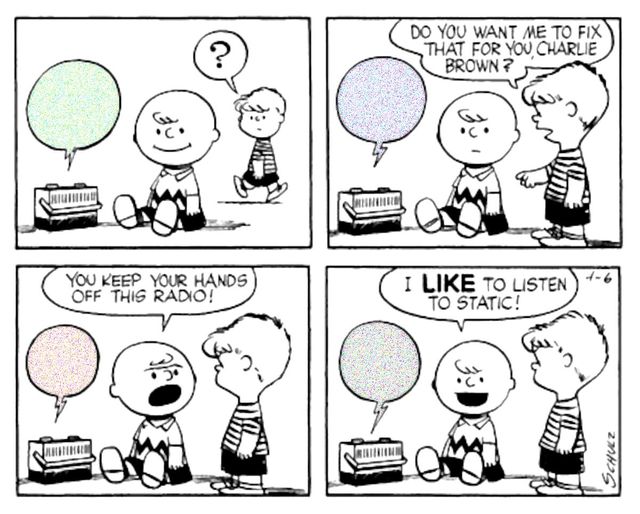
Because when he connects the antenna, it lets him know if he has enough amplification to hear the band noise. He realizes that his radio receiver is not an I-phone, and that “static” is a feature, not a bug. FB Charlie Brown!
Mike WN2A points to a 2022 ITU report on radio noise. This report provides a LOT of information on noise (give it a few minutes to download!) and goes a long way toward explaining the usefulness of noise.
Here is the introduction.
The ITU Radiocommunication Assembly, considering a) that radio noise sets a limit to the performance of radio systems; b) that the effective antenna noise figure, or antenna noise temperature, together with the amplitude probability distribution of the received noise envelope, are suitable parameters (almost always necessary, but sometimes not sufficient) for use in system performance analysis and design; c) that knowledge of radio emission from natural sources is required in: – evaluation of the effects of the atmosphere on radiowaves; – allocation of frequencies to remote sensing of the Earth’s environment; d) that radio noise from man-made sources is significant in setting the limit for some radio applications; e) methods for measurements of radio noise are given in Recommendation ITU-R SM.1753; f) methods for indoor noise environment measurements are given in Recommendation ITU-R SM.2093, recommends that the following information on the background levels of external radio noise should be used where appropriate in radio system design and analysis: