SolderSmoke Podcast #209 SKN, Old Rigs, Movie Review, Safety Tips, Mail Bag

SolderSmoke Podcast #209 is Available:

13 January 2019

http://soldersmoke.com/soldersmoke209.mp3

An HT-37 “With Presence!” Even on CW! A Straight Key Night Story
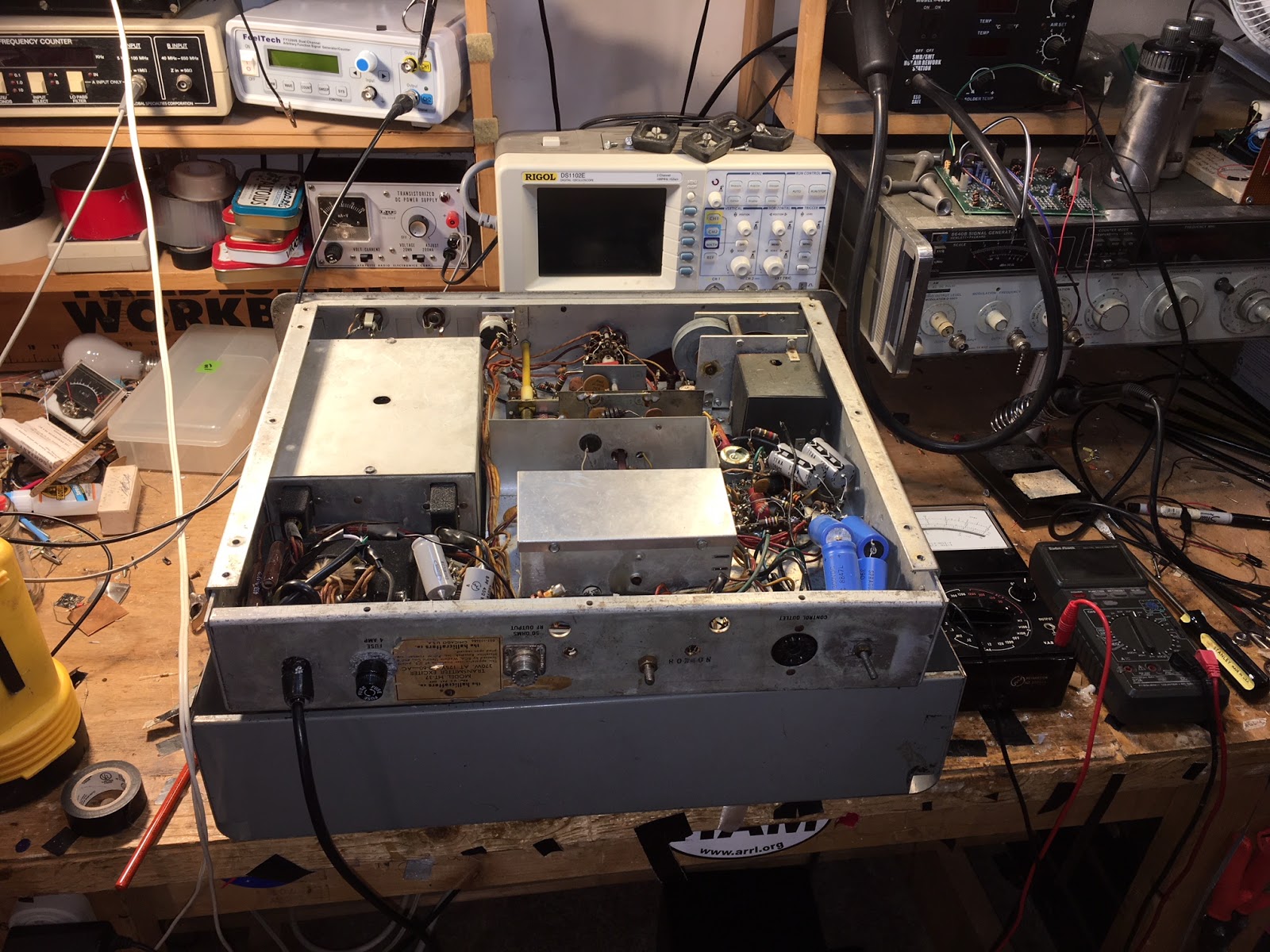
Saving a much-loved HT-37
Drake 2-B Alignment
Tweaking the Mate for the Mighty Midget
Fixing a Deaf DC Receiver
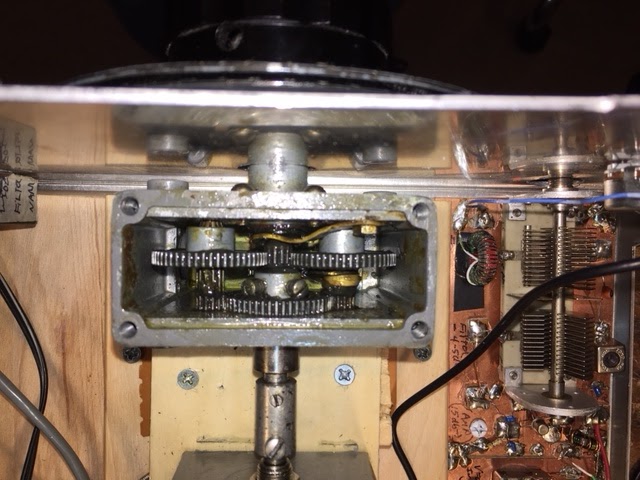
A Wobbly National HRO-ish Gear Box
Minimum Discernible Signal Tests
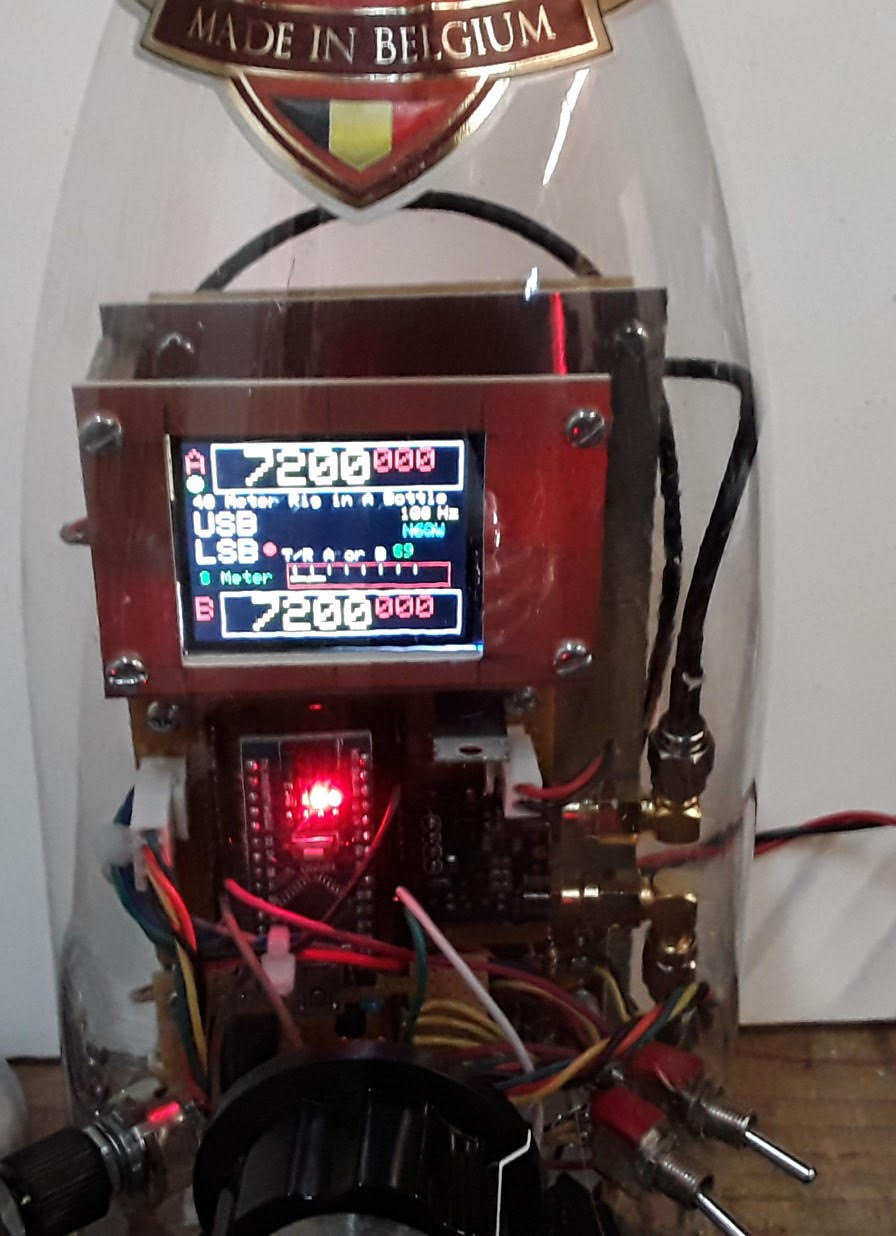
Pete’s Festive Holiday Transceiver in a Bottle

Movie Review: “First Man” Neil Armstrong goes to the moon.

Safety Tips for 2019: Fuses, Hard Drives, Flu Shots.

MAILBAG:
Dave G6AJW builds Pete’s Sudden Transceiver
Rogier KJ6ETL builds a new shack
Steve N8NM Helps save the HT-37
Jim AL7RV W8NSA builds Parasets
Dave AA7EE puts a beacon on the air — Please Listen!
Jan OM2ATC builds and documents an Si5351 VFO
Bruce KC1FSZ Homebrew’s a BITX
KB1GMX’s Tip on IRF-510 Oscillation Prevention
Ryan W7RLF Homebrews a DC Receiver

Listening to August K5HCT from the East and West Coasts on 40
Tim WA1HLR rebuilding his 1968 transmitter.


Old Station On-The-Air — A Transmitter Half as Old as Radio Itself

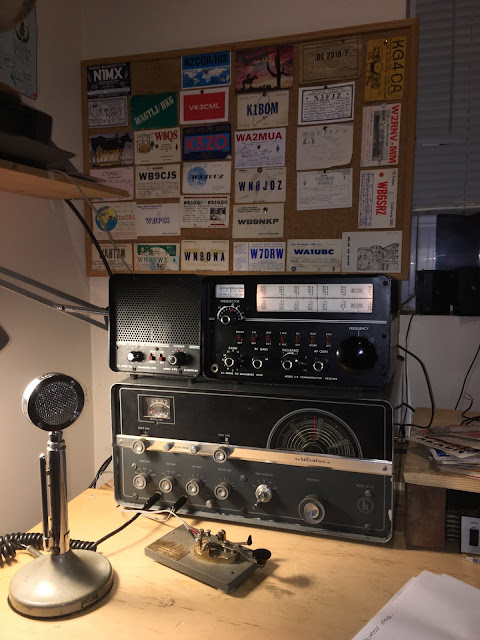
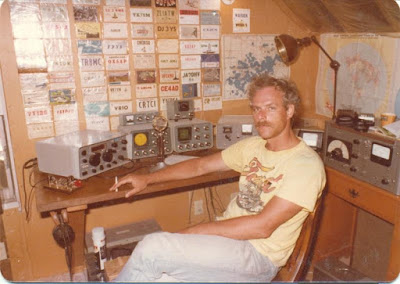
I’m biased, but I think it is “a thing of beauty.” With some unexpected free time available, today I followed up on my HT-37 work by cleaning and aligning the Drake 2B. I was assisted in this by one of the many great YouTube videos by Alan Wolke W2AEW.

The Drake 2B’s 50 kc and 405 kc oscillators were right were they were supposed to be — no adjustment required. And I don’t think they have been peaked since 1973. The 455 kc IF can was also very close to perfectly tuned.

Since most stations from the mid-1960s had some QSL cards on the wall behind the rig, I pulled out some old ones and put them up. Many of these contacts were made by the rigs in the picture.

If we say that 1897 marked the first use of radio, and if we assume that this HT-37 was manufactured in 1959, that means that my old transmitter has been in operation for almost HALF of the history of radio.

The AL7RV (W8NSA) Paraset, Regens, Test Gear, and Schematics Varnished into Enclosures

Jim W8NSA ex AL7RV is an old friend and a really talented radio builder. Over the years he has sent me many boxes of very FB radio parts. I’m sure that almost all of my homebrew rigs have parts from Jim somewhere in the circuitry. Jim recently sent in an update on his radio building efforts.

Bill,


I managed to cobble up some regen’s over the summer. Most fun was my version of Dave Richards, AA7EE Sproutie, it turned out so nice I have it on my bedside table. Yes, the Sproutie has displaced the trusty old Transoceanic, brings back memories of late night SWL’ing with my Space Spanner as a teen.
The Sproutie worked well enough I’m considering a build of the Dave’s Sproutie MK II, maybe not in such a grand cabinet or with such fine metal work as Dave’s but a functional copy.

I also built the regen receiver from the SOE Paraset design, other then a coil winding mistake the receiver worked well at power up.

I built the Paraset receiver to test a number of mods others have suggested to improve the receiver’s performance. Using the mods involves modern solid-state components and additional band-spread functionally. Many consider the mods be in poor taste but they go well making a much better receiver.
I am ready to build my copy/version of the Paraset, now that I’ve missed SKN I have almost a year to get it built.
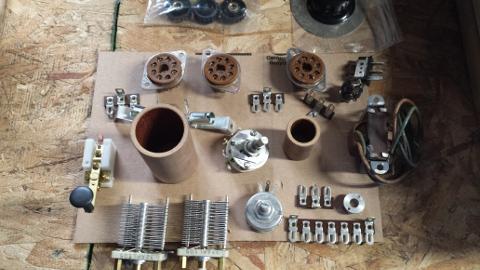
I’ve been gathering Paraset parts for years, was lucky to get in on the group purchase for a set of 3 Paraset knobs made from the same molds by the same company SOE used when building the transceivers in the 1940’s, having a real part of that history is exciting, to me at least.
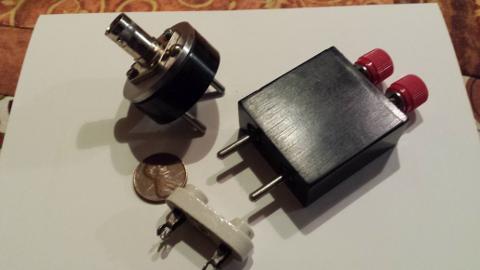
Paraset Parts (see picture above) (some parts shown may not be in the proper location)

At last I have all the major components. I am at the point of gathering up the various resistors and small fixed capacitors needed. Some builders have gone to the efforts of embedding newer, smaller, parts in the carcass of vintage 1930s & 40s parts hollowed out and repainted. Too much effort for me, I want a functional radio, not a museum grade replica, but I really do want to keep the look of the SOE issued set.

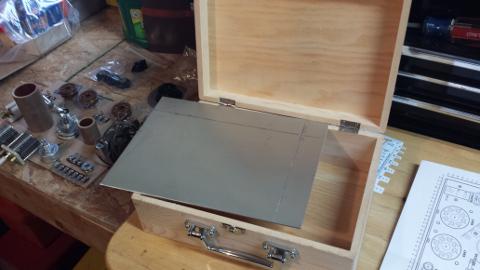
Case and front panel…

Many of the U.S. Paraset builders are using a wooden craft box from Hobby Lobby, It is just about the correct size and shape. You can see at the right side of the photo a detailed panel layout. Building the Paraset is not quite Heath Kit but with so many talented builders having made so much information available I feel so lucky to follow the effort.

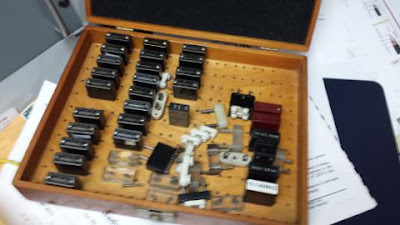
Years ago, during our RV travel days, I picked up a box of Bliley AX2 40 meter crystals. Good price and just about every one of the crystals were found to be working. Have a total of eighteen 40m crystals from 7.0024Mhz to 7.0986Mhz, have two 80m crystals in the CW portion but none of the AX2 crystals are for the traditional QRP frequencies, close but… AF4K and others are selling HC49 crystals for the QRP frequencies, problem is the 6L6/6V6’s used in the Paraset are known to be real crystal crackers.. (as was my 1964 novice rig!).

I’m considering the use of a transistor oscillator and driver stage to feed the 6L6 as a PA in effort to save the crystals and maybe allow the use of an outboard DDS VFO, yes I can hear the moans of dismay from other Paraset replica builders

The box included a number of sockets and crystal adapters too. Was great find. Having so may 40m crystals I’m starting to have thoughts of optimizing the Paraset build for just 40 meters. I can improve the sets performance but of course lose 80m and possibly 60m.

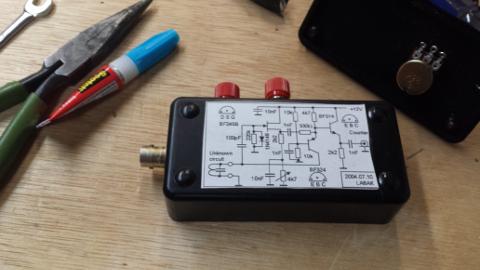
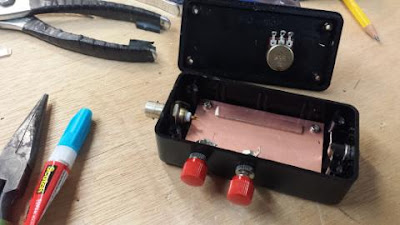
Today’s project while catching up on SolderSmoke Podcasts is a test device to aid in checking the resonant frequency of L/C networks. It’s always nice to prove your math is correct!
Building it Manhattan style into an old rat shack plastic box.


I have always loved the way WW II equipment had the schematics varnished into the covers or cases. I try to do the same with most of the things I build.

Schematic reduced to fit, ink-jet printed. Using an old credit card I spread a very thin layer of E6000 clear adhesive on the case, apply the paper image, then using a clean credit card or the edge of piece of circuit board feather the schematic into the adhesive.

Let dry for about 10 mins, wipe off the excess glue around the edges. Let dry for 24 to 48 hours and cover with a few thin coats of Testors Clear Lacquer Overcoat.. several thin coats, follow the recommendations for re-coat time on the spay your using.

Please read the cautions for using E6000. Pete may not be able to purchase it in his state!
The Paraset antenna output connections use a porcelain crystal socket, the AX2 crystal purchase included a few dead or empty crystal cases, I modified two of them to use as adapters.


OH! and yes, I’ll be using outboard low pass filters with the Paraset!


Thanks again to you and Pete for the blog and smoke efforts!

73, Jim W8NSA aka AL7RV
HT-37 Choke Failure — Why did this happen? What is your diagnosis?

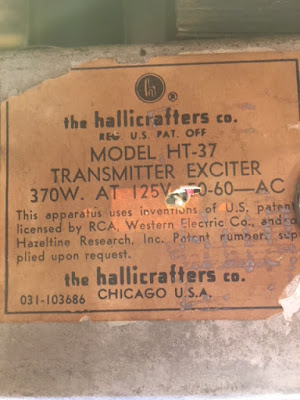
Look, it has been 60 years, so I’m not looking for my money back or anything, but having just repaired the LV power supply choke on my very venerable Hallicrafters HT-37, I started thinking about how and why it failed.

Clues:

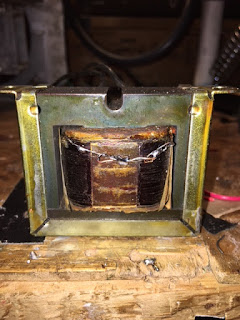
— I found it with four of the windings broken, with the eight broken leads kind of sticking out of the winding wrap.

— The four broken leads were on the outside of the winding (thank God!) an were at the part of the winding closest to the chassis and the back of the cabinet. (See picture below.)

— There was evidence of burning on at least two of the leads.

— The choke is located in the extreme back corner of the chassis, near the back of the cabinet.

— The paper and cellophane wrapping around the windings was a bit deteriorated.

So, what is your diagnosis? What happened to cause the choke to go open?

All I want for Christmas is… an HT-37 L25 Choke– 9 Henries at 135 ma


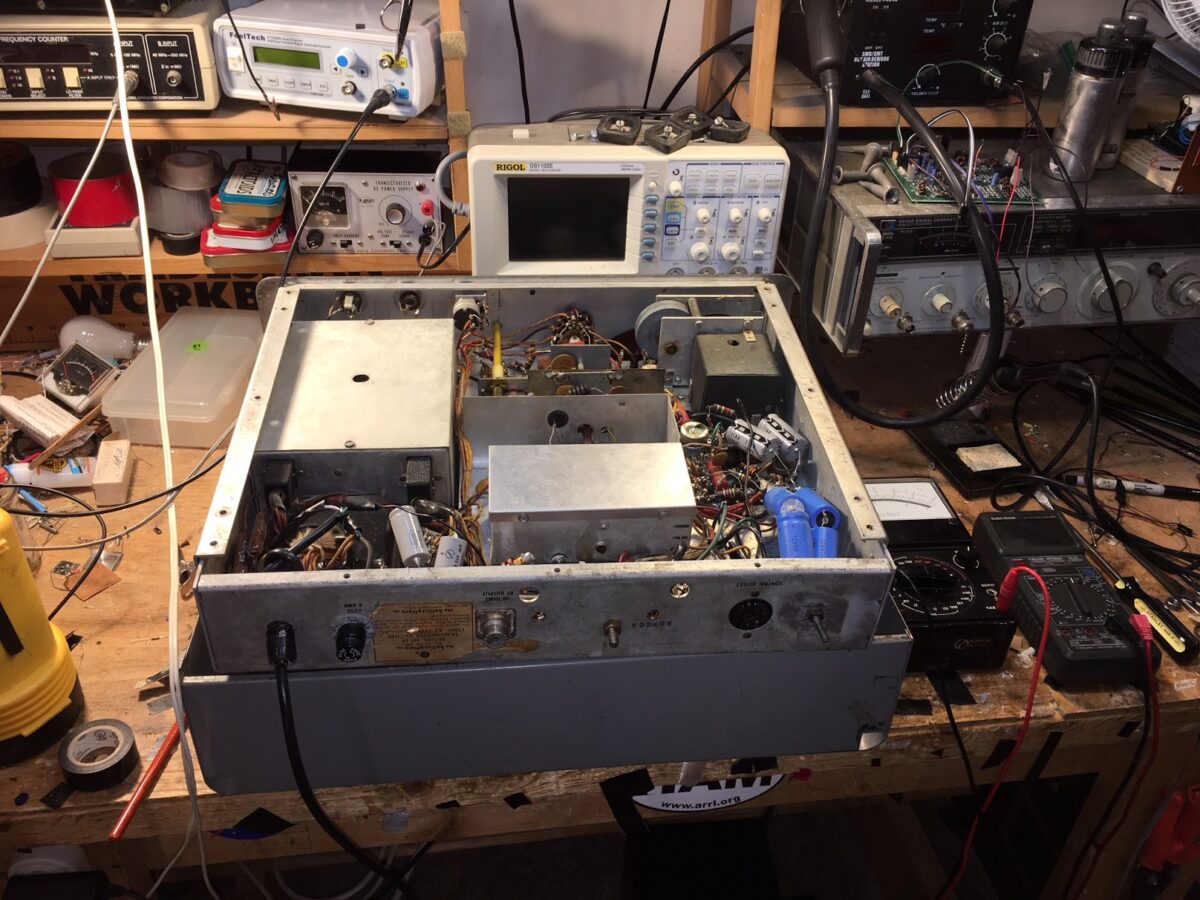
Following my own advice to prepare for Straight Key Night, I tried to fire up my venerable Hallicrafters HT-37 transmitter. It didn’t work. I quickly determined that none of the oscillators were working, so my troubleshooting focused on the power supply. Sure enough, the choke in the low voltage power supply is open. That’s bad.

I briefly considered giving up on this old rig. I don’t really like working with tubes anymore. And this thing is very heavy — a real beast. DX-100-like in its heaviness. It can be hazardous to your health just moving this thing around. Opening up the case is not easy. And there are nasty voltages in there….

But I have had this transmitter since 1973 or 1974. I have fixed it many times, in several countries. I got it from a member of the Crystal Radio Club when I was a kid. There are parts given to me by Pericles, HI8P in the Dominican Republic. I used it to transmit through Russian satellites. That transmitter is like an old friend. I just can’t give up on it.

So I need to replace or repair the choke. Is there anyone out there who has a junker out in the garage or some other source of L25? Or does anyone know of a business that could rewind the choke. Please let me know. I have decided to leave the rig on the bench until I get this thing fixed (it is too heavy to move multiple times!)

It it Hallicrafters Part Number 056-300259. L25 — 9 Henries at 135 ma. Help!

Pete N6QW Rejuvenates the Atlas Twins with an Arduino and an Si5351

Pete Juliano N6QW has turned his attention to the Atlas Twins, a nice single conversion multiband rig. Pete has used an Arduino/Si5351 to replace the analog oscillators in the old Atlas. This improves stability and allows for USB/LSB operation.

Pete very graciously kept the old analog circuitry in the rig, allowing the Atlas to be returned to its pristine analog state at some time in the future. Pete also made some very kind comments about the surprising stability of the original analog oscillator circuitry.

Check out Pete’ site for more details:

http://n6qw.blogspot.com/2018/11/2018-year-of-ssb-transceivers.html

Ian Keyser G3ROO on UK TV with his Spy Set Rigs (video)

Me at the keyof one of Ian’s spy sets — ten years ago?

Check out this nice UK TV report on Ian G3ROO and his spy set radios:

https://www.itv.com/news/meridian/2018-10-19/daring-spies-who-broadcast-from-behind-enemy-lines/

And here is Tony Fishpool’s report on their excellent adventure at Friedricshaffen Hamfest 2018.

http://www.fishpool.org.uk/friedrichshafen.htm

Here are some of the SolderSmoke blog posts on the activities of Ian and the Dover Constructors Club.

https://soldersmoke.blogspot.com/search?q=G3ROO

WB8VGE on QSO Today — QRP, HB, Boatanchors, Drift, Solar Power

Picture

Eric 4Z1UG has a really good interview with Mike Bryce, WB8VGE.

Listen here:

https://www.qsotoday.com/podcasts/WB8VGE

I’ve been a big fan of Mike’s for many years. I’ve talked to him on the air a couple of times. I liked his QRP column in 73 magazine. I share his enthusiasm for Boatanchor rigs. He is a fellow member of the QRP Hall of Fame (who, like Pete and me, at times seems to be pushing the QRO envelope). I like his approach to solar power. He too has been bothered by appliance ops who complain that his boatanchor rigs are 150 hertz “too low.”

His attitude toward contesting is similar to mine — I may be more opposed than he is. I think contesting encourages a kind of harshness and competitiveness that runs contrary to the spirit of the Radio Amateur’s code.

I got a chuckle about Mike’s claim that he almost Worked All States in RECEIVED Official Observer reports. And that he at one point owned THIRTY 104s.

Mike’s observations on the dumbing down of ham radio and on the social (psychological?) problems of 75 meters (“net starting in 5 minutes!” “QRP not allowed on 75”) are sadly on the mark.

Mike’s hint about using a white-out pen to spruce up the front panel of an old Drake radio adds a new household/office material to our rig-fixing arsenal.

Eric’s comment on the Lafayette Catalog resonated with me. I used to read it too.

I hope Mike decides to get on the air more frequently. Just avoid 75 meters and 7.200 MHz Mike.

EF Johnson’s 50th Anniversary Speech. Very nice radio history

Thanks to W0VLZ for this wonderful 13 minute recording of Edgar F Johnson’s 50th Anniversary speech. There is a lot of great radio history in this speech. Highly recommended.

Just click here to listen:

https://www.prismnet.com/~nielw/EFJohnson/EFJ50thTalk.wav

EF Johnson’s hometown bio:

http://www.wasecaalums.com/public/389.cfm

Wow. Mr. Carlson’s New Old-Time Radio and Test Gear Lab. VE7ZWZ — Homebrew Hero

It has been a while since we last visited Mr. Carlson’s lab. As always, we found it amazing. The awesomeness just keeps increasing. Previous visits: https://soldersmoke.blogspot.com/search?q=Carlson

As was the case before, this is really almost too much. THREE DX-100s in the shelves. A massive collection of tubes, some sorted, some un-sorted. But don’t worry — Paul has a good memory and remembers where everything is. I believe him.

For his amazing shack and workshop(s) and for his willingness to repair old-time test gear, Paul VE7ZWZ clearly deserves homebrew hero status.

Thanks Paul.

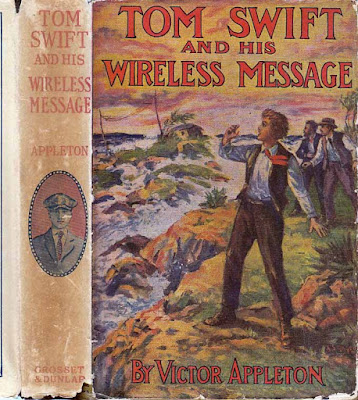
Tom Swift had The Knack


Thanks to Richard for alerting us this important piece of Knack history. Not bad for 1910. You can see Tom’s shack and antenna in the cover image (above). I don’t think he was going for a fan dipole. He built the kind of multi-wire antenna that was in fashion in the early days of radio.

The full text of the book is avaialble free on-line. The radio fun begins in Chapter 20:

Bless my door knob, this was a lot of fun!

Bill,

I am certain I missed the origin of “the knack” as used on your blog. I, wonder, however, if in your youth you read Tom Swift novels? Although now they seem somewhat politically incorrect, I feel that the word may have, for our purposes, evolved there.

In the first novel, “Tom Swift and His Motor-Cycle” (sic) Tom repairs a butter churn’s “system of cogs and handles.” When praised for his abilities he declares, “It’s just a knack.” Stick with me.

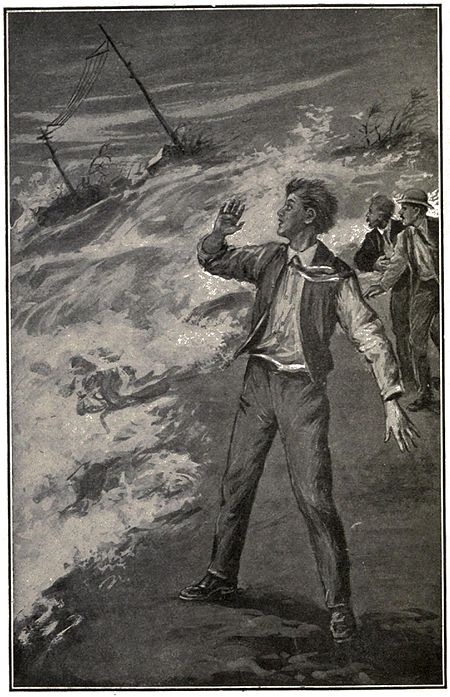
In a later novel, written around 1910, “Tom Swift and His Wireless Message” Tom is shipwrecked on an ebbing volcanic island. He saves the day by constructing a transmitter and receiver from the wreckage of his plane, even though he “did not have the magnets, carbons, coherers and needles” needed. He strings “ wires from the top of the dead treed, to a smaller one, some distance away, using five wires, set parallel, and attached to a wooden spreader, or stay. (Fan dipole?) The wires were then run to the dynamo, and the receiving coil, and the necessary ground wires were installed.” Then,”once the impulses, or electric currents, are sent out into space, all that is necessary to do is to break, or interrupt them at certain intervals to make dots, dated and spaces.” He sent “C.Q.D. (come quick—danger) even though a “new code has been instituted for them, but I am going to rely on the old one, as, in this part of the world, the new one may not be so well understood.” Needless to say, a ship hears, responds and rescues the crew.

That”s “the knack”, alright!

Never give up, and 73.
Richard, KD0NPM


SolderSmoke Podcast #203 Winter, Transceivers, Antennas, DC RX, uBITX, Mixers, ‘fests, MAILBAG

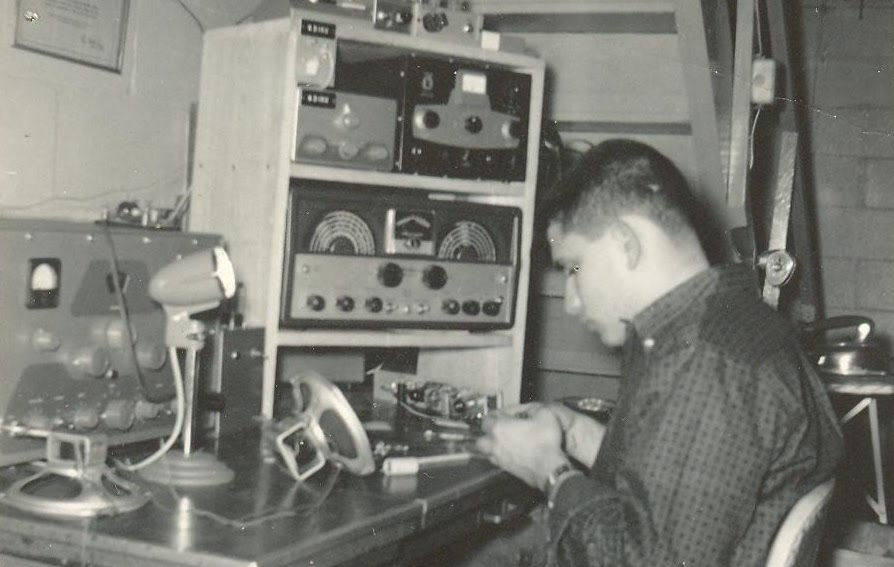
N6QW in 1959. Building an SSB transceiver

SolderSmoke Pocast #203 is (FINALLY!) available:

http://soldersmoke.com/soldersmoke203.mp3


24 March 2018

–The reasons for our delay.
Winter, Computers, College, Family Trees, Lawyers….

— Winterfest 2018
— Pete launches 2018 THE YEAR OF THE TRANSCEIVER
http://n6qw.blogspot.com/
— SDR – Satan’s Digital Radio?
— Direct Conversion Receiver Projects
— Mixer Musings
— A Thailand Troubleshoot
— Nor’Easter knocks out Bill’s Moxon — An appliance replacement?
— Homebrew Electret Mics. Seriously.
— uBITX Build with Rogier
— Civilized Crystal Testing
— Baofeng!
— DRAGNET

— MAILBAG
KD4PBJ’s REGEN
N6ORS’s SDR rig
Mike Rainey’s DX-100

Steve Murphy N8NM on QSO Today

Picture

It was really nice to sit back and listen to Eric’s talk with Steve Murphy.
Don’t miss this one. Listen here:

https://www.qsotoday.com/podcasts/N8NM

My notes:

— On a Stingray bicycle patrol on garbage night, looking for radio parts. FB Steve!
— Started with SWL. A fine radio pedigree.
— Had an R-390A at age 16.
— Uses an LC meter to check on toroid windings.
— Steve: Thanks for the kind words about inspiration.
— Manhattan And Ugly. Mugly!
— Planker! Better on a Board!
— Form Factor First, but then it never fits! Al Fresco!
— Packages arrive from China faster than they go across Israel.
– – E-bay as a really good source for parts.
— Oh god, not an S-38E. Stop torturing yourself Steve.
— N8NM: Radio Renaissance Man: Runs a 2 meter repeater network. Thinking of 900 MHz.
— Papa Legba — I got it from a W9SCH via SPRAT. He got it from Voodoo.
N8NM is chickenkiller.com FB.
— Moderation? Ha! Good luck with that!
— An Electromagnetic Playground where Failure has No Consequences. Well put.

-Happy New Year Eric and Steve! Thanks to both of you.

Straight Key Night at N2CQR

I did my part for the retro-Luddite-CW-Straight Key cause. My HT-37 was kind of wheezing. I may have to go in there to striaghten it out. At times I had it cranked back to less than 5W (to maintain some semblence of QRP street cred).

A highlight was the QSO with Jim W1PID. Jim is a well-known QRPer and a friend of QRP Hero Mike Rainey. Jim and I talked last year — same date, same event, same rig. Jim has a really nice web site: http://www.w1pid.com/

My nephew Jeffrey joined me for the last two contacts. He got a real kick out of it, both the CW and the SSB.

31 December 2017
17S P49MR Martin – Back in the islands! Like an annual QSO.
40CW Pre SKN W1PID on 40 with my HT-37. An annual event! Jim running 75 watts
40CW SKN KF5RBR Dan in AR.
1 January 2018
40CW SKN W8HOG SKCC 87750 Perry in Ohio
40CW SKN N1CGP Dave in Maine using J37 key
40CW SKN WB4JJJ Al in Fairfax
40CW SKN K8SRB Stan in Ohio (with nephew Jeffrey with me)


17SSB WJ2N Andy in Florida (with Jeffrey in the QSO)

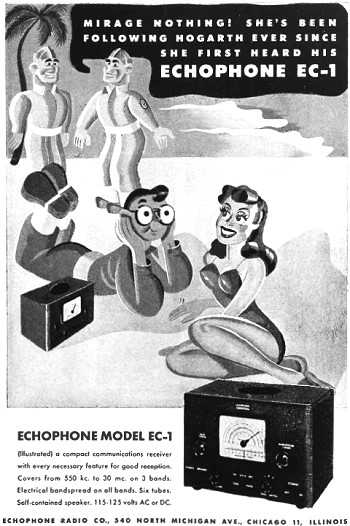
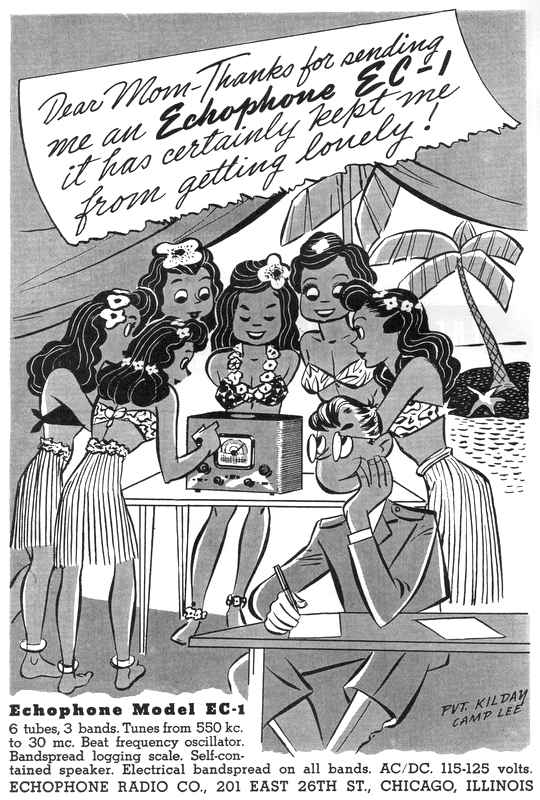
Hallicrafters and the Romantic Life of Private Hogarth

The world of the SolderSmoke podcast and blog are — and will remain — G rated. But occassionally our discussion of ham radio technology causes us to bump up against some racy topics. This happens VERY rarely, and that rarity probably says something about ham radio. We have noted the alleged attractive power of Pete Juliano’s French beret. There was that April 1 story about the new SolderSmoke cologne (“chicks dig it!”). Jean Shepherd was a man of the world — our discussions of him sometimes bring us a bit closer to the prurient boundary line. We occassionally mention the lifestyle of the Dos Equis man. But mostly, we stick to the circuitry.

This morning I came across a character that I hadn’t been aware of: Private (later Corporal) Hogarth. He was the theme of a series of ads run by the Hallicrafters Company during World War II. They were trying to sell their EC-1 broadcast receiver (essentially an All American Five). Their advertising theme was, essentially, “chicks dig it.”


Don’t blame me. I blame Hallicrafters.

K0EOO: Homebrew SSB in 1974

It is not everyday that you get on 40 meters and run into a guy who has actually built a single sideband transceiver. But that is what happened to me today. I spoke to Dennis, K0EOO. He showed an unusual interest in my BITX DIGI-TIA. He went on to explain that he had done some homebewing himself. In the picture (from 1974), right next to his Vibroplex bug we see his homebrew, 80-10 meter, dual conversion, solid state (except for the 6146 final) SSB transceiver with digital readout. Wow. That’s a beautiful rig.

Off his right shoulder is a homebrew 700 watt amplifier using dual 4CX250s. And behind his left shoulder we see a homebrew tube-type receiver.

Note the look of pride and determination in OM’s eyes. You can just hear him saying it: “Rig here is homebrew.”

More pictures of Dennis and his rigs (including some amazing vintage gear) here:

https://qrz.com/db/K0EOO

http://www.isquare.com/millen/members/k0eoo.htm

http://www.vintagessb.net/k0eoo.htm