Mr. Carlson Replaces Old Capacitors — Bathtub Capacitors

I recently posted a video from CuriousMarc about whether or not to replace electrolytic capacitors in old pieces of gear. This is a hot topic in restoration circles.

This week Mr. Carlson put out a video (above) in which he got rid of a bunch of “bathtub” capacitors in an old receiver.

One of the many interesting things in Mr. Carlson’s video was how his test gear initially showed the old capacitors to be good, but on further examination with better test gear he found them to be BAD!

Out with old, in with the new!

To Re-Cap or Not to Re-Cap — Curious Marc on the Electrolytic Controversy in Ham Radio


A while back I got some fairly acerbic feedback when I DARED to suggest that perhaps it would be a good idea to replace the old electrolytic capacitors in ham radio equipment. It was as if I had attacked motherhood and apple pie!

Yesterday I was looking at CuriousMarc’s YouTube channel and I came across the above video. While I had been in the preemptive replacement camp, Marc makes a good case for leaving some of the old caps in place. The fact that the electrolytics usually are open when they fail, and that there are fuses in the power supply to protect the transformers, are important points. His admonition not to replace electrolytics with tantalum caps (which fail closed) was also very useful.

OK, my flame-proof suit is on!

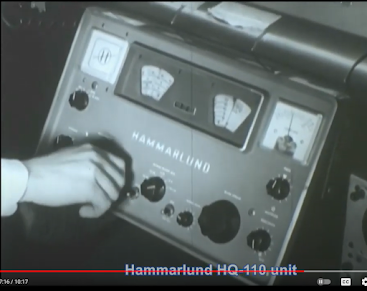
Hammarlund HQ-100 Misidentified in 1963 FCC Film

Oh the indignity! It appears at 7 minutes 16 seconds in this FCC film. It is clearly an HQ-100, but the FCC subtitles identify it at an HQ-110. It is clearly an HQ-100 ( the model without the clock).

https://www.youtube.com/watch?v=LzPIOfpKkRM

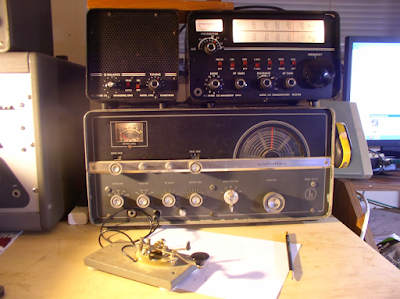
As the owner and operator of what must be one of the few remaining HQ-100s, I feel obligated to defend the reputation of this fine piece of shortwave gear.

How many of you have HQ-100s?

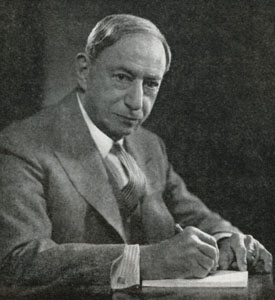
Hugo Gernsback — Was he Like Wayne Green?

“The Electrical Experimenter” sent to me by Nick M0NTV reminded me of Hugo Gernsback. Many of the radio books I have on my shelf have his name on them. He played a big role in early radio and television, and in science fiction. Check out the Wikipedia article on Gernsback:

I see similarities between Hugo Gernsback and Wayne Green. What do you guys think?

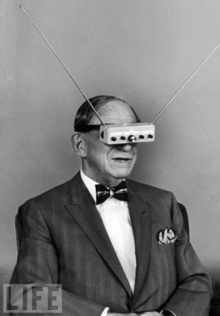
Gernsback’s TV goggles in 1963

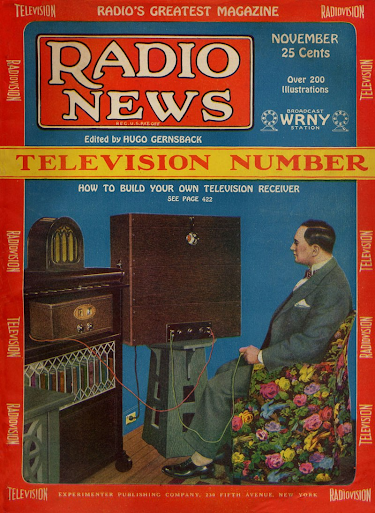
That’s Gernsback watching TV in 1928

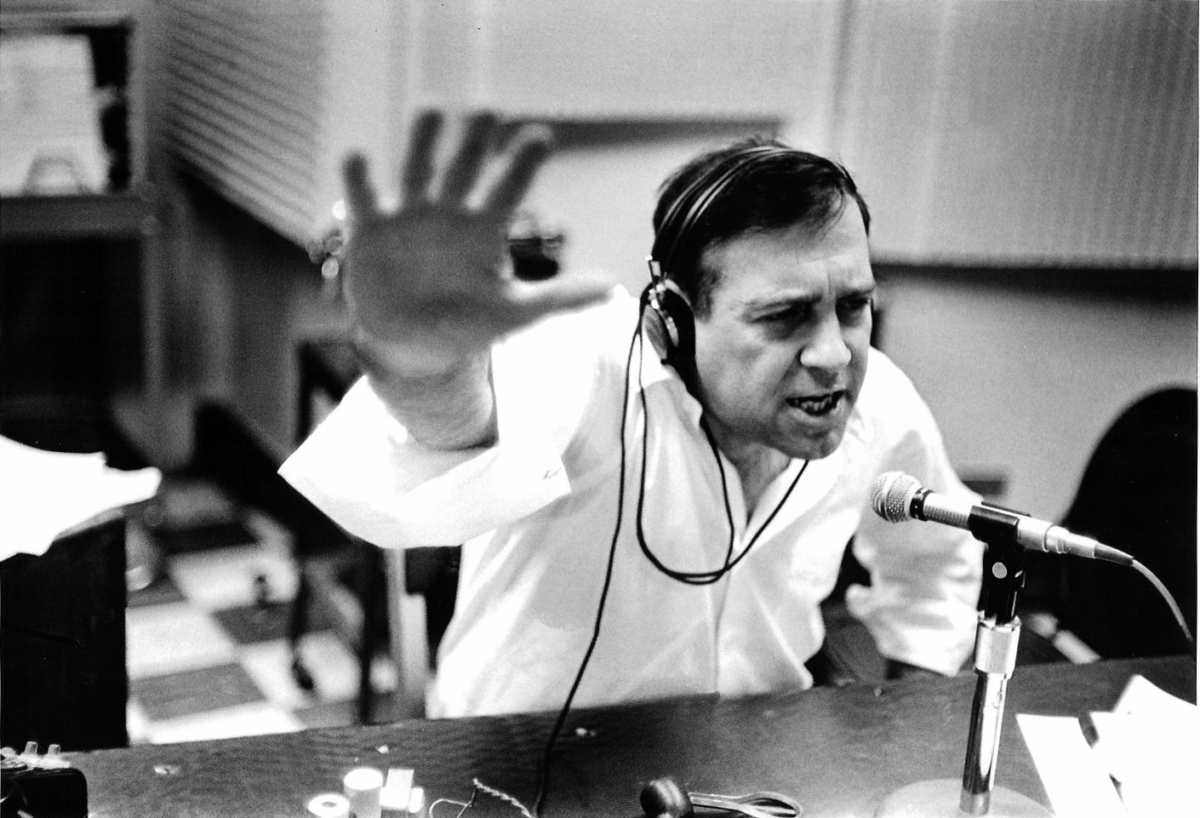
SolderSmoke Re-Play: Shep tries to build a Heising Modulator — Shep on Parasitics and Troubleshooting: “That way madness lies”


You guys really have to listen to this. This is culturally important.

In this 1965 radio broadcast, Jean Shepherd describes his teenage struggles with parasitics and other technical problems in his homebrew 160 meter transmitter.

He describes the sound of parasitics on a signal, saying that they sound as if the signal is being attacked by “debauched erotic locusts.”

He really nails it in describing the scornful, dismissive tone that many hams use in telling their fellow radio amateur that there are problems with his signal. ( I have recently been on the receiving end of this kind of treatment.)

He observes that no one is more worried, “than a man who has built something and can’t get it to work.” Indeed.

During a date with a girl from his high school, he is so obviously preoccupied with his transmitter trouble that she tells him that something is wrong with him and that his mother “should take him to a doctor.”

And he describes the joy that comes when you figure out the problem and get the thing to work.

The REALLY good stuff begins at about the 25 minute point.

http://ia310115.us.archive.org/2/items/JeanShepherd1965Pt1/1965_01_29_Ham_Radio.mp3

Shep was quoting from King Lear:O, that way madness lies; let me shun that; No more of that.” In other words: “BASTA!”

EXCELSIOR!

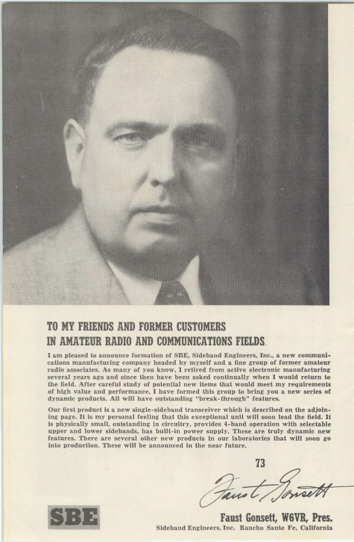
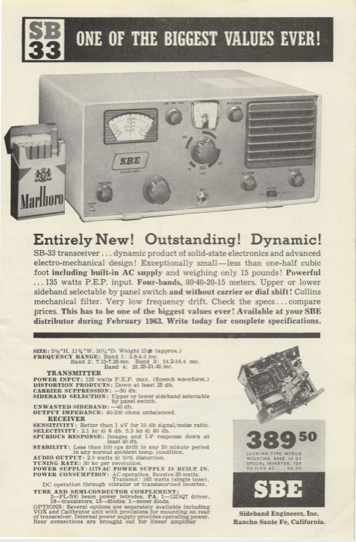
Faust Gonsett and the SB-33 in 1963

Click on the images for better views
When this ad appeared in 73 Magazine in February 1963 I was 4 years old, living on Manhattan Island. Pete N6QW was in the Navy, heading to Midway Island.

Pete writes:

——————-
This ad has a tremendous impact on the foundations of our hobby. The SBE-33 was pure genius in its design and implementation.
  1. It is a hybrid rig using Germanium transistors –the transistor was only 15 years old
  2. The Mechanical band switching showed the strong use of mechanical assemblies
  3. The small size was simply amazing
  4. The Bi-lateral circuitry predates any Bitx circuits.
  5. The urban legend was that a team of illuminati were involved in its design (Don Stoner is one name that pops up)
  6. The Japanese were a quick study and the FTdx100 in 1967 is a result, only better.
  7. Many are still around in shacks. I have three

Gonset was well known for innovative designs – the Gooney Box is another example. Look at all of his compact mobile equipment.

The next point – the final owner of SBE was Raytheon thusly the next generation of SDR Radio Equipment for the US Air Force can trace its pedigree to the SBE-33.

This was the appliance box of 1963. I saw my 1st SBE-33 (August 1963) when likely you were in the 2nd Grade and I was headed off to Midway island.

———————–

I have an SBE-33 that N6QW sent me. Thanks again Pete!

Also, I’d like to note that W6VR had a very cool name. Faust Gonsett. I just sounds like the name of a real radio guy. Google says this of the given name Faust:

“Faust as a boy’s name is of Latin origin, and the meaning of Faust is ‘fortunate, enjoying good luck.’ Indeed.

R-390s, KWM-2s, Airplanes, and Magnetic Loops — A Really Interesting Interview with Ted Robinson K1QAR

Eric Guth 4Z1UG has a really interesting interview with Ted Robinson K1QAR.

I really enjoyed hearing Ted’s inspiring story:

https://www.youtube.com/watch?v=SUUzlKMMANg

https://www.qsotoday.com/podcasts/K1QAR

Listeners will like the discussion of the R-390 and the KWM-2. And his talk about airplanes. And the joy of repair.

Here is Ted’s QRZ.com page: https://www.qrz.com/db/K1QAR

Thanks Eric! Thanks Ted!

The Cure for Frequency “Bunching Up” in Analog LC VFOs — It Is Not So Simple. But we have a good calculator. Comments sought!

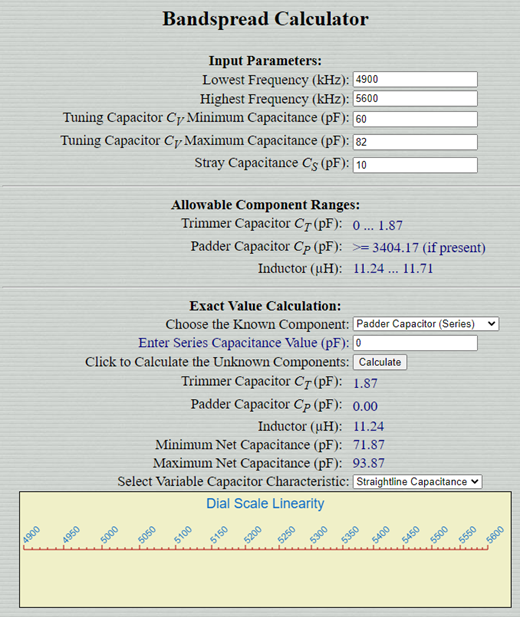
Bob’s calculator shows good tuning linearity with an ordinary SLC capacitor

One of the complaints about analog LC VFOs is that they have non-linear tuning — when you turn the dial (usually attached to a variable capacitor) the space between frequencies is NOT constant. This is especially apparent at the high end of the frequency scale where frequencies (and stations) appear to be severely bunched together, making tuning difficult. This problem contributes to the defection of some great homebrewers: They give up on LC VFOs and they switch to digital VFOs. Sad.

But there is hope: Not all LC VFOs tune this way. Even on rigs from “back in the day,” back when the Si5351 hadn’t even been thought of, some LC VFO rigs tuned linearly. My beloved Drake 2-B and my almost equally beloved HT-37 are good examples. How did they do this? How did they escape the dreaded “bunching up?”

For a while, I thought that it might have had to do with the use of the series tuned Clapp circuit. But on further noodling, this didn’t seem to make much sense.

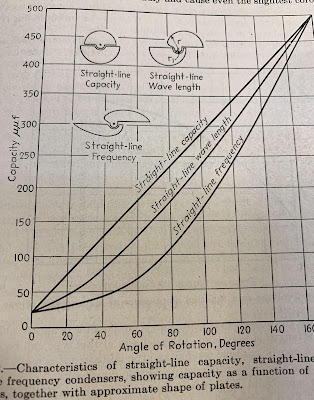
Then — like others — I thought that it must be caused by the adroit use of special capacitors. You see, in ordinary variable capacitors when you turn the dial, the capacitance increases linearly. But in the LC circuit, frequency changes as the inverse of the square of the capacitance. Thus the bunching up. So the solution must come from the use of the special capacitors that compensate for this, that — because of the shape of their plates — produce linear tuning. With these variable caps, frequencies on the dial are spaced out nicely, there is no bunching up. Great right?

From Terman, Radio Engineers Handbook, 1943, page 123

Over the years, many hams have jumped to the conclusion that rigs with good tuning linearity MUST be using these special caps. For example, in 2013 a ham posted in the Antique Radio forum this message:

There are three types of open, variable plate caps;
SLC= straight line capacitance where the capacitance varies linearly,
these are the most common and have half-circle plates
SLF= straight line frequency where the plates are tapered to allow
for linear tuning of the frequency
SLW= straight line wavelength, you get the idea…

SLF and SLW caps have oblong plates.

The effect on tuning a receiver can be dramatic. One example is the
Hammarlund SP series of receivers where the ham bands are very
compressed at one end of the tuning range. They used SLC caps
in the VFO. On the other hand rigs like the Kenwood TS-520
and FT-101 series have linear tuning across each band. These use
SLF variable caps. Most old 1920’s battery radios used SLW
where stations were identified by their wavelength.

Well, not really.

— I now have several VFOs from the extremely linear-tuning FT-101. But when you open them up to look at the tuning capacitor, it is NOT a Straight Line Frequency capacitor.

— Many of us over the years have built VFOs that are quite linear in their tuning without resort to these special capacitors — we did it with ordinary Straight Line Capacitance caps.

— When you look at the “How to build VFO” literature in the ham radio books, you see a lot of good recommendations about using solid, brass-vaned caps with ball bearings at either end. But never do you see circuits that require the use of SLF or SLH capacitors. If they were the key to tuning linearity, we’d see them mentioned in the literature. But we don’t.

So where does the linearity — or bunching up — come from?

The answer comes to us from a really neat calculator from Bob’s Electron Bunker:

http://electronbunker.ca/eb/BandspreadCalc.html

This calculator allows you to select your frequency range, and the tuning range of your variable cap. It then displays for you what the tuning range will look like on your dial. You can see if there will be bunching up, or if the frequencies will be nicely spread out. And — and this is the really cool part — you can then specify if your capacitor is SLF, SLW, SLC or Midline-Centerline. This really illustrates the effect of the different capacitor types.

I used Bob’s calculators to do some experiments with various types of capacitors, various frequency ranges, and various combinations of trimmers and padders. You can see what I did here:

http://soldersmoke.com/VariableCapsSLCSLF.pdf

One important thing to keep in mind: The SLF caps were made for AM broadcast receivers that were tuning from 540 to 1600 kc. That is a 3:1 tuning range. Most of the time in HF ham radio, we are tuning across a much smaller range, say from 5 MHz to 5.5 MHz. That is a 1.1:1 tuning range. In those cases where we ARE tuning across a wide tuning range — for example with a receiver covering 3-9 MHz, the SLF cap can help prevent the bunching up.

But we can have fairly good linear tuning without resort to SLF caps. Bob and his calculator point out that by narrowing the frequency range of interest, and by using either smaller range caps (ordinary SLC caps), or SLC caps with trimmers and padders, we can achieve tuning linearity. And sometimes, when you have achieved this nice tuning linearity with a plain SLC cap, putting a fancy SLF cap makes tuning linearity worse.

One piece of VFO tribal wisdom that is confirmed by all this: It is better to use a smaller variable cap with a maximum capacity of about 30 picofarads.

I think we should spend as much time focusing on VFO tuning linearity as we do on VFO frequency stability. Bob told me that in the old days, the calculations for various tuning linearity scenarios were difficult. But now we have Bob’s calculator. When building a VFO, just use Bob’s calculator, plugging in the numbers to get a preview of what your tuning linearity will be like. If it is bunched up, you can play with the trimmer and padder values to achieve the tuning linearity you desire.


Thanks to Bob of Bob’s Electron Bunker for this great calculator.

You can see another discussion of “bunched-up” tuning in the comments section of this article: https://www.nutsvolts.com/?/magazine/article/may2015_Whipple

What do you folks think of this? Please put comments below.
Why Do Some VFOs Tune More Linearly Than Others?

This has been one of the major complaints about our beloved analog LC VFOs: The frequency tuning on these circuits is often not linear. For given amount of VFO frequency dial turn you can get vastly different changes in frequency. At one end of the tuning range the frequencies are nicely spaced and tuning is easy. But at the other end of the tuning range all of the frequencies are bunched together. This is one of the problems that leads some homebrewers to defect to the sad land of “digital VFOs.”

But wait. It appears that the old designers found a solution to this problem. Just look at the tuning dial of my HT-37. The frequencies are all spaced out evenly. How did they do that?

I had been thinking that this success may have resulted from Hallicrafters’ engineers using the series-tuned Clapp circuit. Here the main frequency determining element is a series-tuned LC circuit and not the parallel tuned LC circuit that we see in the more commonly used Colpitts circuit.

But hold on — how could that be? The frequency bunching problem that we attributed to the Colpitts circuit must also exist in the Clapp, right? I went back to SSDRA where there was a good discussion of Colpitts and Clapp VFOs. The advantage of the Clapp was said to be in its use of a larger value coil which helped minimize the effects of stray inductances. But there was no mention of the Clapp offering improved linearity in tuning.

I have in front of me two transceivers: The Mythbuster uses a 9 MHz Clapp circuit (see below). The 17-12 rig uses a Colpitts Circuit. I checked the tuning linearity of both. Both appeared quite linear in tuning, with no real difference between the two.

Then I looked at the tuning capacitor in the Mythbuster 17-12 rig. It came out of an old Hallicrafters transmitter, probably the HT-44. I looked closely at the stator and the rotor plates. Both are curved. I’m guessing that this may yield a more constant change in capacitance for a given movement of the main tuning dial.

Next I opened up the VFO on the Mythbuster. (It is the VFO from an old Yaesu FT-101.) I couldn’t see the stators very well but it appears that their shape is different from the square shape we often see in variable capacitors. Could it be that this variable capacitor was also made to provide linear tuning?

Back in 2013 Norm Johnson wrote about all this in the Antique Radios.com forum:

A capacitor that has uniform increase in capacitance with rotation will have the stations at the high end of the band squeezed together. Another type known as the straight-line frequency variable capacitor has, as you might guess, a characteristic that gives even spacing of frequencies with shaft rotation. These were popular in the 1920’s but weren’t very good for superhets where you needed to have a dual section capacitor that would tune both the RF and local oscillator, and have them track each other properly. The midline variable capacitor is more compatible with a superhet, and easier to make both sections track properly. This is the type that you see in most receivers from the late 1930’s to the end of the tube era. They don’t have quite the equal spacing between stations across the band that the old straight-line frequency caps had, but they’re much better than the variables that change capacitance linearly with rotation.

I wrote an online calculator that helps in the design of the tuning. It shows what frequency range you’ll get with a specific type of variable capacitor, including the effects of padder and trimmer capacitors. It also displays a dial scale that shows how the frequencies are lined up accross the dial.
http://electronbunker.ca/eb/BandspreadCalc.html

Steve W6SSP also provided some really good info back in 2013:

There are three types of open, variable plate caps;
SLC= straight line capacitance where the capacitance varies linearly,
these are the most common and have half-circle plates
SLF= straight line frequency where the plates are tapered to allow
for linear tuning of the frequency
SLW= straight line wavelength, you get the idea…

SLF and SLW caps have oblong plates.

The effect on tuning a receiver can be dramatic. One example is the
Hammarlund SP series of receivers where the ham bands are very
compressed at one end of the tuning range. They used SLC caps
in the VFO. On the other hand rigs like the Kenwood TS-520
and FT-101 series have linear tuning across each band. These use
SLF variable caps. Most old 1920’s battery radios used SLW
where stations were identified by their wavelength.
Steve W6SSP

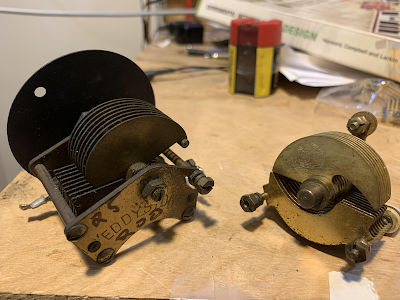
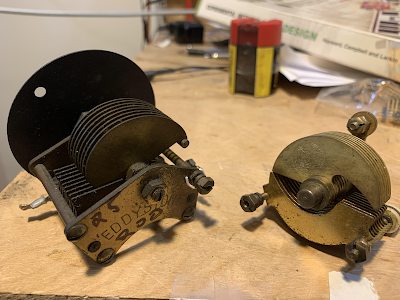
These two variable caps came out of my junkbox. Both are Eddystones, made in England. My guess is that the one on the left is SLF. But could the one on the right (out of an old regen) be SLW?


The Drake 2-B also has perfectly linear tuning. I looked at the manual: “The tuning condenser is of special design…” I’m guessing that they used an SLF variable capacitor. The 2-B had no need for ganged capacitors — the “preselector” was tuned via a separate front panel control.

I looked at the tuning dials on my Hammarlund HQ-100 receiver. It is fairly linear in its tuning, but not as linear as the HT-37 or the Drake 2-B; on all of the tuning ranges the frequencies seem to spread out a bit at the lower end. My guess is that Hammarlund used the midline variable described above by Norm Johnson. The HQ-100 did use a ganged variable cap, with one section tuning the RF amplifier and the other tuning the local oscillator.

Mythbuster on the bottom. 17-12 rig on the top

Where Do You Think This Variable Capacitor Came From? What Piece of Gear Did it Come out of? Is it in the Old Catalogs?

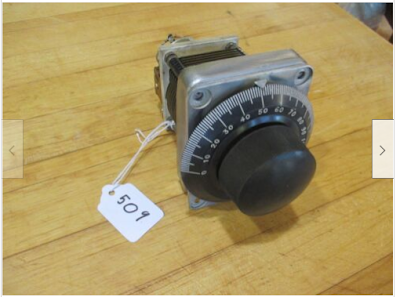
In an effort to stop the slaughter of innocent Heath QF-1s (for their very nice variable capacitors), I bought this thing on e-bay. Here is the info I have:

I checked the resonance of the cap and the coil: It tunes from about 10.140 MHz to about 13 MHz. The cap is nice — brass vanes and with the linear tuning shape. I don’t know about it being from a Hartley oscillator — no signs of a tickler coil. There seems to be some sort of a pass-through cap from “Faradon” of Camden N.J.

Update:
It tunes from about 9 to 138 pf. The coil that it had on the back of the cap is about 1.6 uH and is tapped (Hartley style). The capacitor is marked on the back: “Licensed Under Pats. MC 15257781258423”


From the e-bay ad:

“Here’s a great project part. These were likely a VFO assembly for some RF equipment from the late 1920’s or 30’s. Essentially it’s 4″ Type A Velvet Vernier dial (standard 5:1 reduction drive) with a variable capacitor. The variable condenser is a high quality ceramic frame with brass plates and looks suspiciously like a General Radio house part (also in Cambridge at that time). The variable condenser looks like a SLF shape or similar, about 135pF. It has a ceramic frame and has an insulated shaft, which was critical to keeping hand capacity down back then. It appears to be wired for a Hartley oscillator, probably 10 MHz+ give or take (not measured).

The vernier is in excellent condition–smooth, without backlash or sticking. There are no chips in the skirt and the numbers and nice and clear–these were obviously well cared for over the years. They have the the hard-to-find dial markers!


There is a rigid metal panel to which the vernier assembly is attached, and this in turn supports the condenser frame. I suppose you could just that in a project box with an appropriate sized hole for the shaft and have an instant shielded enclosure for a VFO, or maybe screw it to the side of a breadboard. You can also remove the vernier assembly from the panel and use it separately (e.g., to fix up an old NBD). Lots of possibilities.


There is a loose sheet-metal collar behind the rigid panel that friction-fit a (now missing) can that went over the whole assembly. It’s easy enough to unscrew the front and remove this piece. Everything comes apart if you want, including the unobtainium dial pointer.”

So where do you guys think this very nice cap came from? Who made it? Was it salvaged from a piece of radio gear? Does it appear in any of the old catalogs?

SolderSmoke Podcast #73 Jan 2, 2008 — AA1TJ Circuits and Poetry, Mixers, CW, Straight Key Night at WA6ARA, Boatanchors in South Africa with ZS6ADY (Part 1)

This is the first in a series of four podcast that include Echolink conversations with Andy ZS6ADY about old tube radios (boatanchors) in South Africa. Click on the YouTube link above to listen.

January 2, 2008 SPECIAL NEW YEAR’S EDITION AA1TJ’s circuitry and poetry. Homemade tubes. Book Review “Early Radio” by Peter Jensen. The Vatican’s antennas. Google Earth flight simulator. Mixer madness continues (now in LTSpice). Mars-asteroid collision? Bollywood: The BITX-20 connection. BANDSWEEP: Straight Key Night at WA6ARA. ECHO-GUEST: Andy, ZS6ADY, South African Boatanchor fan. MAILBAG: Jake N4UY(NOVA QRP), Steve G0FUE (Bath Build-a-thon), Nigel M0NDE

TRIGGER WARNING: Solid-Stating Old Tube (Thermatron) Gear (Including — GASP — R-390As)

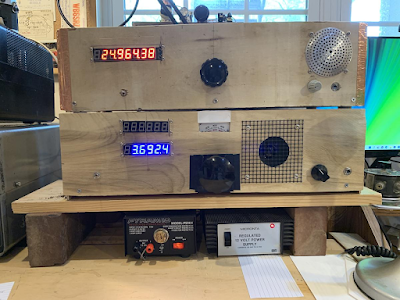
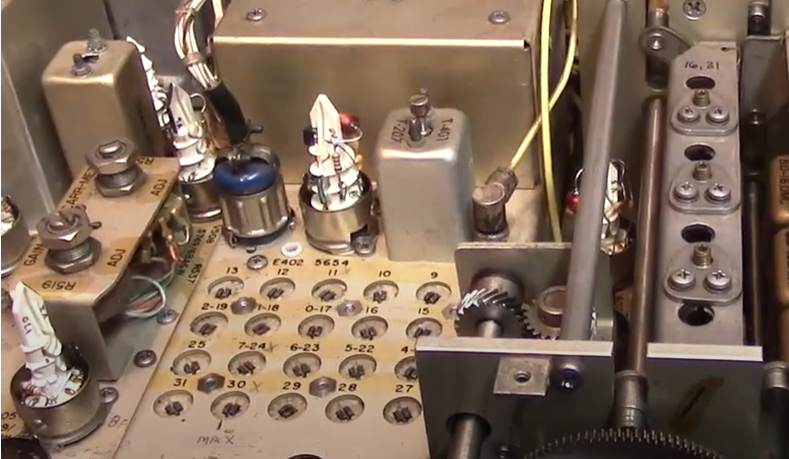
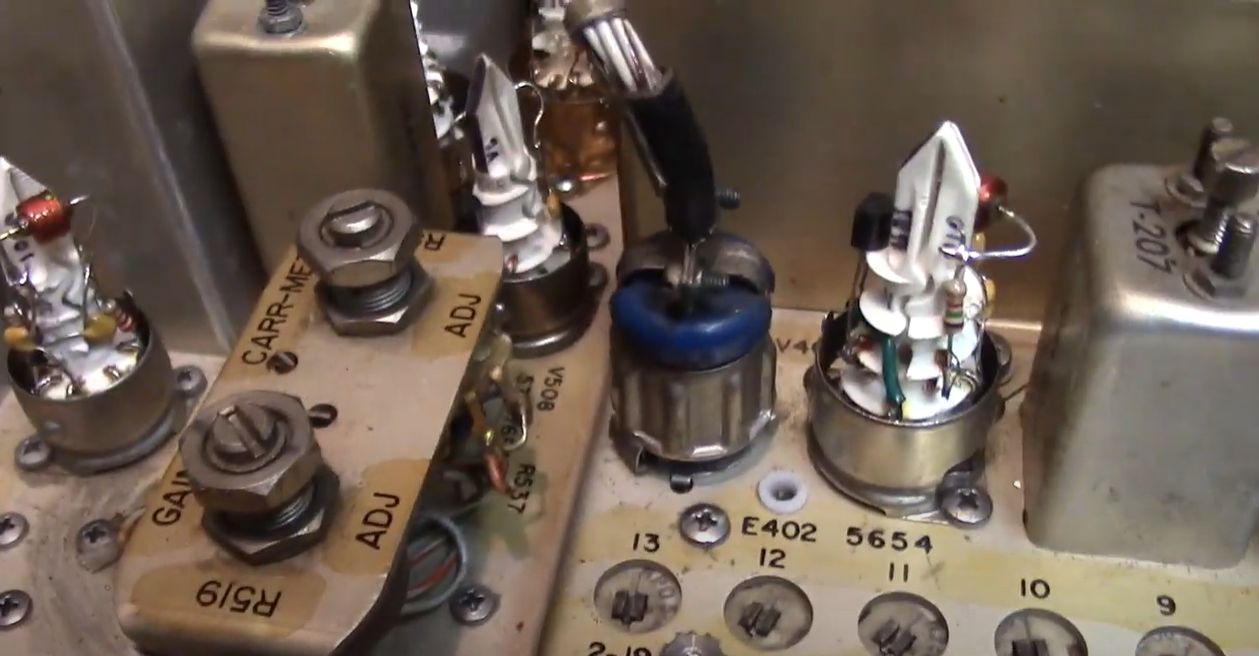
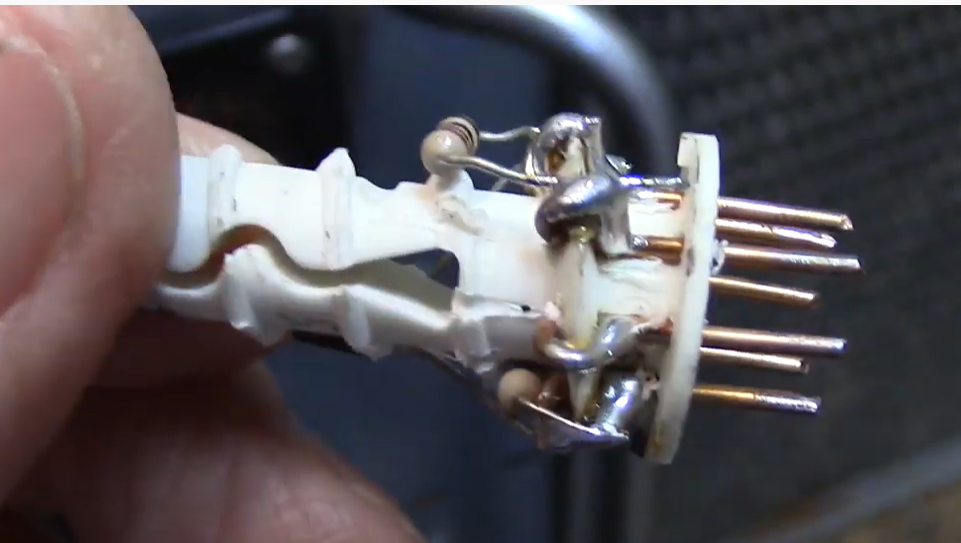
Look at that. Well, maybe some of you shouldn’t. (I’m thinking of you Grayson.) I found the Charles Smith YouTube channel while innocently looking for ideas on how to solid-state the HT-37 VFO assembly I recently bought on e-bay. Charles Smith has some really great ideas in this area. He solid-stated a Heath VF-1. But he took it all to an extreme when he solid stated an R-390A. Take a look at how he built the replacements for the thermatrons: He used those plastic wall sockets that you screw into sheet-rock when you need to hang a picture. This is real genius. He used the tube filament lines to carry DC to these new sockets.

R390A Solid State Conversion Video #1: https://www.youtube.com/watch?v=xhWzX874wYo

Charles Smith’s YouTube Channel

He has videos on the HQ-170 (DEAN: Just say NO!) and the SP-600. He also covers the HQ-110, which is uncomfortably close to my HQ-100.

Who is Charles Smith? What is his callsign? Charles Smith is KV4JT. Here is his QRZ page:
He has some great humor and wisdom in his videos: Procedures that are difficult or more trouble than they are worth are called “bugger-bears.” He advises that if your IF cans are stuck, you should “find a way to unstick them!” Indeed you should! He builds a cool jig to hold the IF section of the R-390A while you are working on it. He provides similar protection (with two long screws) to the VF-1.

Even though some of you will have to go to therapy after seeing all this, I say THREE CHEERS FOR CHARLES SMITH!

A Surprisingly Good Movie from the Late 1960s: “The Ham’s Wide World” (Video)

I found this movie to be surprisingly good. Narrated by Arthur Godfrey, it features Barry Goldwater, and a lot of other hams. There is a homebrewer too! Lots of old rigs we know and love: a Drake 2-B, a couple of Galaxy Vs, a Benton Harbor lunchbox, Heathkit SB-series rigs, many Swans, and was that an HQ-170 that I saw in there? There are also many cool antennas, including a 15 meter quad set up by a bunch of Southern California teenagers.

Near the end, when they visit ARRL Headquarters, we briefly see none-other-than Doug DeMaw, W1FB! FB!

Please take a look at this video and post comments about the rigs, antennas, and radio amateurs that you see in the film.

Surface-Mount Solder Smoke — Is THIS Really Homebrew?

I was recently noting that the assembly of IC, CPU-based projects doesn’t seem like real homebrew radio. I realize that there is a danger here — there is a tendency in ham radio to reject the new and to stick with the old. “SPARK FOREVER” was the rallying cry when CW came along. There are still a lot of AMers who refer to SSB as “Single Slop Bucket.” So, with that in mind I point the blog to the above video. He is using complicated ICs that probably have thousands if not millions of transistors. But he is definitely making something new. And he releases some real solder smoke in the process. FB.

It is probably not for me, but others may like it. Like the old song says “Different strokes for different folks.” YMMV.

Frank Jones’s Homebrew Rig — as described by Michael Hopkins AB5L (SK)

“Frank is all homebrew. His receiver is unshielded outside, but built around a central square of aluminum that houses a Velvet Vernier dial thru the front panel and some tubes I did not recognize jutting horizontally on both sides of the box where coils also plug in. The transmitter is a multi-stage affair on a piece of particle board. The tubes are vertical here, and the bench was littered with brown Hammarlund coils labeled 5, 10, 20, and 80.”

https://soldersmoke.blogspot.com/2021/07/summer-reading-for-homebrewers-frank.html

https://qsl.net/ve7sl/jones%20oscillator.html

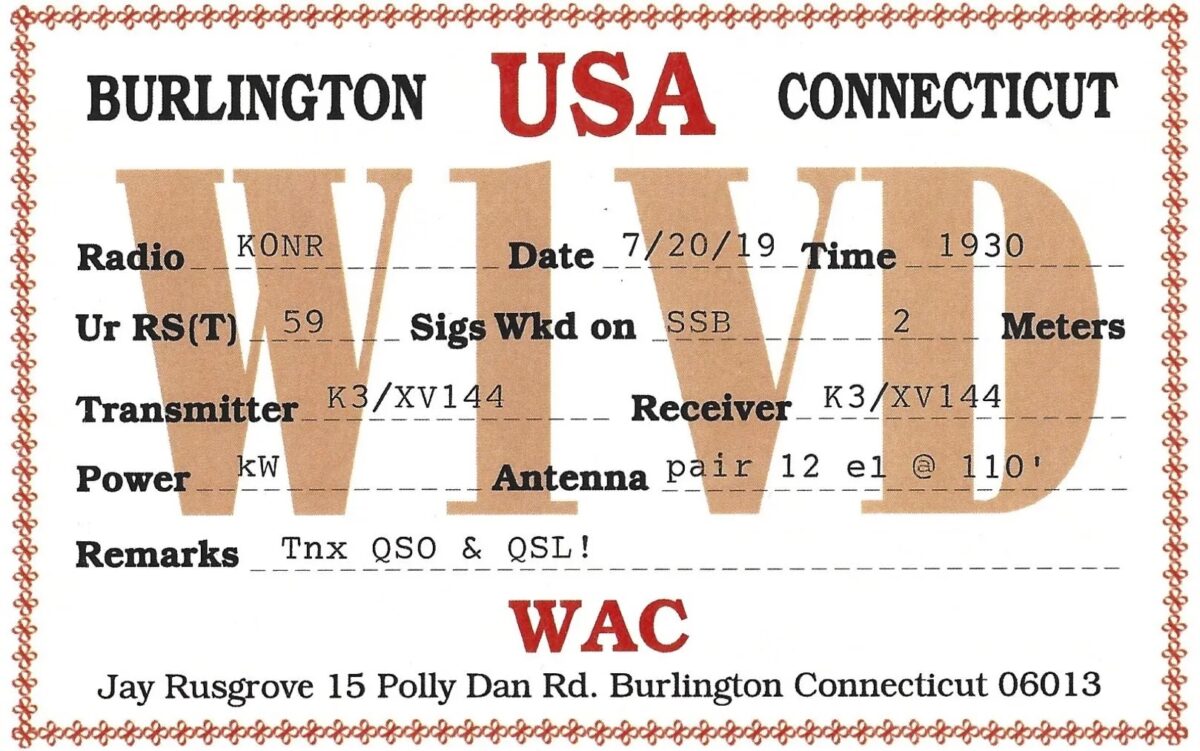
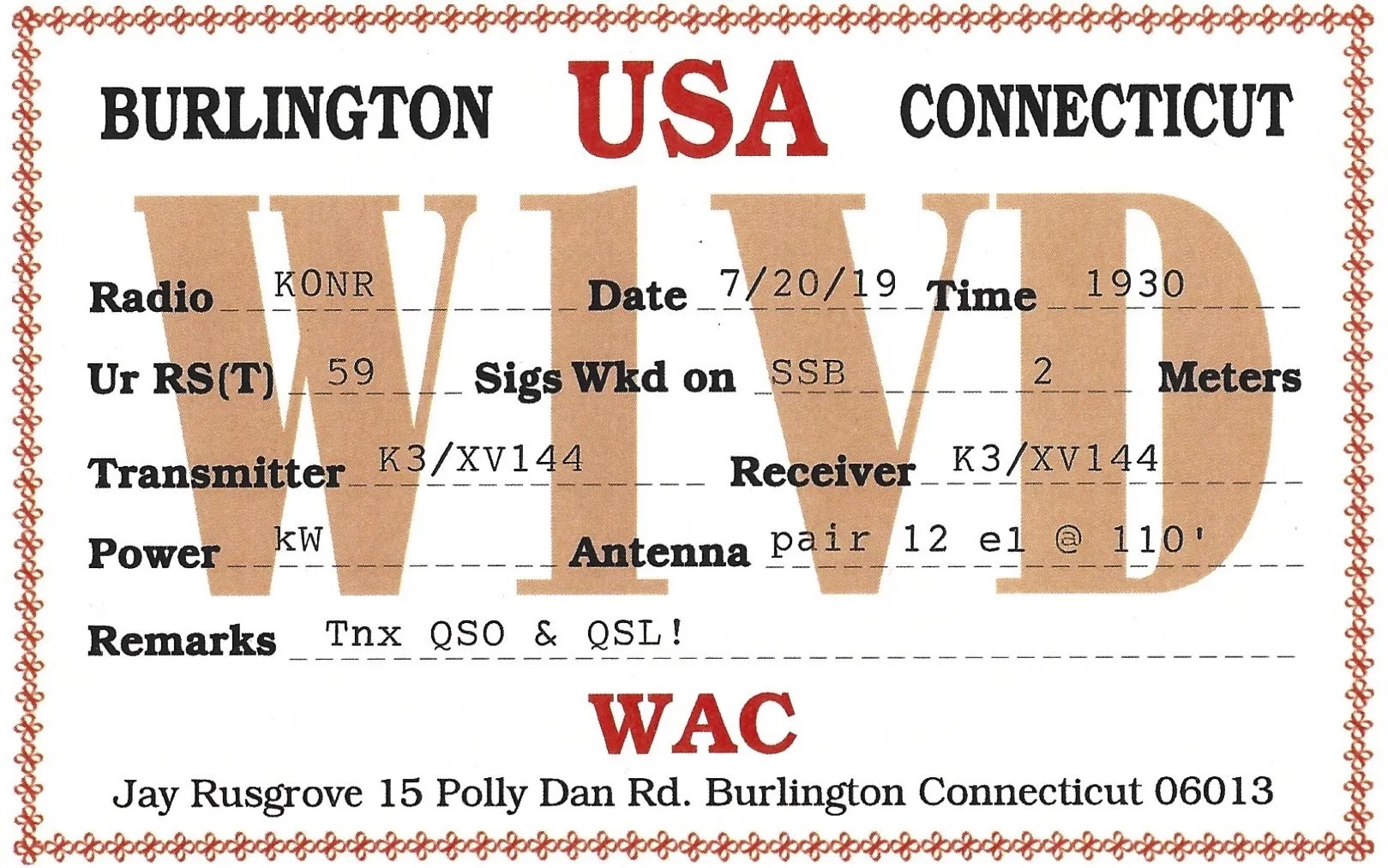
W1VD’s Boatanchor Receiver Tests

I’ve been trying to get more rigorous in my evaluation of receiver performance. My HQ-100 is tuned to Radio Marti, and it sounds great. But how great is it really? And what about all the receivers and transceivers I have built? How good are they?


Our friend Dean KK4DAS is about to start the rehabilitation of his dad’s old HQ-170A. A search for that receiver led me to Jay Rusgrove’s very interesting measurement and analysis of old tube type radios. Jay’s results appear in the links below. More important is his very clear description of how the tests were done and what the results mean (link below). Also included is one link showing a discussion of Jay’s work.


Jay notes:

The decision of which boat anchor receiver(s) to own is seldom based on performance alone. A combination of favored manufacturer, period of manufacture, features, collectability or even just ‘looks’ often rank higher on the priority list than receiver performance. Even if one were interested in performance specs much of the available information is subjective as few receivers manufactured prior to the mid 70s have undergone standardized testing. Hard data on minimum discernable signal (MDS), blocking and two-tone IMD dynamic range is interesting to some operators and important in an historical context as it shows the progression of receiver development.

Jay designed the very first real transmitter that I homebrewed (The VXO 6 Watter from QRP Classics). Jay has been mentioned many times in the SolderSmoke podcast and blog:

Mr. Carlson’s Grand Receiver Restoration Project — Your Input Sought (video)

Mr. Carlson (VE7ZWZ) is launching a series of videos on the restoration of some old boatanchor receivers. I have been working on an old HQ-100, so this all resonates well with me.

He asked for viewer input on which of these receivers he should work on first. I voted for the SP-600 because I wanted to see how difficult it really is to change out the infamous Black Beauty capacitors. My second choice was the R-390, but I warned Mr. Carlson that he might need a chassis crane for that one. No kidding. Really.

I look forward to watching the series. Thanks in advance Mr. Carlson.

1BCG — The 100th Anniversary of the Trans-Atlantic Test

Thanks to the Antique Wireless Association for this really wonderful video, and for their involvement in the 100th anniversary event. Special thanks to Ed K2MP.

On December 11, 2021, the 1BCG team in Connecticut had some technical difficulties. As we all know, that is part of being a radio amateur. Details of the problems are presented here:

http://1bcg.org/1BCG/the-special-event-transmitter/

Phil W1PJE managed to hear and record some of the 2021 transmission (Thanks Phil). Listen here:

https://drive.google.com/file/d/1uPvD9Qh-VJTnyDzOPPSrYfbksks8sQsx/view?usp=sharing

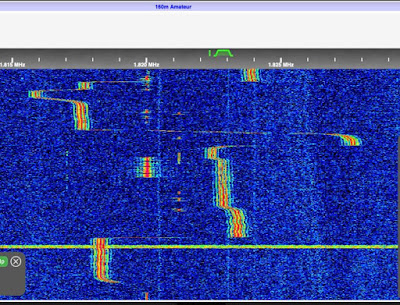
Phil also sent this spectrogram of the signal.


Good thing Paul Godley ran into Harold Beverage on the ship going over.

And imagine me complaining about having to step out into the carport to adjust my antenna — Godley had to trek one mile THROUGH SEA-WEED to adjust his. Respect.

Bluetooth, Winston Churchill, The Speed of Light, and a 1938 Zenith Receiver

Hello Bill –


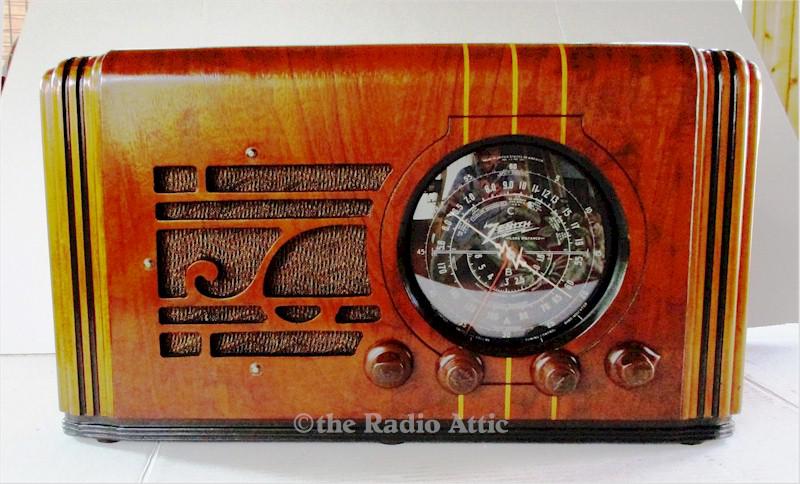
It has taken me a while to put hands on keyboard to send you this message, but having seen or heard a few more of your references to Jean Shepherd, I felt I must. Being a fan of vintage radio equipment and the American scene of the late 1930s, sometime back I acquired a very nice circa 1938 Zenith 5-S-119 AM/Shortwave radio.


Though it had been recently re-capped, it took some effort to get the thing working (needed a new power transformer), and still needs to be aligned, but it made a nice addition to my 1930s NYC Art Deco-inspired office. One reason I bought it was to add a Bluetooth receiver to it so I could listen to podcasts, etc, from my phone. I like the big electromagnetic speaker that those radios have and thought it would be cool to bring this one back to life. I picked up a small Bluetooth receiver board and a power supply for a few dollars online and got it working in the Zenith with no difficulty, except for some AC hum and oscillator noise that I will work on when I have time. So, success!

But here is the Jean Shepherd part. I recall one of his broadcasts in which he offered his theory that every radio transmission ever made is still out there, traveling further and further into intergalactic space and getting weaker and weaker, but still there. What an idea that was. I would say he is right. I have pondered the idea ever since. So being also a Winston Churchill fan, what would be the first recording I would play through the Bluetooth? What else but his 1940 blood, toil, tears, and sweat speech! So there was the scene — the Churchill speech playing the same audio waveform through a radio that might very well have played it live (or close to live) back in 1940! Almost (though not quite) like detecting the original still-traveling radio signal out there past the star Phi2 Ceti or wherever it is now!

Well that was a quick adventure this past summer that I thought you might appreciate.

Keep the Solder Smoke podcasts coming!

Tom Fuhrman, WX2J