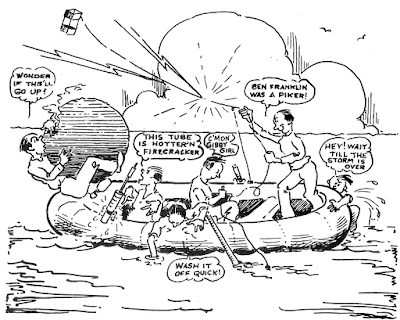
Michael Rainey, AA1TJ, Poet Laureate of QRP and Wizard of the Vermont Hobbit Hole found this drawing and put it on his face book page. It is clearly supportive of the “International Brotherhood of Electronic Wizards” theme of this blog, so I have shamelessly expropriated it. All for the cause Michael! I hope this indicates that OM AA1TJ is emerging from a too-long spate of radio-inactivity.
Michael says the drawing is from the 1920’s children’s magazine, “Kodomo No Kuni” by Kiichi Okamoto. David Cowhig, WA1LBP, provides this translation:
Title “Ni-chan, I can hear it!”
The radio kid is saying something like:
— Wait, no I lost it.
— uhhhh
— I can hear it, I can hear it, I’ve got it!
David notes: Sometimes Japanese use the katakana syllabary to add emphasis like we might with italics or exclamation points.
Back in July we shared a very nice video sent to us by Rupert G6HVY on the radios used by the Kon-Tiki expedition. Many of us had questions about the device used by the intrepid radio operator to generate hydrogen gas (for the antenna balloon) while on the high seas. Mike Herr WA6ARA supplied the answer: 1200 grams of Calcium Hydride crystals. This was part of the WWII rescue radio set CRT-3 (aka the Gibson Girl). Fair Radio Sales occasionally sells this intriguing device: https://www.fairradio.com/catalog.php?mode=search&keywords=hydrogen&submit.x=21&submit.y=8 And here is great site with more details on the other antenna supports in the Gibson Girl set, including a ROCKET LAUNCHED KITE! https://billboyheritagesurvey.wordpress.com/2012/01/17/war-kite-the-gibson-girl-kites/
Just found a short Youtube QRP video which is quite fun. It’s of the radio side of Thor Heyerdahl’s cross-Pacific Kon-Tiki raft expedition in 1947, operating /MM with 7 watts. I found a longer description of what they had and what they did – including a thrilling tale of drying components on coral reefs while they desperately tried to make contact having washed up on an island – but not of the unusual parrot incident with a hydrogen balloon-lofted antenna during the voyage. That’s only in the video.
It’s all gripping adventure radio stuff, and shows what HF and a bunch of tubes could do before the digital satcom age.
“The expedition used call sign LI2B and carried three watertight radio transmitters. The first operated on the 40 and 20 meters, the second on 10 meters and the third on 6 meters. Each unit was made up entirely of 2E30 vacuum tubes providing 10 W of RF input. As an emergency backup, they also carried a German Mark V transceiver originally re-created by Britain’s Special Operations Executive in 1942. Other equipment included a hand-cranked emergency set of the Gibson Girl type for use on the maritime bands, a special VHF set for contacting aircraft and two British Mark II transmitters. The Kon-Tiki also carried a National Radio Company NC-173 receiver. Dry batteries and a hand-cranked generator supplied the power.”
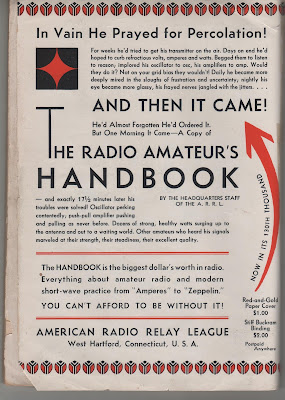
This ad is from the December 1931 issue of QST. This copy has a LOT of mileage on it. In 1993 or 1994, David Cowhig (now WA1LBP) was living in Okinawa Japan and was operating as 7J6CBQ. I was living in the Dominican Republic and operating as N2CQR/HI8. We were both contributing to a 73 magazine column (as “Hambassadors”!) and we were both in the Foreign Service. I wrote to David — he wrote back, sending me some old QSTs, including the one from which the above ad is taken.
This ad shows that many of the homebrew/troubleshooting woes that we face today are very old. And that having access to good technical books is very important when you are trying to overcome these difficulties.
So now I have THREE BITX transceivers on the operating bench. I’ve been getting tired of moving the old D-104 around as I change bands. Surely each of these rigs merits its own mic. This would allow me to avoid the hassle of having to adjust the level on the D-104 each time I change rigs.
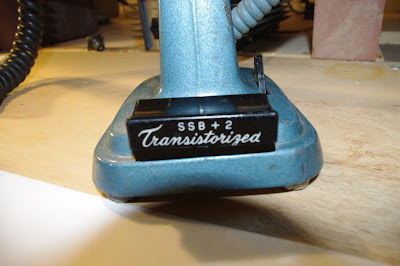
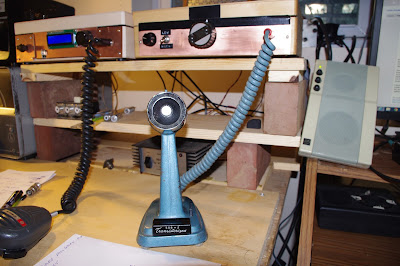
Fortunately in the junk box I have some useable old mics. An old “Turner SSB+2” mic has been kicking around in there for decades. I probably got it when I was a kid. The element was no longer working, so I just popped an electret element in there, took out the preamp circuit, but kept the adjustment pot. At first I had a 3.3 uF coupling cap in there at the output, but this was letting too much 300 Hz energy through. So I changed the coupling cap to .1 uF and this seemed to even things out a bit.
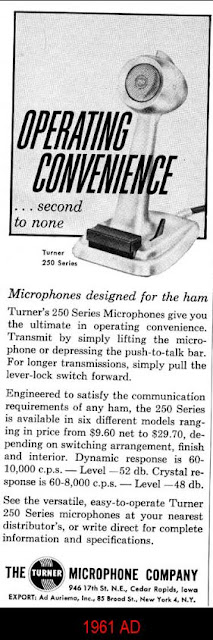
I know, I know: It is CB gear. It is painted BLUE and it looks like something George Jetson would use to talk to his interstellar Good Buddies. But it was preceded by a very similar mic made for hams (see above). And I like it. It even has the word “Transistorized” emblazoned in script across the PTT bar.
Brace yourselves. This is almost too much. Prepare for sensory overload and possible palpitations. Wow. This is really amazing. Note the very casual way Paul manages to mix Eico 430 oscilloscopes with the latest Tek touch-screen ‘scope. Heck, the doesn’t even mention the SP-600s! He does briefly note “a very large transmitter.” Indeed. And he has a microscope on the bench.
This video is part of an excellent YouTube channel called “Mr. Carlson’s Lab.” Great stuff in there. Paul works on everything from old tube type receivers to modern Yaesus and Icoms.
It took me a little digging to find his ham radio call sign. There are many Paul Carlsons on QRZ.com, but Paul’s pronunciation of “solder” gave him away. It seems our Canadian friends also (like the Brits) pronounce the “L.” VE7ZWZ.
Our official SolderSmoke etymologist and lexicographer Steve Silverman explains:
Bill
Here is some ham radio/electronics trivia
In the days when amateur radio used short range spark transmitters, multi-station relays were used to move a message across longer distances. At the end of each transmission, a “K” was sent, which told the receiving operator to commence his relay to the next station. Hence the use of ‘K” to designate a relay in a schematic diagram, and “end-of-transmission” for CW operators. And hence the American Radio RELAY League
Earlier this year Pete and I were talking about the use of the word “rig.” For me this is a hallowed term that captures much of the essence of ham radio. Sadly, in modern parlance “rig” seems to be increasingly substituted by word “radio.” If you are wondering what the difference is, well, I think this video presents a good example of a rig.
There was a nice exchange of e-mails on QRP-L about this video:
Jun 2 at 9:54 PM
Hi Bill. I’ve operated a breadboard rig just to watch the electrons move thru the circuits but never worked such a kluged station yet. 73 de Ed, K1RID (formerly KC1BBC)
On Jun 2, 2015, at 21:30, Bill Cromwell wrote: Hi Ed, I worked some lashups like Mike’s. I still do. Once upon a time I “temporarily” taped a T-R relay under a shelf and used it temporarily enough months for it to come untaped and fall in the middle of a QSO! I finished the QSO anyway. I don’t tape relays to the bottom of shelves any more but the top of the shelf is fair game. No relay ever fell *up*. I’ve worked Mike on the air. We have some of the same views. 73, Bill KU8H
I love it! Keep it up. I travel quite often in my work and listen to all your podcasts.
Since my early teens in the late 70’s I started subscribing to electronic magazines (which I have still keep all every issue). I just found a site that has all the old electronic magazines scanned and posted for all to read. What a resource!http://www.americanradiohistory.com It has all the old Popular Electronic Magazines, Radio Electronic Magazines, Modern Electronics, Electronics Illustrated, etc, in pdf format. Information from the turn of the century … Wow. Back when radio hobbyists made their own chassis for their valve radios. Just google American Radio History and it will be a top link. You might want to share this link with your friends, and listeners.
I have purchased your Soldersmoke book from Lulu — Thumbs up!! Great Book.
Thanks again for sharing your experience with radio and the knack.
Greg Self N8YCB ps: I have always called kluge – KLOO-guh .. and I don’t know why. 😉
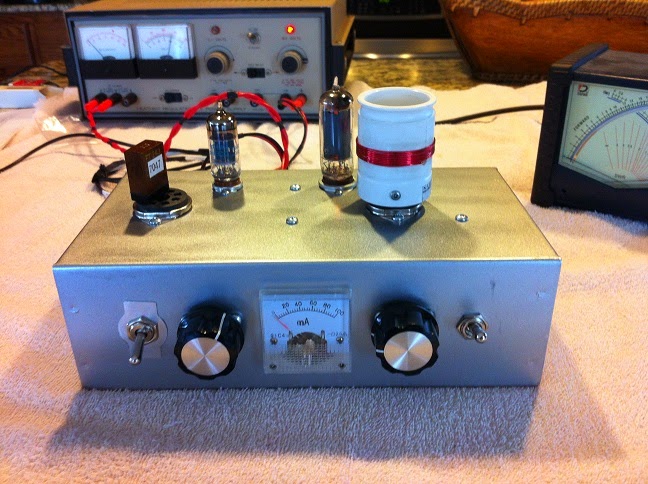
Pete, Bill: Applied power to the 6C4 / 5763 transmitter for the first time today. I made RF. No smoke was released to the wild. Only issue is the load air variable cap is fully meshed at full capacitance and still not getting the dip on it. Need to root in the junque box for a 220 or 330pF silver mica and wire that in across the load cap.
As it is its putting out 2w. Listening on a general coverage receiver I’m not hearing any chirp or drift. Will build a low pass filter and have to interface in the power supply. Still have a few details to do such as labeling the controls but for the most part I just built a transmitter from scratch. Happy day at the workbench.
Another fix is to redo the coax from the RX / TX switch. Didn’t have any RG174 so I just grabbed a clipping of RG8X had laying around. Ugly but got the job done.
Somehow this seems appropriate for Pi Day (3-14). I guess it is because the antenna is circular. Thanks to David GM4JJJ for sending this to us. There is no audio. Kind of fun to watch the lads struggle with the big antenna while wearing coats and ties! David writes:
Hi Bill,
Just watched the video of the progressive receiver and immediately noticed the old Eddystone drive and dial.
My first general coverage receiver was an Eddystone 840C in about 1969 I guess, so it brought back fond memories.
I also had (much later) an Eddystone 770R VHF receiver, which I used to listen to transatlantic 50MHz on during the sunspot peak a couple of cycles ago now. That was before we were allowed to transmit on 6m over here.
Incidentally if you saw the recent film “The Imitation Game” about Alan Turing, you might have spotted the 770R in it, which was actually a mistake as the receiver was not produced until after the war.
Now something to break your heart, and mine actually:
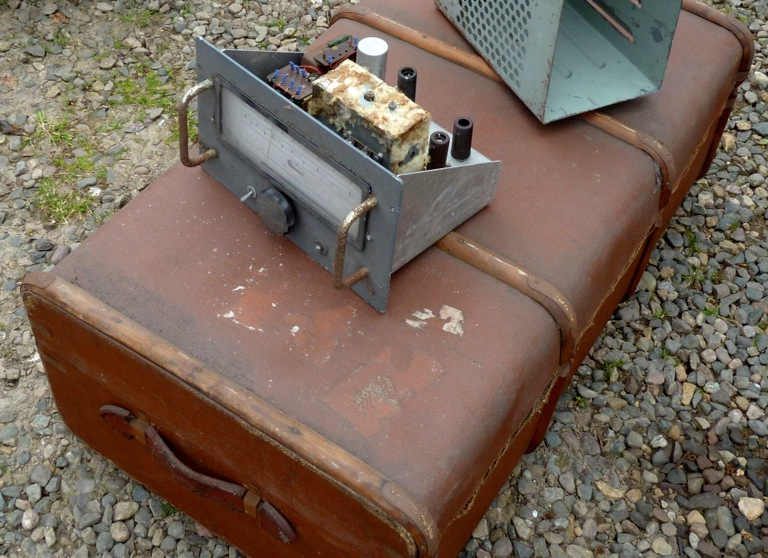
This old rig which was given to me sometime in the 70’s by another ham, was stored the attic of my previous house now used by my brother, and a couple of years ago I had to clear the attic of the “junk” that I had left when I moved out. I didn’t have any more room to store quite a lot of things and I made the decision to take a few things that I never thought I, or anyone else, would need. They went to landfill. 🙁
As you can probably see there is an Eddystone drive and dial driving a VFO which originally had insulation material around it for thermal stability. I think it may have been mixed or multiplied up to 144MHz judging by the scale on the dial. Looking back now I should have tried to save it, but I just felt at the time it would just probably lie in my new attic until I departed and then someone else would have to throw it out.
I don’t know exactly who made it, I was given it by Andy GM3IQL(SK), but I vaguely recall him telling me that it was made by Fraser Shepherd GM3EGW(SK) who I did not know as he died tragically young, but was a brilliant constructor. It could equally possibly have been made by Jimmy Priddy GM3CIG, and I could contact him as he is still around in his 80’s now. At least I had the sense to take some photos. Now a couple of semi related video material that I put up on YouTube.
This is a (silent 8mm) film made in the 1965s about the first moonbounce attempts from Scotland and Jimmy CIG made the film. My Elmer Harry GM3FYB(SK) is in it.
Bill, I really enjoy SolderSmoke podcasts etc, I am returning to ham radio after about a decade, got the bug again….
The KX3 is in the shack, and I have the parts here now to build a QRP WSPR beacon by Hans Summers also.
I like QRP, having previously worked with George GM3OXX back in the 70’s when we went out portable with wideband FM QRP 10GHz (3cm) gear using Gunn diode oscillators. Just a few mW and we could work several hundred miles with small 2 foot dish antennas in the right conditions over water by super refraction. The receivers were just mixers, no active RF amplifiers in those days.
I think the best I did was 322km with my 10mW from Scotland to Wales on 10GHz. A couple of decades I built up a real SSB transverter with surplus MOSFETs for 10GHz and with greater power (250mW) and SSB bandwidths I could work non line of sight paths on that band from home.
I also like QRO for such things as 2m EME (moonbounce) and am in the course of replacing my old 8877 W6PO design 1500W amp for 144MHz with an Italian manufactured LDMOS 1kW amp that is a fraction of the size and weight, who would have imagined a single solid state device would be able to do that at a price amateurs could afford?
Anyway enough of my ramblings.
Hope you don’t mind me taking up so much of your time, I will let you get back to whatever you have on your workbench!
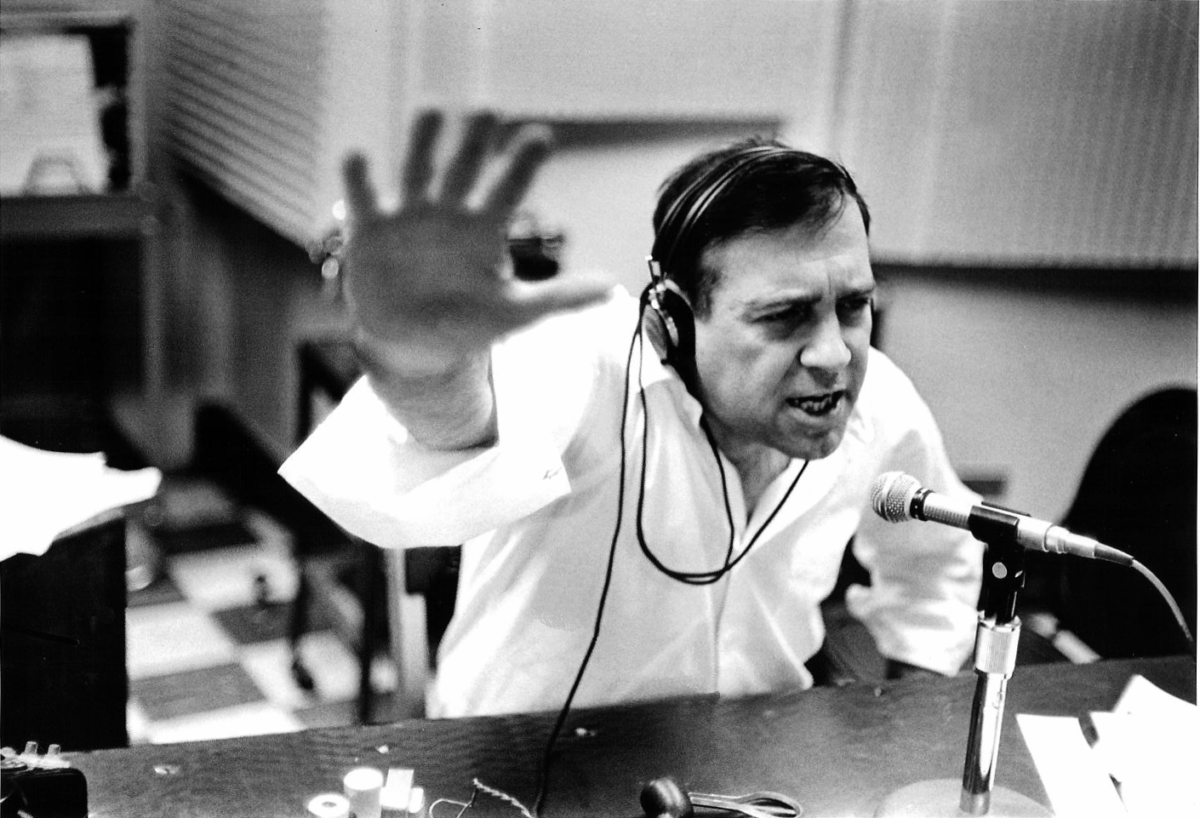
You guys really have to listen to this. This is culturally important. And it is a great follow-up to SolderSmoke 173.
In this 1965 radio broadcast, Jean Shepherd describes his teenage struggles with parasitics and other technical problems in his homebrew 160 meter transmitter.
He describes the sound of parasitics on a signal, saying that they sound as if the signal is being attacked by “debauched erotic locusts.”
He really nails it in describing the scornful, dismissive tone that many hams use in telling their fellow radio amateur that there are problems with his signal. ( I have recently been on the receiving end of this kind of treatment.)
He observes that no one is more worried, “than a man who has built something and can’t get it to work.” Indeed.
During a date with a girl from his high school, he is so obviously pre-occupied with his transmitter trouble that she tells him that something is wrong with him and that his mother “should take him to a doctor.”
And he describes the joy that comes when you figure out the problem and get the thing to work.
The REALLY good stuff begins at about the 25 minute point.
Shep was quoting from King Lear: “O, that way madness lies; let me shun that; No more of that.” In other words: “BASTA!” That is what I have said about my 40 meter troubles. My BITX 20/40 is now a BITX 20.
It has been a while since I visited the Amateur Logic TV site. When I looked in last week I found George and Tommy building a spark transmitter. Pretty cool! The sparks begin to fly at about about the 23 minute point in this video. Very interesting. Way to go guys! SPARK FOREVER! (You will see that emblazoned on the QSL cards of REAL old timers. They were railing against those newfangled Continuous Waves. There is a lesson in there for me… )
In case you missed this. Makes you think, doesn’t it? I’m thinking of a QRPp QRSS transmitter that would just keep on going. Battery designed by Giuseppe Zamboni.
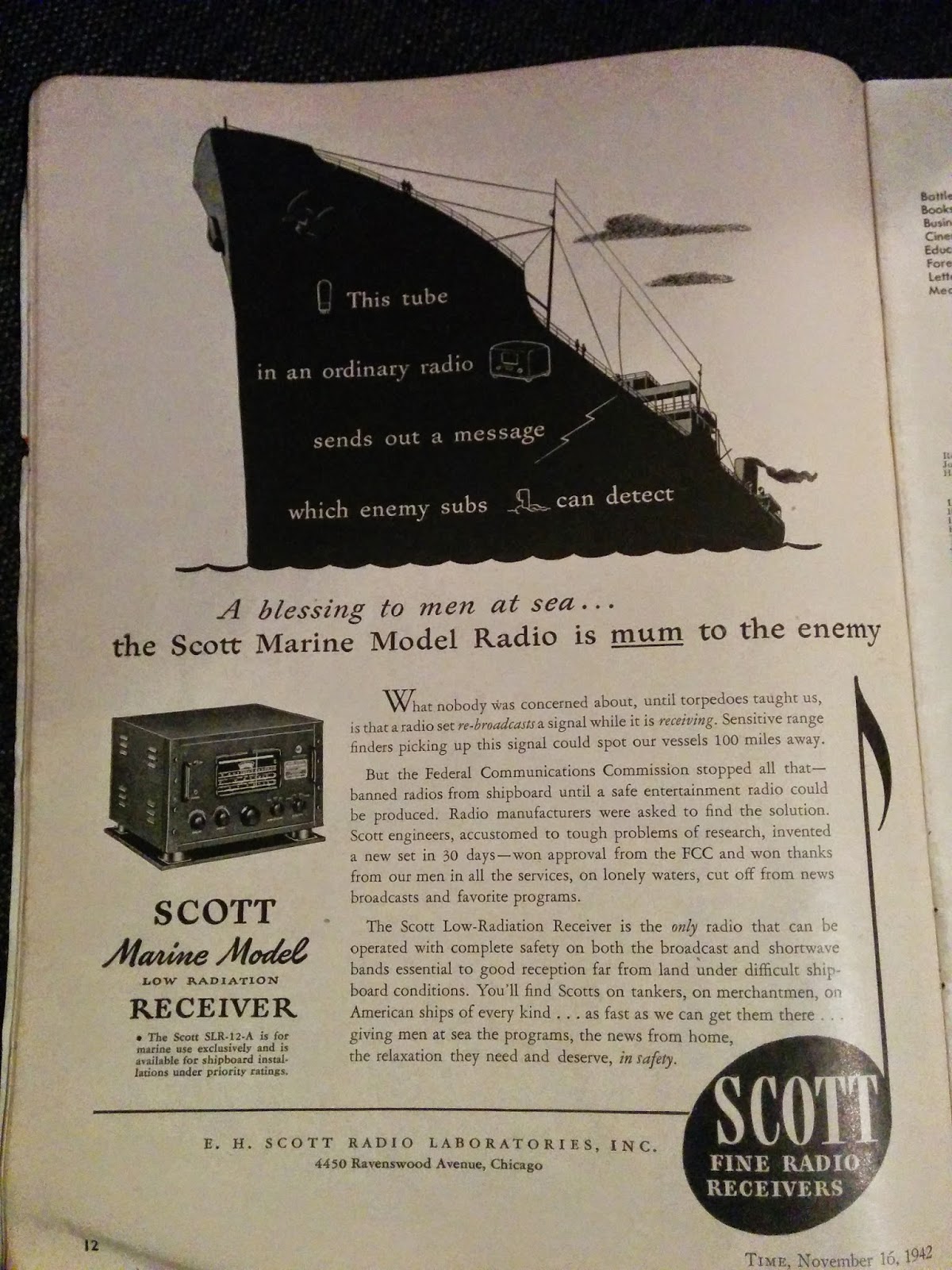
Thomas KK6AHT is the intrepid radio amateur from France who moved to California and successfully built a Minima as his first homebrew project. Yesterday we got additional evidence that Thomas definitely has THE KNACK. It seems that he has been looking through really old radio magazines (clearly a symptom). He sent us this add from 1942. Yikes! Imagine getting your ship sunk because your Local Oscillator is not quite local enough!
…………………
Hey!
I thought you would get a kick out of this 1942 ad. Sounds like those guys had a some good reasons to fight QRM … Who knew the important role played by the FCC during the war?
Now tell me: why were the receivers so noisy at the beginning of the war? What did they change? Happy new year to you both! May the gods of radio (and digital) bring you much fun on the air.
73, Thomas
…………………………
Good to hear from you Thomas. Long time no hear — I was beginning to fear that you had grown disillusioned with homebrewing and had switched to stamp collecting or something else less frustrating.
As for the ship radios, two things come to mind. Some of them may still have been using regens at the start of the war. If so, that was kind of suicidal — regens radiate! The detector moves in and out of oscillation (sometimes staying in oscillation) at the receive freq. The Germans were quite good at detecting and direction-finding these signals, on land and at sea. So the regens would have to go.
Superhets are not quite as bad, but they too can radiate. My Bitx spills out a bit of signal at 23 MHz (VFO) and at 5 MHz (BFO). Without adequate shielding, these sigs could also be detected and triangulated. Looks like the radio in the picture had lots of shielding.
We watched a French movie last night: The French Minister. A comedy about life in the French Foreign Ministry. It was kind of fun.
What are you working on? I am listening to 17 meters using an OLD superhet in which I have replaced the VFO with an Arduino/DDS generator. Works great but the display is making lots of noise.
73 Bill
…………………………….
Hi Thomas,
Well Thomas, I will dip my toe into some very deep water and attempt an answer for you which also is an important clue about QRP operations.
Today we have many many signals co-existing in the radio spectrum. During the war there was much less radio garbage and the military lit up the ether with transmissions very sparingly. But that is on the transmit side. That said the local oscillators (much like you have with the Si-570 on your Minima) used in receivers also produce RF that unless is minimized in some fashion is passed right through to the antenna and can be detected. Regenerative receivers are especially prone to this. Yes some military equipment used regenerative receivers. In fact the famous Paraset had to be constantly moved so it would not be detected.
This receiver generated RF into the antenna was addressed by companies like Scott by shielding everything. That receiver in the photo probably weighed about a 100 pounds or more. Much attention was paid to RF bypassing and grounding. The cheap table top radios were RF generators par excellence.
There was another approach developed in WWII to solve that problem and forms the basis of what makes work that little device sitting in your pocket. The odd part it was invented by a famous movie star. Look up Heddy Lamar in wikipedia. She and a co-inventor came up with the concept of frequency hopping and spread spectrum technology. By jumping frequencies it would be hard to pinpoint a transmitting station. That concept forms the backbone of our cellphone system
Now the QRP part – if the RF output from a receiver local oscillator (milliwatts) can be detected from afar – then it follows QRP works!
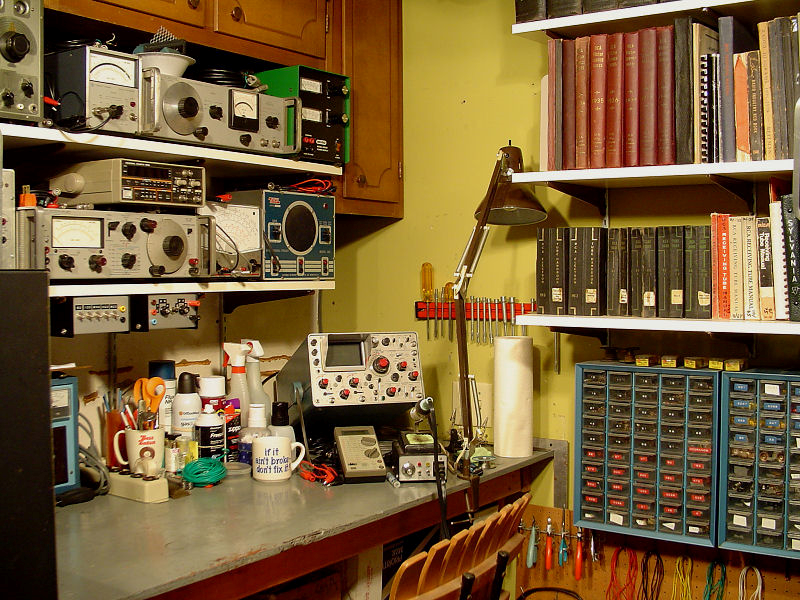
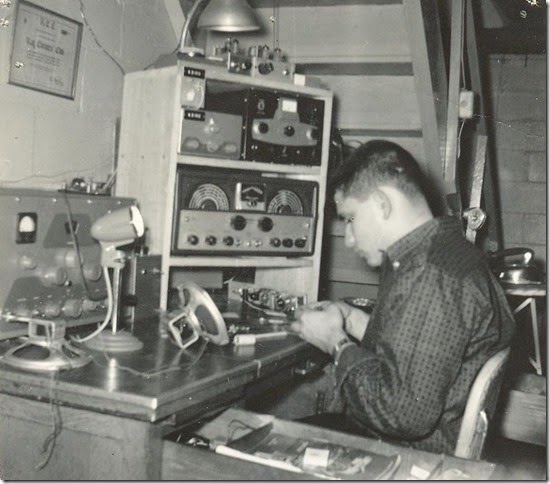
This is vintage early 1960’s and my call sign at that time was K3???. One of my favorite rigs was the Johnson Adventurer which I built and had a 6AG7 driving an 807 –50 watts input. On the top shelf near the lamp is the screen grid modulator for the Adventurer. I was in tall clover.
On the bottom opening is a 40M CW transceiver I built – it had a 6CX8 MOPA—about 5 watts. The RX was a two tube regen.