75 and 40 Meter AM on my HQ-100 (Videos) + Digital Display

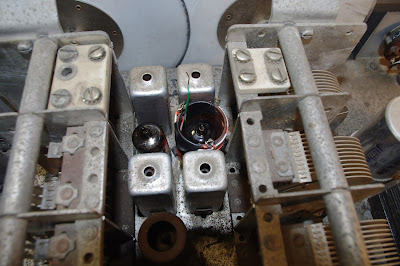
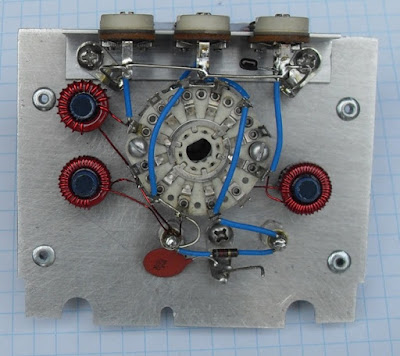
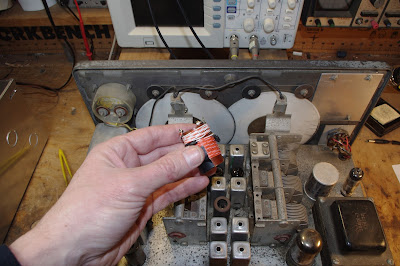
And here is how I sample the oscillator frequency for the digital counter. I use an old trick: I wrap some wire around the oscillator or mixer tube. I made the coil out of an old coil form. I had to play around with the number of turns to get suitable pickup on both 160 and 40 meters. The San Jian board allows for IF freq offset. I use a similar arrangement on the transmit side with the DX-100. By the way, the box that houses the two displays is the carcass of one of the Heath QF-1 Q multipliers from which I heartlessly pulled the nice reduction drive variable caps for use in my BITX rigs.

Add caption

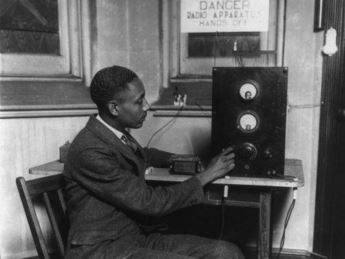
Dr. Rufus Turner, W3LF. Homebrew Hero and Radio Pioneer

Thanks to Farhan for alerting me to this great Hackaday article about a homebrew hero who was — sadly — unknown to most of us. He lived in Washington D.C., right down the road from where I live now. The Hackaday article leaves no doubt about it — Rufus Turner was one of us. He had THE KNACK. He was a true radio pioneer and homebrew hero. It is really a shame that we’ve known so little about him.

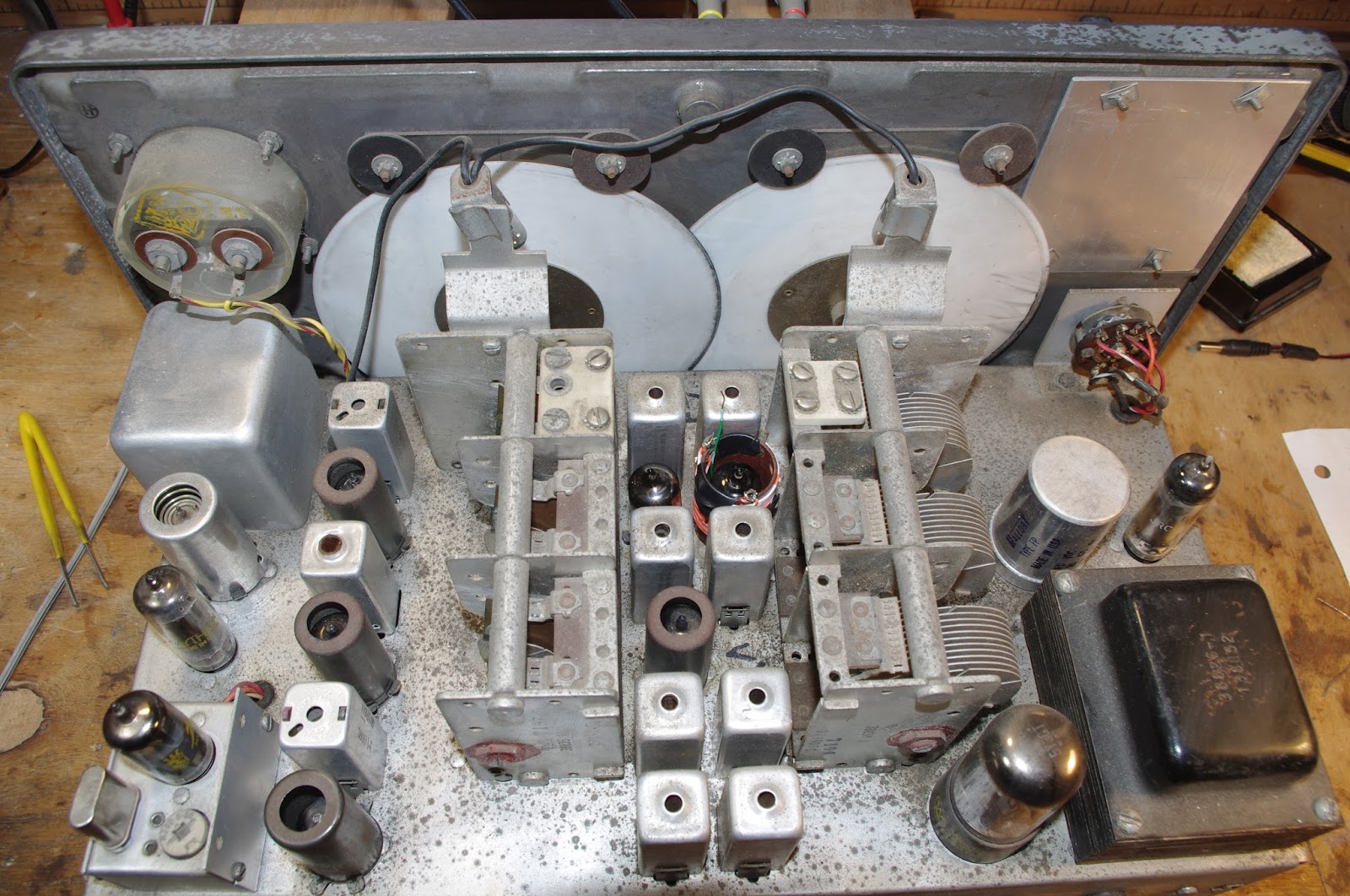
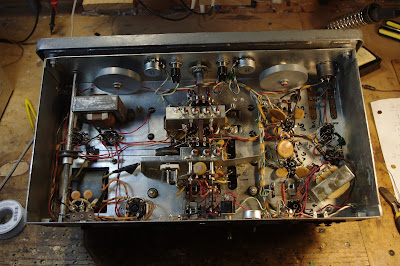
Inside the Hammarlund HQ-100

I continue to work on this old beast. I picked it up in the Dominican Republic around 1994. One of the IF transformers had gone open. I fixed that. Had to replace the AF output transformer too. And the variable cap that tunes the antenna. Check out the flywheels! And the rope and pulley thing. You don’t find those kinds of things in any of those fancy modern rigs.

Earlier I had removed “the exclusive Auto-Response audio output circuit.” See:
http://soldersmoke.blogspot.com/2016/02/snowed-in-audio-mods-on-hammarlund-hq.html

Today I installed a simple feedback network in the AF amplifiers (as prescribed here:
http://www.amwindow.org/tech/htm/hqaudiomods.htm

It sounds nice now. The rest of the bands have been ravaged by some sort of solar event, but 160 seems to be benefiting — signals last night and this morning were quite strong. I was being heard by WA1HLR way up in Maine.

UPDATE 20 Feb 2016: After installing the feedback network mentioned above, I noticed a big increase in AC hum. It was not the electrolytics. I reversed the feedback mod and the hum went away. But the receiver continues to sound a lot better with the removal of the Auto-Response output circuit.

Snowed In! Audio Mods on the Hammarlund HQ-100

It is snowing here today, so I am stuck in the hamshack. YEA!

I’ve had the Hammarlund HQ-100 receiver on the bench because I am building an outboard digital frequency readout for it and for the DX-100. More on this later. But as long as I had it on the bench I decided to do a mod to the audio output that has LONG been needed.

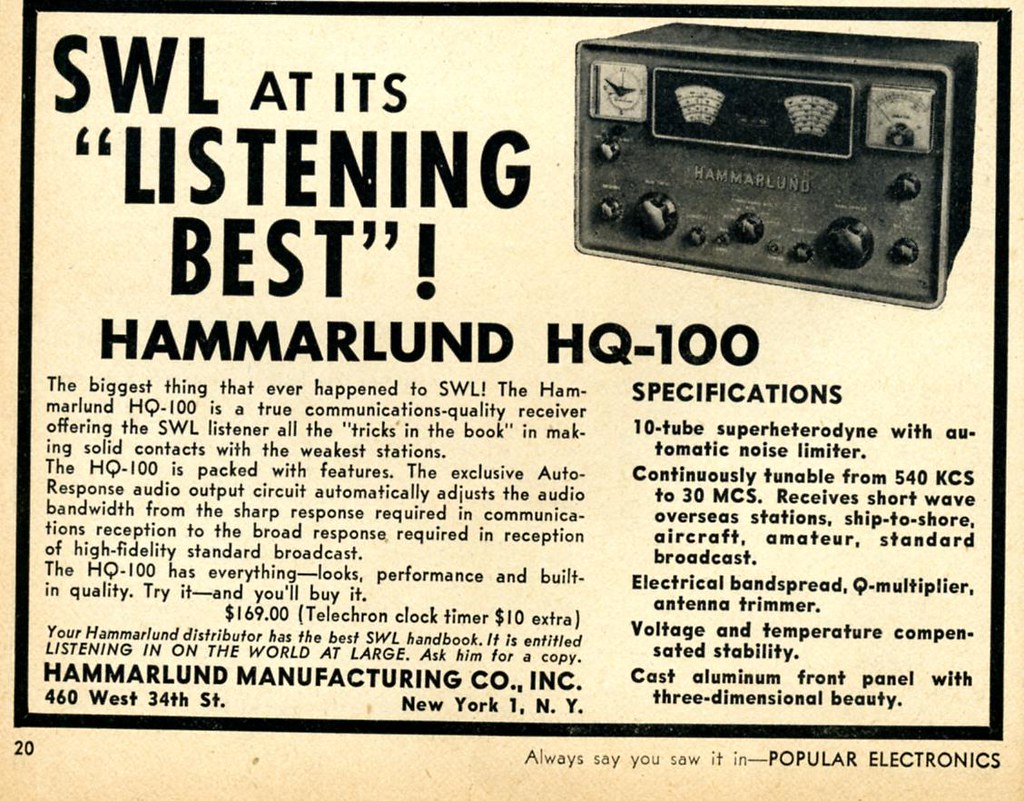
Here is a nice web page that describes the problem and the solution. The problem is the “Auto Response audio output circuit” touted in the add up above. Essentially I had to remove the touted circuitry. The AutoResponseectomy only took me about 15 minutes and the results are quite noticeable. The old receiver sounds a lot nicer. I’m listening to 40 meter AM now. FB.

Here is the page:
The HQ-100 does indeed have “three dimensional beauty.”

Single Sideband + Carrier — The Collins KWS-1


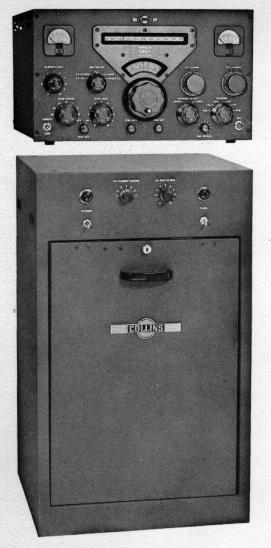
Back on 2 February I was on 160 AM with the DX-100, talking to WA4PGI. At the end of our QSO we got a call from a station. I was at first confused — was this station calling on SSB? Or was he calling on AM? Turns out that he was — in a way — on BOTH. K4DBK was — I think — running an old Collins KWS-1, the transmit side of the famous Gold Dust Twins. Aptly named: It was built in 1955. 1000 watts output. $2095.00 in 1955. Gold dust indeed.


The really interesting thing about this rig was that it put out CW, SSB and SSB plus the carrier. I think that was what we were hearing from K4DBK. FB.

Does anyone have an e-mail address for K4DBK? I’d like to drop him a line.

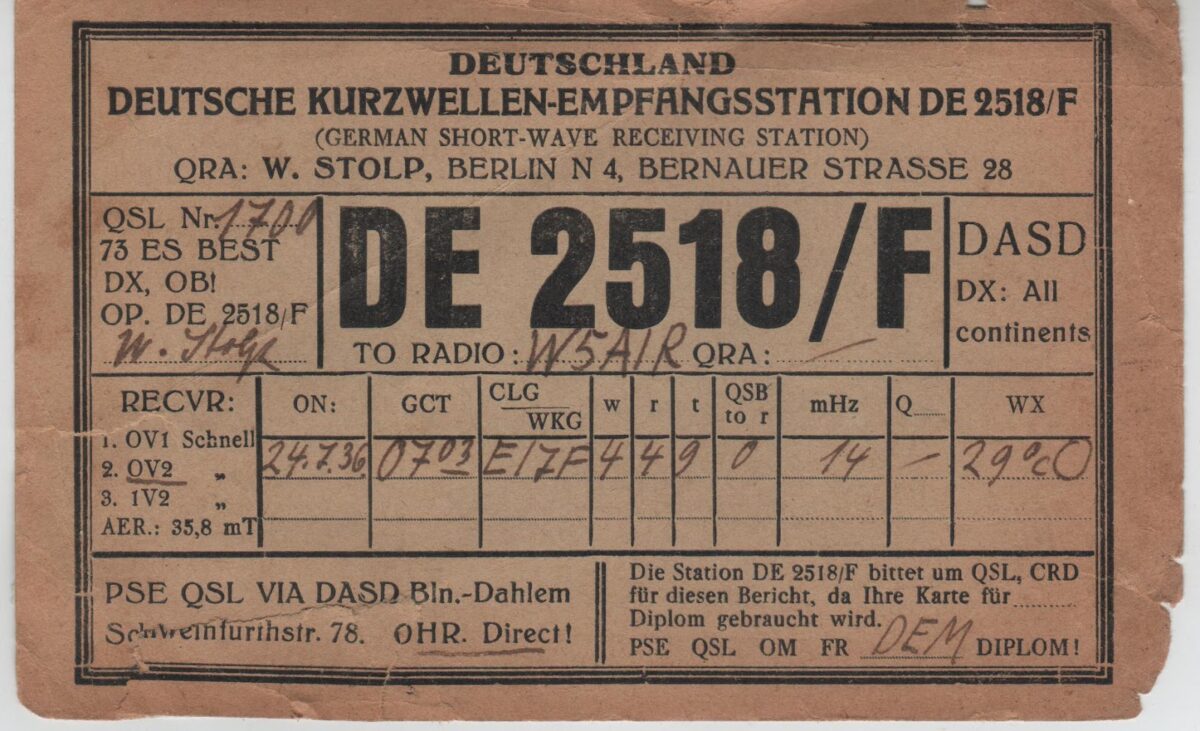
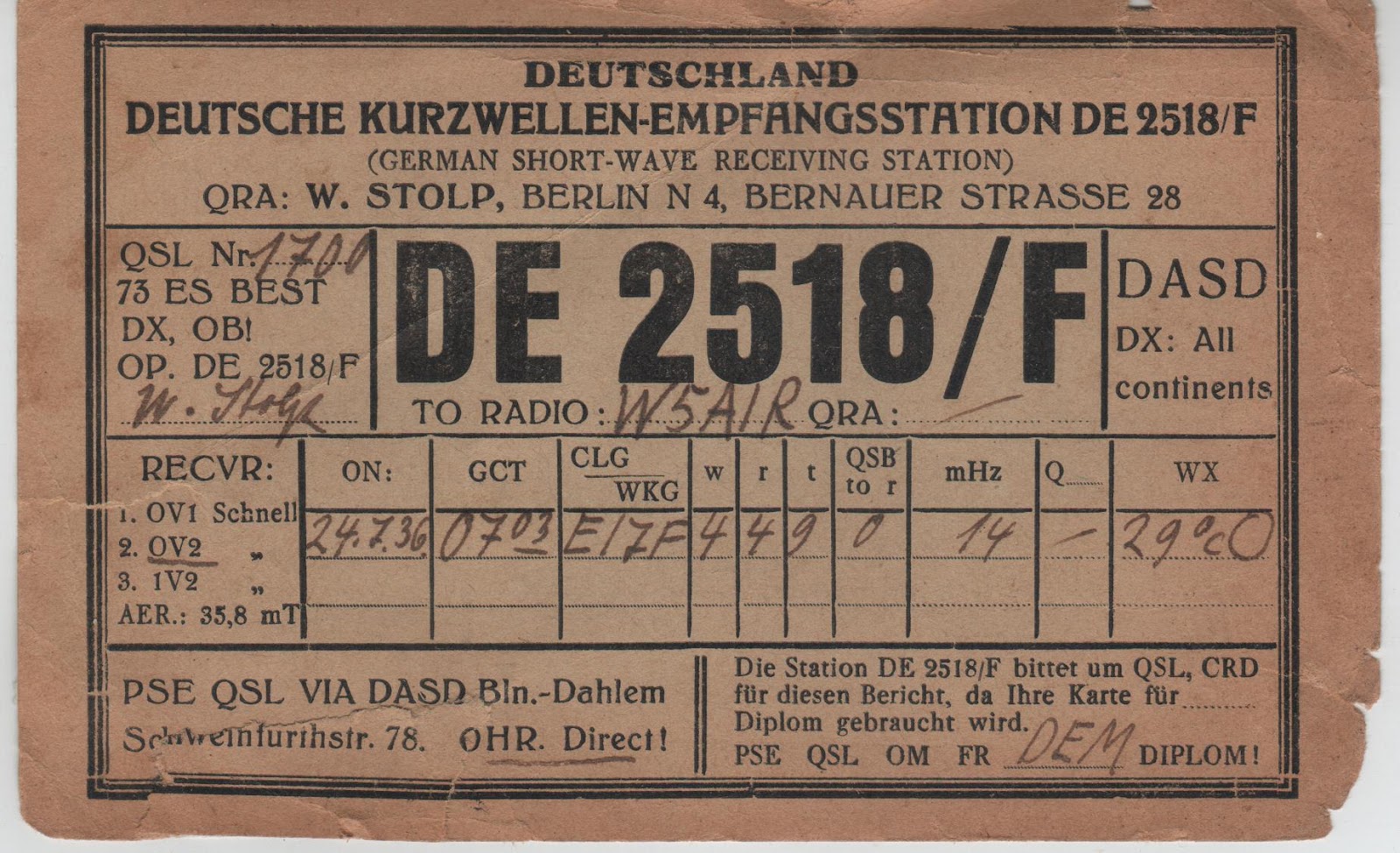
1936 Shortwave Listener QSL card

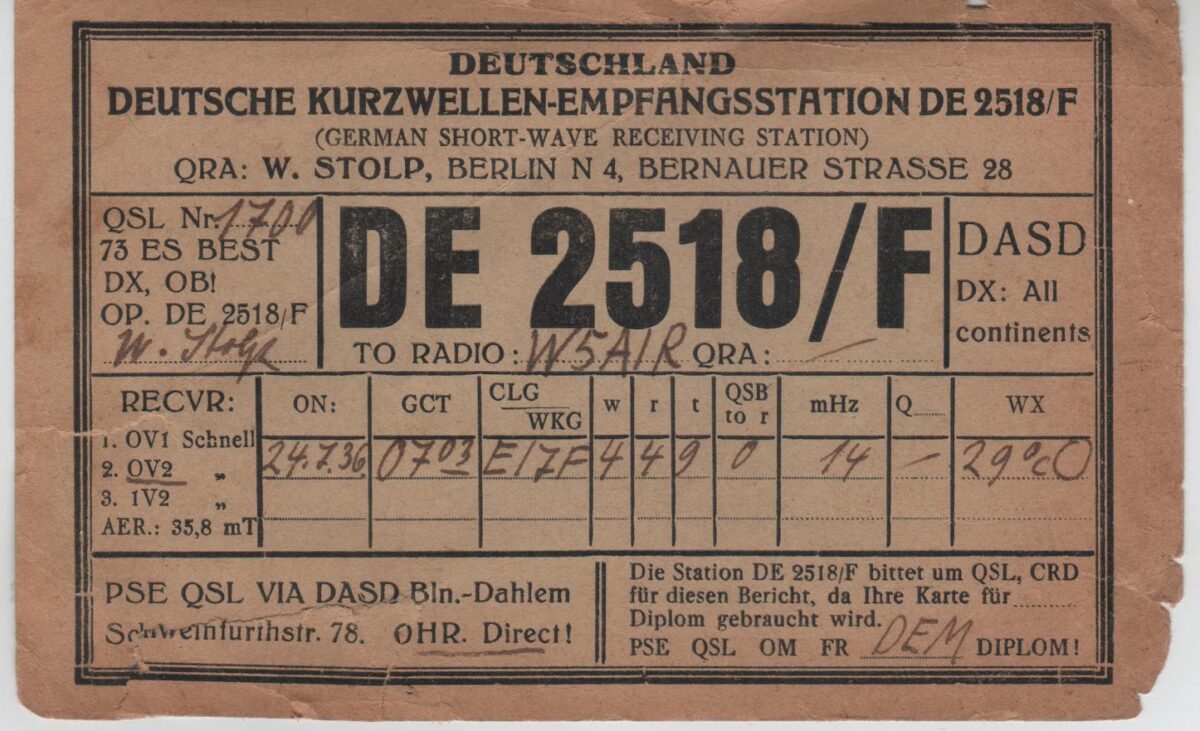
I found this today while rummaging around in the shack. It is starting to fall apart so I figured I better digitize it before it turns into dust.

July 24, 1936. 7 am in Central Germany. 29.0 degrees Centigrade. Clear skies? German Shortwave Receiving Station DE 2518/F monitored W5AIR’s contact with Irish station EI7F on 20 meter CW. The receiver was an OV2 Schnell tube (almost certainly a regen) fed by a 38.5 meter long antenna.

Conditions must have been pretty good — they were approaching the peak of sunspot cycle 17.

In 1954 W5AIR was assigned to Garold D. Sears. He was probably the operator.

1936 Shortwave Listener QSL card

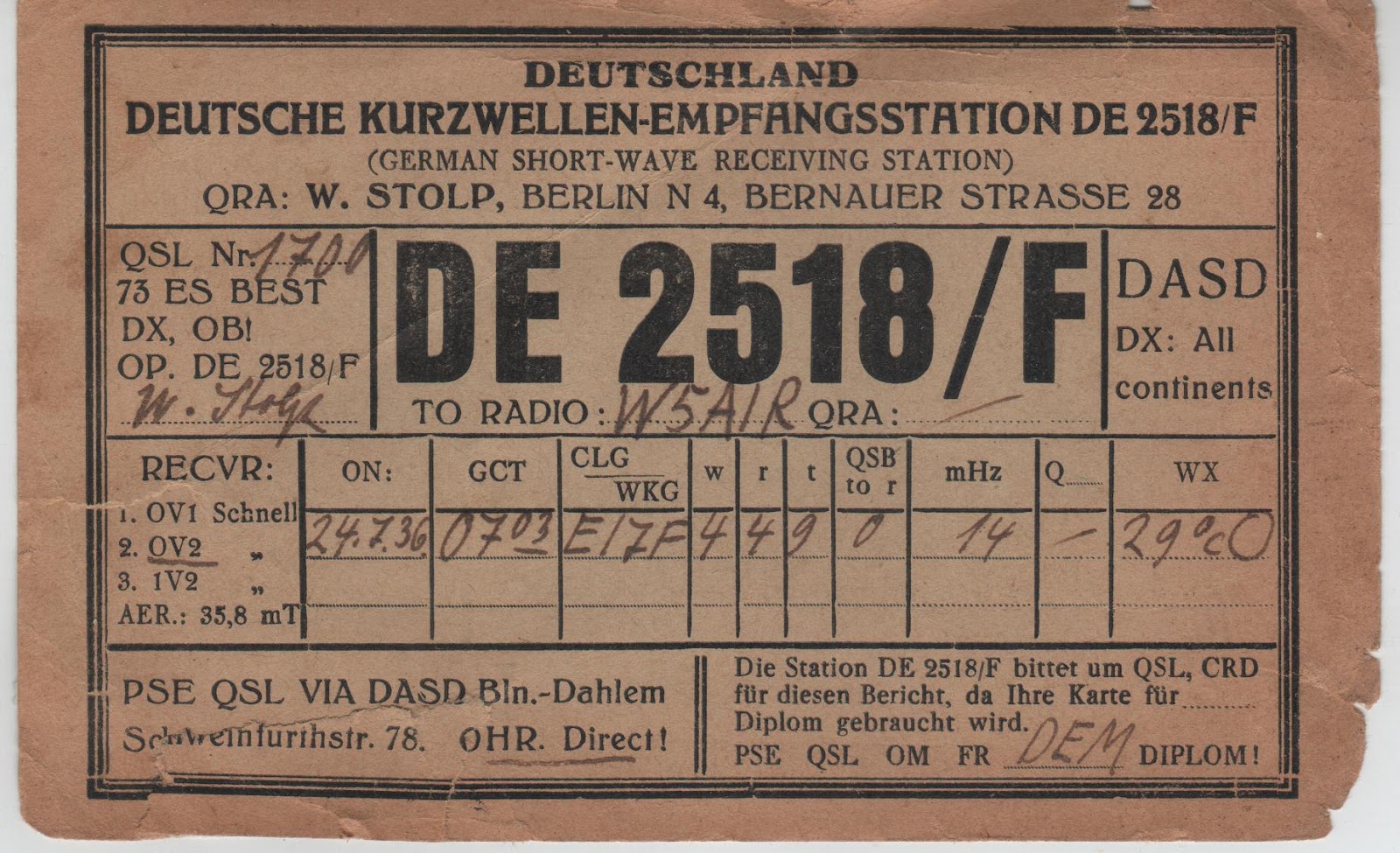
I found this today while rummaging around in the shack. It is starting to fall apart so I figured I better digitize it before it turns into dust.

July 24, 1936. 7 am in Central Germany. 29.0 degrees Centigrade. Clear skies? German Shortwave Receiving Station DE 2518/F monitored W5AIR’s contact with Irish station EI7F on 20 meter CW. The receiver was an OV2 Schnell tube (almost certainly a regen) fed by a 38.5 meter long antenna.

Conditions must have been pretty good — they were approaching the peak of sunspot cycle 17.

In 1954 W5AIR was assigned to Garold D. Sears. He was probably the operator.

Happy New Year! Straight Key Night on 160 Meters

A while back, when I first mentioned getting on 160 meters by year’s end, Pete suggested I shoot for Straight Key Night. As many of you know, suggestions from Pete somehow seem to have a way of becoming ham radio MORAL IMPERATIVES. He seems to be a prophet of sorts, a prophet of THE RADIO GODS. So following the guidance of the oracle of Newbury Park, I found myself in front of my DX-100/HQ-100 on New Year’s Eve, on 160 meter CW for the first time in my 42 years as a radio amateur.
It was great. A couple hours prior to the official 0000Z start of Straight Key Night I had my first 160CW QSO. It was with John WA2MUA up in Summit, NY. John’s QRZ page includes this: Years ago–as a teenager– in an attempt to get enough wire for 160 I wrapped a quarter wave of wire around a pvc pipe, strapped it to a wooden gutter—-burned a large notch in the gutter and could have burned my parents’ house down!” That, my friends, is 160 meter KNACK!

Then, just minutes after SKN kick-off, I worked John W3LR in Eastern Pennsylvania. It was also John’s first SKN contact.

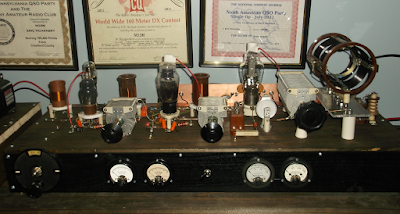
Next up was Eric NO3M. Wow, this one was amazing. Eric was running the homebrew rig pictured above. On his blog Eric describes the rig: “The transmitter is running a 89 Clapp oscillator, 802 buffer, 811 final… Output power is approximately 75W. “
Eric’s antenna is even more amazing: it is a 160 meter four square featuring FOUR aluminum tubing vertical elements with capacity hats and –GET THIS — a radial field consisting of 22,000 feet of bare copper wire. TWENTY TWO THOUSAND FEET OF BARE COPPER WIRE. Wow, you just don’t run into stations like that on 20 meter sideband. Eric’s blog: http://no3m.net/ But Eric — a Vibroplex Champion? On SKN?
I then worked KC2LSD and K1EEE. FB!

My last contact of the evening (and the year) was K1WHS, Dave in Maine. On his QRZ.com page, Dave reports:
On 160 meters, I have a small setup right at my house. I use a K3 with a homebrew 3-1000 amplifier that runs at 1300 watts. The antenna is an 80 ft Rohn 25 in my backyard with some top loading and shunt feeding. I laid out a bunch of radials in an effort to get the efficiency up. At last count I had about 107 1/4 wave radials strung out. 160 is the only band where my feedline is not big fat hardline. I use a run of RG-213. For receive, I have several beverages running in the woods. I use this setup often in the winter as many times, the hilltop shack is not accessible due to heavy snow. I have nothing up for any of the bands between 160 and 10 meters”.
Thanks to all of my SKN contacts! And Happy New Year to all SolderSmoke readers and listeners!

The Secret Life of Machines — The Radio (Video)

Thanks to Rick N3FJZ for sending this to us. In 25 minutes these fellows manage to capture and explain much of the “magic” of radio. Great shots of Marconi, and of Hertz’s first rig. Amazing how they built their own spark transmitter and coherer receiver, launched a kite antenna and sent a signal across the harbor. Great stuff. Lots of history. We’ve met Mr. Wells before — he was “jailed for having the Knack!”

The Pleasures of AM, and The 807 (Truly a Bottle Worthy of the Gods)

Sometimes a message posted in the comments section of the blog is so good that it needs to be raised up and converted into a posting all its own. Such is the case with a message that Rupert G6HVY sent us last month about AM and old rigs. 60 meters eh? Hmmm…


Rupert wrote:

It’s always a pleasure to listen to AM QSOs, which hereabouts seem to be mostly on 80 and 60. I bought an FM board for my FT-101ZD with the intention of getting some 10m action, but now I think I’ll leave the AM board in (you can’t have both) for when I get the beast out of storage. AM, even AM that hasn’t been optimised for beautiful audio, sounds so much nicer than SSB.

The other side of AM is to get old military rigs up and running, which is quite the opposite to the golden voice crowd. Another project waiting for time and energy here is an RCA-built Wireless Sets Number 19, which can put out ten watts or so of AM from its 807 (truly a bottle worthy of the gods) – and of course, there are infinite numbers of 50s and 60s vintage thermionic projects in the contemporary magazines. It would be particularly satisfying to find the original PSU for that, as it has two Dynamotors to convert the 24V DC supply to HT, with the transmitter one cutting in when the PTT (sorry, pressel switch) is hit. I say cutting, it actually runs up to speed over a couple of seconds, giving an original 19 Set a very distinctive slow fade-in at the start of an over. Hearing one of those crackling away on 5 MHz is utterly delicious.

Rupert, G6HVY

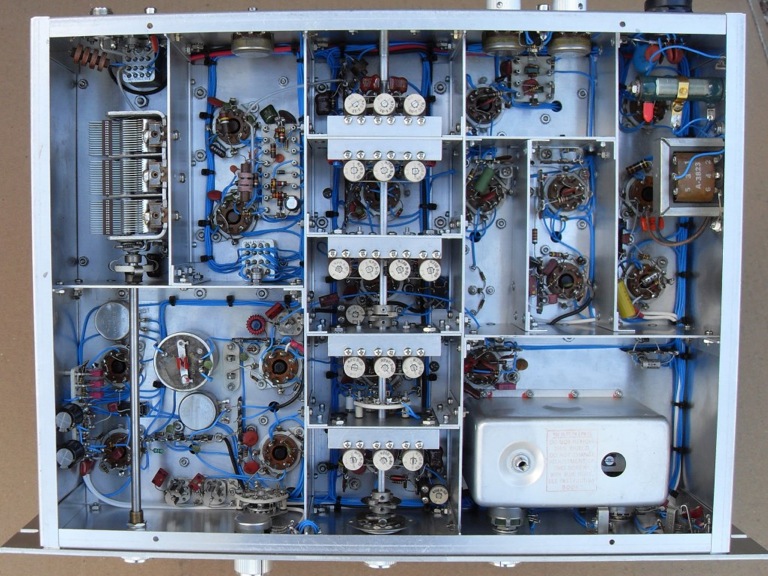
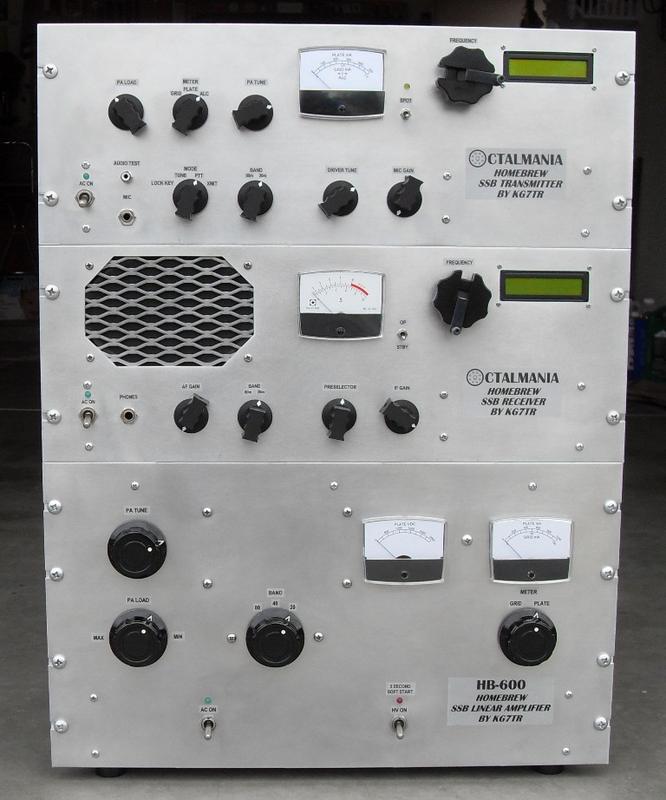
Octalmania — KG7TR’s Amazing Thermatron Rigs

Grayson in Turkey alerted us to Mike’s homebrew rigs:

Bill, Pete:

AM Madness: Just When You Thought It Couldn’t Get any Cooler…

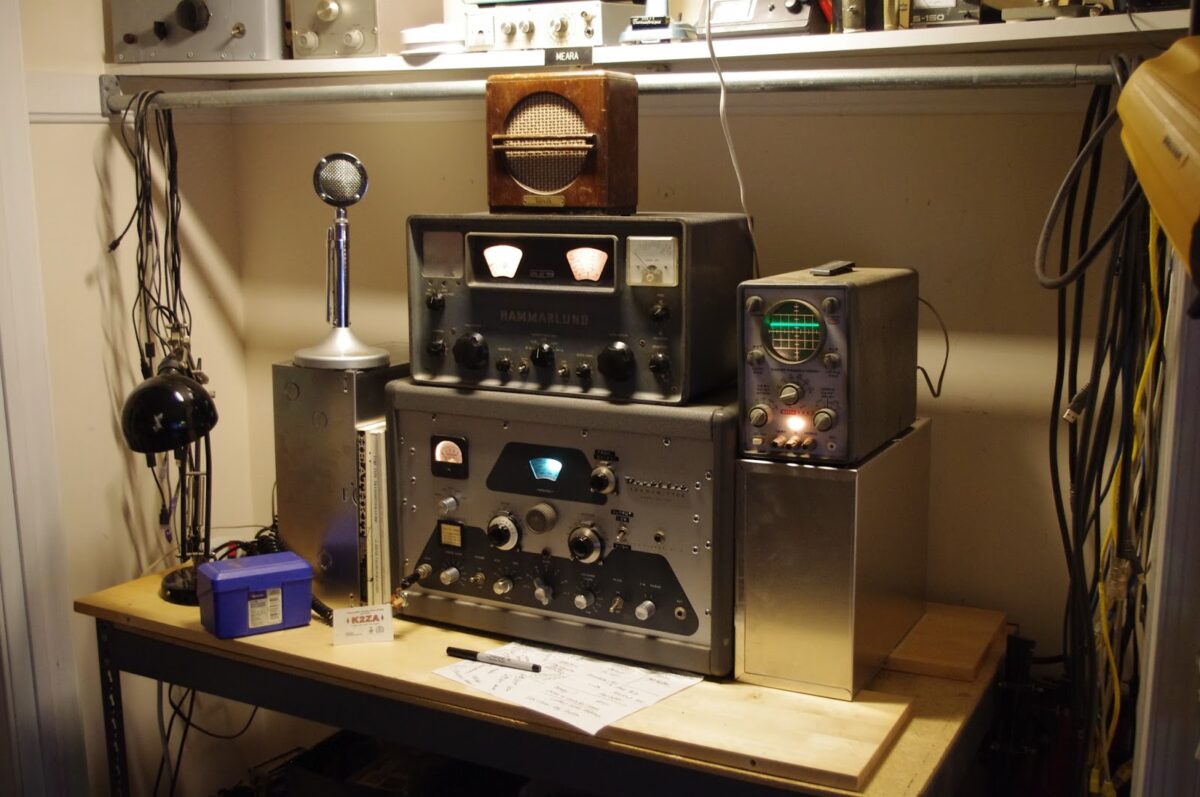
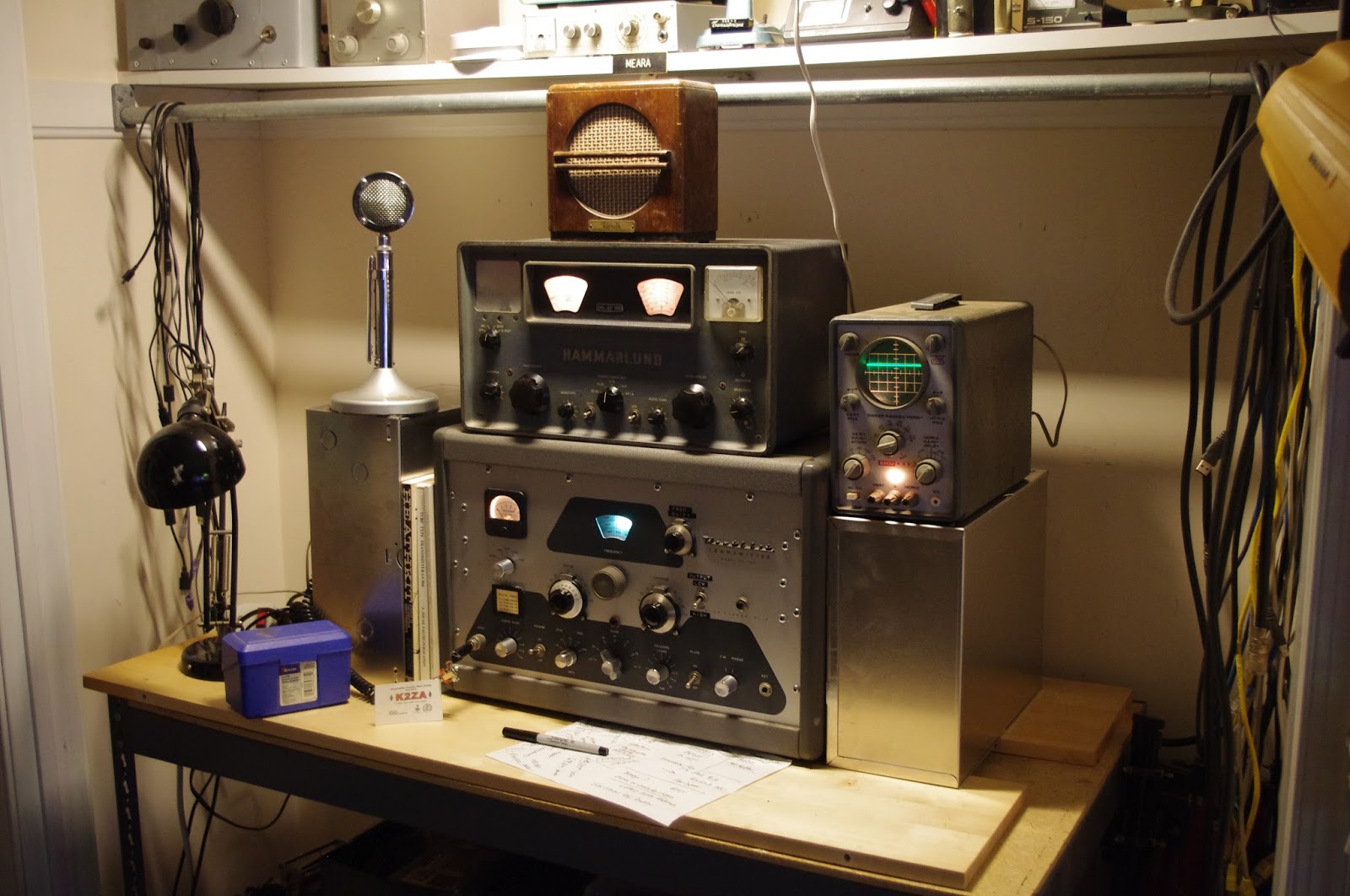
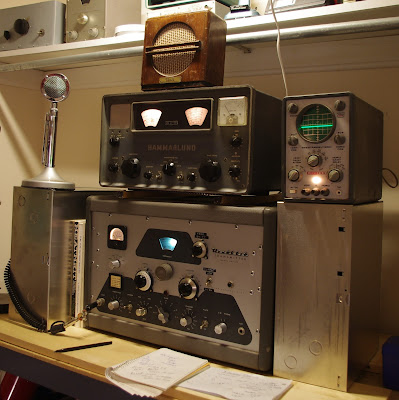
I pulled an old Eico 435 ‘scope out of retirement. I hope to use it as a modulation monitor (any suggestions on easy ways to hook it up for this purpose?). I really like the grey and aluminum look of this station. I tried putting a DX-60 on the same bench, but the green of the “modern” Heathkit clashed with the serious-radio look of the DX-100 and HQ-100. Thanks again to Tim Sutton for the aluminum boxes — I am temporarily using them as supports for the D-104 and the ‘scope. You see, I’m standing up when I modulate this gear. Somehow it seems right. Also, the transmissions on AM are so long that you can go back to your chair and rest (a lot!) between your transmissions. When your turn comes, the few seconds it takes you to get to the rig provide the customary (and polite) “dragging of the feet” that allows others on the frequency to announce their presence. Then comes what is perhaps the most fun part of this setup: the AWESOME KERCHUNK sound of the DX-100 going from receive to transmit. As you can see, we pay a lot of attention to aesthetics and radio ergonomics here at SolderSmoke HQ. That little blue recipe box holds my AM contact card file from the 1996-2000 period of operations from Northern Virginia.
I’m planning on doing a little work on the DX-100. There is a standard set of mods to the audio amplifiers, mostly just changing some caps. And I need to find out why some of the crystals are not working — I suspect dirty contacts. I might also change the mic connector. Looking ahead, Steve Silverman KB3SII (SolderSmoke Lex-pert), Pete Juliano N6QW and I have vague plans for an assault on 160 meter AM.
Over the weekend this rig yielded a number of really FB contacts. Brett N2DTS in South Jersey was running an amazing homebrew station:

And Now for Something Completely Different: Boatanchors! AM! Top Band!

Lately I found myself looking for something different to get involved in. Pete’s conversion of his Ten-Tec commercial rig got me thinking about converting an old CB rig to 10 meter AM. I’m still planning on doing this, but noodling on this project got me thinking about AM in general. I had the DX-100 that John Zaruba K2ZA had given me (it was his dad’s). I had it paired up with an old HQ-100 that I’d picked up in the Dominican Republic 20 years ago. (Looking at the old manual for this receiver, I realized that there is another reason why I feel so connected to it: it was built on West 34th St. in New York City, not far from where I was born.) On Veterans Day (November 11) I connected these two old Boatanchor veterans to my 40 meter dipole, rigged up a connector for my Astatic D-104, and fired up on 40 meter AM.
I had a blast! I found myself in contact with hams who are interested in the inner workings of their gear, guys who know which end of the soldering iron to grab. The DX-100 got great reports — people said it sounded nice.
Sam K4NDY told me that his DX-100 had started out at 100 pounds, but that as time passed (and as he has gotten older) he noticed that it has somehow increased in weight!
Bill K8DBN was running a DX-60 and (like me) an HQ-100 (you see, we’re no longer in Yaesu-Icom-Kenwood land!)
Mike KC2KJ was running a DX-100 and a Drake 2B. FB!
Steve W3DEF was on with his B&W 5100B.
Dave W3CRA was on from the Collins Radio Association. He restores Collins gear. When he told me the DX-100 sounded great, I knew that it really did.
Today I talked to Ed KA3PTX who has this really cool Boatanchor station:
And also today I had a great contact with Howard Mills W3HM, one of the greats in the world of radio restoration. Another fellow on frequency asked me to makes some critical comments on Howard’s signal quality (“Does he have too much low frequency?”) — I refused, saying I was unworthy. (I did say that he sounded great — he did.)
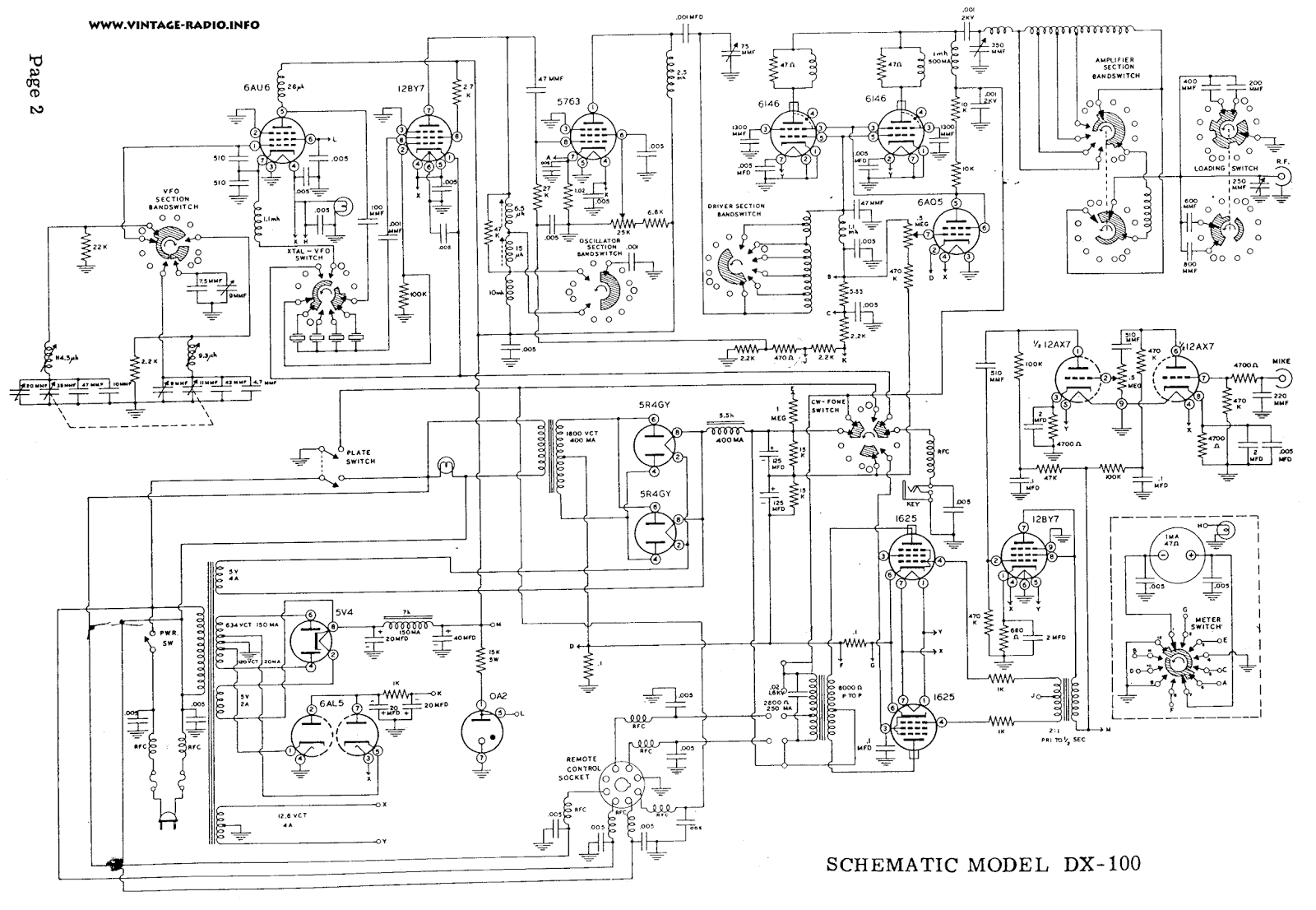
Anyway, I’m out of the rut. An added benefit is that this new (old) interest moves me even further away from microscopic SDR rigs, and closer than ever to the Hardware Defined, analog, discrete component, menu-free radio that I prefer. Check out the full schematic of a DX-100 — simplicity, clarity, beauty:

I had been thinking vaguely about someday getting on 160 meters — I’ve never used those frequencies. Yesterday I noticed that both the HQ-100 and the DX-100 cover this band. THE RADIO GODS HAVE SPOKEN!
Ed Walker of “The Big Broadcast” at WAMU-FM

Ed Walker, the long-time host of “The Big Broadcast” on WAMU-FM in Washington DC passed away on Sunday night, a few hours after his final broadcast. I was a regular listener.
He obviously had an abiding love for radio. His obituary in the Washington Post notes:
Born blind, Mr. Walker grew up with radio as his constant companion from an early age. By age 8, he was operating a low-power radio transmitter in his family’s basement, beaming music to his neighbors’ houses down the block. He would go on to spend almost all of his adult life involved in the medium in some way, all of it on stations in Washington.
Wow, sounds like he had the Knack. I wonder if he ever had a ham radio license?

German Thermatron Homebrew

Michael DF2OK has been melting solder in Germany. Above is a short video of the first sounds made by an AC-1 replica he built. Michael notes: “Yeah, I love these old style radios. You can see nearly everything. 🙂 BTW: All without Arduino and other black boxes and chips!”
FB Michael.

During the AC-1 build Michael struggled with a bad tube. His discovery and resolution of the problem is presented in this video (understandable even to those who don’t speak German):

Finally, here is a nice video of Michael’s 40 meter regen receiver. Anyone who has built or worked with a regen will understand perfectly this video. Watch Michael tune in stations while adjusting the regeneration. Note his demonstration of the lack of hand capacitance. FB Michael! Thanks!

November 2015 QST — Wrist Radios, Phase Noise, and a 1958 BITX!

A Early BITX

I liked this issue. Highlights:
Page 30. Glen Popiel’s article on the Arduino.
Page 33. I know this may come as a surprise, but in spite of my admitted Ludite tendencies, I found the article on High-Speed Wireless Networking to be very intriguing.
Page 38. Hey! Mike Aiello N2HTT has an article about an Arduino-based CW recorder. FB Mike!
Page 54. Review of LNR LD-5 QRP Transceiver. “The LD-5 is actually an SDR in a box with switches and knobs…” They give a phase noise graph.
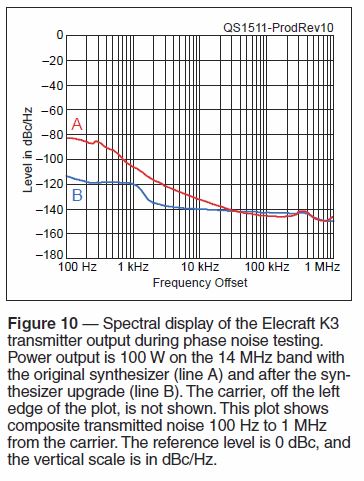
Page 58. Review of Synthesizer upgrade for the Elecraft K3. Uh-oh. Phase noise again. The review says the upgrade results in a reduction of phase noise, but the graphs seem to show an increase in transmitted phase noise on 20 meters as soon as you go 10 kHz from the transmit frequency. I guess this is a tradeoff for a larger decrease in close-in (less than 1 kHz spacing) phase noise? But if the objective on the transmit side is to deal with “a major problem with multiple operators in the same band segment in close proximity” resulting from transmitted phase noise, is this a good trade-off? Also, it would have been interesting to know if the reviewer could detect — by ear — any improvement in the received signal.

Wayne Burdick, N6KR, of Elecraft e-mailed us to let us know that there was an error in this QST article. The original graph in the article showed an improvement in phase noise at close-in frequencies, but it also showed a significant worsening of the phase noise beyond 10 kHz. THIS CHART WAS INCORRECT. The Upgrade does, in fact, improve the phase noise performance. A corrected version of the article appears here:

Here is the corrected graph:

Page 71. My nightmare. The WristRig. The Apple Watch on 40 meters. Sorry Steve, Dick Tracey did not have The Knack, and tackling the “Apple Watch challenge” is not an indication of “homebrew chops.” Software coding chops yes, but homebrewing is, for me, a different thing. (But, as we always say, too each his own… And thanks to Steve for the interesting article. )
Page 82. Ross Hull. Very interesting article, especially the part about OM Ross’s untimely death by electrocution.
Page 100. “The Cosmophones” by Joe Veras. Cool pictures (as always) from Joe. And I loved the first lines: “What in the world is a bilateral transceiver? Byron Goodman, W1DX, posed that question in his June 1958 QST review of the Cosmophone 35.” Wow, four months before my birth By Goodman was writing about BITXs in QST!

The Amazing History of the Gibson Girl Rescue Radio

A video about the Kon-Tiki expedition got us wondering about how you could generate hydrogen gas for an antenna balloon while on a raft at sea. (That’s the kind of question that keeps Knack victims up at night.) This led us to the Gibson Girl rescue radio. This morning I found a fascinating web site that gives the long, multi-country history of the curvaceous rescue rig:

The Amazing History of the Gibson Girl Rescue Radio

A video about the Kon-Tiki expedition got us wondering about how you could generate hydrogen gas for an antenna balloon while on a raft at sea. (That’s the kind of question that keeps Knack victims up at night.) This led us to the Gibson Girl rescue radio. This morning I found a fascinating web site that gives the long, multi-country history of the curvaceous rescue rig:

Old Spark (But Thankfully Not Forever)


For the last couple of weeks I have been plagued by noise on the HF bands. In spite of being in a very built-up area of Northern Virginia, I usually have low noise levels. But for the last couple of weeks I’ve had intermittent but frequent arcing noise. It sounded like classic power line arcing.

My 17 meter Moxon antenna provided a clue as to where it was coming from: As I spun the antenna around, the noise was always a lot stronger to the North-North West.

On Wednesday morning on the way to work I noticed that the fire department and the power utility were working frantically on a pole about a mile from our house. It had obviously been on fire — it was still smoking when we went past.

When I got home I was pleasantly surprised to find the arcing noise gone. It took me a few minutes to make the connection — yes, the smoking power pole was to my North-North West.

OBVIOUSLY THE RADIO GODS CAME TO MY ASSISTANCE!

This was a good demonstration of the fine front-to-back characteristic of the Moxon antenna. And a reminder of what radio signals sounded like in the days of spark.

Alan Re-Caps His Drake 2-B

That Drake 2-B is a beautiful thing. Every time I look at an older tube rig I’m reminded of the three dimensionality of these old machines. Solid-state rigs are in Flatland, but tube rigs are in three dimensions.

Alan makes a very cool use of the I-pad in this repair. And I’m jealous of his Hayseed Hamfest Electrolytic (I opted for the multiple caps hanging below the chassis). Excellent management of the solder-sucker by Alan. And I was impressed by the disciplined way he pulls solder from the reel — he has the reel right next tot he rig and dispenses it directly. I tend to hack off small lengths of solder and end up with lots of little bits of solder on the bench.

Glad to hear that the other caps on the Drake are standing the test of time. I wish the same could be said for all the caps in my Heath HW-101.

One thing caught my eye in Alan’s video: The dial cord. You know you have become a true 2-B aficionado when you have actually gotten good at replacing the dial cord. It is something of a rite of passage. Perhaps this will serve as the basis for a future video by W2AEW,

Thanks Alan! And congrats on passing 4 MILLION YouTube views. People watch because your videos are so good.

Our book: “SolderSmoke — Global Adventures in Wireless Electronics” http://soldersmoke.com/book.htm Our coffee mugs, T-Shirts, bumper stickers: http://www.cafepress.com/SolderSmoke Our Book Store: http://astore.amazon.com/contracross-20