“Sideband Suzy” and the History of SSB

Farhan alerted us to a very interesting presentation on the history of single sideband: It was in episode 81 of Bob Heil’s “Ham Nation” show. It starts at minute 22:

https://www.youtube.com/watch?v=xSF0WBdK1IQ&feature=youtu.be

Two things really caught my attention:

— Note how OM Carson, way back in 1915, had figured out how to get rid of the carrier, but needed some way of eliminating the unnecessary sideband. He did it by using his antenna tuner as a filter. FB OM!

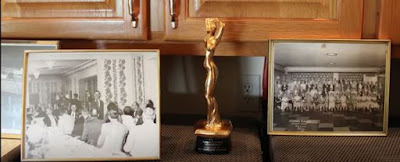
— In the early days of SSB, when it was an exciting new technology, hams had regular “sideband dinners.” At these events an award was presented. Kind of like an Oscar or an Emmy I guess. The award was the “Sideband Suzy” (see above). Kind of a classic figure… but half of Suzy was missing!

Cool Jazz from New Zealand as Heard on a Homebrew Superhet Receiver (VIDEO)

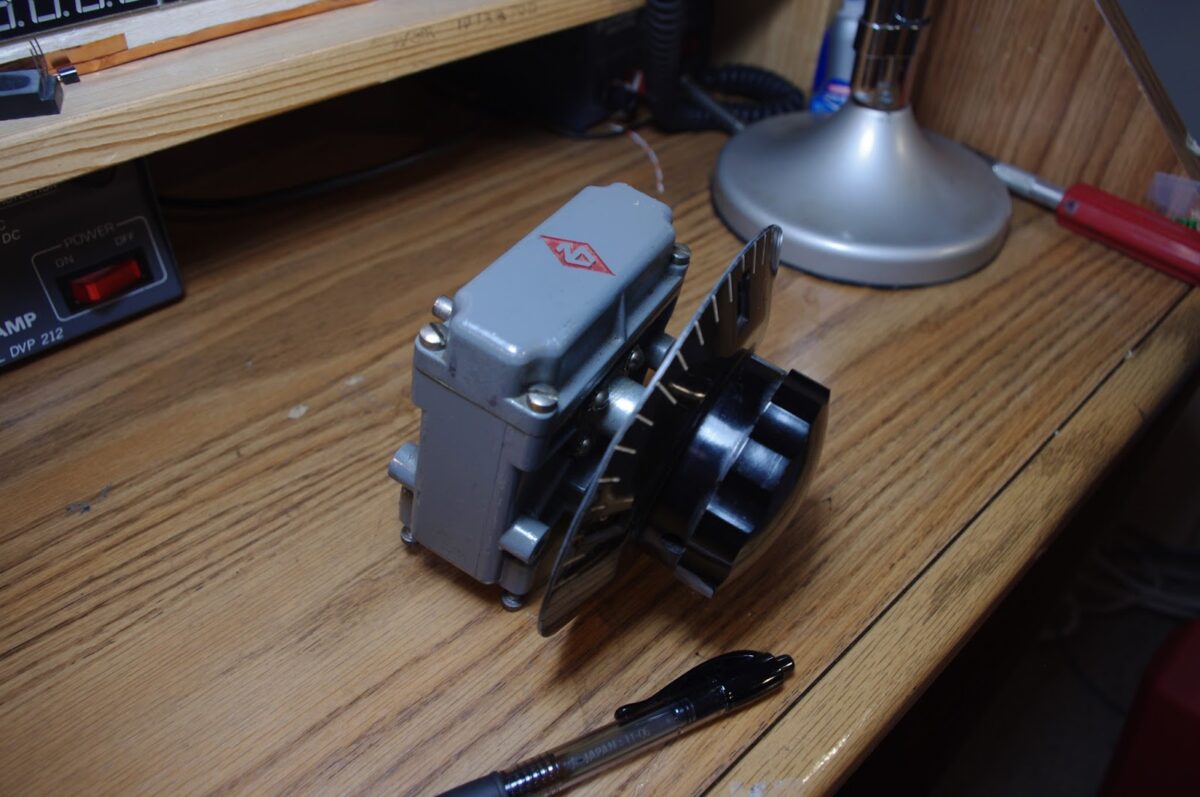
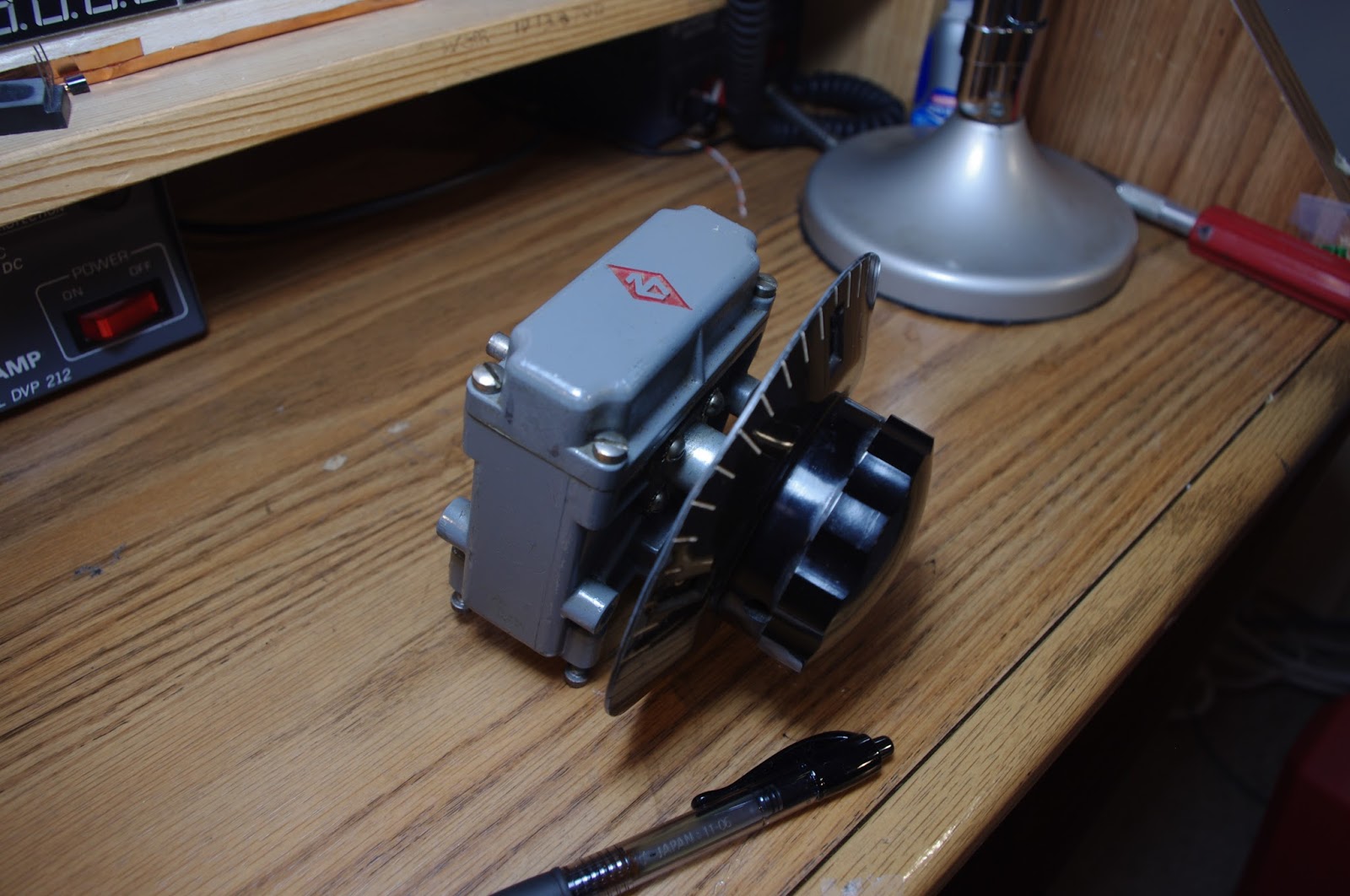
I’m making slow but steady progress on this one. The origin of the project was the beautiful National HRO dial and gearbox that Armand WA1UQO gave me.

I decided to use a 455 kHz IF because;
1) That was the IF of the old HRO receivers (the ones that won WWII)
2) I had a nice TOYO CM455 crystal mechanical filter that would be good for SSB.
3) I figured it would be easy to add in a wider filter that would be good for AM shortwave listening.
4) I like to keep the IF below the frequency of the VFO.

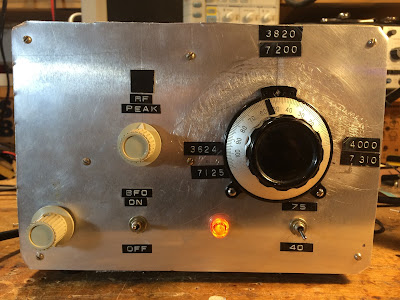
The wide filter turned out to be harder than I thought, but I think I have finally achieved the selectivity I was looking for. I’ll have a switch on the front panel that will allow me to go from “AM-Wide” to “SSB Narrow.” The switch will change the filters and the detectors, and will turn the BFO on and off.

Still to do: I need a high-pass filter to knock down RFI from nearby AM broadcast transmitter. And an RF gain control would be nice.

I’m really glad Radio New Zealand is there. It provides welcome relief from the shortwave fire and brimstone. Radio Romania is also doing a fine job on shortwave.

The Last Hallicrafters Transceiver…REBORN! TWICE!

Pete Juliano and his colleague Giovanni Manzoni led me this morning to the happy land of Hallicrafters hybrid nostalgia.

It all started with Pete’s latest blog post:
http://n6qw.blogspot.com/2016/10/more-junk-box-rigs.html

I admit that I had never even heard of the Hallicrafters FPM rigs. Pete’s (uh, I mean Giovanni’s) video show’s Pete’s junk-box rebuild of the old rig. Very nice. Note the presence of the Si5351…

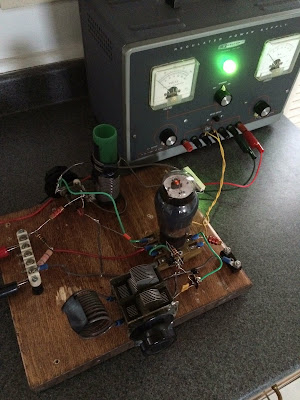
I needed more background info, so I turned to YouTube. This led me to more old friends: Dale Parfitt W4OP has a really nice video of his rebuild of the Halli FPM rig (see above). From his video we learn why Dr. Juliano prescribed a dose of Si5351 for the patient: Dale tells us that VFO instability was a major problem with this rig. Dale fixed his with the addition of an X-Lock board from yet another friend of SolderSmoke: Ron G4GXO of Cumbria Designs.

Dale really out-did himself by building an add-on accessory box for the FPM. Very nice. I especially liked the addition of the W3NQN passive audio filter for CW. I always have misgivings about adding audio filters to Direct Conversion receivers — this will reduce QRM, but you are still listening to both sides of zero beat. But when you add a sharp CW audio filter to an SSB superhet you will end up with true “single signal reception.” FB Dale.


Please send Pete Juliano and Giovanni Manzoni some positive feedback and words of encouragement. Please urge them to keep up the good work on the blog and the videos. Theirs is sometimes a lonely task — without feedback it can sometimes seem like putting messages in a bottle and throwing them into the digital sea. Please let them know that their work is being seen! Leave some positive comments on Pete’s blog. (No snark please — The Radio Gods will retaliate if you harsh N6QW’s mellow.)

The Invention of the Reflectometer: Naval Research Lab Report #3538

Dennis Klipa N8ERF has been doing great work exploring the technical intricacies of the humble SWR meter (and believe me, there are intricacies). He’s also been looking at the history of this invention.

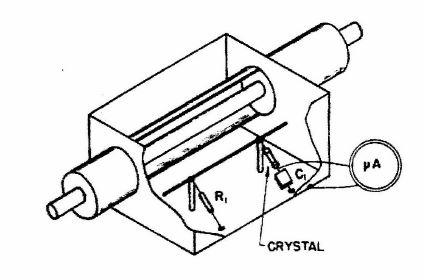
This summer, Dennis and I came across the April 1964 issue of Popular Electronics. On pages 74 and 75 of that issue we found a clue that seemed to point to the origins of the device: the article referred to Naval Research Lab Report #3538 by O. Norgorden, published on September 15, 1949. This may be the paper that led to the widespread use of SWR meters by radio amateurs.

Surprisingly, this important paper was not to be found on the internet. Exhibiting an admirable dedication to the preservation of an important element of the radio art, Dennis wrote to Naval Research Lab and purchased from them a copy of the report. Unfortunately, the version Dennis got had been copied and recopied so many times that it was hard to read. So he went the extra mile and re-typed it.

With his permission, I am giving this article its internet debut by posting it here:

http://soldersmoke.com/SWR N8ERF.pdf

Three cheers for Dennis Klipa for unearthing this important piece of radio history.

The NAA VLF Station (NOT QRP!) and Brad’s Receiver

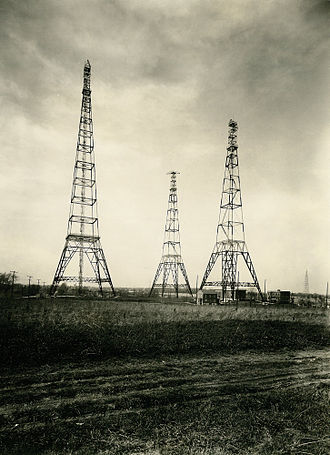
NAA Towers — Arlington Va. 1913
Brad WA8WDQ wrote to us about a VLF (24 kHz) his receiver project (see below). This led to some Googling about the VLF station NAA. Wow, there is some important radio history associated with that call sign. The station’s original location was just a few miles from I where I live now. From Wikipedia (https://en.wikipedia.org/wiki/VLF_Transmitter_Cutler):

The station began operations in 1913 as a radio telegraphy station call sign NAA in Arlington, Virginia, at a facility next to Fort Myer. Although its broadcasts occasionally included band concerts and speeches, it was most famous for its nightly time signals. The three towers known then as “The Three Sisters” stood 600 feet, 450 feet and 200 feet (183, 137, and 61 m) above the ground. The site was referred to as “Radio”, Virginia. The towers were the second largest man-made structure in the world behind only the Eiffel Tower. The word “Radio” was first used instead of “Wireless,” in the name of this Naval Communications facility. The First Trans-Atlantic voice communication was made between this station and the Eiffel Tower in 1915. The Nation set its clocks by the signal and listened for its broadcast weather reports. The Towers were dismantled in 1941 as a menace to aircraft approaching the new Washington National Airport. The towers stand today at United States Naval Academy in Maryland, on the edge of the Chesapeake Bay.

Be sure to read about the de-icing system for the antenna. It uses more power than the actual transmitter!

From Brad:

Bill, Pete,
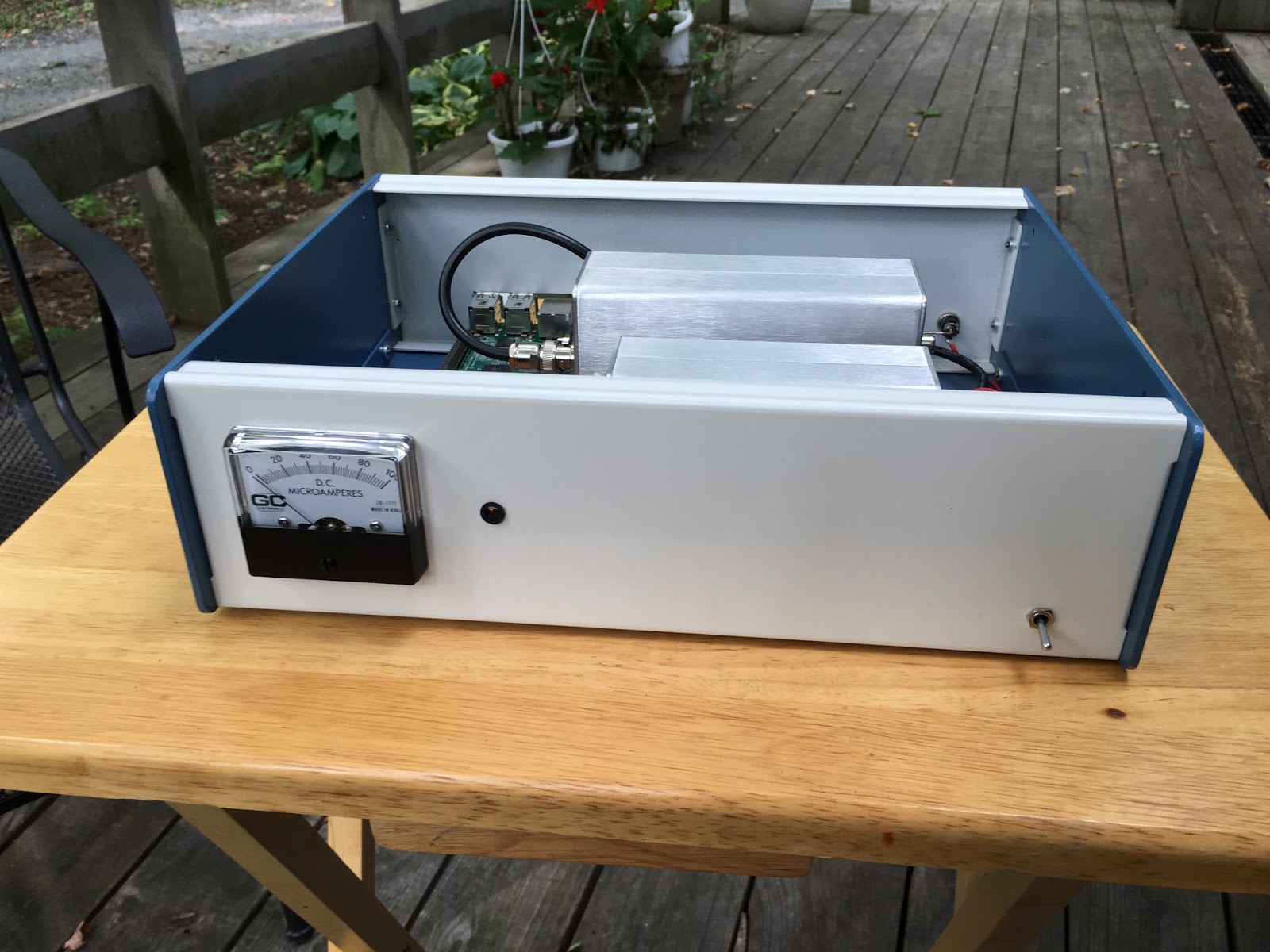
Here’s the current status of the 24 KHz NAA SID receiver. All the major sub-assemblies are mounted in the chassis and power is hooked up. For convenience, I’ve been using the PowerWerx USBbuddy switching DC-DC converter to supply +5V power to the Raspberry Pi from the +12V input. I’ve found them extremely RF quiet, clean and stable; capable of supplying 3A though this project will only need about 1.5A @ +5V. At this point, I’m just waiting for Adafruit to send the A/D chip I’ll wire up to the Pi on that empty protoboard just under the meter. Speaking of the meter, it’s not really needed as the Pi records and broadcasts over Wi-Fi the received signal level. However, I like my projects to have some sort of physical human interface so I added the signal level meter and an LED for SID event alarms :).
As previously mentioned, my bench test of the receiver using my signal generator was successful. Once everything is wired, I’ll do an actual on-air signal test receiving NAA.
Brad WA8WDQ

Radio New Zealand Booming in on 7245 AM

The day is off to a good start here at SolderSmoke HQ, with Radio New Zealand booming in on my homebrew Mate for the Mighty Midget receiver. I was listening from around 0900 to 1030 UTC on 7245 kHz. Once again we see that The Radio Gods favor homebrew receivers. Gray line propagation also played a role.

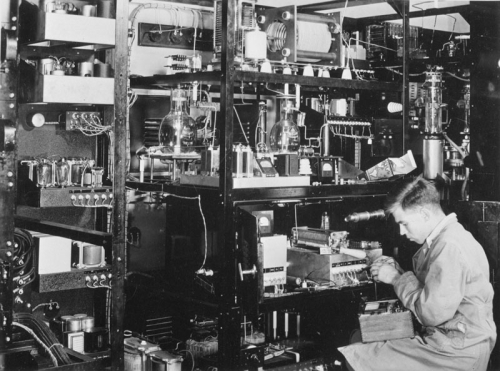
Above we see a technician at work at RNZ in 1945. More historic photos here:
http://www.pcc.govt.nz/About-Porirua/Porirua-s-heritage/Porirua-s-suburbs/Titahi-Bay/Historic-site–Radio-New-Zealand-Transmission-Station

W9ZN’s CW Warm-up: “Ben’s Best Bent Feet”

I happened to come across this fellow’s signal on 40 a week or so ago. His warm up routine really had me scratching my head. I’ve been on the air for a long time, much of it on CW, and I never heard anything like this. Listen to the video (!) and you will see what I mean. Harmless fun I guess, and there does seem to be a connection to radio history.

Building a VFO. A BIG VFO. IF options?

Once again, The Radio Gods have Spoken (TRGHS). An off-hand comment at the Manassas Hamfest, a bit of encouragement from Pete Juliano, and the next thing you know Armand WA1UQO has sent me this beautiful National HRO dial and reduction drive. This thing is so nice… Well, put it this way: this is the first time I’m building a rig around the dial!

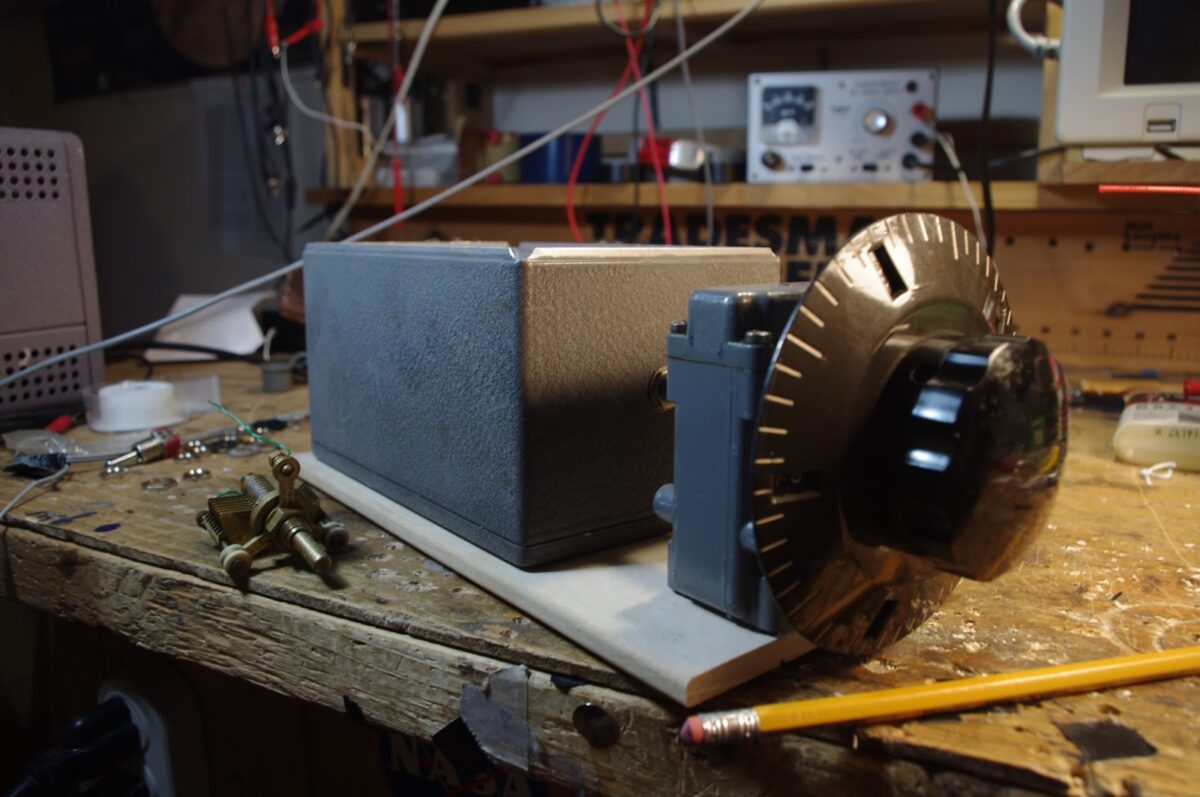
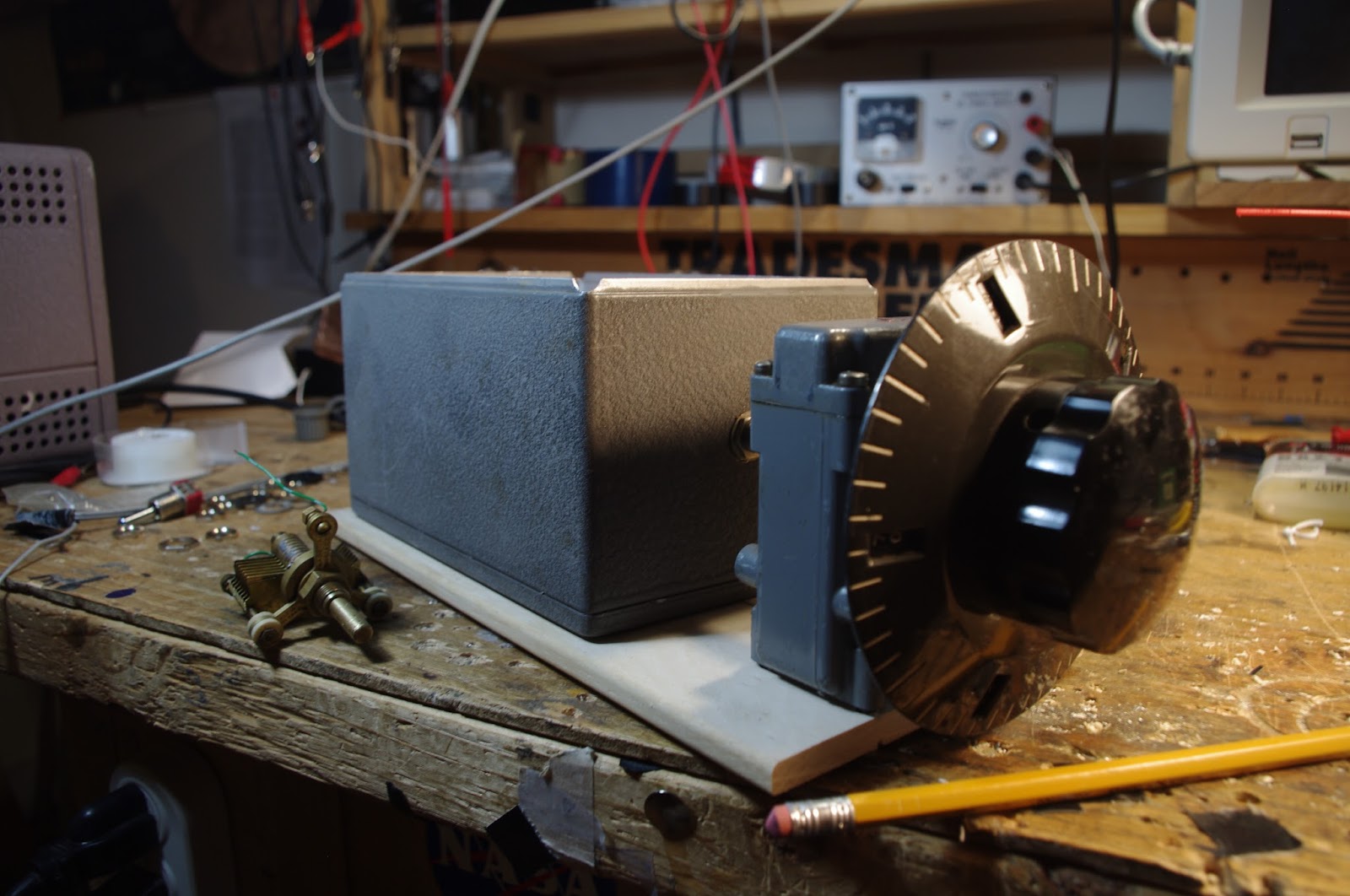
Further evidence that TRGHS: I needed something on which to base the HRO dial and a box for the VFO. Wouldn’t you know it: That Whole Foods “grilling plank” that I bought a few weeks ago was PERFECTLY sized for this task. Eerie, don’t you think? As for the VFO box, well TRGHS again: pictured above you see a side view of the box from one of the Heath QF-1 Q multipliers that I cannibalized for the variable caps. Finally, for the main tuning cap, I took another look at that old brass variable cap that I took out of a 1930’s era British regen (pictured above). It had been hopelessly stuck for a long time. I twisted it a bit and was amazed to see that it is stuck no more. TRGHS! (I just need to find a suitable nut so that I can mount the old cap in the QF-1 box.)

I’m thinking that this VFO will be the heart of a general coverage shortwave superhet receiver. I want filters for AM and SSB and I’d like it to cover 5 MHz to 10 MHz. I’ve been noodling various IF possibilities, but concerns about birdies and spurs keep driving me back to 455 kHz. I have a crystal-mechanical filter for that freq. And a big box of 455 kc transformers. What do you guys think of this option?

HRO (not HOR!) — The King of Reduction Drives

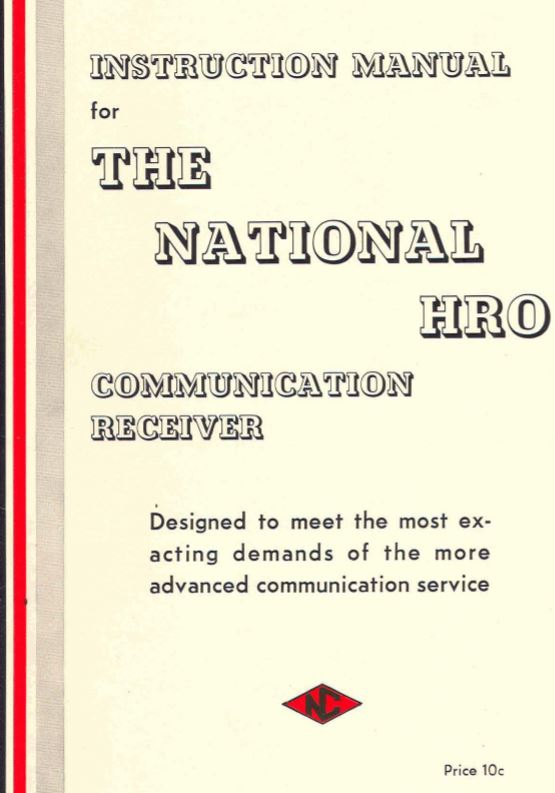
At the recent Manassas Virginia hamfest Armand WA1UQO and I came across an old HRO receiver. Armand mentioned in passing that he had an HRO dial and drive for me if I wanted one. When Pete heard this he said I definitely NEEDED one. Armand heard Pete’s comment and very kindly put an HRO dial and reduction drive in the mail for me.

Wow, it is a magnificent thing! After years of struggling with small Jackson Brother reduction drives and with reduction drives brutally cannibalized out of innocent Heathkit Q multipliers, I now realize that I have been playing in the minor leagues. This, my friends, is the reduction drive that helped win WWII! I will have to build something worthy of its inclusion.

The designation HRO has a wonderful story behind it:

This is from: http://www.cryptomuseum.com/df/hro/

The new radio was also designed by James Millen at the National Radio Company, but this time with two RF amplifiers and two IF amplifiers at 455 kHz with a 20Hz crystal filter. He kept the pluggable coil packs as part of the design and added the now famous epicyclic dial, which allows the operator to tune the frequency scale in 1/500th units (with the aid of a calibration chart).

The design was finished in 1934 and National pushed hard to get the receiver out by the end of that year. When creating the tools for the first production run, the tool makers had to work overtime and used HOR (Hell Of a Rush) as a job number on their overtime slips. As National’s marketing department didn’t want their radios to become known as HORs (whores), the name was changed to HRO (Hell of a Rush Order). Despite the best engneering efforts, technical problems delayed the release of the the radio until March 1935. The price at the introduction was US$ 233.

Another site provides tech details and history on the drive itself:
https://www.prismnet.com/~nielw/PW_NPW_Dial/hro_dial.htm

The HRO dial introduced by the National Radio Company in late 1934 was the hallmark of top-of-the-line National receivers from the mid 30s through the 60s. By late 1936 the “HRO dial” was appearing on the NC-100 series of receivers and even the 1-10, National’s VHF receiver. Throughout WWII many of the NC-100 variants that National provided to the military used this same dial. By 1950 National had added built-in direct frequency readout to the HRO-50 but still kept the same 0-500 reading dial. Through the mid-50s and into the 60s National mimiced the HRO dial look on their mid-priced receivers such as the NC300, 303 and 270. Even the solid state HRO-500 introduced in the early 60s used a version of this dial. When combined with the required 20 to 1 venier gear drive, the HRO dial provided an effective scale length of 12 feet and was direct reading to 1 part in 500. Ten turns of the dial drives the tuning capacitor stop to stop. Published HRO calibration curves showed each ham band spread over eight turns (or 400 divisions). In addition, dial divisions were about 1/4 inch apart. On all bands below 10 meters the HRO dial is easily resettable to within a KC (or KHz).

SolderSmoke Podcast #188: Blue Rig, 6U8 RX, Dial strings, Hamfest, VFO Builds, MAILBAG

SolderSmoke Podcast #188 is available.

http://soldersmoke.com/soldersmoke188.mp3

Audio “sparkle”

Bench Reports:
Pete: Blue Rig, Amplifier Project, LBS and Simpleceivers around the world
Si5351s in the new Elecraft KX2

Bill:
Mighty Midget Mate 6U8 RX Refinement
Using a Millen 61455 IF can
Broad, but beautiful. But not as nice as PA3GSV’s
Tweaking a VFO the old fashioned way
Reduction Drive Re-works.
A Confession: Using Amplified Computer Speakers

Back to the lipsticked pig. Pete convinces Bill to fix the S38-E
dial cord.

Manassas Hamfest Report.

Field Day.

Mysteries:

Who is WV2YAU

Who sold Bill the hombrew SWR meter at Manassas?

MAILBAG

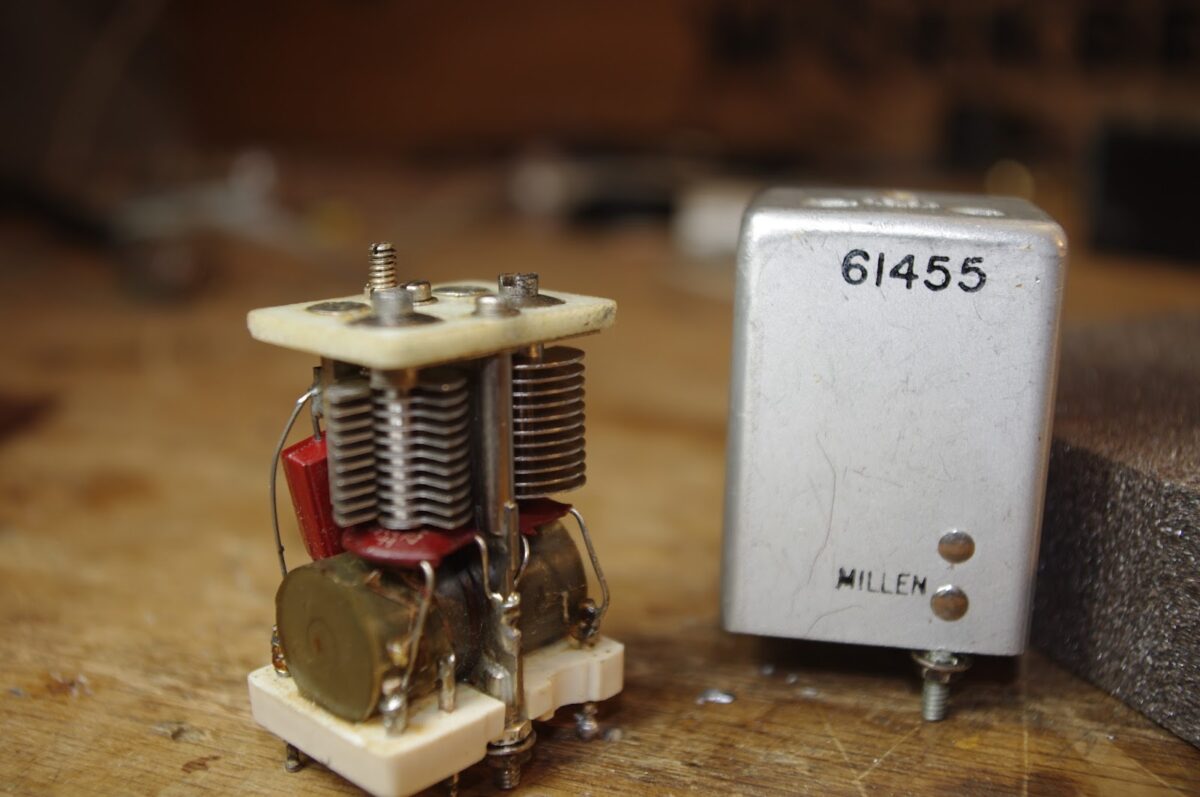
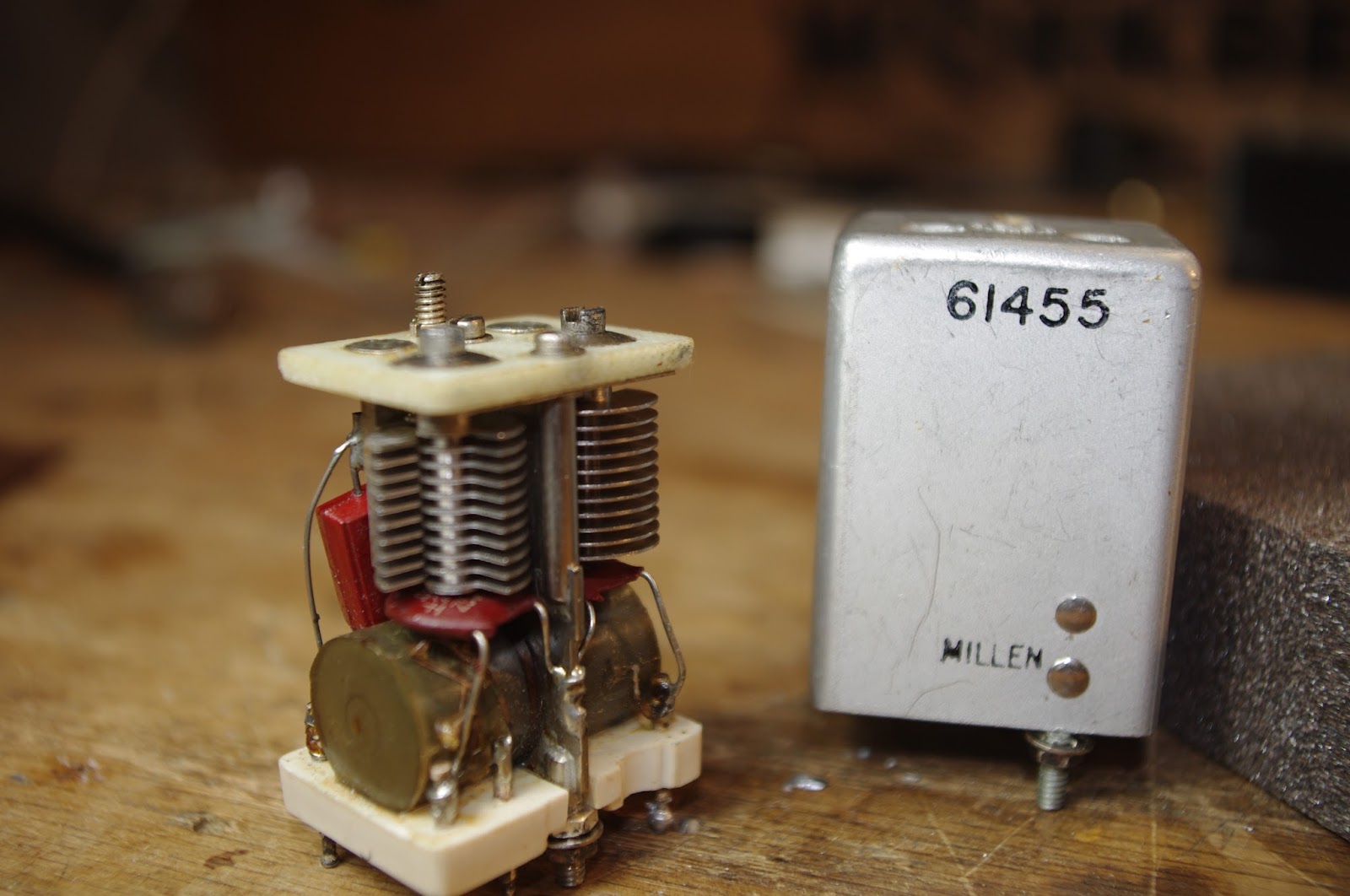
Inside a Millen 61455 IF Transformer

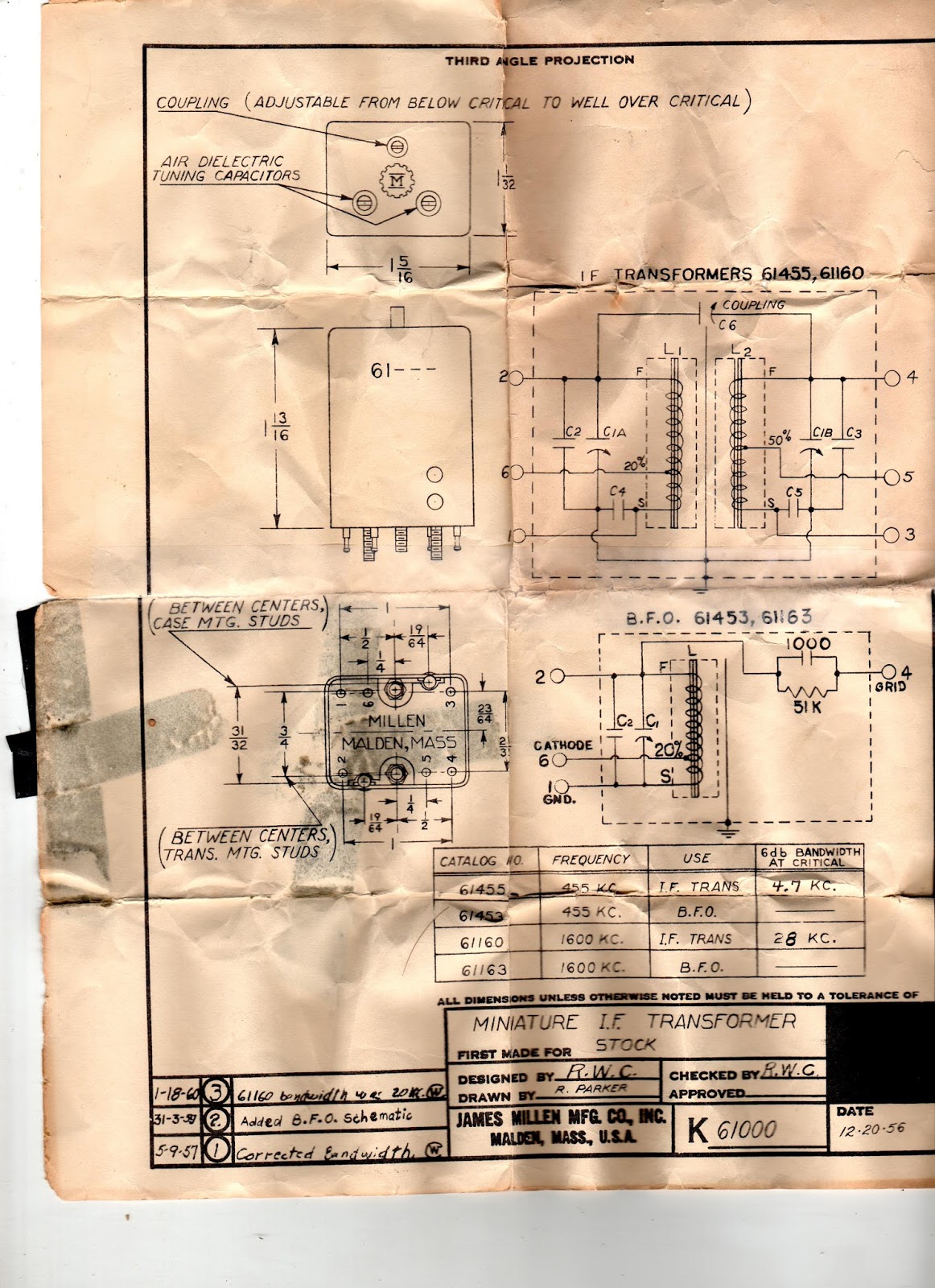
I found this in my junk box. I’ve put it in my old Mate for the Mighty Midget receiver, in the place of the Toyo CM455 crystal-mechanical filter (which I found to have excessive insertion loss). I think its very cool how they squeezed two variable caps into that little can. Designed in 1956. Works great. Note the promised passband: 4.7 kc at 6 db down. Not bad for an LC device.
Here is the spec sheet:

A Reduction Drive for the Mighty Midget’s Mate Receiver

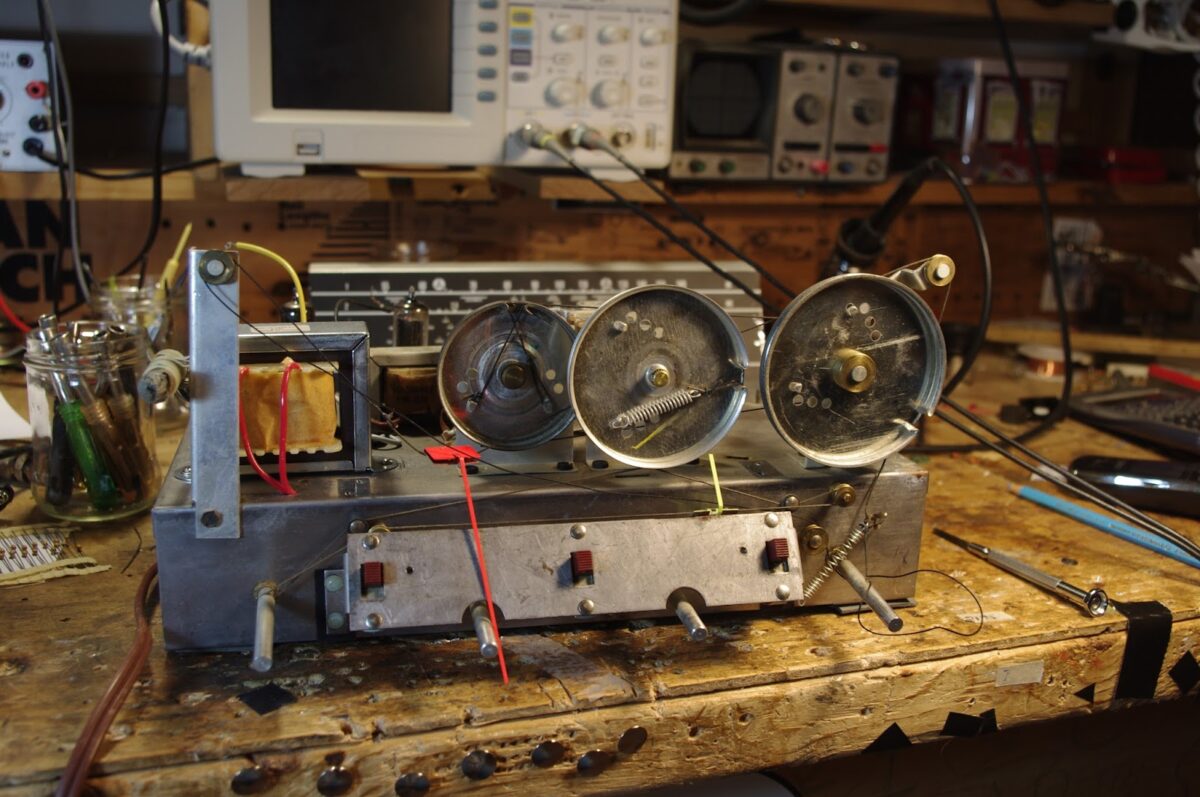
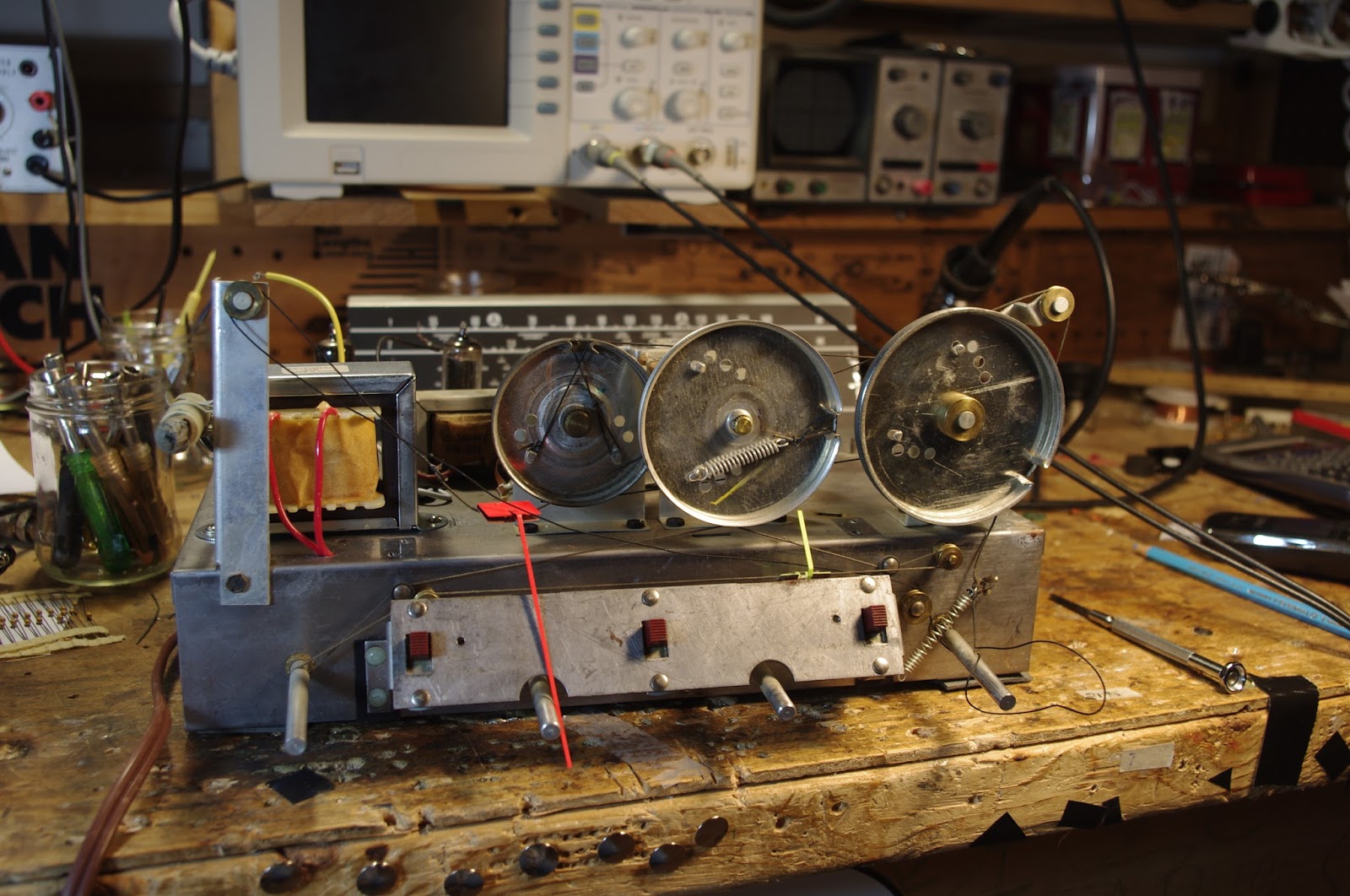
This morning I put a reduction drive onto the main tuning cap of my 6U8 Mate for the Mighty Midget receiver. Before I had been directly turning the 35 pf variable cap. The tuning rate was a bit too high for easy tuning of SSB stations. This drive went in nicely and it does reduce the tuning rate considerably, but it feels a bit tight. Is there anyway to loosen up one of these drives?

Pigs, Lipstick, and my old Hallicrafters S38 “Widow Maker”

I blame Grayson for this. After getting my old 6U8 superhet running nicely on 80 and 40, my attention turned to an old Hallicrafters S38-E that had been relegated to the car port (Armand saw it out there, looking abandoned.) I didn’t like it because of its “transformer-less” “widow-maker” power supply. I was afraid to even GIVE it away for fear that someone would electrocute themselves. But Antique Electronics Supply had an isolation transformer, so the order went in.


I have to rewind or replace one of the primaries on the input antenna coil. This was a victim of the original cheapo power supply. Apparently the antenna terminal got grounded when the chassis was “hot.” POOF — smoke was released.
The bands do seem to sound better through thermatrons… And there is an undeniable 3-D aspect to working on these old rigs.
So yes, in a certain sense REAL RADIOS GLOW IN THE DARK.

………….

Bill, I think that as long as you don’t work on it in the car port in your bare feet you’ll be fine! Good luck with it and don’t blame Grayson too much. I think it was destined to come back in the house eventually. The radio gods have been whispering in your ear!
Ciao! & 73, Armand

…………

Bill:
I’ll take the blame, no problem!

S38 is nice to work on, plenty of room, no magnifying glass required. But I have to admit I am not a big fan of working on low cost AC line powered “raft-anchors” (too little for a boat). Definitely give it a isolation xformer and replace the filter cap(s). If it doesn’t weight 50+lbs, a bit lightweight for me.

If you need a good thermatron homebrew project (and who doesn’t really), I’ll send you plans for a nice 4-thermatron (including compactron) AM/CW 20/40M 5 watt transmitter I am finishing up (90% of the work is “finishing up”). Designed from scratch. Actually works. Uses a new construction technique I’ve been working on.
Grayson

……….

Hi Bill,
As I read about your next project – kept thinking –you can put lipstick on a pig BUT it is still a pig. I had one and put an isolation transformer on the front end –but found I was showing signs of carpal tunnel syndrome on my left hand as I kept retuning the radio because it drifted so much. Have fun.

Pete


Pete:
I don’t know. Simplicity is a virtue, and this thing is pretty simple: RF amp, mixer, LC oscillator, detector, audio amps. Broad as a barn door with just two 455 kc IF transformers for the filter. Lots of room on the chassis.
As for drift, my little 6u8 RX with LC oscillators in both LO and BFO settles down very nicely.
Bill
……………

Hi Bill,
I surely didn’t mean to denigrate your next homebrew project and perhaps it was that the one I had was a dud in the lot.
But I then moved up to the SX-99 and was in tall clover. Besides today we have some things we can do to enable “tamer” oscillators. So why not? You need to team that up with the M^3 and make some contacts.
Pete
………….

Pete: I KNEW you would try to get a synthesizer of some sort inside the S38-E. But I say NO! I had a lot of fun getting the LC oscillators in my 6U8 rig to tune exactly where I wanted them to tune. You know, play around with the cap in series with the main tuning cap to change the tuning rate (better than removing plates — they are hard to put back on!). Then changing the values of the L and C elements to get the thing to oscillate in the desired range. Then wrap it all up with some Dymo tape on the 1/2 CD “tuning dial.” Sure, I know, that would have been a few keystrokes on the Arduino, but somehow this old way puts you closer to the physics, closer to the electrons. Take a look at the e-mail about Wooden Boats, VFOs and PTOs on yesterday’s SS blog.
The “widow maker” potential of the S38-E was apparently on the minds of the guys who designed the cabinet. The whole box and the front panel are all very carefully insulated from the chassis. Plastic nuts!
Nice looking pig, by the way. She may appear on the blog soon.
73 Bill
HEAVY METAL! How to Handle HEAVY Boatanchors — And Which is Heavier: R390 or DX-100?


Grayson:

I was on 40 AM today and I mentioned to the guys your thoughts about the possible need for a block and tackle and a metal beam in your shack roof to help you deal with your R-390A. They sympathized completely. One fellow claimed he knows hams who are working out with weights just so they can handle their boatanchors. Another guy said he is thinking of building a small crane, perhaps powered by his chain saw (yikes!). A third fellow said he actually bought a thing called a “lifting table” from Harbor Freight.
This got me to thinking: How much do those R-390s really weigh?
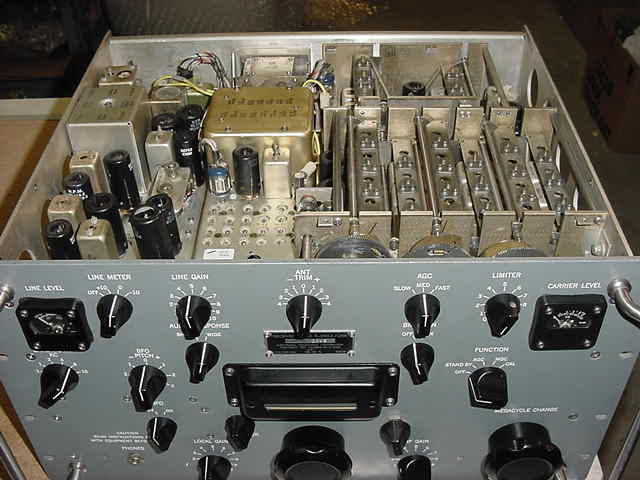
A MERE 85 pounds! That’s it? Holy cow, the DX-100 has a listed shipping weight of 120 pounds!
73 Bill
Bill:

Nice thing about a “regular” boat anchor (DX100, HT37, SX101, etc.) is that you can put it on its side and get fairly easy access to both sides, and all the components at once. The problem with the R390 (and a lot of Collins military gear) is Collins worked hard to cram so much in a “small” space that you have to take whole sections apart to get at anything. So you have to “flip” the chassis over, side, over, on its back, etc. UGH. To get at the RF front end components, you gotta take the front panel off before you can remove the RF chassis. UGH
I know about the lifting table from harbor freight. A really nice shack accessory. Puts the rig at a better height to work on. With a “lazy susan” thing on top, a nice arrangement! Maybe next Christmas.
73, TA2ZGE


Grayson
TA2ZGE – Ankara, Turkey
KJ7UM
Follow the Hollow-State Design Blog