Mythbuster Video #3 — Using the VFO from a Yaesu FT-101

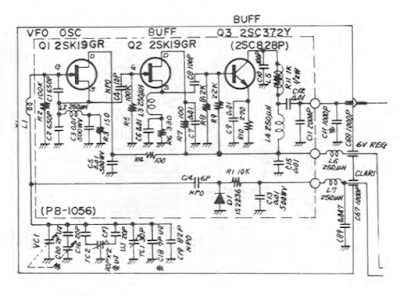
FT-101 VFO
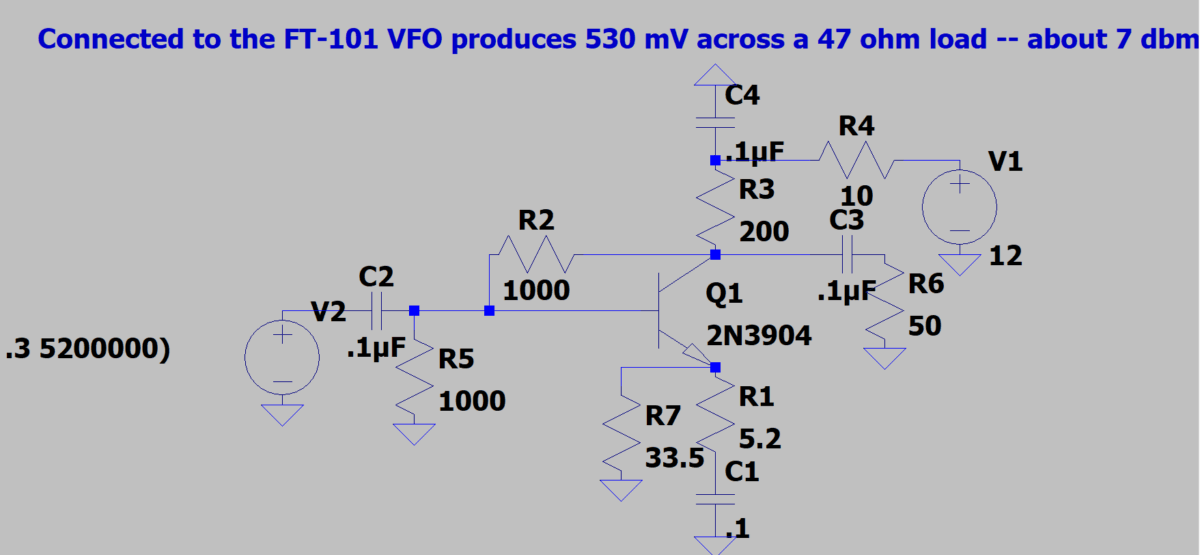
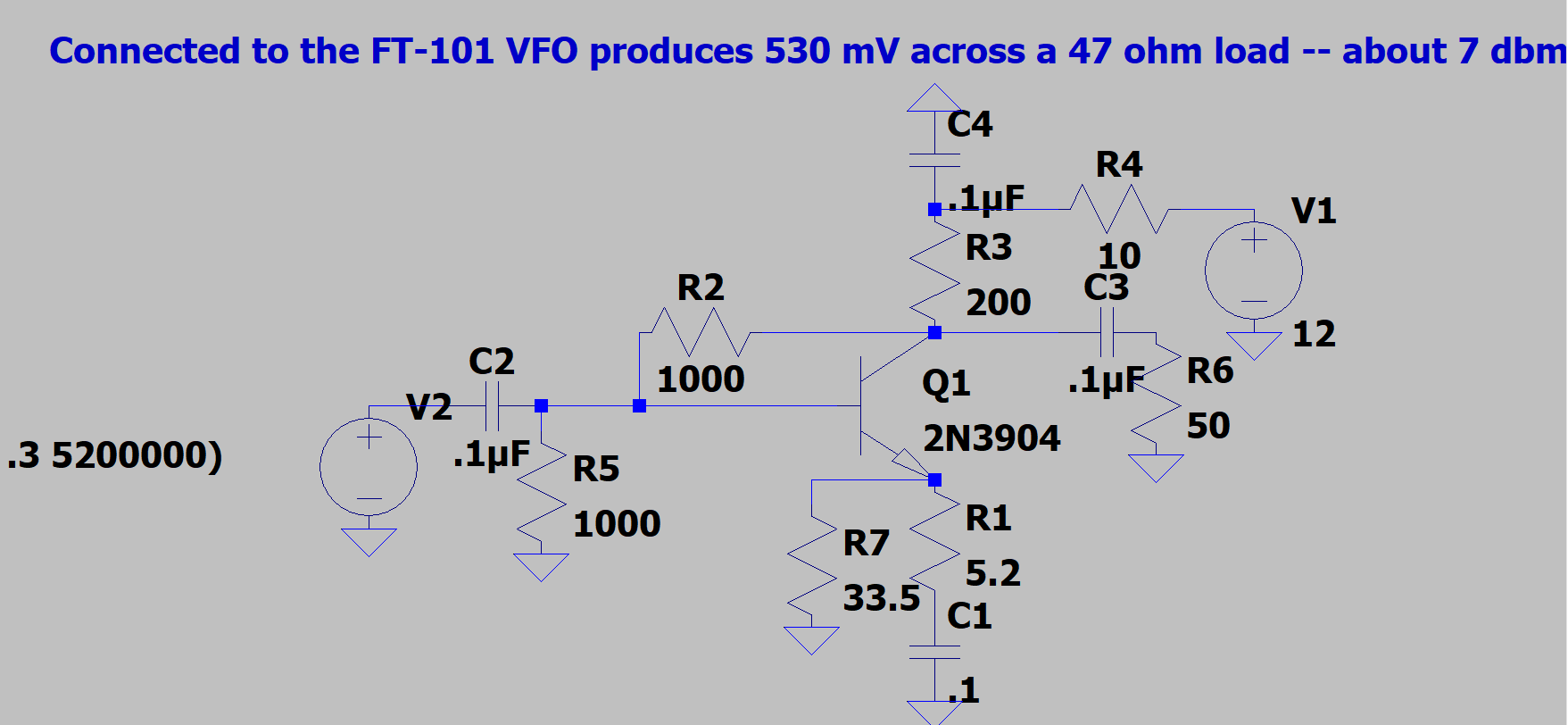
I used LTSpice and Wes’s FBA program (from LADPAC) to come up with a circuit that would provide the needed gain. I needed to get the 290 mV rms signal (across a 50 0hm load) up to the 500 mV rms signal needed by the ADE1 mixer. Above is the amplifier that I came up with. The key here is to adjust R2 and R1 to get the required gain.

Mythbuster Video #2 — 10 Pole Crystal Filter

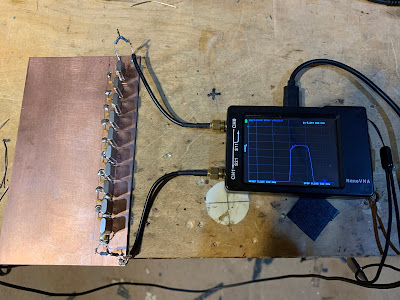
This is a 5.2 MHz crystal filter. I used the G3UUR method for determining the crystal’s motional parameters. I then used Dishal and AADE software to design a 10 pole Cohn Min-Loss filter. I tested the bandwidth with an Antuino Scalar Network analyzer (thanks Farhan!) and a NanoVNA. I found the passband to be a bit tight for SSB, so I replaced the capacitors with caps of a slightly lower value — this broadened the passband. It is still a bit tight, but the SSB audio — while not enhanced or Hi-Fi — sounds fine.

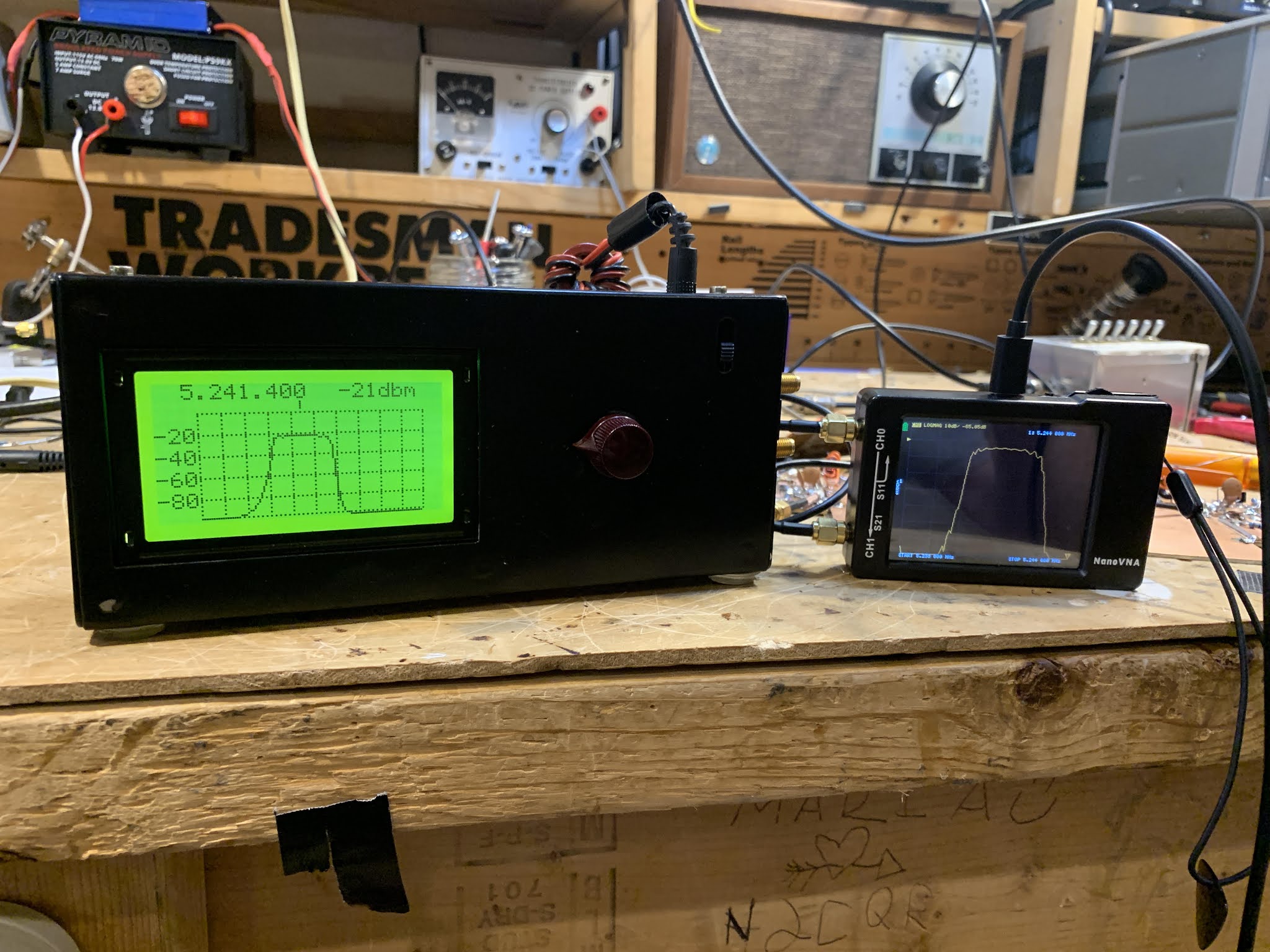
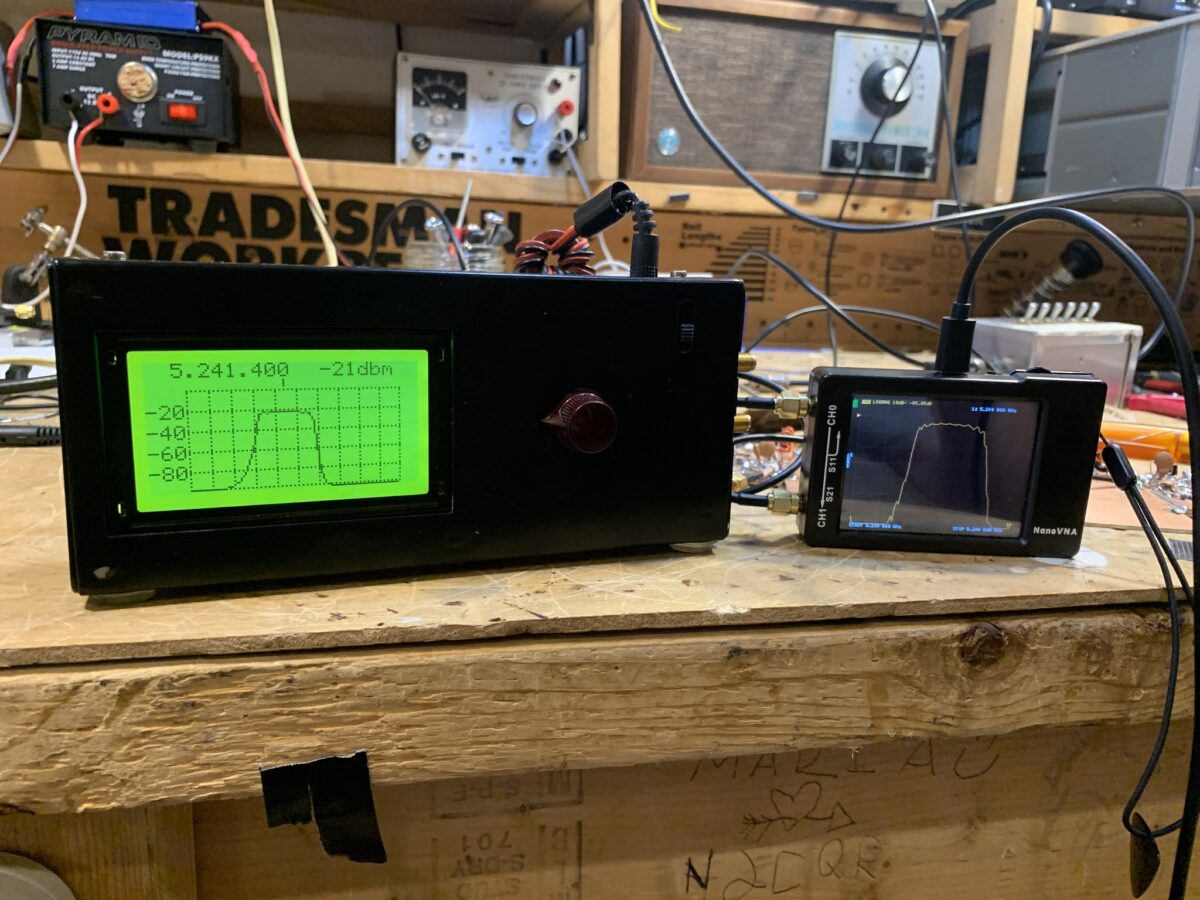
Passband filter shape as seen in the Antuino and in the NanoVNA. The -20 db line in the Antuino actually corresponds to no loss.


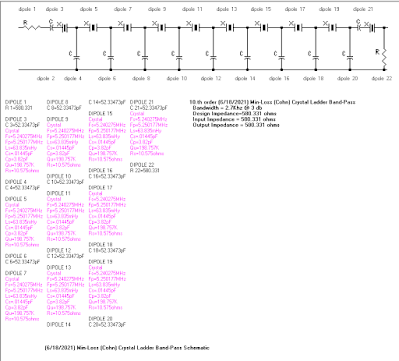
The schematic provided by the AADE software. Dishal software may have come up with better, more correct values for the capacitors.

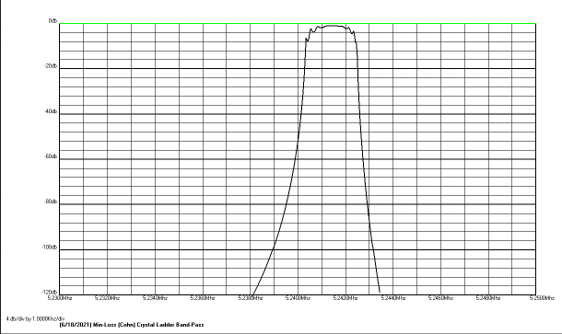
The passband as predicted by AADE. Skirts so nearly vertical as to strike fear in the hearts of SDR owners!

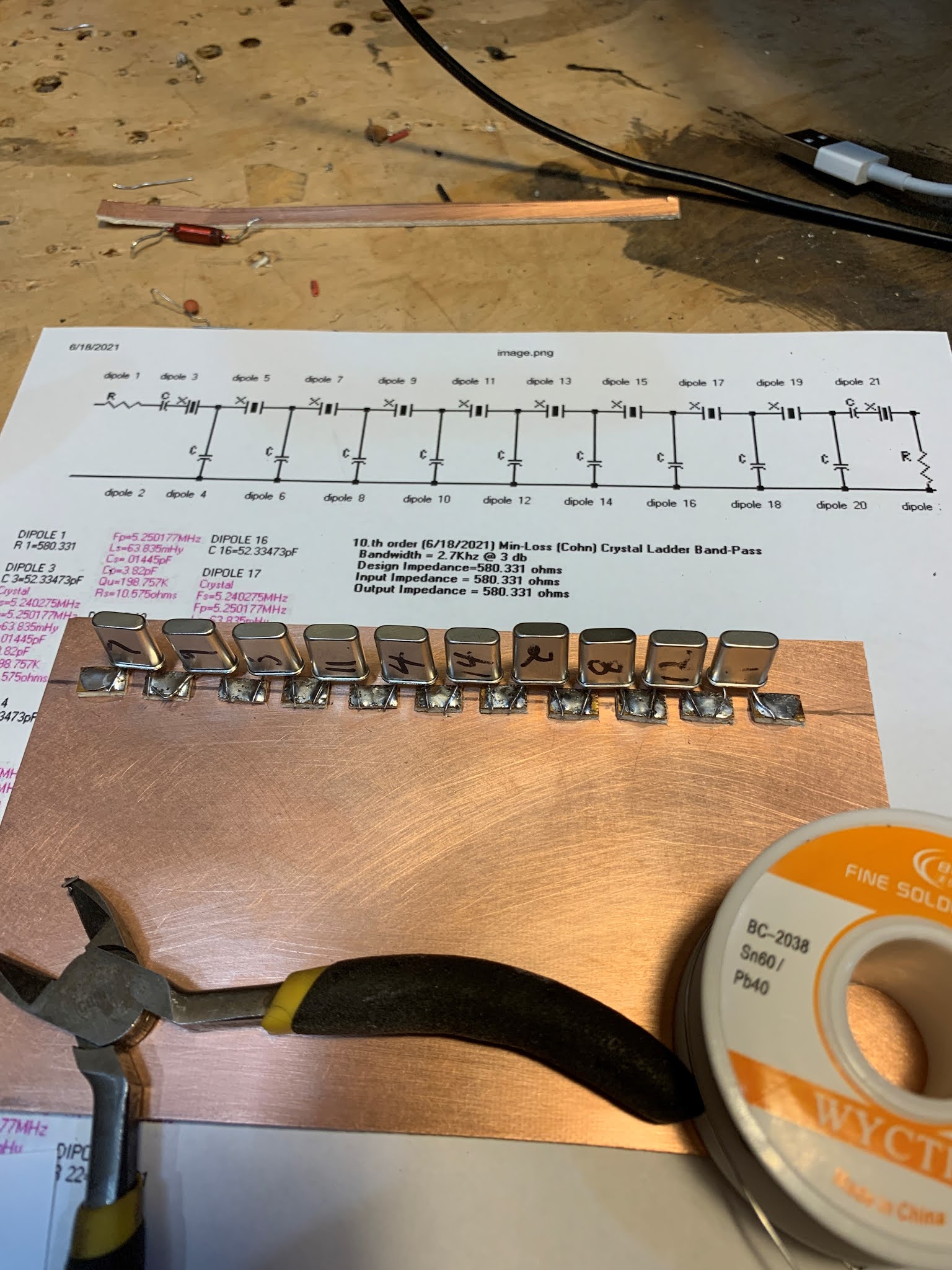
Filter under construction — waiting for the caps from Mouser.

First scan with the NanoVNA. Insertion loss looks very high but that is only because I am terminating the filter with resistors — I just wanted to see the passband shape.

A Video Series on the Mythbuster 75/20 Rig — Video #1

I am happy to report great progress on the Mythbuster project. I have the receiver working on both 75/80 and 20 meters. And it in fact inverts the 75 meter LSB signals, turning them into 5.2 MHz USB signals for passage through my 5.2 MHz USB filter/BFO combo. No switching or shifting of the BFO is needed.

I am following Farhan’s BITX20 advice — I have paused in the construction and am enjoying the receiver that I have built. I’ll build the transmit circuitry later.

Inspired by Frank Jones (you really should be reading the FMLA articles) I have this rig prototyped “Al Fresco” on a pine board that I found discarded on a neighbors front stoop.

There is no RF amplifier in this rig. Following the advice of multiple receiver gurus, I ran the BP filters right into the ADE-1 diode ring mixer. I have the TIA amps set at about 24 dbm. There is a lot of audio gain from the LM386 and the audio pre-amp. This seems to be enough, even on 20. I hear the band noise when I connect the antenna on both 75 and 20.

Here is the first video in the series. I’m posting them first on Patreon, then, a few days later, here and on the YouTube channel.

10 Pole Crystal Filter Passband as Seen in Antuino and NanoVNA

I continue to work on the “Mythbuster” rig, but I am taking it slow, trying to learn something from each stage. I’m especially trying to master the used of the great test gear that has arrived in my shack in recent years: The Antuino, the NanoVNA, and the TinySA.

Above you can see the passband of the 10 pole crystal filter as measured across the 50 ohm terminations on the filter. I use simple FT37-43 transformers to match the filter impedance down to 50 ohms. I used the Antuino first — it scanned the passband and held the image on its screen. I then disconnected the Antuino and connected the NanoVNA. So in this shot you can see the passband on both devices.

You will notice that the Antuino says there is a 20db insertion loss. That’s only because in the Antuino 20db is really 0 db loss. I think the NanoVNA gives a more accurate insertion loss reading — about 3-5 db. The cool thing is how similar the shapes of the passband are.

SolderSmoke Podcast #231 — Travel, SST, Mythbusting, Filters, TIAS, NanoVNAs, DC RX in SPRAT, Drake A Line, Spillsbury, STICKERS! Mailbag


SolderSmoke # 231 is available:


Annual Field Day Special Edition

Travelogue: To the Dominican Republic!
New dog — Meet Guapo (see below).

A great Father’s Day for Pete and Bill. I got a TinySA.
Pete got some cool chick magnet glasses (see below).
Watch out Newbury Park!


Bill’s Activity

SST Transceiver. Took it to Dominican Republic.
Made only one contact, but QRP-QRP.
Not a lot of CW activity, and not a lot around 14.060.
A lot more FT8 visible on the NA5B WebSDR.
That might be better for this kind of operation.
I might try SST CW out today from the backyard. Field Day!

Fired up my 20 meter DSB NE602 rigs. Made two contacts.
Still trying to fully understand the NE602 Gilbert Cell. Lots of mystery in there.

Building “The MythBuster.” 75/20 with sideband inversion.

10 pole 5.2 MHz filter. Used Dishal and AADE.
Used NanoVNA to see the passband.
G3UUR for crystal parameters.
Cohn Constant K topology.

Also used NanoVNA to check input and output impedance on the TIA amps I will use around the filter.

Pete’s activity:

Article on DC receiver in SPRAT. FB response. 50 receivers under construction.

Work on Drake A Line.

Jim Spillsbury.

——————————

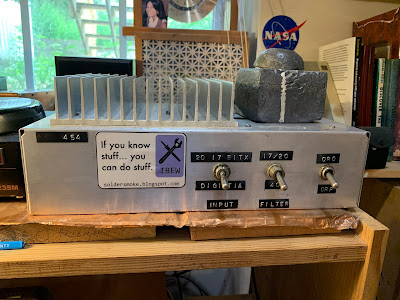
The N5JHH IBEW SolderSmoke stickers (see above and below). How we will use them.

Mailbag:
N2SVD
K8ITY
Tom (Junkbox receiver)
N0ZIB (Curse you, SolderSmoke!)
DL6ID
N2NLY
VK2EMU
ZS1KE
AF7O
NG2E
VU2ESE
OK1RP
N5JHH

The Stubborn Myth about USB and LSB

It has been repeated so often and for so long that many of us have come to believe it. I myself believed it for a while. Like many myths, it has a ring of truth to it. And it is a simple, convenient explanation for a complex question:

Why do ham single sideband operators use LSB below 10 MHz, but USB above 10 MHz?

Here is the standard (but WRONG) answer:

In the early days of SSB, hams discovered that with a 9 MHz SSB generator and a VFO running around 5.2 MHz, they could easily reach both 75 meters and 20 meters (True). And because of sideband inversion, a 9 MHz LSB signal would emerge from the mixer as an LSB signal (True), while the 20 meter signal would emerge — because of sideband inversion — as a USB signal (FALSE!) That sideband inversion for the 20 meter signal explains, they claim, the LSB/USB convention we use to this day.

Why this explanation is wrong:

There is a very simple rule to determine if sideband inversion is taking place: If you are subtracting the signal with the modulation FROM the signal without the modulation (the LO or VFO) you will have sideband inversion. If not, you will NOT have sideband inversion.

So, you just have to ask yourself: For either 20 or 75 are we SUBTRACTNG the Modulated signal (9 MHz) from the unmodulated signal (5.2 MHz)?

For 75 meters we have: 9 MHz – 5.2 MHz = 3.8 MHz NO. We are not subtracting the modulated signal from the unmodulated signal. There will NOT be sideband inversion.

For 20 meters we have 9 MHz + 5.2 MHz = 14.2 MHz. NO. No subtraction here. No sideband inversion.

So it is just arithmetically impossible for there to be the kind of happy, easy, and convenient USB/LSB situation described so persistently by the myth.

———————————

We discussed this several times on the podcast and in the blog:

https://soldersmoke.blogspot.com/2015/05/sideband-inversion.html

https://soldersmoke.blogspot.com/2012/05/usblsb-urban-legend-debunked.html

This myth shows up all over the place:

We see the myth here:

http://n4trb.com/AmateurRadio/Why%20The%20Sideband%20Convention%20-%20formatted.pdf

Here the web site owner warns that this is “highly controversial.” Really? Arithmetic?

http://9m2ar.com/lsb7.htm

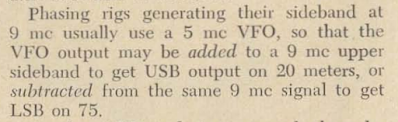
The myth is very old. Here is a clip from a 1966 issue of “73” magazine:

https://worldradiohistory.com/Archive-DX/73-magazine/73-magazine-1966/73-magazine-01-january-1966.pdf

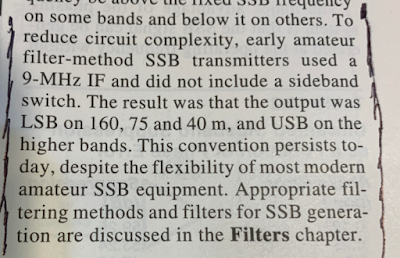
Finally, to my disappointment, I found the myth being circulated by the ARRL, in the 2002 ARRL Handbook page 12.3:

The fact that the Handbook attributed this to a desire to “reduce circuit complexity” by not including a sideband switch should have set off alarms. We are talking about hams who built their own SSB rigs, usually phasing rigs. A sideband switch would not have added significant circuit complexity. I think they could have handled it.

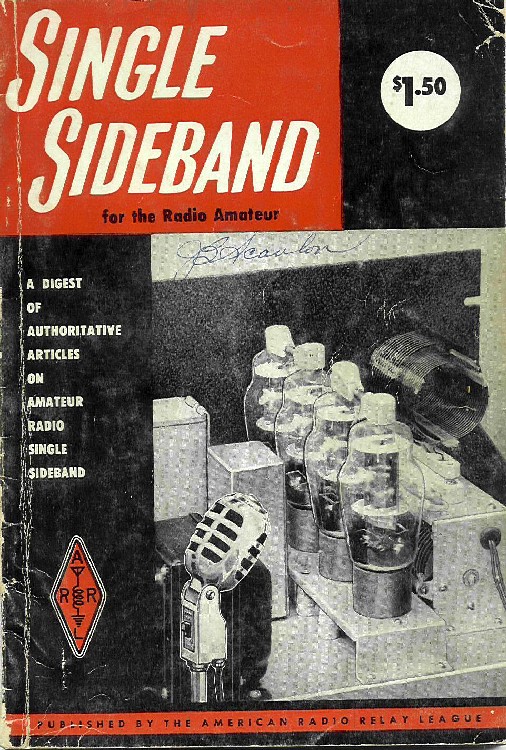
It is interesting that earlier ARRL Handbooks do not repeat this myth. I found no sign of it in Handbooks from 1947, 1959, 1963, 1973, and 1980. And I found no sign of it in several editions of that great ARRL book “Single Sideband for the Radio Amateur.”

For my next homebrew rig, I will build a rig that DOES do what the myth promises. I will have the SSB generator running on 5.2 MHz USB. The VFO (out of an old FT-101) will be running around 9 MHz. So for 75 meters we WILL be subtracting the signal with the modulation from the signal without the modulation: 9 MHz – 5.2 MHz = 3.8 MHz. There will be inversion. This 75 meter signal will be LSB. For 20 we will just add the 5.2 MHz USB signal to the 9 MHz VFO. There will be no inversion. We will have a USB signal on 20. I’m thinking of calling this new rig “The Legend.” Or perhaps, “The Mythbuster.”