and
https://www.smithsonianmag.com/smart-news/scientists-shot-lasers-moon-decade-then-one-bounced-back-180975585/
SolderSmoke Daily News — Ham Radio Blog
Serving the worldwide community of radio-electronic homebrewers. Providing blog support to the SolderSmoke podcast: http://soldersmoke.com
https://www.nytimes.com/2020/08/15/science/moon-lasers-dust.html
Thanks to Chuck KE5HPY for alerting us to this very interesting article.
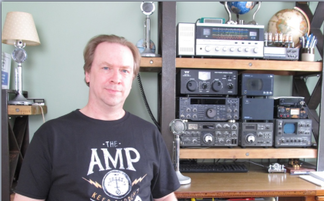
Well, we were talking about it on 40. This just proves that there is more to 40 meter SSB than the never-ending quest for audio “brilliance,” “presence,” “body” and “sparkle.” I was working at the bench yesterday when I heard Frank NC1I telling another fellow about his 35 years of experience with moonbounce. Wow, you don’t hear that kind of talk on 40 every day. Frank also said that the contact I was listening to was one of very few HF contacts that he has made in recent years. I just had to jump in to encourage him to get on 40 more regularly. He seemed impressed with my BITX40 Module (which I was using). I warned him of the buffoonery that can be found on the band, but told him not to be deterred by it — there are a lot of FB hams on 40.
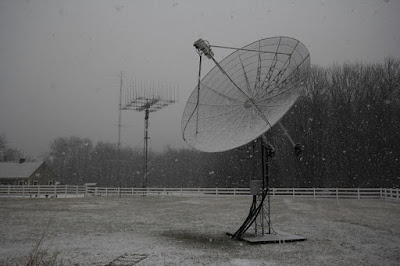
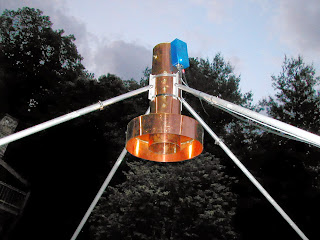
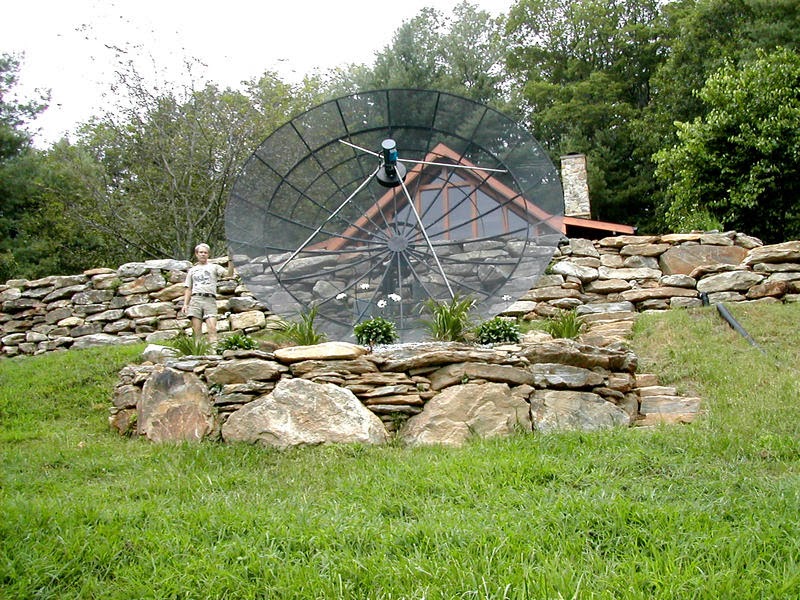
Above you can see Frank’s amazing antenna farm. The dish is for 23 cm EME. Behind the you can see his 70 cm array. That is 48 (FORTY EIGHT!) end-mounted Yagis, aimed into space.
Check out Frank’s QRZ.com page: http://www.qrz.com/db/NC1I He has some great pictures of his shack. In case you are wondering why he has so many rotator control boxes, remember that the dish and the Yagi array need two each (azimuth AND elevation).
Alan mentioned this in his interview with Eric on the QSO Today podcast. I really liked Alan’s video of the Project Diana moonbounce commemoration. That HUGE display showing outgoing signals and then the echoes off the moon was really cool. EME is on my to-do (someday) list.

David GM4JJJ was the fellow who sent us the video of early Scottish moonbounce ops. This morning he sent me a tale of woe involving some transverters and several BASTA! moments. I will spare you all the painful details, but I really liked this paragraph about David’s use of sigs from a French space surveillance radar:
… While the transverter for 144 MHz was being tested out into my new homebuilt antenna I tried receiving the French space surveillance GRAVES RADAR on 143.050 MHz. It is easily detected here in Scotland via meteor scatter. It is also so strong that passing space hardware like the ISS reflect the RADAR and can also be detected, showing up on FFT displays with their rapid Doppler shift. GRAVES is also easily detected by moonbounce, I could see it and hear it on my single 10 element yagi pointed at the horizon without a preamp. Even when the moon was at 15 degrees elevation here, and even higher in France the signal was strong enough to be picked up in one of the lobes of my antenna. You can actually see what the vertical pattern of the antenna looks like as the moon rises through the peaks and nulls of the antenna in conjunction with the constructive and destructive interference patterns caused by ground reflections and the direct path to the moon.
Our book: “SolderSmoke — Global Adventures in Wireless Electronics” http://soldersmoke.com/book.htm Our coffee mugs, T-Shirts, bumper stickers: http://www.cafepress.com/SolderSmoke Our Book Store: http://astore.amazon.com/contracross-20
Somehow this seems appropriate for Pi Day (3-14). I guess it is because the antenna is circular.
Thanks to David GM4JJJ for sending this to us. There is no audio. Kind of fun to watch the lads struggle with the big antenna while wearing coats and ties!
David writes:
Bill, I really enjoy SolderSmoke podcasts etc, I am returning to ham radio after about a decade, got the bug again….
Our book: “SolderSmoke — Global Adventures in Wireless Electronics” http://soldersmoke.com/book.htm Our coffee mugs, T-Shirts, bumper stickers: http://www.cafepress.com/SolderSmoke Our Book Store: http://astore.amazon.com/contracross-20
Bill:
Our book: “SolderSmoke — Global Adventures in Wireless Electronics” http://soldersmoke.com/book.htm Our coffee mugs, T-Shirts, bumper stickers: http://www.cafepress.com/SolderSmoke Our Book Store: http://astore.amazon.com/contracross-20
Dale W4OP
for PAR Electronics, Inc.
http://www.parelectronics.com
Our book: “SolderSmoke — Global Adventures in Wireless Electronics” http://soldersmoke.com/book.htm Our coffee mugs, T-Shirts, bumper stickers: http://www.cafepress.com/SolderSmoke Our Book Store: http://astore.amazon.com/contracross-20
Hack-A-Day ran a story on EME pioneer Zoltan Bay. In the comments section someone posted this memorable video about a moonbounce station in Central Kansas. Wow. Putting using naval gun as an AZ-EL rotor for the dish is really thinking outside the box. Then deciding to put the whole thing atop another tower… Great stuff.
Here is another moonbounce video. VE2ZAZ was using a smaller antenna (!) and JT65. FB.
Our book: “SolderSmoke — Global Adventures in Wireless Electronics” http://soldersmoke.com/book.htm Our coffee mugs, T-Shirts, bumper stickers: http://www.cafepress.com/SolderSmoke Our Book Store: http://astore.amazon.com/contracross-20
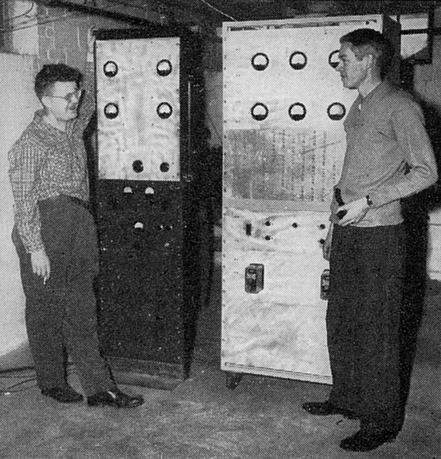
The link below will take you to an amazing collection of QST articles describing the early days of EME or “moonbounce.” Very interesting. I was really blown away when I found out that Ross Bateman, W4AO, (pictured above, on the left) did the very first amateur moonbounce work from the small suburban Washington town that I live in now — Falls Church, Virginia!
I am trying to find OM Ross’s old address or more info about him. If anyone has an old callbook, could you please look up Ross Bateman, W4AO, aka W4XNB? He worked at the National Bureau of Standards.
The moonbounce story is filled with interesting technology and characters and clubs. Sam Harris and his Rhododendron Swamp VHF Society sounds like our kind of group! Scroll through the OK2KKW web site and you will come across our esteemed Doug DeMaw and Bill Orr.
http://www.ok2kkw.com/eme1960/eme1960eng.htm
Our book: “SolderSmoke — Global Adventures in Wireless Electronics” http://soldersmoke.com/book.htm Our coffee mugs, T-Shirts, bumper stickers: http://www.cafepress.com/SolderSmoke Our Book Store: http://astore.amazon.com/contracross-20
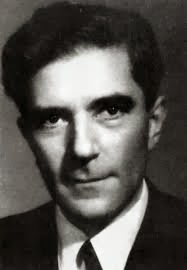
In March 1944, Bay recommended using the radar for scientific experimentation, including the detection of radar waves bounced off the Moon. The scientific interest in the experiment arose from the opportunity to test the theoretical notion that short wavelength radio waves could pass through the ionosphere without considerable absorption or reflection. Bay’s calculations, however, showed that the equipment would be incapable of detecting the signals, since they would be significantly below the receiver’s noise level.
The critical difference between the American and Hungarian apparatus was frequency stability, which DeWitt achieved through crystal control in both the transmitter and receiver. Without frequency stability, Bay had to find a means of accommodating the frequency drifts of the transmitter and receiver and the resulting inferior signal-to-noise ratio. He chose to boost the signal-to-noise ratio. His solution was both ingenious and far-reaching in its impact.
Bay devised a process he called cumulation, which is known today as integration. His integrating device consisted of ten coulometers, in which electric currents broke down a watery solution and released hydrogen gas. The amount of gas released was directly proportional to the quantity of electric current. The coulometers were connected to the output of the radar receiver through a rotating switch. The radar echoes were expected [11] to return from the Moon in less than three seconds, so the rotating switch made a sweep of the ten coulometers every three seconds. The release of hydrogen gas left a record of both the echo signal and the receiver noise. As the number of signal echoes and sweeps of the coulometers added up, the signal-to-noise ratio improved. By increasing the total number of signal echoes, Bay believed that any signal could be raised above noise level and made observable, regardless of its amplitude and the value of the signal-to-noise ratio.26 Because the signal echoes have a more-or-less fixed structure, and the noise varies from pulse to pulse, echoes add up faster than noise. From: http://history.nasa.gov/SP-4218/ch1.htm
During the war, Zoltán Bay protected Jewish colleagues from Nazi persecution. In 1998, the State of Israel honored him as Righteous Among the Nations for his actions and listed his name at Yad Vashem.
Our book: “SolderSmoke — Global Adventures in Wireless Electronics” http://soldersmoke.com/book.htm Our coffee mugs, T-Shirts, bumper stickers: http://www.cafepress.com/SolderSmoke Our Book Store: http://astore.amazon.com/contracross-20
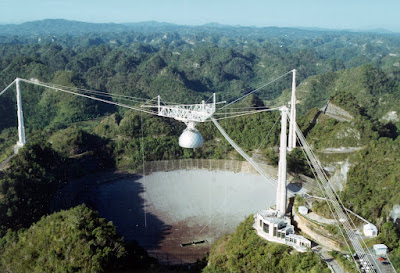
Rafael in Mexico sent me some very interesting info about World Moonbounce Day. Today!
From: “MM”
Sent: Wednesday, April 07, 2010 3:06 PM
Subject: [amsat-bb] Arecibo on 432 MHz Moon Bounce
> Hi all:
> Here is a EME event you cant miss.
> Dust off your CW key, its time for Satellite, QRP EME.
>
> The 1,000 foot dish has 60 dBi on 432 mc and 400 watts.
> That comes out to be approximately 243,902,443 Million Watts ERP.
>
> enjoy
>
> wf1f
> www.marexgm.org
>
> (thanks to KB1MGI for passing on this data)
>
>
> Arecibo on 432 MHz Moon Bounce
>
> The Arecibo Observatory Amateur Radio Club will be putting the
> 1000-foot radio telescope on the air for 432 MHz EME from April 16-18.
>
> It can be heard with a small hand-held yagi pointed at the moon
>
> The scheduled times of operation are:
>
> April 16: 1645 – 1930 UTC
>
> April 17: 1740 – 2020 UTC
>
> April 18: 1840 – 2125 UTC
>
> Callsign: KP4AO
>
> Tx Frequency: 432.045 MHz
>
> Rx Frequency: 432.050 to 432.060+
>
> Tx power: 400 W
>
> Antenna gain: 60 dBi
>
> System noise temp: 120 K (cold sky)
>
> System noise temp: 330 K (when pointed at moon)
>
> KP4AO can be heard with a small hand-held yagi pointed at the moon and a
> good receiver. A 15 dBi antenna and 100 W will be enough to work us on
> CW.
>
> Operators at KP4AO will do their best to work as many stations as
> possible. Each session will start with a brief announcement and CQ in
> SSB. SSB QSOs may continue for 30 minutes to an hour, if the QSO rate
> remains high.
>
> The mode will be shifted to CW as soon as it is judged that higher QSO
> rates would result.
>
> We will listen for calls at frequencies 5-15 kHz higher than our own,
> and even higher if QRM warrants. Callers who s-p-r-e-a-d o-u-t are more
> likely to be copied.
>
> If you’ve already worked us in any mode, please do not call again —
> give others a chance.
>
> If we call “CQ QRP”, we will listen for stations running 100 W or less
> to a single yagi. Please do not answer such a CQ if you are running more
> power or have a larger antenna.
>
> On April 18, if we reach a condition where most calling stations have
> been worked, and we judge that operating in the digital mode JT65B would
> produce a higher QSO rate, we will switch to JT65B.
>
> Note that any of these planned operating strategies may be changed as
> circumstances dictate.
>
> We are extremely fortunate to have been granted access to the world’s
> largest radio telescope for this amateur radio good-will event. We look
> forward to working as many stations as possible in the alloted time!
>
> >From QRZ.COM