Great Video on Mixers


You know that you are sinking deep into The Knack when you watch a video like this one and find yourself thinking: “FANTASTIC! WOW! Now I know why square waves are better!” I really liked this one. In the beginning I was kind of concerned about his refusal to explain how non-linear, non-switching mixers work. He actually used the dismissive non-explanation that I’ve always found so disappointing: “Blah, blah, blah… it’s in the trig.” And he actually said, “Blah, blah, blah.” But he more than made up for it when he got into the switching mixers. Note that his drawing (at the start) of “Mixing by Switching” attempts to show the waveform that results from an LO “chopping up” an incoming RF signal. I always find that picture worth a thousand trig equations.

I also really liked his explanation of the benefits of rapid rise time in switching mixers, and how slow switching causes the diodes to spend some time in the non-linear part of their curves, giving rise (!) to IMD products (I’m paraphrasing). You can really see why they say it is better to drive diode rings with square waves. So stop trying to put low pass filters between your LO and the diode ring. Square waves are your friends here.

Mr. Marki seems to be one very cool EE. And I’d like to hear more about his dad. Here is some more about the Marki engineers:

http://mwexpert.typepad.com/markimicrowave/
GREAT Video on Mixers

You know that you are sinking deep into The Knack when you watch a video like this one and find yourself thinking: “FANTASTIC! WOW! Now I know why square waves are better!”

I really liked this one. In the beginning I was kind of concerned about his refusal to explain how non-linear, non-switching mixers work. He actually used the dismissive non-explanation that I’ve always found so disappointing: “Blah, blah, blah… it’s in the trig.” And he actually said, “Blah, blah, blah.” But he more than made up for it when he got into the switching mixers. Note that his drawing (at the start) of “Mixing by Switching” attempts to show the waveform that results from an LO “chopping up” an incoming RF signal. I always find that picture worth a thousand trig equations.

I also really liked his explanation of the benefits of rapid rise time in switching mixers, and how slow switching causes the diodes to spend some time in the non-linear part of their curves, giving rise (!) to IMD products (I’m paraphrasing). You can really see why they say it is better to drive diode rings with square waves. So stop trying to put low pass filters between your LO and the diode ring. Square waves are your friends here.

Mr. Marki seems to be one very cool EE. And I’d like to hear more about his dad. Here is some more about the Marki engineers:

http://mwexpert.typepad.com/markimicrowave/

Visualizing Harmonics and Square Waves

Very illuminating. Very cool. We want more! Show us how a mixer works!

From:
http://hackaday.com/2015/09/17/visualizing-the-fourier-transform/?utm_source=feedburner&utm_medium=feed&utm_campaign=Feed%3A+hackaday%2FLgoM+%28Hack+a+Day%29&utm_content=Netvibes

Our book: “SolderSmoke — Global Adventures in Wireless Electronics” http://soldersmoke.com/book.htm Our coffee mugs, T-Shirts, bumper stickers: http://www.cafepress.com/SolderSmoke Our Book Store: http://astore.amazon.com/contracross-20

Si5351 Phase Noise? A Tale of 3 Oscillators

Si5351 at 16 MHz
There is still a lot of talk about the supposedly horrible phase noise of the Si5351 chip. In a recent episode of a popular (and very good!) podcast about homebrewing, the podcasters talked about this in the context of some megawatt AM shortwave broadcast stations that had oscillator phase noise problems and were wiping out large portions of the HF spectrum. I don’t think those stations were running Si5351s, but the listener was left with the impression that these handy little chips are very noisy with lots of spurs and will inevitably produce horrible dirty, spectrally impure signals.
This has not been our experience. Following Pete’s lead, several of us are using the Si5351 to generate both VFO and BFO signals in our transceivers, with good results. The receivers sound very good and we have not heard complaints of “broad” or “noisy” transmitted signals.
I decided to dig into this a bit. This was also an excuse for me to use the FFT and screen capture features on my Rigol ‘scope.
I now have THREE BITX transceivers in the shack. My BITX17 uses a VXO at round 23 MHz (IF at 5 MHz)/ My BITX20 uses a classic LC VFO running around 3.5 MHz (IF at 11 MHz). Finally, my BITX40 (DIGI-TIA) uses the dreaded and much reviled Si5351 running at around 16 MHz (IF at 9 MHz). I thought that these three rigs would provide a good opportunity to test the scurrilous claims about the Si5351.
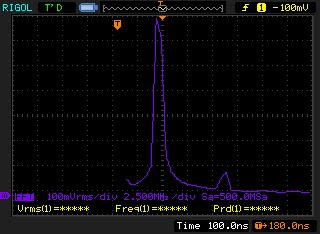
As a simple first test, I put my Rigol scope in FFT mode and just put the probe at the VFO Mixer’s LO input. The screenshot above is the FFT for the Si5351. It looks pretty clean to me. The ‘scope is looking at 15 Mhz above and below the VFO signal.


VFO at 3.5 MHz
Next I measured the output of the BITX20 VFO at the same point (input to the VFO mixer). (I had to change the vertical range, but the horizontal was unchanged.) Here you can see the second harmonic (just because at this low freq it is within the freq range setting of the ‘scope). It doesn’t look much different than the Si5351. 


VXO at 23 MHz
Finally, here is the BITX17 VXO at 23 MHz, again at the input to the VFO mixer. It looks remarkably similar to the Si5351, don’t you think?
More on this to come. The ARRL Handbook (2002) has a good discussion on phase noise. I am digging into this and hope to do some more tests. For now, I think we should reserve judgment on the utility (for us) of the Si5351. 


Our book: “SolderSmoke — Global Adventures in Wireless Electronics” http://soldersmoke.com/book.htm Our coffee mugs, T-Shirts, bumper stickers: http://www.cafepress.com/SolderSmoke Our Book Store: http://astore.amazon.com/contracross-20

Peter Parker Reviews a DSB Kit and Presents Cool Mods (3 Videos). Also: Why DC Receivers Don’t Work with DSB sigs. (It doesn’t seem fair!)

I found Peter’s recording of the DSB signal being received by a DC receiver to be very interesting. We’ve long been warned about the very ironic incompatibility of DSB rigs and DC receivers.

In “W1FB’s Design Notebook,” Doug DeMaw wrote (p 171): It is important to be aware that two DSSC (DSB) transmitters and two DC receivers in a single communication channel are unsatisfactory. Either one is suitable, however, when used with a station that is equipped for SSB transmissions or reception. The lack of compatibility between two DSSC (DSB) transmitters and two DC receivers results from the transmitter producing both USB and LSB energy while the DC receiver responds to or copies both sidebands at the same time.” Bummer.

In essence, we’ve been warned that the simple DSB/DC rigs we’ve put on the air cannot communicate satisfactorily with similar rigs. We are, it seems, doomed to only speak with SSB/Superhet rigs.

The later portion of Peter’s second video allows us to hear just what happens when we try to listen to a DSB signal with a DC receiver: It sounds, well, unsatisfactory. I was trying to figure out why. Here are some ideas:

Simplify things by assuming we are transmitting only a single audio tone of 1000 Hz through our DSB transmitter. The rig’s VFO is at 7100 kHz. The 1 kHz tone results in signals at 7101 and 7099 kHz. Along comes somebody with a Direct Conversion receiver. If he were able to put (and keep) his receiver oscillator on EXACTLY 7100 kHz, he would end up (by taking the difference products from the product detector) with a 1 kHz tone resulting from the 7099 kHz signal AND a 1 kHz tone from the 7100 kHz signal. But there would be phase differences between these two signals, so you would end up with a less than pure 1kHz tone. (Did I get that right?) And if — as is likely — your local oscillator is a bit off frequency you’d get a real mess. If for example the local oscillator was at 7100.1 kHz, you’d have tones at 900 Hz (7100.1 – 7101) and 1.1 kHz (7100.1 – 7099). Yuck.

You might think you could just use the local oscillator in your DC receiver to replace the carrier in the DC receiver, turning it into an AM signal, then use an envelope detector as you would with any AM signal. But not so fast! For this to work your local oscillator would have to be not only at the same frequency as the original carrier, but also in the same phase. That is hard to do. (Hard, but possible — that is what they do with synchronous detectors using phase locked loops.)

I think you can actually hear many of the DC-DSB problems as Peter tries to tune in the DSB signal of VK7HKN using the DC receiver in the MDT transceiver. It is indeed unsatisfactory. But don’t worry. It is highly unlikely that when using a DSB rig you will encounter another DSB rig. I speak from experience on this. Pity.


Our book: “SolderSmoke — Global Adventures in Wireless Electronics” http://soldersmoke.com/book.htm Our coffee mugs, T-Shirts, bumper stickers: http://www.cafepress.com/SolderSmoke Our Book Store: http://astore.amazon.com/contracross-20

BITX DIGI-TIA Build Update #3 Video of Receiver in Operation

A few things I forgot to mention in the video:

That USB port on the front panel has already come in handy. I needed to switch the tuning increment from 1 kHz to 100 Hz. I just went into the Arduino program, removed one zero, and then re-uploaded the code.

I also put to use the sideband inversion rule-of-thumb: My IF is at 9 MHz. I want to receive signals in the 7.2 MHz range, and I want the VFO running ABOVE the IF frequency. So obviously the VFO will be running at around 16.2 MHz. So, rule-of-thumb time: Will I be subtracting the frequency with modulation from the frequency without modulation? Yes I will! So, there will be sideband inversion. This tells me where to position my BFO frequency. The signals on 40 start out as Lower Sideband. But as explained above, by the time they get to the filter they will be inverted and will be upper sideband signals. So I need to put the BFO slightly BELOW the filter passband so that I can tune the signals in such a way as the sidebands fit into the filter passband and have the proper frequency relationship to the BFO to allow for demodulation. I put it at 8.9986 MHz. With the Si5351, changes to the BFO and VFO frequencies are very easy.

Our book: “SolderSmoke — Global Adventures in Wireless Electronics” http://soldersmoke.com/book.htm Our coffee mugs, T-Shirts, bumper stickers: http://www.cafepress.com/SolderSmoke Our Book Store: http://astore.amazon.com/contracross-20

IF Selection — Which Filter for the New Rig?

With some prodding from Pete Juliano, I am moving forward on my next transceiver. Same wood box enclosure (with copper flashing), but this time I am greatly relaxing some of the radical fundamentalist restrictions: Chips will be allowed. VFOs and VXOs will be replaced by an Si5351. Filters will not have to be homebrew. Pete has been putting his CNC machine to use and making me some nice boards with isolation pads already milled in. Oh, the luxury!

I am going to use the Termination Insensitive Amplifiers designed by Wes Hayward and Bob Kopski back in 2009. These are especially useful in bilateral type transceivers because they allow you to nail down the termination impedances on the crystal filter IN BOTH DIRECTIONS. That’s is important if you want the same filter shape on both transmit and receive.

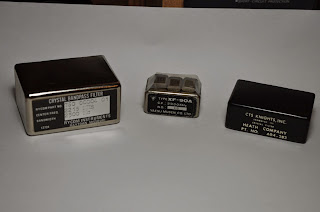
But now, with the trauma of my unfortunate IF selection on the BITX 20/40 (now just 20, sniff…) in mind, what filter should I use on this rig? The three main candidates appear above. The 9 MHz Yaesu filter was given to me some time ago by Steve “Snort Rosin” Smith. The Heath filter (3.395 MHz) and the larger silver one (2.215 MHz) were given to me by Armand Hamel. (Thanks Guys!)

My main band of interest for this rig is 40. But if possible, I’d like to be able to use it on 15 and 12 meters, and maybe even 20 and 17, hopefully without having to change filters.

So what say the gurus? Which one should I use? Or should I put two of them in there, with provisions that would make it easy for me to move from one to the other?

Right now my inclination is to go with the 9 MHz filter, perhaps with the 3.395 MHz filter also available.

Our book: “SolderSmoke — Global Adventures in Wireless Electronics” http://soldersmoke.com/book.htm Our coffee mugs, T-Shirts, bumper stickers: http://www.cafepress.com/SolderSmoke Our Book Store: http://astore.amazon.com/contracross-20

Sideband Inversion


Joel Hallas, W1ZR, (aka “The Doctor”) has an especially good column in QST this month. He takes on a topic that has confused (and re-confused!) many of us: sideband inversion. Simply put, if you have a single sideband signal, and you put it through a mixer, depending on the frequencies involved and on whether you take the sum or the difference product of the mixer, the sideband may or may not get INVERTED! You could start out with an UPPER sideband signal coming out of your sideband generator, then, after you mix it with your VFO (or Si5351!) you end up with a LOWER sideband signal. This can be quite an unpleasant surprise.

Joel gives us a good rule for remembering when this will happen:

“Sideband reversal occurs in mixing only if the signal with the modulation is subtracted from the signal that isn’t modulated.”

Words to live by my friends. Words to live by.

The confusion on this topic often arises in discussions of the old scheme of using a 5 MHz, 9 MHz filter/VFO combination to generate LSB on 75 meters and USB on 20 meters. This is very convenient, but you need to remember Joel’s rule to get this scheme right! If you start out with a sideband generator putting out UPPER sideband at 5 MHz. and mix it with a VFO running at 8.5 — 9.5 MHz, for 20 meters you will take the SUM of the two frequencies. So no sideband inversion. You will be happily on 20 meter USB (the mode used on that band). For 75 meters you will be SUBTRACTING the SIGNAL WITH THE MODULATION (5 MHz) from the SIGNAL WITHOUT THE MODULATION (8.5-9.5 MHz). So, following Joel’s rule you WILL get sideband inversion. Here you will be on 75 meter LOWER sideband (the mode used on that band).

It is easy to get confused on this. I got confused when Steve Smith sent me a 9 MHz filter out of an old Yaesu. I had visions of using the old 9 MHz 5 MHz scheme. But no…. With a 9 MHz sideband generator, you can get on both 75 and 20 with a VFO running at 5 to 5.5 MHz, but you won’t get the nice sideband inversion situation described above because with neither band will you be subtracting the signal with modulation (9 MHz) FROM the signal without modulation (5-5.5 MHz).

It was very nice that Joel admitted to falling victim to this kind of confusion himself in a column he wrote years ago.

Thanks Joel!

Our book: “SolderSmoke — Global Adventures in Wireless Electronics” http://soldersmoke.com/book.htm Our coffee mugs, T-Shirts, bumper stickers: http://www.cafepress.com/SolderSmoke Our Book Store: http://astore.amazon.com/contracross-20

Pete Tries Baluns on the DBM

A couple of weeks ago I ran a post about an old 73 Magazine article that extolled the virtues of putting baluns at the RF input and IF output of diode ring mixers. Dedicated experimenter that he is, Pete Juliano gave it a try:

Hi Bill,
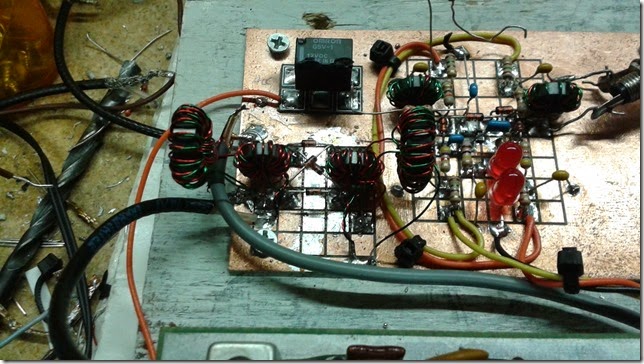
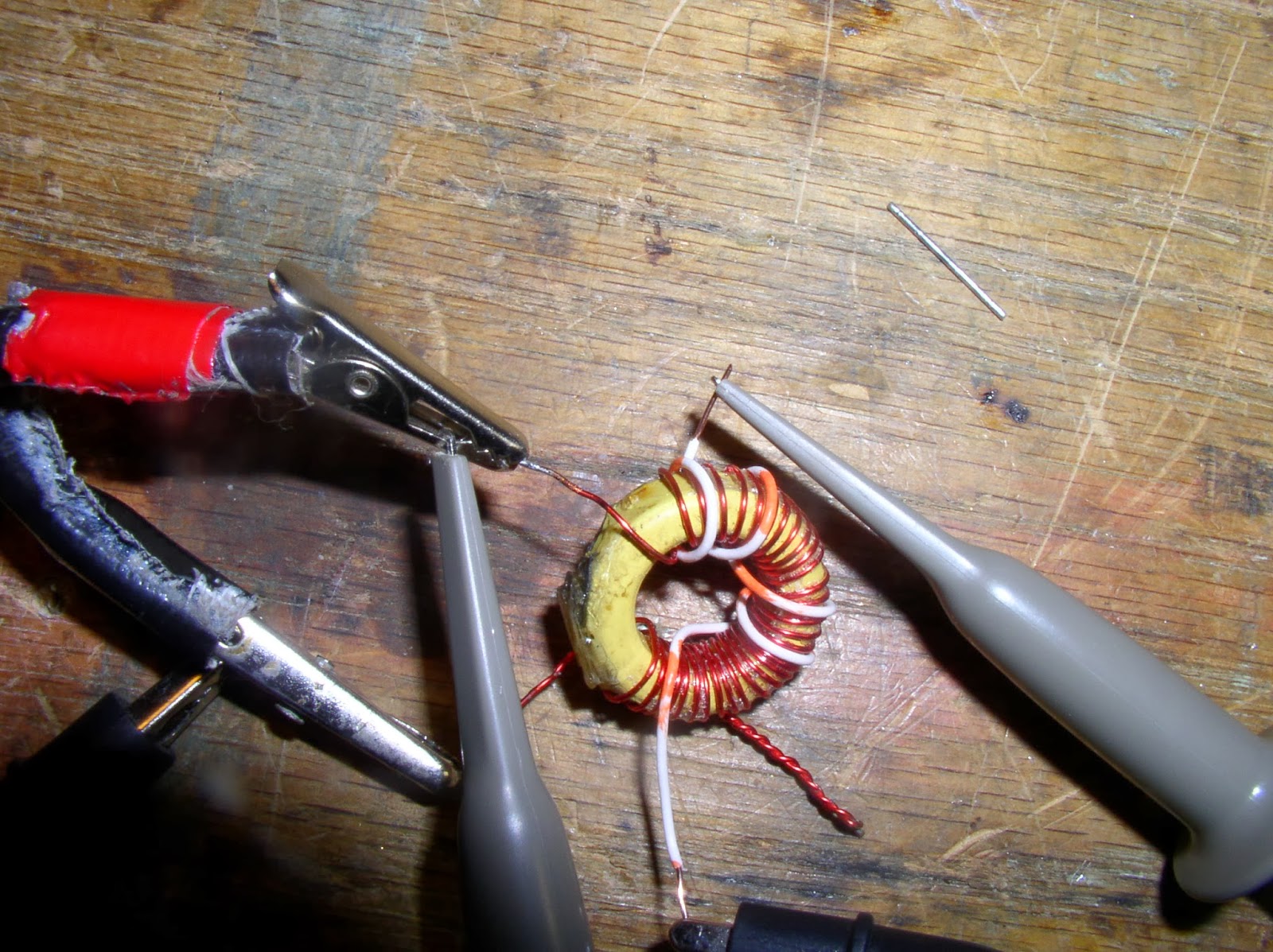
I did the modification and used 20 bifilar turns of #26 on a FT-50-43 core for each transformer.
The most important observation is that I did not see any degradation of performance and in fact I think has helped an overloading situation I was seeing on some extremely strong signals.
The photo is of a DBM that is behind a bilateral stage that on Rx is the RF amplifier and on Tx is the Tx pre-driver. I do have another single transistor RF amp ahead of this. In normal operation the next stage would be the Band Pass Filter.
The back end is an IF amplifier, AGC, Product Detector, balanced modulator and mic amp stage all on a board that came out of a Hallicrafters FPM-300 SSB/CW transceiver. There is a you tube video of this prototype project.
73’s

Pete N6QW

Thanks Pete!

Our book: “SolderSmoke — Global Adventures in Wireless Electronics” http://soldersmoke.com/book.htm Our coffee mugs, T-Shirts, bumper stickers: http://www.cafepress.com/SolderSmoke Our Book Store: http://astore.amazon.com/contracross-20

Building a Better Diode Ring Balanced Modulator (with Knack Karma)

So yesterday Pete and I were talking about Dave W2DAB’s Michigan Mighty Mite malady. Dave is tantalizingly close to the joy of oscillation. Wizard that he is, I think Pete diagnosed the problem with his eyes closed from 3000 miles away. I sent Dr. Juliano’s prescription to Dave this morning and expect the concrete canyons of Upper Manhattan to be ringing with pure 800 Hz tones as soon as Dave fires up his soldering iron.

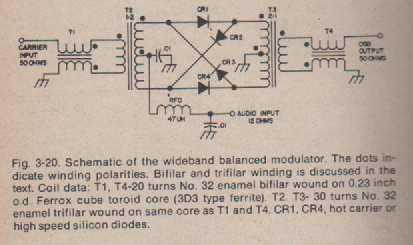
Anyway, I then told Pete that I’d been looking through my bookshelf for something suitable for my 11 year-old nephew Sebastian. I found something for him, but I also came across a book that was too advanced for the young fellow: “The Master Handbook of Ham Radio Circuits.” TAB Books, 1977. By “The Editors of 73 Magazine.” Between turkey sandwiches I started looking through this book. I immmediately found an article of interest: “A Better Balanced Modulator.” The author (unnamed) looks closely at the performance of our beloved and much-used diode ring mixer with dual trifilar transformers. He concludes that the unbalanced input and output coils (in the traditional configuration) detracts from the balance needed for optimum carrier suppression. He suggest the use of baluns at input and output (see above) and claims significant improvement in carrier suppression. Very interesting. (If anyone wants to dig into this, e-mail me.) There is also a very simple solid-state VFO circuit that promises phenomenal stability.

Anyway, I found myself trying to remember where this great book came from. Then I remembered someone sending it to me. A quick check of my e-mail revealed the source: Dave W2DAB sent it to me three years ago. Thanks again Dave!

Our book: “SolderSmoke — Global Adventures in Wireless Electronics” http://soldersmoke.com/book.htm Our coffee mugs, T-Shirts, bumper stickers: http://www.cafepress.com/SolderSmoke Our Book Store: http://astore.amazon.com/contracross-20

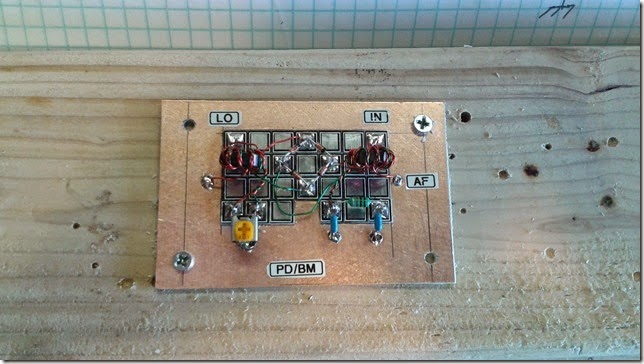
Pete’s Mixer (Pictures)

Hi Guys,
Just finished building the PD/BM that will be used in the final circuit of the LBS Part I. I will also upload a video of the build.
The W1REX MeSquares really work very well and greatly facilitate the build. So the newbie builder — will have one leg up by using the squares method.
73’s
Pete N6QW

Pete’s video on this circuit appears below — just scroll down a few.

Our book: “SolderSmoke — Global Adventures in Wireless Electronics” http://soldersmoke.com/book.htm Our coffee mugs, T-Shirts, bumper stickers: http://www.cafepress.com/SolderSmoke Our Book Store: http://astore.amazon.com/contracross-20

Pete Builds a Doubly Balanced Modulator (Video — Part 3)

Another beautiful piece of cinema from Giovanni Manzoni’s Newbury Park Studios. Bravo Giovanni!

Pete is obviously a doubly balanced kind of guy. I liked his use of the W1REX MePads and the breadboard. Also, the balance pot and the un-balance switch are very handy innovations.
Most of all I like the way Pete’s video takes you from schematic to actual circuit.

Thanks Pete!

Our book: “SolderSmoke — Global Adventures in Wireless Electronics” http://soldersmoke.com/book.htm Our coffee mugs, T-Shirts, bumper stickers: http://www.cafepress.com/SolderSmoke Our Book Store: http://astore.amazon.com/contracross-20

Homebrew Double Balanced Mixers by Pete Juiano (Part II) Video

Another great video from Pete. I like the unbalancing mod — I hate having to whistle into the mic!

Our book: “SolderSmoke — Global Adventures in Wireless Electronics” http://soldersmoke.com/book.htm Our coffee mugs, T-Shirts, bumper stickers: http://www.cafepress.com/SolderSmoke Our Book Store: http://astore.amazon.com/contracross-20

Pete’s Homebrew Double Balanced Mixer Video (Part 1)

Another great video from the famed Italian Director Giovanni Manzoni! Bravo Giovanni!

Pete’s discussion of double balanced mixers and the associated toroids has made me feel uneasy about my efforts in this area. I wonder if my diodes were completely matched. And I KNOW that my toroids are not as well done as Pete’s.

I recently put an SBL-1 into my old, long-evolving 20 meter ceramic resonator DSB rig. Careful with those nice little boxes! A bit too much juice and you can fry the little internal toroids (as I have done!).

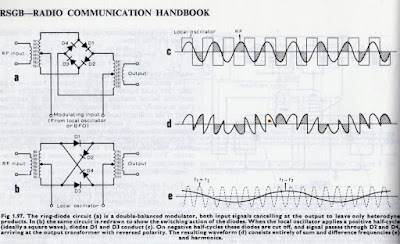
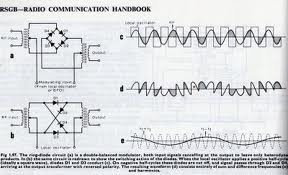
A while back I found in an RSGB Handbook a nice diagram showing how the diode ring mixer does its thing:


Our book: “SolderSmoke — Global Adventures in Wireless Electronics” http://soldersmoke.com/book.htm Our coffee mugs, T-Shirts, bumper stickers: http://www.cafepress.com/SolderSmoke Our Book Store: http://astore.amazon.com/contracross-20

Sines, Squares, Harmonics, ‘Scopes, FFTs, and Sounds

Bil Herd of Hackaday did a very nice video on Sine Waves, Square Waves and FFTs. This is, of course, an important part of understanding how mixers mix. I look forward to his upcoming video on Direct Digital Synthesis.

Our book: “SolderSmoke — Global Adventures in Wireless Electronics” http://soldersmoke.com/book.htm Our coffee mugs, T-Shirts, bumper stickers: http://www.cafepress.com/SolderSmoke Our Book Store: http://astore.amazon.com/contracross-20

Alan Wolke Looks at Diode Ring Mixers

Bill, I remember in your Soldersmoke book that you had difficulty for a long time trying to understand how a mixer created the sum and difference frequencies, and how this was accomplished in a diode ring mixer. I know that you’ve got it all sorted out now, but I thought this was a good topic for a video anyway.

Here’s my video on the subject:

73,
Alan


Alan: Thanks. Great stuff. Yea, I’ve been looking at the innards of mixers for a long time. In my book, I try to explain how I have come to understand the physics of the mixing action — how the use of a non-linear element causes two signals to “multiply” and how this “multiplication” results in sum and difference frequencies. I tried to go beyond the trig functions because for me the trig didn’t really explain anything.


In the book I was looking at the classic two diode mixer (beloved of Doug DeMaw!). A few years later, on the blog, I was looking at the action of the diode ring. I concluded that there is a big difference between how the diode ring works and how the two diode mixer works. RSGB provided a great diagram:


73 Bill

—–
I guess one way of describing the difference between a two diode mixer and a diode ring would be to say that the more simple mixer multiplies the signal by 0 and 1 (if it is operating in “switching mode), while the diode ring multiplies by 1 and -1.

Our book: “SolderSmoke — Global Adventures in Wireless Electronics” http://soldersmoke.com/book.htm Our coffee mugs, T-Shirts, bumper stickers: http://www.cafepress.com/SolderSmoke Our Book Store: http://astore.amazon.com/contracross-20

Herring Aid: It was NOT the dots! Rotational Sense and Phasing

Opposite “sense” winding and resulting phase shift


My second attempt at building a Herring Aid 5 (the first was 1976) continues.

I thought I had discovered an error in the schematic that (I hoped) explained my failure to get this simple receiver running (scroll down for details). But Dex, ZL2DEX, in New Zealand spotted something that got QST off the hook and put all the blame back on me:

I had failed to check the rotational sense of the windings. The schematic called for 4 turns over the Radio Shack choke. So I just went ahead and wound them. I didn’t pay any attention to the direction of the winding. I then hooked it up in accordance with the phasing dots in the diagram. And it didn’t work. So I switched the coil connections around. And it worked. Aha! I thought! QST messed up! It wasn’t my fault.

Dex brought me back to reality. He noted that I probably wound the coils with the wrong rotational sense. I confirmed this. I rewound the coil following the rotational sense of the choke. I hooked it up following the phasing dots of the schematic. This time the oscillator started right up. So the problem wasn’t an incorrect drawing of the phasing dots. Instead it was my failure to remember that phasing is more than just the top or the bottom of a transformer’s winding. Rotational sense is also important. That’s why “phasing dots” are sometimes referred to as “sense dots.”

This doesn’t come up very often, because most of the toroidal transformers we make are bifilar or trifilar — the windings are always in the correct sense because we twist the wires together before putting them on the coil. When we look at those phasing dots, we are focused on getting the proper tops of coils connected to the appropriate bottoms of other windings. We don’t pay any attention to the sense of the windings. Thanks to Dex for bringing me back to my senses 😮

Grob’s Basic Electronics has this definition for those phasing dots:

Used on transformer windings to identify those leads having the same instantaneous polarity.”


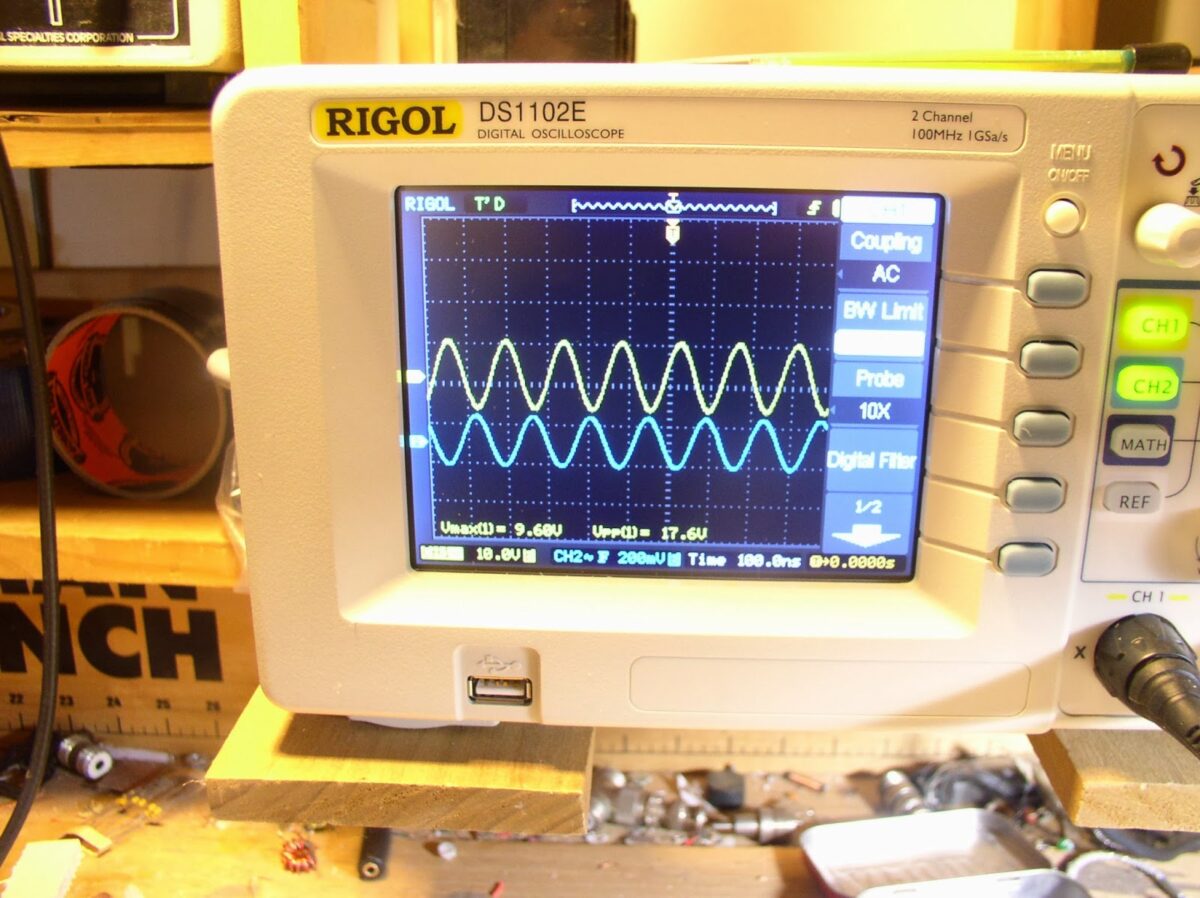
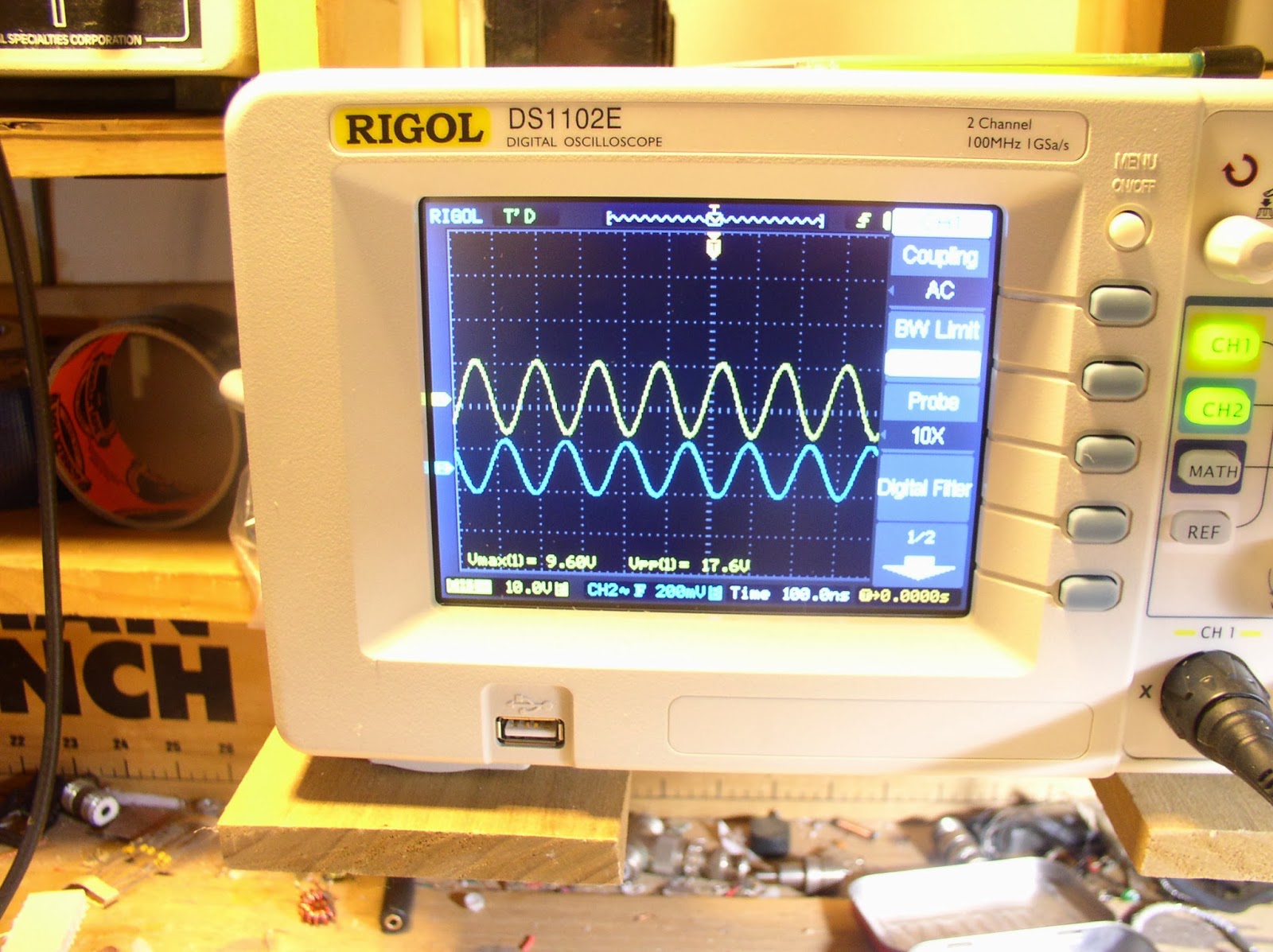
This morning I did a little experiment to confirm all this: I took a toroidal core and wound a little transformer. Using a dual trace scope, I looked at the input and output wave forms. Sure enough, when the windings are in the same rotational sense, there is no phase shift. But when that secondary is wound in the opposite sense, you get a 180 degree phase shift. I know this is very basic, but it was fun to re-learn it and to confirm is.

But I still don’t have the little receiver running. I think there are a few problems. That single BJT mixer stage needs a lot of RF (2.5 volts p-p) from the oscillator. Also, I think the 10 uH chokes that I am using are not the same as the chokes used in the original Herring Aid design. So when I build transformers on these chokes, they don’t work very well.

But I will keep at it. It has been 38 years… I can wait another week or two.

Our book: “SolderSmoke — Global Adventures in Wireless Electronics” http://soldersmoke.com/book.htm Our coffee mugs, T-Shirts, bumper stickers: http://www.cafepress.com/SolderSmoke Our Book Store: http://astore.amazon.com/contracross-20

SSB Generation: Ideas from Around the World


I liked this thread on the EMRFD mailing list. The question of how best to generate SSB is very interesting, and I also liked the global scope of the Q&A: Peter in Hungary asks the question, Farhan in India and Allison in the U.S. respond.

On 9/25/12, ha5rxz wrote:
When generating an SSB signal from audio and a 9 MHz carrier which would be
the best mixer to use?
a) A high-level ring bridge mixer such as the SRA-1H
b) An H-Mode mixer using an FST3125 chip
c) An H-Mode mixer using a 74HC4016
d) Something else
Note that this mixer will not be used to demodulate.
Peter HA5RXZ

……………………………..
Ashhar Farhan wrote:
In my experience, if you keep the audio level low enough, it is
difficult to beat a simple two diode mixer.with a 10 db attenuator in
the output. Having just two diodes makes balancing of reactive as well
as resistive differences of the two diodes quite trivial. Schottky
diodes are best.
One thing, I did discover though is that the balance should be to
minimize the harmonic distortion, rather than just the carrier
suppression.
What we are shooting for is to keep the In-band IMD down. Carrier
suppression is just hygiene. So, you will want to tune in to the
signal, modulating it with two tones and see it on a audio spectrum
analyzer (freely downloadable from the net) and try getting the third
spike down.
Though the ‘packaged’ mixers don’t give you the needed control for
hi-fidelity, for trivial usage, NE602 is pretty good. Just drop it
into the rig and live with what you get (which is not bad at all).
The best resource is the chapter on phasing receivers and transmitters
in emrfd. Rick is the guru. I hope he joins this thread.

– Farhan

……………………………………..
FROM KB1GMX:

I’ll weigh in..

Yes, they all work. You need a provision for adjusting carrier balance on some but anything over 40db will be good.

I’ve used 602/612s, SBL-1, SBL-1H, diode rings, and even varicap
diodes (there is a design using them in capacitively balanced
a modulator from many years ago. They all work if the levels are correct.

These days I use the sa612 for simple designs, SBL-1 with a 50ohm
pot added for balance for better radios and the 4 diode ring I’ve
used many times as its uncritical, needs only one untapped
transformer and easy to make. Most of those are listed in the
older 1975 through current handbooks and EMDRFD.

If needed I can post to the files section a few designs but
they are all textbook and all are capable of good results.
In just about all the diode modulator cases a fairly strong
carrier (5mW or more) is needed and the audio will be about
10db lower for very good result. The active devices like the
ca3028(and friends), SA612, MC1496 the levels for the carrier
and audio must be matched accordingly for the device. You can
look at the output with a scope and get a first order eyeball
call on quality (no carrier and no clipping or limiting) and a
receiver (any your ears) will tell you if its right.

Allison

Our book: “SolderSmoke — Global Adventures in Wireless Electronics” http://soldersmoke.com/book.htm Our coffee mugs, T-Shirts, bumper stickers: http://www.cafepress.com/SolderSmoke Our Book Store: http://astore.amazon.com/contracross-20

The Polyakov QRSS Receiver

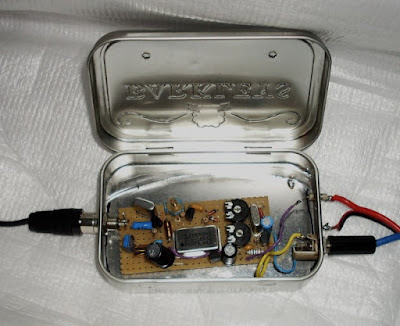
Of course, we like it because it is in an Altoid-like box. And because it is Direct Conversion. And because it is used for QRSS, with the output fed to an on-line grabber. But this one is EVEN BETTER because it uses a Polyakov detector!

Check out PA1GSJ’s receiver: http://www.qsl.net/dl1gsj/html/qrssrx30.html

View the output (live): http://www.qsl.net/dl1gsj/qrss/

More on Polyakov detectors: http://soldersmoke.blogspot.com/search?q=polyakov

How much AF amplification needed between diode ring and a sound card?

Progress continues on my WSPR direct conversion receiver. The Colpitts oscillator is working nicely and is very stable. Yesterday I glued an SBL-3 diode ring to the board and hooked it up. With my ‘scope and sig generator I can see it turning 30 meter RF into audio. So far so good.

Now it is time to build the AF amp. Here’s my question: How many db do I need? The standard 100 db DC RX AF Amp seems like a bit of overkill — this thing won’t drive a speaker or a headphone, but instead, a computer soundcard. What do you guys think? How many db?