AA1TJ: Reggies Rule! Diode Amps! QRP to the Max!

Whenever I find myself in need of some radio-inspiration, an e-mail from Mike, AA1TJ, seems to pop up in my inbox. This morning’s message and the associated video (above) were especially inspirational. Mike was e-mailing Steve, WA1HFF.

Hi Steve,
Thanks for the message and the great QSO! I was running my one transistor transceiver that I call the Reggie. You can read about it on my webpage at

http://mjrainey.googlepages.com/reggie

My antenna is nothing to write home about; just an end-fed half-wave wire bent into an “EL” at 35 feet.

I’ve made just over 240 contacts with my Reggie in a little more than a year’s time; working 19 states. My best (and only) real DX was the Bahamas. All of these contacts were made with no receiver gain on this end; just a pair of diodes fed by a one-transistor BFO, and onto the headphones.

A couple of fellows have built their own Reggies, so you might run into one on 80m now and then. I’ve made three Reggie to Reggie QSOs thus far.

Steve, last night I was trying something new; I ran a loudspeaker from an audio amplifer connected to my Reggie. What’s unusual is that my audio amplifer was made from three, common power supply rectifiers (1N5401’s). I’m not kidding! It’s a nearly forgotten circuit from 1954 that I (re)stumbled upon a couple of weeks ago. It uses the phenomenon of PN junction charge-storage to produce amplification.

Last week I used two diode gain stages for a total power gain of 48dB to drive my headphones. Yesterday, I added a third diode gain-stage and connected it to a loudspeaker for shack-filling audio volume.

I made a video of last night’s setup (the same setup I worked you with). You can see it at

http://www.youtube.com/watch?v=3DA07A6BLDg

Thanks again for the nice contact last night, Steve. You were armchair copy here! :o)

Best wishes,
Mike, AA1TJ

Here’s a question for Mike: Can you build that kind of amplifier with homebrew point-contact diodes? If so, you’d be opening up the possibility of a homebrew solid state receiver with homebrew solid state devices. Oh man, this stuff makes me feel like such an APPLIANCE OPERATOR.

Final Report from the Maine Code Talker/160 QRP Rexpedition

Rex, W1REX, has a really nice article on this week’s historic QRP expedition to the Maine coast. As you have read in this space, Michael, AA1TJ, challenged the mighty Atlantic with nothing more than the 15 milliwatts generated by his own voice. No joy this time, but we are sure that Michael will soon experience the same thrill felt by Marconi when that first, faint S was heard on the other side. Seab, AA1MY, overcame serious kite problems and fulfilled a long-held QRP ambition by working across the pond on 160 meters with less than 5 Watts. Congrats Seab! Congratulations to all the Rexpedition team members. It has been really fun to follow your adventure.

Read all about it here: (The link to the Rexpedition article is near the top of the page, but don’t miss the wonderful kits that Rex is offering further below!)

http://www.qrpme.com/

AA1TJ Code Talker on the Maine Coast

Apparently no voice-powered transatlantic joy yet, but we all know it is just a matter of time. And I think this will be something completely new in radio history! Great try guys! Keep at it!

From W1REX last night:

We started about 8:45 am this morning, because AA1TJ was too excited to
wait any longer! He shouted into his #2 can for a couple of hours until
I thought he was going to burst a vessel….and I’m not talking about
one of the many passing by out on the ocean. We thought that we had a
2-way QSO a couple of times but the returns were simple lost in the
noise. Michael ran out of steam….or breath…and none of us old-timers
could cut the mustard..or soup…or whatever was in the can.

Seab, AA1MY, launched the kite last night prepping for an attempt at a
160m record. He intended to operate on 1.811 and cross ‘the pond’ with a
minuscule signal but the bridle broke on the kite and it sailed away….
It could be on the other side of the pond for all we know, as it was
never seen again. He launched a back-up kit tonight and had it up there
into the lower stratus-sphere but needed just a little more height as
there was still some antenna wire on the ground…but alas, the wind
came to an abrupt stop and the flying kite came to an abrupt just a
short time later.

So to sum up todays results: ZILCH!

We want to thank EVERYBODY who kept an ear out for us today and hope you
have the time and patience to try it again tomorrow morning!!

TOMORROW’S ITINERARY:

We have more wire up on 20m and will attempt another across the pond QSO
starting at 8:00AM local time or 1300 Zulu. Mike has to pick up his wife
at the airport in NH so the attempt will terminate long about 9:30AM
local time. So we have another 90 minutes to try for the record and YOU
have another 90 minutes to be a part of it. Listen in at 14.055 MHz
starting at 1300 hours. Put your good ears on and listen sharp… Hope
you hear us AND we hope to hear you hearing us…

Seab will take another stab at the 160m record (MAINE weather
permitting) probably around 700AM local time 1200 Zulu. He is
heartbroken that his dead-cert kit took a powder and dashed his dream.
Little back-up kite and a sightly altered antenna farm hopefully will
come through for him. Give a listen over there on the other side of the
Atlantic.

Transatlantic Team Heads to the Coast!

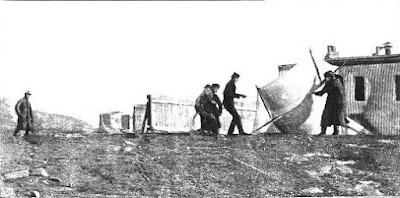
When it comes time to cross the pond, it seems only natural to head to the beach. That’s what Marconi did (above we see his team struggling with a kite at Newfoundland). And that is what AA1TJ, W1REX, AA1MY and W1PID are doing today and tomorrow. Here is Michael’s message to QRP-L describing the expedition. Good luck guys!

Some of the lads are heading over to the Maine seacoast on Monday
morning for what we’re calling a “Rexpedition.” W1REX was kind enough
to secure the use of his family’s beachfront camp for us for a couple
of days. He explained the urgency to them, saying, “…a bunch of
radio-heads want to talk to Europe with the equivalent of a cellphone
with a dead battery.”

Rex, Seab, AA1MY and Jim, W1PID, are going to arrive early on Monday
to begin putting up the antennas. I plan to show up in time for lunch;
hopefully after all the hard work is done. Seab wants to erect a pair
of half-wave phased verticals on 20m. I think the plan is to lift a
160m antenna using one of Seab’s big kites.

Our hope is to cross the pond on both 160m QRP and with my
voice-powered 20m transmitter. The weather forecast looks great at
least through Tuesday. My “Code Talker” will be rockbound on
14.055MHz; same as last Thursday. We’ll begin the voice-powered 20m CW
attempt the first thing on Tuesday morning (11/10/09). Again, the goal
is to span the Atlantic, but as always, I’ll be very pleased to work
anyone that hears me.

By the way, last Thursday’s voice-powered operation on 20m was a great
success. Altogether, I worked four stations and received one SWL
report. The best DX was W4FOA in Chickamauga, GA; a distance of
923miles. Tony reported that my 15mW signal was “an honest 579”. W4OP
– located one hundred miles to the north of Tony – handed me the same
report and followed up with an amazing recording (you can hear it on
my website). Later in the day I received an email from AD5VC. Dana
reported that he clearly copied my callsign while listening on the LSU
club station (K5LSU) in Baton Rouge; a distance of 1375miles (nearly
half the distance between the Maine coast and London, England).

I thought these were remarkable results for 15mW into an endfed wire
at 35 feet. It makes next week’s attempt from a saltwater QTH, coupled
with the low-angle of radiation with a spot of directional gain all
the more exciting.

So please keep us in mind come next Tuesday morning. I’m guessing Seab
will be operating 160m QRP on both Monday and Tuesday evenings.

Thank you,
Mike, AA1TJ

Crossing the Pond… with the power of your voice

Michael Rainey, AA1TJ, has his eye on the North Atlantic. He’s been thinking about maritime horns, and how far they could reach. He’s built another kind of horn. I’m pretty sure that this one will soon take his voice and — using ONLY the power of that voice — send it across the mighty Atlantic. That’s a pretty astonishing horn!

Yesterday Michael put a really nice message up on the QRP-L list. This is the kind of message that has earned him the title “Poet Laureate of QRP.” Here is an excerpt:

I’m currently sitting at a desk on top of Vermont’s highest mountain.
In the far distance I can see the Presidential mountain range of New
Hampshire
. Roughly twice as far away is the Atlantic Ocean. The other
night I spoke into a tin can, and the power of my voice carried a
message to the Maine seacoast where K1MPM heard me as clear as a bell.
I think this is absolutely magical. The present prospect of blowing
into a tiny horn and having this pittance of exhaled energy carry a
message back to England – when the bone shaking horn on the old Queen
Mary
couldn’t carry to the horizon – is nearly beyond comprehension. I
know this is how everyone of us feels when we operate QRP.

Read the rest of Michael’s message here:
http://mjrainey.googlepages.com/lavoixdesoc%C3%A9ans

Listen to “El Silbo” Voice-Powered Rig!

POWER SUPPLY

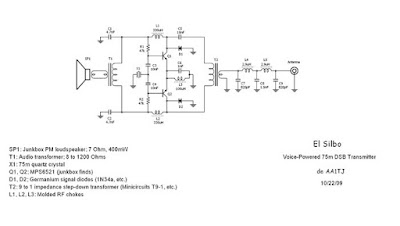
Michael, AA1TJ, has had more contacts with his voice-powered DSB rig. (Scroll down a bit for a look at the schematic and more comments on this amazing project.) Michael has posted two recordings of his signal (as received at distant stations). When I played these files, Ubuntu showed one of those semi-psychedelic groovy “visualizer” displays, complete with oscilloscope-like patterns; the signal looked FB Michael!
Have a listen: http://mjrainey.googlepages.com/elsilbo

“El Silbo”: Michael Rainey’s Amazing Voice-Powered DSB Transmitter


Oh man, the wizard of the Vermont hobbit hole has really outdone himself this time. Michael Rainey, AA1TJ, has posted a very interesting report on his experiments with voice-powered radio. I was, of course, delighted that he went with DSB. Check it out: http://mjrainey.googlepages.com/elsilbo

I don’t mean to seem like I’m taking any credit for this, but I did provide Michael some technical advice on how to increase power output:

Michael: Obviously the Italian elements in the project were of critical importance. Some of them may have escaped your attention. I note that an olive can was involved… For further progress I think you should consider working in some of the other substances that help keep Italy going: cappuccino, Nutela, and perhaps some vino bianco…

Another thing: While you are shouting, be sure to use the proper gesticulations. I recommend that you go Neapolitan here — they are the best. I’d say that before each CQ, you should put yourself in a Neapolitan frame of mind: imagine that someone has bumped into your car and that you and the other guy are arguing about who is at fault. This should generate at least 20 mW!

In boca a lupo! 73

Bill

AA1TJ’s Nifty Fifties Pixie

Once again great things are happening in the underground lab of Michael, AA1TJ. Michael has temporarily put aside his work on Iron Pyrite-based receivers, and is now working the world with 50’s era point contact transistors. I can feel the enthusiasm, even all the way over here in Rome. I particularly liked Michael’s description of the QSO in which the other guy heard his backwave. Backwave is the very small signal that is sometimes put out when the key of simple transmitter is up. For example, the oscillator on my old VXO-controlled 6 watter (from “QRP Classics”) ran all the time — I just keyed the amplifiers. Sometimes guys would report hearing some of the RF from the oscillator even when the key was up. (By the way, the term backwave reminds me of a word used sometime by Billy and Maria: backwash. As in, “No Maria, you can’t have a sip of my soda — you always leave backwash!”)

In his e-mails, Michael mentions that the physics of the point contact devices are a bit of a mystery for him. I recall that the book “Crystal Fire” by Riordan and Hoddeson had some pretty good info on how these early transistors worked.

Here are some excerpts from Michael’s e-mails on this project:

I haven’t had time to document this pyrite/tunnel diode receiver on account of a phone call that I had two weeks ago from Jack Ward at the Transistor Musuem. Jack approached me with an idea to recreate the first ham radio contacts using transistors. Of course, the point-contact transistors involved are now pretty rare items. No problem for a fellow with a transistor museum though!
Jack kindly sent me a couple of Western Electric, 2N110 “relics.” I had some initial trouble with “squegging,” and I wasn’t able to produce oscillation above 380kHz. To read a recent tale of one fellow’s trouble trying to tame the 2N110, please see
I especially liked where he wrote, “I did seriously consider giving up at this stage and taking up heavy drinking.” ;o)
However, I located an old textbook that discussed circuit design theory using point-contact transistors (the physics of these devices are still clouded in mystery). What I learned made all the difference. A few more hours at the bench and I had an 80m transmitter putting out 10mW.
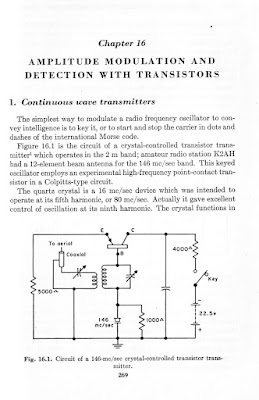
The story gets better though, Ned. A circuit briefly described in another old book really caught my attention. It was pretty much the same circuit as was used by George Rose, K2AH, in his first transistor QSO. Only, a circuit (designed by G3IEE) showed a pair of headphones in dotted lines, next to the collector resistor. The text merely said
“As indicated, the circuit also functions as an oscillating detector type of receivere for local continuous wave operations whith head phones plugged into the collector circuit instead of resistor R3. Good reception and break-in operation were obtained.”
That got my blood moving! Positive results came right away on the bench. The received signals were every bit as strong as with my Reggie and the Cub Scout heterodyne (what I started calling, “Chester,” after the name of the mine where the pyrite was found).
I had my first QSO last week using Jack’s point-contact transistor (made in 1956) in the transceiver designed by G3EII (in 1954). Jim, W1PID, was my first contact. Since then I’ve made over a dozen QSO’s with five different stations.
FYI, I’ll paste a message below that I sent to Jack Ward this weekend. One thing I forgot to add is that W1VZR copied my 10mW signal on his Cake Pan regenerative receiver over in Maine last week. Aside from my three QSO’s with VE3DJX at a distance of 319 miles, the other notable results to-date were hearing both W1DFU and W1PID – in the course of separate QSOs – when they dropped down to an output power of 100mW.
Again, I haven’t had a chance to post much on my web site, but I do have the current schematic up, and you can see both K2AH and G3IEE’s circuits in scans from the old transistor book. G3IEE’s circuit is shown in Figure 16.2 in the second jpeg image.
One more thing, Ned. I hooked up this past week with G3JNB. Victor was one of the fellows (he was only 21 at the time) working with Tony, G3IEE, back in 1954 to make the first-ever, UK ham radio QSOs using transistors. Victor has already posted an envelope containing copies of his log, the QSL card from G3IEE and the original, 1954, Wireless World article describing their results. In the course of our Skype video call last week, Victor held up to the camera the RAF telegraph key that he used for his QSO with Tony. Pretty neat, eh?
I’ve got to get back to work here. Congratulations on getting your Reggie up and running, Ned. I look forward to seeing the photos and I’d surely like to hear about any contacts you make with it. Speaking of which, I have some photos of Jim, W1FMR’s beautifully constructed Reggie that I’ve been meaning to post on my web page. Once I get around to it would you mind if I include one of your photos as well?
Best wishes,
Mike, AA1TJ
Hi Jack,

Yes, I had great fun with our little 2N110’s this past week. Of of now, I’ve had well over a dozen radio contacts with five different stations. I used 10mW of output power to make these contacts. The distances shown are all “as the crow flies.”

W1PID, Sanbornton, NH, 67miles; lowest power used on his end 100mW
VE3DJX, Smith Falls, Onatario, 319 miles; 10watts on his end
W1DFU, Wallingford, VT, 42 miles; his lowest power was 100mW
W1VZR, Limerick, ME, 100 miles; 40w

Pete, the last fellow listed, heard the 2N110 while it was running as a “beacon” with a continuously looped Morse code message. Having received my call-sign he located my email address and shot off a reception report. I saw his message pop up on my computer and quickly looked up his telephone number. He was still at his radio when he picked up the phone. I found him pretty excited as my signal strength had sharply risen in the last few minutes. He asked if there was a problem with my keying circuit as he could still hear a faint tone on my frequency when my transmitter should have been silent. “Ha!” sez I, “You’re hearing a 100 microwatt back-wave radiation!” The distance separating us divided by the 100uW power is equivalent to 1 million miles per watt; a very impressive figure!

One more station answered my CQ this past week from near Hartford, CT. However, I can’t recall his call sign and I’m currently at work but my logbook is at home. My output power was up to 17mW during that contact; on account of a temporary change that I made to the circuit. However, pushing the transistor to that power level reduced the quality of the keying, and so I returned to 10mW following that contact (earlier, I’d reported that my output power was 12mW, but a more careful measurement indicated that I was only putting out 10mW).

You might have noticed that I’ve posted the schematic to my web site. However, I expect the circuit will change over the next week, or so, as I still want to tinker with the keying circuit. By all reports my signal is good but it has just a touch of keying “chirp.” Chirp is what hams call a variation in the received signal tone when the telegraph key is first depressed. Again, I expect to have that sorted out before long.

Yes, it was a real pleasure talking with Victor, G3JNB. FYI, I’ll send you copies of all the documents that he provides. He said that he’s including some original data sheets for point contact transistors that he’s held on to these past 55 years. I’ll keep copies and send the originals to you.

I asked Victor if he’d like me to build a duplicate radio for him using the second 2N110 that you sent me. I think he was thrilled to hear my offer. Don’t you think it would wonderful if he, of all people, managed to make a contact using a reproduction of the point-contact transmitter that he and Tony, G3IEE, used in those pioneering days?

The order of business next week is to finalize the circuit design and begin building two identical circuits into permanent radios. Of course, I’ll take time off, now and then, to try and make more contacts. I’m already astonished that it was possible to span a distance of 319 miles (not once, but thrice!) using your ancient transistor relic.

Acting on your suggestion, I looked up the other fellows mentioned in K2AH’s article. It turns out that Tommy Thomas, W2UK, was quite a radio pioneer on VHF.

http://www.infoage.org/html/p-43W2uk.html

Unfortunately, I’ve learned that he passed away not so long ago. The call signs of the other two fellows are not currently in the FCC database (I suspect because they are gone as well). A quick search on the Internet turned up nothing on them.

Victor, G3JNB, remarked that he believes that he is the only one left of his original group of transistor enthusiasts. Doubtless, one reason is that he was only 21 years-old at the time of the experiments with G3IEE.

Victor reports that Tony, G3IEE, worked as an engineer for Mullard. I guess that explains where his transistors came from. Victor used a standard vacuum tube transmitter for his first contact with Tony, but sometime later he built his own one-transistor transmitter following Tony’s design. Victor says that he used it to make one or two contacts across town before he put it on the shelf. Again, I’ll be very interested to see the photocopy of his station log from that period.

One more thing, Jack. I’m fortunate to count George, G3RJV as a pal-o-mine. George is a recently retired Anglican vicar, but he also founded the GQRP; what began as a society of UK amateurs interested in low power operation. Since then, it has become something of an international institution. I had a message of congratulations this week from George; saying that he’s keeping a watchful eye on our project. In return, I inquired if George might be able to put me in contact with folk that might help shed light on what was going on at that time (transistor-wise) in the rest of “Hamdom”. That is, I’d like to assemble a folder on the topic of “first transistor QRP QSOs” for Japan, Western and Eastern Europe, Australia, etc.. I’ll keep you apprised of any news.

That’s all from here, Jack. Once again, I’d like to express my thanks to you for including me in your project. It’s already been great fun and a real pleasure to meet some wonderful people.

Kind regards,
Mike, AA1TJ
AA1TJ’s Point Contact Contacts

I was very glad to see that Mike, AA1TJ, is back in his underground shack and once again pushing the limits of QRP technology. This may be one of his greatest QRP-capers:

Gents,

It was one of those rare days on the bench where everything I touched
turned, if not to gold, at to least silver. At the end of my last shop
session on Friday I could only get Jack Ward’s point contact
transistor to oscillate as high as 385kHz. And that was without a
load. I brushed up on the theory over the weekend and set upon the
circuit today after lunch with a vengeance.

Better yet, over the weekend I found a wonderful circuit in a
transistor handbook dating from 1956. This circuit first appeared in
“Wireless World” in may of 1954 (“160 Metre Transistor Transmitter”).
At first glace, the circuit looks identical to George Rose, K2AH’s
historic circuit. However, Mr. Cockle (don’t yet know his call sign)
shows a dotted transformer and headphones next to the collector bias
transistor. He’d figured out the point contact oscillator could double
as a direct conversion receiver! A 1954 vintage “Pixie,” only
simpler! The key to it all is the signal tank in the base circuit.
That is to say, the transmitter output power is picked off the base
circuit tank. It sounds daft, but bear in mind the circuit has more in
common with a tunnel diode oscillator than it does a feedback
oscillator that most of us are familiar with.

I’ll cut to the chase as I want to get back on the air ASAP. The
Western Electric point-contact transistor is sending 12mW up the
transmission line. The same circuit is working FB as a receiver with
full break-in and 800Hz RIT offset. I put it on the air at 2234 this
evening. At 2247 K1IQI answered my CQ. He first sent a “QRZ?” so I
repeated my call several times. He came right back with my call and
gave me a 219 report from Monson, MA. Unfortunately, QSB wiped out my
next transmission. He returned with an apology, wished us better luck
next time and then he was gone. Close but no cigar!

I’m headed back to the shack once I send this message. I’m rock-bound
on 3533.6kHz. I’ll be calling CQ and listening until 0300, or so.

Right, here I go.

73/72,
Mike, AA1TJ

Taming the Beast: Progress on the One FET Regen Rig

I went back to work on the ET-1R, my relay-based version of the single FET transceiver (check the index on the left under Minimalist Radio for more on this). The contest this weekend (was it CQ WW DX?) gave me plenty of signals to tweak the receiver with. I finally got the RX in the right freq range, and I have a nice banset/bandspread arrangement with two variable caps. I attacked the dreaded hand capacity issue via the use of non-conducting attachments to the capacitor shafts (one is the cap from a pen, the other is a piece of wood from a clothes pin).

The slaughter of innocent MPF-102s has ended (some victims are visible on top of the SPRAT). The culprit was NOT voltage spikes from the relay coil (although that might have contributed). Instead, what was happening was that I had the gate voltage set way too high on the transmit side. Whenever I powered up the rig, it was for an instant in the transmit mode (before the relay kicked in). The high voltage jolt on the gate was enough to kill the FET.

You can see the transmitter tucked in behind the relay. It moves my SWR meter on key down, so I’m confident I can get at least one QSO (perhaps across Rome) with this rig. Then, I intend to retire it. It will probably be a few years before I forget the pain and decide to build another minimalist regen rig.

Links from #111: W7ZOI, VU3ICQ, AA1TJ

Here is the excellent discussion of bi-directional amps I mentioned. From the web site of W7ZOI:
http://w7zoi.net/Bidirectional%20Matched%20Amplifier.pdf

Here is Farhan’s new JBOT 5 watt final amplifier:
http://www.phonestack.com/farhan/jbot.html

Here is the mysterious (and perhaps diabolical) Xtaflex from AA1TJ (the first rig EVER to promise “buns of steel.”)
http://mjrainey.googlepages.com/xtaflex

Crystal Radios from Heaven, Regens from ?

Yesterday I was describing the heavenly sounds coming from my crystal radio. In a minimalist mood, this morning I fired up (an appropriate term!) my ET-1 regen rig. This is the single FET transceiver described in earlier blog articles. The contrast with yesterday’s experience couldn’t be starker. Instead of Gregorian chants, I was greeted by the screeches of excessive regeneration. The crystal receiver seemed to WANT to demodulate signals, the regen required all kinds of adjustment and coaching and, it seemed, black magic. All this made me think that while the crystal sets are heavenly, the regens seem like they are from the other place.
There is a Roman ham who has said he will try to have a contact with me using this ET-1 rig. One will be enough, then it will be back to direct conversion and superhets for me.

Thoughts on Minimalist Radio

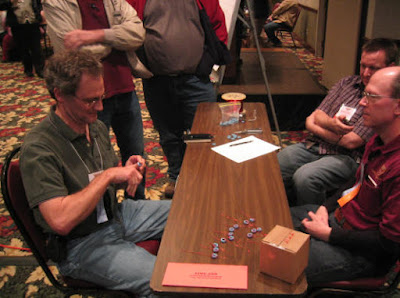
I had a lot of good articles on the old web-page version of this blog. I want to get them into the index, and the only way I can think of to do this is by posting them again. I don’t think this is a problem: many readers will have never seen them, and even for those who have, many of these are so good they deserve a second look. This 2006 piece by KK7B is a good example (The picture is from Roger, KA7EXM’s FDIM 2007 photo collection and shows KK7B winning a toroid winding contest):

A FEW THOUGHTS ON MINIMALIST RADIO FROM KK7B
(Originally posted on the EMRFD Yahoo group)

If you really want to do minimalist radio, you may want to step way
back and take a look at some very early history. The Pixie circuit
has many more components than an early CW station from the era
immediately after spark.

Rather than starting with the Pixie and trying to figure out what to
eliminate, maybe a better approach is to start from zero and decide
what you need. Combining transmit and receive functions is the last
thing to think about.

Starting with the receiver…. The first thing you need is wire up
in the air. The more, the better. If you have the real estate for a
full sized dipole on 80 meters, you can collect enough signal energy
to hear on a crystal set when conditions are good. I’ve copied CW
signals on 40 meters with just a dipole, transmatch, a 1N34 diode, a
good pair of headphones, and a one transistor Pierce oscillator
running on the bench. The leakage from the crystal oscillator picked
up by the antenna beats against the incoming signals. I didn’t power
the oscillator with lemon juice, but I could have (see Bob Culter and
Wes Hayward, “Lemonized QSO” in March 1992 QST.)

Then for the transmitter, just heat-sink the Pierce oscillator and
key the connection to the load. The shift in load impedance will
offset the crystal oscillator frequency.

A dual pi-net transmatch configuration would take care of the
harmonics and allow maximum energy transfer between the antenna and
diode–but I’d analyze it to make sure the harmonic suppression is
more than legal.

So far I count 5 components for the dual Pi-Net transmatch, a 1N34
diode, 6 components for the one-transistor Pierce oscillator. A
dozen parts, plus headphones, a key, and battery–or some electrodes
to push into a lemon.

That would make contacts, but Wes and I have discussed a basic rule
for radios, which is that a station should be able to work an
identical station over a distance of a few miles. It could probably
be done with the above station, but a single transistor audio
amplifier running at maximum gain between the 1N34 and headphones
would make it possible to extract many more signals from the 80 meter
dipole. That’s another 5 or 6 parts. So now I’m up to about 20.

For a more serious station, I’d probably add two more transistors and
a diode, so I could have a separate PA, a balanced mixer, and two
audio stages. The receiver would end up looking a bit like EMRFD
figure 8.7 with a PA tacked on. That would have about 35 parts, but
it would be able to work DX off the ionosphere…about the same
complexity and performance as many other variations on the theme. A
previous version of the Pixie from the 1970s was called “The
Optimist.”

Unlike Muntz–instead of starting with someone else’s circuit and
trying to eliminate parts until I had something that just barely
works, I’d start from scratch, study EMRFD (and other references too–
but in EMRFD all the circuits have been designed and tested) for
circuit ideas, and then start experimenting on the bench, one stage
and one component at a time. Since one of the joys of minimalist
radios is that they can be understood all the way down to the device
physics, I avoid ICs. (I particularly avoid cell-phone ICs, which I
designed for a number of years. It’s like working in a sausage
factory–you are much happier if you don’t know what’s inside.)

Minimalist radio is one of the more interesting design games that we
play using the methods of EMRFD. It’s cheap, it’s interesting…and
as we dig in, we discover that the details can be every bit as
challenging for a radio project with 30 parts as one with 30,000.

Have fun.

Best Regards,

Rick kk7b

The MOSquito — More Minimalism from Catalonia


Joan and Eduardo — the guys who brought us the Flea — have come up with another very interesting insect: The MOSquito. A single IRF510 does all the RF work. There is a computer involved, but it looks to me like it just does some audio DSP. The video is in Spanish, but all true Knack victims will be able to follow it. More info their web site:
http://ea3ghs.googlepages.com/mosquito
Enhorabuena Joan y Eduardo!

Clockwork CW: The Path to Minimalist QRSS?


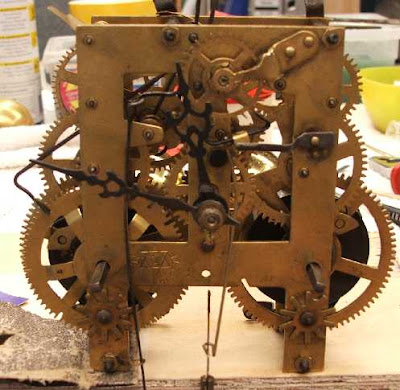
Well, maybe not using that one. But something like it. The idea — mentioned recently on the podcast — is to use a mechanical clock mechanism to generate the CW for a QRSS beacon. This would allow us to get the transistor count for our beacon down to one. For some odd reason, some of us find this appealing, especially when you consider that the transistor count on the receive side is in the tens or hundreds of millions. One is the magic number. You can see how this project brings together two of the biggest littlest recent trends in the QRP radio: QRSS and minimalist radio.
It’s kind of scary when you Google something and are referred back to your own blog. That’s what happened to me on this subject. Back on May 28, 2008, this was posted (by me!) as a comment to one of the beacon-related posts:

Hello Bill and Others:
A few years ago, a buddy had made a neat keying operation made by taking a
one RPM clock motor and had it rotate a printed circuit board disk that had
the callsign etched on it several times sequentially. Clock motors are
made to run continuously for years, and it stood up with just an
occaisional cleaning of the wiper arm with spray cleaner.
All the best to all!
73 de Lee Smith VE4ANC

This message from Lee was a response to a January 1999 question from me. So we are sort of re-inventing the wheel here.

Of course, there are some QRSS beacon circuits out there with VERY low transistor counts. Hans Summers has one on his site that used a bi-stable multivibrator to generate a pattern for QRSS. That would yield a total transistor count of 2 or 3. But we are going for one single transistor. And I kind think we should look for something that will allow for the transmission of callsigns.

Here’s an e-mail exchange from the Knights of QRSS mailing list that may generate some ideas:

Re: [Knightsqrss] Junkbox + soldersmoke = pattern generator

Saturday, March 7, 2009 10:43 AM

From:

To:”n2cqr”

Very nice idea Bill. After tiny solar mepts this could been our next QRPP/ET challenge .
73 de Paolo IZ1KXQ
——— Initial Header ———–

From : knightsqrss-bounces@cnts.be
To : knightsqrss@cnts.be,”Soeren Straarup” xride@x12.dk
Date : Fri, 6 Mar 2009 21:48:55 -0800 (PST)
Subject : Re: [Knightsqrss] Junkbox + soldersmoke = pattern generator
It would be fun if the clock were a “wind up” type. And for extra credit: Power the transmitter with the energy from the same spring mechanism (or other wind-up device) that powers the clock!
ET PHONE HOME!
— On Fri, 3/6/09, Soeren Straarup <xride@x12.dk> wrote:

From: Soeren Straarup <xride@x12.dk>
Subject: [Knightsqrss] Junkbox + soldersmoke = pattern generator
To: knightsqrss@cnts.be
Date: Friday, March 6, 2009, 3:30 PM
Hi list,
Hans Summers has made an astable multivibrator as pattern
generator.
Bill Meara has thought about making a analog clock.
Alan Yates loves my idea of an exercise bike pattern
generator.
Though i’m open for suggestions. No pics, pc or
any other programmable
devices.

Rules of design:
1) KISS
2) Should be in most junk boxes
3) Pattern should be easily changed (diversity, more
homebrewers)
4) KISS
This is for a simple Pixie2 TX modified to be a QRSs TX.
Stability? SSShhh.
Vy 73 de OZ2DAK
Soeren Straarup | aka OZ2DAK aka Xride

Out of the Ozarks… The NS-40!

I think this new rig is really interesting. NS stands for “No Simpler.” It has only 14 parts. The coils are etched into the PC board (see above) — I’ve never seen that before in an HF rig. It runs Class E and puts out 5 watts! The Designer is David Cripe, NM0S, and a kit is available from the 4 States QRP Club for only $30. Look here for more details:
http://www.wa0dx.org/wa0itp/ns40.html

Out of the Sonoran Desert… The Gnat!

We’ve been away for a few days, down in the shadow of Vesuvius, but I’m back in the shack now, and this morning I’ve been looking more closely at the latest creation out of the Sonoran Desert:
Chris Trask, N7ZWY, has given us the design for an amazing rig he calls “The Gnat” (Chris has a deep interest in the flora and fauna of the Sonoran Desert.) Like the ET-1 and FETer, The Gnat is an HF transceiver using only one active device. Chris uses a 2N2222 transistor. But unlike the other one-device rigs, The Gnat uses no switches or relays for T/R transitioning — his rig goes from Receive to Transmit just by pushing the key down. The receiver is, of course, a regen. And get this: The Gnat can produce somewhere in the area of .5 watts to 2 watts of RF. Wow, that’s one big bug! There’s definitely a lot of Knack in The Gnat. Check it out:
http://www.home.earthlink.net/~christrask/Gnat%2040.pdf

Minimalist Mania: AA1TJ-AA1MY QSL, New Yahoo Group

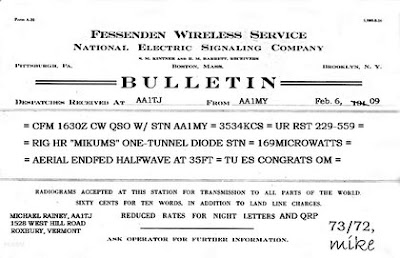
Above is the very classy QSL that Mike, AA1TJ sent to Seab, AA1MY, confirming the first ever tunnel-diode skywave QSO (see below for more details). Go Mikums!

In related news, Jerry, NR5A (who has also been bitten by the minimalist bug) reports the creation of a new Minimalist Radio Yahoo group:
http://groups.yahoo.com/group/Minimalist_QRP_Transceivers/

(Jerry and I have been attempting to translate some technical terms found in British schematics. Even though I lived there for four years, I admit to being stumped by “s.o.t.” given with values for capacitors. Could this be “subject of test”? )

AA1TJ and AA1MY MAKE QRP HISTORY

I was feeling smug about my version of the ET-1/FETer single FET transceiver. I built the transmit portion of the rig this morning, and it fired right up, producing a nice clean CW signal. But then news came in of the historic 100 mile QSO between Michael, AA1TJ, and Seab, AA1MY. Michael was using his new Mikums rig, an 80 meter transceiver built around one tunnel diode. My FET rig seems like a QRO appliance in comparison to the Mikums. Michael’s diode rig was putting out 160 micro watts. Yes, 160 uW. Congratulations to Mike and Seab. I’m sure Mike would not mind my sharing his e-mail on this subject (see below). Reading it, you can just feel the excitement that came from this historic contact. I’m sure tunnel diode inventor Leo Esaki (pictured above) would be pleased.
Be sure to check out Michael’s description of the rig:
http://mjrainey.googlepages.com/mikums
Also, don’t miss the pages on Reginald Fessenden:
http://www.newsm.org/Wireless/Fessenden/Fessenden.html

Friends,
Seab, AA1MY sent me a message just over an hour ago saying that he suddenly began hearing my Mikums transceiver running as a beacon! Seab lives in Bethel, Maine, an air distance of exactly 100miles/160km from my QTH. A few hours earlier I’d measured Mikums output power at 169uW (yes, microWatts!).
I was at the computer when his message appeared so I quickly called him on the telephone. He said that he’d been monitoring while he was busy with some paperwork. He’d just returned from fetching a load of firewood and all of a sudden there I was! He put the phone near his loudspeaker and I just about fell over! I was weak, but perfectly readable.
Then I practically hung-up on the poor fellow in order to race down to my shack in order to try for a QSO. I heard him clear as a bell at a power of 40w (I reported 459, but I ought to have sent 559). He confirmed my report and then dropped down to 4w. Although weak, I easily copied his 429 report to me. I gave him a 219, which he confirmed.
Oh boy…it’s done. We made a skywave QSO using a one-tunnel diode transceiver. I’m practically giddy here :o)
Many thanks to Jim, W1PID, who has patiently listened for several days. In fact, Jim has copied my CQ and callsign several times before my signal evaporated on a breeze of QSB. In return, I copied Jim’s Small Wonders Labs DSW at 2w on Mikums with no problem the other day. Again, many thanks, OM. The next time we meet, I’m buying, okay?
Again, way to go Seab; that’s one small step for man….naw, more like one more exciting and thoughly useless (ain’t it great!) milestone in the history of QRP :o)
73/72’s all around,
Mike, AA1TJ

My ET-1 / FETer (Transceiver Made with One FET)

Magnificent, don’t you think? This is my version of the ET-1 or FETer. It is an HF transceiver using only one active device — a single MPF-102 Field Effect Transistor. I didn’t have a 4 pole Double Throw switch in the junkbox, but I did have a 4PDT relay, so I used the relay. So far I have only built the receiver. It is working nicely. I was listening to German and Polish stations on 80 meter CW this morning.

I had always wanted to build W2UW’s ET-1… I’ve been reading in “Empire of the Air” the inspiring account of Armstrong’s invention of the regen receiver… Then, along came SPRAT 137 and G3XBM’s FETer. I could no longer resist. Solder was melted.

It is great fun to listen to 80 meters and realize that the only thing between you and the ether is one small FET (you can see mine standing proudly atop the relay!) . Its a lot like using a crystal receiver. That one FET is serving simultaneously as an RF amplifier, mixer and BFO!

On to the transmitter! Thanks to OM Armstrong, to Glen (W2UW), and to Roger (G3XBM).