The Joy of Analog Oscillation — A Character-Building Experience

Gentlemen,
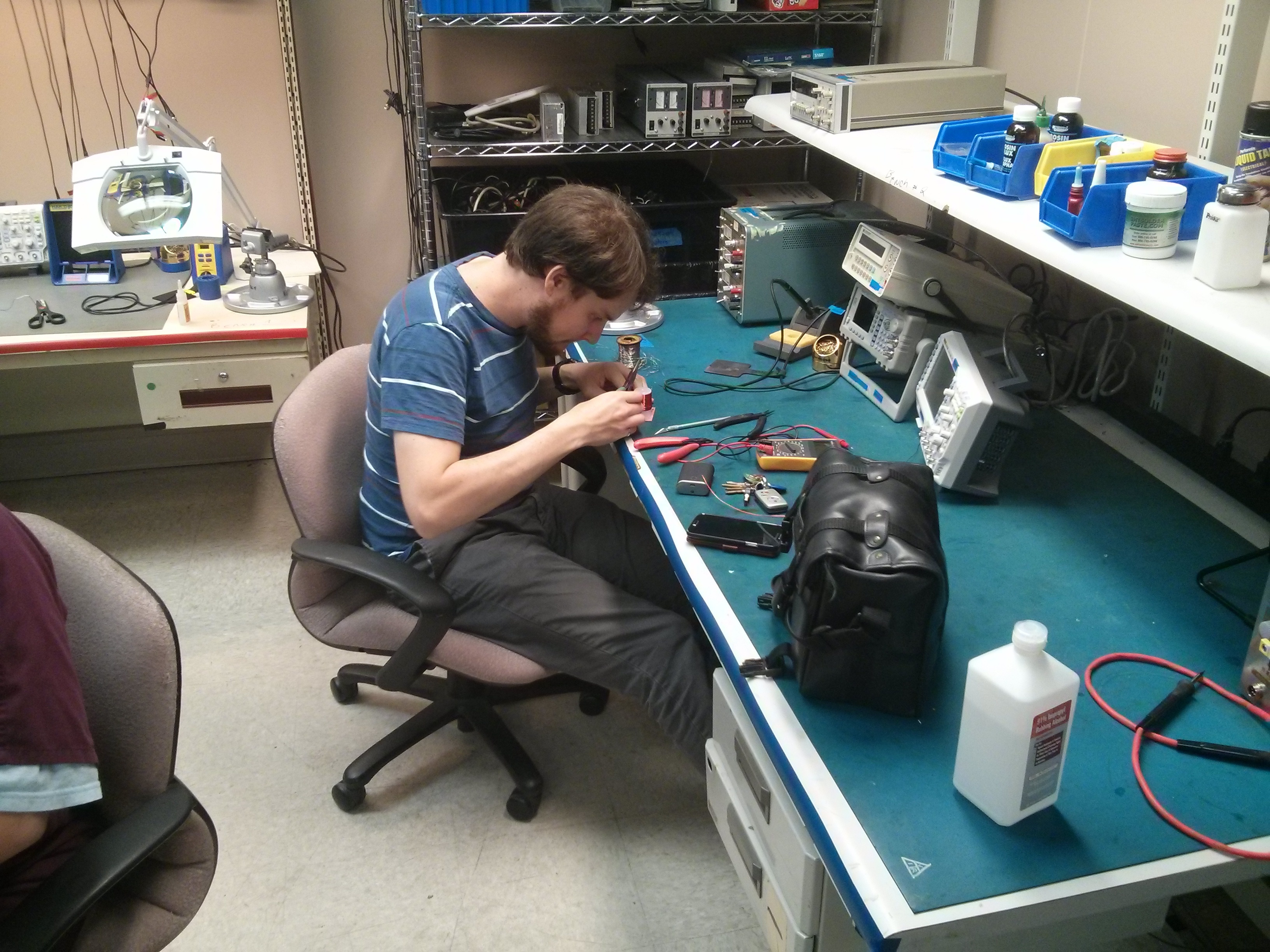
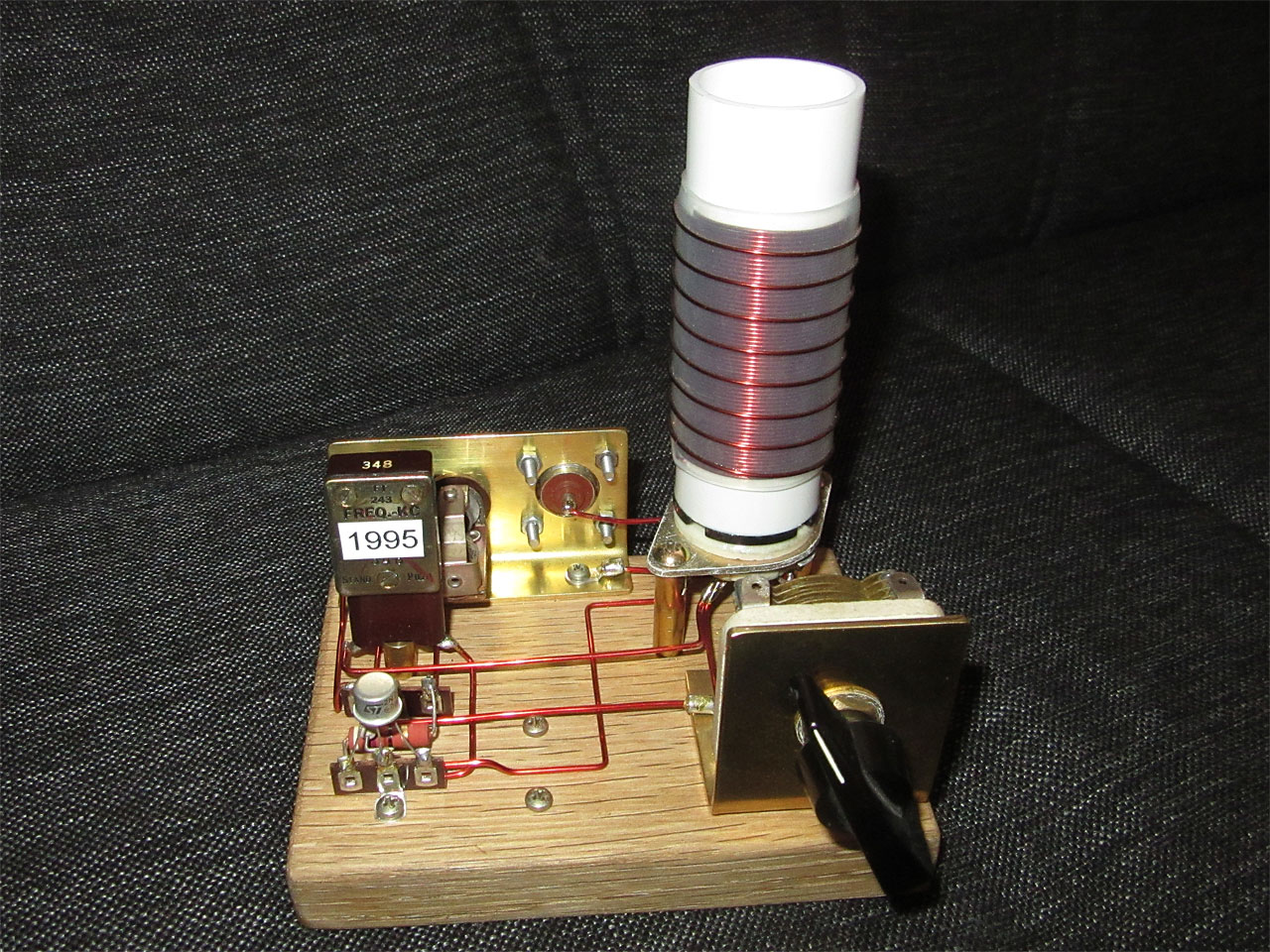
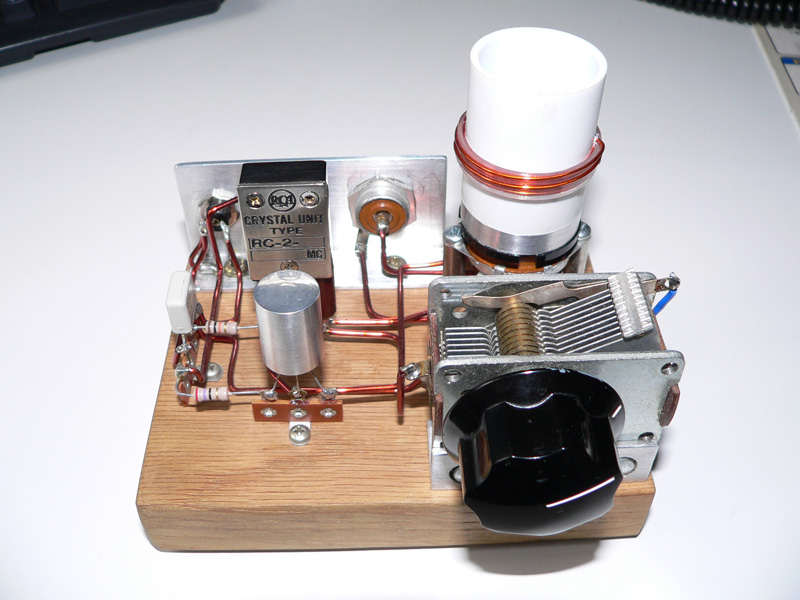
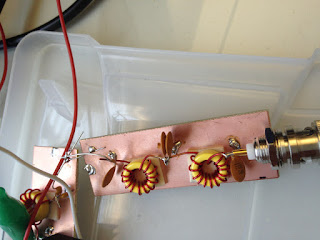
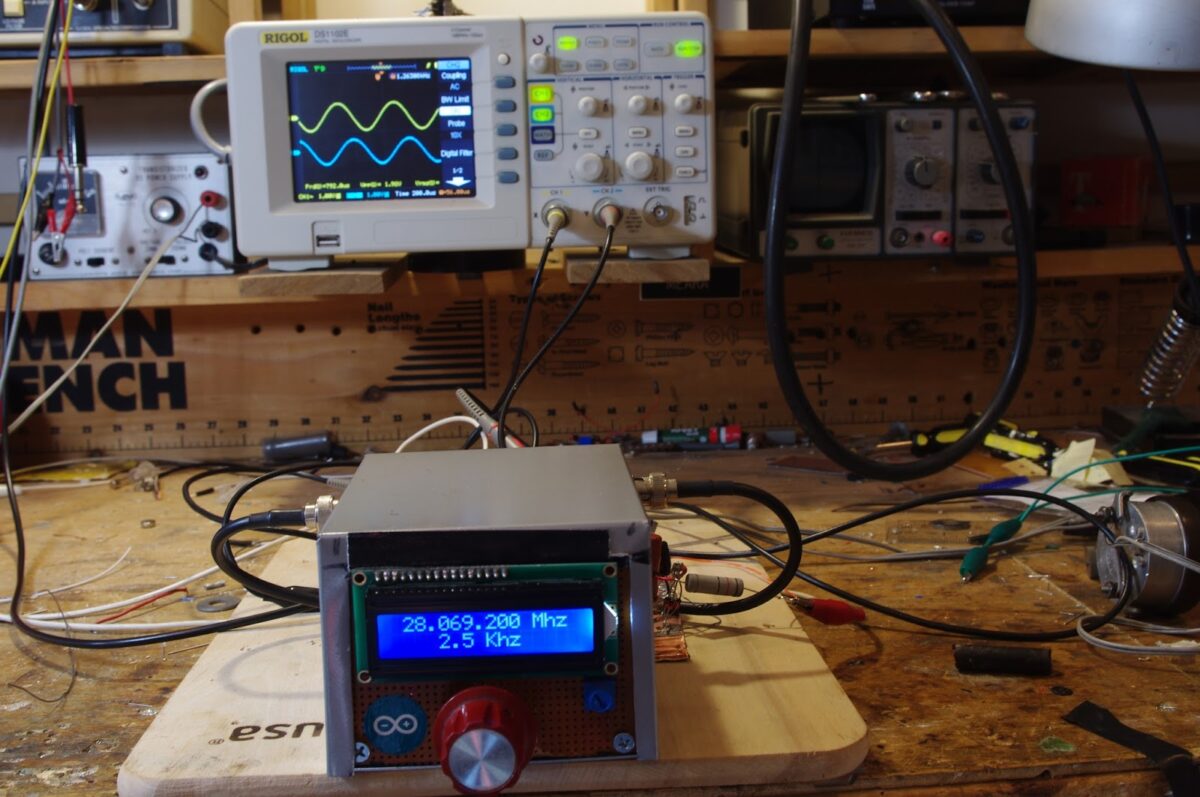
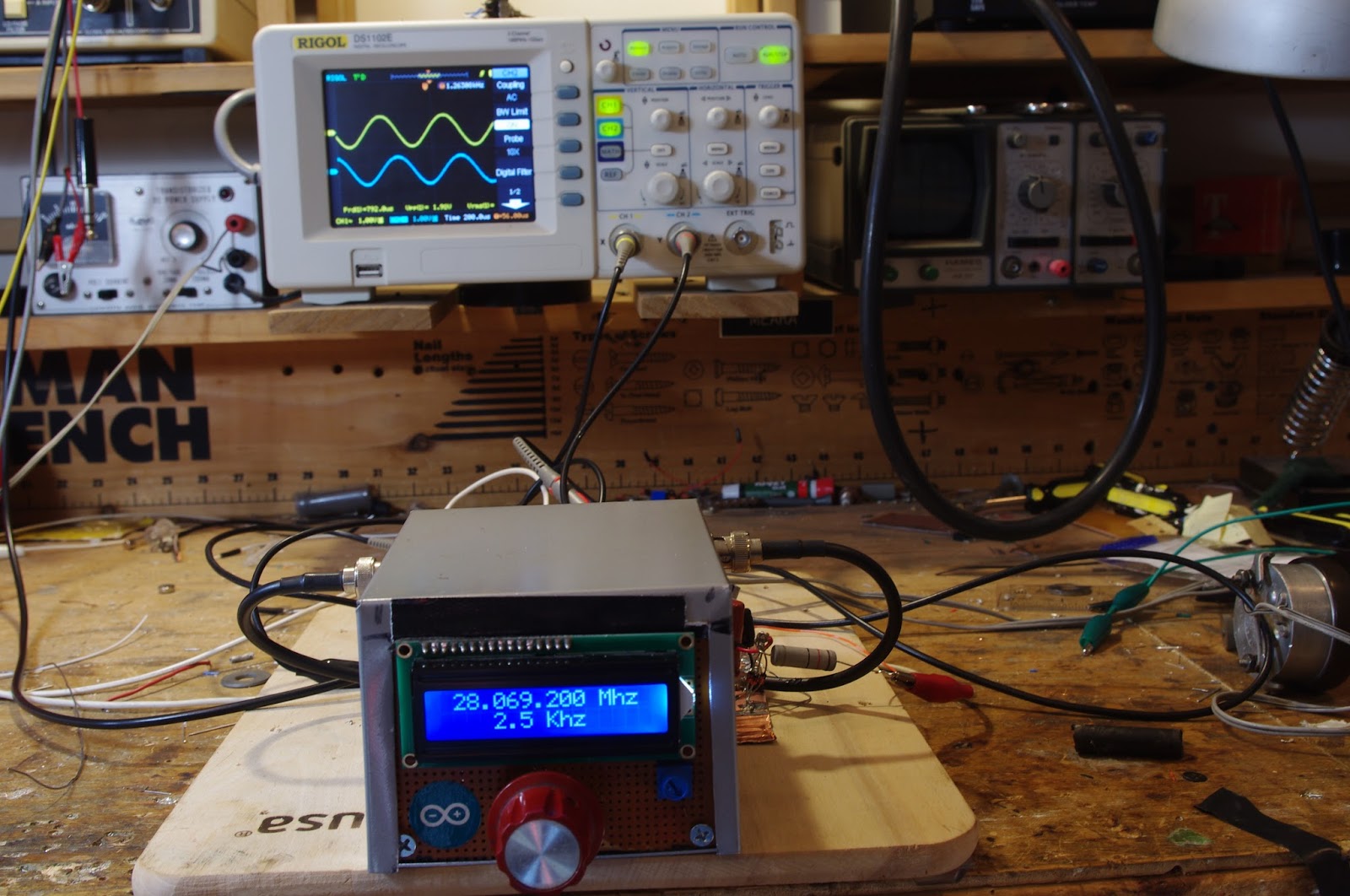
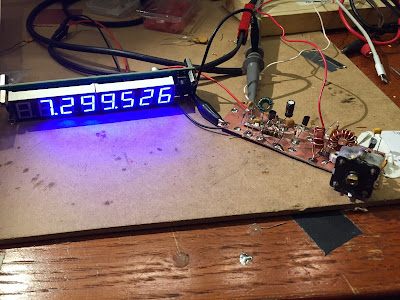
I’m a younger ham, just 26, and I’ve just experienced what I think you call Joy Of Oscillation as I completed my first L-C VFO. What fun!

I’m working on Peter Parker VK3YE’s Beach 40 Double-Sideband transceiver, and while my natural proclivity is toward the SI5351 and it’s brethren, I figured it would be character-building to actually put together an analog VFO for once.

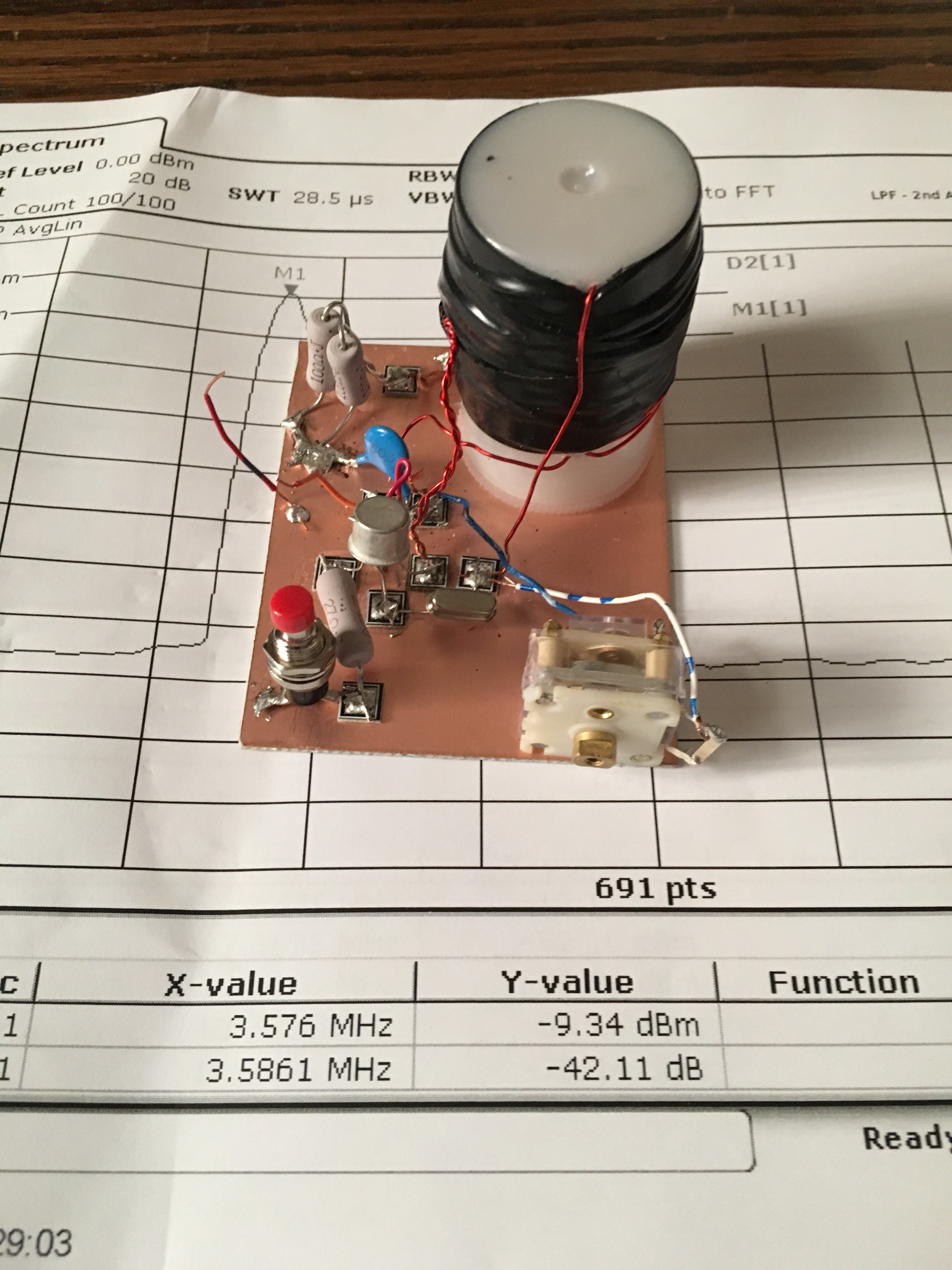
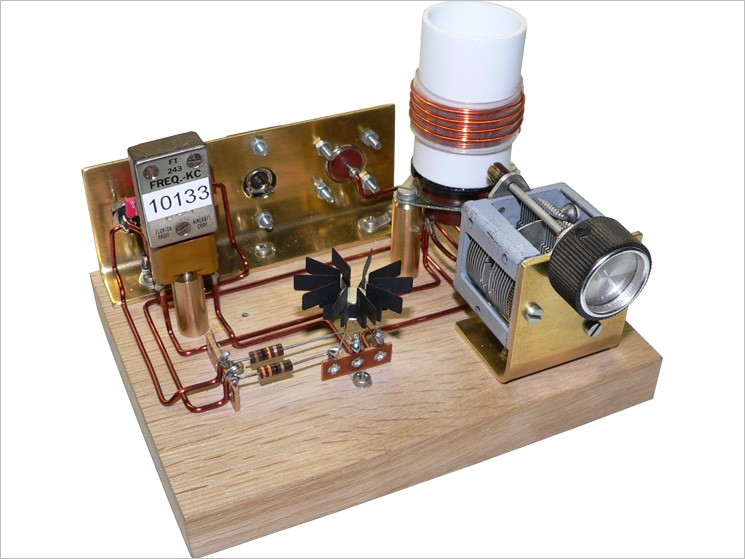
After much tweaking of the feedback capacitor in the oscillator, and massaging the tank inductors, and conking out an additional buffer stage to drive the diode-ring mixer at the appropriate level, and gluing Manhattan pads on top of Island pads…. I say, without reservation, that this was great radio fun! And isn’t that what it’s all about?

(Now it only it didn’t drift so much… so I guess it’s not quite complete yet)
Just wanted to share, love the podcast and the blog, I learn something new each episode.

All the Best,

Jeff, KK9JEF

—————————

Great stuff Jeff. Character building indeed! As for the drift, try this:

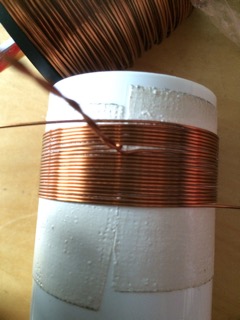
— Replace the toroid in the oscillator circuit with a coil wound on a non-metallic core. I use a cardboard tube from a coat hanger.

— Make sure the capacitors in the oscillator and even in the buffer are NP0 caps (they don’t change in value as they heat).

— Try to run the oscillator stage at reduced voltage. Six volts is better than nine.

— After you solder, always let the device cool down for several hours (or even overnight) before you evaluate it. Heat from the soldering iron will be dissipating and changing the freq for a LONG time.

Above all, IGNORE the inevitable recommendation from Pete Juliano that you forget about all this nonsense and just go with an Si5351.

Please keep us posted on your progress.
73 Bill N2CQR
KB8M’s Mighty Mite — Beware the Treacherous P2N2222!

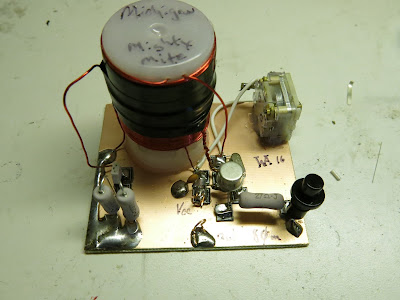
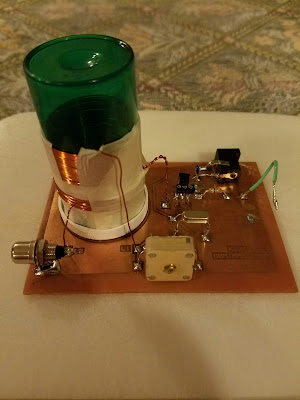
Doug KB8M did a beautiful job with his Michigan Mighty Mite. But, as often happens, it still didn’t work. He turned to us for advice. I gave him a long list of things to check, but Pete brought the power of superior tribal knowledge to the problem and spotted the defect immediately: The transistor was in backwards. It is a P2N2222. That means the pin out it C-B-E not the usual E-B-C. I had fallen into this trap with one of my BITX rigs and had to pull out and reverse many of those transistors. Fortunately for Doug he had used a socket for the transistor. TRGHS!!!!!!!!!!!!! JOO!!!!!!!!!!!

Dallas Mighty Mites from a MakerSpace


CBLA Dallas Division: Multiple Mighty Mites in the Lonestar State

Bill:

Just thought you would like to know that I am a new member of the color
burst army. I am also a member of the Dallas Makerspace and our Amateur
Radio Special Interest Group is planning on offering classes (open to
HAMS and non-HAMS) where we build these Mighty Mites for the colorburst
frequency.

The class version will have a resistive dummy load instead of antenna,
to allow the project to be built by non-HAMS. The idea is to get our
HAMS who just use commercial radios interested in building radios. It
is also to get our general members (who like making things) into HAM radio.


Walter

Soldersmoke Podcast #186 Is Available — April 1 Rap Up, Pi Talk from Pete, Collins and Raspberries, Bill’s Analog RX, Visits and Hamfests, MAILBAG

SolderSmoke podcast #186 is available:

— April 1 WireWrapRap Rap-up. Feedback from participants.

— Bench Reports:
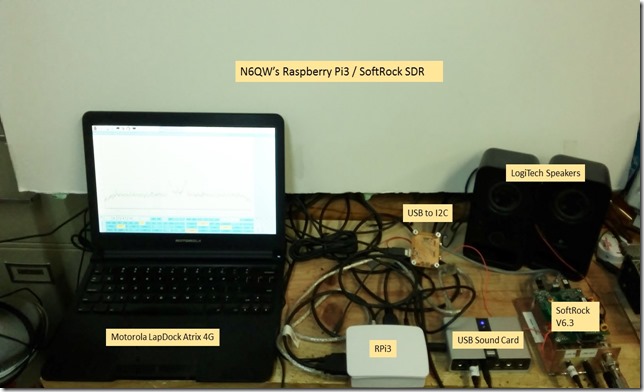
– Pete talks about his Raspberry Pi SDR DSP rig.
– Bill talks about on his Mate for the Mighty Midget Receiver and his R2 Frankenstein.

— A story from Pete’s youth: Cruising the “Miracle Mile” with a Heathkit “Ten-er.”

— Why do we need more RF amplification (in receivers) on 20 than on 40?

— Have you ever tuned the BFO freq in a superhet by the “sound of the noise?”

— A visit to Washington by Jonathan W0OX and family.

— Bill goes to Winterfest Hamfest with Armand WA1UQO

— Pete on the importance of balance (in life).

— Great interviews on QSO Today: Peter Parker, Grayson Evans, and Ashhar Farhan.

— MAILBAG:
– Paul Darlington M0XPD has a new book about life, travel, and the Dayton Hamvention.
– Michael AA1TJ QRV with a tuning fork at its 2,000th harmonic.
– Jonathan M0JGH living dangerously with homebrew QRP in Italy.
– Ben KC9DLM JoO with MMM
– Stefan DL1DF needs 3.579 MHz rock “with mojo.” We have it for you OM.

The music for SolderSmoke 186 was written and performed (the bass lines) by Pete’s son Tim. Thanks Tim!
Pete also suggested that we have some rap lyrics for this music, so renaissance man that he is, he composed some words. We are still looking for a performer.


Yo we solder no more – its wire wrap and cables
The cables connect to the small black box
hold on to your pants and pull up your socks
A cable goes here and a cable goes there
Turn on the switch and its Shazam all software


From Wayne and Garth in San Diego: EMRFD Joy of Oscillation Part 2

Oh great and mighty masters of the SolderSmoke:

We’ve continued on with this project and it has been a lot of fun.
Sure, there’s
THE JOY OF OSCILLATION
but we’ve progressed to
THE JOY OF MODULATION (added a keyed buffer)
THE JOY OF AMPLIFICATION (added driver and PA, not threatening QRO, yet)

THE JOY OF RADIATION (perhaps my favorite)
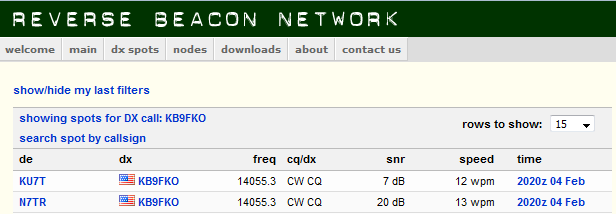
THE JOY OF RECEPTION (picked up by RBN, yeah!)
last on the list is to experience
THE JOY OF COMMUNICATION

for that, we’ll try out a number of different receivers. Cheap SW
portable. Softrock Lite. websdr.org.

Does one try to count all the joys? 🙂

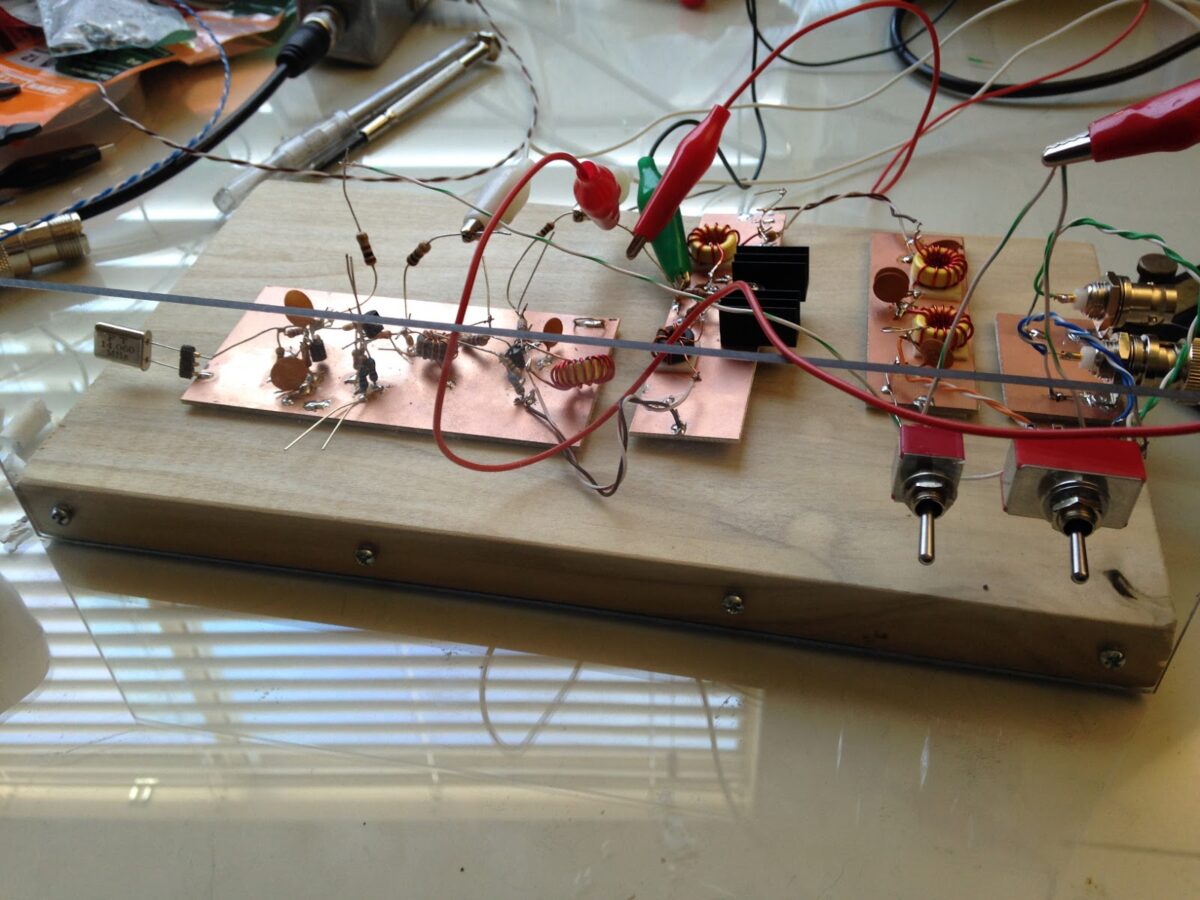
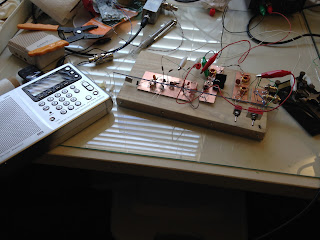
Here’s a few snaps:

0.jpg – RBN evidence
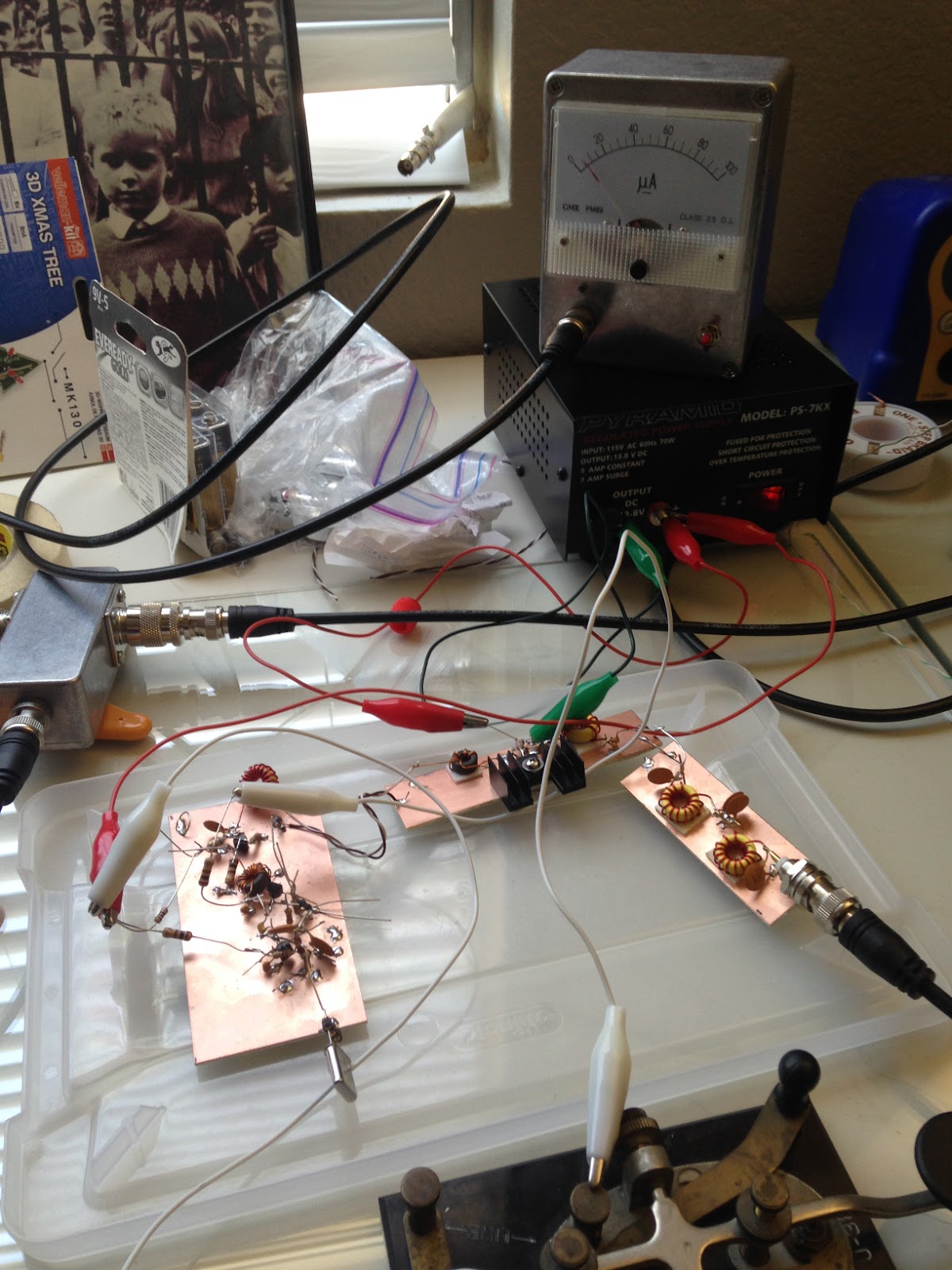
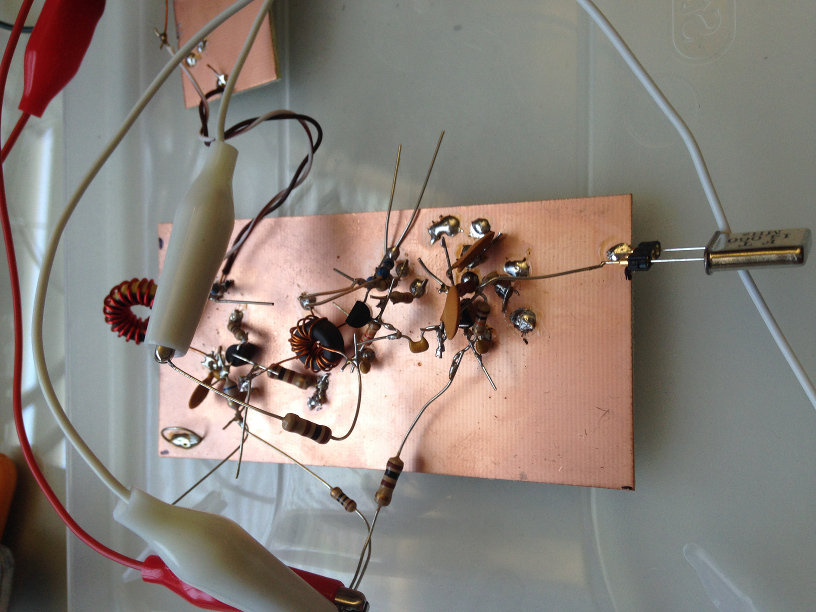
1.jpg – lashup on the lid of a tupperware container
This worked great for throwing the work in progress in a backback for
our build session meetups.
2.jpg – Fig 1.34 less output LPF.
3.jpg – The missing LPF. THE JOY OF FILTRATION (OK, that’s taking it too far.)

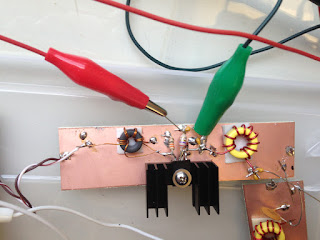
4.jpg – Fig 1.35 amp with BD139 transistor.
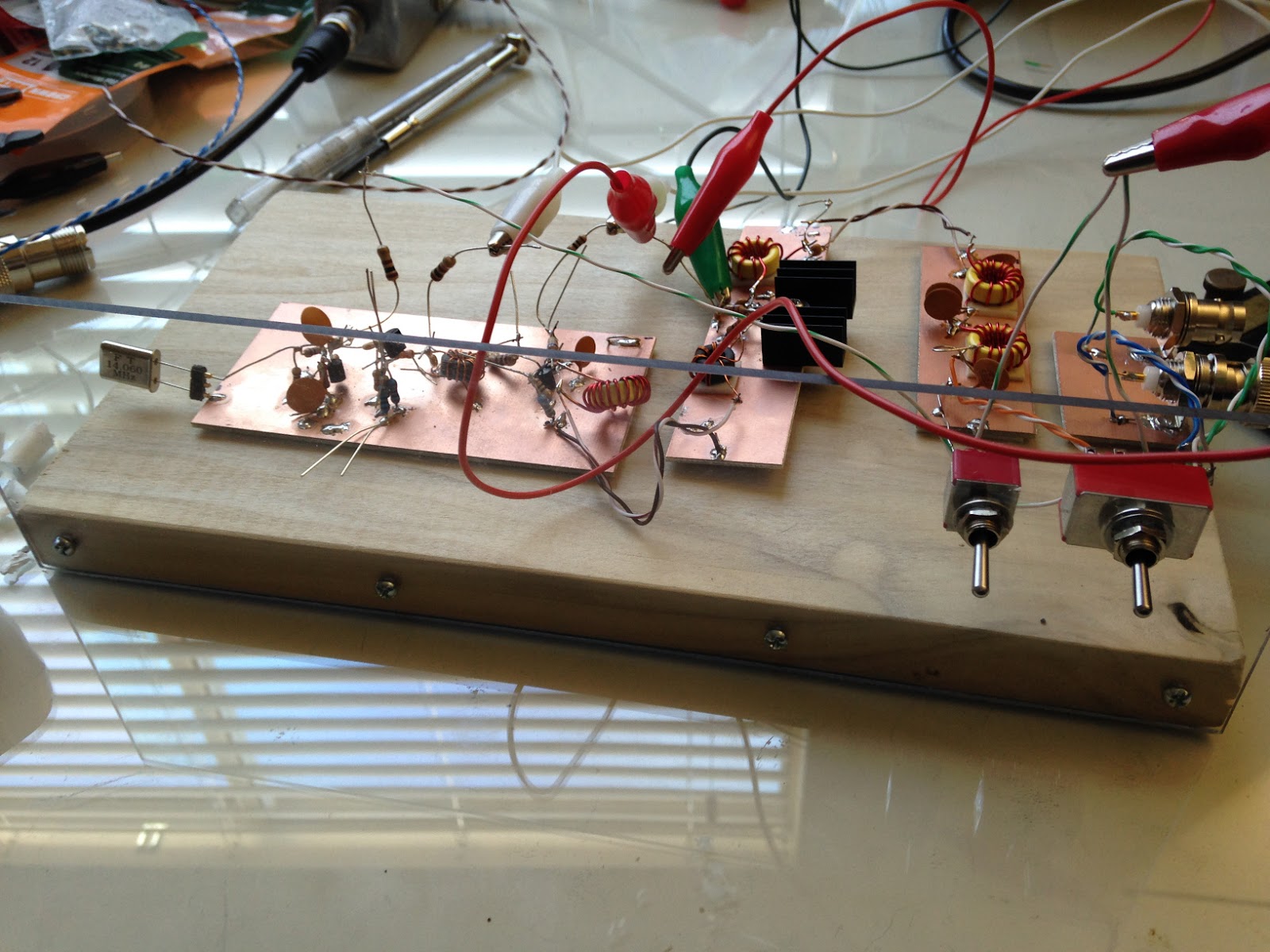
5.jpg – “breadboard” and a front panel to hold the T/R switch. Key
and cheap SW portable for RX. Waiting for DX contest to end, so I
have a chance. 🙂

6.jpg – simple breadboard chassis

Our fun has certainly been cheap. The parts cost, including PCB and 1
BNC jack, was about $13 in low quantity from Mouser (and Diz) for all
but the amp. The amp portion was $4 in low quantity from Mouser (and
Diz), and most of that was the expensive heatsink. The “chassis” was
just a piece of cheap 3/4″ hardwood and lexan from home depot. I
drilled and tapped the holes in the wood for the #4 screws. (Seems to
hold quite nicely. I thought I might have to harden the threads with
CA adhesive as is done sometimes with balsa.)

If there are any of those air variable caps left that you are meting
out to the worthy, well, like Wayne and Garth, “we are not worthy.”
If you do have between 1 and 4 and find it in your heart, we’d be very
grateful.

Best regards,

Drew
kb9fko
San Diego

VA2NM’s Michigan Mighty Mite (with Tuna Tin LPF!) (video)

EMRFD Joy of Oscillation (Part 1)

Guys:

I have been catching up on the last few SolderSmoke podcasts after
that little QSO Today diversion. I wonder how many others did the
same thing? I have really enjoyed these recent ‘casts. Lots of
fantastic HB content. Funniest moment was when Bill described his
post-project workshop as looking like the aftermath from an electronic
barfight.

I took a new ham up on a SOTA activation last year. Then about a
month ago, he said that he wanted to do HF HB. He said he had been
googling and found so much that he didn’t know where to start. I told
him that I’d be interesting in doing a beginner HF HB project with
him.

I could have pointed him to LBS, et al. I could have pointed him to
the Michigan Mighty Mite. I did neither. I pointed him to:
http://web.cecs.pdx.edu/~campbell/EMRFD1dot34.pdf Note the name of
the document. I pointed him also to:
http://www.arrl.org/files/file/Product%20Notes/chapter_1.pdf
(Did you guys know that chapter was online and free?) We scaled to 20m and
kitted parts for this. And parts for a 4th transistor PA for serious
QRO. 🙂

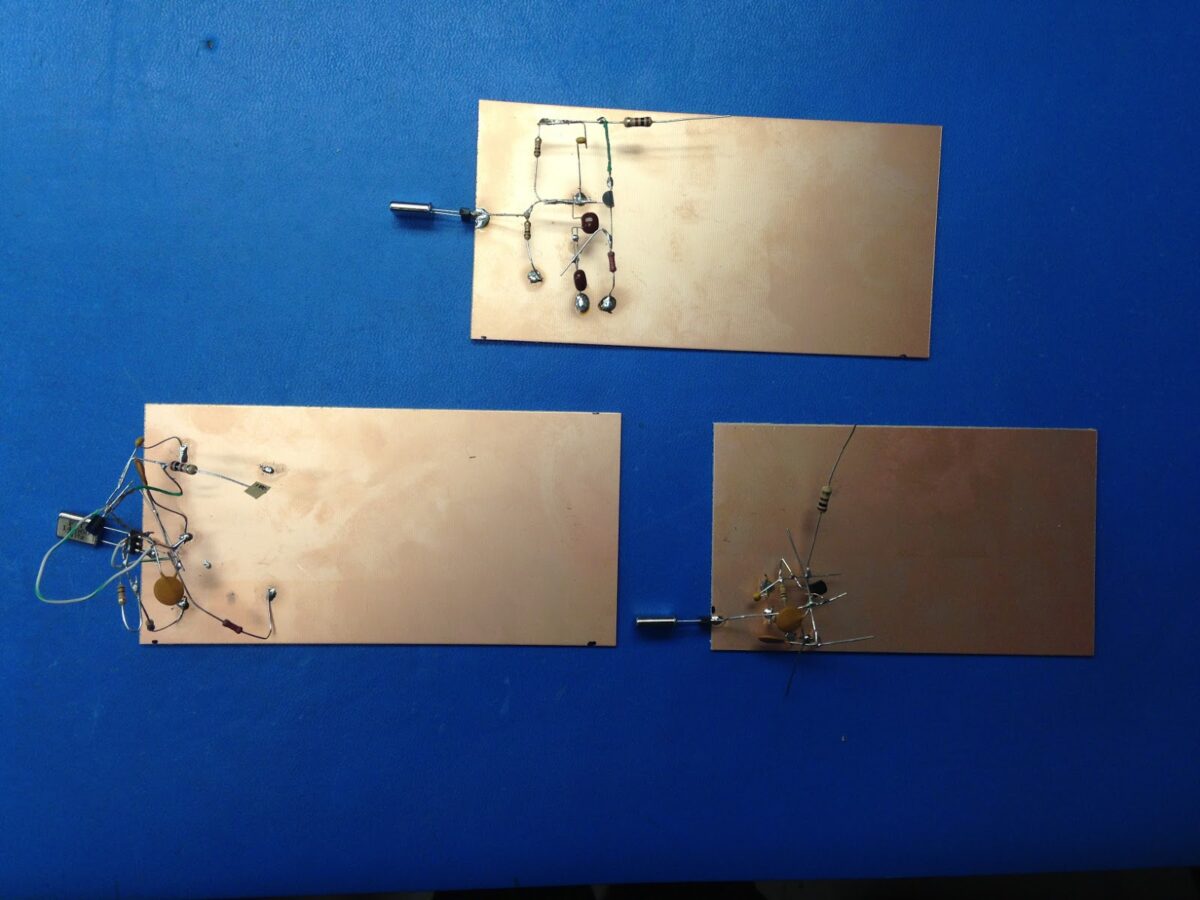
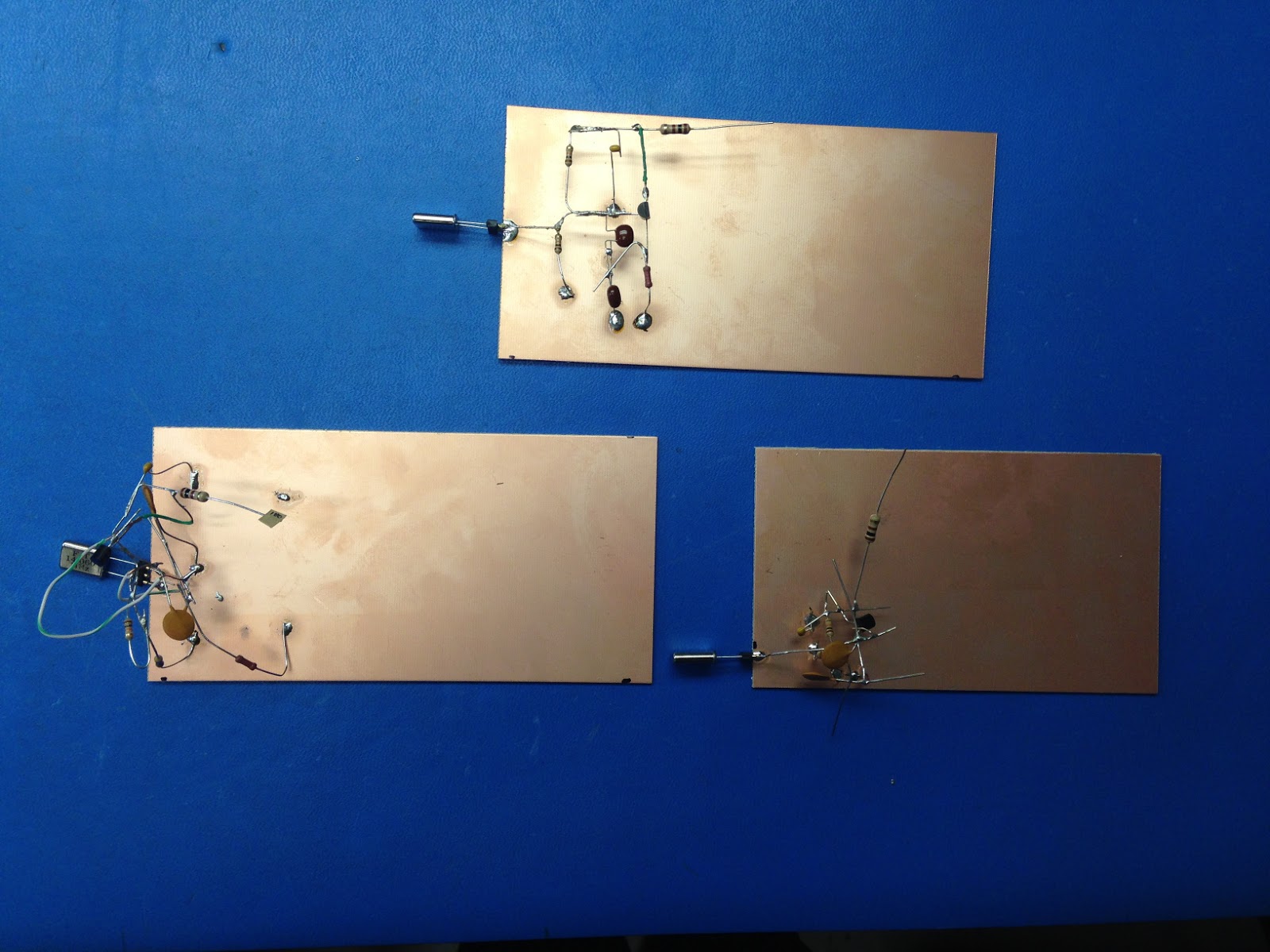
Two others joined us building for 40m. Check out the attached photos
of the first 3. The joy of oscillation was experienced by all.

After testing each oscillator, and borrowing from an article KK7B ran
in CQ VHF, I told each that he had to ID every 10 minutes. Even
though nobody was going to hear these signals a few hundred yards
away. (But it sounds loud on a shortwave portable a few inches away!)
I even wrote out the dots and dashes for a couple of them.

Next stop: to have everyone find a curbside TV discard, rip out some
parts, and get on 5 meters! Haven’t we gotten it back now, after the
transition to digital TV? 🙂

OK, maybe the next stop is to add some gain stages and experience the
joy of communication. The joy of QSO-ification? The joy of
EM-radiation? 🙂

Best regards,

Drew
kb9fko

2 Attachments

German Mighty Mite works Venice on 40 (video)

In spite of being a bit off frequency, sTef, DL1FDF (aka VY1QRP) has been inducted into the Color Burst Liberation Army. Congratulations sTef! Normally we would requite operation on 3.579 MHz, but sTef has been granted special dispensation because 1) he doesn’t have a 3.579 MHz rock, 2) our stock of this crystal has been depleted, and 3) he actually made a contact with this rig, working II3ICZ in Venice. FB sTef. If anyone has a color burst crystal for sTef, please let us know.
sTef writes:

I would like to say „Thanks” to both of you for your ongoing inspirations in soldering and homebrewing. After 15 years out of ham radio it were you two guys who got me back into the world of -> SOLDERSMOKE. Thanks for that.And belive me been away for 15 years and now getting back into it feels a sometimes a little bit too “digital“ …. ARDUINO or NOT TO ARDUINO ? This is the question….
Anyway…
So what could be more sophisticating than having a MMM ready on the work bench and answering a CQ call on 40m with that thing and be heard.
Yes, the first QSO today with my MMM was for you both.
I worked the Italian Radio Station II3ICZ. I was 559 into Venice with 0.5 watts from the MMM into my full-size triple leg for 40m.


Alan Wolke W2AEW Builds a Michigan Mighty Mite (Video)

We are honored to induct Alan Wolke W2AEW into the Colorburst Liberation Army. And for his valiant effort to build and explain a MMM Low-Pass filter, he is immediately promoted to the rank of CBLA Two Star General. Congratulations General Wolke.

As is the case with all of his videos, this one has already had an impact far and wide. Ian writes from far-off Western Australia:

SolderSmoke Podcast #183 Pete’s B’day, Simple-Ceivers, Binaural Bliss, 160 or Bust, GOOD BEHAVIOR, MAILBAG

Bill’s Frankenstein R2 receives 7 MHz signal and generates I and Q outputs


SolderSmoke Podcast #183 is available. And it is GOOD!

http://soldersmoke.com/soldersmoke183.mp3

20 December 2015

— Foxes in the Backyard
— Pete completes another orbit
— Simple-ceiver Success!
— Frankenstein Receiver: IT IS ALIVE! AND BINAURAL!!!
— 160 Meter AM OR BUST!
— Fun on 40 AM — Lots of Multi Elmac AF-67s! Who knew!
— The Amateur’s Code, and violations thereof.
— Negative Frequencies? I don’t think so.
— Capacitor Offer from our Secret Benefactor: EXPANDED ELIGIBILITY
— Projects for 2016: Pete goes Raspberry Pi, Bill goes DX-100
Mailbag:
— Croation Creation
— Salvadoran 2B
— N3FJZ’s Homebrew QSL
— WA7HRG’s LBS-ZIA-Simple-Ceiver Mashup Rig
— KC0IZR turning VCRs into Mighty Mites in NOVA
— AB1YK Starting with DC RX, going BITX
— G8GNR puts Mighty Mite on AM!
— G3ZPF Modulates THE SUN (Amazing)
— VK3YE’s Simple Superhet
— Grayson in Turkey drools over KG7TR’s Octalmania
— N7REP reaches for the Zantac because of Arduinos and Surface Mount

Modulated Michigan Mighty Mite?


This suggestion from across the pond is a bit “out there.” In fact, for me it brought to mind the famous line from the Noel Coward song about who goes out in the mid-day sun… This does seem like an endeavor for our stoic British cousins. You’ll need a very stiff upper lip to AM modulate a Michigan Mighty Mite! Peter’s observation about the “SSB kilowatt nerds” resonated with me and reminded me of the reaction I got when I tried to put a DSB rig on the air in London. But hey, go for it Peter! Please let us know the results. For those who are rock-bound in the CW portion of the band (like 3579) this might be something fun to try using a dummy load — just to see if you can send an AM Mighty Mite signal across the shack.

Hi Bill,

Your recent Soldersmoke thoughts re. MMMites have been niggling my imagination; I think radio should be fun, educational, simple and cheap, to encourage young folks to get a license and “appliance users” to melt some solder.

Mike Rainey (AA1TJ) and Jim Kearman (KR1S) have done superb work in reducing RF circuits to a functional minimum… so egged on by a certain Mr. Bill Meara, I’m looking at modulating a MMMite Tx on 80m and building the simple Rx to go with it. I chose 3615kHz as it’s a frequency UK VMARS (Vintage Military Amat Rad Soc) use for A.M. – the SSB kilowatt nerds who think the sky will fall down if A.M. corrupts the ionosphere have accepted a few enthusiasts firing a watt or ten of A.M. skywards. I blame you want to say thanks for setting my mind in this direction.

See how this sounds: modulate a MMM by inserting an electret mic capsule (2 terminal type) between the transistor base and ground, not forgetting the RF choke from the electret capsule output to the base bias 10k resistor, to avoid the xtal feedback signal being absorbed in the electret…

Yep, that’s it: job done, the MMM now produces A.M. as the base current, fed by 10k from the +ve rail in the original MMM, is now partially shunted to ground by the electret capsule. I’ll adjust the base bias resistor to get 50% “no speech” carrier and good mod. depth. I’m trying to avoid a mic amp stage; keeps it simple & sweet. If I can get 500mW in total, that’s ~ 100mW in each sideband – on a good day with a following wind, on 80m that should go a mile or twenty.

Which leaves a drop dead simple Rx to design – somebody has done similar, HERE, You got it: an LM386 audio amp as a regen Rx. I had considered the ZN414 TRF Rx, or it’s modern equivalents, but they are nowhere near as common as an LM386, or as cheap. IF it works on 80m…! Or, I could try an xtal controlled regen Rx, as per Mike / Jim’s designs. Either which way, I’m sure I can find a cheap, simple and effective Rx – but if you know of any…..?

Cheers Bill, TTFN!

Peter Thornton G6NGR

YAMMM! Yet Another Michigan Mighty Mite! From KC0ZIR in Northern Virginia

Bill,

Thank you for the podcast and the loads of tribal knowledge from you and Pete! I recently started going through the SolderSmoke backlog, and I am just getting to the Colorburst Liberation Army episodes. I had some crystals for 40m laying around, so I started reading up and winding on a film canister.
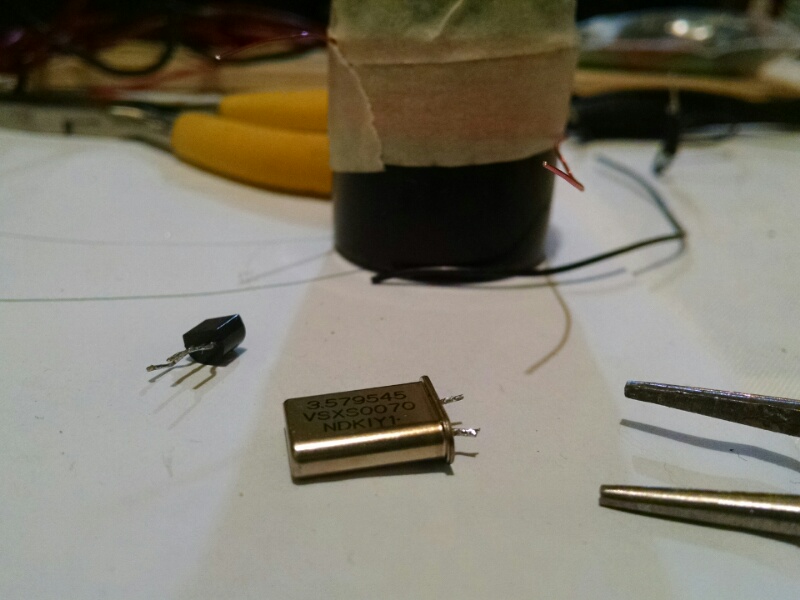
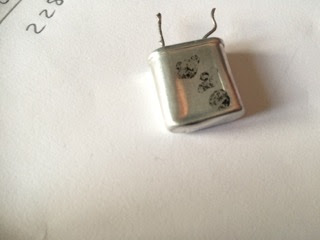
Later, I thought I’d hop up the current episode of the podcast while I work, and I heard you guys talk about another push for the Michigan Mighty Mite. I happened to be salvaging bits from an recycling-pile VCR at the time, and I came across this crystal with a familiar label: 3.579545. The radio gods have spoken, so I will be winding a new coil for 80m.
I heard you mention the anonymous benefactor, but I have some aluminum foil, and I plan to brew the cap as well, there are a few options here: http://www.instructables.com/howto/variable+capacitor/
I thought I’d tell you a quick story anyway, because I just want to be a part of the fun. When I was little, our radios all had retractable antennas, and the TVs all had rabbit ears or loops. I would spend nights trying different materials and orientations to try and get better signal. At one point, I ran as much wire as I could in my brother’s room (he had a big garage-sale cabinet tv), and we were getting channels from all over the place. We knew when each channel would be showing reruns of Star Trek, so we could catch an episode or two almost every day of the week. We even got some channels that I thought were only available on satellite. I had read in my box of Popular Mechanics magazines that some dish setups re-broadcast their signal on VHF/UHF frequencies with low power, I always suspected that’s what we were picking up.
I didn’t know much (or really anything) about the theory behind antennas at the time. I’m still a bit hazy, like with the 75 ohm / 50 ohm cable thing. I thought resistance was a function of length, how can different lengths of coax be the same ohm rating?
Anyway, I just wanted to let you know I’m new to homebrewing, and you guys are a big part of that!
73,
Dan, KC0ZIR
Northern Virginia (a little to the left of you, it sounds like)
…………………………

Excellent Dan!

Getting the 3.579545 MHz rock out of a dead VCR definitely adds mojo to the rig. Indeed, TRGHS! Thanks for sharing your Knack Story. I hope to meet up to you, perhaps at the hamfests of Northern Virginia. In my capacity as Grand Poohbah and Arbiter of Capacitor Eligibility, I hereby deem you ELIGIBLE for a variable capacitor. Our secret benefactor will be contacting you.

73 Bill


Colchester Mighty Mite

GM Bill,

So, I got round to making my Michigan Mighty Mite!

The crystal arrived almost safe and sound, thanks to the USPS’ mail crusher. Perhaps they think that because email and packets can be compressed they can do the same with parcels? (the photo really doesn’t do it justice – the orange area is a large dent…):


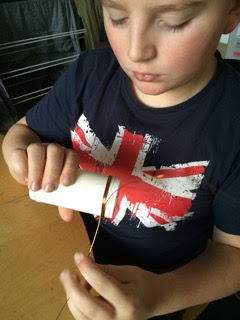
No 2 son, Cameron (12), got involved – The extremely neat tank coil is his handywork :


And so to the video: Not only does it oscillate on the correct frequency as shown here, it also has the added bonuses of oscillating around 21.5Mhz (which is the number my frequency counter gives – which caused a great deal of head-scratching on first smoke), and muting the FM broadcast receiver on 96.1MHz on the shelf 3 feet away!. The dummy load is the 3w metal film resistor suspended in mid air.


You might notice more resistors in the circuit itself than the diagram calls for. I chose to have 2 x 20K resistors in parallel to produce a single 10K resistance that could handle .6W. And the poor old 27R .3W resistor got really hot and discoloured before rapidly increasing its resistance ( !! ), so I used 4 (2 serial pairs in parallel) to handle the current. They still get hot, but survive. And the 2N2222a has a bulldog clip heatsink.

Please excuse the uncorrected error at the end of the CQ call!!

This is the second transmitter I have ever built – the other one is a 30m Hans Summers QRSS kit which you also get the ‘blame’ for 🙂

Thank-you, Bill. Keep up the good work.

73’s de G7TAT, Colchester, England.


SolderSmoke Podcast 182: Bears! MMM Update, On Pete’s Bench, 160 AM Dreams, MAILBAG

20151116_091050[1]
N6QW Selfie
SolderSmoke Podcast #182 is available
Travelogue: In Shenandoah with BEARS!
Michigan Mighty Mite Update and a Generous Offer (with conditions).
BENCH REPORT:
— Pete’s Ten Tec Conversion using LTSpice
— Pete’s Simple-ceiver
— My CB to 10 conversion plans
DREAMS OF 160 METER AM: KB3SII, N2CQR, N6QW Building for Top Band
Raspberry Pi Nightmares
Homebrew to Homebrew (HB2HB) Contacts
Elser Mathes Cup — We have some competition!
QST, “The Radio Art,” and The Channelization of HF Bands
WA5BDU Nick Kennedy on QSO Today Podcast
Ed Walker of “The Big Broadcast” was a ham: N3HFT
MAILBAG: A Letter from Turkey: Tubes and R-390s
Si5351: G4GXO says give it a go!

W2DLH’s 20 meter Mighty Mite

N2CQR & N6QW,

I ran across a reference to the SolderSmoke book and read through it very quickly. Through the book, I discovered the SolderSmoke podcast and have been enjoying every minute!
I just want to thank the two of you for the inspiration and new motivation I’ve found in a hobby I’ve loved for 25 years! I’ve never tried homebrewing anything but that’s about to change.
It took me a while but we have oscillations on or about 14.060 MHz!
I adjusted the circuit to use resistor divider biasing of the 2N2219 and changes to the biasing and coil to accommodate the 20m crystal. Also the only cap I had that worked was a 10-50pF trimmer. Aside from my placing the crystal in the wrong point in the circuit because I wasn’t paying attention, this Michigan Mighty Mite needed minimal tweeting. The antenna is a 50 ohm resistor which the KX3 heard very well with its attenuator in line.
Now my problem is that I listen to SolderSmoke in the car and it’s bad form to take notes and drive at the same time. Also, I find myself wanting to experiment with all of the ideas from the podcast at once… If I build your LBS in modules, Pete, then I can experiment later and swap circuits to my hearts content.
One question for now…where is a good source of plentiful, inexpensive crystals?
Thanks again, guys!

Darryl Hambly, W2DLH
– – – – – – – –
Grid DM78pu
G-QRP 15014
QRP ARCI 15138
SKCC 10990
– – – – – – – –
http://www.qrz.com/db/W2DLH

Waco Mighty Mite Mojo!

Eric: Wow, great news from Waco. JOO indeed! And I really liked the WAY you did it, liberating crystals and wire from old TVs. That definitely adds mojo to the Waco M^3. Bill

Hello Bill,

My name is Eric Melling KD0OXY. I have, as of tonight, officially passed selection for the CLA. My Michigan Mighty Mite began oscillating tonight between 1830 and 1900 CST and I am ecstatic about it! My foray into home brewing began mid-2011 when I obtained my general class ham license (I took Technician and General at the same time taking advice from my late grandfather). The first radio I ever purchased was the Pixie II kit and boy was that frustrating. I meticulously assembled the kit and worked very hard to stuff the transceiver, volume control, options to use the on-board key or a straight key, and maybe an on-board speaker or phones. But, to my chagrin, I was treated to the sweet wafting smell of the magic smoke long before ever getting on the air. I eventually did get on the air with my aforementioned grandfather’s VHF/UHF HT and until recently, this has been the extent of my Ham career.
But on the advent of my starting an MA in applied linguistics at a school in Dallas (hour and a half from home in Waco) and the rekindling of my electronics knack occurring near- simultaneously with my discovery of the SolderSmoke Podcast, I decided to give it another go. First, I got the old pixie kit to oscillate and then ripped it apart for parts to another project (non-radio). Then I procured a second Pixie kit from ebay and built that. It oscillated right away! Still no contacts; my CW is… improving.
All this to say that I still had an itch that wanted scratching Enter: The Color Burst Liberation Army! Not only could I truly build something from scratch, I could follow my true calling and de oppresso liber some crystal. So I pulled some 30 (or so) gauge magnet wire from an old CRT. I had wound and rewound my coil three times (and unfortunately, the third one looks the worst) for 80m then 20m (far fewer turns) and back to 80m with N’JOO (No Joy of Oscillation) in any configuration. I am using a polyvaricon pulled form an old AM/FM transistor radio, the Mitsumi PVC-2FX which has 82 pF, 140 pF, 20 and 40 pF sections which I have wired in parallel giving me ~0-282 pF of range? And finally, I was using a MPS A42 NPN transistor. I had to run some resistors in parallel and some caps in series to get the right values, but I eventually got it all together and looking pretty smart on a 1″ x 1.5″ piece of perf board. Alas! Nothing!
I was poking around at the circuit and realized that when I keyed the transmitter, the coil would get really hot right at the tap. I still don’t know why that was, but I figured it was a good sign as it meant something was happening. I also was getting plenty of pops and clicks on the receiver. Anyway, to make a short story long, I decided that the dark mark under the transistor was a bad sign, found an NTE 123 and plugged it in instead. And oh what a wonderful day to hear the first warblings of my very first all scratch built transmitter hitting the airwaves! And here is the video: https://youtu.be/yq2M1ryMkII
Probably more than you wanted to hear, but there it is. I do plan to build an SSB transceiver someday (hoping sooner than later). I feel you and Pete and your podcast have really set me out on the right foot! I hope to HB2HB with you soon!

Sincerely,
Eric KD0OXY

Psst… I know a guy with some caps…. Variable caps… Real beauties…. But only for Mighty Mites.

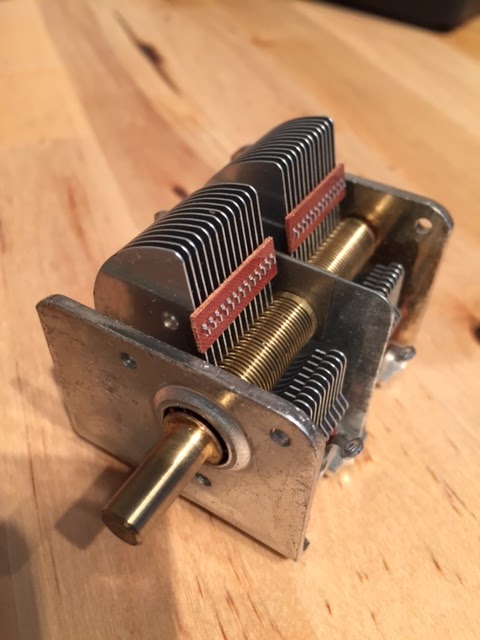
Feast your eyes my friends. That is 400 micro-microfarads of variable capacitance. (400 picofarads for you sophisticated young folks.) A benefactor interested in expanding the ranks of the Color-Burst Liberation Army has stepped forward to make us an offer that is hard to resist: He will send ELIGIBLE recipients one each of these fine electronic components for the cost of postage (approximately 6 bucks in the USA).

He has specified that ELIGIBILITY is limited to those who need this part to build or complete a Michigan Mighty Mite. And I have been appointed “Grand Poobah and Chief Arbiter of Capacitor Eligibility.”

So here is the deal: Send me an e-mail telling me about your planned or stalled Michigan Mighty Mite project. Include some information about your personal “Knack Story” — tell us why you share in this strange compulsion to build a largely useless 250 mW 3.579 MHz oscillator. If I find your plans believable and your Knack Story compelling, I will recommend you for a capacitor. Purely aspirational MMM projects and obviously fabricated Knack Stories will not make the cut.

Supplies are limited, so act now!