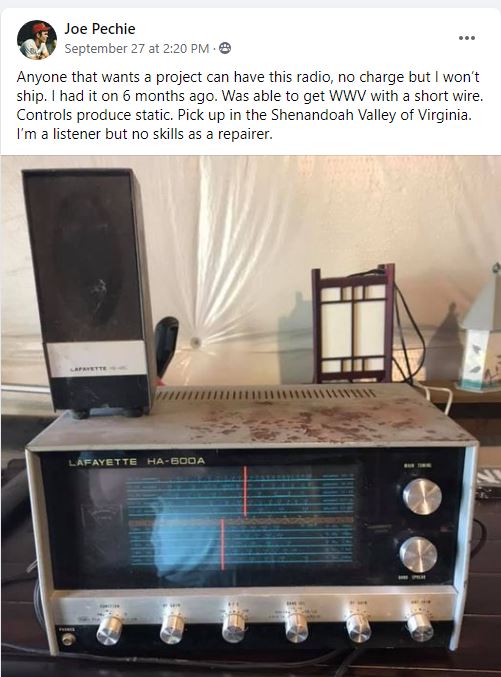
The HA-600A that I picked up last week was looking kind of sorry. There was a lot of rust on the cabinet. Below is the before picture.
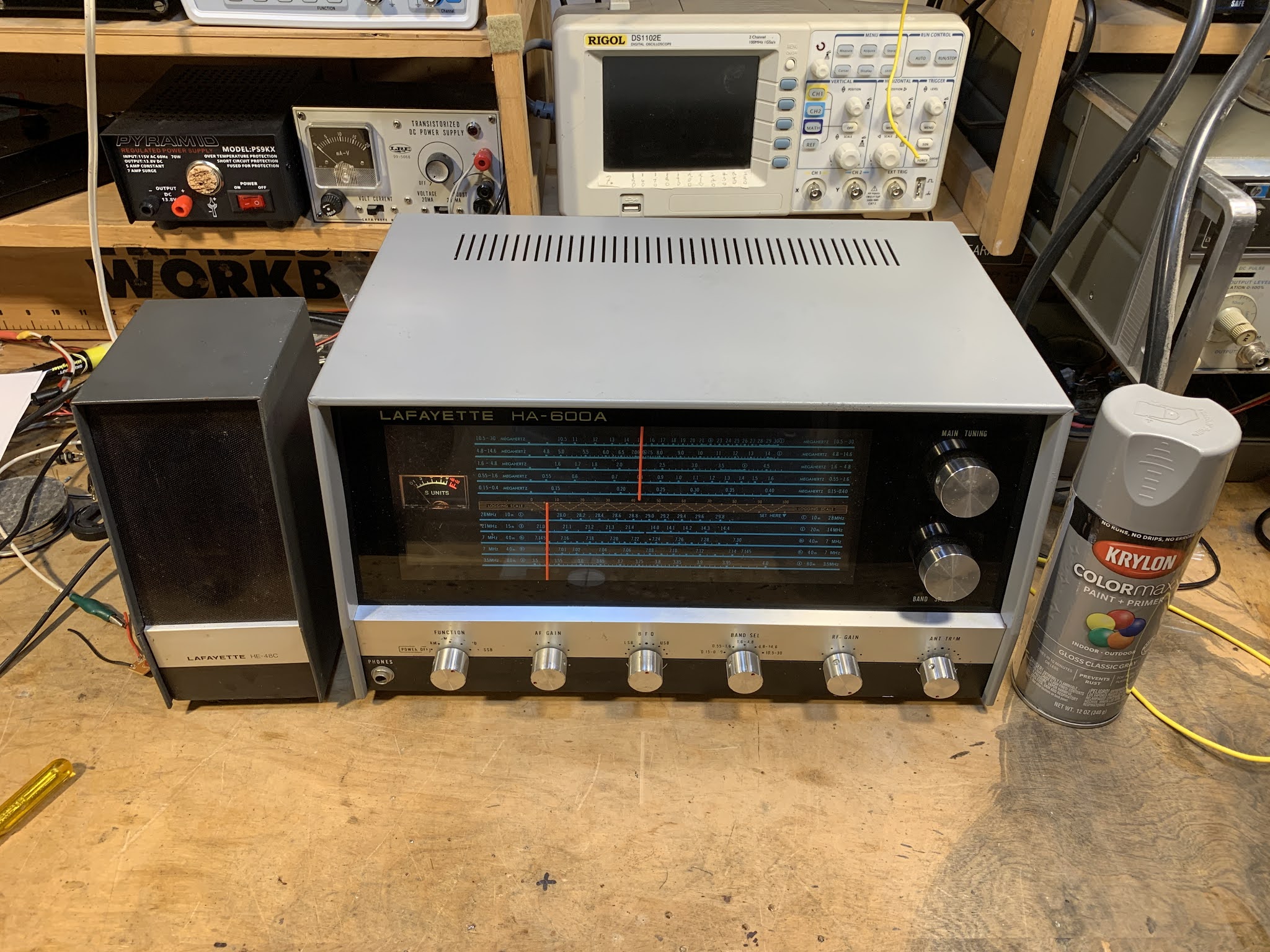
I’m not really into cabinetry or radio aesthetics, but it is amazing what a 6 dollar can of spray paint can do. Formula 409 also helps. I moved the light bulbs forward a bit to get more light on that Juliano Blue dial.
I am really enjoying this radio. It has brought back many memories. I think I got one for Christmas in 1972. I was 14. I got my Novice ticket on April 27, 1973 and made my first contact on July 19, 1973. For that first contact I was using an HA-600A and a Heathkit DX-40. Later I used the Lafayette with a Heathkit DX-100. The HA-600A was replaced by the far superior Drake 2B on April 11, 1974. So I used this receiver for more than two years.
Looking around inside this receiver (and following up with Google) I learned some more about it:
— It was made in Japan.
— The manual says it has a “mechanical filter” but in fact it has a Toyo ceramic filter. This may have been just an honest mistake by the folks who wrote the manual — maybe they didn’t understand the difference between the two types of filters.
— There is a big difference between the HA-600 and the HA-600A, mostly in the front end circuitry. The HA-600 has fewer amplifier circuits at the front end. This probably explains why the HA-600 I picked up did not seem to live up to my memories of my teen-year HA-600A.
The fellow who gave it to me tells me that it had belonged to the short-wave listener father of a friend of his.
I know we have a lot of tube-type receivers that are much older than this thing, but I still think it is pretty amazing that this is a receiver that I used almost half a century ago. And it is still as good as new.
So on September 27,2020, I was sitting quietly in my shack, perusing the postings on various radio-related Facebook groups, when suddenly I saw it: my very first shortwave receiver, the magic box that had put me firmly on the path to amateur radio, the Lafayette HA-600A. Joe, the owner, was offering it FREE to anyone willing to pick it up at his home in Virginia’s Shenandoah Valley. Holy Cow! I was scheduled to drive through that very valley later that week. A message was sent and the deal was done. CLEARLY THE RADIO GODS HAD SPOKEN (TRGHS).
Sure, the cabinet looked a bit rough, but I had high hopes for this receiver. A while back I had — in a similar fit of nostalgia — bought what had been advertised as a Lafayette HA-600A on e-bay. But it turned out to be a Lafayette HA-600 (no A). I immediately noticed a big difference in performance. That was NOT the radio that I remembered, not the receiver that had carried HCJB and Radio Moscow to me. Joe was clearly offering the A model.
A few days later I was in Joe’s front yard for the hand-off, and a few days after that the HA-600A was on my bench.
I quickly realized how little I knew about this receiver. Mine was a Christmas gift, probably in 1973. (A few days ago I talked to my mom and thanked her for driving all the way to New Jersey to get this receiver for me.) I was so taken with this thing that I feared doing something — anything — that might mess it up. I lived in fear, for example, that some sort of freak mid-winter lightning bolt might destroy it. I covered it with a towel each night lest dust encumber its “jeweled movements.” Obviously I was just not inclined to crack open the case and have a look around. So I didn’t, and the receiver remained pretty much an appliance for all the time I owned it. (I eventually sold it on consignment at Electronics 59 in Spring Valley, New York. The proceeds probably went toward the purchase of a much better Drake 2-B receiver.)
I downloaded the manual and familiarized myself with the receiver: It is a single conversion superhet with a 455 kc IF. It is all solid state with no ICs — all discrete transistors and diodes. The manual claims it has a mechanical filter. I kind of hoped for something like a Kokusai mechanical filter, but it turns out that the filter was really ceramic, not mechanical. Bummer.
The thing fired up right away and was inhaling on the correct frequencies. I noticed immediately that (as Joe had indicated) some of the controls were scratchy. I also noticed that the ganged band selection switch was intermittent and required some jiggling to get it to work properly. A few squirts of Deoxit D5 took care of all that. There seemed to be a bit of dirt in the main tuning capacitor, but I think I managed to blow that out using a can of Dust-off. I was quickly listening to the SW broadcast stations, and to radio amateurs on 75 and 40 meters.
Out of curiosity, I compared schematics of the HA-600 and the HA-600A. There was indeed a big difference — the front end of the 600 lacks a lot of the RFA amplification circuitry of the A model. That’s probably why is seemed so deaf and so different from what I remembered of the A model.
There is really not a lot to do on this receiver. I’ll get some paint to fix up the top cover. I may check the alignment. But this single conversion receiver is so simple that alignment would be quite easy. In many ways this receiver seems like a solid state analog to the Hammarlund HQ-100, but without the clock, and without the regeneration circuitry. The dial lacks the exotic station locations (Java!) that make many of the older receivers so much fun. I guess this is an indication that this receiver was aimed more at amateur radio operators than at shortwave listeners ( I was both). I wonder how the ham band-only HA-800 compares to the HA-600A?
I could pair this receiver up with a DX-40 transmitter that I have on the shelf and I’d be most of the way toward re-creating my novice station. Anyone have a Globe VFO Deluxe? That would complete the setup.
Thanks very much to shortwave listener Joe Pechie for providing what is, for me, a very meaningful piece of gear.