Singapore Knack

Bunnie Huang has The Knack. This was confirmed when, with obvious delight, he said that he’d found in China a book of schematic diagrams of a wide variety of laptops. He then studied said schematics and endeavored to understand the role played by one transistor in the LED display of one of the computers. KNACK CONFIRMED! Somebody get Bunnie a ham license! Cool video.

Our book: “SolderSmoke — Global Adventures in Wireless Electronics” http://soldersmoke.com/book.htm Our coffee mugs, T-Shirts, bumper stickers: http://www.cafepress.com/SolderSmoke Our Book Store: http://astore.amazon.com/contracross-20
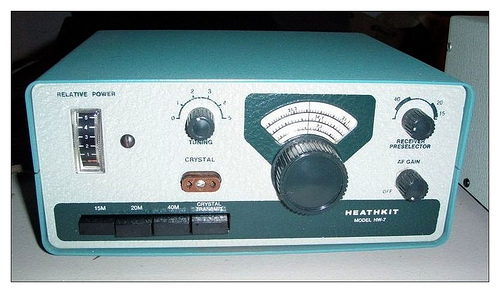
UPDATE: HW-7 Fixed After 36 Years

Dave Oldham had sent us a report on his resurrection of a long-broken HW-7. I responded by saying that the FCC should give him a license on the spot, based solely on his HW-7 success. Well, Dave got his license (by the normal procedures) and has put his rig on the air. Here is Dave’s report:

Update — Granted a license today. Couldn’t wait to make a contact. Took just a couple of minutes. Heard Dave, N9KKY, calling CQ and I answered him and he heard me. The very first contact this old radio has ever made. Based on his location he was 237 miles from me as the crow flies. My dipole is between 12′ to 18′ off the ground, so it was NVIS since Dave was off the ends of my wire. Anyway, between whipping the dial back and forth to hear and be heard plus other close stations and my newb status to both sending and receiving Morse, the QSO was short and mostly missed by me. But it was neat hearing my new call sign, KC9WIP, come back to me on this ole girl…I’m happy! 73

Our book: “SolderSmoke — Global Adventures in Wireless Electronics”http://soldersmoke.com/book.htmOur coffee mugs, T-Shirts, bumper stickers: http://www.cafepress.com/SolderSmokeOur Book Store: http://astore.amazon.com/contracross-20

HW-7 fixed after 36 years!

Give this man a license! He deserves one. Great job David.
—————–
Bill,


Found your podcasts (137 & 8) about the HW-7. Really enjoyed hearing your enthusiasm. I have owned one since 1976…my dad purchased it for me while at the Dayton Hamvention. Unfortunately it didn’t work when we plugged it in. Dad didn’t have the money to fix it at the time and as a 15 year old, neither did I. So it went into a box and was stored.
Fast forward to 2008 and my youngest son asked me what Morse Code was. I told him and showed him…I didn’t remember hardly any code. He wasn’t interested in learning that didn’t deter me and I wondered about the HW-7. So I went to the attic and found the box with the old rig. It still didn’t make a sound when turned on so I decided to crack the case open and go through the troubleshooting guide…I had the manuals for both the radio and power supply. I determined the 40673 was bad.
Got online and snooped around and couldn’t find a source for a replacement so I started looking into equivalent parts and ran across the NTE454. Ordered it, made some “soldersmoke” and replaced it, turned on the radio and was happy to hear hum from the power supply in my headphones. Switched over to a 9 volt battery, attached a long wire and was blessed to hear CW coming through loud and clear!
Dad, a ham from years past, almost didn’t believe me when I called to let him know. “Fantastic!” was his response when I explained how it happened. (He’s an EE and I’m a graphic designer.)
During the investigation I also discovered that the original owner never finished the assembly guide. Found a tool at Radio Shack that I could tune the coils with, borrowed a frequency counter from a local TV station’s tech and with dad’s help aligned the rig according to the manual. Got the dial into rock solid sync with the FC. Both on RX and TX.
I never heard what it sounded like with the 70673, however, looking at the data sheets for both Mosfets, the noise level of the NTE454 is lower. Typical for the NTE454 is 1.8 compared to 3.5 of the 40673. The max is 4.5 compared to 6.0 according to RCA. I have ears, thank you, and have copied a station located halfway down the Baja peninsula running 100 watts into a vertical. I was using a dipole 12′ up in Indiana. I say copied because I have yet transmitted with it. Because of life I have been delayed (many years) in getting my ticket. However I will be taking the Tech exam…possibly even the General exam in July…but I have a bit more study to do for General. As a tech I would only be able to use 40 meters
I have retrieved dad’s J-38…still sporting the 76 Dayton Hamvention sticker on the bottom, polished it up and have been practicing for when I can get on the air. 7 1/2 WPM currently, but slowly gaining. I hear that working stations on the air will help the speed increase.
Anyway, the HW-7 is going to be my rig for a while…thought about selling it…because of the stories I’ve read…but I like listening to it JUST LIKE YOU for the SSB rag chews near the top of the 40 meter band. I also listen to the slower guys on CW to get my ear tuned to it. You also confirmed how to tune and listen so I will have possibly, an easier chance in making contacts. I also know a few local hams that can schedule with me.
The HWA-7-1 power supply needs mods though. Plan on putting in place some caps and some magnetic beads to hopefully reduce the hum to a respectable level. Anyway, I appreciate your sharing and hope to work you sometime.

David Oldham
Greenwood, IN

Our book: “SolderSmoke — Global Adventures in Wireless Electronics” http://soldersmoke.com/book.htm Our coffee mugs, T-Shirts, bumper stickers: http://www.cafepress.com/SolderSmoke Our Book Store: http://astore.amazon.com/contracross-20

Ponderosa Knack! Bonanza Astronomy!

I loved this episode, and I think most of you guys will too. I was alerted to it by an article by famed comet hunter David Levy. Wow! I never would have thought that in a 1962 episode of the cowboy show Bonanza, we would find amateur astronomy and experiments to determine the speed of sound and the speed of light. Amazing. There is no radio in this so it is not really The Knack, but young Mr. Michelson (yes, the Nobel Prize winner) does set up a shack-like workshop and he is trying to measure c. So this is all very Knack-like. There is also a very nice moral to this story, a moral that is related to our notion of an International Brotherhood of Electrical Wizards.
Three cheers for Ben Cartwright!

You can find the episode here. It runs for 48 minutes:
http://www.youtube.com/watch?v=hzPRGV0HbMk

Our book: “SolderSmoke — Global Adventures in Wireless Electronics”
http://soldersmoke.com/book.htmOur coffee mugs, T-Shirts, bumper stickers: http://www.cafepress.com/SolderSmokeOur Book Store: http://astore.amazon.com/contracross-20
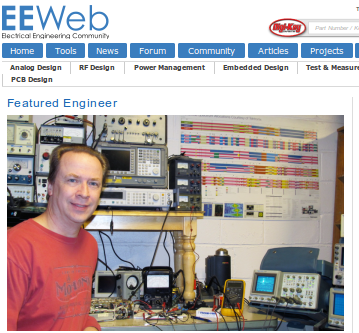
EE Web Featured Engineer: Alan Wolke, W2AEW

I really liked this interview with our friend Alan. You can see definite signs of an early case of The Knack here: I was especially impressed by the fact that he made one of his first antennas from wire salvaged from the deflection coil on an old TV. (I took the easy path and chopped up my dad’s extension cords!)

I also liked Alan’s response to the question about his favorite software tool: “Gee, solder is soft, can we consider that software? I use a lot of that!” This is very reminiscent of a quote from the legendary Bob Pease (colleague of Jim Williams): “My favorite programming language is solder.” (That quote was sent to me by Steve WA0PWK. Thanks Steve.)

Lots of good troubleshooting wisdom in this interview, and Alan’s enthusiasm for electronics clearly shines through:
http://www.eeweb.com/spotlight/interview-with-alan-wolke

If you’re also interested in the field of electronic repairs, visit www.guidetocareereducation.com for a list of schools offering electronics and engineering training programs.

Also, be sure to check out Alan’s YouTube videos, especially those on how to use an oscilloscope:
http://www.youtube.com/user/w2aew


Our book: “SolderSmoke — Global Adventures in Wireless Electronics”http://soldersmoke.com/book.htmOur coffee mugs, T-Shirts, bumper stickers: http://www.cafepress.com/SolderSmokeOur Book Store: http://astore.amazon.com/contracross-20

Yi Yao has The Knack!

Hi Bill,

I discovered SolderSmoke a few years ago by listening to another pod
cast. Ever since, I have been hooked on this podcast and listen to it
whenever I have time. I have finally caught up and finished episode
142 today. I love the enthusiasm and spirit of discovery and creation
that goes into the stories in SS.

The first time I heard about amateur radio was in high school. It
seemed to be a overly nerdy thing at the time and I wasn’t sure what
it was. However, after I started listening to SS, I discovered that
this is something that I wanted to do. So, on New Years Eve with the
kind help of a local examiner (Ori, VA3XW), I wrote my basic and
advanced exam and passed with honours. In Canada, we only have 3
categories: basic, advanced and morse co
de. I am very excited about
this and I am glad that SS made me make the jump.

You know, every time the word knack comes up, it is portrayed in a
negative way. Someone is “afflicted” with the knack or shows knackish
“symptoms” as if it was a horrible disease. I would like to change
this perspective.

I hereby declare myself blessed with the knack. Ever since I was a kid,
I disassembled various electronics around the house (to the dismay of
my parents). I knew when I was doing something right when I could put
something back together and it worked, or later, it worked better than
before. Despite my parents’ persuasion to pursue other branches of
non-technical studies, I made up my mind to study electrical
engineering (must have been a teenage rebellion thing). Nonetheless
I finished school and found a job doing electronics design which I
love. Some of the people that you meet in this field are just
phenomenal. It has been a good career decision and I think it is truly
amazing. Thus, I see the knack as being a gift which I was fortunate
enough to hold.

I think one of the most important aspect of the knack is the desire to
understand and have self reliance on what we use on a daily basis. I
repair my own bikes and I’ve never bought a ready made computer.
Having a home machine shop greatly helps in this regard too. My first
oscilloscope I designed and built myself:
http://yyao.ca/projects/oscilloscope/
I have also resolved to build my first rig instead of buying one.
However, work is really busy these days, and it doesn’t look like I
will be able to do this soon. One of these days, I will construct my
own rig and wiggle the ether.

I am currently visiting Silicon Valley here in California. There is
much to visit and do here. For example, the De Anza Flea Market
happens every 2nd Saturday (which is my first introduction to a swap
meet):
http://www.electronicsfleamarket.com/

The Computer History Museum is amazing:
http://www.computerhistory.org/

For a limited time, you can see Jim William’s work bench at the
museum. If you thought your workbench was messy, you haven’t seen
anything:
http://www.eetimes.com/ContentEETimes/Images/EELife/williams%20desk.jpg

Now, imagine having the world’s most smartest electronics engineers
having dinner together. That’s what the Analog Aficionados Party is about:
http://www.edn.com/blog/Anablog/41523-Analog_Aficionados_party_Feb_18_2012.php

On top of that, there are a lot of trade shows which you can go to
check out the latest and greatest of test equipment. They don’t have
the same feel as some of my analog oscilloscopes, but they are shiny.
As you can see, this is a paradise for anyone blessed with the knack.

Anyhow, this email is long enough and I hope your eyes haven’t glazed
over yet. My best regards to you, Billy, Maria and your wife.

73,
Yi Yao
VA3YAO
Our book: “SolderSmoke — Global Adventures in Wireless Electronics”http://soldersmoke.com/book.htmOur coffee mugs, T-Shirts, bumper stickers: http://www.cafepress.com/SolderSmokeOur Book Store: http://astore.amazon.com/contracross-20

Finnish Knack

Congratulations Ari! Thanks for the nice e-mail.

Hi,

I just wanted to thank you for your inspirational and enjoyable
book “SolderSmoke — Global adventures in Wireless Electronics”.
I bought it from Amazon.com as an electronic eBook a few months
ago and started reading. After a few pages a lot of flashbacks
from my own youth came into my mind.

In the early 1980’s when I was a teenager I got some local
electronics and ham-radio books into my hands through relatives
and the local library. They were very interesting and I got
my mind and time set into DX-listening, building electronic devices
etc., but the HAM-radio licence just seemed to be so difficult
to achieve that I sort of displaced the idea from my mind
for a long time.

After that I did my conscriptional military service in the
Finnish navy, passed a 5-month radio communications course
(including the part that I feared the most in the HAM-radio
exam too – the CW) and served as a radio and battle control
radar operator on-board local corvette Turunmaa in the
late 80’s.

After that university studies, foreign job assignments and
establishing my own family extinguished a lot of these former
hobbies for quite some time but now for the past few years as
things have sort of stabilized, I started to think and do
something about them again. Inspired at least partly by your
book decided to try it out and started studying the material
for our local radio amateur license exams. The exams were held
a couple of weeks ago and my license arrived today in the mail.

73 de Ari OH2ECG

Our book: “SolderSmoke — Global Adventures in Wireless Electronics”http://soldersmoke.com/book.htmOur coffee mugs, T-Shirts, bumper stickers: http://www.cafepress.com/SolderSmokeOur Book Store: http://astore.amazon.com/contracross-20
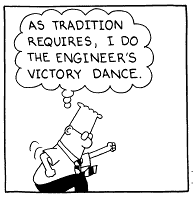
The Knack, defined

Of course, our British cousins will have some problems with this. (We already have some lexicon problems there — I can sense many of them wincing every time I say “SodderSmoke”!) But I’m sure they will be understanding here. And indeed, the Knack can sometimes leave you Knackered! (BTW: I currently have an annoying little soldering iron burn on the tip of my right finger.)

Hi Bill,

Maybe I’m not the first to think of these two words, but here goes:

Knacking v/n. as a noun, the act of artfully and cleverly designing, building from scratch, or repairing devices using, usually electronic in nature, specifically amateur radio related…not related to hacking As in: “My knacking was a success and I finally got my Drake 2B working on 30 meters” Somewhat redundant, since knacking IMPLIES extreme cleverness, knacking ALWAYS has a successful result, by definition!

as a verb (as in “Googling”) to artfully and cleverly design, build, or repair a device, normally electronic in nature as in “I was knacking my JBOT amp yesterday and successfully added a new low pass filter” Implies high level of cleverness and determination and a modicum of luck

knacker n. one who artfully and cleverly designs, builds or repairs electronics, especially amateur radio related, implies high level of accomplishment and can be used by knackers to describe themselves without embarrassment or outright bragging. Knackers do not need formal training in electronics to fully qualify. Knackers always know who they are and can be identified by burn scars on their fingers from soldering accidents.

Keep your great blog and podcasts going.

73

Steve Silverman
KB3SII

Our book: “SolderSmoke — Global Adventures in Wireless Electronics”http://soldersmoke.com/book.htmOur coffee mugs, T-Shirts, bumper stickers: http://www.cafepress.com/SolderSmokeOur Book Store: http://astore.amazon.com/contracross-20

Some unbridled Australian enthusiasm… (Two Videos from Oz)

Our book: “SolderSmoke — Global Adventures in Wireless Electronics”http://soldersmoke.com/book.htmOur coffee mugs, T-Shirts, bumper stickers: http://www.cafepress.com/SolderSmokeOur Book Store: http://astore.amazon.com/contracross-20
Homebrew Hero: Kazuhiro Sunamura, JF1OZL

In case anyone in the SolderSmoke community has not yet visited the site of Kazuhiro Sunamura… Be sure to check out his site. He has a really amazing range of projects:

http://www.intio.or.jp/jf10zl/

Here is the bio of OM OZL. As you can see, he definitely has the Knack, and clearly has the sharing attitude of a true member of the International Brotherhood of Electronic Wizards:

My name is Kazuhiro Sunamura. I am a 50 year old mechanical engineer, born in 1956. I am not an engineer in electronics. I have been interested in electricity and radio from the age of ten. For the last ten years, I have been active on my ham radio station JF10ZL. I have also written articles about my some of my radio projects in Japanese for the Japanese CQ Magazine. Now I have decided to get onto the internet and will take the opportunity of showing you my equipment and ideas. Please have a look at my schematics. I will be very happy if this material helps you with your own radio projects. I am a member of the J.A.R.L. affiliated Tsuchiura Club, the local ham club in my home town.

Our book: “SolderSmoke — Global Adventures in Wireless Electronics”http://soldersmoke.com/book.htmOur coffee mugs, T-Shirts, bumper stickers: http://www.cafepress.com/SolderSmokeOur Book Store: http://astore.amazon.com/contracross-20

Homebrew Ferrari

Speaking of homebrew motors, a number of people sent me this YouTube video about another intrepid European with amazing workshop skills. Great stuff. (It reminded me of the title of one of Jean Shepherd’s books: “Ferrari in the Bedroom.”)

Our book: “SolderSmoke — Global Adventures in Wireless Electronics”http://soldersmoke.com/book.htmOur coffee mugs, T-Shirts, bumper stickers: http://www.cafepress.com/SolderSmokeOur Book Store: http://astore.amazon.com/contracross-20

The Woz’s Early Exposure to Electronics

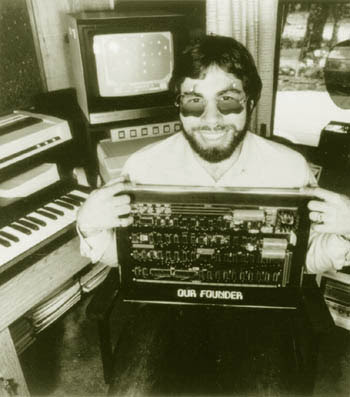
Here is what I was trying to — hic– say about Steve Wozniak –hic– in Podcast #139:

From “Steve Jobs” by Walter Isaacson:

“One of Steve Wozniak’s first memories was going to his father’s workplace on a weekend and being shown electronic parts, with his dad “putting them on a table with me so that I could play with them.” He watched with fascination as his father tried to get a waveform line on a video screen to stay flat so that so that he could show that one of his circuit designs was working properly. “I could see that whatever my dad was doing, it was important and good.” Woz, as he was known even then, would ask about the resistors and transistors lying around the house, and his father would pull out a blackboard to explain what they did. “He would explain what a resistor was doing all the way back to atoms and electrons. He explained how resistors worked when I was in the second grade, not by equations, but by having me picture it.”

This is clearly the approach to electronics that we see in the book “From Atoms to Amperes” by F.A. Wilson.

Mike, KC7IT, gave Woz a new title “the uber-knack-master of all time”:

Woz is the uber-knack-master of all time, and always has been in my book. His Apple II design is a work of genius in getting ten pounds of function out of five pounds of parts.

One of many examples: Apple II was the first personal computer to use DRAM memory chips, which were brand new then and kinda scary even for us pros. DRAMs store data as charges on tiny leaky capacitors. Every 20 milliseconds or so they have to be refreshed.

Everyone else had counters and logic just for refresh. Woz arranged the Apple II’s display memory, so reading out the pixels to the TV screen 60 times per second did the refresh too, at no cost in circuits or performance. The elegant design of a pure knack genius.

Our book: “SolderSmoke — Global Adventures in Wireless Electronics”http://soldersmoke.com/book.htmOur coffee mugs, T-Shirts, bumper stickers: http://www.cafepress.com/SolderSmokeOur Book Store: http://astore.amazon.com/contracross-20
An Inspirational Homebrew Motor from Spain


Bruce, KK0S, alerted me to this inspirational masterpiece from Spain. It is, as he points out, one of a number of really great videos about top level homebrew craftsmanship from Europe (remember the French homebrew tubes?).

Other comments from Bruce:
Did you notice that the calipers and micrometer this guy was using were seriously old-school. Totally manual readout. Not even a dial on that set of calipers! On top of that, his little lathe was manually fed. Notice in one of the shots, he is shown turning the cross slide feed wheel. No CNC anywhere. I can’t be positive, but I don’t think the lathe had a digital position readout either. This man is a machinist in the truest sense of the word. The Knack not only lives – it thrives!

Our book: “SolderSmoke — Global Adventures in Wireless Electronics”http://soldersmoke.com/book.htmOur coffee mugs, T-Shirts, bumper stickers: http://www.cafepress.com/SolderSmokeOur Book Store: http://astore.amazon.com/contracross-20
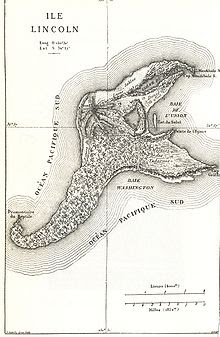
“The Knack” on a Mysterious Island

Paul, W2IOG, sent a nice e-mail about a very early use of the term “The Knack”: 1874 by Jules Verne. (What word did he use in French?). I took a look at the Wikipedia page and discovered that there was indeed quite a bit of “The Knack” on Lincoln Island:

“With the knowledge of the brilliant engineer Smith, the five are able to sustain themselves on the island, producing fire, pottery, bricks, nitroglycerin, iron, a simple electric telegraph, a home on a stony cliffside called “Granite House”, and even a seaworthy ship. They also manage to figure out their geographical location.”

Hello Bill,

I have been a listener to your Soldersmoke pod-casts for a couple of years now. I am also a regular reader of the blog as well as a long time victim of “The Knack”. I was browsing an old book store the other day when I came across a beautifully illustrated copy of Jules Verne’s book “The Mysterious Island” copyright 1920. I couldn’t resist, and when I reached chapter nine of part one of the book I was really glad I had made the purchase. In the story, which takes place in 1853, castaways on an apparently uninhabited island are trying to make fire for the first time. After trying and failing to make sparks by striking stones together, two of the castaways try the following:

“Pencroft, although he had no confidence in the proceeding, then tried rubbing two pieces of dry wood together, as [primitive people] do. Certainly, the movements which he and Neb gave themselves, if they had been transformed into heat, according to the new theory, would have been enough to heat the boiler of a steamer! It came to nothing. The bits of wood became hot, to be sure, but much less so than the operators themselves.

After working an hour, Pencroft, who was in a complete state of perspiration, threw down the pieces of wood in disgust. ‘I can never be made to believe that [primitive people] light their fires in this way, let them say what they will,’ he exclaimed. ‘I could sooner light my arms by rubbing them against each other!’

The sailor was wrong to despise the proceeding. [Primitive people] often kindle wood by means of rapid rubbing. But every sort of wood does not answer for the purpose, and besides, there is ‘the knack,’ following the usual expression, and it is probable that Pencroft had not ‘the knack.’ “

Congratulations on getting that 17 meter rig back on the air!

Paul W2IOG


Our book: “SolderSmoke — Global Adventures in Wireless Electronics”http://soldersmoke.com/book.htmOur coffee mugs, T-Shirts, bumper stickers: http://www.cafepress.com/SolderSmokeOur Book Store: http://astore.amazon.com/contracross-20
Steve Jobs (age 12) calls Bill Hewlett (of HP)

“When he was in eighth grade, Steve Jobs decided to build a frequency counter for a school project and needed parts. Someone suggested that he call Bill Hewlett. Finding a William Hewlett in the telephone book, the 12-year-old Jobs called and asked, “Is this the Bill Hewlett of Hewlett-Packard?” “Yes,” said Bill. Jobs made his request. Bill spent some time talking to him about his project. Several days later, Jobs went to HP and picked up a bag full of parts that Bill had put together for him.”

More HP stories: http://www.hp.com/retiree/history/founders/hewlett/quotes.html

Our book: “SolderSmoke — Global Adventures in Wireless Electronics”http://soldersmoke.com/book.htmOur coffee mugs, T-Shirts, bumper stickers: http://www.cafepress.com/SolderSmokeOur Book Store: http://astore.amazon.com/contracross-20
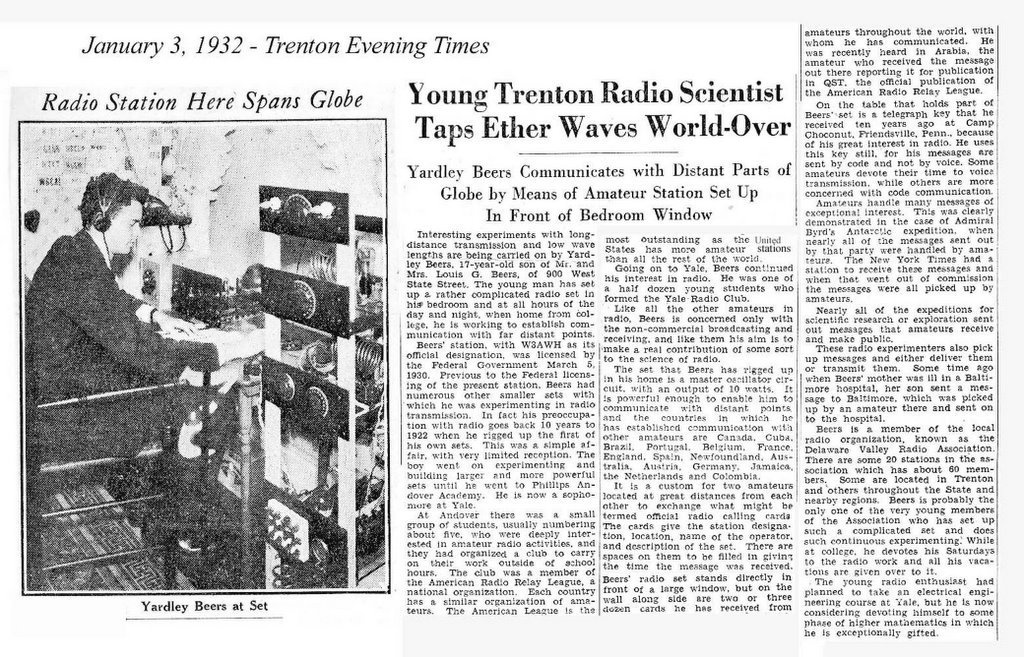
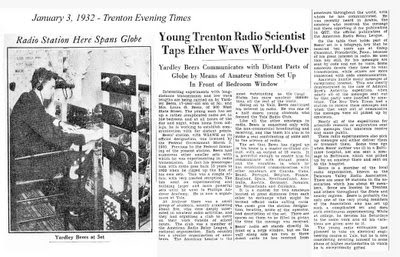
Better Link to 1932 Yardley Beers Article

(From the November 2004 issue of QST)

I hear that picture I posted of the 1932 newspaper article was pretty much illegible. Sorry about that. Try this one from the Delaware Valley Radio Association. Scroll down a bit until you see OM Yardley in his front bedroom shack (the one with a window on the world!). On my Firefox browser I was able to click on it and get an easily read-able view.

https://www.homebrewradio.us/blog/wp-content/uploads/2011/10/Yardley20Beer20DVRA1.jpg

Thanks DVRA!

BTW: Did you catch the name of the fellow who taught young Yardley the Morse Code? Atherton Noyes. Such good strong names!

Our book: “SolderSmoke — Global Adventures in Wireless Electronics”http://soldersmoke.com/book.htmOur coffee mugs, T-Shirts, bumper stickers: http://www.cafepress.com/SolderSmokeOur Book Store: http://astore.amazon.com/contracross-20
More on Yardley Beers

Just click on the article and use the zoom feature of your browser to visit the teenage shack of Yardley Beers.

Our book: “SolderSmoke — Global Adventures in Wireless Electronics”http://soldersmoke.com/book.htmOur coffee mugs, T-Shirts, bumper stickers: http://www.cafepress.com/SolderSmokeOur Book Store: http://astore.amazon.com/contracross-20

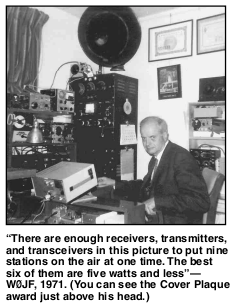
Homebrew Hero: Yardley Beers

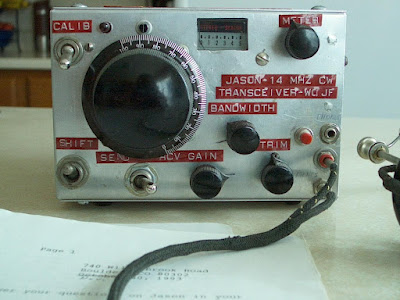
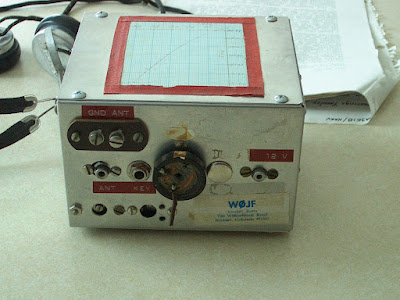
How’s that for a beautiful homebrew rig! Prompted by our discussion of distinctive ham radio names, Harv, WA3EIB, sent us a very nice report on Yardley Beers, W0JF. The rig pictured is Yardley’s “Jason” 20 meter QRP transceiver. Yardley had named the rig for his cousin. Harv met Yardley at a Colorado hamfest in 1993:

“On the table in front of Yardley was an Aluminum Box fashioned into a QRP radio named, “Jason”, 2 broken and worn head phones from the 1920’s, a few 1980’s QST and, several odd radio parts. My bulb of brilliance was not working that day. I said, “I don’t know what I’m looking for!” Somehow Yardley must have studied my eyes. I had locked my vision onto his very elaborate QRP rig. He paused for a few moments and said, “You into QRP?” By this time I felt more relaxed because he was now on my wavelength. I said, “Why yes, I would rather work with a homebrew radio that the ones with features that no one seems to know what they do!”

Harv bought the Jason (and everything else on Yardley’s table) and established a lasting friendship with W0JF.

There is a nice article about OM Yardley’s life in the November 2004 issue of QST.

Our book: “SolderSmoke — Global Adventures in Wireless Electronics”http://soldersmoke.com/book.htmOur coffee mugs, T-Shirts, bumper stickers: http://www.cafepress.com/SolderSmokeOur Book Store: http://astore.amazon.com/contracross-20
Bringing some Knack into Astro-Photography

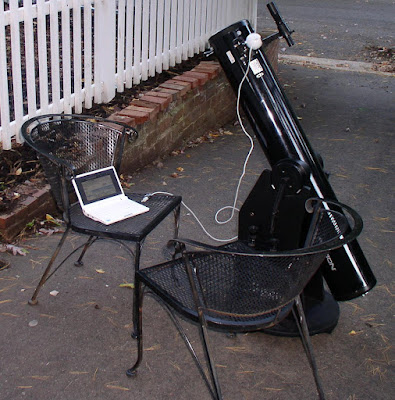
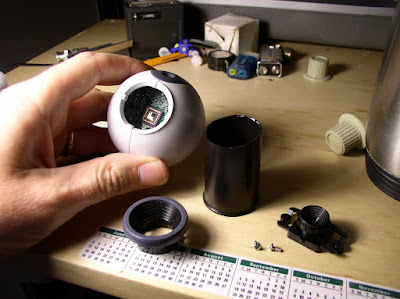
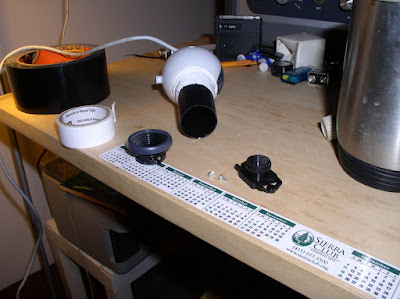
I’ve been meaning to do this for a long time. It is a neat little project that allows for a quick and satisfying mixture of electronics and astronomy. It has been described on the web many times: Take an old web cam (preferably one of the old eyeball-looking devices) and remove the lens (I found it very cool to expose the charge coupled device).
Take a plastic 35 mm film container (hurry, while supplies last!) and chop off the bottom. Tape the container to the sans-lens webcam. Here’s the fun part: Insert 35 mm container and webcam into the focuser of your telescope. Bring laptop out to the telescope and take digital pictures with your telescope.
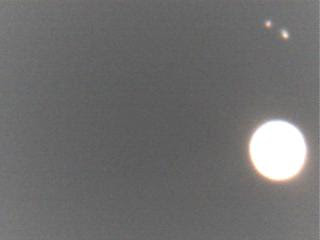
I used Billy’s old Asus eeepc and a very simple program called Cheese. (There has got to be something better for this kind of work.) But my results were very good. Last night I got images of Jupter and two of its moons. This morning I got some great shots of our moon.
Our book: “SolderSmoke — Global Adventures in Wireless Electronics”http://soldersmoke.com/book.htmOur coffee mugs, T-Shirts, bumper stickers: http://www.cafepress.com/SolderSmokeOur Book Store: http://astore.amazon.com/contracross-20
Comet Hits Sun, SFI up, Report from San Vito

The SOHO spacecraft caught some great images of a comet crashing into the sun. The YouTube clip above is from July. Here is NASA video of one that took place just last week:

http://www.nasa.gov/mission_pages/sunearth/news/comet-cme.html

Coincidentally I’m sure, the solar flux has increased significantly and the upper HF bands are working again. My 17 meter rigs still need final amps — I am ordering parts for Farhan’s JBOT circuit. (I plan to build three or four.) But because I had the 2B on 15 meters for the Sputnik event (still no Sputniks heard here) I noticed that DX was coming on that band. Using my HT-37 and a 40 meter dipole I easily worked several Europeans on 15 meter SSB. Especially nice was a long rag chew (using my rusty Italian) with Gianfranco, IZ4NPE, in beautiful Ferrara, Italy (a bicycle city).

Somehow tying this all together, I got an e-mail from Walter in San Vito, Puglia (the heel on Italy’s boot). Walter has one of those “dream jobs” for a radio amateur: He tracks sunspots!

Hi Bill,

Walter here from San Vito, Italy. Just wanted to drop a note to say hi and let you know that I’m enjoying your book. Thanks for making it available as a Kindle version. While reading, it brought back similar experiences with me as a youngster. I too was fascinated by airplanes and would ride my bike to the local airport and watch for hours as the planes would take off and land. My mom gave me my first airplane ride as a birthday present when I was 11. I have to admit that I was scared when we made our first airborne turn. I didn’t realize that a plane banks in the turns. I was also fascinated with shortwave radios and my best Christmas gift was a Radio Shack Globe Patrol (regenerative… hi hi) receiver kit. The gift from by grandparents was a Weller soldering gun (140 watts) to put it together with. Again, great job on the book.

The Sun has been keeping us busy at the Solar Observatory. I’m monitoring anywhere from 4 to 12 flares a day, 2 regions popped out of nowhere yesterday. The radio bands have been favorable with all the activity. I’ve got several projects in the works, a Genesis G3020 SDR rig is about 1/3 completed on the workbench now. It’s probably me when you see Puglia show up on the website spinning globe. Take care and keep the podcast’s coming. Ciao for now.
– Walter

I7/AC4IM

Our book: “SolderSmoke — Global Adventures in Wireless Electronics”http://soldersmoke.com/book.htmOur coffee mugs, T-Shirts, bumper stickers: http://www.cafepress.com/SolderSmokeOur Book Store: http://astore.amazon.com/contracross-20