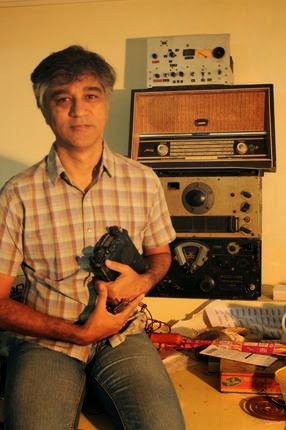
It is absolutely what I need, and what ham radio needs today!!!
I am at about episode 168 trying to catch up.
I would really like to build a Mighty Mite.
In fact, going on the record,
I AM GOING TO BUILD THE MICHIGAN MIGHTY MITE.
If you have any crystals left could you please send me one.
I’ve got a 9 year old boy that’s home schooled and I want to make this electronics hobby a stepping stone to a higher learning experience.
I got in to ham radio to learn electronics and somewhere along the line I just learned how to send and receive CW and how to pass multiple choice question tests. Somehow along the way I lost my love of radio. I still have a nice modern day rig, but it has no “soul”. I heard that comment in one of your episodes and it really rang a bell with me and when it rang I said,
“Oooh, that’s Awesome! “
I want a radio experience with soul!
I think that maybe why folks still use CW. It’s a mode with soul. I know you champion SSB, but home brewing a CW transmitter and receiver has got to be a truly soulful experience. And its one I intend to have as one of my own.
I too want to enjoy the “Joy of Oscillation “.
With you guys inspiring me, I am sure this will be a wonderful adventure.
THANK YOU! THANK YOU! THANK YOU!
For your guidance and inspiring work in the field of homebrew radio.
Sincerely,
Paul Hodges
KA5WPL
P.S.
The chemistry of you 2 guys on the show REALLY remind me of Click and Clack. You guys really work well together!
PLEASE DON’T STOP!
73
———————
Paul: Consider yourself inducted. There are, however, some conditions:
1) You MUST build the MMM and make it oscillate (thus experiencing the JoO).
2) You MUST send a picture or (better) a video of your MMM in operation.
3) You have to give me permission to put your e-mail (below) on the SS blog.
4) You have to send me your address so I can issue you a for-real SS 3.579 crystal (with mojo).
Deal? 73 Bill
—————–
Deal,
I’ll do my best to get video, at the very least I’ll get pics.
As for making it actually oscillate, well if the “radio gods” let it be then I’ll be having some good vibrations going on in the shack. Hope to have it going before first snow…of 2015…
Also, being inspired as I am, I made a CW contact with 5 watts since I emailed you last.
Thanks for helping me get the fun and excitement and the adventure back in to ham radio!
Sincerely,
Ka5wpl
P.S.
Please send a card if you have one with the crystal.
PPS Also why not initial it if you’ve got a small enough pen 🙂
Shell, WA6KJN, has built some really cool homebrew rigs. And an airplane.
On his QRZ page Shell writes: “I have saved all my old homebrew gear. This is a tube SSB exciter using a pair of 6146’s in the final. It has a Collins mechanical filter. Built in the 70’s. It had a matching receiver also with a mechanical filter in the I.F.”
Check out the QRZ page for meore inspiration (and some good ideas on towers):
I was delighted when Rupert posted some sage advice about how to deal with my recalcitrant amplifier. He managed to include a reference to Mr. Spock in his message, helpfully noting that some of these amp problems would challenge the Vulcan’s logical powers. That made me feel better. I sent a few words of thanks to Rupert and got back this really great “Knack Story”:
Hi Bill,
Well, all I have on HF amp instability is anecdote and half-remembered theory. But I do like the sort of challenges that building RF on the bench brings up – a problem worthy of one’s attention proves its worth by fighting back!
I’ve enjoyed Soldersmoke (or should I say Soddersmoke) for years now, and even if I haven’t bought the T-shirt, have bought your book. I first inhaled the demon fumes when I was barely into double digits, and the addiction kicked in hard – I fixed my first radio, a valve (tube!) FM 1950s broadcast receiver using a soldering iron that was actually one of my father’s wooden-handled screwdrivers heated on the gas ring of the cooker in the kitchen. My parents were mystified but supportive…
London is indeed a hard place to play radio. But that makes it doubly pleasurable when it works: it rather feels like you’re operating under cover, a special forces op sneaking the signal out under the noses of the regime. I once had a birthday picnic on Hampstead Heath where I brought my SOTA beam and fishing-pole mast: the local constabulary turned up and were also mystified but not quite so supportive… “What if everyone did it?” they asked. “Oh, if only…” I thought but did not say.
I do hope you can pacify your errant amp. Sometimes these things can be fixed by brainpower, sometimes by just mucking around until they get bored before you do. But normally I find that I’ve learned a lot when the problem’s solved. RF isn’t black magic, it’s a gateway into another world that’s marvellous and enthralling, but ours to know. I read a really good paper by Freeman Dyson, where he said that Maxwell invented modern physics, because his equations were the first to show that the real world of how things work is both beyond our natural experience, but accessible through thought and logic. The real entrancing thing about radio is that it proves this – we can talk across the world by translating our knowledge into a tiny handful of otherwise inert bits and pieces that tap into something utterly beyond our senses. And it’s open to anyone who cares enough to try.
(I also have an unshakeable and unhelpful addiction for obscure but interesting radios, as my QRZ page confesses. And things I helped design and build when I was an engineer are now in the NSA and Bletchley Park cryptologic museum collections. That, as they say, is quite another story…)
Anyway, thanks again for emailing – I’m thrilled to hear from you, and perhaps, who knows, one day we may make contact the way God and Maxwell intended – via QRP on a lively band while dodging the noise and bouncing our photons off the Heaviside Layers.
Best 73s,
Rupert, G6HVY
————————
Rupert’s QRZ.com page contains additional evidence of his Knack affliction and International Brotherhood of Electronic Wizards membership:
Other equipment here includes a Wireless Sets No 19 Mk III, an R1155, a Barlow Wadley XCR-30, an ICR-73, some PMR stuff on 4 metres, some old CB kit (shhhh!) and other obscurities. I like kit that has something different about it the 19 set, for example, is of course famous for its wartime role, but it was also the very first transceiver. The XCR-30 is really interesting, not only for being a high tech product of 60s apartheid South Africa (so a morally complex thing to own), but for having a very esoteric design that provides 0-31MHz coverage without bandswitching, very high stability and accuracy (you can generally pre-tune an AM broadcast station anywhere on the bands from the dial and be within 1KHz on switch-on, and all from a handful of transistors. There are stories to tell about all of my radios.
Started in radio when I was too young to get my ticket, so was forced – forced, I tell you – onto CB radio, in the days when it was very popular and very illegal. Had a couple of crystal-TX, super-regen RX walkie-talkies (QRPp and RX so wide I could pick up Radio South Africa on the BC 11m band) to start with, thence bought a ‘for conversion to 10m’ populated CB PCB from a batch at Plymouth ARC Rally and just bunged a set of toggle switches on the PLL-02 divider inputs. This was the mid-late70s, when skip was high… Did the RAE ASAP after my 16th birthday, first legal amateur rig (I may have built things with 6V6s that may have made odd noises on the local Top Band AM Sunday morning net) was an Icom IC-2E. My richer friend, who was a G6E, had an FT-290R, which was obv. nicer but obv. deafer. “FT-290. IC-2E. I can hear him. He can’t hear me.” Used 19 sets at school, so have that addiction too. Since then, the hobby has been in and out of my life (like QTHs, wives, jobs and money), but the love of radio never has.
—————————
I also understand that he once worked at a dodgy TV repair shop in the back streets of Plymouth and can still swap out a gassy PL509 with the best of ’em.
Ken Marshall G4IIB here the guy that wrote the SDR Primer in Sprat 162. I have been listening to your excellent podcasts. You guys cover a lot of ground in the May issue and touched on to the SDR dongle, its potential for future developments etc. I noted that you where going to buy another to cover VHF. Well if it ain’t too late consider this New version by Newsky they are already getting difficult to get a hold of and are only available in the USA. It uses an R820T2 tuner (better LNA) an upgraded and stable crystal oscillator, a reinforced antenna coax and socket. The one I managed to get hold of also had a modified PCB with solder pads for the the Q channel (pins 4&5) to connect the toroid. Incredable at 22 of your Bucks. See the pictures and read all about it on amazon.com.
All we need is for them to slot a 12 or 16 bit ADC in and we could have a truly great SDR receiver.
I noticed in your podcast you mentioned radio astronomy and satellite reception. Ironicaly back in 2013 this is how I started with SDR dongles. I read an aticle on the web on meteor scatter and started experementing with a dongle. Meteor scatter hunting is a bit like watching paint dry unless there is a known storm. So this led me on to the Funcube satellites. The signals from which although QRP 200mW are very stong and you can receive them on almost any antenna. The funcube dashboard software is available for free from AMSAT and alows you to download telemetry. You can also listen to amateur SSB an CW transmissions. There are lots of satellite tracking software available too. This then led onto weather satelite picture reception I built a 4 ele turnstile antenna for this but I found that I needed an LNA for reception at my location. I then started to listen to the amateur bands. Like you Bill I became interested in radio at the age of 11 and got licensed in the early 70’s but work commitments meant I had a 30 year absence from Ham Radio until I stumbled on these SDR Dongles. They got me back into the hobby and I joined the GQRP Club. I noticed that almost no one in the QRP fraternity was talking about RTL SDR hence I started writing the Primer and submitted it to George in late 2014 for publication in Sprat. As you know it appeared in the Spring Sprat and seems to have generated lots and lots of interest in the QRP community. I am delighted by this response and look forward to lots more interesting articles and podcasts. Have fun with your dongle.
Ken G4IIB
PS I wrote another article on getting these dongles to work under Linux. Linux uses completely different architecture so that the software used is completely different to windows. I notice that the software I use for Linux is also available on Mac OS which uses similar architecture (UNIX) so in theory it should also work on a Mac. Quite a few people have expressed an interest in getting a dongle to work on a Mac. As I do not poses a Mac I have not tried this out.
Last week I was interviewed by Eric 4Z1UG for his podcast “QSO Today.” I was at first reluctant to do this, simply because of time constraints: I already have difficulty finding the time to record SolderSmoke. But when I listened to Eric’s interview with Wayne Burdick N6KR of Elecraft, and learned that they had been teenage ham radio friends, I wanted in! Our interview was a lot of fun. You can listen to it here: http://www.qsotoday.com/podcasts/n2cqr or via ITunes.
Please help Eric out by subscribing to his podcast and by linking to his site. I’m sure he’d appreciate comments on our interview.
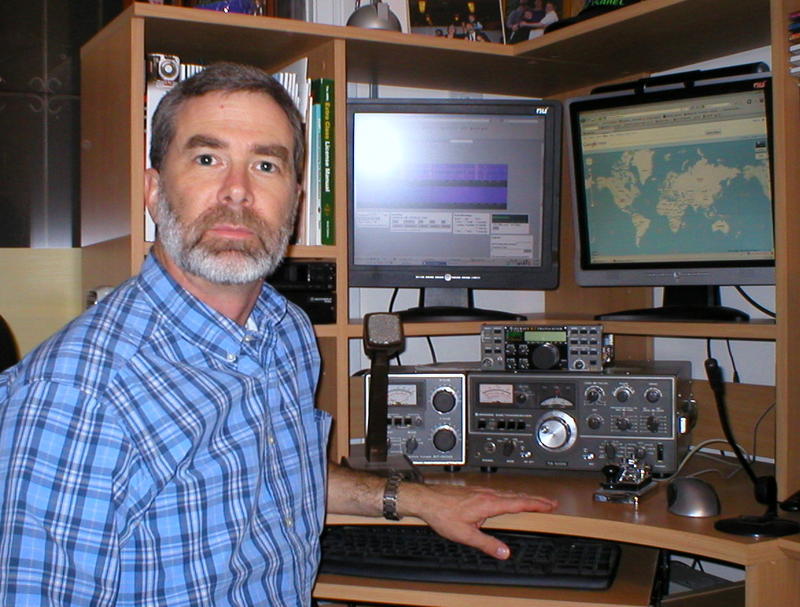
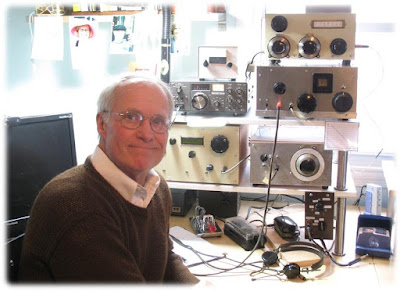
That’s Jerry KI4IO of Warrenton Virginia sitting in front of truly impressive collection of homebrew gear. The cream-colored box above the Vibroplex is Jerry’s new 7 MHz phasing transceiver. He has a wonderful write-up of this rig in the qrp-tech group files section:
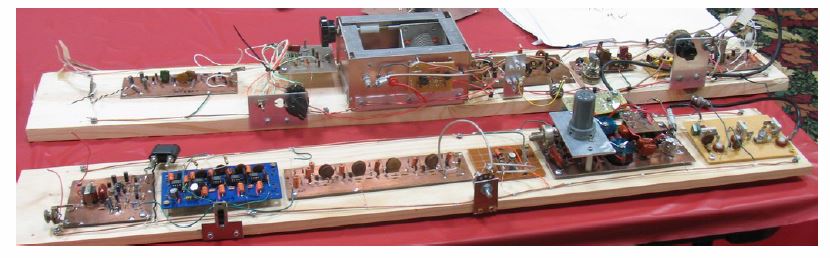
You may have to join the yahoo group to access it, but believe me, it is worth it. Jerry took a very eclectic approach to circuit selection and came up with a very cool rig. Lots of soul in that new machine! Here it is in breadboard form:
Jerry worked in U.S. Embassies as a communications officer and is obviously a member of the International Brotherhood of Electronic Wizards. From his QRZ page:
While in India I was licensed at VU2LHO and worked a lot of US hams with a 135′ flat-top and open-wire feed. I had the antenna strung between two bamboo towers atop the embassy housing 2ND-story roof-top. I also put up a 3/8 wave vertical on the roof for 10 meters. That little antenna had 110 radials stapled into the roof scree and worked very well! The rig was a HW-101. I was in Kathmandu, Nepal from early 1980 to late 1982. I could not obtain a license there, but became good friends with Father Moran, 9N1MM, and would often spend time up at his place putting his Drake station on CW. Pretty cool being real DX!
Warrenton, Virginia is not far from my QTH (it is the birthplace of Cappuccio the wonder-dog).
http://www.qsotoday.com/podcasts/n6kr Eric 4Z1UG does a podcast called QSO Today. He interviews interesting hams. A few days ago I listened to his talk with Wayne Burdick, N6KR, as I worked on my Tuna Tin 2/Herring Aid 5 rig. It was the perfect accompaniment, but the interview was so good that I intend to listen to it again, this time with no distractions from melting solder. Thanks Eric. Thanks Wayne. Here it is. Just click on the “Listen to podcast”” button:
You are absolutely right, I should stick to the plan and finish the project before tromping off in a different direction. Anytime I’ve ever changed designs before I have completed a task, usually results in something far less than expected.
The real joy is completing a project and looking back at what was accomplished.
My own personal goals for the Minima Transceiver Construction include…
1. Build it from SCRATCH – Manhattan Style. 2. Start with modular construction – so that each circuit can be tested, troubleshot and modified in the future. 3. SMA connectors and coax to every stage so, I can divide and conquer the function of all modules. 4. Document the entire journey so I can actually see where my learning’s took me. 5. Provide myself, a basic building block for future transceiver construction and designs. 6. Improve my skills, techniques and knowledge through my mistakes and understandings. 7. Learn to SLOW DOWN, study, plan and write, in my own words, what the circuit(s) do and how they function. 8. Be a mentor to others and share what I have learned. 9. Be more of an Amateur Radio Experimenter and less of a Ham Radio Operator. 10. Continue to dream and design.
Each day should be NEW and EXCITING. There should be a thrill in every step of the way, even in the midst of failures.
Thank you both for taking the time to respond. Thanks for the encouragement and sharing what happens on your own bench.
I’m an avid follower of Soldersmoke and builder of sorts. I began as a ham operator in 1965. My parents claim I was born with my hands wrapped around a soldering iron.
As you may have noticed, the Michigan Mighty Mite has become a popular rage thanks to Bill and Pete and the Soldersmoke gang. They have encouraged a great number of individuals to study, build and learn. The basics of a simple one transistor transmitter can be a key element to creating, inventing and pushing the brain to greater understanding.
When I was first licensed I was encouraged by a fellow ham. This wise man, was way more senior than myself and out of kindness, he sat me down in front of his workbench and grilled me on the key components and reasons for adding a Low Pass Filter in radio transmission. Following the lecture, he pulled the parts for the filter from his cabinet and said, “Now build it!”
Fifty years later, that same nurturing education is still with me and our hobby. When I was in New England in the 1970’s & 80s, I became friends with Ted Gent, G3ODG. He was a good friend and a real inspiration to art of build. We have long since lost contact with each other however, Ted helped me along as I ventured into solid-state homebrew receivers.
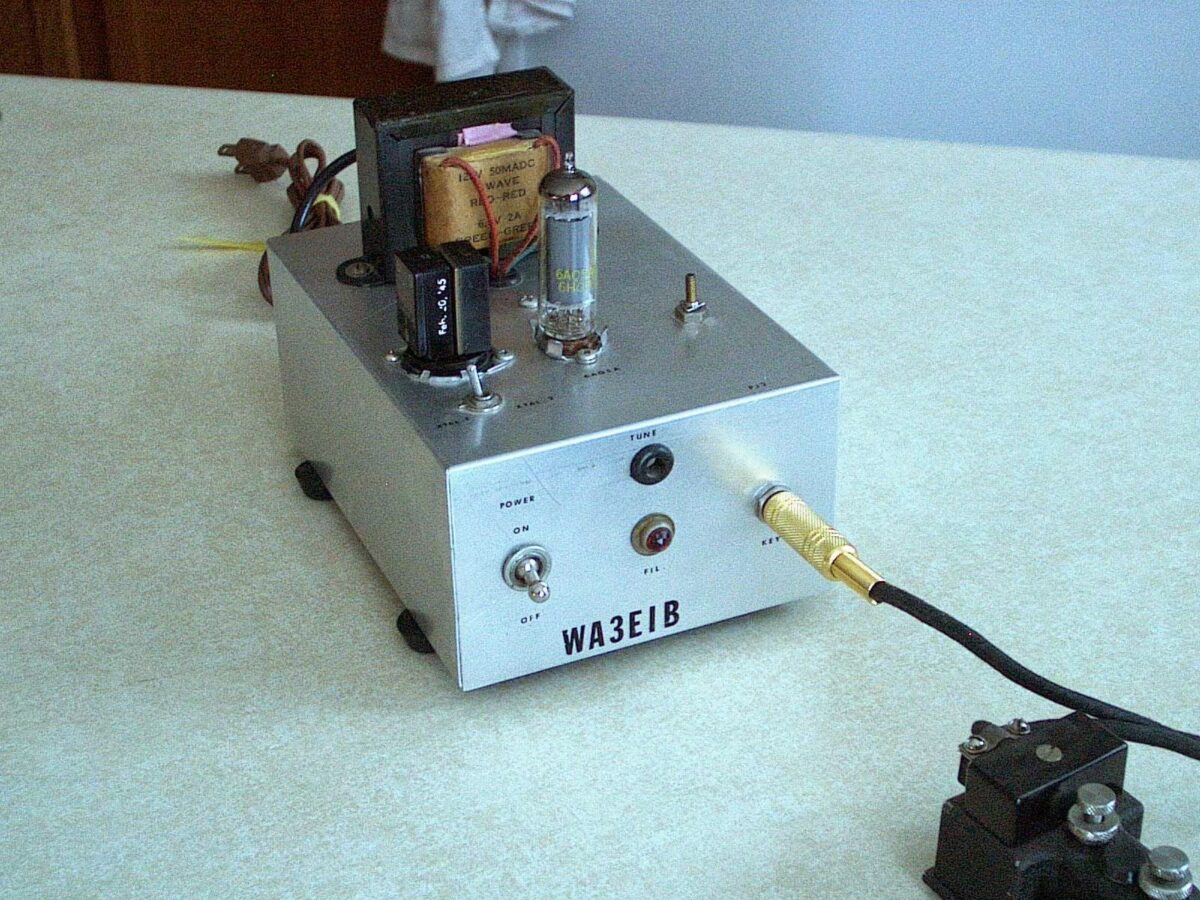
I have enclosed a photo of a similar one valve oscillator that I built when I was 15. So much thrill is derived when your hands construct a useful element of your radio shack.
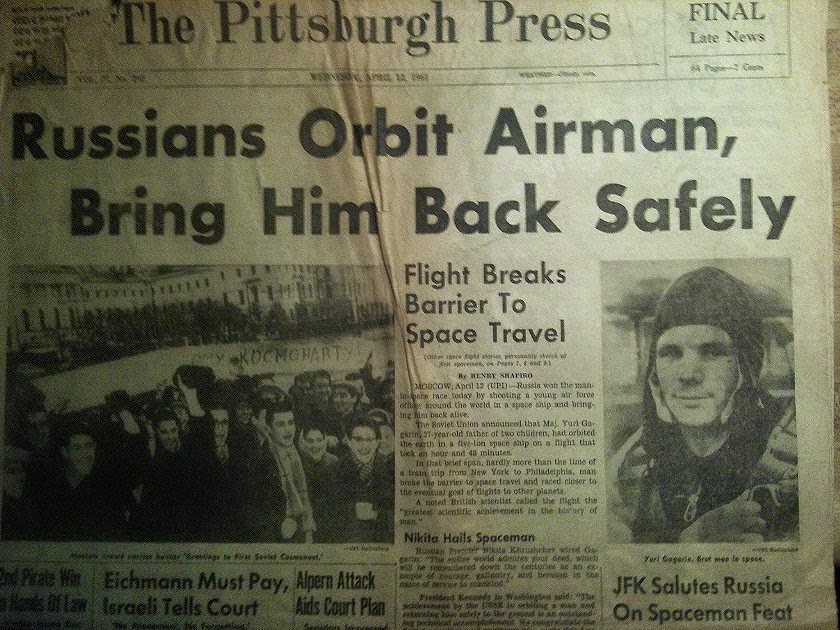
In keeping with historical events, I have enclosed a few snap-shots from the 1961 Pittsburgh Press dated Wednesday, April 12, 1961. Yes, a few of us recall that very day. I had filed this newspaper in my Scrap Book back then. It was a bitter sweet thing, to read for most, as we hoped the U.S. to be first but none-the-less, we smiled anyway because, it proved a person could go into space and return. (Flight Breaks Barrier to Space Travel). I was very enthusiastic about Rockets, Travel and current events. I built my own capsule in the rafters of my parents home and spent all day up there in the tiny confines as I launched my own secret adventures into Outer-Space.
Hope you enjoy the photos. I can provide a better set of copies if you are interested.
73’s
Harv – WA3EIB Idaho Falls, ID
Harv: I converted a small closet into what I saw as an excellent simulator of the Apollo 11 Command Module. Bill
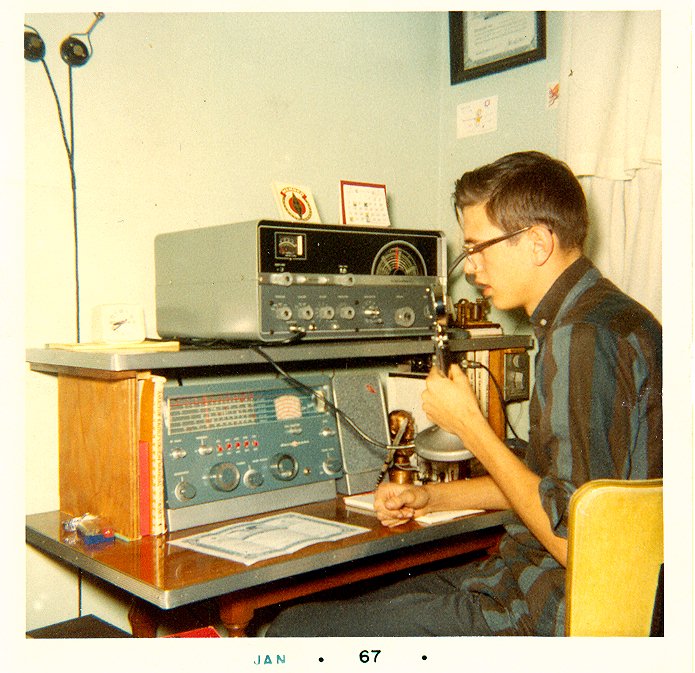
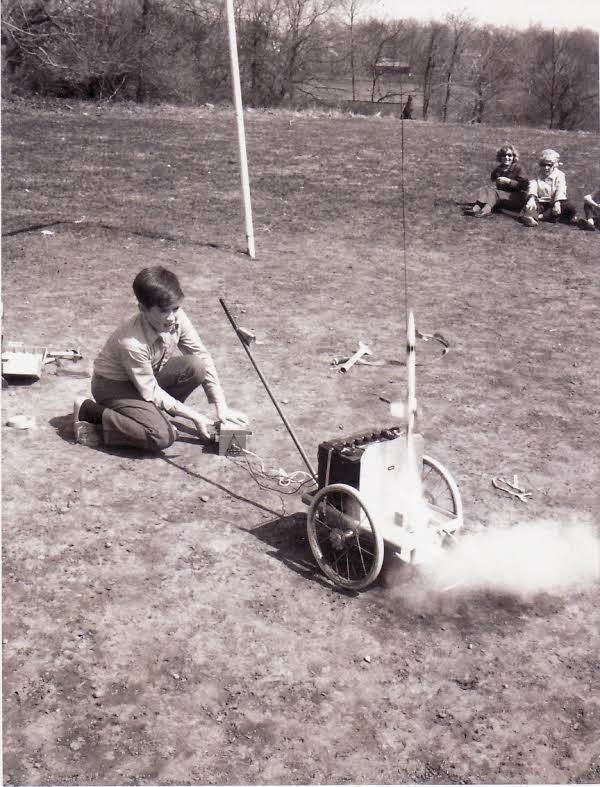
Through Facebook, I have re-established contact with my fellow members of the Waters Edge Rocket Research Society. That’s me, age 10, hitting the button on a homebrew launch controller.
Just a quick hello from MN to tell you how much I have been enjoying your podcast. Although I have “plugged” your stuff in multiple magazine columns over the years, I’m a bit late getting into the listening game. My current contract job has me doing a lot of driving, however, so I now have several years’ worth of soldersmoke to enjoy.
Several of the most recent episodes have made it clear that we have covered some common ground in our amateur radio careers.
I was licensed in 1977 at age 15 — a year after I built my Tuna Tin 2 🙂 The transmitter was a smashing success. I used it with my Tempo One transceiver, or at the electronics repair shop at a local National Guard base (where my mom worked as a civilian administrator). I would ride my bike to Camp Ripley (only 8 miles or so), and the guys in the signal shop would let me use the shop’s Collins KWM-2 HF transceiver (and attached dipole). Other than my efforts, I don’t think the KWM-2 got much use…
I, too, tried to get the Herring Aid 5 to work, with no luck at all. Listening to your podcast was like being in a time machine of sorts 🙂 I wonder if I got the “sense” of the oscillator secondary messed up? I never did get that thing to make even a sound. I don’t have it any longer. The same goes for the TT2. They got “lost” when I stored a bunch of stuff at my dad’s place in-between moves, as did a home-brew 4-400A amplifier and a 6146B amplifier for my Ten-Tec Argonaut. Darn!
Don’t forget about the matching VFO — the Chopped Beef Slider (CB Slider), which was built into a chopped beef can, of course! I didn’t build one, but as I recall it was a diode-tuned 40-meter VFO for the TT2.
Your “regen rage” and its subsequent easing was also amusing. I have had a love-hate relationship with those buggers, too, although mine was mostly love. You referenced Dave Newkirk’s (now W9VES) 40-meter QST regen article in a podcast. I was fortunate enough to be a QST editor at the time Dave was in his “second residence.” That guy forgot more about receivers than I will ever know, and he helped me tremendously in official and unofficial capacities.
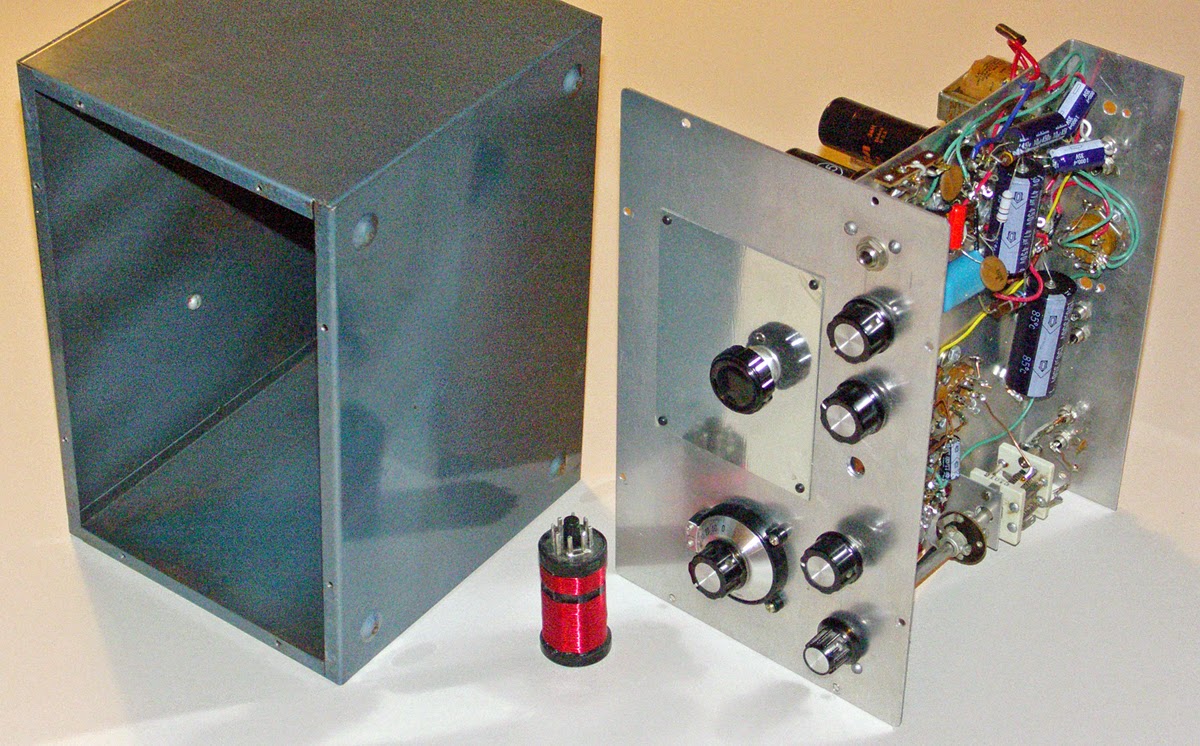
I have attached a photo (above) of a multiband regen that Dave helped me build (he designed and dispensed wisdom while I built the radio). He took a schematic from a 1930s ARRL Handbook and tweaked it a bit, helping me add a VR tube, “more modern” tubes and a few other goodies. Just to be difficult, I sampled the tank circuit with a tiny-value capacitor and a high-gain MMIC amplifier so I could drive a frequency counter, which displayed the receive frequency as long as the tank was oscillating. It was fun, but it was difficult to isolate the digital noise from the counter, so I only really turned on the counter as necessary, or to calibrate a dial, etc. The chassis used to be an Eico audio signal generator… In the photo the Jackson Brothers dial and bezel/tuning scale isn’t completely installed. After sitting in a box for 25 years, the regen still works but probably needs new tubes, as it’s rather deaf 🙂 Blasphemy aside, I’m moving on to solid-state regens…
I, too, just got a Rigol DSO. Wow, the “one-button” measurement is almost too easy.
I’m prepping my book, Stealth Amateur Radio, for release on the Kindle (and maybe other e-book formats), but it’s available now from my website, www.stealthamateur.com.
Keep up the good work, Bill.
I’ll be listening. 🙂
73,
–Kirk Kleinschmidt, NT0Z Rochester, MN
Editor, 1990 ARRL Handbook Technical Editor, Ham Radio for Dummies QST Assistant Managing Editor, 1988-1994 Ham Radio Columnist since 1989 for: Popular Communications Monitoring Times and now, The Spectrum Monitor (www.thespectrummonitor.com)
My book, “Stealth Amateur Radio,” is now available from www.stealthamateur.com and on the Amazon Kindle (soon)
I love it! Keep it up. I travel quite often in my work and listen to all your podcasts.
Since my early teens in the late 70’s I started subscribing to electronic magazines (which I have still keep all every issue). I just found a site that has all the old electronic magazines scanned and posted for all to read. What a resource!http://www.americanradiohistory.com It has all the old Popular Electronic Magazines, Radio Electronic Magazines, Modern Electronics, Electronics Illustrated, etc, in pdf format. Information from the turn of the century … Wow. Back when radio hobbyists made their own chassis for their valve radios. Just google American Radio History and it will be a top link. You might want to share this link with your friends, and listeners.
I have purchased your Soldersmoke book from Lulu — Thumbs up!! Great Book.
Thanks again for sharing your experience with radio and the knack.
Greg Self N8YCB ps: I have always called kluge – KLOO-guh .. and I don’t know why. 😉
Not even the U.S. Postal Service’s Anti-Crystal Steam Roller can stop an intrepid homebrewer. OM N9IZ got his Mighty Mite working and produced a really nice video and blog post on the project. You can just feel the enthusiasm: On the blog he writes: “Everything was assembled on a bread board for trial. I must admit to being overjoyed when I saw the visual waveform on the PowerSDR panafall display of my Flex-5000A main shack radio. So much so, that I ran through the house calling for my YL, KC9TAH. She was in the shower and thought I’d cut off a finger or something while in the mad scientist lair. Much to her dismay, it was only a nasty CW signal emanating from the Flex speaker. She did humor me by going out to see the marvelous project before asking me what I was going to fix for lunch.” FB OM! Bill I thought you might like to hear that another MMM has been brought into the fold. You might remember that the crystal you sent me was steamrolled by the USPS. Believe it or not, it works! Not sure the frequency is exactly spot-on, but who cares…it works! I enjoyed it very much and made a youtube video of the testing process. I also took pictures and posted it all to my webpage. Most of my other projects have been more QRO in nature so I’m treading in uncharted territory. We’ll see how far that goes, but right now I’m loving it. I have my issue of QRP Quarterly and plan to follow along in constructing the LBS project. All for now from Hoosierland. Hope you enjoy the blog post on my webpage. 73 OM.
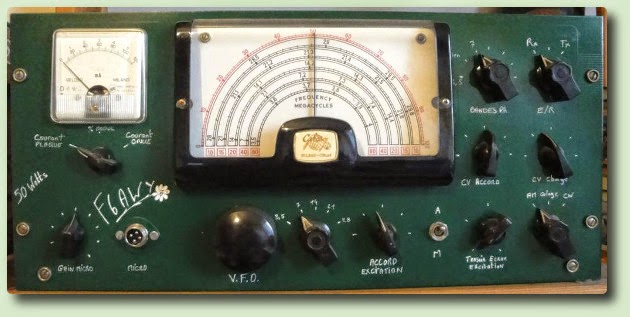
There he is: Patrick, F6AWY, the builder of the beautiful wooden-case SSB transceiver featured here two days ago. Born in 1945, Patrick has been melting solder since age 15. This picture made me think that there must be some connection between string instruments and homebrew genius: Farhan plays guitar. So does Pete Juliano. I think it was Rick Campbell who was strumming the banjo at FDIM… More about Patrick here: http://www.araccma.com/f6awy-p821004
Here is another of Patrick’s projects. He completely rebuilt an old Geloso AM transmitter. Note the markings on the front panel. Signed with a dash of F6AWY panache! More about this project here: http://www.araccma.com/emetteur-am-pas-a-pas-avec-f6awy-p820986
Translation tip: Open these pages in Google Chrome. Then, simply RIGHT CLICK on the page and select TRANSLATE TO ENGLISH.
We’ve heard of a few of these “long-delayed” projects. My own 38 year pause in the Herring Aid Five receiver project comes to mind. I like Keith’s idea of a “homebrewers home frequency” but I strongly suspect it would be a very lonely place! Thanks for sending us the pictures of your rig Keith.
Bill:
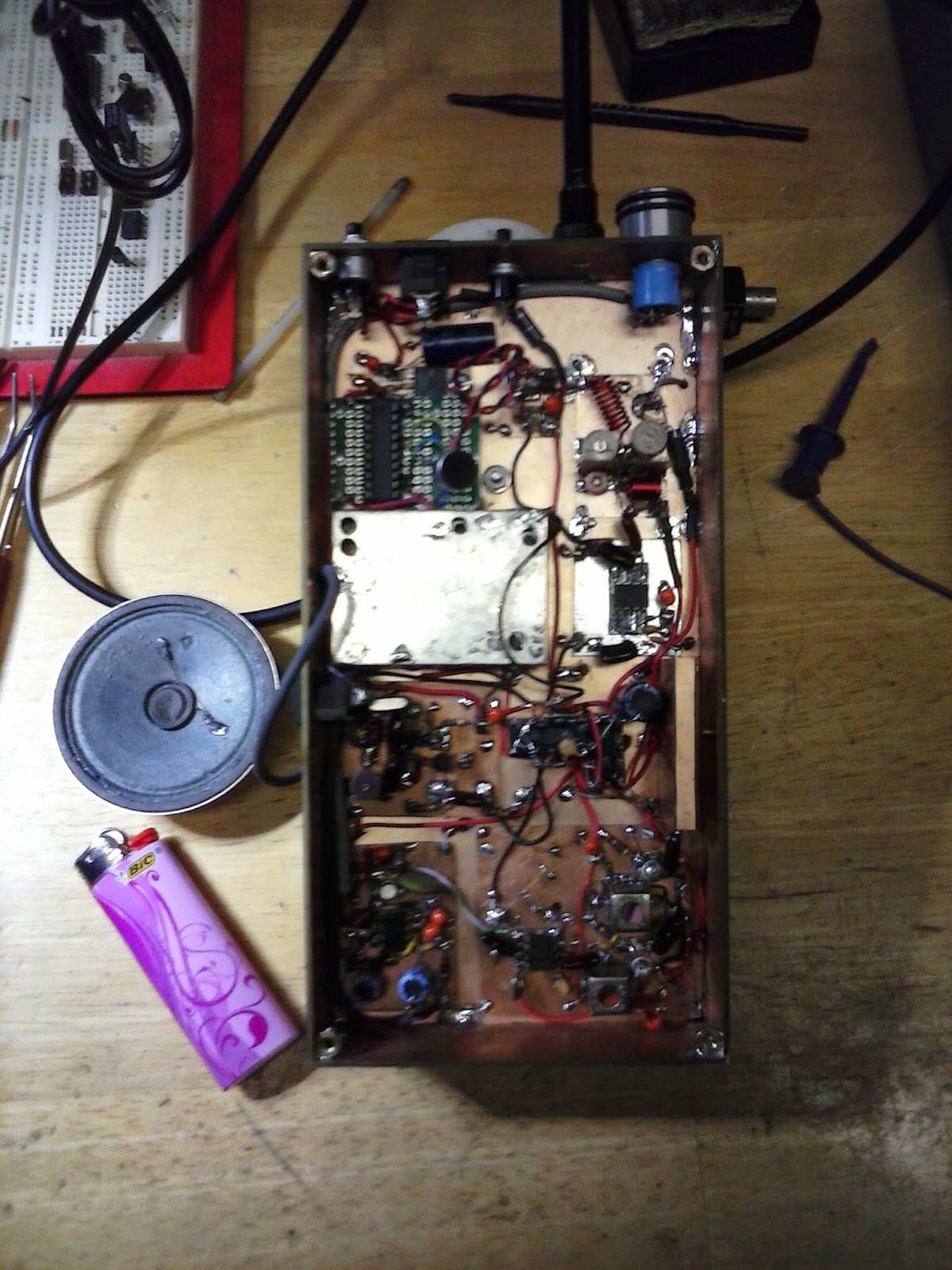
This project started out about 20 years ago as a 2 meter FM handheld, then sat in boxes for decades. Thanks to you and Pete and your podcasts keeping me company, it morphed into a homebrew 2 meter SSB rig. It saw ‘firstlight’ last weekend. Of course I had to operate it without the covers but I made a short QSO, about 1 mile across town with the wife (kg6oeo). Homebrewers should pick a “Homebrew home frequency” on various bands to facilitate homebrew to homebrew contacts.
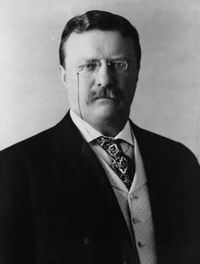
“It is not the critic who counts; not the ham who points out how the homebrewer stumbles, or where the builder of rigs could have built them better. The credit belongs to the ham who is actually at the workbench, whose hands are scarred by solder and metal and glue; who strives valiantly; who errs, whose amp oscillates again and again, because there is no effort without error and shortcoming; but who does actually strive to build his rigs; who knows great enthusiasms, the great devotions; who spends himself in a worthy cause; who at the best knows in the end the triumph of high achievement, and who at the worst, if he fails, at least fails while daring greatly, so that his place shall never be with those cold and timid operators who neither know victory nor defeat.”
Oh man, I was struggling yesterday. I guess I had been lulled into a false sense of security by the phenomenal ease with which I had put my BITX 17 on the air, then added a 120 watt amplifier, all without any sign of the dreaded feedback and parasitic oscillations that had plagued almost all of my previous projects. So when I decided to add the low pass filter and the switching/relay arrangements needed to use the amplifier with my BITX 20/40 rig, I kind of expected a similar trouble-free experience. WRONG! And you know what? I think guys on 40 and 20 are a bit less forgiving and collegial than the folks on 17. As I struggled to exorcise the transceiver, I’d make some changes then hopefully go out onto the airwaves and call CQ, looking for a signal report. Well, I got them. Many were not accompanied by call signs. I’d be in contact with someone who was trying to help, and — as we were trying to figure out what it might be — we’d be bombarded with harsh, sometimes angry, anonymous commentary: “YOU’RE 20 kcs WIDE!” “Are you on AM?” “You have a CARRIER!” One fellow scornfully told me “That little QRP rig of yours is not ready for prime time.” Ouch. (I didn’t realize we were on prime time. Isn’t this AMATEUR radio?) Others would answer my CQ by announcing that I was “on the wrong frequency.” Others would respond (off frequency) and tell me I was distorted — I’d ask them to tune me in, then they would say, “Oh yea, you are OK — you were just on the wrong frequency.” Some of these guys seemed to be under the impression that there are “channels” on 40 meters. It was a real disheartening mess. Then came the saving grace. I got the e-mails that appear below. WOW! My faith in ham radio was renewed! In the 18 months that I’ve been running the BITX rigs, I’ve never once worked another station using a homebrew rig. But Rick and I were 3/4 of the way there yesterday. And he was using a direct conversion receiver of his own design, with a PTO in an enclosure made from “flattened out tin-plated food tins.” Fantastic! It was as if the radio gods had arranged all this to pull me out of the depths of parasitic despair! Thanks Rick! A video of his receiver picking up my BITX 20/40 appears above. Pete and I will talk about the actual troubleshooting in the next podcast. I am HOPING to have it fixed by then. I may have to sacrifice some chickens to Papa Legba.” ……………. Bill,
I’m a long-time SolderSmoke podcast listener, and today one of my ham radio dreams came true.
I was listening to 40 meters today on my homebrew direct conversion receiver, and I heard your call. At first I didn’t believe it was you, but there you were.
At first I just sat there dumbfounded, just listening, but soon realized that I should make a video of this “rare DX” (rare DX for me hi hi), and post it on YouTube for you to review.
My apologies for the low audio in the video. I was using my iPhone and its inboard mic leaves a lot to be desired, but the best audio of you is at 0:13, 0:50, and again at 2:12 into the video.
Heard you on 7.16 MHz, Sunday 2-22-2015 at 10:15 a.m. local east-coast time (15:15 UTC).
I’m located in Manchester Maryland (North – Central Maryland). My homebrew 40 meter rig is a PTO tuned direct conversion receiver with all discrete components. My antenna is a simple wire dipole about 6 feet above the ground just outside by workroom window.
Below are links to the YouTube video of your QSO , and the schematic the DSB transceiver that you were received on. The rig is one that I designed, based on the published works of many home-brewers from the web. I call it the Lakeside 40 (in homage to Peter Parker’s Beach 40 transceiver).
So far I only completed the receiver section, and hope to complete the transmitter sometime this summer so I can use the rig at Lake Marburg (at Codorus State Park in PA), thus the “Lakeside” in the rig’s name. http://youtu.be/emsKg5n5-0c
Yes, what a coincidence with the PTO! That’s the same WA6OTP PTO design I based my PTO on.
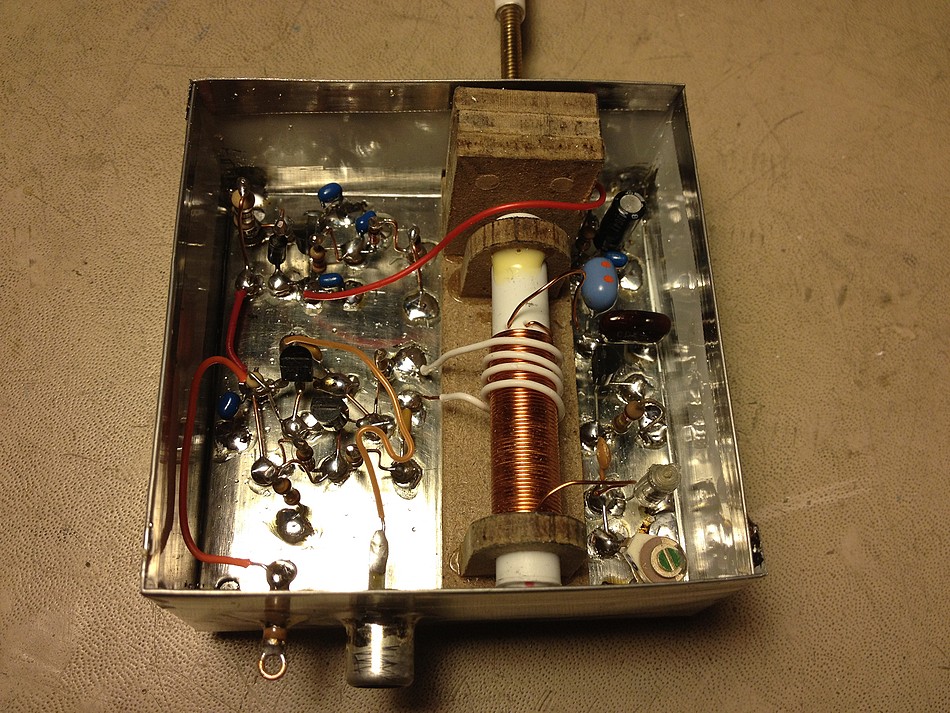
I created a webpage tonight(very much a work in progress) so you can see the details of how I constructed my PTO in the Lakeside 40, as well as my rendition of a BITX 20. Click the [Permeability Tuned Oscillator], or [My rendition of a Bitx 20] links on the left of the page.
The ground plane for the Manhattan construction (and RF tight enclosure for the PTO) are made from flattened out tin plated food cans, and the coil-form for the PTO is cut from Masonite wall panel material with my scroll saw.
Don’t get discouraged from the less than enthusiastic response from the others about your signal, pay them no mind; I’m sure they simply didn’t realize the significance of what it represented. To me, your signal was the most perfect signal I have ever heard. It was perfect because I know (from your pod-casts, and my attempts at homebrew) what it took for it to be produced. Its existence, and the fact that I successfully received it on my little homebrew rig too, represents the fundamental core foundation of Amateur radio; experimentation, building equipment with your own hands from scratch, expanding ones knowledge in the radio art, and most important, having fun and enjoying the excitement that comes from using gear that *you* built.
I cannot put into words how significant hearing your signal was for me today – thank you! My biggest regret is that I didn’t have a means of transmitting yet on 40 meters, and my Bitx 20 is not ready yet, perhaps in the future we can have homebrew to homebrew QSO’s where we can fine-tune our designs and tweak things (however we’ll have go above 7.175 MHz, or 14.225 MHz since I only hold a General ticket at the moment).
Oh man, we’ve all been there in one form or another. The struggle, the frustration, then, THE TRIUMPH! I love when his mother drops the plate. Thanks to John KC0BMF