XQ6FOD — A GREAT Knack Story from Chile


Greg VK1VXG sent me this link. I had a blog entry on this a few years ago, but I didn’t do it justice. This is a truly amazing and inspirational knack story, the story of Manfred, XQ6FOD. So many lines from this page resonated with me. For example:

I always regretted having disassembled this radio. It was so nice, so compact… Everything was hand made, there was not a single right angle in it… I felt like a murderer after destroying it. But, I needed the parts…

I designed this thing during a family summer trip into Chile’s beautiful deep south. The VFO part was designed on Chiloe Island, the IF and receiver circuit took shape at Futaleufu, Rio Cisnes, Puerto Aysen and Coyhaique, while the difficult RF power amplifier work was done on the return trip via Bariloche in Argentina. So this is an international design! Once back at home, for the first time in my life I did a thorough computer simulation of the whole thing. I hacked around the program for two weeks, and then my poor Atari had to spend another two weeks crunching numbers. It found some potential problems. I improved gain distribution, corrected mistakes, and then went straight to designing the printed circuit board, without doing any real-world test.

Check it out:


The Wizard of Wimbledon writes of Emperor Hadrian’s QTH, HMS Belfast, JFK and QRP

Dear Bill

I write this to you from my shack in Wimbledon, south west London, with the crackle of the bands slowly waking up across Europe, having just devoured the final few pages of your excellent Soldersmoke book; an intriguing and entertaining tale to which many of us can relate, a highly-accessible technical primer which certainly helped me to clarify a few niggling “Yes, but why?” questions, and a compendium of handy tricks to try during future projects – thank you for sharing your story.

I was amused to read that GB2RN, on HMS Belfast in London, where I am now one of the “new boy” volunteers, was an inaugural contact for your Azorean 17m DSB rig. As it turns out, 12000 tonnes of British warship seems to play an crucial role in testing QRP radios:


Enjoying a peaceful hilltop picnic in December 2014 with my girlfriend, gazing out over the idyllic Italian countryside above Frascati, it occurred to me that what the situation really called for was a 40m QRP CW transceiver (I was possibly alone in this thought). Soon after returning home I set about researching small, reliable kits which could slip into my jacket pocket but still tune across the band.

The EGV-40 (in memory of Miguel EA3EGV, EA-QRP co-founder) seemed ideal: a “tutti frutti” architecture of well-proven designs, based around a VXO for high stability.
My construction schedule was leisurely, paced for enjoyment and attention to detail. At all times I looked to maximise reliability, crucial when operating from a hilltop, far from a workbench. To pre-harmonise the radio with an outdoor life, on sunnier occasions I often found myself soldering in the garden. For a personal touch, I made sure to instill plenty of “soul”, reminiscent of my electronics journey so far: my late grandfather’s tools and solder were used throughout, alongside my own, together with reclaimed parts from old school projects and my elmer’s junk box; finally, in a shameless attempt at appeasement, my remarkably understanding girlfriend even helped to solder the final capacitor… and may be invited to recommend the paint colour!

In mid-December 2015 we once again flew out to Rome for our pre-Christmas break. Our first day was spent exploring the stunning Villa D’Este (stunning to behold, an ideal high radio QTH but far too beautiful for my wires to pollute the scenery without getting into trouble…) and Villa Adriana, near Tivoli. It was only right at the end of the afternoon, and annoyingly lower down towards the plains, when I stopped for a few minutes for an attempted sked with GB2RN.

Lesson 1: trees with lots of branches and twigs are a real pain for throwing wires through! I had guessed this already, but it truly is an exponential problem.

After conquering a geometric puzzle, I had my EFHW strung so that the point of maximum radiation was about 4m in the air – not exactly ideal for DX but theoretically reasonable for a nice high angle of radiation, like I needed. The feed point (fortunately a current null) was at roughly half this… time to get on the air!

Lesson 2: when operating outdoors – beware of the locals!

Rather than a comfortable bench I resorted to operating whilst sitting cross-legged on the grass, balancing my ex-German military miniature key on my thigh as I tapped it with my finger and attempted to steady it with my left hand.

The ambient sound of the 40m band seemed very different in I-land – that was the busiest I’d heard it outside of contests, riddled with deafening Eastern-bloc calls but not a single station from any of the British nations, which I presume must have largely been in the shade of the skip; apart from booming GB2RN beaconing to me high on the band 🙂

The Villa closes at 1700 and from past experience the wardens come around at 1630 to chase stragglers out from the far corners. Annoyingly one such woman decided that my guy wire and its supporting tent peg looked highly out of place and must be interfered with. My Italian is woefully incompetent at the best of times, so I resorted to gesticulating at her wildly with my left hand as my right attempted to stay faithful to sending clear CW.

Perhaps it was for the best; had she understood that I was “Making a scheduled contact with a British warship via Morse code using home-built equipment which I had smuggled into the country by air last night”, the tale might have taken an entirely different twist…

Cold hands, fading light and a dead leg from sitting in an awkward cross-legged position which is frankly impractical for anybody beyond the age of 8, but I was utterly thrilled to have enjoyed my first QSO from overseas, and particularly so since it was with my Elmer on the ship using a station which I had diligently put together myself over a number of months.

The first wisps of solder smoke have already left my iron this morning as I embark on the next stage of my QRP apprenticeship – to make the jump from a kit operator to a scratch-built home brew. All my life I have yearned to understand from first principles, and our remarkable hobby offers us a unique privilege to do so whilst sharing experience along the way.

Our objectives are decidedly more modest in scale, but I’m often reminded of President Kennedy’s famous quote: “We choose to go to the Moon in this decade and do the other things, not because they are easy, but because they are hard”.

72/3

Jonathan
M0JGH

PS Should you or any of the Soldersmoke brotherhood ever be in London and wish to operate from GB2RN, please don’t hesitate to contact me.
Possibly the Best Ham Radio Interview Ever: Farhan on “QSO Today”


Stop what you are doing. Run — don’t walk — to the “QSO Today” website of Eric Guth 4Z1UG. There you will find his interview with Ashhar Farhan VU2ESE.

There is so much great information, inspiration and wisdom in this interview. I was so captivated by it that — even with the availability of the pause button — I was unable stop listening even for the time it would take to walk to the kitchen to refill my coffee cup. But at the same time, listening to Farhan describe the joy of bringing a new receiver into operation compelled me to go over to the bench — in mid-podcast — to tweak a receiver that I am working on.

In this podcast you will hear about how Farhan got started in ham radio, about his Elmers about the origins of the BITX, about the Minima and the new HF-1 rig, about Farhan’s spectrum analyzer project and about a new goodwill effort to send BITX circuitry to aspiring hams around the world, especially in developing countries.

Throughout you will hear Farhan speak of the importance of the book, Experimental Methods in RF Design.
I really do think this is the best ham radio interview I have ever heard. Congratulations and thanks to Eric and Farhan.
Here is the link:

Grayson Evans TA2ZGE on “QSO Today”

Picture


Eric 4Z1UG has a really great interview with Grayson Evans TA2ZGE. I’m writing this as I listen.

My reactions:

I sympathized completely with his reaction to EE professors who insisted that current flows from positive to negative. Indeed. Let’s turn those arrows in the diode and transistor symbols around!

I too stripped down a Heathkit VFO and rebuilt it from scratch.

I share Grayson’s aversion to metal work. Viva Manhattan!

Here is the interview:

Another Lightwave Communication Knack Story from the UK


Hi Bill,

I’ve been following your podcast since you started and enjoy every episode. I’ve been licensed here in Scotland since 1970 as GM8EUG.

I thought you/others might be interested in how I got into radio/electronics and how I feel I may have the ‘Knack’.

The above reference reminded me of some experiments I carried out in 1967 as a schoolboy. There were no ready sources of parts locally for me.. I lived in a rural area so the nearest electronics parts shop was 50 miles away so it was all done by letter and mail order.

My first audio link was driven by a tube broadcast receiver with a 3 volt torch bulb connected instead of the loudspeaker. (I hadn’t heard of impedance matching!) This flickered nicely on speech/music peaks. The bulb was positioned at the focal point of a parabolic car headlamp reflector from a scrap car. I now had a beam of light with audio on it.
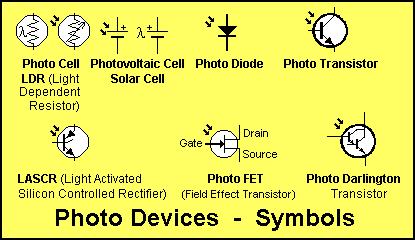
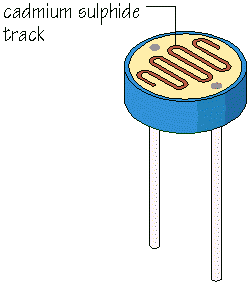
Next step was the receive side…I didnt have access to a photo cell but had a Cadmium Sulphide photo resistor. Connecting a pair of low impedance headphone in series with this cell and a 1.5 volt battery gave me recognisable audio when the cell was in the beam…no amplifier needed!

Next step was greater range…this was achieved with a 6 inch shaving mirror to focus the beam onto the photo resistor. This gave me the length of the street (100 yards when it was dark outside )with the flickering beam shone out of my schoolboy bedroom window resulting in puzzled looks from passers by.

Next problem was the frequency response.. all bass and no treble. Some research indicated that the photo resistor had a slow response so that was part of the problem but I had a hunch… How fast does a filament bulb react to audio? Biasing the bulb with a 1.5 volt cell so that it glowed dimly with no audio improved the audio response greatly.

So what got me into radio…my father was a Chief Radio Officer in the Merchant Navy during WWII and my schoolboy bedtime reading (the only technical stuff I could find ) was his textbook …the 1939 edition of the Admiralty Handbook of Wireless Telegraphy. Capacitors were called condensers and they were measured in ‘jars’!

That was the start of a career. I’ve now moved through testing international telephone exchanges, installing 2 way radio for the whole of Scotland for British Rail (paid for my hobby!) and finally 32 years in IBM writing manufacturing test software from the original IBM PC to Thinkpads.
Now retired I am active on WSPR and am writing Android apps to keep my brain in gear.

I just can’t leave this stuff alone!

Hope this of interest/amusement.

73s

Neil Roberson GM8EUG


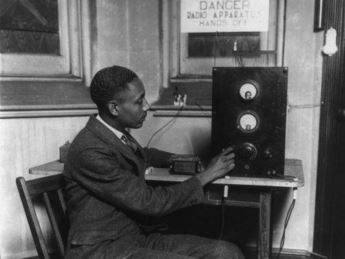
Dr. Rufus Turner, W3LF. Homebrew Hero and Radio Pioneer

Thanks to Farhan for alerting me to this great Hackaday article about a homebrew hero who was — sadly — unknown to most of us. He lived in Washington D.C., right down the road from where I live now. The Hackaday article leaves no doubt about it — Rufus Turner was one of us. He had THE KNACK. He was a true radio pioneer and homebrew hero. It is really a shame that we’ve known so little about him.

ZL2CTM’s Teensy SDR SSB Superhet — Very Cool

Hi Bill

I thought I would drop you a quick line to show you something I have been playing around with for the past couple of weeks. It’s a SSB superhet using a PJRC Teensy 3.1 microcontroller (YouTube link below), and a great audio library by Paul Stroffregen. Suffice to say I’m really happy with it.

There is a direct conversion front end, albeit using a VFO 15kHz down from the incoming RF. The 15kHz IF is then fed into the Teensy audio line in which can handle up to 22kHz. From there everything is in software. First is a 2.4kHz BPF tuned to the LSB, followed by mixer with a 15kHz BFO. Finally, there is a 2.4kHz LPF. Next step is to add both CW-wide and CW-narrow filters which can be selected during run time.
As you can tell from the video, my antenna is not the best and I have quite a bit of QRM in the shack. I really need to think about a better antenna, but that’s another story.
I have been following your R2 endeavors with interest, and as I said to Pete I will attempt to replicate the R2 on a Teensy. I will try and use the divide by 2 arrangement you tried as the logic looks right.


I will also be adding in a transmitter. For that I’ll use the microphone input and then take the audio from the line out straight to the RF pre/power amp.


I must admit that I really enjoy homebrewing hardware/software hybrids as you get the best of both worlds. As i say that, I wonder how much ADCs cost these days to directly digitize RF… Now that would be interesting.

I’ll say again that I really enjoy following the podcast. I have loved electronics since I was a small boy when my parents bought me a battery, switch and light bulb. This age of cheap DDSs, microcontrollers and the like is amazing, and I get so much enjoyment putting them all together to make functioning ham radios. I hope more get into the homebrew field as the entry barrier is dropping fast.

Keep up the good work.

73s
Charlie
ZL2CTM


Alan Wolke W2AEW Interviewed on QSO Today! And it is GREAT!

Picture
A very cool interview indeed. But how could it be otherwise? With Eric on one end of the Skype connection and Alan on the other, coolness was inevitable.

In this interview we are reminded of the FACT that Alan has a major case of THE KNACK. Proof is found in the way he obtained the wire for his first SW antenna: he unwound the magnet wire in the yoke transformer of a discarded TV set. THAT, my friends, is the stuff that KNACK is made of!

Check it out:
I share Alan’s affection for the TEC 465 ‘scope, but I twitched a bit when he said it is “easy to work on.” It scared the hell out of me! It features both plug-in transistors and lethally high voltage — so high that Alan had to lend me a special high voltage probe just to do the measurements.

Alan’s mention of Project Diana and the history of moonbounce reminded me of Ross Bateman, W4AO, the wizard who, in 1952 bounced the first amateur radio signals off the moon. He did it from the town I live in now, Falls Church, Virginia. Alan provided me with the address from which the signals were launched.

Thanks Alan! Thanks Eric!

YAMMM! Yet Another Michigan Mighty Mite! From KC0ZIR in Northern Virginia

Bill,

Thank you for the podcast and the loads of tribal knowledge from you and Pete! I recently started going through the SolderSmoke backlog, and I am just getting to the Colorburst Liberation Army episodes. I had some crystals for 40m laying around, so I started reading up and winding on a film canister.
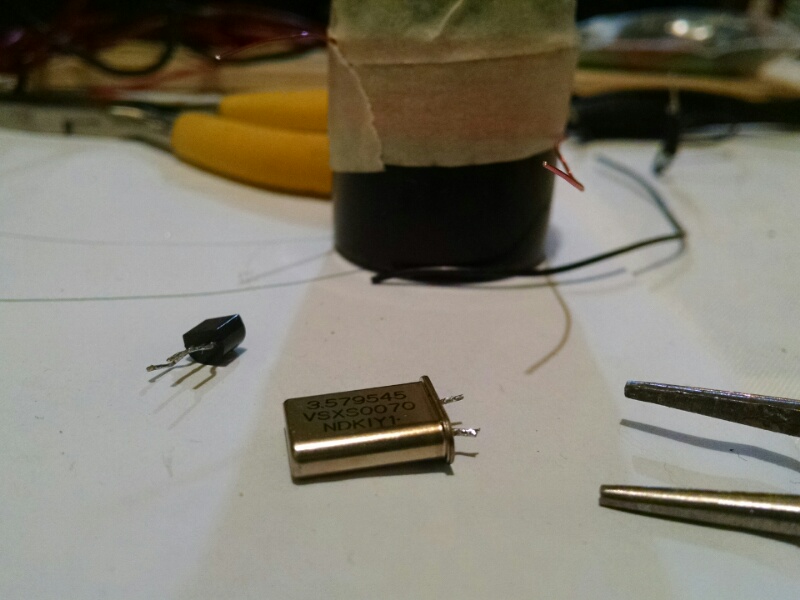
Later, I thought I’d hop up the current episode of the podcast while I work, and I heard you guys talk about another push for the Michigan Mighty Mite. I happened to be salvaging bits from an recycling-pile VCR at the time, and I came across this crystal with a familiar label: 3.579545. The radio gods have spoken, so I will be winding a new coil for 80m.
I heard you mention the anonymous benefactor, but I have some aluminum foil, and I plan to brew the cap as well, there are a few options here: http://www.instructables.com/howto/variable+capacitor/
I thought I’d tell you a quick story anyway, because I just want to be a part of the fun. When I was little, our radios all had retractable antennas, and the TVs all had rabbit ears or loops. I would spend nights trying different materials and orientations to try and get better signal. At one point, I ran as much wire as I could in my brother’s room (he had a big garage-sale cabinet tv), and we were getting channels from all over the place. We knew when each channel would be showing reruns of Star Trek, so we could catch an episode or two almost every day of the week. We even got some channels that I thought were only available on satellite. I had read in my box of Popular Mechanics magazines that some dish setups re-broadcast their signal on VHF/UHF frequencies with low power, I always suspected that’s what we were picking up.
I didn’t know much (or really anything) about the theory behind antennas at the time. I’m still a bit hazy, like with the 75 ohm / 50 ohm cable thing. I thought resistance was a function of length, how can different lengths of coax be the same ohm rating?
Anyway, I just wanted to let you know I’m new to homebrewing, and you guys are a big part of that!
73,
Dan, KC0ZIR
Northern Virginia (a little to the left of you, it sounds like)
…………………………

Excellent Dan!

Getting the 3.579545 MHz rock out of a dead VCR definitely adds mojo to the rig. Indeed, TRGHS! Thanks for sharing your Knack Story. I hope to meet up to you, perhaps at the hamfests of Northern Virginia. In my capacity as Grand Poohbah and Arbiter of Capacitor Eligibility, I hereby deem you ELIGIBLE for a variable capacitor. Our secret benefactor will be contacting you.

73 Bill


M1GWZ’s Knack Story: From Crystal Sets to BITXs

M1GWZ writes: “Just to establish my DIY radio credibility, here is a photo of my contest-winning crystal radio. Unpowered, it has logged commercial stations from Ireland to Russia, and from Northern Norway to Algeria. Excuse the mess in the background – the workshop is being re-organized!”

Carissimo Bill (I don’t speak Italian. I’m just showing that I have read the book).

One of the benefits of early retirement after ten years in the electronics industry and twenty-five as a University academic is that one gets the chance to research one’s interests and also have time to experiment with them. You correctly comment that you doubt you will have trouble occupying yourself in retirement – this is true, but be prepared for the frustration of not making as much progress as you would hope for! Chores still steal your time from you – and you have no excuse for avoiding them when you’re retired.
I was recently alerted to the availability of your book via Kindle, but have only just got around to reading it (retirement…). It has been both a joy and a curse. Congratulations! It made fine reading in a couldn’t-put-it-down way, but has also added several more items to my already-arm-length retirement project list. This, of course, is the price one pays for education and for evading the curse of boredom. As a radio ham friend of mine says with a sigh, “So many projects, so few lifetimes.” As a result of reading your book, I am now pursuing satellite communication with my Yaesu handheld, and will put together a dedicated homebrew Yagi-plus-transceiver system in the New Year. The Baofeng two-bander handheld can now be had for £18 in the UK, so I can afford to dedicate one to the system permanently. Cheap technology to talk via satellites! So far, I have just been listening in – for the last three days.
I have been building radios and short wave listening since I was about nine years old. If it wasn’t for a schoolfriend’s father and a crystal set, I might not be e-mailing you now. (They are still talking about killing off MW AM transmissions in the UK. Sad for kids building simple radios, but good news for European DX! Swings and roundabouts. I’d like to give the Xtal Set Society www.midnightscience.com a mention – virtually all the recent crystal radio technology involved was discussed and developed on their forum. ) Upon graduating in 1980, I found a life without exams strange, so I took and passed my amateur radio licence exams as a way of learning more about electronics. Then life intervened (work, romance, microcomputers, marriage, job changes, son) and it was twenty years before I actually took out the licence. No Morse test so I was initially VHF / UHF only, but later the rules changed and I had a full (phone) licence. However, I only wanted to tinker about with handhelds when visiting friends in the USA (met via crystal radio forums on the internet), so my station consists only of a Yaesu VX-7R and a VX-2R (purchased at Dayton Hamvention) as a backup. I’ve never wanted to fork out the grand or so for an HF transceiver (although now I’m retired…), but I would like to reach out on 20 metres. Now, curse you, I realize that I have all the electronic parts to build a BITX SSB transceiver – and may have to do so. Another item on the project list…
Apart from amateur radio and DIY discrete-level DIY electronics, it turns out that we might have a couple more things in common. Through visiting the Dayton Hamvention, I now have many friends via the AMRAD club around Washington DC and have met quite a few hams from the Vienna and Loudon groups. I have attended Dayton for about the last fourteen years but circumstances change and we might now decamp to February’s Hamcation in Orlando. Meanwhile, I live about four miles away from Kempton Park and have attended most of the rallies there, so there is a good chance that we two may at least have occupied the same room, albeit without actually meeting, on at least one occasion. It’s a small, beautiful world.
Anyway, you’re a busy man and I’m a verbose retiree, so I just wanted to thank you for the book and the inspiration it has given me to do more in ham radio. I also build DIY audio projects including (music) synthesizers, but at least I can use up a few more junkbox components before they’re used to weigh down my coffin.

Regards,

Philip Miller Tate M1GWZ

G3ZPF’s Knack Story: Debunking Tech Fairy Tales, Surviving Nixie Tubes and Ferric Oxide

Bill:

I‘m finding the book very entertaining, and am currently about halfway
through it. Like you there were a few electronic ‘fairy tales’ that I
was suckered into and I was pleased to see your debunking of them. My
professional training was structural engineering so anything electronic
I picked up along the road, and was thus an easy mark for misdirection.

I still remember the first time I realized that teachers sometimes don’t
understand what they’re teaching, but just repeating what they were
told. At age 11 we were using a thin tube with a slug of mercury and was
told that at -273c the air under the mercury would have zero volume. I
knew it was BS, but was too young to know why. A decade later I worked
it out for myself, by accident really, and I still feel slightly
resentful about being misled. Turns out that -273c is a ‘convenience’
(aka a fudge factor) which makes the combined gas law work :-p

The first electronic fairy tale I encountered was “the feed impedance of
a half-wave dipole is 72 ohms”. Taught to me while studying for the UK
radio exam, and trotted out repeatedly in the RSGB magazine.

This magically mutated into 50 ohms when the Japanese rigs started to appear,
which made me a tad suspicious, and when my very young self finally
scraped enough cash together for the ARRL handbook I spotted the graph
showing variation of feed impedance with height.

I was devastated. I remember wondering why all the old guys at the club
(who I spent most Sunday mornings listening to on 160m AM as an SWL)
didn’t know this.

In that instant I saw that all my hours of climbing up & down ladders;
cutting and pruning my very low dipoles to get 50ohms (bear in mind how
changeable and usually awful the UK weather is) had been utterly pointless.

From that point on I used doublets + open wire feeder. Up the ladders
just once and all tuning done in the shack in a comfy chair with a coffee
in one hand using a PROPER balanced ATU, not some shonky single ended
thing with a balun on the back.

Of course I found out about saturating balun cores the painful way (a
T200 core stays very hot for a very long time), and accidentally
discovered the current balun (which I called the idle-mans balun) at a
time when nobody distinguished between a voltage balun and a current one.

I took my inspiration from the ‘coax round a ferrite ring’ method of
stopping TV coax braid from conducting my RF into the TV. Fast forward
20 years and current baluns are the way to go. Its tough being a visionary.

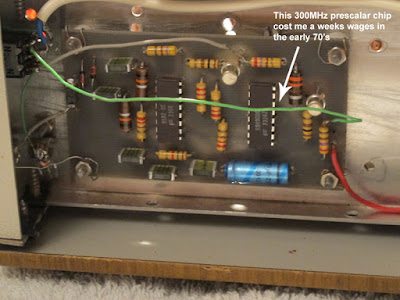
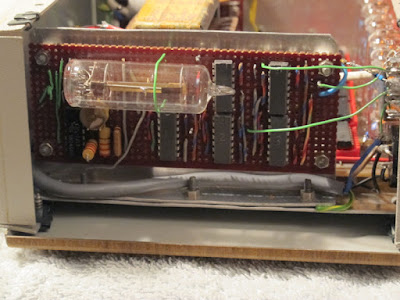
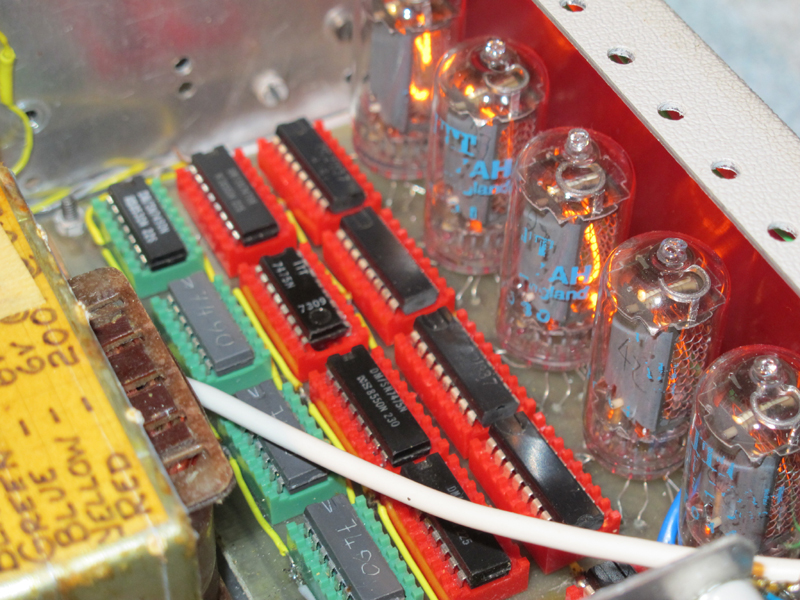
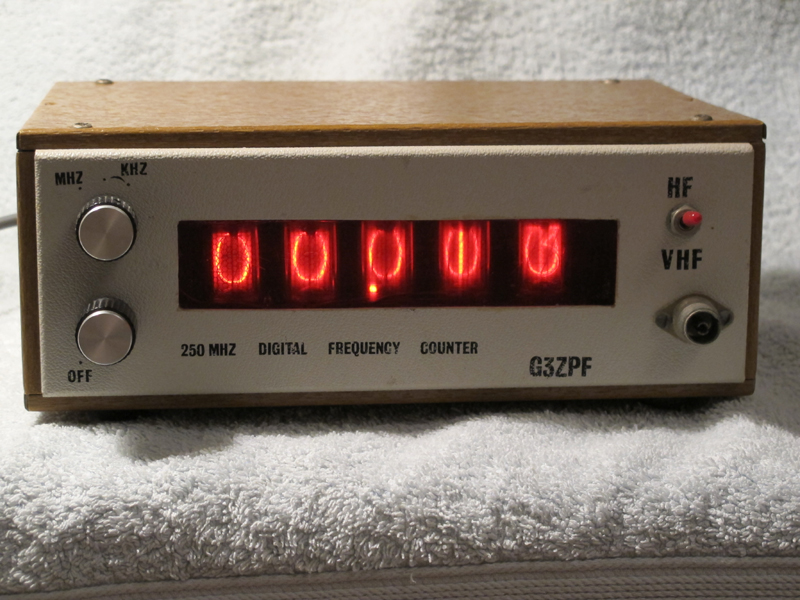
I remember spending a weeks wages (back in the 70’s) on a Fairchild
9H59DO prescaler chip for my TTL freq counter. Like you I hate chassis
bashing and the counter only went in a box after I’d had so many jolts
off the 150v rail to the nixie tubes I figured it was box-it or die 🙂

The circuit of the counter was ‘designed’ by me lifting the simplest
version of each part of the circuit from dozens of peoples designs &
just hoping it worked. By the time I’d finished I had learned enough to
know I was lucky it did work….and what a mess spilled Ferric oxide
makes on a pale grey bedroom carpet.


When GQRP first started up a bunch of us locals used to have a 10m net.
Primarily for ragchews but also to give the newly licensed types at the
club their first ever CW QSO on air. We were all sufficiently enthused
to build a 2w xtal controlled 10m CW TX. Using a 2n3819 in the PA & 2w
meant the matching was easy to 50 ohms.

We were all within a few miles of each other so 599+, so one guy built a
half-watt version. Still 599.

I decided to go for it. Grabbed my sig genny off the shelf. It had a 50
ohm output. Lightbulb moment. Set it to 1microvolt outputans keyed the
aerial with it. 539 all round, albeit with some chirp and drift. Well, it
was a valve sig genny.

1uV across 50ohms is qrpppppp. Thats when I realised the million miles
per watt is no challenge at all when radiating extremely low powers over
short distances.

Might be harder today though. Back then we could hear the receiver
noise floor on 10m. Not much chance of that now.

But I confess I was always far more interested in operating than
building. Never had the luxury of a workshop. Always tucked into the
corner of a bedroom. If I couldn’t hold it in one hand and drill it with
the other it couldn’t happen.

I remember hearing that Kennedy had been shot at the instant it
happened. I was on 20m listening to a pair of USA hams rag-chewing and
they both had the TV on. I rushed downstairs to tell my parents who told
me I was talking nonsense “or it would have been on the news”. Took a
couple of hours for it to appear on our TV news.

I used to love chatting to the USA novices on 15m CW back in the late
70’s. Some of those guys were real pros. You could hear them coming back
to your CQ while screwing the trimmers on their xtals to get co-channel.

I still treasure a letter I have from one youngster. It was his first
QSO outside the USA. He tells how his mom got so excited she ran into
the road telling all the neighbours her lad was talking to England.
…..yes the one in Europe 🙂

Life seems a lot more cynical these days.

Even to this day I find the concept of my voice turning into electrons
which throw themselves into space and sometimes hit another piece of wire
in another country and reproduce my voice genuinely ‘magical’. Sadly my
grandkids don’t ‘get it’. They’re happy with Skype, facetime, and TXT.

The closest they came to interest was the eldest grandson (at age 10)
saying “grandad, can I have that telegraph key when you’re dead?”.
Sensing my surprise he added “I’m not interested in morse, but it looks
kinda cool”. Now he’s 20. Bought his first apartment, and his first BMW.
Making his way in the world and glued to his iPhone.

It would be kinda nice to get back onto 160m AM, but sadly the
electrical ‘crud’ levels in the UK are S9+ down there 🙁

I spent 30 years in front of a TS930, which was able to produce proper
AM because where most rigs had one xtal filter it had pairs of them. You
slide the filters over one another to get narrower passbands for CW and
if you slide them past each other you can gget DSB or AM.

Thanks for taking the time to write your book. You’ve lived a very
varied and interesting life. I wrote a SciFi novel back in 1980 but at
that time there was only one scifi agent in the UK and she didnt like
it. Maybe I’ll get it onto kindle one day.

I was expecting a lot of free time in retirement, but between the 3
grandkids and my 94 yr old mom I have less time than when I was working.
But despite the dodgy knees and eyesight its the best job ever 🙂

Regards,

David G3ZPF
www.g3zpf.raota.org
www.raota.org

Waco Mighty Mite Mojo!

Eric: Wow, great news from Waco. JOO indeed! And I really liked the WAY you did it, liberating crystals and wire from old TVs. That definitely adds mojo to the Waco M^3. Bill

Hello Bill,

My name is Eric Melling KD0OXY. I have, as of tonight, officially passed selection for the CLA. My Michigan Mighty Mite began oscillating tonight between 1830 and 1900 CST and I am ecstatic about it! My foray into home brewing began mid-2011 when I obtained my general class ham license (I took Technician and General at the same time taking advice from my late grandfather). The first radio I ever purchased was the Pixie II kit and boy was that frustrating. I meticulously assembled the kit and worked very hard to stuff the transceiver, volume control, options to use the on-board key or a straight key, and maybe an on-board speaker or phones. But, to my chagrin, I was treated to the sweet wafting smell of the magic smoke long before ever getting on the air. I eventually did get on the air with my aforementioned grandfather’s VHF/UHF HT and until recently, this has been the extent of my Ham career.
But on the advent of my starting an MA in applied linguistics at a school in Dallas (hour and a half from home in Waco) and the rekindling of my electronics knack occurring near- simultaneously with my discovery of the SolderSmoke Podcast, I decided to give it another go. First, I got the old pixie kit to oscillate and then ripped it apart for parts to another project (non-radio). Then I procured a second Pixie kit from ebay and built that. It oscillated right away! Still no contacts; my CW is… improving.
All this to say that I still had an itch that wanted scratching Enter: The Color Burst Liberation Army! Not only could I truly build something from scratch, I could follow my true calling and de oppresso liber some crystal. So I pulled some 30 (or so) gauge magnet wire from an old CRT. I had wound and rewound my coil three times (and unfortunately, the third one looks the worst) for 80m then 20m (far fewer turns) and back to 80m with N’JOO (No Joy of Oscillation) in any configuration. I am using a polyvaricon pulled form an old AM/FM transistor radio, the Mitsumi PVC-2FX which has 82 pF, 140 pF, 20 and 40 pF sections which I have wired in parallel giving me ~0-282 pF of range? And finally, I was using a MPS A42 NPN transistor. I had to run some resistors in parallel and some caps in series to get the right values, but I eventually got it all together and looking pretty smart on a 1″ x 1.5″ piece of perf board. Alas! Nothing!
I was poking around at the circuit and realized that when I keyed the transmitter, the coil would get really hot right at the tap. I still don’t know why that was, but I figured it was a good sign as it meant something was happening. I also was getting plenty of pops and clicks on the receiver. Anyway, to make a short story long, I decided that the dark mark under the transistor was a bad sign, found an NTE 123 and plugged it in instead. And oh what a wonderful day to hear the first warblings of my very first all scratch built transmitter hitting the airwaves! And here is the video: https://youtu.be/yq2M1ryMkII
Probably more than you wanted to hear, but there it is. I do plan to build an SSB transceiver someday (hoping sooner than later). I feel you and Pete and your podcast have really set me out on the right foot! I hope to HB2HB with you soon!

Sincerely,
Eric KD0OXY

Psst… I know a guy with some caps…. Variable caps… Real beauties…. But only for Mighty Mites.

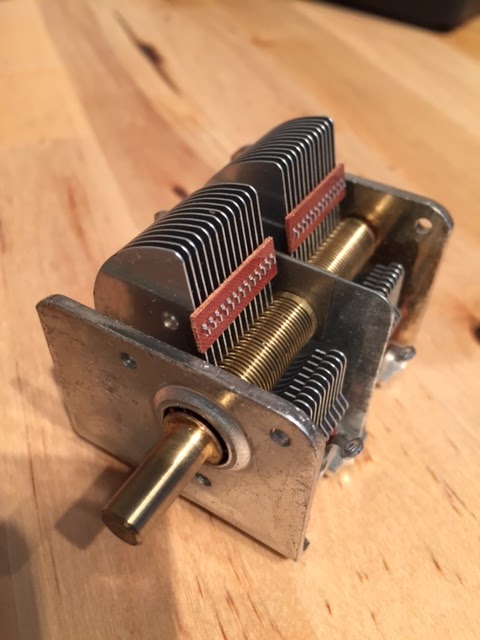
Feast your eyes my friends. That is 400 micro-microfarads of variable capacitance. (400 picofarads for you sophisticated young folks.) A benefactor interested in expanding the ranks of the Color-Burst Liberation Army has stepped forward to make us an offer that is hard to resist: He will send ELIGIBLE recipients one each of these fine electronic components for the cost of postage (approximately 6 bucks in the USA).

He has specified that ELIGIBILITY is limited to those who need this part to build or complete a Michigan Mighty Mite. And I have been appointed “Grand Poobah and Chief Arbiter of Capacitor Eligibility.”

So here is the deal: Send me an e-mail telling me about your planned or stalled Michigan Mighty Mite project. Include some information about your personal “Knack Story” — tell us why you share in this strange compulsion to build a largely useless 250 mW 3.579 MHz oscillator. If I find your plans believable and your Knack Story compelling, I will recommend you for a capacitor. Purely aspirational MMM projects and obviously fabricated Knack Stories will not make the cut.

Supplies are limited, so act now!

Haunted by the Gong (Ooooo that’s Awesome!) Donald’s Knack Story


Bill:

First off thanks for the wonderful podcast. I only just discovered it and I have loaded as far back as I can go on my Phone. I have been listening to it every waking moment. Though I fear that even at one or 2 a month no amount of commuting, dishwashing or bathroom cleaning will allow me to catch up with you.

I so identify with your idea of the Knack. I was forever taking things apart, my mom had to remove anything that could be used as a tool from her home for my first few years as even at age 2 I was into clocks, cabinets and basically anything that wasn’t nailed down. Until your podcast I hadn’t even heard of the International Geophysical Year, but discovered I missed it by only 3 months being born in March of 59. I do think though that those of us that were even a little knackish were encouraged on our way by the Space program.

Even though I grew up in Canada, I was riveted to the TV for every space launch, touch down or space walk. Many of my first memories are watching grainy broadcasts from Gemini and then on to Apollo. Even now I stayed up to watch the Mars rover land those few years ago.

Radio was always a special interest for me from the First Short wave radio I got from my grand father. I remember discovering WWV, BBC VOA and the Netherlands english language programming. This of course launched me into a frenzy of stringing wires higher and higher much to the chagrin of my parents. My poor dad that was an arts major didn’t know what to think of me.

I’d always wanted to get in to ham radio but the code requirement held me back. My dyslexia kicked me really bad. I had the little tapes from radio shack and I’d work and work but got no where. So i resolved myself to just shortwave listening.

I was laughing when you talked about your relationship with Regenerative Radios as one of the first radio projects I built was the “Science Fair Globe Parol Regenerative Radio” From radio shack. Here is a link to the thing http://www.ohio.edu/people/postr/bapix/rsglobep.htm I still have it at my mom’s house. The last time I put batteries in it it would at least get WWV. Which is no small feet when you realize I built it with one of those Weller Soldering Guns that you could reseal canned goods with. I’m sure if I opened it up now there’d be blobs of solder the size of Cicada’s in there.

I was just listening to Episode 147 where you were talking about the All American 5 tube radio. I must have tore down 20 of those things as a kid. Your Right they were dangerous as anything you could get. Most of them the chassis was hot if the plug was in wrong and there wasn’t like a fuse or any safety equipment in there to stop you from hurting yourself. Yes they were cheep and made so without a transformer, and all the tube heaters in series with the panel bulb for a bit of protection to prevent a surge on power up. But one other feature they had was that when they were originally produced there was still some DC mains power around and they would run if you put in the Plug the right way. My old electronics teacher claimed that you could run them off 3 45 volt batters on the Farm in a pinch. Though 19 40’s battery technology I’m not sure if that was a practical solution. Though In High School that’s what we had to learn. Learned to tune, debug and repair those puppies.

After high School I went into the phone company and later made my way as a lot of us Knackish people in to the computer/software industry. And low and behold after about 30 years they dropped the Code requirement and now living in the States I went out and finally got a license.

I just wish I had found your podcast sooner as I would have done things a little differently. However I have managed to do some serious kit building. I have built two TNC’s, one for the beaglebone and one for the Pie. I have built one softrock receiver and another Softrock emsamble RXTX that I’m just trying to figure out how to make work. I also built though it’s not really a kit a Kx3 that is my main HF rig.

I thought I was really interested in the computer radio connection but wow when I see what you have done with the BITX and the manhattan build I’m thinking I want to build a rig that maybe I can run some JT65 or PSK31 on. I know what you mean about the Phone and SSB but right now stuck in the city of Chicago my antenna space is limited and i’m surrounded by power poles so I have a lot of noise no matter what I do.

One thing I need to talk to your buddy Pete as in the left over spare time I have, between work family and radio I’m trying to complete the BSC that I never did during my misspent youth. But I’m stuck at the final project. I need something that needs some code and could be written up as a research paper I keep thinking there has to be a radio project here somewhere.

Anyhow that’s enough I’m sure you get lots of people with their stories but I thought a little of what I encountered might be interesting. I really appreciate the podcast love all the personal stories combined with the tech talk. Keep up the good work. I’m looking forward to getting current.

Donald L. Gover KC9ZMY

P.S. I have woken up twice as of late thinking I heard a Gong followed by “Oooo That’s Awesome” Maybe I’m listening a little to much 🙂
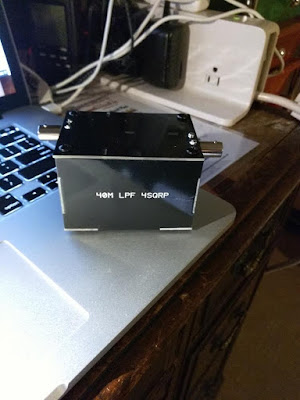
P.P.S Again catching up on the podcasts though my podcast listening time is a little reduced as I bought your darn book that’s very interesting! But I wanted to make sure that I did inform the Knackers Union, whom I believe that Steve Snort Solder Smith is the enforcement officer that I had already constructed my 40m low pass from 4 state QRP. I have provided photographic evidence of it’s construction and promise not to QRP on 40M without it.

Hardware Hacking by Nicolas Collins


David Cowhig WA1LBP and I are the only two Foreign Service officers to have also been 73 Magazine “Hambassadors” (impressive, right?). David was covering Okinawa for 73 (and for Uncle Sam!) while I was doing the same in the Dominican Republic.

Today David sent me a link to the book “Hardware Hacking” by Nicolas Collins: http://www.nicolascollins.com/texts/originalhackingmanual.pdf

It is not exactly about ham radio, but there is a lot of electronic wisdom in Mr. Collins’ book. You folks will like it. I especially liked the hand-drawn schematics — this adds soul to the book.

Nicolas Collins is an interesting fellow. He is Profesor, Department of Sound, The School of the Art Institute of Chicago.
https://en.wikipedia.org/wiki/Nicolas_Collins

http://www.nicolascollins.com/read.htm

November 2015 QST — Wrist Radios, Phase Noise, and a 1958 BITX!

A Early BITX

I liked this issue. Highlights:
Page 30. Glen Popiel’s article on the Arduino.
Page 33. I know this may come as a surprise, but in spite of my admitted Ludite tendencies, I found the article on High-Speed Wireless Networking to be very intriguing.
Page 38. Hey! Mike Aiello N2HTT has an article about an Arduino-based CW recorder. FB Mike!
Page 54. Review of LNR LD-5 QRP Transceiver. “The LD-5 is actually an SDR in a box with switches and knobs…” They give a phase noise graph.
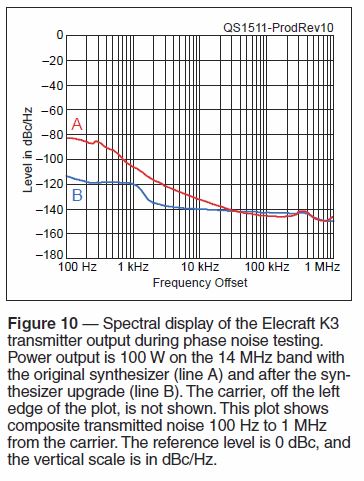
Page 58. Review of Synthesizer upgrade for the Elecraft K3. Uh-oh. Phase noise again. The review says the upgrade results in a reduction of phase noise, but the graphs seem to show an increase in transmitted phase noise on 20 meters as soon as you go 10 kHz from the transmit frequency. I guess this is a tradeoff for a larger decrease in close-in (less than 1 kHz spacing) phase noise? But if the objective on the transmit side is to deal with “a major problem with multiple operators in the same band segment in close proximity” resulting from transmitted phase noise, is this a good trade-off? Also, it would have been interesting to know if the reviewer could detect — by ear — any improvement in the received signal.

Wayne Burdick, N6KR, of Elecraft e-mailed us to let us know that there was an error in this QST article. The original graph in the article showed an improvement in phase noise at close-in frequencies, but it also showed a significant worsening of the phase noise beyond 10 kHz. THIS CHART WAS INCORRECT. The Upgrade does, in fact, improve the phase noise performance. A corrected version of the article appears here:

Here is the corrected graph:

Page 71. My nightmare. The WristRig. The Apple Watch on 40 meters. Sorry Steve, Dick Tracey did not have The Knack, and tackling the “Apple Watch challenge” is not an indication of “homebrew chops.” Software coding chops yes, but homebrewing is, for me, a different thing. (But, as we always say, too each his own… And thanks to Steve for the interesting article. )
Page 82. Ross Hull. Very interesting article, especially the part about OM Ross’s untimely death by electrocution.
Page 100. “The Cosmophones” by Joe Veras. Cool pictures (as always) from Joe. And I loved the first lines: “What in the world is a bilateral transceiver? Byron Goodman, W1DX, posed that question in his June 1958 QST review of the Cosmophone 35.” Wow, four months before my birth By Goodman was writing about BITXs in QST!

Civility, Ham Radio, King Hussein, and the International Brotherhood

Hi Bill,

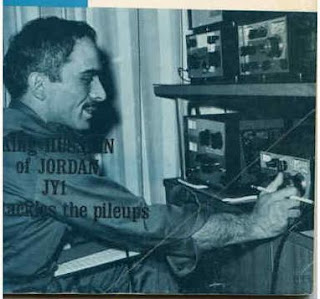
Interested to hear you talking about civility … My introduction to amateur radio was via a Heathkit GR 64 and Roy, G3PMX. When I finally took my ticket – 1970, and passed, I called him on the phone to tell him – he told me to come on up to his QTH, I did, via an old bike taking about 30 minutes to get up the hill. When I got there, he put me on the mike, the guy the other end was really great, talked about being a part of an international brotherhood and a movement for world peace – just a magical first contact …

Roy asked me if his call seemed a little odd, it did, it was short, JY1, but I was really slow to cotton on to who I’d just spoken to… What really blows me away to this day was that the King of Jordan sat in his shack and waited for a 16 year old kid to pedal up the hill just to give him a fantastic first contact … My only regret is that I never got to speak to him again to say “thank you” – when you talk about legacy radios, it isn’t the tech that we need to hold on to, though we do, it was what that man did to reach out to a fellow amateur.

By all accounts, he was a fantastic guy, he used to sit at Roy’s kitchen table drinking coffee and just being one of the guys … Sadly I was at sea by then hence not meeting him.

Roy knew him because he worked for Marconi & put the antennas on the palace, Hussein just appeared having that Roy was an amateur and they had a long conversation about radio – when he turned to leave, Roy asked his name so that he could stay in touch – Hussein told him to just ask for Hussein the radio guy – never let on that he was King …

Roy said that on several occasions, JY1 travelled to the UK more or less incognito and hired fairly innocuous cars to get about the country simply because he was here as an amateur, not a head of state …

I really do regret that I never got the chance to say “thank you” to him – it was the sort of gesture that I have always thought typifies what you have tried to support and continue, and is indeed carried on by the likes of Joe Taylor who once took the time to respond to an email from me explaining how to set a WSPR system up despite being Nobel Prize winner !!
Great example of the spirit of amateur radio transcending all else 🙂

73s, Nick, G8INE

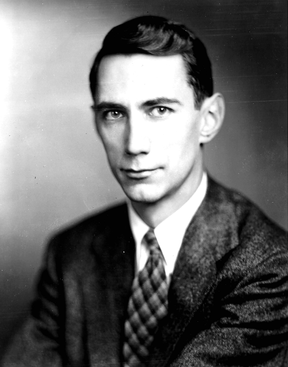
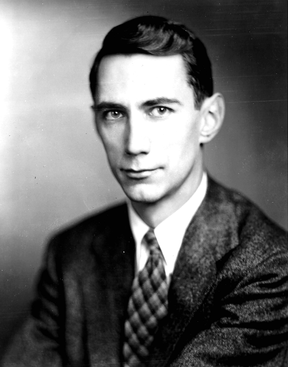
Claude Shannon had The Knack (video)

From Wikipedia:
Shannon showed an inclination towards mechanical and electrical things. His best subjects were science and mathematics, and at home he constructed such devices as models of planes, a radio-controlled model boat and a wireless telegraph system to a friend’s house a half-mile away. While growing up, he also worked as a messenger for the Western Union company.
His childhood hero was Thomas Edison, whom he later learned was a distant cousin. Both were descendants of John Ogden (1609–1682), a colonial leader and an ancestor of many distinguished people.

*************


And he he was part of a scheme to beat Vegas at the roulette wheel through the use of what may have been the first wearable computer:
http://www.engadget.com/2013/09/18/edward-thorp-father-of-wearable-computing/

An excerpt from that site:
After their initial meeting, Thorp says, “we got right to it,” and he spent about half his time for the next eight months working away with Shannon in that basement lab in Shannon’s house, on one of Massachusetts’ Mystic Lakes. In his paper, Thorp described the lab as a “gadgeteer’s paradise,” with what he estimated to be about a hundred thousand dollars’ worth of electronic, electrical and mechanical items. The regulation roulette wheel, ordered from Reno for $1,500, was set up on an old slate billiard table.
Thorp describes Shannon as the “ultimate gadgeteer,” and recalled in his paper that the man he met in that office was a “thinnish alert man of middle height and build, somewhat sharp-featured,” and that “his eyes had a genial crinkle and the brows suggested puckish incisive humor.” That humor would become evident as the two worked together at the house on the lake. Thorp wrote that Shannon taught him to juggle three balls, and that he rode a unicycle on a steel cable strung between two tree stumps. “He later reached his goal,” he wrote, “which was to juggle the balls while riding the unicycle on the tightrope.”

Our book: “SolderSmoke — Global Adventures in Wireless Electronics” http://soldersmoke.com/book.htm Our coffee mugs, T-Shirts, bumper stickers: http://www.cafepress.com/SolderSmoke Our Book Store: http://astore.amazon.com/contracross-20

Claude Shannon had The Knack (video)

From Wikipedia:
Shannon showed an inclination towards mechanical and electrical things. His best subjects were science and mathematics, and at home he constructed such devices as models of planes, a radio-controlled model boat and a wireless telegraph system to a friend’s house a half-mile away. While growing up, he also worked as a messenger for the Western Union company.
His childhood hero was Thomas Edison, whom he later learned was a distant cousin. Both were descendants of John Ogden (1609–1682), a colonial leader and an ancestor of many distinguished people.

*************


And he he was part of a scheme to beat Vegas at the roulette wheel through the use of what may have been the first wearable computer:
http://www.engadget.com/2013/09/18/edward-thorp-father-of-wearable-computing/

An excerpt from that site:
After their initial meeting, Thorp says, “we got right to it,” and he spent about half his time for the next eight months working away with Shannon in that basement lab in Shannon’s house, on one of Massachusetts’ Mystic Lakes. In his paper, Thorp described the lab as a “gadgeteer’s paradise,” with what he estimated to be about a hundred thousand dollars’ worth of electronic, electrical and mechanical items. The regulation roulette wheel, ordered from Reno for $1,500, was set up on an old slate billiard table.
Thorp describes Shannon as the “ultimate gadgeteer,” and recalled in his paper that the man he met in that office was a “thinnish alert man of middle height and build, somewhat sharp-featured,” and that “his eyes had a genial crinkle and the brows suggested puckish incisive humor.” That humor would become evident as the two worked together at the house on the lake. Thorp wrote that Shannon taught him to juggle three balls, and that he rode a unicycle on a steel cable strung between two tree stumps. “He later reached his goal,” he wrote, “which was to juggle the balls while riding the unicycle on the tightrope.”

Our book: “SolderSmoke — Global Adventures in Wireless Electronics” http://soldersmoke.com/book.htm Our coffee mugs, T-Shirts, bumper stickers: http://www.cafepress.com/SolderSmoke Our Book Store: http://astore.amazon.com/contracross-20