AA7EE Casually Kills a Direct Conversion Receiver, then Coldly Discards a Diode Ring Mixer

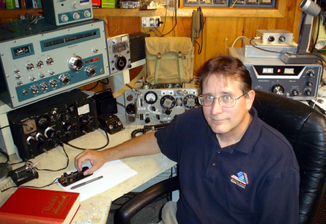
I was really glad to see that Dave AA7EE has — after a long absence — posted another article on his blog. The article has some great personal reminiscences about his involvement with direct conversion receivers. Here is one passage:

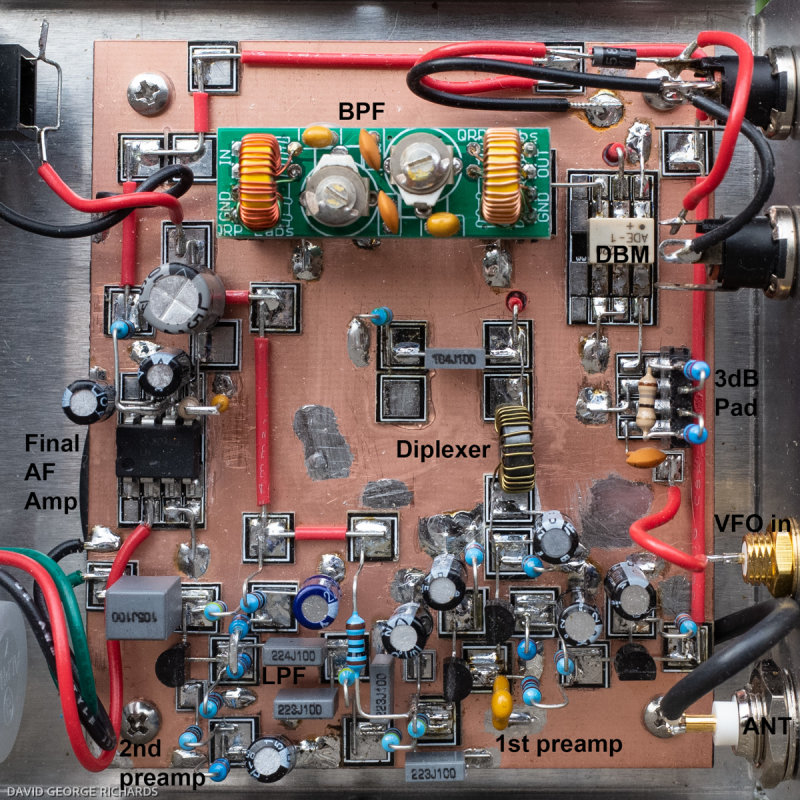
I spent many happy hours tuning around and listening on 80M with the DSB80. It was this first experience that cemented my affinity for direct conversion receivers built with commercially available diode ring mixer packages. It just seemed so simple – you squirt RF into one port, a VFO into the other, and (after passing the result through a diplexer) amplify the heck out of the result. The seeming simplicity of the process of converting RF directly to baseband audio has held great appeal for me ever since. Unfortunately, that project didn’t survive. One day, in later adulthood, in my apartment in Hollywood, I reversed the polarity of the 12V DC supply and, discouraged at it’s subsequent refusal to work, tossed the whole thing away. Now, I cannot quite believe that I did that, but it was during a long period of inactivity on the ham bands, and complete lack of interest. If only I could go back, and not have thrown it into the dumpster of my apartment building! Hollywood is ridden with recent notable history. My little double sideband transceiver met it’s unfortunate end just 100 feet from the spot where Bobby Fuller, of The Bobby Fuller Four, was found dead in his car, in 1966, the subject of a still unsolved mystery to this day. The death of my little DSB rig was a lot less mysterious. To think that I heartlessly tossed an SBL-1 mixer into a dumpster, is a mark of how far I had strayed from my homebrewing roots, forged in a little village in England. Now, a few years later, in a city known for it’s sin and excess, I had cruelly ended the life of a stout and honest diode ring mixer. I suppose I should spare a thought for the polyvaricon but, well, you know – it was a polyvaricon!

https://aa7ee.wordpress.com/2021/03/04/the-ve7bpo-direct-conversion-receiver-mainframe/

Jean Shepherd Goes to a Hamfest — And Much More

Here is something nice to listen to in your shack…

I hadn’t heard this one before. It is about Shep’s teenage trip to a hamfest, but it also about his youthful enthusiasm for ham radio and electronics. Many of us can identify with this very easily.

He talks about what must have been a very early use of “blue boxes” — the audio tone generators that allowed young miscreants (including the Woz) to make long distance phone calls for free. I wish I had gotten into this. It sounds like fun.

He talks about how painful it was to be on phone (AM phone) with just 2.5 watts homebrew, when everyone else was running a lot more power.

And wow, they played a baseball game at the hamfest. Phone guys vs. CW guys.

I won’t spoil it by telling you the results of the hamfest raffle.

EI7CLB’s Ladybird Receiver (George Dobbs Design), and Voice over the Internet

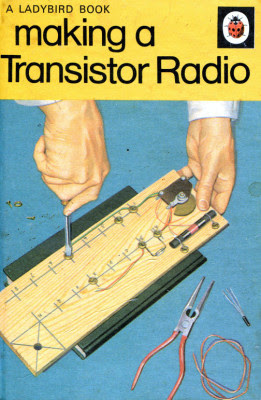
I suggested that Tryg once again gather the parts to build George Dobbs’s Ladybird receiver. He should use the same wooden base. That would be great.

As for VOIP, I told Tryg that SolderSmoke got its start in a VOIP program called Echolink — Mike KL7R and I used to converse from London to Alaska. Mike recorded one of our conversations, and that became SolderSmoke #1. I was using VOIP even before that — from the Dominican Republic in the mid 90’s I was connecting my Radio Shack 2 meter HT to an early VOIP program Internet Phone or I-phone. The company that made it was an Israeli firm called Vocaltech.

—————————
Hi Bill,

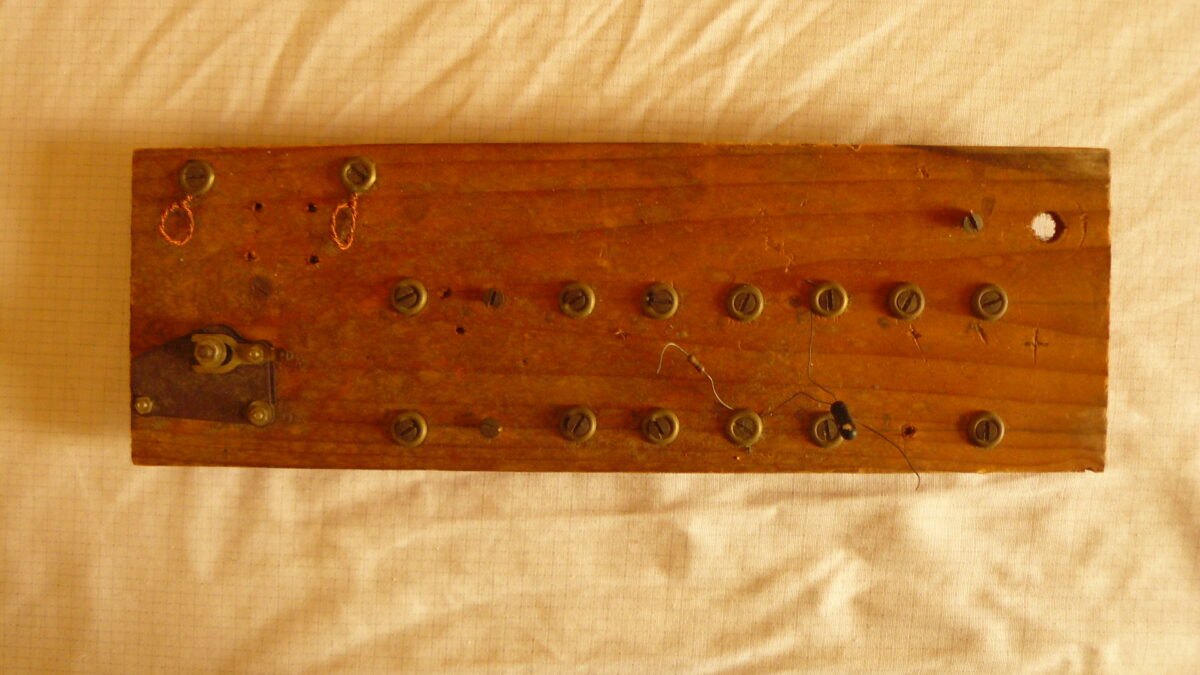
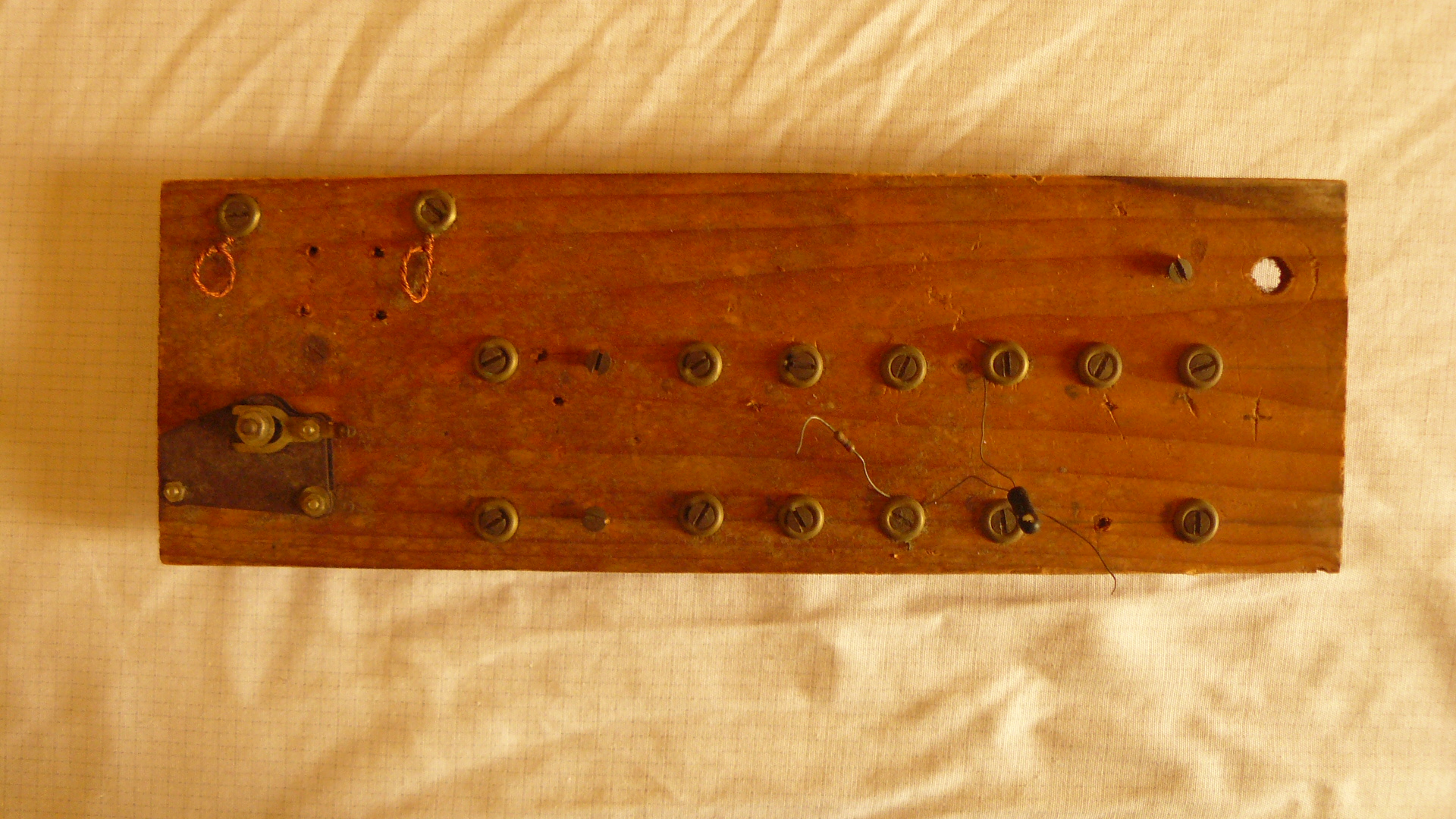
Thanks for the recent emails and podcasts. I have attached a picture of my first radio – or at least what is left of it. I plundered it for parts down through the years as you can see. It is the build from the late Reverend George’s “Making a Transistor Radio”, the Ladybird book that really put the hook in me all those years back. I was probably only 11 when my late Grandmother and I went to Dublin by train (300 mile round trip) to Peats of Parnell Street to buy what components my pocket money could afford in order to build the first couple of stages of the radio, The wooden base was cut for me by a worker at a local furniture making factory here in Galway. He got a great laugh out of it when I told him I was going to build a radio – he kept putting the wooden blank up to his ear and joking: “I can’t hear anything yet!”. I will always remember it.

On another front I wanted to thank Pete and yourself for an entertaining and informative couple of podcasts. I made the leap a couple of months back and bought a set of boards for a uSDX (W2CBA version) but I may just use it as a receiver if I ever get around to building it. I don’t know yet. The kit that Pete mentioned in episode #228 really got me excited. I expect you can imagine that my imagination is running riot at the moment.

Finally, I would be interested to hear about your take on half duplex VOIP apps such as Peanut. I realise that it is not ‘real’ radio to many but I have enjoyed several contacts with operators around the world with it and it has been quite satisfying. These ops that I have spoken with have often been infirm, elderly or have mobility issues. There are also a couple that are under HOA restrictions. One OM in particular lives in a retirement village and is a full-time carer for his wife. I think it is a good thing that they can still be involved in radio without all of the physical demands it might make on them or annoying their neighbours. It might, at least, it might be a worthwhile topic for discussion. Thanks again for an excellent Podcast. BTW, I am a bit of a guitar nut too – is that a Stratocaster that Pete is holding in the picture on the Soldersmoke Blog Page?

Right ho, time to put the kettle on. Tea is a vital component for operational efficiency in my radio world!

73,

Tryg de EI7CLB

Bootleggers! Radio Criminality — Some Jean Shepherd Stories

Thanks to Adam N0ZIB who alerted me to Shep’s Cincinnati story about the stolen AM broadcast station. I then found another YouTube video that had that story, but preceded by an even better tale of ham radio bootlegging.
Adam found his story on this fantastic YouTube channel — a collection of Shep stuff:

Thanks Adam. 73 and EXCELSIOR!

James West, Inventor of the Electret Mic, has THE KNACK

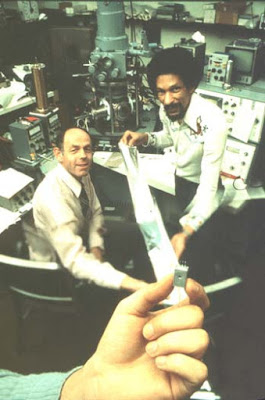
James West (r) with Gerhard Sessler (l) Bell Labs 1976

https://hackaday.com/2021/02/17/james-west-began-40-years-at-bell-labs-with-world-changing-microphone-tech/

For many reasons, this is a really nice story. It is about a kid with The Knack, a kid who, like young James Clerk Maxwell, wanted to understand how things work. It is also a technology story, the story of the invention of a device very important to us: the electret microphone. (Remember the earlier carbon mics in telephones? I’ll bet more than a few of our readers are guilty of stealing a few of those mics from pay phones.) And it is a reminder of the benefits of helping kids who might need a mentor… or and Elmer.

Thanks Hack-A-Day. And three cheers for James West.


Jenny List’s Favo(u)rite Things

Over on Hack-A-Day Jenny List (G7CKF) has a really nice article about ham radio and homebrewing. She truly has The Knack: She got her start in radio electronics at age 9 when her parents gave her George Dobbs’s Ladybird book.

https://hackaday.com/2021/01/21/a-few-of-my-favorite-things-amateur-radio/

One of her paragraphs really seemed to capture the SDR-HDR conflict that we so often joke about:

The age of the homebrew RF tinkerer may be at a close, at least in the manner in which I started it. Nobody at the cutting edge of radio is likely to be messing around with discrete transistor circuits in the 2020s, unless perhaps they are working with extremely exotic devices up in the millimetre wavelengths. It’s all software-defined radios, opaque black plastic boxes that deliver a useful radio experience on a computer but that’s it. No more homebrew, no more tinkering.

Whew, good thing I’m not on the cutting edge. It sounds kind of sad. Oh well, that leaves more discrete transistors for us to tinker with.

Jenny’s Profile on Hack-A-Day:

[Jenny List]: Contributing Editor and European Correspondent

Jenny List trained as an electronic engineer but spent twenty years in the publishing industry working on everything from computer games to
dictionaries before breaking out and returning to her roots.

She grew up around her parents’ small farm and blacksmith business in rural England, so making (and breaking) things is in her blood. Countless projects have crossed her bench over the years, though these days you’ll find her working with electronics and in particular radio, textiles for clothing and costume, decrepit classic cars, and real cider from first principles.

When she’s not writing for Hackaday she works on language corpus analysis software, designs and sells amateur radio kits, sits on the board of Oxford Hackspace, and is a freelance electronic design engineer and programmer.

Thanks Jenny!

STOP. LISTEN. Shep on Building a Shortwave Receiver

Oh man, how could I have possibly missed this one? Perhaps I didn’t, but even if this one has been on the blog before, it is so good that it is worth repeating.

Shep really captures the frustrations and joys of a teenage radio builder. I could really identify with this. It all reminded me of my heartbreaking effort to build the Herring Aid 5 receiver.

So much cool stuff in this 1963 recording:

— The wonderful smell of radio service shops.
— The terrible shirt and tie choices of radio service guys.
— The truly dire consequences of mistakes in published schematic diagrams.
— The AGONY of not being able to get a homebrew radio to work.
— The JOY when you finally do get it to work. Shep’s “whole life changed” when that happened.
— Hugo Gernsback, Lee DeForest and “unscientific scientists.”

As the YouTube video plays, they show several covers of old Short Wave Craft magazines. At one point they show some homebrew phone rigs. I think they look like my wooden box BITX rigs. And the front panels are clearly Juliano Blue. TRGHS.

Here is the 1933 Oscillodyne article that launched Shep’s effort:

EXCELSIOR!

Our Editorial on the U.S. Election

In our last podcast we took a few minutes to share with our listeners our views on the U.S. election and who we think they should vote for. Here is the text of what we said. We stand by every word.

————————————-

Just days before a very important U.S. election we feel obligated to express our opinion and to let our listeners in the U.S. know who we think they should support.

Some of you will think this is inappropriate — we disagree. Several of the long-running and more recent themes of SolderSmoke are wrapped up in this election:

SolderSmoke is all about global community, the International Brotherhood of Electronic Wizards. Trump just rejects the idea of global community. He is all about building walls, imposing travel bans, rejecting refugees, circling the wagons, and blaming our problems on foreigners. This is one of the reasons we oppose him.

SolderSmoke is all about Science and Technology. Trump is anti-science. He is a climate change denier. That’s another reason we oppose him.

Speaking of science, since the onset of the pandemic we have been urging SolderSmoke listeners to protect themselves, their families, and their communities by following the advice of doctors and scientists. We urge them to socially distance, and to wear masks. We even invented an acronym in support of this — SITS – “Stay In The Shack.” Incredibly, Trump has been pushing in the opposite direction: He ridicules the use of masks. He calls our leading doctors “idiots.” He stages super-spreader events at his rallies and at the White House. Look, more than 200,000 Americans have been killed by this thing. I know five people who have buried close relatives. Yet Trump STILL treats this virus as some sort of political hoax. This is one of the many reasons we oppose him.

We are both military veterans. We have both been offended by the way Trump — who is a draft dodger himself — has disparaged those who have gone into harm’s way for the United States. We remember what he said about John McCain. His scorn for veterans and service members is another reason we oppose him.

There are many other reasons to oppose Trump, but those are the ones we feel are most relevant to SolderSmoke.

Election day is Tuesday. PLEASE, for the good of the country and the world, get out there and vote against Trump. Wear your mask and stay safe as you do so, but get out and vote. Especially if you are living in Florida, North Carolina, Georgia, Pennsylvania, Wisconsin, Michigan, Arizona, Texas, or Omaha, Nebraska, please help vote Trump out of office and please urge your friends and relatives to do the same.

Wisdom from AA0ZZ: NO LIBRARIES! ASSEMBLER CODE ONLY! — “Digital Crap” — “No Magic Fruit” What qualifies as a real rig? Si570 vs. Si5351

Bill,

Why do you guys make your Soldersmoke podcasts so darn intriguing such that I can’t listen to them in the background while I’m doing something else? Good grief! I start listening and before long you make me stop and chase down a rabbit hole to find something new that you mentioned that I had no clue was out there. Before long I’m doodling out a new sketch or playing with at a new design for something I really need to experiment with or build “next” or something I need to try. It is taking too much of my time!! J

I’ve been listening to your podcasts for years. Way back, before I knew you and before I knew you were doing these Soldersmoke blogs with Mike, KL7R, and just before he was so tragically killed, I was collaborating with him on a simple frequency counter project using a PIC microcontroller. We were making good progress on a neat design. I later completed the project but always kept his contributions noted as part of the source code.

I’ve been making PIC-based VFOs for years – dating back to about 2000 – aiming them at builders who were looking for something to go along with Rick Campbell’s (KK7B) receivers. Rick is a good friend now, after we met in the Kanga booth at Dayton where we both were demonstrating our stuff. (Bill Kelsey (N8ET) of Kanga, was the “marketer” for my kits as well as Rick’s for many years.) My original VFO kits used a DDS (high-end AD9854) that simultaneously produced I and Q signals which made it perfect for Rick’s phasing gear. Rick is a big supporter of my work but he still kids me about polluting his beautiful analog world with my “digital crap” (copyright KK7B term). When I came out with a newer version VFO using a Silicon Labs Si570 PPLL (I can hear already Pete Juliano groaning) it was a big improvement over the AD9854 in noise/spur reduction. I documented this all in a QEX article in about 2011 and Rick (and Wes Hayward) were very supportive/appreciative of my work.

I have used the Si5351 also and I understand Pete’s point of view. It’s “plenty good” for most amateur projects. However, it remains a fact that the Si570 is a better part and produces a cleaner signal. That’s the reason why the Elecraft KX3 uses a Si570. Granted, the newer Elecraft KX2 uses a Si5351 but it’s most likely because they wanted to preserve battery life (the Si570 uses more power but not nearly as much as the AD9854) and also to reduce the cost. I do understand! I also fully understand the ability of the Si5351 to produce I and Q signals via different channels. I’ve had extensive conversations about this with Hans Summers, at Dayton and online. I use a pair of Flip-Flops on the output of the Si570 instead. My PIC code driving the Si570 is ALL written in ASSEMBLER code. Yep! I’m an EE but have had a career mainly in software development and much of it was writing assembler code. I dare say there aren’t too many gluttons for punishment that do it this way. I do it because I want to understand every line of code don’t want to be dependent on anyone else’s libraries. Every line of code in my VFO’s and Signal Generators is MINE so I know I can debug it and it can’t get changed out from under me. (This problem bit Ashar Farhan hard on the Raduino of his BitX. Tuning clicks appeared because the Si5351 libraries he used changed between the time he tested it and released it. I was really appalled when I dug into this and resolved to NEVER use libraries that I didn’t write myself. Similarly, this also makes me have some distaste for Arduino sketches. I would rather see ALL of the code including the initialization code, the serial routines, etc, rather than having them hidden and get pulled in from Arduino libraries. That’s similar to the reason why Hans Summers didn’t use an Arduino in his QCX. He used the same Atmel microprocessor but developed/debugged it as “C” code with the full Atmel IDE/debugger.

By the way, Pete mentioned the Phaser FT8 transceiver by Dave, K1SWL, in a recent podcast. Dave is a very close friend, even though I haven’t met him in person since about 2000. We Email at least daily and some of it is even about radio. J I did the PIC code for the tiny PIC that controls the Si5351 in the Phaser. Yes, it’s written entirely in Assembler again! I do know how to do it for a Si5351. That Si5351 code is not nearly as much “fun”, though. I know, this will make very little difference to guys who write Arduino “C” code to control it but under the covers it’s a world of difference. It takes me about 15 serial, sequential, math operations to generate the parameters for the Si5351. None of them can be table driven and they all have to be performed sequentially. (This is all hidden in about 5 lines of complex, Arduino “C” code but the operations are all there in the compiled assembler code.) In contrast, my Si570 code is almost all table driven. I just have to do one large (48-bit) division operation at the end to generate the parameters. Yes, that’s a bit of trickery to do in ASM. There are no libraries do this.

I will point out one more advantage of the Si570 in comparison to the Si5351. It has the ability to self-calibrate via software instead of relying on an external frequency standard. In my Si570 app I can read up the exact parameters for the crystal embedded inside the Si570, run my frequency-generating algorithm “backwards” and determine the exact crystal frequency (within tolerances, of course) for that particular Si570. Then I update all the internal tables using that crystal frequency and from then on all generated frequencies are “exact”. I love this! Frequency often moves by about 6 kHz on 40M.

Oh yes, I must mention the difference of home solderability of the si570 vs the Si5351. Those little Si5351 buggers are terribly difficult to solder at home while the Si570 is a breeze. I know, many folks will just buy the AdaFruit Si5351 board and it’s already soldered on but, again, I like to do it all myself. No “magic Fruit” for me.

Now that I retired a couple of years ago and am getting out of the VFO kitting business I can finally build complete rigs instead of just making the next-generation VFO’s for everyone else to use. I recently build a tiny, Direct Conversion rig with a Si570 signal generator (of course) and a diode ring mixer (ADE-1). Look at my web page, www.aa0zz.com to see it, along with my VFO projects that I’ve been building in the past. As you well know, Direct Conversion is fun to build and the sound is astounding; however, they are rather a pain to use! Yes, I did make it qualify as a real rig by making several contacts all over the country. (Wes Hayward gave me the criteria: he told me that I must put any new rig on the air and make at least one contact before it qualifies as a real rig.)

The new rig that’s on my workbench is my own version of a phasing rig, experimenting with a Quadrature Sampling Detector (QSD, sometimes called a “Tayloe” mixer), using some ideas from Rick’s R2 and R2Pro receivers and many innovations of my own. At present my new higher-end Signal Generator works great, the QSD receiver works great (extremely quiet and MDS of -130 dB on 40 meters) and the transmitter is putting out about 16 watts with two RD16HHF1’s in push-pull. You can take away my “QRP-Only-Forever” badge too, not that I’ve ever subscribed to that concept! Still more tweaking to do with the TX but now I’m also working on the “glue” circuitry and the T/R switch. The SigGen, RX and TX are all on separate boards that plug into a base board which has the interconnections between boards and the jacks on the back. I’ve built DOZENS of variations of each of these boards. Fortunately they all fall within the size limit criteria to get them from China at the incredible price of $5 for 10 boards (plus $18 shipping) with about 1 week turnaround. Cost isn’t really an object at this point but it’s more of getting a hardware education that I sadly missed while I concentrated on software for so many years. it’s certainly nice to have willing mentors such as Rick, Wes, Dave (K1SWL), Don (W6JL) and many others to bounce my crazy ideas off. Yes, I’m having a ball!

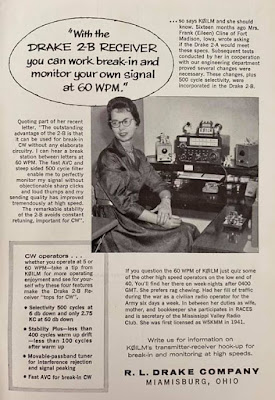
I was licensed in 1964 but out of radio completely from 1975 to 1995. Do you like the picture of my DX-100 on my web page? My buddy in the 60’s had a Drake 2B and I drooled over it but couldn’t afford one.

Now I must finish this rig before you guys send me down another rabbit hole. Too many fascinating things to think about! I literally have a “priority list” on the my computer’s desktop screen. Every time I come up with a new project idea – something I really want to play with such as a Raspberry Pi, SDR, etc, I pull out the priority list and decide where it fits and what I want to slide down to accommodate it. That’s my reality check!

Take care, Bill. Thanks for taking the time to give us many inspiring thoughts and ideas.

73,

-Craig, AA0ZZ
Knack Story — Tom WX2J

RTTY Model 15

Hello Bill,
Greetings from a fellow ham in Northern Virginia. I have enjoyed the SolderSmoke podcast for a few years now, and I just heard your recent presentation to the Vienna Wireless Society. We have a lot in common so it is about time I reach out to make your acquaintance.
I was born in NYC and grew up in Northern NJ. I was first licensed in 1969 as a high school student (51 years ago! Goodness!). My novice callsign was WN2JFX, and I progressed from Novice and then to General and Advanced as WB2JFX, and then eventually to Extra (in about 1990 — while the 20 WPM code requirement still existed). At that point I put in for a 2X1 callsign and received WX2J, which is a nice twist on my original call.
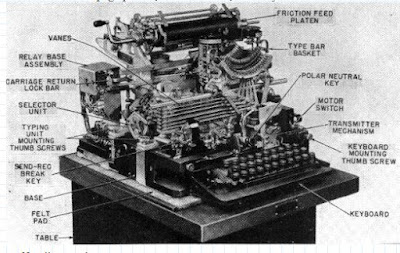
I was fanatically active in my early years in ham radio. My Elmer (George, K2VVI, SK) set me up with a DX-40, and my parents provided a brand new Hallicrafters S-120 (you could copy the whole 40 meter band without changing the frequency!). I think I Worked all States as a Novice and learned that the human brain is the most amazing audio filter on the market. When I made General, George lent me an old Hallicrafters SX-25, and then I was really in good shape. Besides CW, I was also very interested in RTTY. I had my own Model 15 leaking oil in the basement and had a blast watching the magic of that thing printing messages out of thin air. I have always been a home-brewer, and one of the first serious things I built was a two- or three-tube RTTY demodulator from the Handbook. Aluminum chassis, chassis punches, tube sockets — the whole works. I have no idea what the real inductance was of the inductors that went into the filters but somehow if the signals were strong enough, and on 850 Hz shift, it could actually demodulate signals. I probably still have that thing around here somewhere.
Another local ham bequeathed me his entire collection of 73 magazines – 10+ years starting with the first issue (~1960). I read them from cover to cover so many times I probably have them memorized. I became a real fan of Wayne Green, W2NSD, who was always ornery and controversial but a very interesting guy. I met him at a hamfest many years later and we had a great chat.
In any case I wanted to mention some other things that resonate with me as I listen to your podcast. As a kid growing up in the shadow of NYC in those years, you can bet that the Jean Shepherd broadcast was a regular part of our life. My dad used to listen to it every night — 10:15 p.m. I believe, on WOR — and we both used to greatly enjoy his stories of lighting up the fuse panel and nearly blowing up the house as he and his old man were playing with radios, etc. It was a common theme in our house too when my ham radio signal would blast into the TV set or I dangled new antenna wires off the house and out of the trees — “You’re going to blow this house up!” I studied electrical engineering in college and was commissioned in the Air Force upon graduation. I served a 20-year career in the Air Force and stayed somewhat active in ham radio. I was licensed and operated out of Okinawa (KA6TF) and England (G5ERE) during tours of duty in the early 1980s. Always an HF guy, in about 1982, in Japan, I bought myself a new Icom IC-720A, and this is still my primary rig. I was an early adopter of PK-232 and did some extensive building and experimenting with it. Sadly though, in the last 25+ years, my ham radio experience has mostly been vicarious as my work and family obligations have just not left much time for ham radio. I do have a G5RV wire antenna strung up but very rarely jump on the air — sometimes during contests.
In high school we made a field trip to ARRL HQ in Newington, CT. While there we did all the things people do on such a visit, but one of the high points for me was meeting Doug DeMaw. I can just hear how Shepherd would describe it — “I turned the corner and there he was! In person! The high priest of homebrewing! Doug DeMaw. In the flesh!” Cue the kazoo. I actually also met Shepherd at a book signing (Wanda Hickey’s Night of Golden Memories?). I remember presenting him with a computer-printed banner of his callsign — K2ORS — produced by one of the few functioning computer programs I had written in high school. I also heard him on the HF bands one night — I think he was in Florida — and actually made contact with him, if barely being able to exchange callsigns can count as a contact.
Well, more than you wanted to know. I just wanted to let you know that I enjoy your podcast and can personally relate to very much of what you say. Although I am steeped in Hardware Defined Radio, I am also a software guy so I expect that my future includes SDR. I hope you and Pete are able to continue the podcast for a long time to come because I need the full HDR-SDR spectrum to be covered — hi.
73,
Tom Fuhrman, WX2J

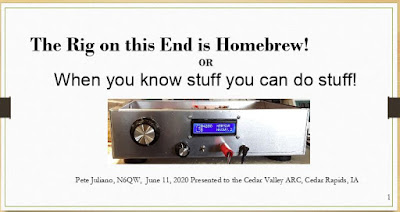
Pete Juliano’s Presentation to the Cedar Valley, Iowa Amateur Radio Club (Slides)

Earlier this month Pete N6QW spoke via Zoom to the Cedar Valley, Iowa Amateur Radio Club. This was an especially appropriate venue for Pete, the creator of the KWM-4; Cedar Rapids was the long-time home of Collins Radio. Many of those in the club used to work for Collins.

Here is Pete’s PowerPoint presentation: http://soldersmoke.com/N6QWslides.pptx

Some notes on the event:


For the Zoom connection, Peter used his Linux Mint computer.
Pete mentioned that Gene Senti, while tinkering in his basement, developed the KWM-1. One of the guys in the audience confirmed Pete’s account, but added something: Collins employees could buy ham gear at a discount. Senti bought a brand new 75A4 receiver (commercial price in late 50s was about $900) and he modified it from being just a receiver into a transceiver. Imagine taking a new radio and doing that! But when he got it working, Art Collins came over to his home to see the invention. The rest is history.
Pete got grilled a bit on why he was still using “analog’ front ends on his several SDR builds — why not Direct Digital Conversion? Pete says he may now try to build a DDC rig.

There was also a lot of very nice feedback on the SS Podcasts – there were many regular listener’s in that group.

You can see Pete’s slides here:

http://soldersmoke.com/N6QWslides.pptx

Dilbert, Shep, Dex, Pete, Farhan, and Wes! N2CQR Presentation on Homebrewing to Local Radio Club

Dean KK4DAS asked me to speak to our local radio club, the Vienna Wireless Society. It was a lot of fun. I talked about my evolution as a homebrewer, some of the rigs I made, the moments of joy, and the tales of woe. You can watch the presentation in the video above.

I was really glad to be able to explain in the presentation the importance of people like Pete, Dex, Farhan, Wes, Shep and even Dilbert.

I was also pleased to get into the presentation the N2CQR sign that Peter VK2EMU made for me. Thanks Peter!

Here is the URL to the YouTube video (also above):
https://www.youtube.com/watch?time_continue=3414&v=VHSr-v4QO7Q&feature=emb_logo

And here are the PowerPoint slides I used:
https://viennawireless.net/wp/wp-content/uploads/2020/06/VWS-presentation-Rig-here-is-homebrew.pdf

Listen to Homebrew-to-Homebrew Quarantine Contact with Glenn KU4NO on his 37 year-old Homebrew SSB Transceiver

This was really amazing. I had been feeling guilty about not getting on the air much during quarantine. I mean, we have these airwaves and we have the gear, right? Shouldn’t we be more social, more friendly and get on the air more? I tried yesterday with marginal results (conditions were poor). I called CQ on 40 SSB this morning — nil, except for one grumpy guy who said I was splattering on his morning coffee clatch. Then I heard KU4NO calling CQ. I did not recognize the call. But when I told him I was on a homebrew transceiver, he matter-of-factly sad that he too was on a homebrew rig. When he started to describe it (see below), it all came back me. His is one of the most soulful of homebrew SSB rigs. And I realized that it may also be THE OLDEST HOMEBREW SSB RIG STILL IN USE IN THE WORLD. (If anyone knows of a homebrew SSB transceiver older than 37 years and still on the air, please let me know.) This was exactly the kind of contact that I needed. TRGHS.

Glenn put out a lot of homebrew wisdom. He said a lot of inspiring things. (He did also at one point talked about wanting to shoot his plasma TV, but that’s understandable.) So I recorded most of our contact. (I have his permission to put it on the web).

You can listen to our contact via the YouTube video above.

For my report on an earlier contact with Glenn click here:
https://soldersmoke.blogspot.com/2018/07/a-rig-with-maximum-soul-5-band.html

So, it is worth it to get on the air. They are rare, but people like Glenn are out there, running very interesting rigs. And when you find them, you feel like you’ve hit the jackpot.

Thanks Glenn!


Other Kinds of Knack: Woodwork Wizard! (video)

This guy has some amazing tools, and even more amazing skills. I find it inspirational to occasionally take a look at other kinds of workshops. Check it out. Video above.

Along similar lines, the young Englishman Leo was in Washington state with his girlfriend when the lock-down and travel bans kicked in, so his work on Tally Ho (and his videos) continue. See:
https://youtu.be/zXV0ywqj7zY

SITS! or Stay in the wood-shop!

The Woz on Technology, Surplus Parts, Intercoms, and Ham Radio

Thanks to Dan Random for alerting us to this. During the first five minutes Woz talks about being an “electronics kid” and becoming a ham radio operator. For me also, wired intercoms were a precursor to ham radio.

More SolderSmoke blog posts on Steve Wozniak here:
https://soldersmoke.blogspot.com/search/label/Wozniak%20–%20Steve

Boat Knack — Rebuilding a 1910 yacht “Tally Ho”

https://www.youtube.com/channel/UCg-_lYeV8hBnDSay7nmphUA

I present this as part of our occasional series on people with other kinds of Knack. The young Englishman in this series of videos is definitely in this category. Watch him acquire the 1910 yacht “Tally Ho” for 1 pound sterling, transport it to Washington state, SINGLE HANDEDLY build a boat shed around the huge vessel, and carry out the restoration. Oh yea, all the while shooting videos of his work. Great stuff.

I advise you to watch the series from the beginning. The next video in the series will load automatically.

Be sure to subscribe the channel.

Thanks to Ryan Flowers of https://miscdotgeek.com/ for alerting us to this.

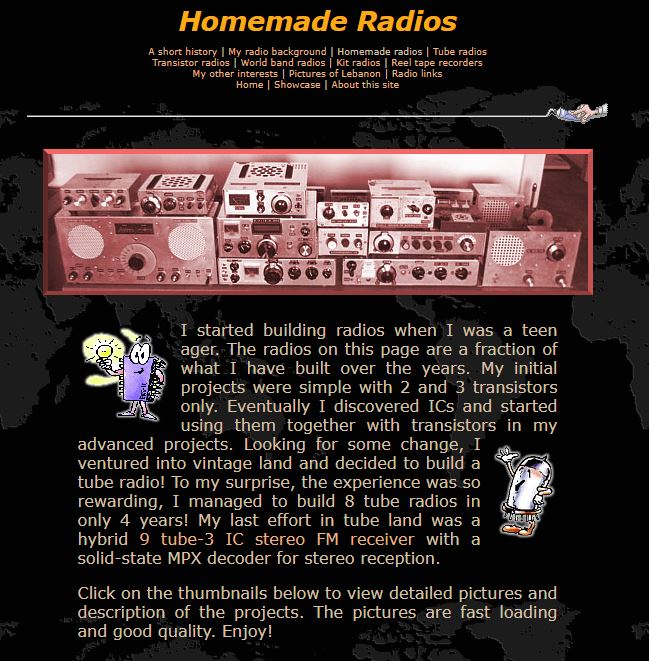
Lebanon’s First Radio Website

I found this site through Paul VK3HN. He took the AM detector circuit for his AM receiver from one these Lebanese homebrew radios.

There is some really great information on this wonderful website. It has been online for some 20 years — I wish I had found it earlier. The author shares his Knack story — this is a wonderful example of the International Brotherhood of Electronic Wizards (IBEW).

http://www.midcenturyradios.com/index.html

And he has very cool schematics, really well done. Click on image to enlarge:

Mike WU2D on QSO Today with Eric Guth 4Z1UG

Eric Guth has a great interview with homebrew and boatanchor guru Mike WU2D.

Listen here:

https://www.qsotoday.com/podcasts/WU2D

Wow: “My receiver was from a Sherman tank.”

His story about getting in trouble after “borrowing” his friend’s callsign was really great.

I also liked his wise comment about how anyone who homebrews simple gear will collect some “wallpaper” from official observers and the FCC. Mike is right: we shouldn’t get too concerned about minor transgressions. If we do, we run the risk of becoming so careful, cautious, and fearful that we never BUILD anything.

There is a wonderful discussion of the Paraset.

Mike coins a term that we might want to add to the SolderSmoke lexicon: RetroQRP. (Over to you Steve Silverman. Your call OM.)