National Dial and Gearbox Problem Resolved

Thanks to all who offered advice and assistance. With help from you guys — and especially from Pete Juliano N6QW — I think I have this fixed.

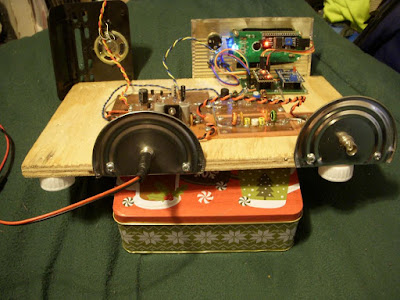
Pete was right — the problem was really with the variable capacitor. The one I was using was kind of stiff and irregular in its motion. I found another one in the junk box that was easier to turn (it has one set of ball bearings). This fixed most of the problem.

I also spent more time making sure the shaft of the cap lined up perfectly with the shaft of the gear box. This also helped a lot.

I realize now that some of the “stickiness” that I occasionally feel while tuning may be coming from the dial — not from the gear box. It looks like my dial took a hit that slightly bent one portion of it. It seems that the numbers have a bit of trouble clicking over on that portion of the dial. Some lubricant may help there. But I can live with it.

The receiver now tunes very smoothly and I can go right back to a frequency and find the signal exactly where I left it. There does seem to be a very slight difference depending on whether I “approach from above” or “approach from below” — but this is not a big deal.

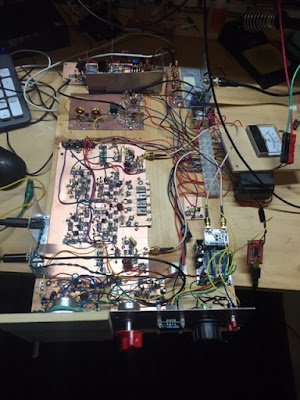
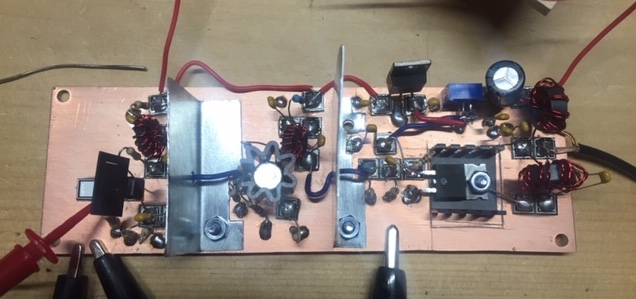
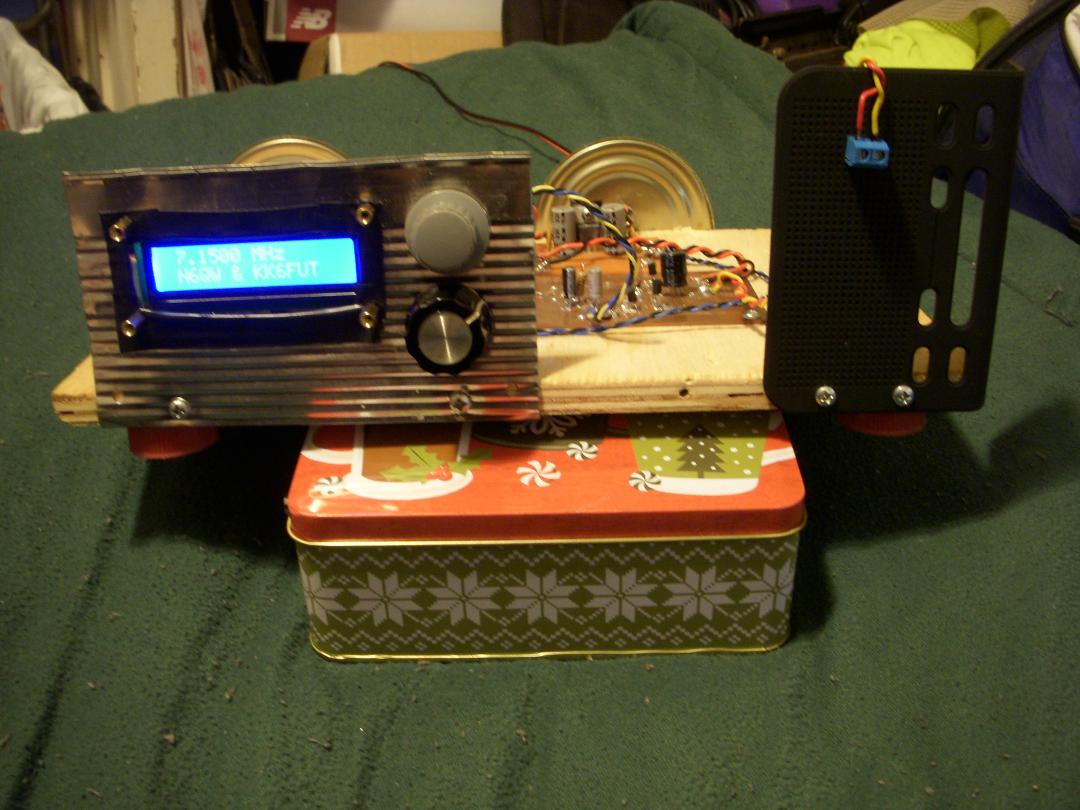
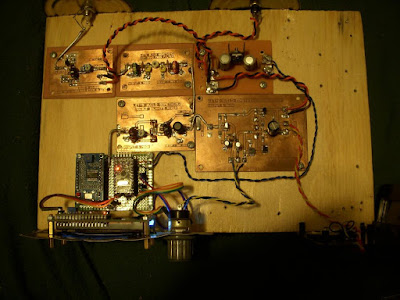
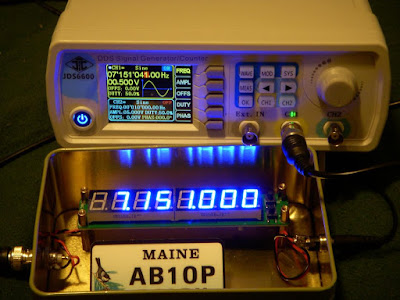
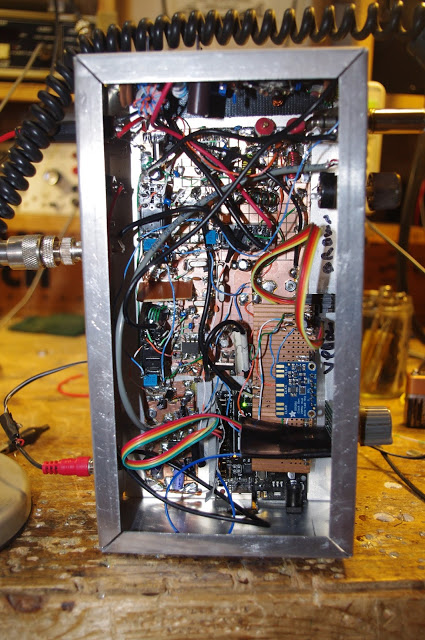
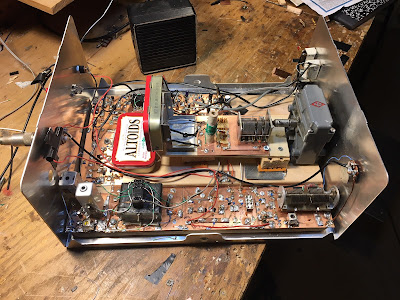
Check out the pictures of the receiver and the VFO. Note the “cardboard from a coat hanger” coil form. The winding is held in place with nail polish varnish. I had planned on having the variable cap, the coil , and the associated fixed caps all in a box for better thermal stability, but the VFO is very stable even without the box. I have the VFO running 455 kc ABOVE the signal frequency. It runs from about 7455 kc to about 7800 kc. I could have set it up to run 455 kc BELOW the signal freq. That would have made it a bit more stable (it is easier to attain VFO stability at lower frequencies) but VFO is so stable that I probably won’t mess with it. I followed DeMaw’s rules: Physical stability, NP0 caps. For the NP0 caps, put several of them in parallel to get the desired capacitance value. Keep heat-producing active components away from the coils and caps.

Thanks again to Armand WA1UQO for giving me this amazing piece of radio history. And thanks to Tim Sutton for the big box that holds this receiver.

James Millen knew what he was doing. See: http://www.isquare.com/millen/millen-page.htm
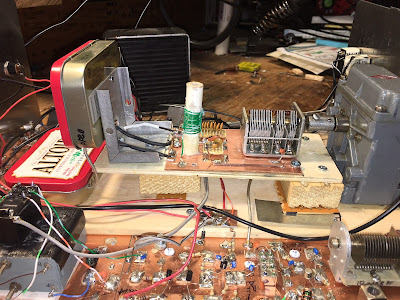
KC1FSZ’s Peppermint III Homebrew BITX with Mods


Hi Guys:

I had some time over the holiday to finish off my second scratch-built rig. I am very thankful that I got the work done on these projects before I read Pete’s “Don’t Build It” diatribe. That would have been very demoralizing. 🙂

Scratch build #2 (called Peppermint III) is still fundamentally BITX although I’ve made changes this time around. I’ve switched to ADE-1 mixers with LO ports driven by adjustable gain buffers (ala N6QW LBS). I’ve noticed that performance can be improved a lot if you can buffer/tweak the LO levels of the VFO and BFO (particularly carrier suppression on TX). I did W7ZOI TIAs in the IF chain. I’ve also taken the shielding/layout of the finals more seriously and have been able to dial up the power a lot (I did the KB1GMX thing with cutting off the drain pin on the IRF510 and using the tab). The software is also greatly improved and now supports LSB/USB modes as well as software-driven PTT control for RTTY/FT8 and the hooks for my poor man’s panadaptor. I’ve been working lots of stations on QRO.

Total build time was about three months (half the time of #1) and the layout came out much smaller than before. I made a trip over to Williams/Sonoma after Christmas and picked up the 2018 edition of the Peppermint Bark candy tin on discount and I think I can make it all fit. More to follow …

Happy New Year and 73s,


Bruce KC1FSZ


W7RLF Homebrews a Receiver — FB!


Ryan W7RLF has joined the small and elite group of radio amateurs who have homebrewed a receiver. And it is a receiver filled with soul, juju and mojo; the project was inspired by Wes Hayward and Farhan, and used components from Hans Summers. Congratulations Ryan and thanks for all the work you did in documenting your experience.

Who will be the next intrepid ham to join the homebrew receiver club?

Hello Sirs!


This month I read Wes Hayward’s post on the history and heritage of DC receivers in ham radio and it brought a lingering interest to a head. I had to build one. I run the BITX40 and uBITX group on Facebook, and I posted to the other hams there: Which DC receiver should I build? Farhan recommended his DC40. Mind you, I’ve never homebrewed a radio before, so this is all new territory for me.

I did build it, and it does work. It also uses QRP Labs stuff from our friend Hans Summers. This thing has a lot of QRP heritage 🙂 I documented it every step of the way including all of my dumb moves and things I got wrong, and my desire is to inspire others to try homebrewing the way Wes, Farhan, Hans, and you YOU GUYS have inspired me to try it. I am hooked, of course! Here’s a link to my blog to Part 1:


It’s a four part series (unofficially 5 really) with 8000 words to it, and I hope you guys enjoy it and I’d be ticked pink if was worthy of mention on your show. Here’s a video of it too:


73 to you both and I wish you the best!

Ryan Flowers W7RLF

SolderSmoke Podcast #208

SolderSmoke Podcast #208 is available:

http://soldersmoke.com/soldersmoke208.mp3

15 December 2018

Pete and the California fires
Bill goes to Brooklyn
2 meter simplex
A return of the trivial electric motor
Audio from Mars
HF Conditions — a real mixed bag

Pete looks back at 2018 — The Year of the SSB Transceiver — Lessons Learned

Hans Summers, the QSX and the virtues of SDR
W7ZOI’s DC Receiver Retrospective
The 1972 Solar Flare and the Vietnam War

SHAMELESS COMMERCE: Buy your gifts through the Amazon link to the upper right.
Consider SolderSmoke the book as a gift. Visit Pasta Pete’s for cooking ideas.

Don’t Build It! Sage — but unexpected — advice from Pete.

Straight Key Night approaches.

Book Reviews:
–“What is Real?” (Quantum Physics)
— RHdb by K6LHA.

Movies
“Bohemian Rhapsody”
“First Man” (Not yet!)

MAILBAG:
Steve G0FUW
Ed KC8SBV


Pete N6QW Rejuvenates the Atlas Twins with an Arduino and an Si5351

Pete Juliano N6QW has turned his attention to the Atlas Twins, a nice single conversion multiband rig. Pete has used an Arduino/Si5351 to replace the analog oscillators in the old Atlas. This improves stability and allows for USB/LSB operation.

Pete very graciously kept the old analog circuitry in the rig, allowing the Atlas to be returned to its pristine analog state at some time in the future. Pete also made some very kind comments about the surprising stability of the original analog oscillator circuitry.

Check out Pete’ site for more details:

http://n6qw.blogspot.com/2018/11/2018-year-of-ssb-transceivers.html

Ralph AB1OP — A New Receiver (with Mojo) and A New Acronym (with Attitude)

Bill and Pete,


😀 Completed the wiring the LBS Part I (pics attached)
I’ve said wiring completed but, it’s not really done. lt will need some peakin’ & tweakin’ and I already have made design changes to the power board.

My Summer Project took ALL Summer, had the usual excuses with Summer activities, family obligations, interruptions and days of just plain goldbricking.

At last all the LBS Part I boards were laid out, etched, populated, soldered and installed. As a novice Toroid winder it took a while to get the toroids done. (I had to do THREE DBM Transformers to get two to match.)

Some features of note:
1. Extensive use of the recycle bin for front / rear panels and feet. (Tin can and bottle caps) Go Green!
2. Extra Mojo was induced with using the 10K pot Farhan supplied with my first Bitx40 Kit that I did not use, (I replaced it because I could not find knobs for 4mm shafts back then)

3. Junk box speaker (8 Ohm – 0.5 W) from a cheap radio alarm clock my Mom threw away after it stopped working.

4. Use of the RG405 coax for interstage RF connections. (No Murphy’s Whiskers)

😞 My tale of woe. Apparently after connecting the LBS Part I stages together I put the AD9850 module back in it’s socket upside down — then applied power, Awaiting the replacement. HIHI

😜 SITB or Stick-It-To-Bezos. Again this month my Ham stuff budget was blown on an Amazon order (replacement AD9850 modules being not cheap anymore). I started at the soldersmoke blog web page search bar so there should be a little something heading to your North Virginia QTH from Jeff.

73,
AB1OP_Ralph

“The Thrill That’ll Hit Ya…” AGAIN! Three cheers for Pete, SPRAT, and GQRP

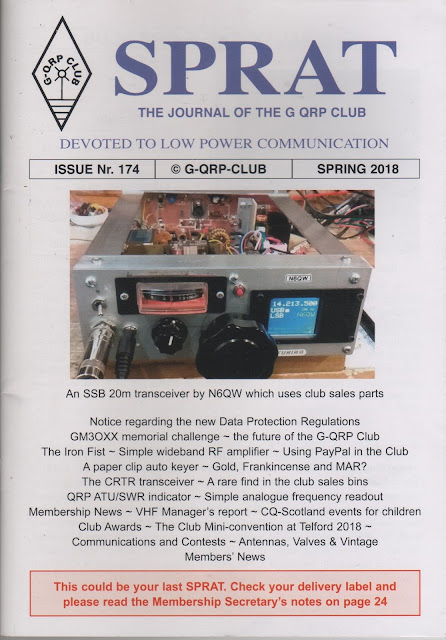
On the cover of issue 173 of our beloved SPRAT magazine they had my little Direct Conversion receiver. We joked on the podcast about the old song by Doctor Hook about getting on the “Cover of the Rolling Stone.” Well, on the cover of issue 174 they have one of Pete’s magnificent creations.

Thanks again to the guys who put so much work into SPRAT magazine. They are now looking for some help. Please subscribe, and check out page 4 of issue 174 for details on the help that GQRP is looking for.

SolderSmoke Podcast #201 Santa, Storms, BUILDING A DC RX, SDR, uBITX

SolderSmoke Podcast #201 is available: http://soldersmoke.com/soldersmoke201.mp3

9 December 2017

Santa Juliano

Forest fires, snow storms, and an earthquake.

Santa arrives from Hyderabad — uBITX in the house.

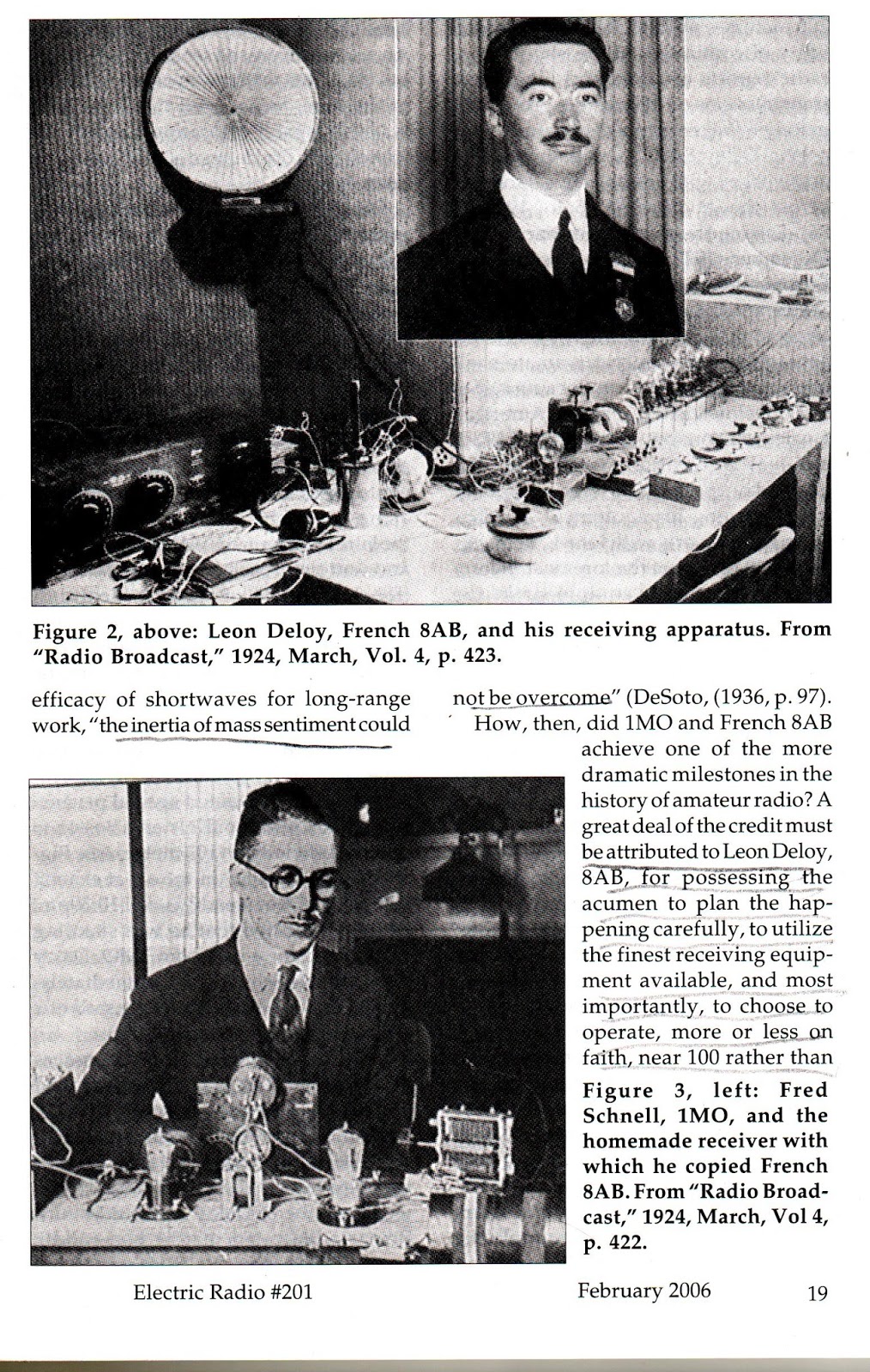
Radio history. First transtalantic amateur contacts.

Bill’s International Brotherhood Ceramic Discrete Direct Conversion Receiver Project.
— Goals — Build your own receiver. Really. From scratch. No cheating.
— How to get started. Get parts and tools.
— Stage by stage.
— VFO first — maybe build two.
Bill built two already
— Nephew is testing the first one.
— Polyvaricon limitations.
— Varactor limitations
— Variable cap limitation.
MEETING THE JULIANO STABILITY CRITERIA

Understanding the F5LVG mixer

Pete goes to the dark side with an SDR receiver.
Pete’s 800 Watt Amplifier gives him trouble. TRGHS.

People in the News
Cliff Stoll — Still Passionate about Electronics
Peter Parker — VHF/UHF By the Bay
Yardley Beers — Early SSB with “The Black Rose”
John Kraus — Moonbounce without the Moon.

MAILBAG


Discrete Ceramic 40 Meter Direct Conversion Receiver in Action (Video) — BUILD THIS THING!

I’ve been holding off on making this video until I improved the stability. N6QW is vigilent! I only did this video after certifying that it meets the Juliano Stability Criteria. I had to dispense with the polyvaricon and go with an air variable.

We will be talking about this on the SolderSmoke podcast next weekend. I hope to put on the blog a stage-by-stage discussion of how to build this receiver.

The dial from HI8P and the knob from a SW receiver that Elisa gave me definitely add soul to this new machine.

JOIN THE RANKS OF THE TRUE HOMEBREW RADO MAKERS! BUILD A RECEIVER! BUILD ONE OF THESE!

Videos of iPhone Box DC Receiver

These are just a couple of short videos that I made for my nephew before sending him this receiver.

As you can hear, deafness is not a problem with this design! I did make some frequency stability improvements after this video was made — I think you can hear a bit of drift. Still, not bad for a very simple circuit using a polyvaricon superglued to the back of a cardboard box.

I’ll post more videos of the second version of this receiver. There are further improvements in frequency stability. My goal: “Juliano Si5351” levels of stable-ness.

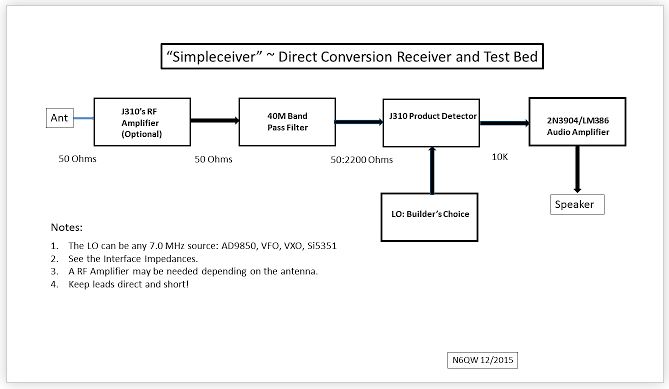
The Return of Pete’s Simple-ceiver Plus (and a possible analog option)

Winter is approaching ladies and gentlemen, and it is time to think about radio projects. Bob N7SUR suggested a direct conversion receiver project. I think this is a great idea. As a kid, I had fallen victim to the idea that building receivers was “too hard” for radio amateurs. Not true! DC receivers to the rescue! Carry on with the DC revolution first launched by Wes W7ZOI in 1968.

Pete N6QW is providing guidance and tribal knowledge via his blog. For those of you who want to join the ranks of those who have defied the conventional wisdom and have broken through the “receivers are too hard” barrier. I say build yourself a DC receiver. Build it from scratch. Many of you already got your feet wet in homebrewing with the Michigan Mighty Mite project. Now it is time to jump into a DC receiver project.

You folks already know what kind of VFO Pete will prefer: It will be an Si5351. That’s fine. But I will try to keep the banner of discrete component analog ludite-ism flying high. This morning I ordered a batch of 7.37 MHz ceramic resonators. I hope to pull them down into a significant portion of the 40 meter phone band. If this works, I will share the batch with anyone who wants to joining my Analog Army (remember the CBLA?). Note (above) that Pete has magnanimously left open the possibility of using a non-digital VFO. What a guy!

Check out Pete’s project here:

http://n6qw.blogspot.com/2017/08/a-new-line-of-transceivers-difx_19.html

“So You Want To Build?” Words of Wisdom from Pete Juliano


Everything on Pete’s blog is worth reading, but this article was so good that I could not resist posting a link to it here.

Tribal knowledge from a leader of the homebrew tribe:

http://n6qw.blogspot.com/2017/08/a-new-line-of-transceivers-difx.html

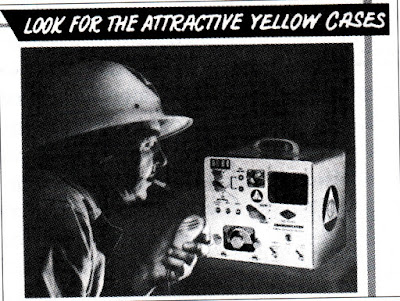
Yellow Fever! The Cold War Origins of Juliello

How could you miss them? That yellow was bright! Apparently you needed high visibility to cope with the looming danger of nuclear annihilation. The operator in the ad is obviously calm in the face of Armageddon — note the cigarette dangling from his lips. In this 1956 Gonset ad we can see the inspiration behind what — many decades later — has emerged as the avant-garde ham radio color scheme known as Juliello. The roots of this aesthetic are clearly not in the psychedelic “Mellow Yellow” hippie era. No, this color has harder, more flinty origins.

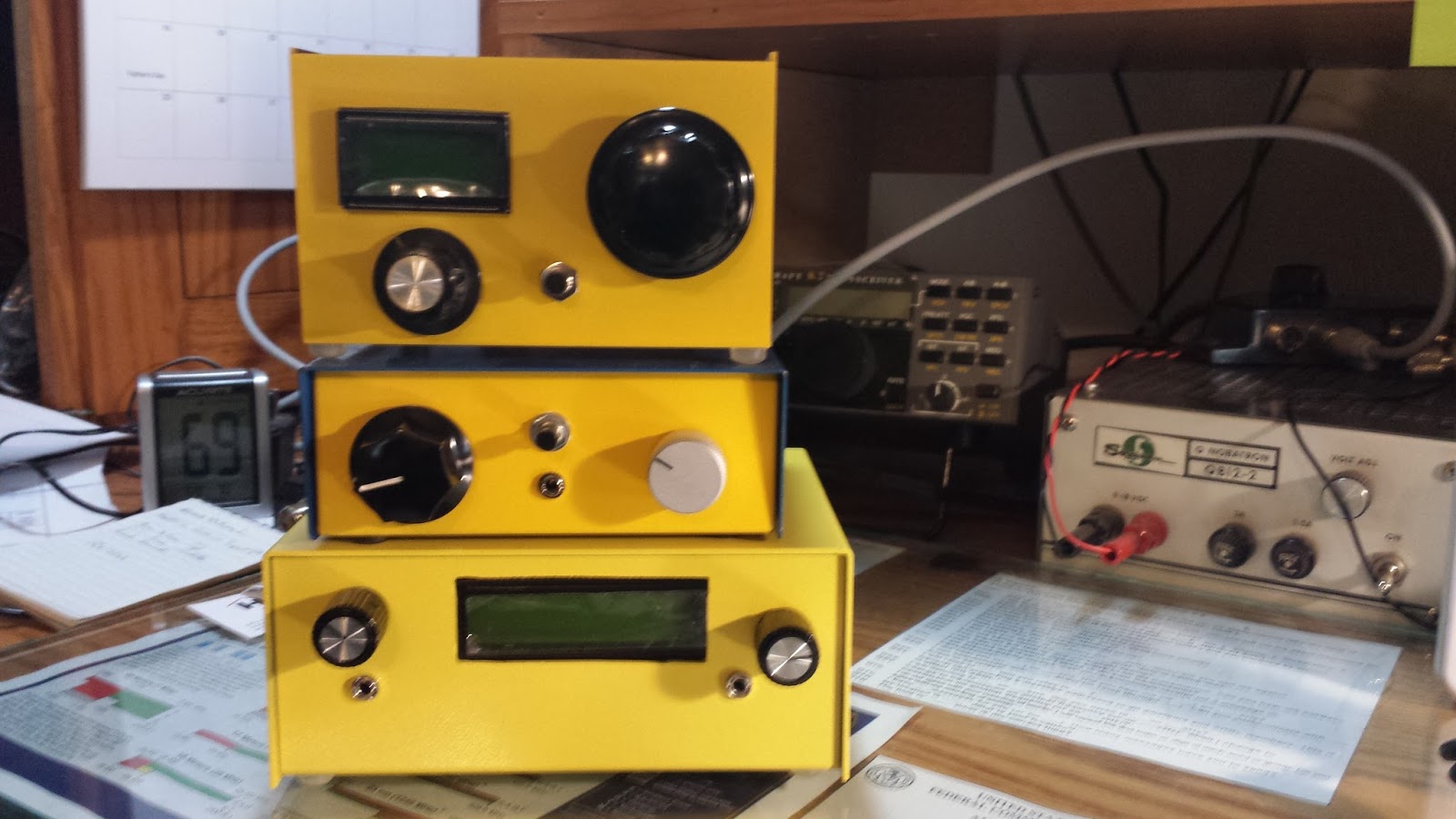
Pete Juliano is not the only one to embrace this look. Podcast #198 elicited this response from our friend Armand WA1UQO:

Pete:
Don’t let that Meara guy give you a hard time over the yellow Rigs. The last three of mine have been yellow and I’m happy to see I’m not the only one with good taste. In the picture they are from top to bottom a 30M One Watter, a 20M One Watter and of course the BITX 40. The 20M does have a Juliano Blue cover though to give it an extra bit of class! As always, enjoyed the podcast.
Bill, see you at Berryville?
73, Armand WA1UQO


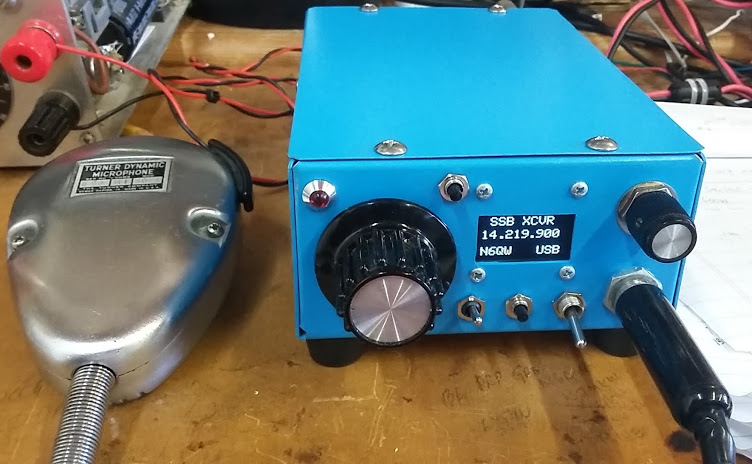
The Possible Inspirations behind “Juliano Blue”

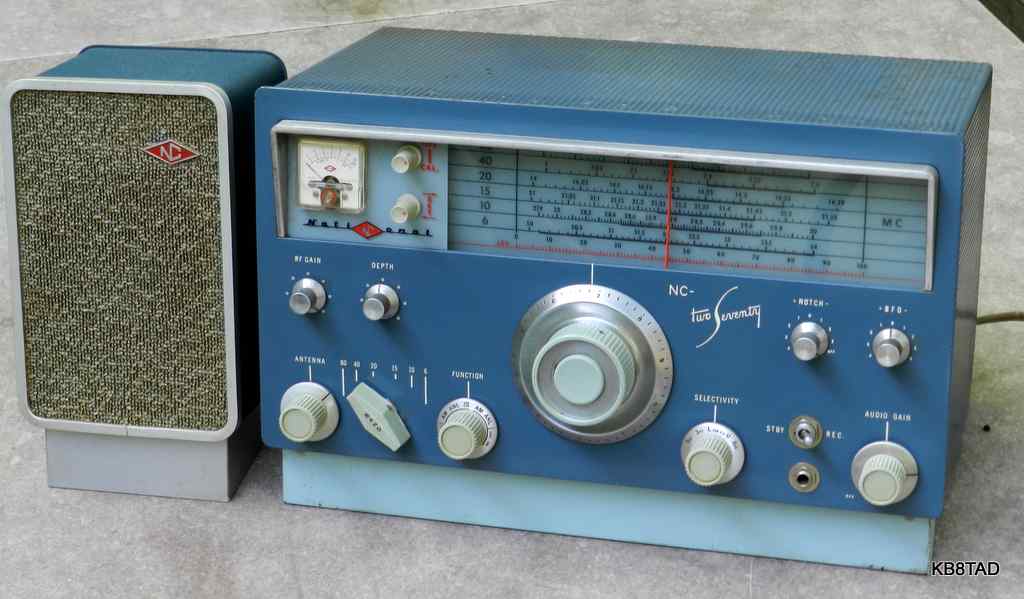
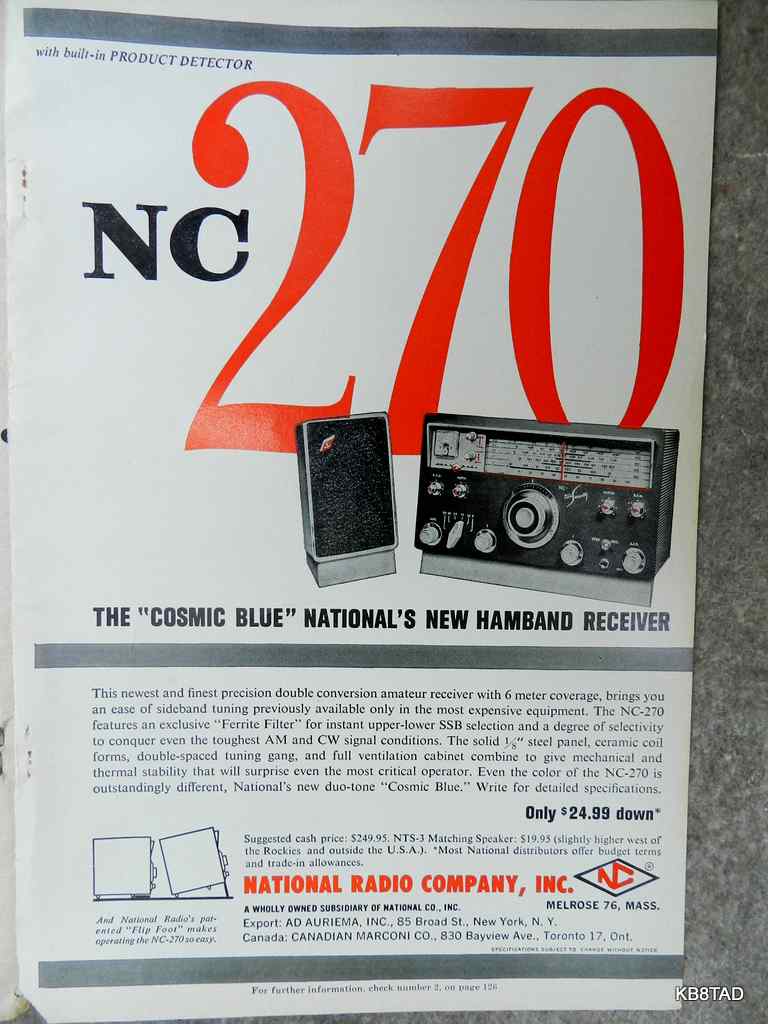
Close in color don’t you think? Dave Ishmael WA6VVL noted the NC-270 receiver’s color was “Cosmic Blue.” Indeed, National noted the unusual color (“outstandingly different”) in its advertising. This now-rare receiver was produced between 1960 and 1964, so it could have influenced Pete. Of course, the CK-722’s color could also have played a role…

BTW, shouldn’t we ask Pete to get out his guitar and give us some “Juliano Blues”? We need some music to go with the paint.

My Organic Chip Rig with an LTSpice Schematic

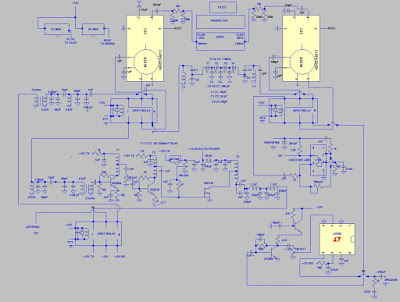
CLICK ON IMAGE TO ENLARGE

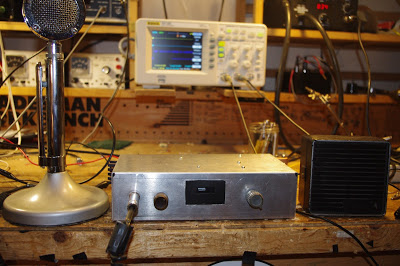
This is a rig that came together through a process of Spontaneous Construction. It started out with an innocent effort to get an Organic Light Emitting Diode display to work with an Si5351/Arduino combination. Then I figured I’d make a superhet receiver with it. Then Pete said I should make it a transceiver.

Most of my earlier transceivers so closely followed the schematics of Farhan or others that it didn’t really make sense for me to prepare a new schematic. This one was different. So I decided to prepare a proper schematic. I tried a few of the free-ware CAD or drawing programs, but each of them had a learning curve at the entrance. So I turned to LTSPICE. I have already climbed that learning curve.

The results appear above. Click on the image to make it bigger. I’m sure there are errors in there. And I think some of my parts choices might be less than optimal. But it works well.

The filter was deigned with the help of AADE software.

The idea of using two NE602s with a filter between them came (I think) from the Epiphyte.

The band pass filters were designed with ELSIE software.

The RF power chain is mostly from Farhan’s BITX40 module, with the pre-driver and driver modified for a bit more gain. Farhan’s amp is the most stable power amplifier I have ever used. It hasn’t given me any trouble, even at 20 Watts. Strongly recommended.

The microphone amp is derived from the 741 op amp circuit used in the (in)famous Wee-Willy DSB rig.

The receiver AF amp also comes from Farhan’s BITX40Module.

Please let me know if you spot errors or have suggestions for circuit improvement.

A link to the .asc LTSpice file appears below. Perhaps some brave soul more skilled in LTSpice than I am might want to turn this drawing into an actual simulation. Some of the parts (like the NE602s) have actual simulated components behind the drawings. Others (like the relays and the LM741 and LM386) are just drawings. But go ahead and flesh this thing out. Who knows, it might come to life in the PC and start making QSOs on 40!

Here is the .asc file: http://soldersmoke.com/NE602 Rig.asc

The Transistor! 1953 Bell System Film — Great Stuff!

Thermatron fans beware! There is some trash talking of tubes in this 1953 Bell film. But there is also a lot of recognition of the contribution made by our beloved valves. I especially liked the report on the historic 1915 phone transmissions from Arlington, Virginia. ( I drive past the transmitter site every work day). FIVE HUNDRED TUBES combined to send the human voice from Arlington to both the Eiffel Tower and to Pearl Harbor, Hawaii. FB OM! 59!

I was disappointed, however, that this film failed to recognize another momentous 1953 achievement in sold state electronics: In that year, 11 year-old Pete Juliano built his first solid state amplifier — an audio amp using a CK722 transistor. Read about it here: http://soldersmoke.blogspot.com/2015/03/pete-juliano-homebrwing-with.html

The fact that Pete was homebrewing solid state circuits at the time that this film was made is a reminder of the vast experience that he has, and of how much technological progress we have made in such a short period of time.