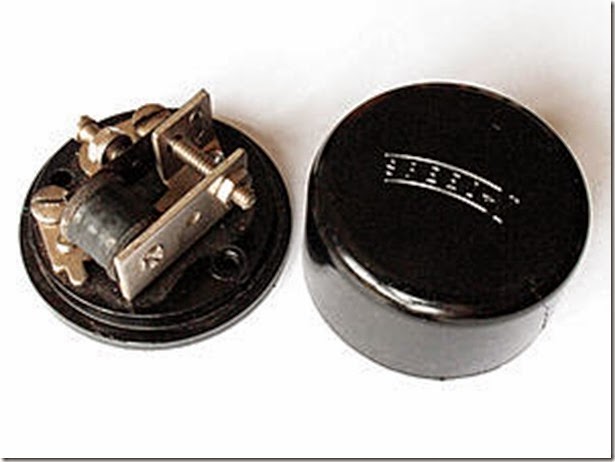
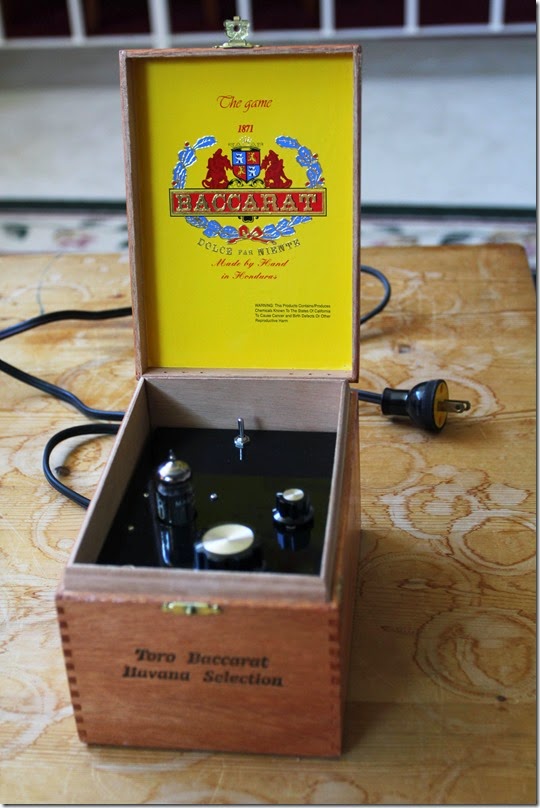
Tube Transmitter in a Cuban Cigar Box

Beautiful use of a cigar box by Ben, KK6FUT. Ben is working in close proximity to Pete N6QW and has obviously fallen under the influence of Pete’s “Build Something With Tubes” field.
Watch out for the high voltage Ben. You aren’t in Arduino-land anymore! One hand behind the back OM!

Our book: “SolderSmoke — Global Adventures in Wireless Electronics” http://soldersmoke.com/book.htm Our coffee mugs, T-Shirts, bumper stickers: http://www.cafepress.com/SolderSmoke Our Book Store: http://astore.amazon.com/contracross-20
Impedance Matching Transformers — Pete’s Magic Decoder Ring!

We got some questions on this and Pete was kind enough to write up some notes on the topic. We may talk more about this during the next podcast (Saturday):

Broad Band Impedance Matching Transformers.

Broad Band impedance matching transformers are designed to transfer power over a wide frequency range. More basic you have an amplifier that has an output impedance of 200 Ohms and you want to match that to a 50 Ohm load.

So what is the magic decoder ring so that you get a 4:1 match, ie going from 200 Ohms to 50 Ohms. Getting technical for a moment the maximum power transfer theorem says maximum power is developed when the source is matched to the load. The Broad Band Matching transformer enables that to happen over a wide frequency range.
So how do we get from 200 Ohms (the source) to 50 Ohms (the load)? Just as there are many airlines that fly from LA to NY so it is with the matching approach. We will cover several.

First a short discussion about broadband cores themselves. One of the most common cores for HF work is the type 43 core which is good up to about 50 MHz. For transformers up to 200 MHz then the type 61 are a better choice. Typically at HF the FT -37-43 is one of the more common ones see (3/8 inch in diameter), as is the FT-50-43 which is ½ inch in diameter. The iron powder cores are not the 1st choice for broad band matching.

#1 Way:
Build a transformer that has a primary of x number of turns (and since it is large, 200 Ohms will have more turns) and the secondary will have y number of turns ( and since it is smaller, 50 Ohms, will have fewer turns.) The transformer action is based on the ratio of the Primary turns Squared to the Secondary Turns squared. Our transformation is 4:1.
Thus if we divide the primary turns squared and divide it by the secondary turns squared the result is 4. Here are some example: if we had a primary of 8 turns ( 64) and a secondary of 4 turns (16) – 64/16 = 4. So that is our transformer a primary of 8 turns and a secondary of 4 turns. When building these transformers use two different colors of wire as that makes it much easier to identify the windings. Observe the phasing, meaning the end you connect to the collector of your output transistor is the start end. That same start end for the secondary winding is the output “hot” side of the secondary.

#2 Way.
The same ratio holds in going from 200 to 50 Ohms. But this time we will use a single winding of 8 turns and at 4 turns we will have a tap for the 50 Ohm point. Since that tap will very likely have Dc on it connect a 100 NF cap at the 4th turn winding and this is the output. What you have just done is create an auto transformer.

#3 Way.
At time one may have an oddball transformation and you can cascade transformers and multiply their individual turns ratios. At one time I needed a 9:1 transformation. I built a 2.5 transformer and then hooked that to a 4:1 and the result was a 9:1 transformer.
The attached table has “worked out” some common matches that are often needed like matching a 50 Ohm amplifier to a 500 Ohm Crystal Filter which is a 10: 1 match. This is easily done with a 6 turn primary (50 ohms 6^2 = 36) and the secondary has 19 turns ( 500 Oms 19^2 = 361). 361/36 = 10.03:1. Close enough for ham radio! The 1st way is probably more preferable for this application.
Pete N6QW

11/2014

Our book: “SolderSmoke — Global Adventures in Wireless Electronics” http://soldersmoke.com/book.htm Our coffee mugs, T-Shirts, bumper stickers: http://www.cafepress.com/SolderSmoke Our Book Store: http://astore.amazon.com/contracross-20

Pete’s Video on Connecting Arduinos and DDS chips (video)

After watching all Pete’s work with the smaller Arduinos, that Uno R3 board seems HUGE. That’s what I should stick with. Great idea using those robust terminal strips. Thanks Pete.

Our book: “SolderSmoke — Global Adventures in Wireless Electronics” http://soldersmoke.com/book.htm Our coffee mugs, T-Shirts, bumper stickers: http://www.cafepress.com/SolderSmoke Our Book Store: http://astore.amazon.com/contracross-20
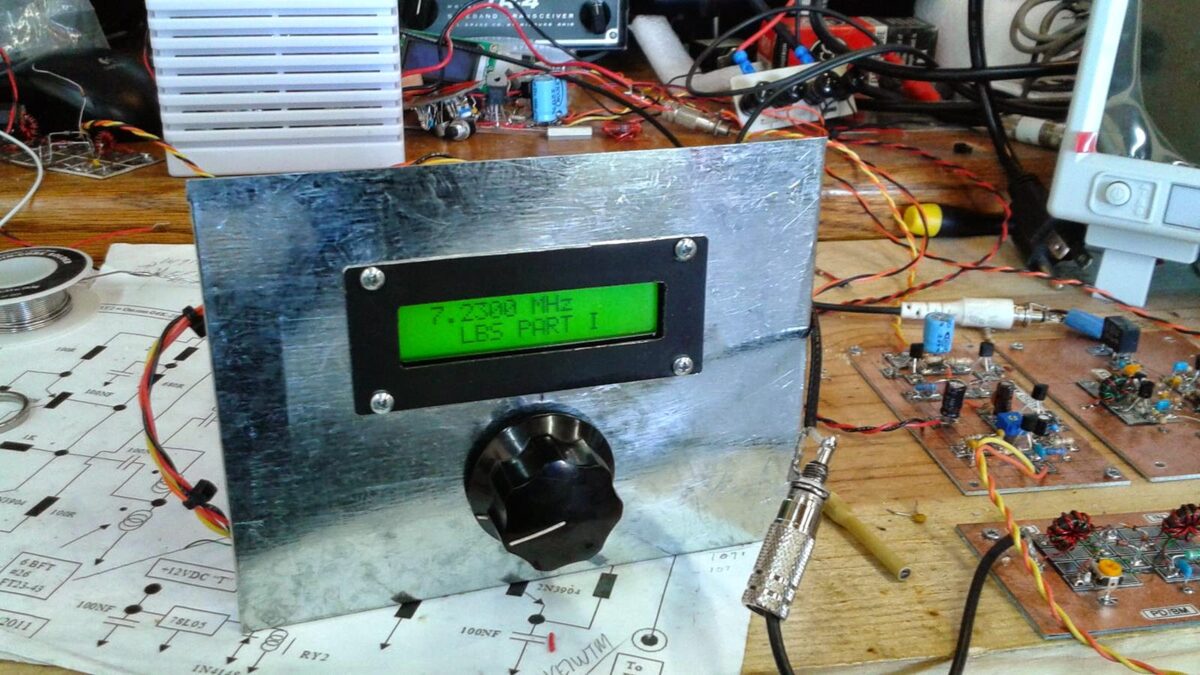
Pete and Ben’s “Let’s Build Something” Direct Conversion Receiver

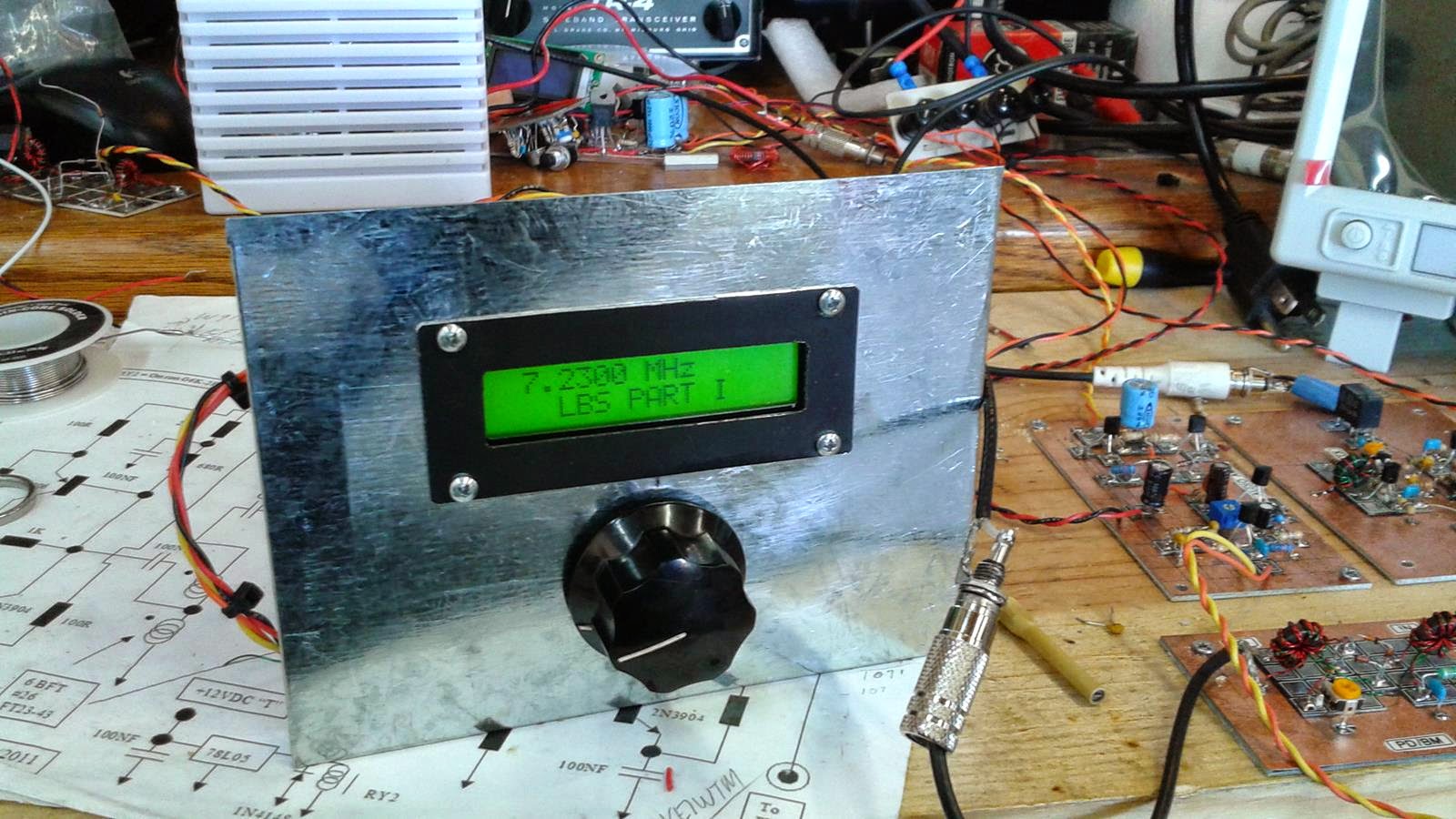
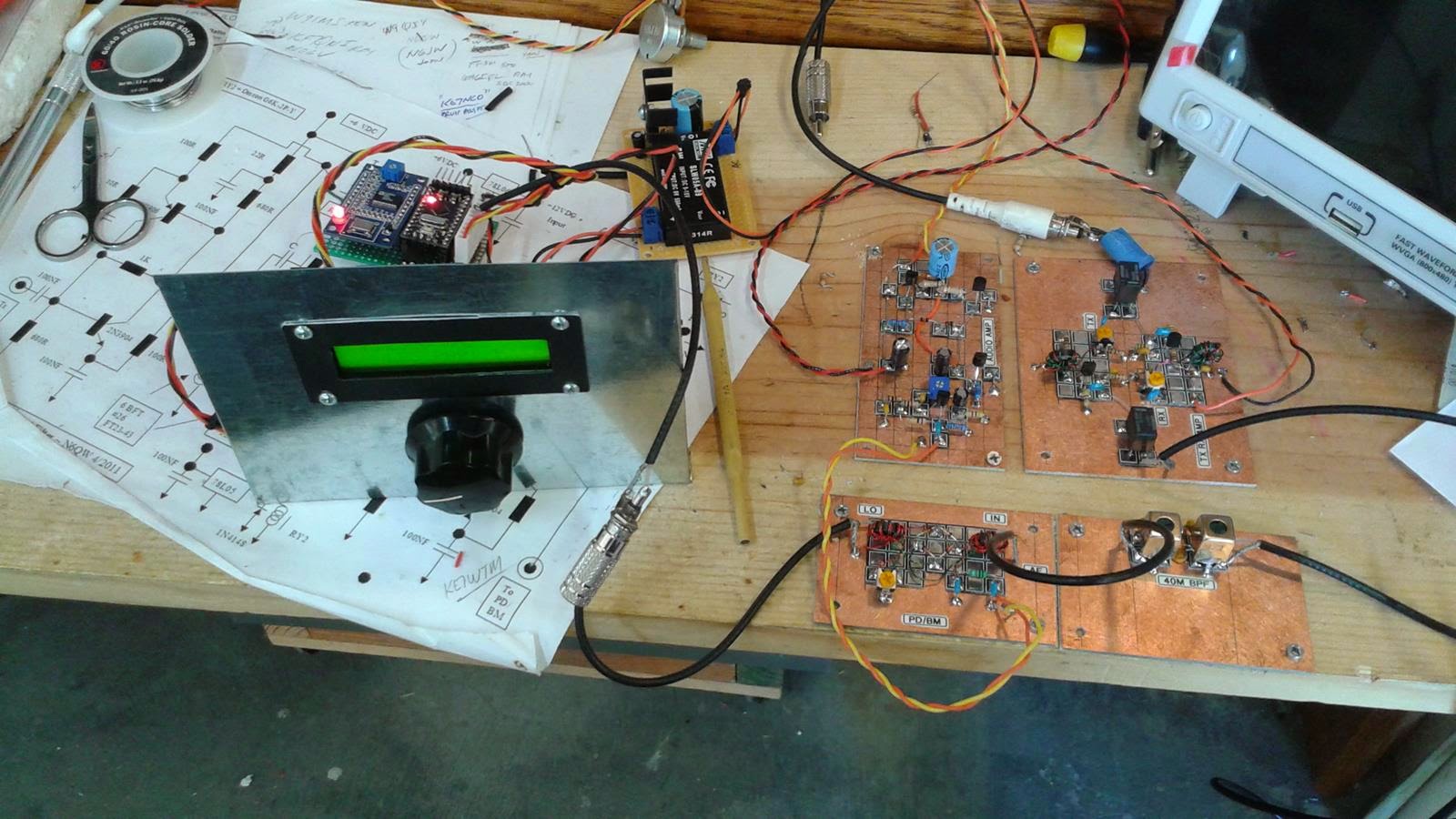
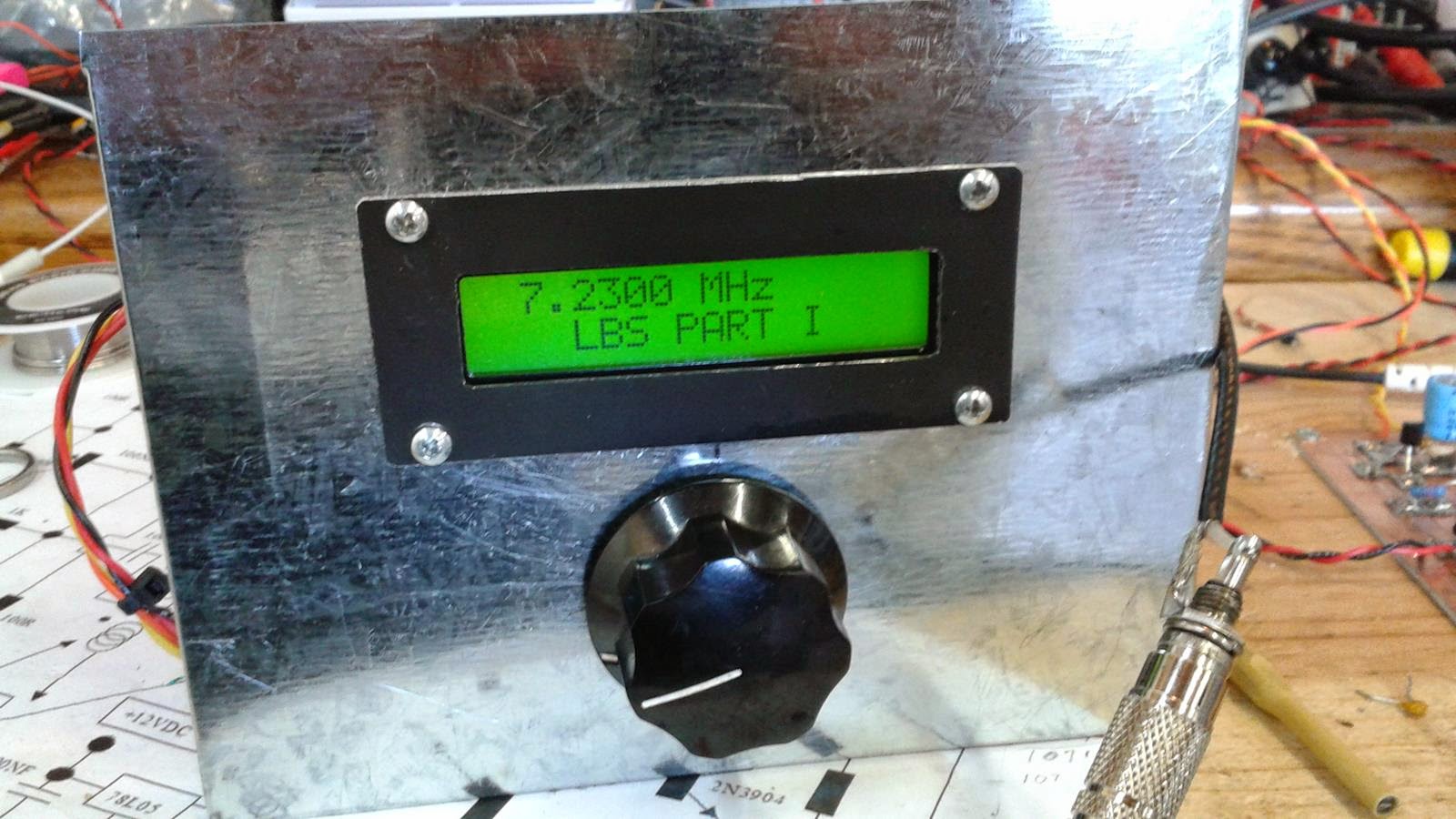
This direct conversion receiver is part of the “Let’s Build Something” project of Pete N6QW and Ben KK6FUT. Publication will be in QRP Quarterly late in January 2015. Pete reports that the front panel is a piece of galvanized sheet metal from Home Depot –total cost 82 cents.

Our book: “SolderSmoke — Global Adventures in Wireless Electronics” http://soldersmoke.com/book.htm Our coffee mugs, T-Shirts, bumper stickers: http://www.cafepress.com/SolderSmoke Our Book Store: http://astore.amazon.com/contracross-20
Colin’s BITX

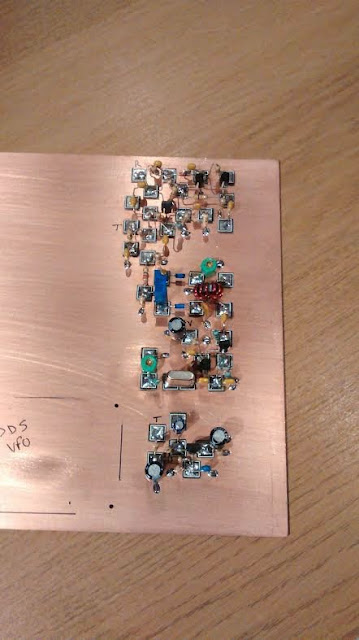
With advice and tribal knowledge from N6QW and MeSquares from W1REX, Colin M1BUU, is making excellent progress on his BITX. I see that he has some territory on the board reserved for a DDS VFO. That’s fine, but here’s and idea for Colin and other builders: Why not build it with the standard VFO first and then add the DDS or Si570 VFO later, perhaps as an external accessory? That way you get the experience of building an LC VFO — the full BITX experience.

Yea, it is hard to imagine Paul M0XPD as a newcomer to the hobby such a short time ago — he is definitely now in the ranks of the esteemed digital Elmers.

And yes Colin, we do hope you avoid unwanted oscillations. Because of Farhan’s great design you have a good shot at avoiding this plague. But be prepared OM. It happens to the best of us. A lot. Stiff upper lip! Never give in!
*************
Hi Bill,
I enjoyed your video about your Arduino experiment. You bet me to it! I’m really looking forward to getting my version of an Arduino powered BITX up and running.
Steady progress is being made, yesterday I added my first bidirectional amplifier to the build. I now have the mic amp, BFO, balanced modulator and first amp completed. I tested the BFO on it’s own and got a respectable looking signal out of it and with a good swing below 10MHz.
Next I need to add the crystal filter, second IF amp and mixer. Pete’s video will help for the mixer! BTW, I’m using the ver3 schematic but I intend to use the ver1 band pass filter.
I set out building the circuit following the N2CQR layout diagram but I’ve already run short on space! I do have a good excuse though, my board is smaller than yours (10″x6″).
Despite my best intentions, I’m falling back towards old habits of making my circuits physically small. I’m using MeSquares in order to try and force myself to space things out a bit. I do hope that I don’t end up with any unwanted coupling!
I must try hard to leave lots of space between the next bits of circuit.
I was listening to SolderSmoke 104 today and Paul M0XPD was introduced as a new ham. Little did we know that Paul would become such a big player!
73, Colin M1BUU

Our book: “SolderSmoke — Global Adventures in Wireless Electronics” http://soldersmoke.com/book.htm Our coffee mugs, T-Shirts, bumper stickers: http://www.cafepress.com/SolderSmoke Our Book Store: http://astore.amazon.com/contracross-20
DDS amplifier

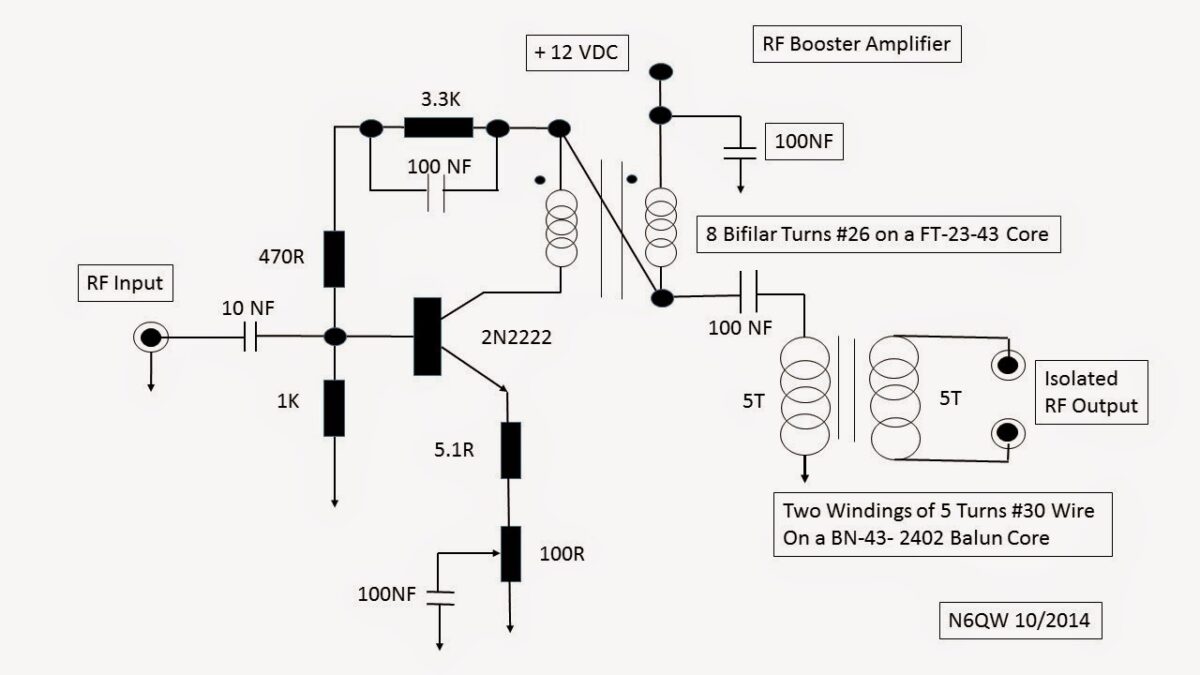
Tony, G4WIF, asked about an amplifier to boost the output of the AD9850 chip. Here is Dr. Juliano’s prescription:

You might find that once you plug that DDS into a circuit you may not quite get 1 V pk to pk and in fact after about 10 MHz it really starts to sag. See the attached drawing as you can put this “afterburner’ on the output of the DDS. The isolated output is good if you are interfacing with “toob” type equipment –it can be left off if you are doing SS or just left in place. This is the output from the amp and as you can see fairly clean.
73’s
Pete N6QW
IMG_0266

Our book: “SolderSmoke — Global Adventures in Wireless Electronics” http://soldersmoke.com/book.htm Our coffee mugs, T-Shirts, bumper stickers: http://www.cafepress.com/SolderSmoke Our Book Store: http://astore.amazon.com/contracross-20
Digitizing my BITX17 with an Arduino and an AD9850 chip

This is only temporary! My analog, discrete, hardware-defined BITX17 was NOT harmed or even modified for this little experiment.

Our book: “SolderSmoke — Global Adventures in Wireless Electronics” http://soldersmoke.com/book.htm Our coffee mugs, T-Shirts, bumper stickers: http://www.cafepress.com/SolderSmoke Our Book Store: http://astore.amazon.com/contracross-20
Background on the use of Si5351 — code and integration with Arduino Nano (video)

I somehow missed this one. Here Pete talks about how the use of the Si5351 in ham radio has been evolving, who has been working on it, etc.

Our book: “SolderSmoke — Global Adventures in Wireless Electronics” http://soldersmoke.com/book.htm Our coffee mugs, T-Shirts, bumper stickers: http://www.cafepress.com/SolderSmoke Our Book Store: http://astore.amazon.com/contracross-20
Pete Goes Superhet with the Si5351 generating BOTH VFO and BFO (video)

Congrats to Pete for his amazingly fast development of a 40 meter superhet receiver using a single Adafruit Si5351 paired with an Arduino Nano for ALL of the frequency generation. No more VFOs, no more crystals. It sounds great! Amazing stuff.

Our book: “SolderSmoke — Global Adventures in Wireless Electronics” http://soldersmoke.com/book.htm Our coffee mugs, T-Shirts, bumper stickers: http://www.cafepress.com/SolderSmoke Our Book Store: http://astore.amazon.com/contracross-20

BIG Amplifiers with SMALL Microcontrollers and LOTS of Tribal Knowledge

Hi Bill,
I wanted to forward to you a slightly edited email I sent to one of our podcast listener’s as I think this is a really good example of some “Tribal Knowledge”.
—————————————————————————————————————————————————————————————————————————–
Hi OM,

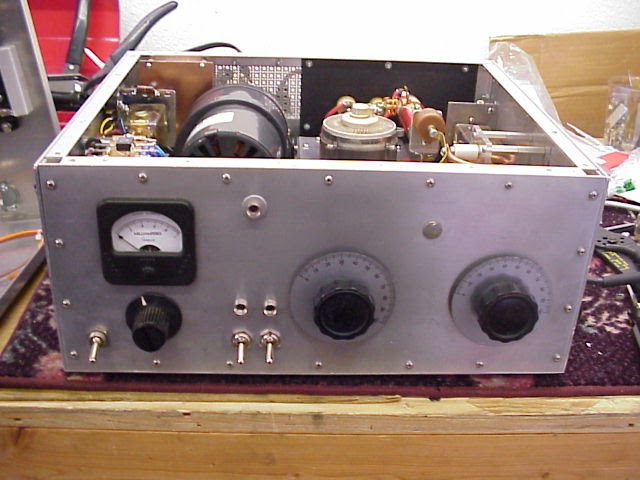
Ham radio publications are much like the Internet –all that is published must be scrutinized. One such publication had a beautiful QRP to QRO amp using a 3CX800A7. A few watts in and 800 Watts out. My daughter was in FM radio broadcasting and I told her to introduce herself to the station engineer and to look out for any pulls – then the floodgates opened –about a week later I had a 3CX800A7.
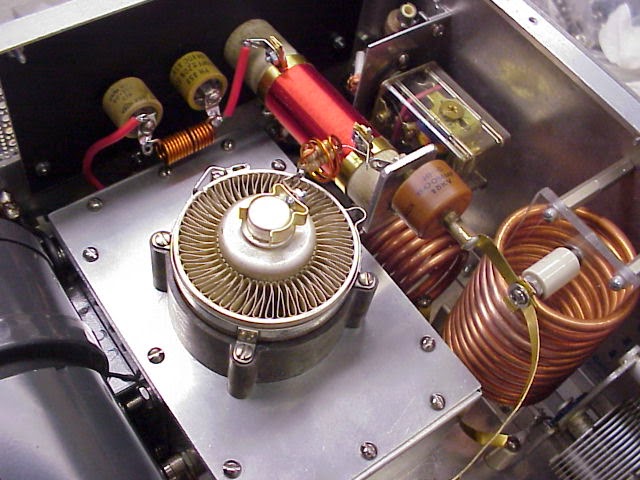
So I started to work on the amp. The circuits just didn’t make sense and parts were missing that would make it work correctly. I contacted the author and here is what he shared. He built the amp but never did get to proof the final article. In fact he sent me his notes and sketches which were correct. Thus I could have never built that amp using just the article. I built it for one band, 20 Meters. It has a tuned input and a Pi-L output so is quite excellent on harmonic reduction.
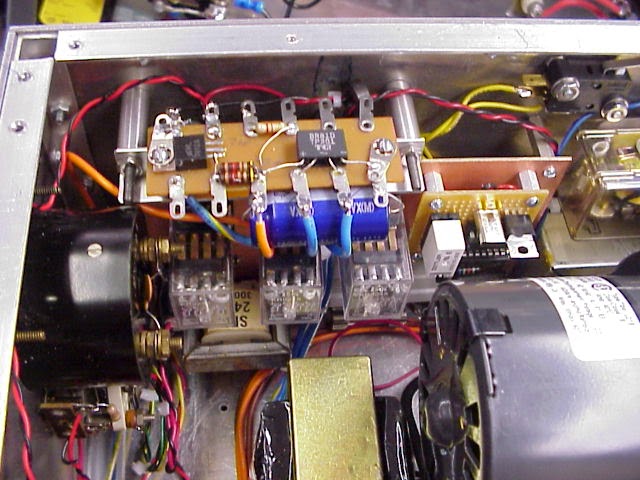
Oh BTW this amp caused me to learn about PIC Microcontrollers. You cannot hit the 3CX800A7 with HV voltage until the cathode is warmed up (must be a female tube). That time delay is 3 minutes. I could not find a suitable time delay relay with a 3 minute delay that didn’t cost an arm and a leg. So that is when I thought about using the PIC16F84 as a time delay relay. Later I ported that over to a 12F675. The cost was less than $10. In the 3CX1500A7 amp ( another free tube) I have two microcontrollers in there. One is used for a three second step start on the filaments (don’t want to shock the filaments with inrush current) and the second for the 3 minute delay before starting the HV step start sequence.
You can see the “Big AMP” on my website at http://www.jessystems.com.
There was only one problem – I was worried about the cooling of the tube so I made sure there was plenty of air which I dump into a very small sub-chassis and the exhaust is out through the tube. Well “Dah” large volume in and small port for exhaust and you have a jet engine sitting on the desk top. Man it was loud – I would wear headphones when it was working. When I built the 3CX1500A7 amp I used a larger plenum so not as loud.
There are several key points I want to make about tribal knowledge:
  1. Turn off the soldering iron and spend a good deal of time “noodling” over the circuit so that it is clear what each function will do and that all the wires connect to something.
  2. Contact the author and ask lots of questions and you might be surprised to find out the published design is not what was designed!
  3. Look for uncommon solutions to build problems. Many times parts used in the articles are so unique that only one exists in the whole world and it is installed in the authors unit.
  4. The amp was built in 2000 and the use of the PIC16F84 as a time delay for an amp was a bit leading edge but don’t be afraid to employ some advanced technology into your projects. [Today an Arduino built into the amp could do time delay, temperature control of blowers, SWR sensing, grid trip protection and even warm your coffee.]
  5. In the Big AMP I figured out how to keep the blower going for about 1 minute after the amp is turned off to “cool down” the tube. The point here is to think about not just the amp itself but refinements to make that $600 tube last for a very long time thus filament current inrush protection and tube cool down.
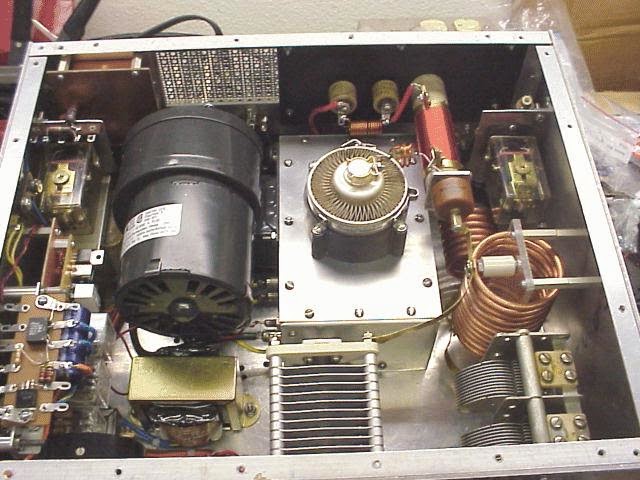
  6. Don’t forget SAFETY – there is 2000 Volts @ 1 amp running around chassis–it is an electric chair sitting on your desk top. I included a microswitch that when the top cover is off it de-energizes the HV circuits. See if you can spot it in the photos.
73’s
Pete N6QW
PS The amp really does exist –see below.

Our book: “SolderSmoke — Global Adventures in Wireless Electronics” http://soldersmoke.com/book.htm Our coffee mugs, T-Shirts, bumper stickers: http://www.cafepress.com/SolderSmoke Our Book Store: http://astore.amazon.com/contracross-20
Pete’s Boards Come Alive as a Direct Conversion Receiver (video)

I love it when a new rig is spread out on the workbench like this, pulling in its first signals. Like First Light on on a new telescope. These are the same boards you have been seeing in Pete’s previous videos: The Si board, the mixer, and the AF amp. Now they are linked together in the form of a Direct Conversion receiver.

Our book: “SolderSmoke — Global Adventures in Wireless Electronics” http://soldersmoke.com/book.htm Our coffee mugs, T-Shirts, bumper stickers: http://www.cafepress.com/SolderSmoke Our Book Store: http://astore.amazon.com/contracross-20
Pete’s “Let’s Build Something” Audio Amplifier (video)

Who needs LM386 ICs? Pete goes discrete! Love the MePads. And I knew Pete was going to test it with his finger! He’s just taking stray hum from the power lines and coupling it to the input through that Exacto knife.

Seems to me like these boards is getting close to actually receiving signals.

Our book: “SolderSmoke — Global Adventures in Wireless Electronics” http://soldersmoke.com/book.htm Our coffee mugs, T-Shirts, bumper stickers: http://www.cafepress.com/SolderSmoke Our Book Store: http://astore.amazon.com/contracross-20
Pete’s Mixer (Pictures)

Hi Guys,
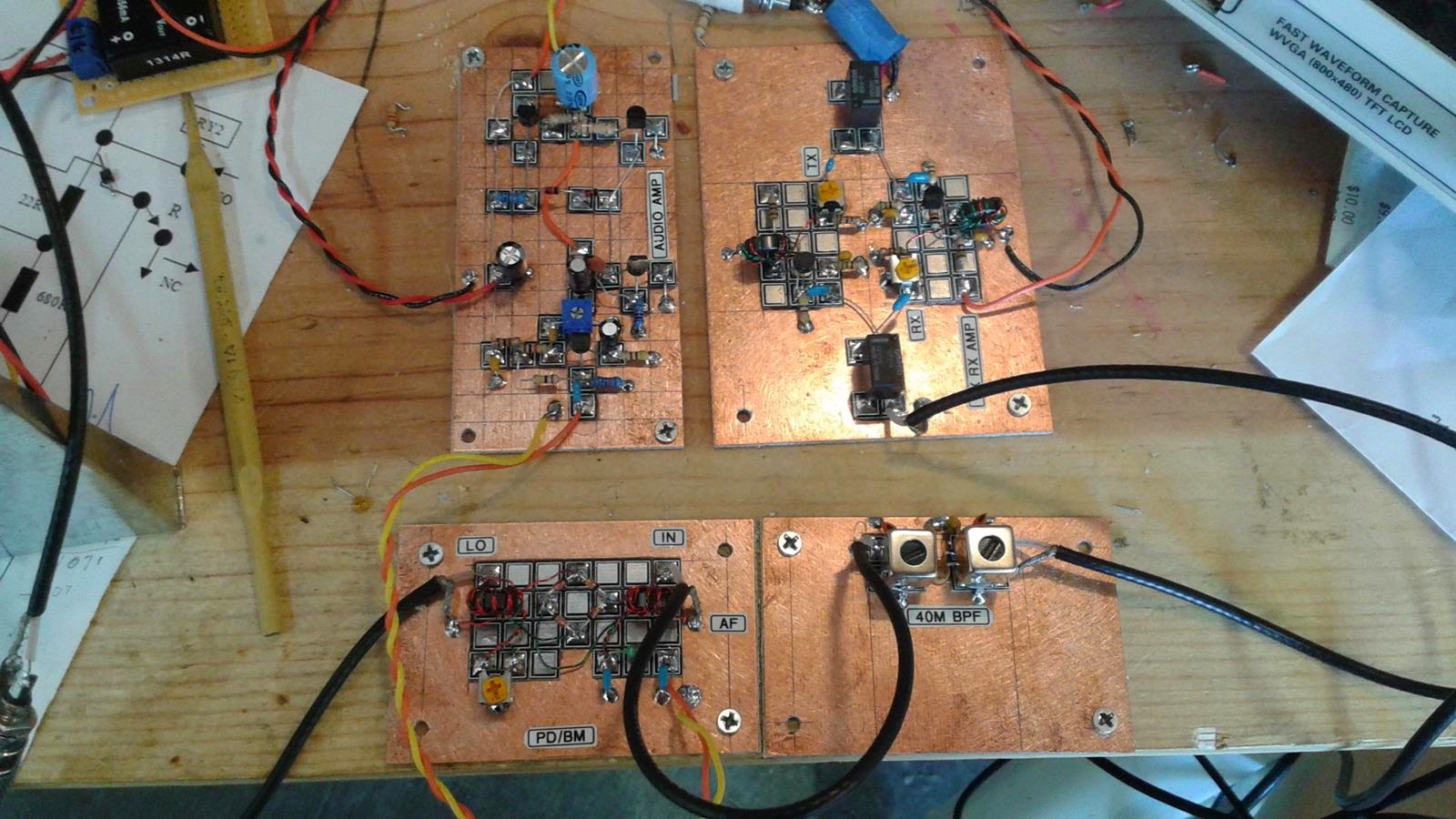
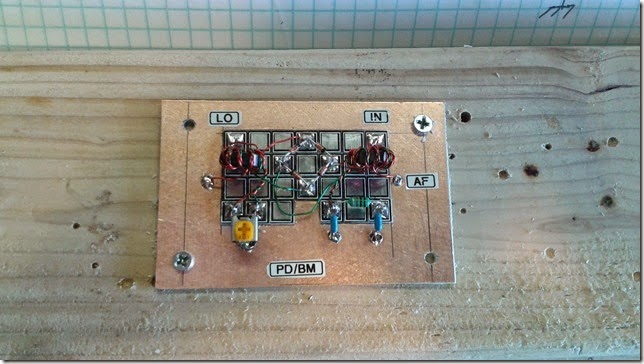
Just finished building the PD/BM that will be used in the final circuit of the LBS Part I. I will also upload a video of the build.
The W1REX MeSquares really work very well and greatly facilitate the build. So the newbie builder — will have one leg up by using the squares method.
73’s
Pete N6QW

Pete’s video on this circuit appears below — just scroll down a few.

Our book: “SolderSmoke — Global Adventures in Wireless Electronics” http://soldersmoke.com/book.htm Our coffee mugs, T-Shirts, bumper stickers: http://www.cafepress.com/SolderSmoke Our Book Store: http://astore.amazon.com/contracross-20
Bandpass Filter Construction by Pete Juliano (video) TFMS!!!

MePads! Arduinos! Breadboards! SuperGlue! Graph paper! Noodling! Room for Relays!
TFMS (TUNE FOR MAXIMUM SMOKE!)

Another great video from N6QW. Thunder power!

Our book: “SolderSmoke — Global Adventures in Wireless Electronics” http://soldersmoke.com/book.htm Our coffee mugs, T-Shirts, bumper stickers: http://www.cafepress.com/SolderSmoke Our Book Store: http://astore.amazon.com/contracross-20
Pete Builds a Doubly Balanced Modulator (Video — Part 3)

Another beautiful piece of cinema from Giovanni Manzoni’s Newbury Park Studios. Bravo Giovanni!

Pete is obviously a doubly balanced kind of guy. I liked his use of the W1REX MePads and the breadboard. Also, the balance pot and the un-balance switch are very handy innovations.
Most of all I like the way Pete’s video takes you from schematic to actual circuit.

Thanks Pete!

Our book: “SolderSmoke — Global Adventures in Wireless Electronics” http://soldersmoke.com/book.htm Our coffee mugs, T-Shirts, bumper stickers: http://www.cafepress.com/SolderSmoke Our Book Store: http://astore.amazon.com/contracross-20
OH NO! SolderSmoke Goes QRO! Bill’s Amplifier Project (video)

I got the Communications Concepts Inc. EB-63A amplifier working today. Yea!
Kind of ironic that the highest power amp I have ever built gave me the LEAST trouble. This just goes to show that circuit layout is very important. This amp is a proven design, with a proven layout and board. That’s why it didn’t turn into a 140 watt solid state oscillator!

Our book: “SolderSmoke — Global Adventures in Wireless Electronics” http://soldersmoke.com/book.htm Our coffee mugs, T-Shirts, bumper stickers: http://www.cafepress.com/SolderSmoke Our Book Store: http://astore.amazon.com/contracross-20
Spark Forever! Pete’s First Transmitter

The SolderSmoke legal team (we too use Dewey, Cheetham & Howe!) has advised us to be very careful about divulging the details on this rig. They are not sure about the statute of limitations. Beyond what he said on the podcast, all Pete will say is that TOOBs were involved: 1S4, 3S4, 3Q4, 3Q5, 3V4s. He says power out was ALWAYS less than 100 mw ERP. That’s his story and he’s stinking to it.

Our book: “SolderSmoke — Global Adventures in Wireless Electronics” http://soldersmoke.com/book.htm Our coffee mugs, T-Shirts, bumper stickers: http://www.cafepress.com/SolderSmoke Our Book Store: http://astore.amazon.com/contracross-20

Tribal Knowledge Video: Putting Screw Threads in Aluminium

http://youtu.be/LuqliWT1k5A

Thank you Giovanni Manzoni, whoever you are!

Our book: “SolderSmoke — Global Adventures in Wireless Electronics” http://soldersmoke.com/book.htm Our coffee mugs, T-Shirts, bumper stickers: http://www.cafepress.com/SolderSmoke Our Book Store: http://astore.amazon.com/contracross-20

Pete’s 17 Meter VXO Transceiver (Video)

Pete:

I like it! You and I may be the only people in the world with that kind of VXO range control switch on the front panel!
I checked my VXO. I run it at around 23 MHz. I use two single crystals, also switched by a relay.
The 23.144 rock tunes from 23.127 to 23.151 24 kHz
The 23.166 rock goes from 23.144 to 23.168 24 kHz
So I could have had 48 kHz were it not for the overlap. As it is, I get 41 kHz. Not bad.
The reason I went with this LO freq was that I had these crystals from the Dale Parfitt/Doug DeMaw Barebones Barbados Receiver. DeMaw had used color burst rocks for a 3.579 MHz IF, but Dale shifted up to 5 MHz. I could occasionally hear WWV! (But with the 3.579 I heard W1AW in the IF!)
73
Bill

Our book: “SolderSmoke — Global Adventures in Wireless Electronics” http://soldersmoke.com/book.htm Our coffee mugs, T-Shirts, bumper stickers: http://www.cafepress.com/SolderSmoke Our Book Store: http://astore.amazon.com/contracross-20