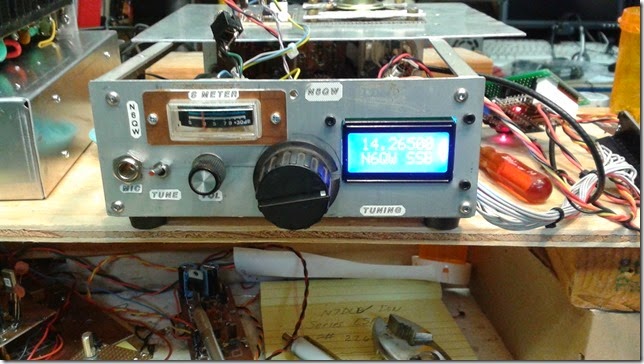
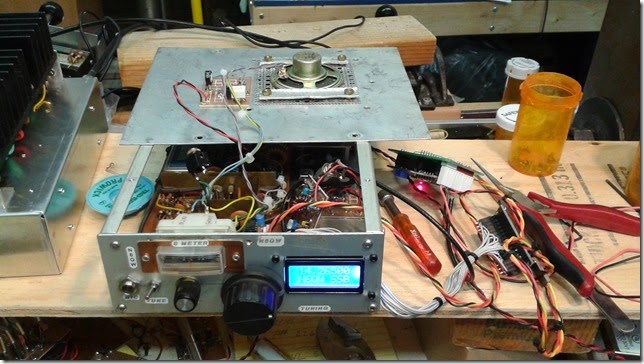
Pete has a Blog!


Check out the new blog from Pete, N6QW. We hope he continues to post. Please link to his blog and help spread the word. Here it is:

http://n6qw.blogspot.com/

Our book: “SolderSmoke — Global Adventures in Wireless Electronics” http://soldersmoke.com/book.htm Our coffee mugs, T-Shirts, bumper stickers: http://www.cafepress.com/SolderSmoke Our Book Store: http://astore.amazon.com/contracross-20

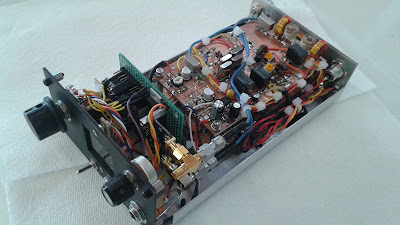
Mikele’s Croatian Belthorn Transceiver

Mikele’s rig is a real “International Brotherhood of Electronic Wizards” kind of project. The Belthorn design is out of England. N6QW has added a lot of California influence. The Nokia screen adds a bit of Finland. And of course Mikele’s excellent construction makes this a profoundly Croatian rig.

We love seeing rigs in their “out in the open ” phase. Thanks Mikele!

Our book: “SolderSmoke — Global Adventures in Wireless Electronics” http://soldersmoke.com/book.htm Our coffee mugs, T-Shirts, bumper stickers: http://www.cafepress.com/SolderSmoke Our Book Store: http://astore.amazon.com/contracross-20
Pete’s LBS II Transceiver

Look at that. That is the work of a master homebrewer. More info and more great pictures here:

http://www.n6qw.com/LBS2.html

Our book: “SolderSmoke — Global Adventures in Wireless Electronics” http://soldersmoke.com/book.htm Our coffee mugs, T-Shirts, bumper stickers: http://www.cafepress.com/SolderSmoke Our Book Store: http://astore.amazon.com/contracross-20
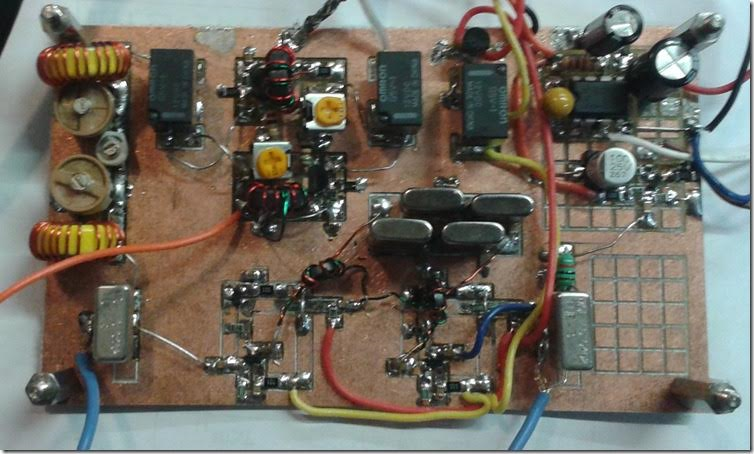
Pete Shrinks the Transceiver (Video)

Pete writes: This video shows the LBS XCVR shrunk down to a mainboard that is 2.5 Inches by 4.5 inches. The board contains the 20 Meter Band Pass Filter, the RxTx Mixer, a TUF-3, two bilateral amplifier stages a 5.185 MHz Homebrew Filter. a TUF-3 PD/BM. The Audio amp stage and the microphone amp. Not built as yet is the bi-directional stage that on receive is the RF amp and on transmit the Tx pre-driver stage. Extensive use of SMD components makes the size reduction possible. The transmit final stages will be on a 2nd board that is stacked on top of the mainboard. An Arduino Pro-Mini does all of the control for the Si5351 VFO/BFO. The final size will be 4X6X2. Oh it also has a color display! http://www.n6qw.com/.

Our book: “SolderSmoke — Global Adventures in Wireless Electronics” http://soldersmoke.com/book.htm Our coffee mugs, T-Shirts, bumper stickers: http://www.cafepress.com/SolderSmoke Our Book Store: http://astore.amazon.com/contracross-20
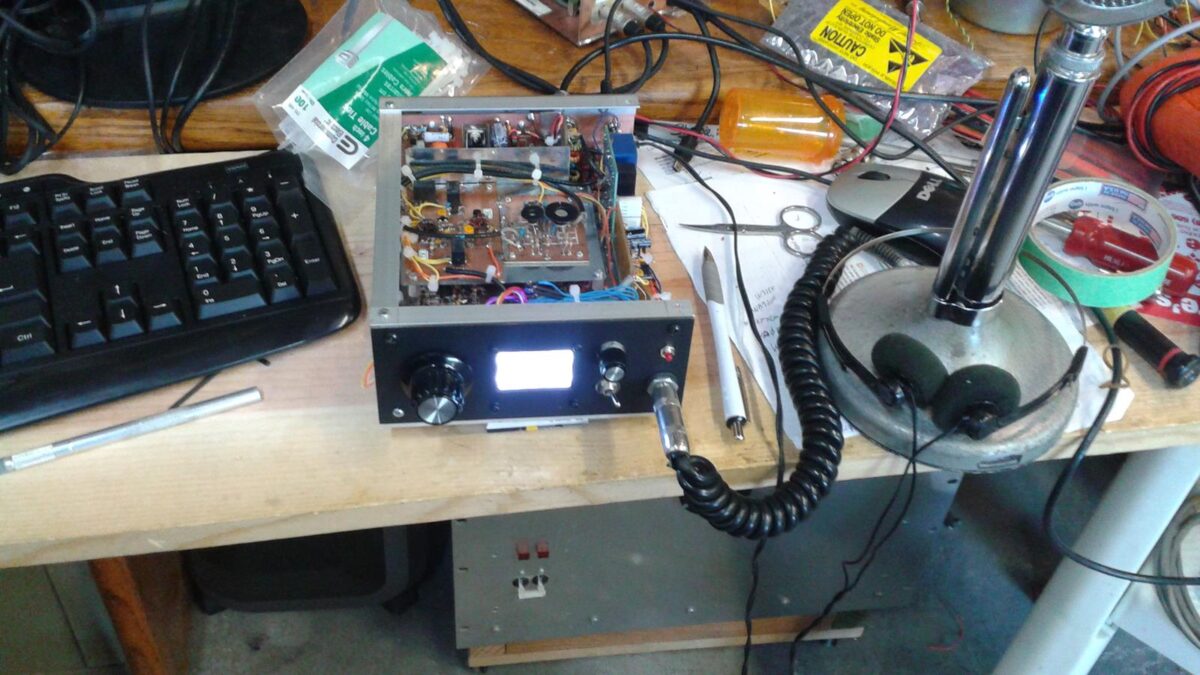
Video of Pete’s VERY COOL Zia Build

This is cool in so many ways:

I like the RF amp along the back with the LP filter off to the side.

The stacked PC boards are very nice.

The Display — What can I say?

Having stations from the Philippines (DU) for the receiver demo. Nice touch.

Mesh-like side panels! And the plexiglass top! Wow!

PAINTING THE COPPER-CLAD FRONT PANEL BLACK! WOW! BLACK IS THE NEW COPPER!

Nice feet for the rig. Feet are key.

NO NOTICEABLE PHASE NOISE. No Si5351 output bleed-over.

Love the name: ZIA!! (That was my only contribution.)

Pete Puts His Zia in a Box

Wow, Pete really knows how to pack a lot electronics into a small box. (He claims that he does this to justify the $250000 CNC machine!) I remain very jealous of that cool display panel. 

Our book: “SolderSmoke — Global Adventures in Wireless Electronics” http://soldersmoke.com/book.htm Our coffee mugs, T-Shirts, bumper stickers: http://www.cafepress.com/SolderSmoke Our Book Store: http://astore.amazon.com/contracross-20
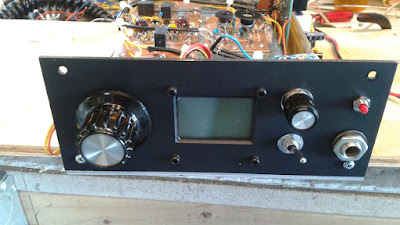
Progress on Pete’s “ZIA”

It is practically SPARKLING! Beautiful job Pete. I’m glad you are actually boxing this one up!

Pete has many more pictures of this project here:
http://www.n6qw.com/TIA.html

He also notes that there may have been some sub-conscious Knack wisdom at work when I dubbed his rig “The Zia.” I was thinking strictly in terms of language and ethnic heritage: TIA stands for Termination Insensitive Amplifier. But in Spanish it means “aunt”. But in Italian Aunt comes out as Zia. So Pete’s should be a Zia, right? Capisce?

Well Pete puts an electronic twist on it:

“Once again you are spot on with ZIA (With Z the electronic symbol for Impedance). Thus Impedance (The symbol Z) Insensitive Amp. Thank You.”

Our book: “SolderSmoke — Global Adventures in Wireless Electronics” http://soldersmoke.com/book.htm Our coffee mugs, T-Shirts, bumper stickers: http://www.cafepress.com/SolderSmoke Our Book Store: http://astore.amazon.com/contracross-20
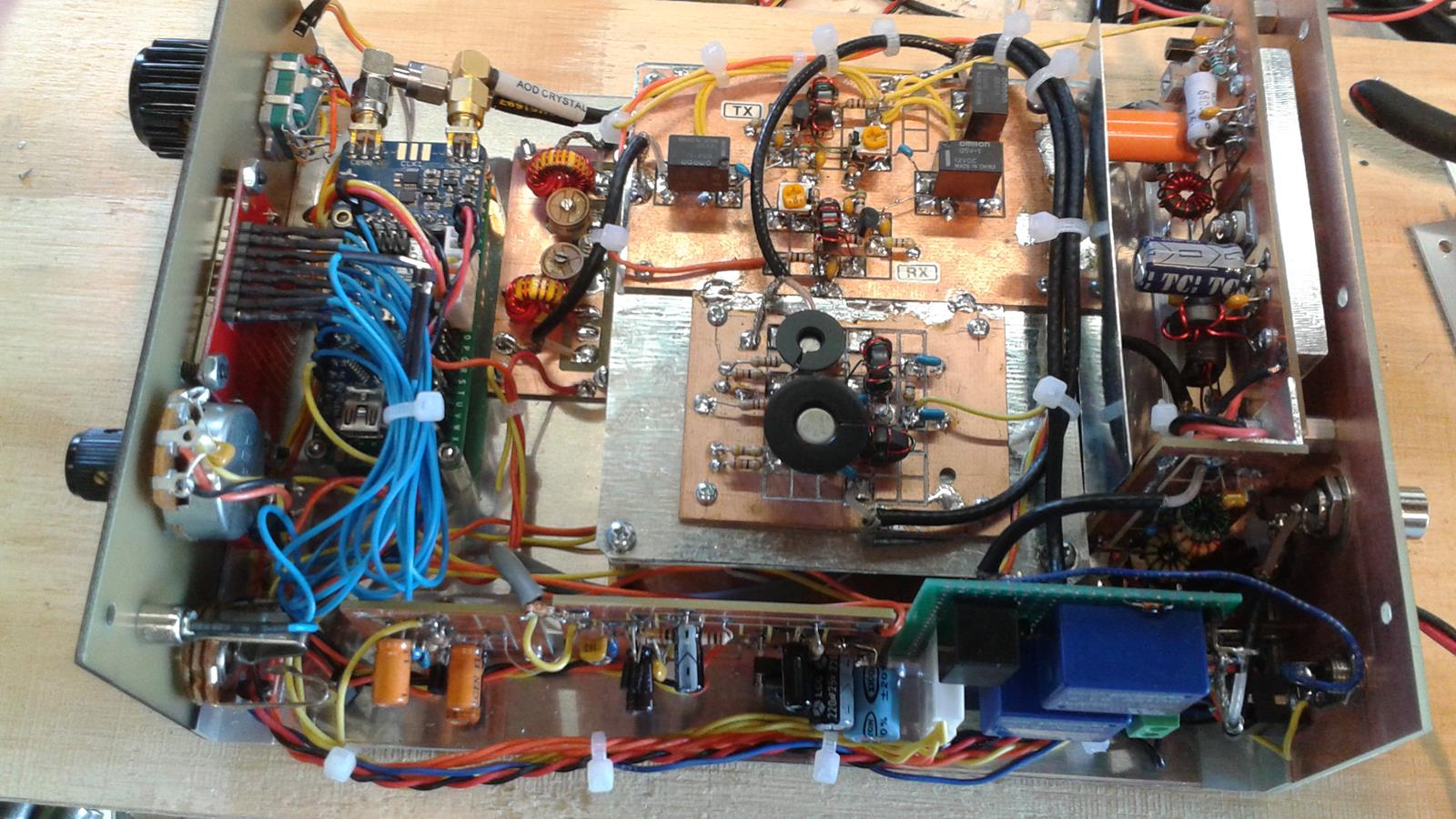
SolderSmoke Podcast 177 Bicoastal Termination Insensitivity Unphased by Phase Noise

SolderSmoke Podcast #177 is available:
13 June 2015
— PETE JULIANO INDUCTED INTO THE QRP HALL OF FAME
— Bench Reports: Bicoastal Bilateral Success: A Tale of Two Tias
Only 3 TIA rigs in the world? It depends…
Relay improvements in the BITX Builds
Straightening out amp problems
The many uses of copper foil
No phase noise or bleed-over troubles
Plug-in filters
Adjusting TIA amp gain on RX and TX (too much is not good!)
Getting the BITX to work with the CCI amp
Allison wisely prescribes 3 db pads
Curing hum by moving the power supply (duh!)
— Farhan’s New Minima — Crying out for an Si5351?
— Mike KL7R’s Web Site is Back (thanks to W8NSA)
SolderLex: Rigs or Radios? We go with Rigs
— A ham rite of passage: Build a Dipole!
— What does your shack look like at the end of a project?
— MAILBAG
The CORRECT pronunciation of Belthorn
Multiplication and Division by 4
W8NSA, Vietnam, a Transoceanic and a 9V Battery


Our book: “SolderSmoke — Global Adventures in Wireless Electronics” http://soldersmoke.com/book.htm Our coffee mugs, T-Shirts, bumper stickers: http://www.cafepress.com/SolderSmoke Our Book Store: http://astore.amazon.com/contracross-20
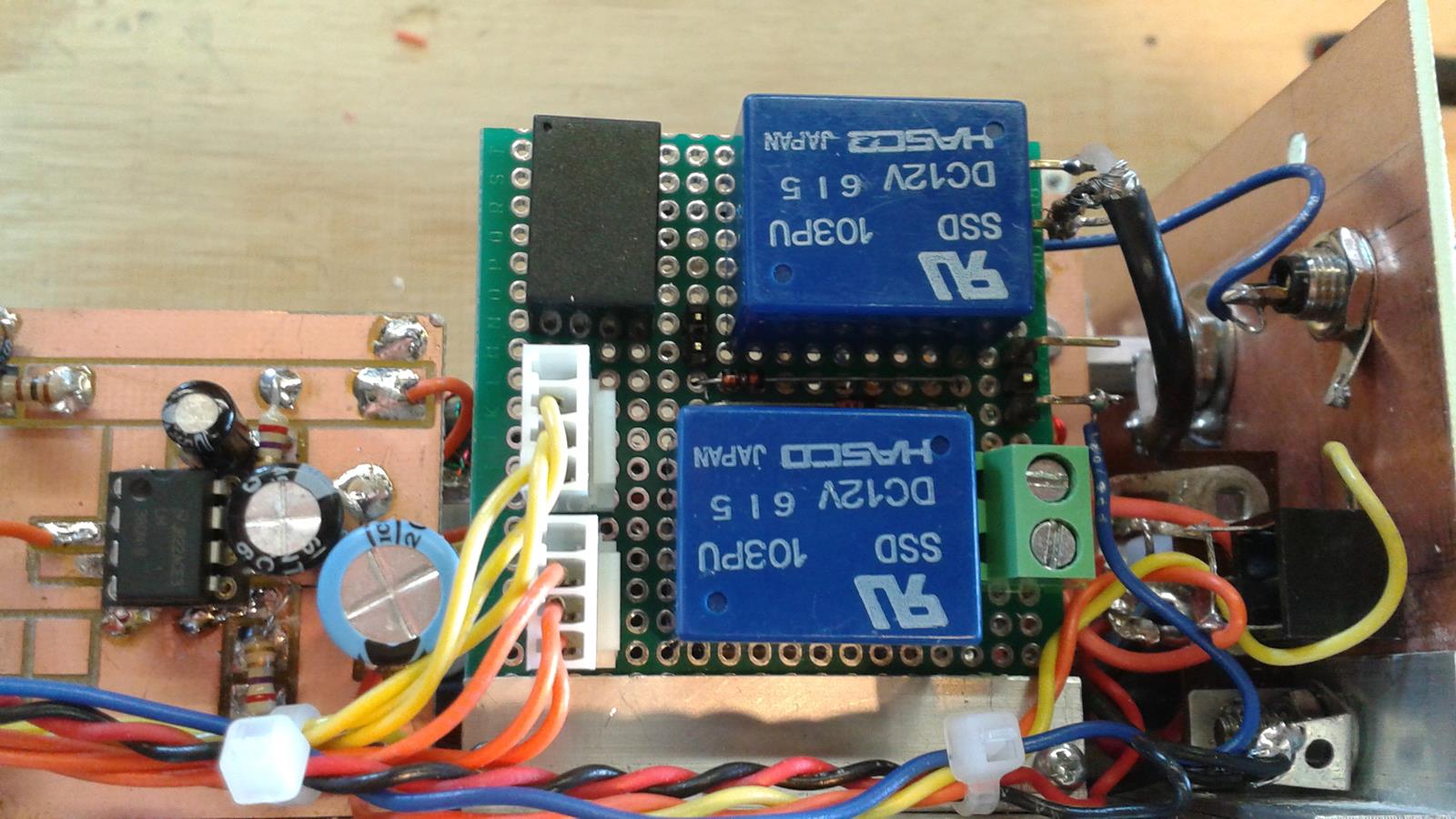
BITX DIGI-TIA Build Update #7: On The Air!

With lots of encouragement from Pete, I finally got the BITX DIGI-TIA on the air. The first contacts were made yesterday. I have it on 40 meter SSB. The finicky denizens of that audio-conscious band seemed to like the sound of the rig. I was almost reluctant to tell them it is homebrew (no need to stir up trouble!)
The plug in filter arrangement seems to work very well. This will allow me to put this rig on many other bands. All I have to do is build some additional filter boards and upload modified versions of the software. There is even space to make a plug-on socket for the crystal filter (the 9 MHz IF would not be cool for 17 meters).
I’m really pleased with the RF power chain (the original BITX chain). This time I built it all in a straight line along the back of the transceiver with lots of attention to shielding and grounding. There were no instability problems. The amplifiers did not try to be oscillators. I was shocked!
I did have to reduce the gain of the three termination insensitive transmit amplifiers. Using the chart in the 2009 Wes Hayward/Bob Kopski article, with just a few resistors you can set the gain. I had built them with 19.4 db gain each. This turned out to be too much — the slightest amount of audio into the SBL-1 was driving the amplifiers to peak output. So yesterday I changed all three amps to 15 db (I think that was what Farhan had in the original BITX). It only took me about 15 minutes and it seemed to take care of the problem. I am getting 7 or 8 watts out of the IRF-510.
T/R switching is very smooth and quiet using just two small 12V relays.
Thanks to Pete for the mil-pad boards and the encouragement (especially on the use of the Si5351). Thanks to Farhan for the BITX architecture. Thanks to Steve Smith for the Yaesu filter. Thanks to Wes and Bob for the TIA circuit. Thanks to Thomas in Norway for the Si5351 software. And Thanks to Allison for all the good advice.


Our book: “SolderSmoke — Global Adventures in Wireless Electronics” http://soldersmoke.com/book.htm Our coffee mugs, T-Shirts, bumper stickers: http://www.cafepress.com/SolderSmoke Our Book Store: http://astore.amazon.com/contracross-20
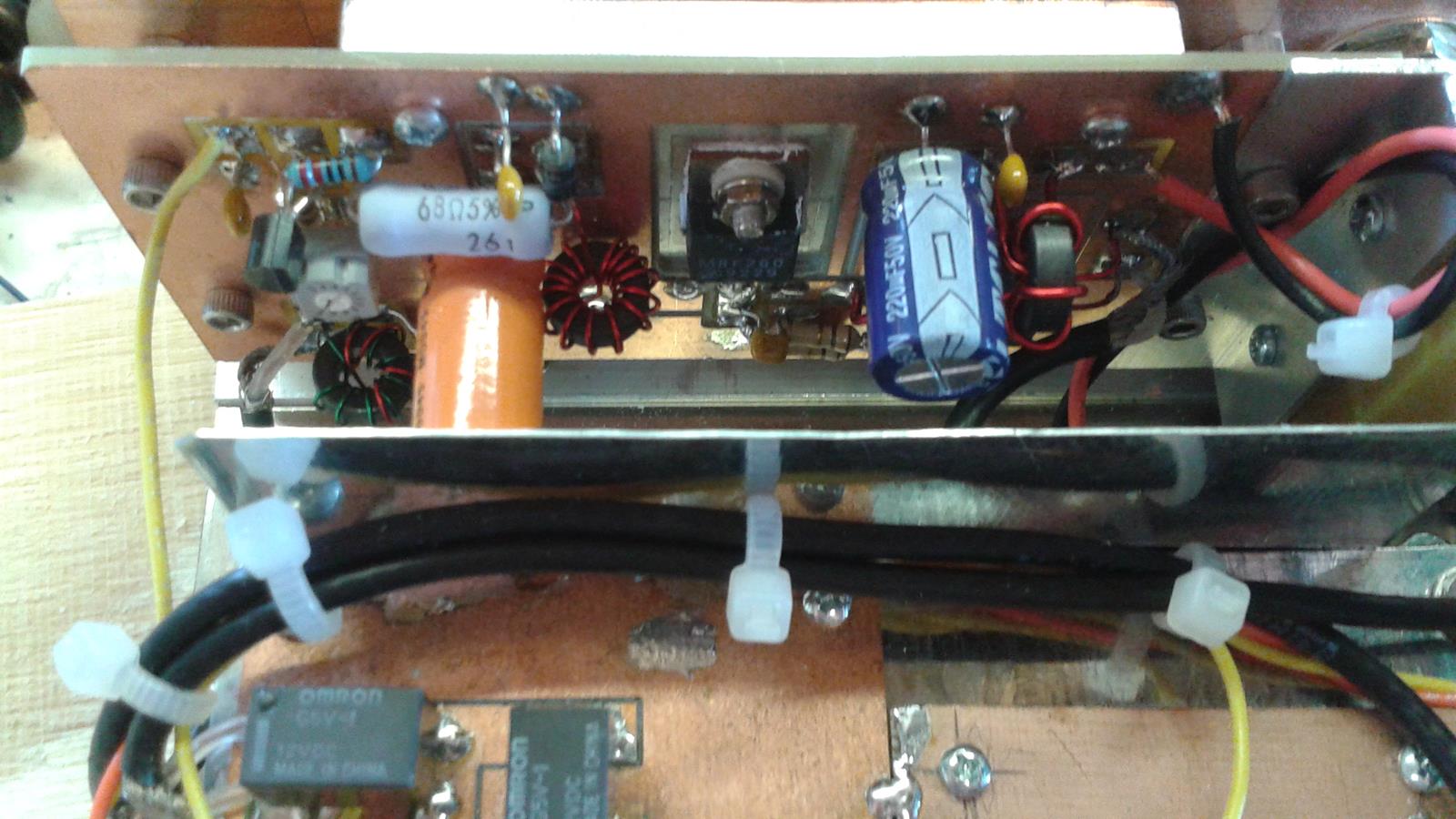
BITX DIGI-TIA Update #4

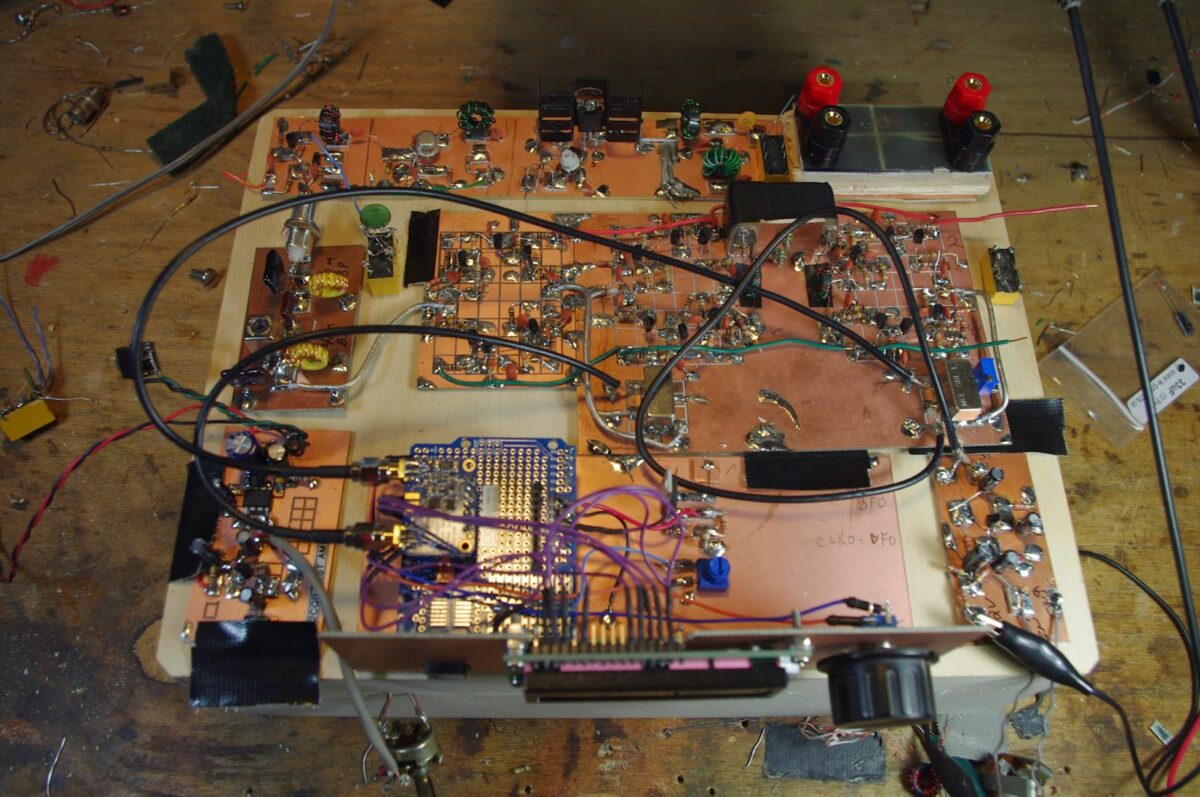
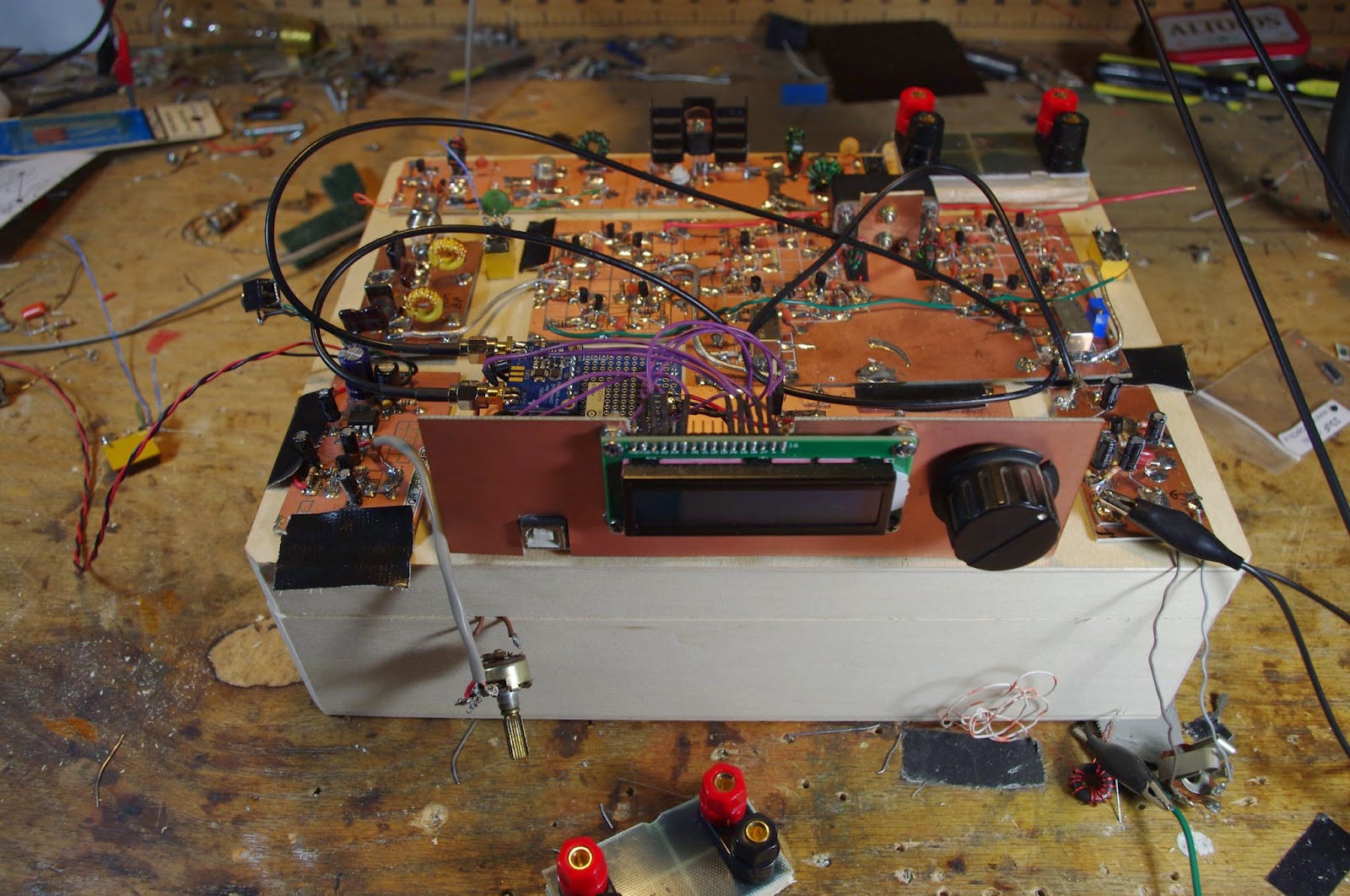
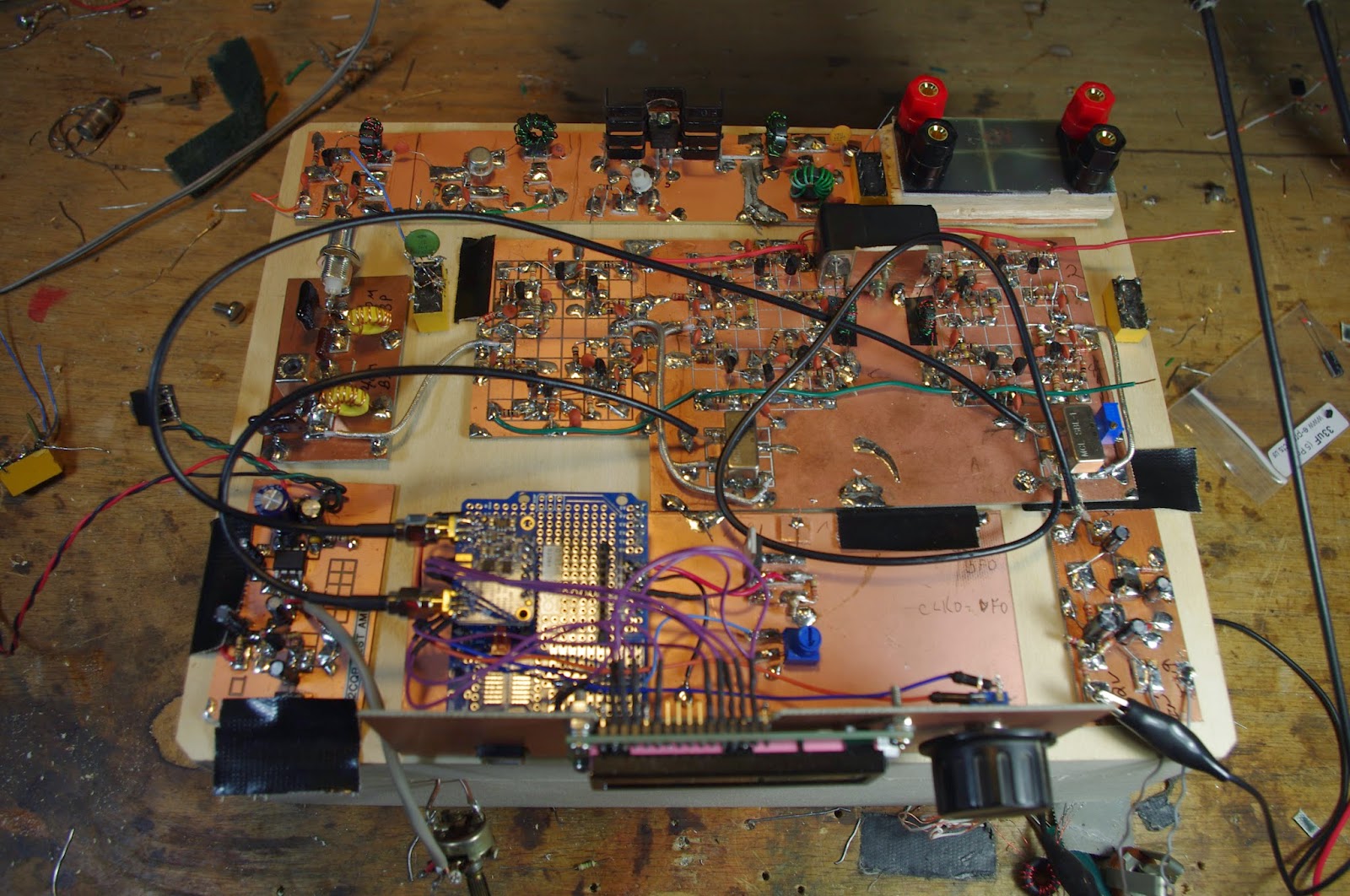
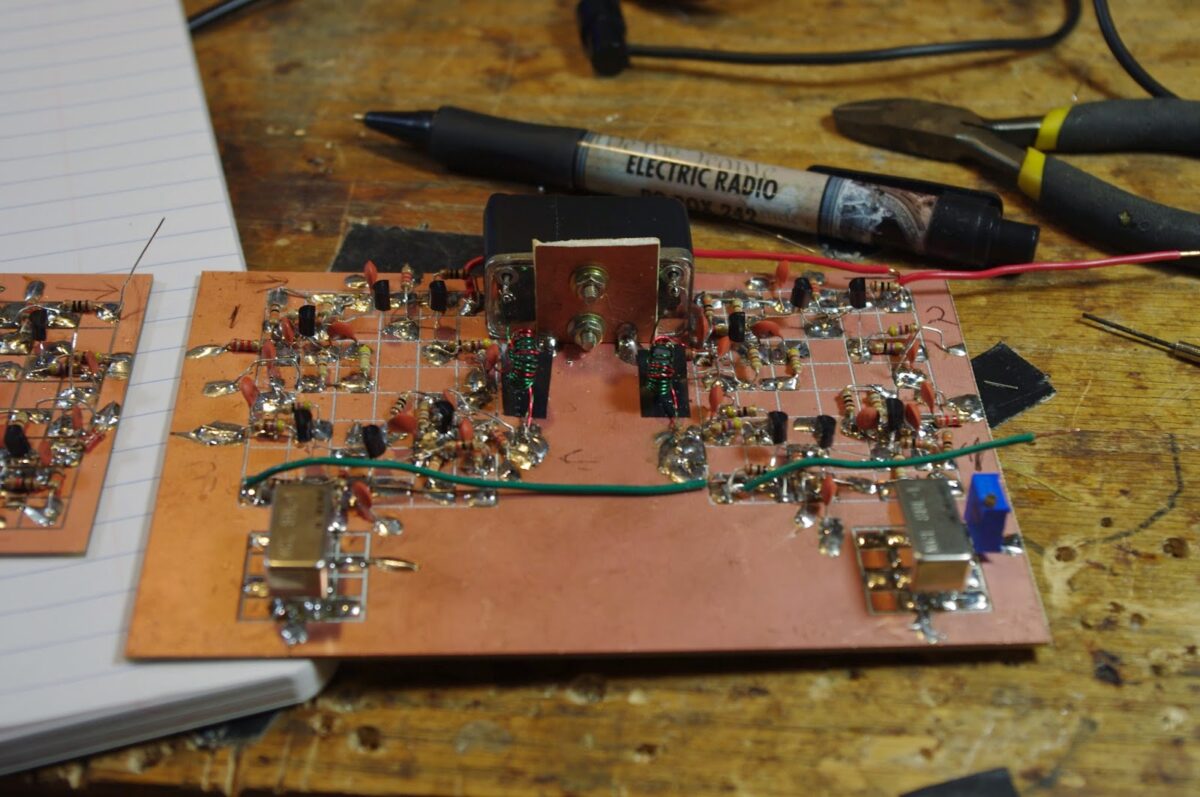
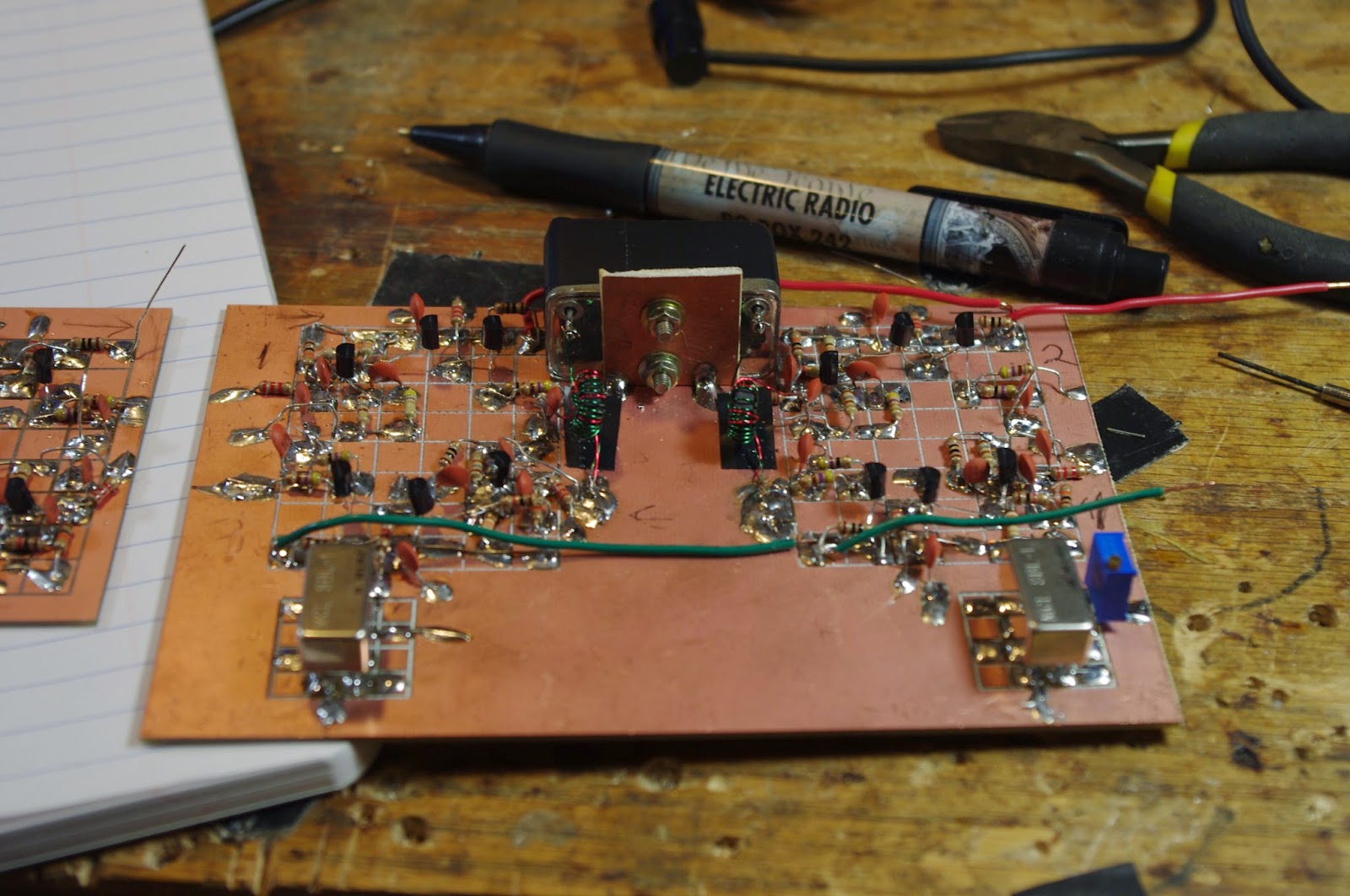
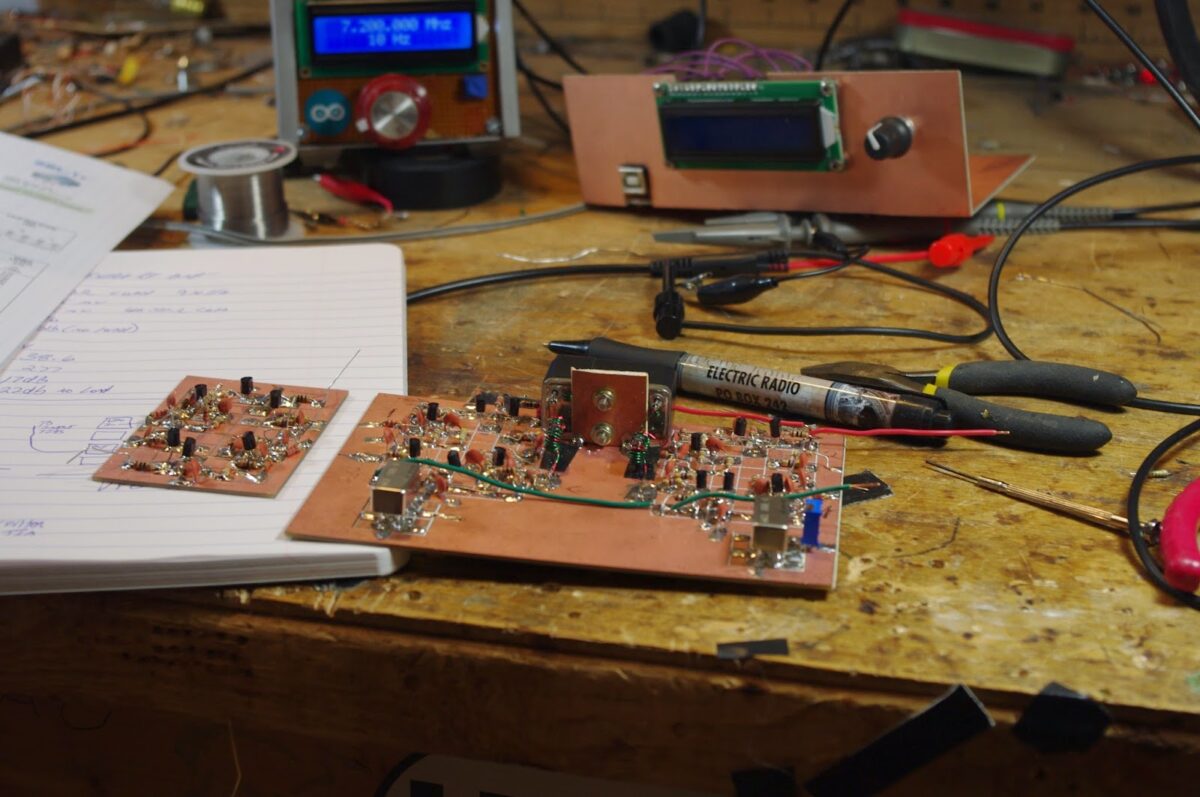
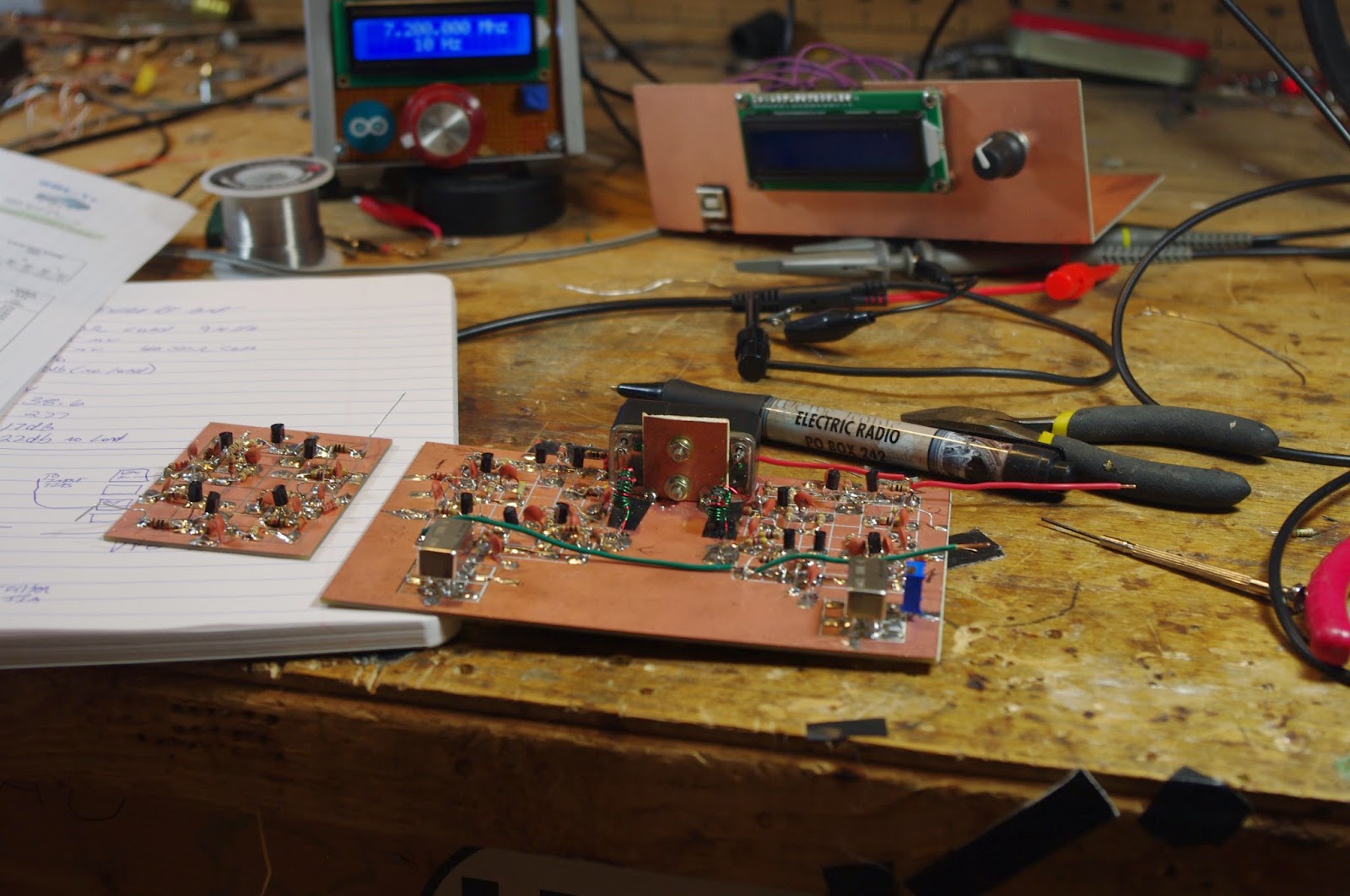
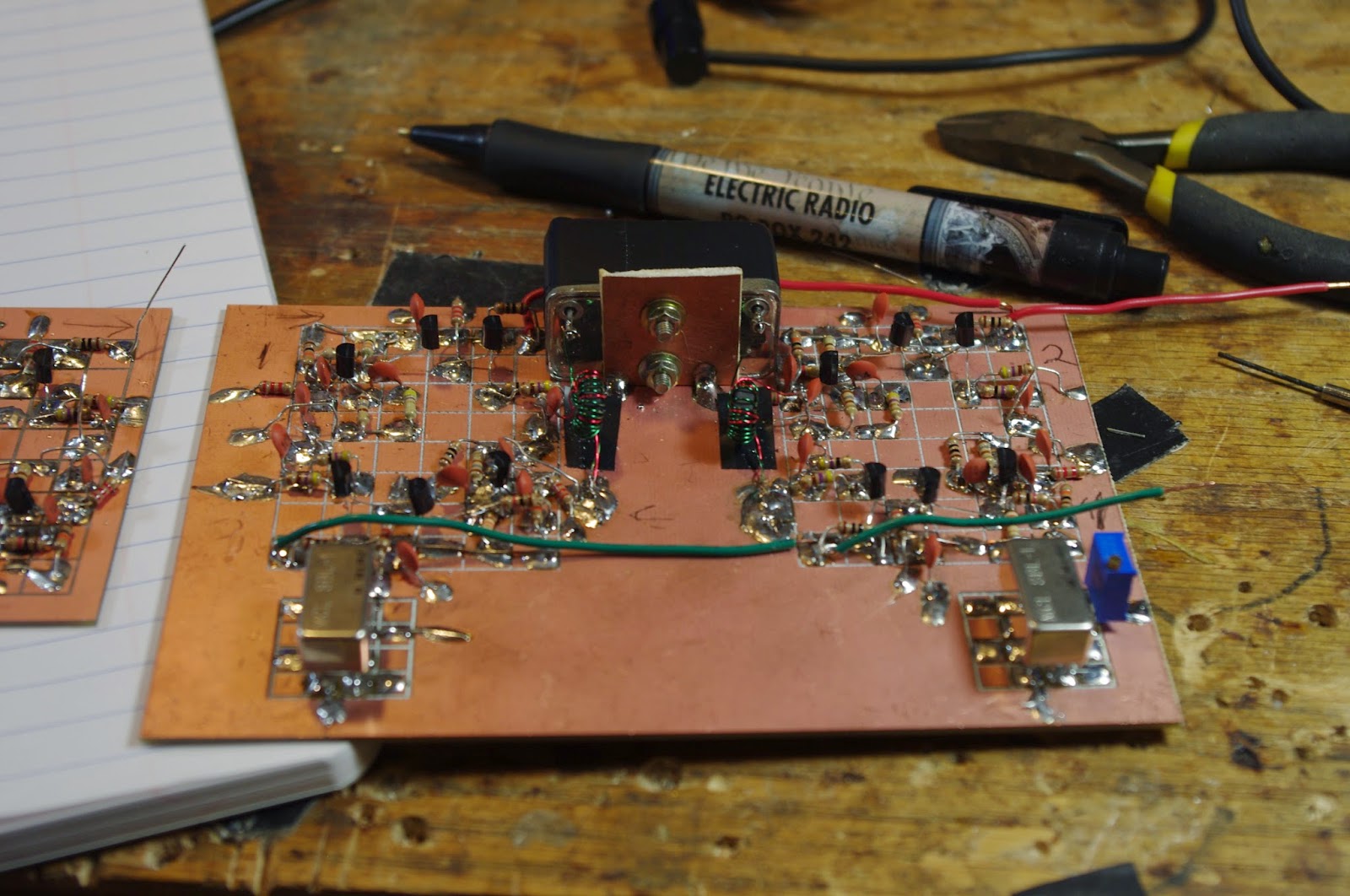
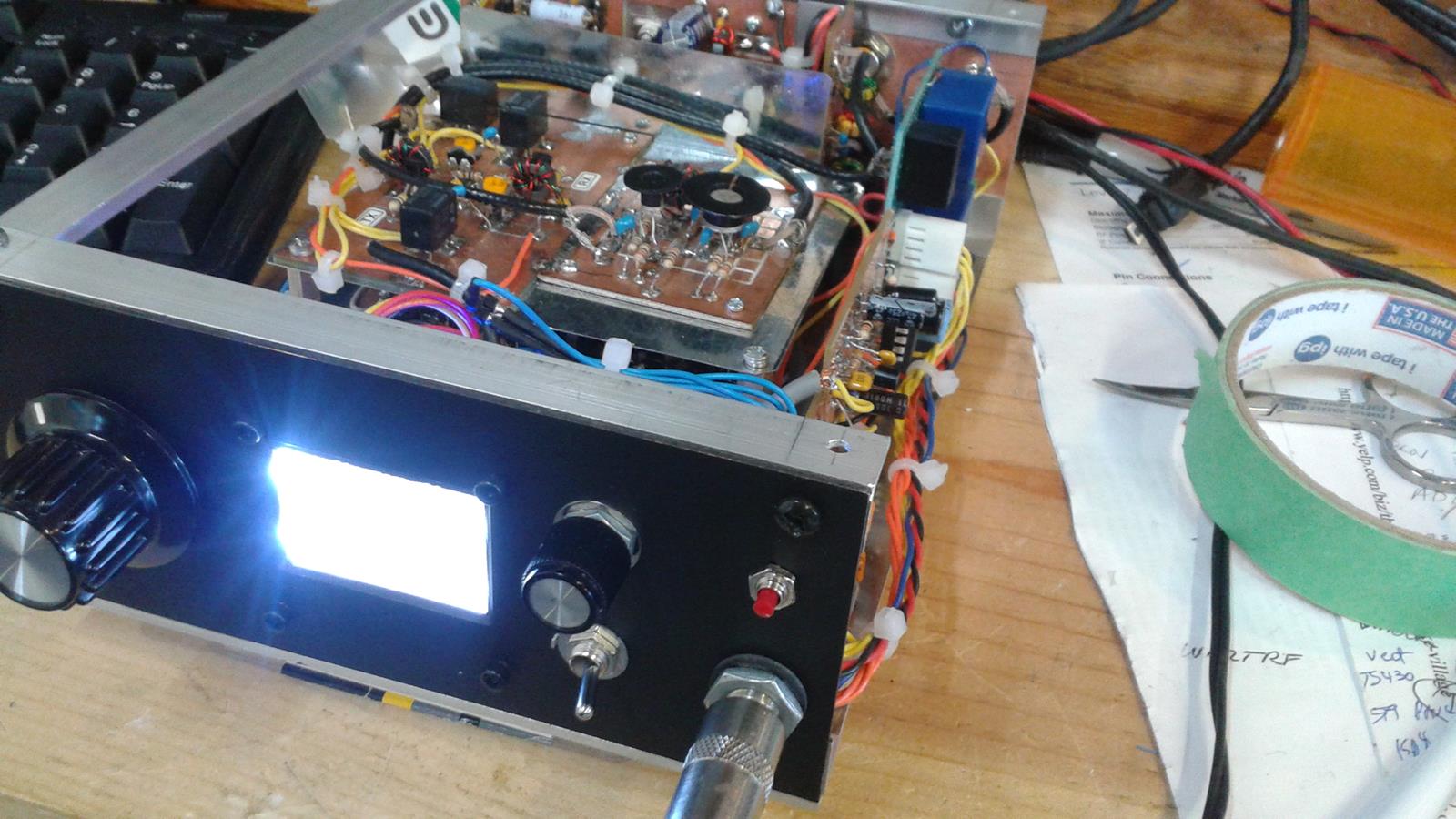
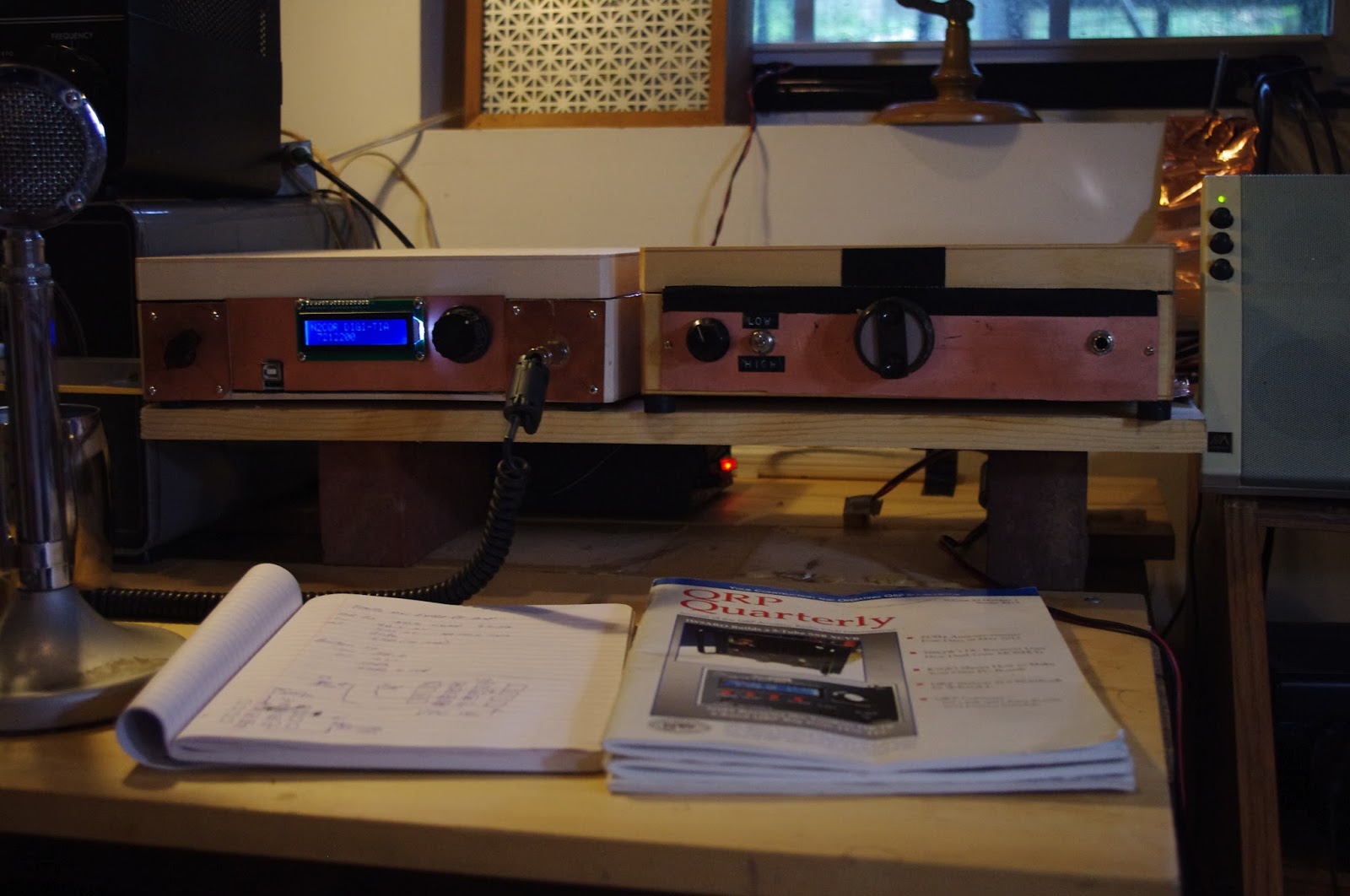
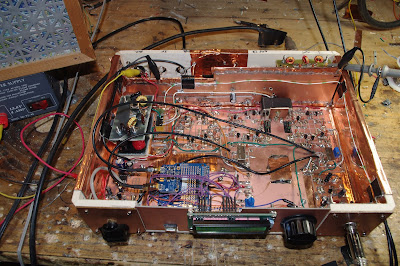
Lots of progress over the long weekend. Along the back you can see the three stages of the RF amplifier chain: 2N3904, 2N2218A, IRF510. I intend to add inter-stage shielding, and one long shield between the chain and the rest of the rig. Front and center is the Si5351 board (code by LA3PNA). Mic amp (which gave me a lot of trouble!) is to the right of the Si5351. AF (RX) amp is to the left (2N3904 and LM386). The big board in the center has the three Termination Insensitive Amplifiers (thanks Wes and Bob), the 9 MHz filter (thanks Steve Smith!) and the two SBL-1 mixers (thanks to Pete Juliano for the “mil-pad ” boards). And thanks to Farhan for the overall BITX concept and the TIA suggestion.
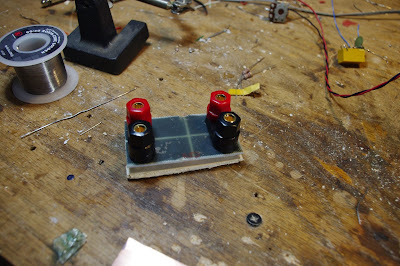
In the upper right you will see where the plug-in low-pass filter will plug in (a better picture appears below). I will use a similar plug-in for the band-pass filter. Combined with the BFO/VFO flexibility of the Si5351, this plug in feature should allow me to cover many bands with this rig. 

Our book: “SolderSmoke — Global Adventures in Wireless Electronics” http://soldersmoke.com/book.htm Our coffee mugs, T-Shirts, bumper stickers: http://www.cafepress.com/SolderSmoke Our Book Store: http://astore.amazon.com/contracross-20
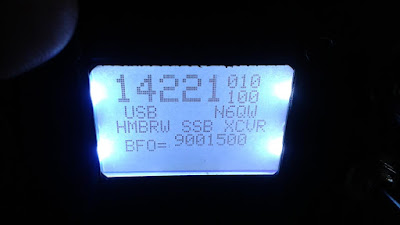
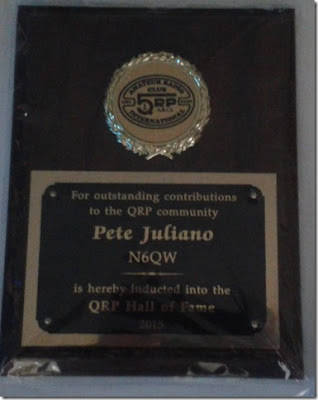
Pete Juliano, N6QW, Inducted into the QRP Hall of Fame

Reliable sources in Dayton, Ohio and in the United Kingdom report that Pete Juliano, N6QW, has been inducted into the
QRP Hall of Fame.
Wow, that’s great news!
Richly deserved!
Congratulations Pete!

Our book: “SolderSmoke — Global Adventures in Wireless Electronics” http://soldersmoke.com/book.htm Our coffee mugs, T-Shirts, bumper stickers: http://www.cafepress.com/SolderSmoke Our Book Store: http://astore.amazon.com/contracross-20
SolderSmoke Podcast 176: Knack-Related Conditions: Termination Insensitivity, Sideband Inversion, Dongle Modification, Area 5351 Conspiracy Disorder

SolderSmoke Podcast #176 is available! (And it is GOOD!)

http://soldersmoke.com/soldersmoke176.mp3

16 May 2015

Bench Update:
Pete releases some magic (amplifier) smoke
Pete’s new termination-insensitive transceiver makes first contact
Bill goes Yaesu (well, just a filter)
Juliano Mill-Pad boards
Termination Insensitivity is not a personality disorder!
Flip those Bilat Boards! Pete’s cool technique for bilat building
Bill’s project notebook and stage testing
Installing the W6JFR EMRFD SBL-1 Bal-Mod Mod

AREA 5351: Myths, Urban Legends, and Conspiracy Theories about the Si5351

A Rule of Thumb for Sideband Inversion

Dongle Madness and the Dangers of Dongle Modification
What is a dongle?
24 Mhz to 1.7 GHz right out of the box
Modification for 0-29 MHz
Tapping the IF of a Drake 2-B
Getting another one for VHF-UHF
Dongling Meteors, Satellites and Airplanes

SPRAT cover AD9850 in 1988! Three cheers for SPRAT (and QQ and QST).

Elecraft’s new Rig

Our book: “SolderSmoke — Global Adventures in Wireless Electronics” http://soldersmoke.com/book.htm Our coffee mugs, T-Shirts, bumper stickers: http://www.cafepress.com/SolderSmoke Our Book Store: http://astore.amazon.com/contracross-20
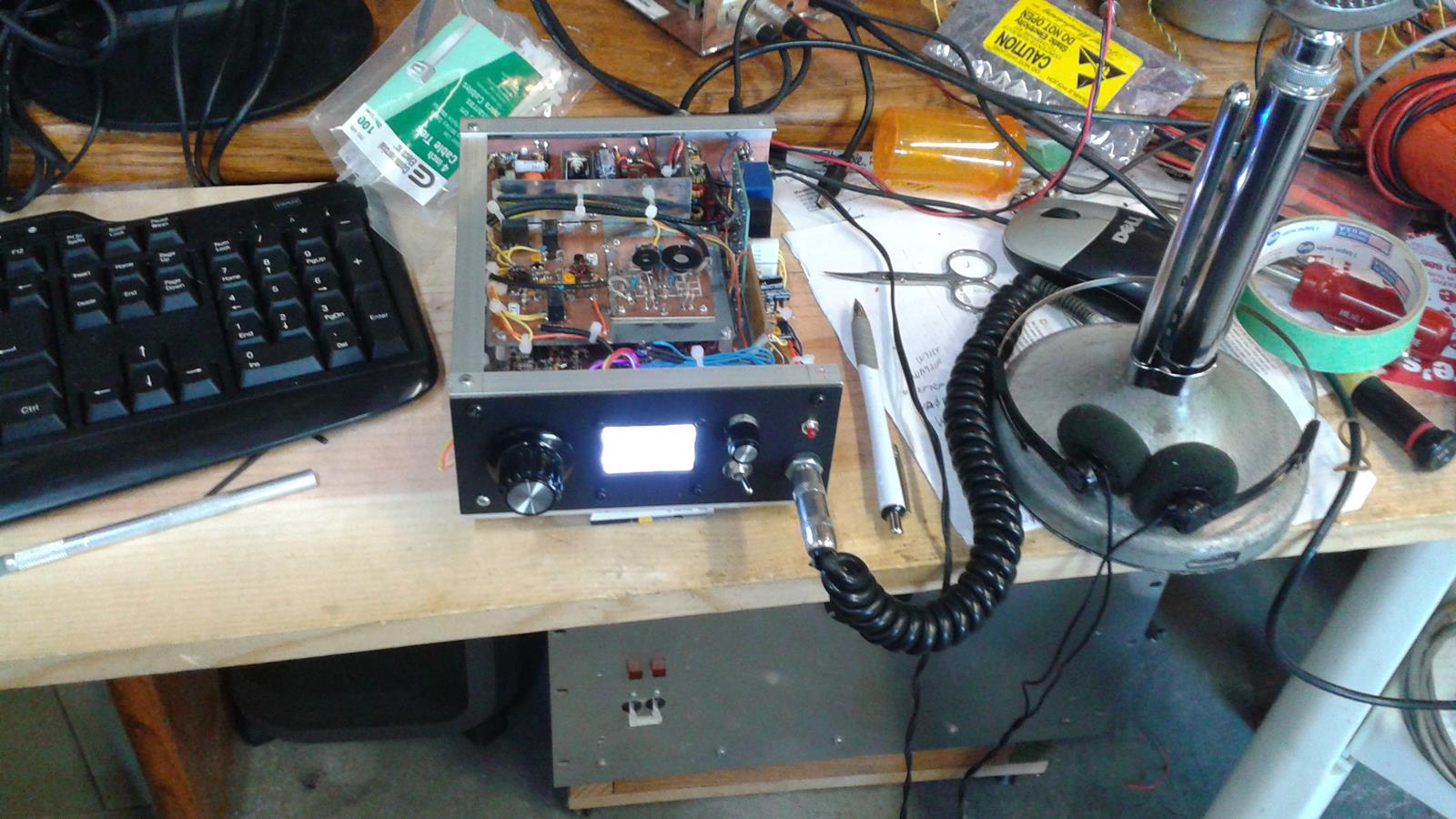
SolderSmoke Podcast 176: Knack-Related Conditions: Termination Insensitivity, Sideband Inversion, Dongle Modification, Area 5351 Conspiracy Disorder

SolderSmoke Podcast #176 is available! (And it is GOOD!)

http://soldersmoke.com/soldersmoke176.mp3

16 May 2015

Bench Update:
Pete releases some magic (amplifier) smoke
Pete’s new termination-insensitive transceiver makes first contact
Bill goes Yaesu (well, just a filter)
Juliano Mill-Pad boards
Termination Insensitivity is not a personality disorder!
Flip those Bilat Boards! Pete’s cool technique for bilat building
Bill’s project notebook and stage testing
Installing the W6JFR EMRFD SBL-1 Bal-Mod Mod

AREA 5351: Myths, Urban Legends, and Conspiracy Theories about the Si5351

A Rule of Thumb for Sideband Inversion

Dongle Madness and the Dangers of Dongle Modification
What is a dongle?
24 Mhz to 1.7 GHz right out of the box
Modification for 0-29 MHz
Tapping the IF of a Drake 2-B
Getting another one for VHF-UHF
Dongling Meteors, Satellites and Airplanes

SPRAT cover AD9850 in 1988! Three cheers for SPRAT (and QQ and QST).

Elecraft’s new Rig

Our book: “SolderSmoke — Global Adventures in Wireless Electronics” http://soldersmoke.com/book.htm Our coffee mugs, T-Shirts, bumper stickers: http://www.cafepress.com/SolderSmoke Our Book Store: http://astore.amazon.com/contracross-20
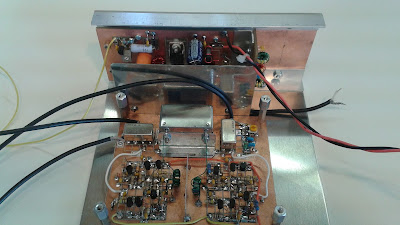
BITX DIGI-TIA Build Update #2 Installing and Testing Yaesu SSB Filter

Termination Insensitivity. It sounds like some sort of psychological problem, but it is not!

Our book: “SolderSmoke — Global Adventures in Wireless Electronics” http://soldersmoke.com/book.htm Our coffee mugs, T-Shirts, bumper stickers: http://www.cafepress.com/SolderSmoke Our Book Store: http://astore.amazon.com/contracross-20
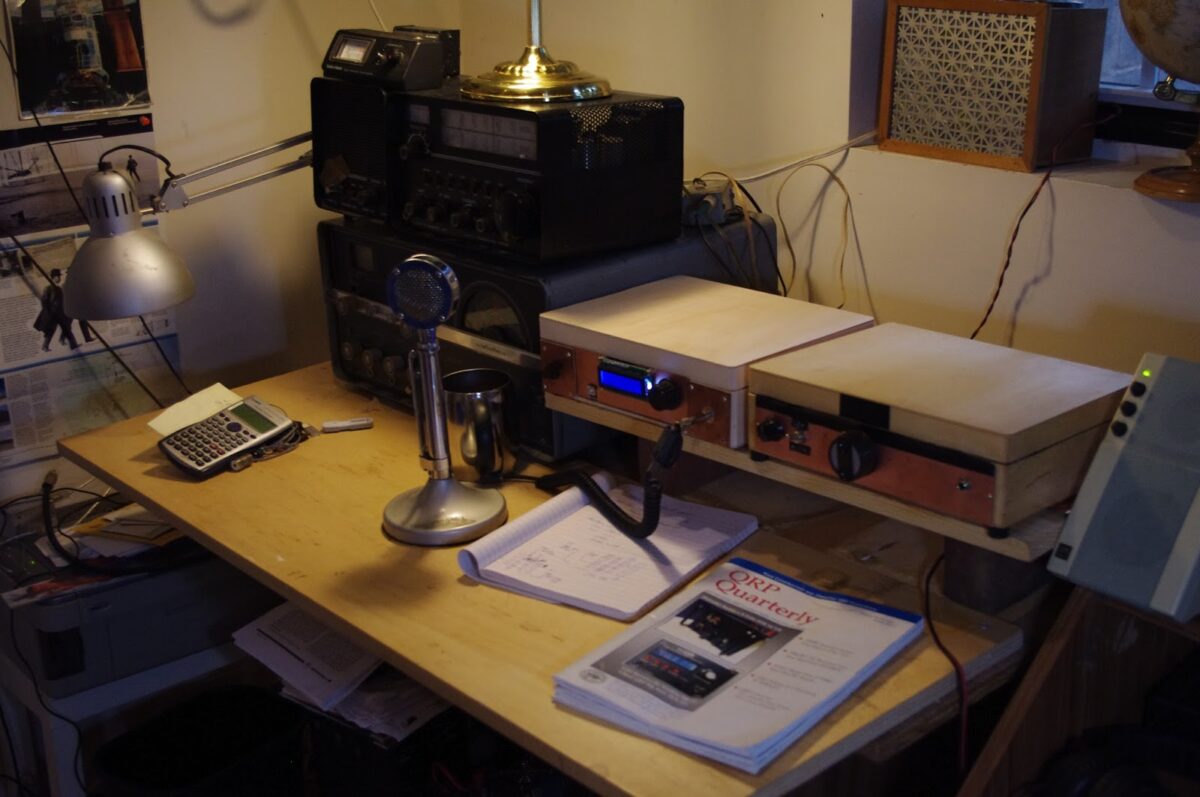
BITX DIGI-TIA Build Update #1 Building the First 2 TIA Amplifiers

I started building the new transceiver today. I am tentatively calling it the BITX DIGI-TIA. Digi because it will have at its heart an Si5351 for BFO and VFO signal generation, and TIA because it will use Termination Insensitive Amplifiers (TIAs). These TIA amps are designed to present a 50 ohm impedance not matter what impedance you connect to the other end. This is a very useful feature when you are trying to get a certain impedance for a crystal filter in a bidirectional rig — you want the same termination impedances in both directions.
I built the “top” halves of two of the TIAs, using CNC-cut boards given to me by Pete Juliano. Thanks Pete! I like the boards, and I no longer have a thick coating of dried SuperGlue on my fingers.
Both amps seem to be performing very well. Some numbers:
Current draw at 12 V (no signal) 30 ma.
Gain at 9 MHz (no load): Amp 1: 27.2 db Amp 2: 26.5 db.
I then took a 110 ohm load and put it across the output of Amp 1. Gain dropped to 23.9 db (as you’d expect). BUT HERE’S THE GOOD PART: The input voltage from my homebrew sig generator stayed exactly the same. Termination insensitivity.
More on these amps (with a link to Wes’s article) here:
Next I’ll put the 9 MHz filter between these amps and measure the shape of the filter passband.


Our book: “SolderSmoke — Global Adventures in Wireless Electronics” http://soldersmoke.com/book.htm Our coffee mugs, T-Shirts, bumper stickers: http://www.cafepress.com/SolderSmoke Our Book Store: http://astore.amazon.com/contracross-20
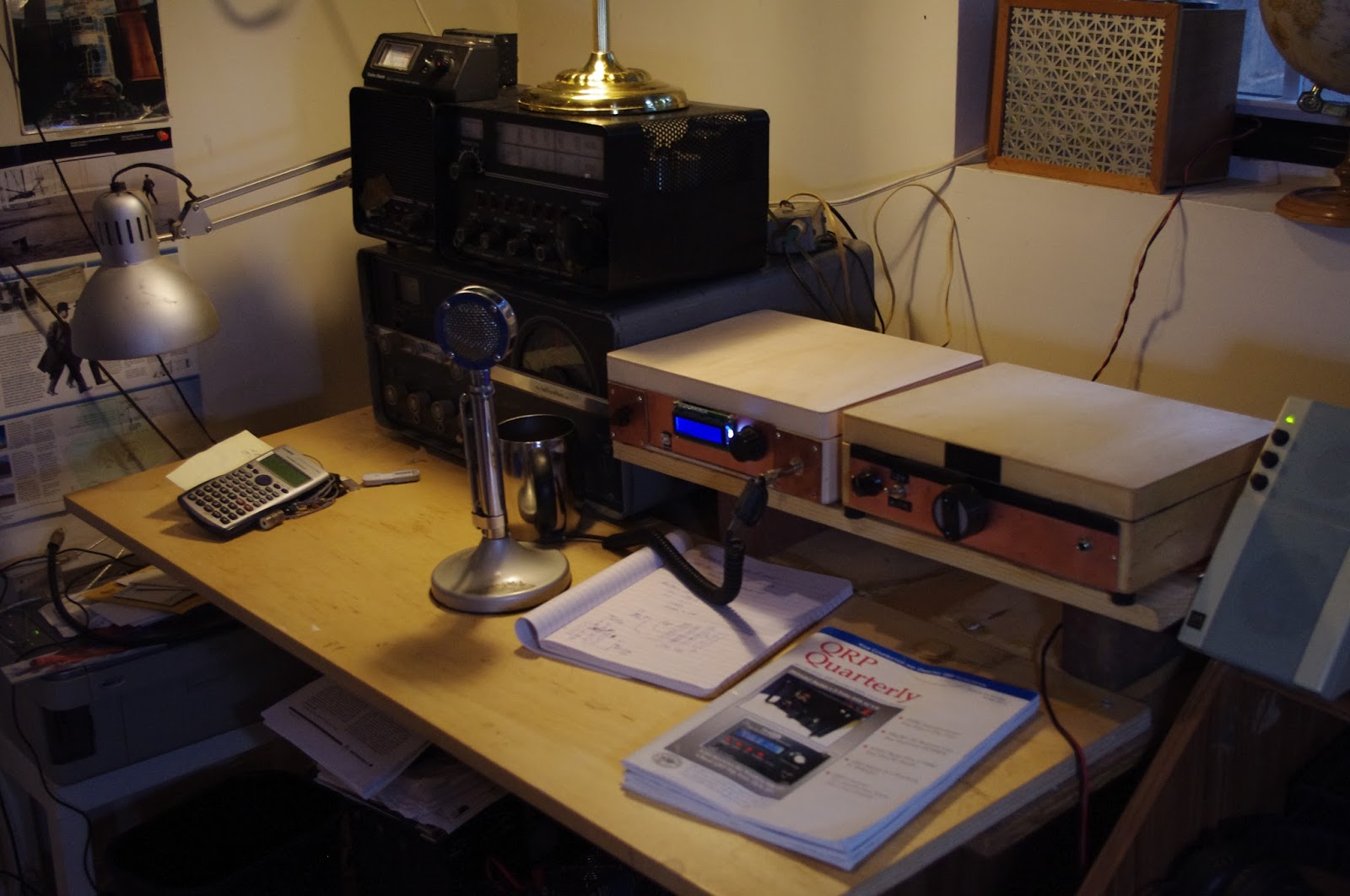
IF Selection — Which Filter for the New Rig?

With some prodding from Pete Juliano, I am moving forward on my next transceiver. Same wood box enclosure (with copper flashing), but this time I am greatly relaxing some of the radical fundamentalist restrictions: Chips will be allowed. VFOs and VXOs will be replaced by an Si5351. Filters will not have to be homebrew. Pete has been putting his CNC machine to use and making me some nice boards with isolation pads already milled in. Oh, the luxury!

I am going to use the Termination Insensitive Amplifiers designed by Wes Hayward and Bob Kopski back in 2009. These are especially useful in bilateral type transceivers because they allow you to nail down the termination impedances on the crystal filter IN BOTH DIRECTIONS. That’s is important if you want the same filter shape on both transmit and receive.

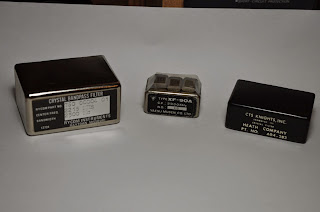
But now, with the trauma of my unfortunate IF selection on the BITX 20/40 (now just 20, sniff…) in mind, what filter should I use on this rig? The three main candidates appear above. The 9 MHz Yaesu filter was given to me some time ago by Steve “Snort Rosin” Smith. The Heath filter (3.395 MHz) and the larger silver one (2.215 MHz) were given to me by Armand Hamel. (Thanks Guys!)

My main band of interest for this rig is 40. But if possible, I’d like to be able to use it on 15 and 12 meters, and maybe even 20 and 17, hopefully without having to change filters.

So what say the gurus? Which one should I use? Or should I put two of them in there, with provisions that would make it easy for me to move from one to the other?

Right now my inclination is to go with the 9 MHz filter, perhaps with the 3.395 MHz filter also available.

Our book: “SolderSmoke — Global Adventures in Wireless Electronics” http://soldersmoke.com/book.htm Our coffee mugs, T-Shirts, bumper stickers: http://www.cafepress.com/SolderSmoke Our Book Store: http://astore.amazon.com/contracross-20
“Basta Blues” with Pete Juliano on the Guitar

What makes this short video special is the fact that the music was all completely designed (composed) and homebrewed (played) by Pete himself.

From Pete:

In Italian when one has finally had enough –the Hue and Cry is BASTA! I have been having some Basta Moments in trying to make Arduino 1.6.3 work with sketches developed in Version 1.0.5.

So for some comic relief I decided to program a 240X320 Color TFT with a random pattern generator using the word Basta! Of course is was done in Arduino 1.0.5!
Pete N6QW

Our book: “SolderSmoke — Global Adventures in Wireless Electronics” http://soldersmoke.com/book.htm Our coffee mugs, T-Shirts, bumper stickers: http://www.cafepress.com/SolderSmoke Our Book Store: http://astore.amazon.com/contracross-20
SolderSmoke, ArduinWoes, and BrainwagonBastas!

It might not be apparent, but I have it on good authority the guy with the blue face pulling the Brainwagon was saying “BASTA!” when this drawing was made, probably after an evening spent with Arduinos and their fascinating I2C libraries.

Mark, K6HX, kindly offered to help us with our ArduinWoes (painful details are available in SolderSmoke Podcast #175). Mark went to the trouble of getting the display and I2C backpack that have been giving us trouble, and then went and did a lot of testing to find the origins of the problems. He has written this all up in two brilliant blog posts:

http://brainwagon.org/2015/04/21/a-not-entirely-simple-lcd-display-for-the-arduino/

http://brainwagon.org/2015/04/22/using-a-sainsmart-lcd-panel-with-the-arduino-1-6-3-ide/

You will notice that Mark has made quite liberal use of the word “basta.” As Pete has noted, in order to get the full effect of this very therapeutic Italian word, you have to make use of the correct hand gesture. Veronika nails it at about 1:28 in this video (WARNING: VERONIKA CAN BE QUITE EXPLICIT):

Thanks Mark for all your help on this. I’m not sure if we are entirely out of the woods yet, but it is reassuring that we are not the only ones screaming…

.

Our book: “SolderSmoke — Global Adventures in Wireless Electronics” http://soldersmoke.com/book.htm Our coffee mugs, T-Shirts, bumper stickers: http://www.cafepress.com/SolderSmoke Our Book Store: http://astore.amazon.com/contracross-20
Once again, into the digital morass…

Well, it has happened to me yet again: After a somewhat happy period of stubborn luddite rejection of digital technology, yesterday I decided to jump into the fascinating world of Si5351 PLL chips. I don’t have to tell you who is responsible for this decision. But he is of Italian descent and lives in Southern California.

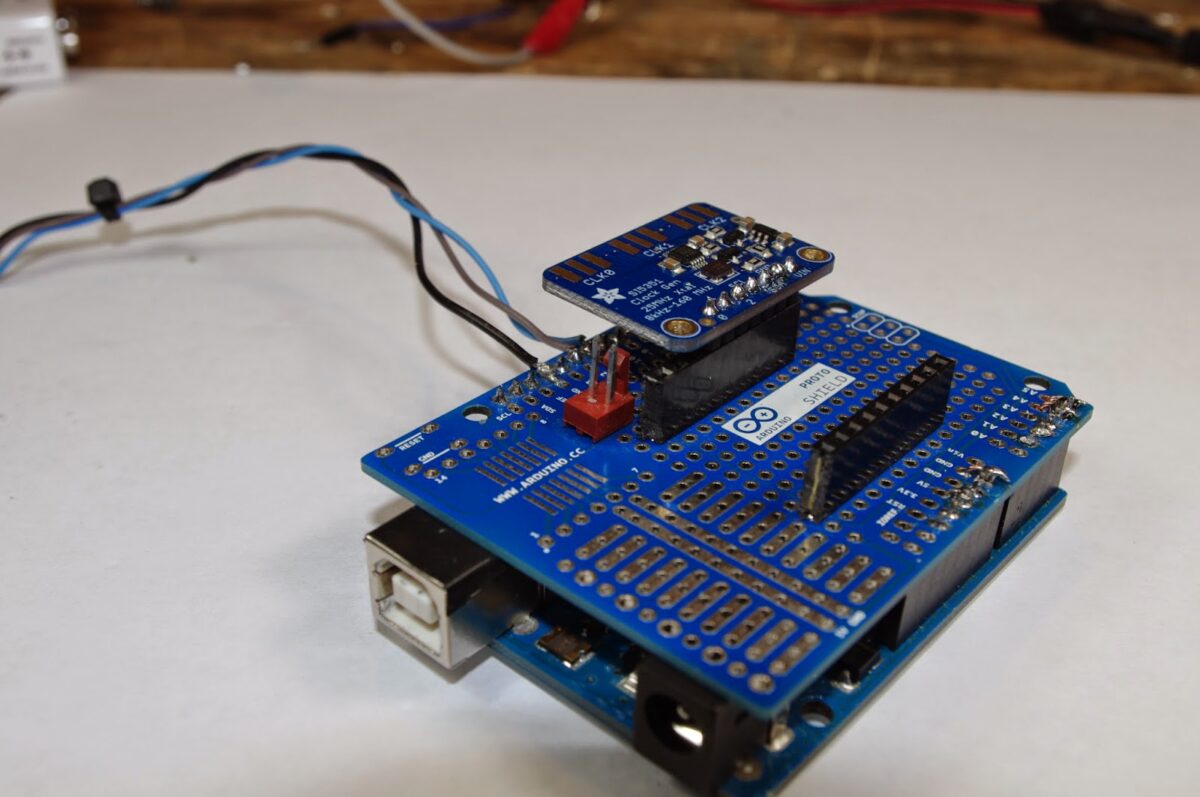
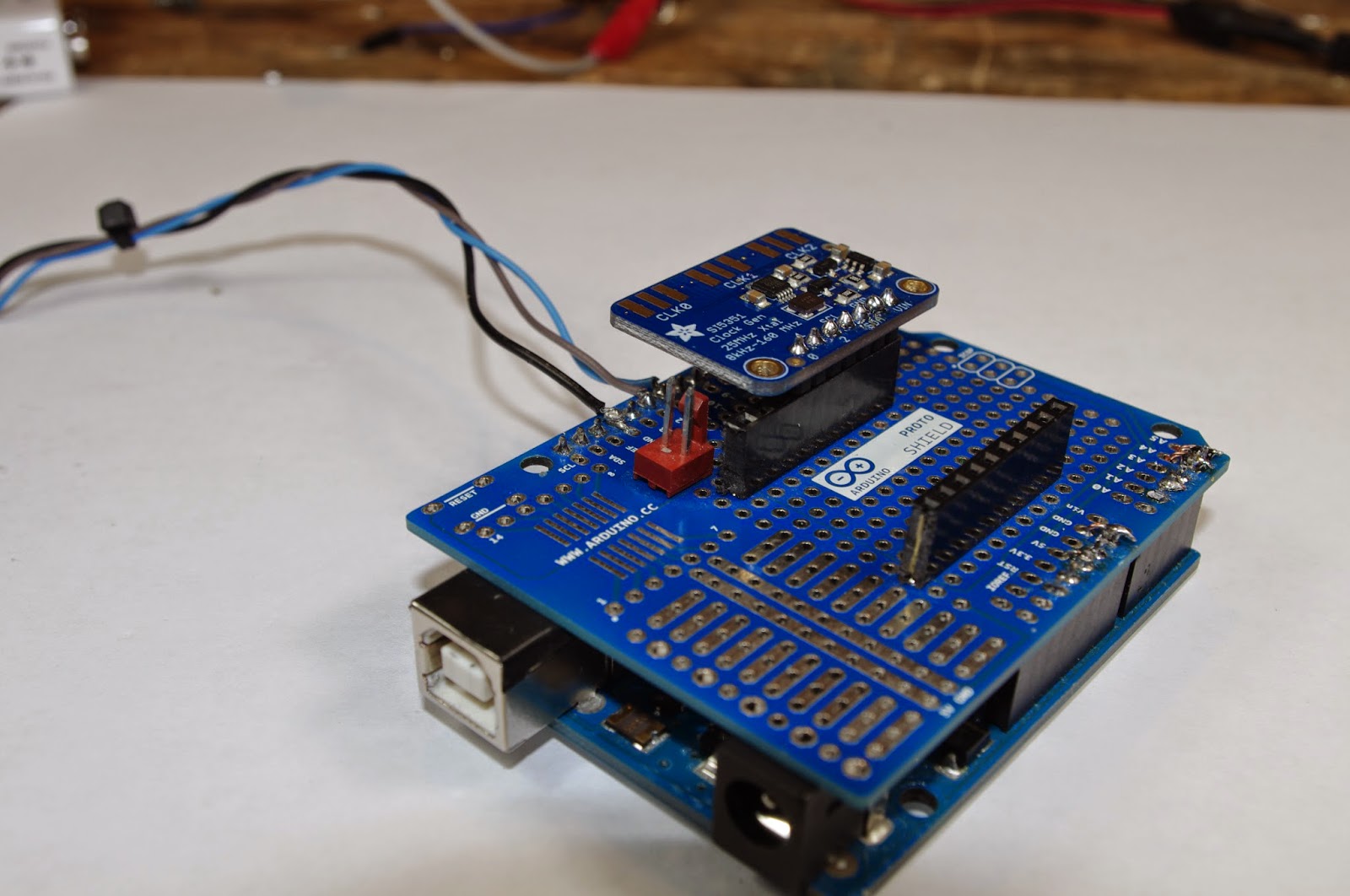
I’m working with an Arduino Uno board and a prototyping shield sent to me by the same Italo-Californian gentleman. The physical wiring of the Si5351 was remarkably easy — just four connections. Wow, I thought, this is going to be easy. WRONG.

Lady Ada’s sketch and library compiled and uploaded without difficulty and the little device was simultaneously spitting out 125 MHz, 13 MHz, and 10 kHz energy. Pretty cool.

But I got into trouble when I tried to load some of the VFO circuits out there. Most of the trouble was caused by my errors in managing all the libraries and such. But as I was telling Billy, it really seems to me that the folks who work on this stuff are using another language. And the problem is that it is a NON-HUMAN LANGUAGE. If it were French or even Chinese, it would probably be easier. But you end up getting error “messages” like “U-int-8 has not been declared!” Oh, I see. I found myself thinking back fondly to my recent problems on 40 meters with the screeching amp and the helpful ESSB guys. Ah, the good old days.

So, I’m not going as far as declaring microcontrollers to be demonically possessed (remember the regens?) But I do suspect extraterrestrial involvement in these little devices.

In the end, I got several of the VFO sketches working. You get a sense of how new the Si5351 VFO work is when you find yourself using code that was written last week or last month. Thanks to Lady Ada, Pete N6QW, Jason NT7S, Tom AK2B, and Thomas LA3PNA. All of these folks are doing great work, moving the radio art forward (even if they are working with ET).

Our book: “SolderSmoke — Global Adventures in Wireless Electronics” http://soldersmoke.com/book.htm Our coffee mugs, T-Shirts, bumper stickers: http://www.cafepress.com/SolderSmoke Our Book Store: http://astore.amazon.com/contracross-20
The Slaughter of Inductors, Capacitors, and Crystals Continues…

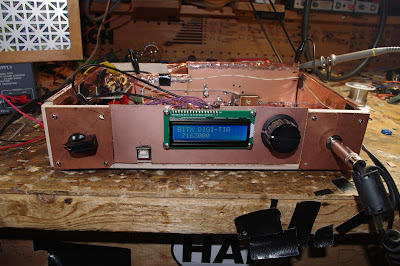
Oh the humanity! Pete Juliano has turned his digital attention to previously completed projects. Perfectly fine rigs — whose only crime was that they used LC or crystal (VXO) oscillators — are now being ARDUINOED by the maniacal Dr. Juliano. Not even Huff and Puffs will be spared. This is like the French Revolution! We hear that Pete has even mastered the art of cutting the square holes that are needed for his “displays,” so there is no stopping him now. 

Our book: “SolderSmoke — Global Adventures in Wireless Electronics” http://soldersmoke.com/book.htm Our coffee mugs, T-Shirts, bumper stickers: http://www.cafepress.com/SolderSmoke Our Book Store: http://astore.amazon.com/contracross-20