A Homebrew Italian Space Program

Peter, VK3PB, alerted me to the six YouTube videos about the Judica Cordiglia brothers of Turin, Italy. These guys were young and enthusiastic amateurs when the space race began in the late 1950s. They quickly developed some very impressive monitoring facilities that allowed them to listen to both US and Soviet space missions.

Watch these videos and you will not only get a look at the technical work of these intrepid and skilled amateurs, but you will also get a sense of the many intangible things that make Italy such a special place. You’ll get a sense of the human warmth, the friendship, the enthusiasm and fun that characterize life here.

They had the foresight to film a lot of their youthful technical adventures. The videos take us back to the Italy of the late ’50s and early 60’s. (That roof that they built their antenna on looks EXACTLY like mine!)

Don’t miss these videos. They are really wonderful. Here are the links (if you have trouble, just search YouTube for “Space Hackers 1/6” “Space Hackers 2/6” etc.

http://www.youtube.com/watch?v=1F_67UAaG70
http://www.youtube.com/watch?v=N-y2DuYNxm4
http://www.youtube.com/watch?v=s8sElZpvzRU
http://www.youtube.com/watch?v=wcGPXZPYHNs
http://www.youtube.com/watch?v=A9kiSMcrqRg
http://www.youtube.com/watch?v=WUT-eZH0860

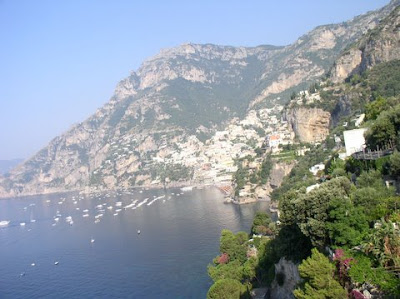
Italy Travel Report: Positano

We were down on the Amalfi coast this week, near Positano. This is on the southern coast of a beautiful peninsula that juts out into the Med, a bit South of Naples. I brought a SW receiver with me, but didn’t hear too much. We did some fishing, down near the boats you see in the picture. This was the view from our window. I’ll mention this in SolderSmoke 89 (probably tomorrow), so I thought I’d put a picture on the blog.

Over the Alps with 5 Milliwatts and Solar Power


Yesterday morning the lower portion of the 30 meter QRSS band was dominated by three Italian stations: Near the bottom of ON5EX’s grabber screen was the very clear and FB CW of Fabio, IK0IXI. Fabio runs about 50 milliwatts to a Windom and operates from Civitavecchia, a beautiful coastal town about 20 miles from Rome. Here you can take a look at his rig, and his schematic: http://www.geocities.com/ik0ixib/bcn.html A bit further up were the droopy dashes of yours truly, 200 mw (QRO!) to my all-purpose end-fed wire. And a bit further up from me was the very interesting signal of Paolo, IZ1KXQ. Paolo runs 5 milliwatts from a super-simple solar powered rig (see above) that resides on the roof of his house. It puts out a distinctive square wave sig.

IKoIXI’s crystal is in an oven and is temperature stabilized. He stays on the same freq all day. We’ve found that my signal seems to drift down in freq during the course of the day, as Rome heats up. It moves about 15 hz down from early morning to afternoon. IZ1KXQ’s rig is more exposed to the heat, and seems to move quite a bit more, and his sig moves UP in freq. I think this drifting adds to the QRSS fun.
FB Paolo! FB Fabio!

Here is IZ1KXQ’s schematic:

Jason, the Argonauts, and QRP

You don’t often find beauty in software read-me files, but I found some in those of I2PHD and IK2CZL. Take a look at this. It is from the read-me file for a Slow Speed CW program:
—————————-

ARGO -- A QRSS Viewer by I2PHD & IK2CZL

Argo is program for viewing QRSS signals, i.e. very
slow CW, or DFCW signals, i.e. slow CW where dots and
dashes are of the same length, but offset in frequency
by a few Hertz, or even a fraction of an Hertz.

The name Argo is taken from that mythical ship which,
with the Argonauts on board, headed to Colchis,
in the quest for the Golden Fleece, much like the LF
Hams are in search of that fraction of dB of S/N which
will allow them to make that elusive QSO.

--------------------------

Here is where you can get the Argo software.
Free! And lots of other good programs
(check out Spectran):

http://www.weaksignals.com/

Bravo Alberto! Grazie!

The I-QRP Club Magazine

The Italian QRP Club (I-QRP) has a very nice quarterly bulletin. They have recently started to present a good portion of the articles in both Italian and English. The May 2008 edition is very FB, with many good articles, including one on impedance matching with broadband transformers.
Thanks to the I-QRP Club for making this available to hams around the world!

Here’s the link:

http://www.arimontebelluna.it/i_qrp/bollettino.htm

The only station on 80 in Rome at 0430 local: W1AW… then K1JJ

I was up earlier than usual this morning (my Italian ham friends think my schedule is totally nuts!). As usual, I tuned across 80 — it seems 0430 is a bit too early even for the hardcore fanatics who can be heard starting at around 0530 local. But there was one CW signal distinctly audible: good old W1AW, pounding out code practice close to the color burst frequency.

A bit later I tuned up around 3.8 Mhz, where the DXers hang out. There I heard a familiar call (and voice!) from the homeland: K1JJ. I used to listen to OM JJ on 75 Meter AM. What a signal he has in Europe! The Italians were all saying “Mama mia!” And what an antenna! From JJ’s web site (at QRZ.com) :

NE/Europe: Dual quads system. (4 elements total) A two-element quad on a 40′ boom at 190′ high (63 meters) phased to a second identical two-element quad at 190′ high on a separate tower. These two-element quads are spaced 1.17 wavelengths apart from each other, (spaced 100 meters apart) beaming broadside to Europe. The horizontal pattern is narrow, only about 35 degrees wide because of the collinear gain…intended for central Europe. The two quads are fed with equal length coaxial hard-lines that are run into the shack, and connected in-phase. The take-off angle is about 28 degrees, much like a flat, horizontal Yagi at 135′ high. The AVERAGE height of the quad loops dictates this take-off angle.

I went out for pizza last night with I0YR, IK0JNI, and IK0ZMH. We had a great time.

From Sicily: An SSB Transceiver using only 5 tubes!


It’s 5:30 am. I’m in the shack with a cup of coffee. The only sounds are birdsongs from the window and an Italian 80 meter SSB QSO from my Drake 2-B. Life is good.

And it got better when I found the rig pictured above. It is the work of Andrea IW9HJV and Johnny IW9ARO, two obvious victims of “The Knack” from Sicily.

It is a beautiful 20 meter SSB transceiver. And it uses just 5 tubes. While it doesn’t have the bi-directionality of the BITX-20 (you can’t really do that with tubes) it does share the BITX-20’s simplicity and elegance of design.

The web site of Andrea and Johnny is another work of art. Check it out!
http://www.webalice.it/hotwater/RTX5x20.htm
Bravo Andrea! Bravo Johnny! Bravissimo!