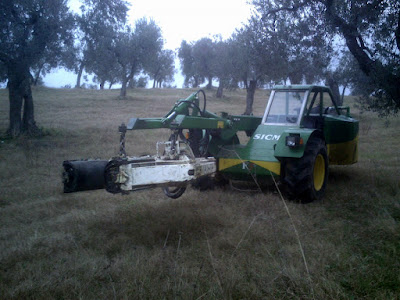
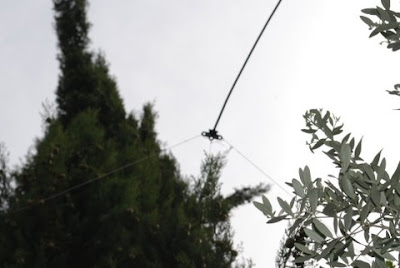
 No, not from the digital mode. The interference was from the harvesting of real olives. We were out in the country on Tuesday (Italian holiday) and I was on the air with the HW-8. The backup alarm from the machine pictured above occasionally confused my copying of the CW. But it is a very interesting machine. It grabs the base of the olive trees with that rubber-covered gripping device, then it shakes them violently until all all the ripe olives are let loose. The ground shakes during the process. In spite of the QRM, 20 meters was sounding quite good in the afternoon, with many strong sigs from the USA, and one very stong VK6. Go sunspots!
Category: Italy
No Smoke, but stars, an HW-8, and one (dead) Cinghiale!
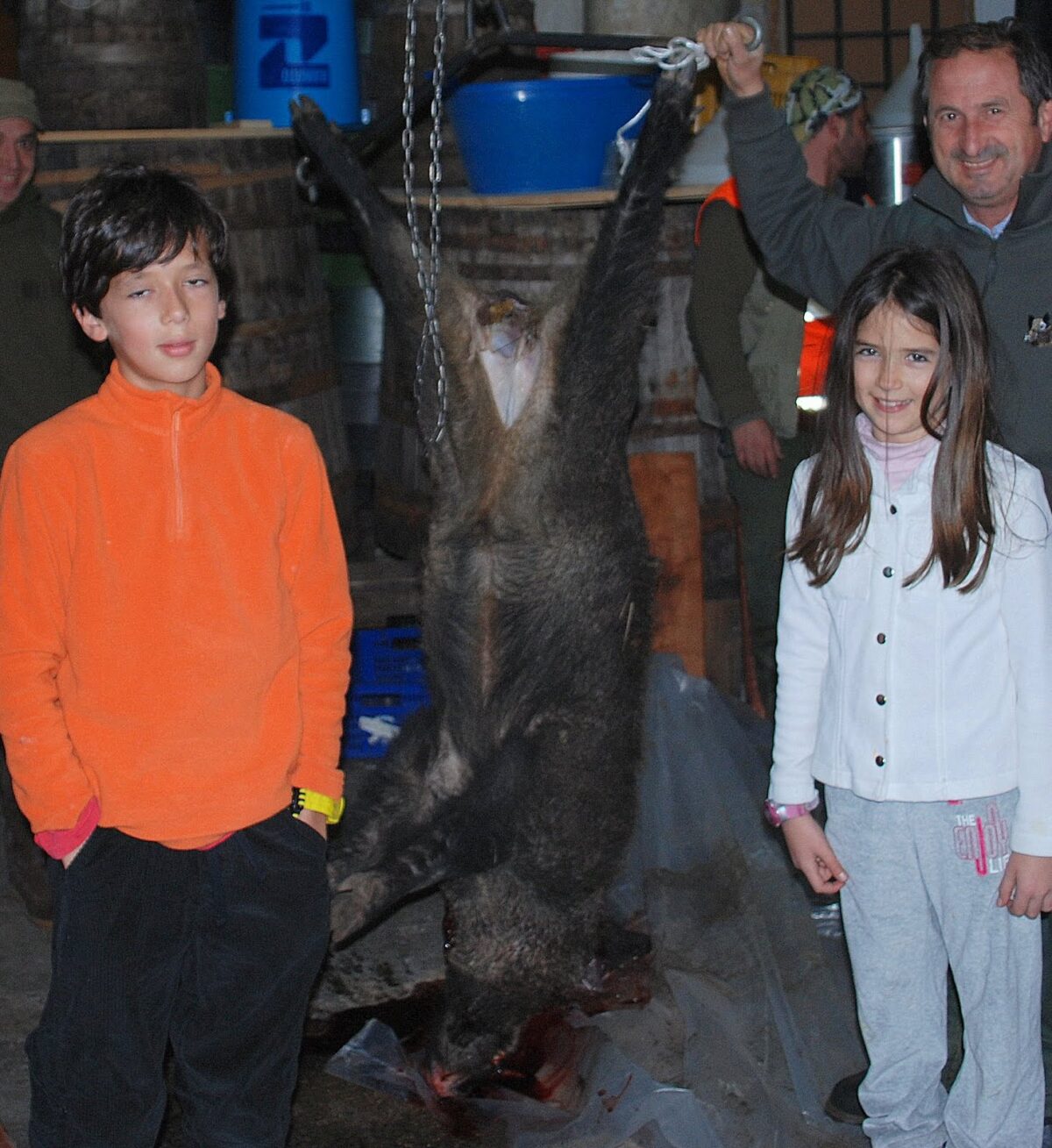
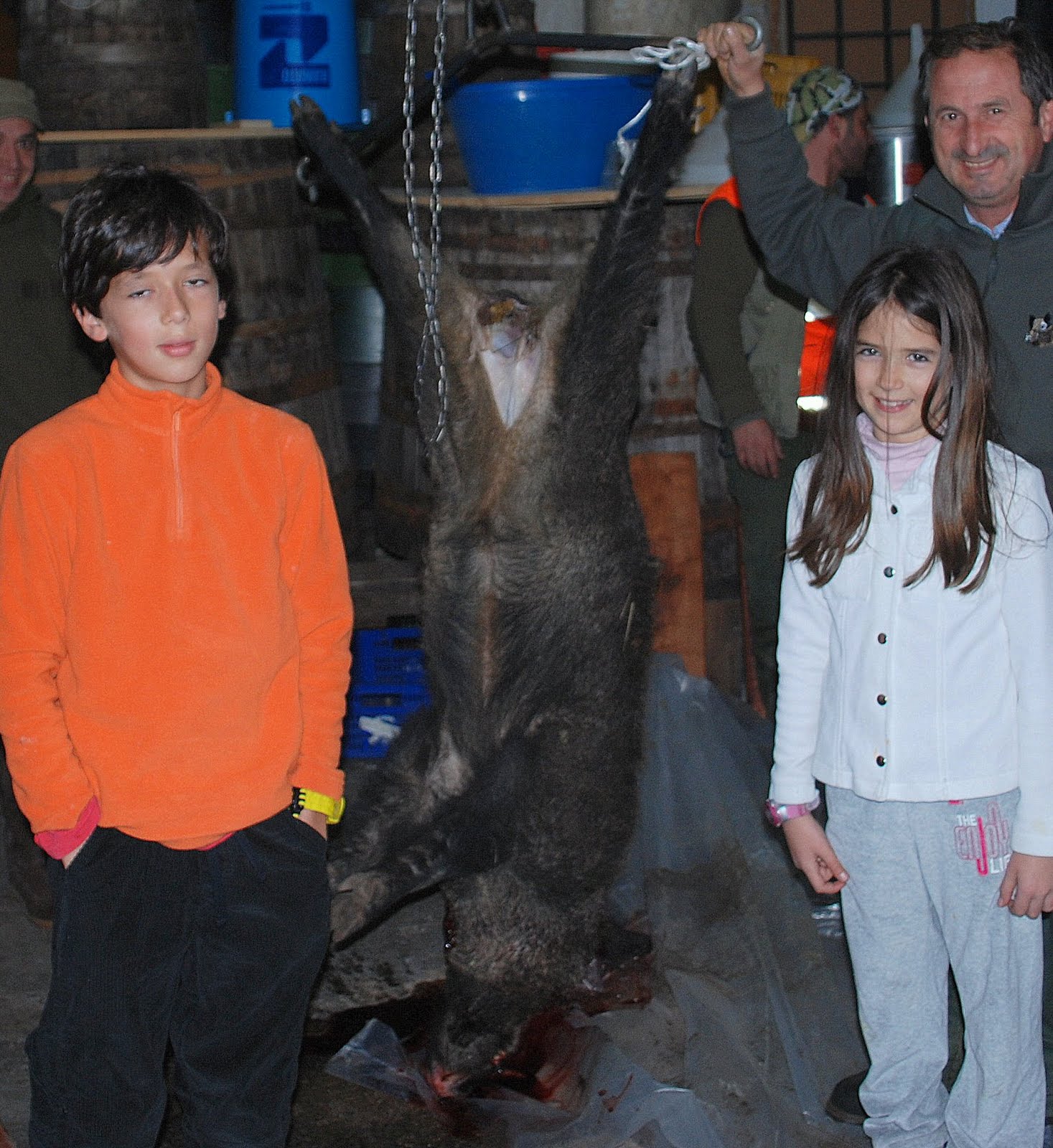 No podcast today — we were out in the country. As you can see from the picture above, the question of just how big the Sabina wild boars really are has been answered. The one pictured above was shot today very close to our country place (neither Billy nor Maria did the shooting!) The hunters tell us that this one was considered a big one. As you can see, it is about the size of Billy.
I had the telescope out this weekend — we were looking at the moon, Jupiter, Mars, and the Orion nebula. Also watched a satellite going over shortly before dawn. And one meteor.
I was on the air a bit, on the CQ WW DX contest. Worked about six stations. Was on 40, 20, and 15 with the HW-8.
I will try to get SS 119 out as soon as I can. I hope all you turkey eaters had a good holiday.
SolderSmoke Podcast #118
 http://www.soldersmoke.com
In SolderSmoke 118:
15 November 2009
Trip to the North of Italy — All the way to Trieste!
SSSSS SSSSSSolution?
Playing with PSK-31 — Shortwave Watching
I0/N2CQR wins CQ WW DX! (QRP, HB, DSB category)
New England Code Talker
Monitoring Apollo 11
Adventures in Surface Mount Soldering with Softrock 40
MAILBAG
“El Silbo”: Michael Rainey’s Amazing Voice-Powered DSB Transmitter
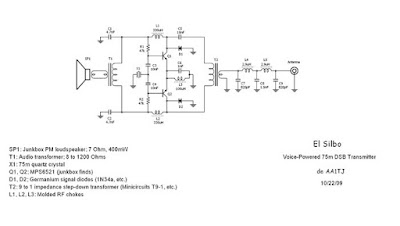
Oh man, the wizard of the Vermont hobbit hole has really outdone himself this time. Michael Rainey, AA1TJ, has posted a very interesting report on his experiments with voice-powered radio. I was, of course, delighted that he went with DSB. Check it out: http://mjrainey.googlepages.com/elsilbo
I don’t mean to seem like I’m taking any credit for this, but I did provide Michael some technical advice on how to increase power output:
Michael: Obviously the Italian elements in the project were of critical importance. Some of them may have escaped your attention. I note that an olive can was involved… For further progress I think you should consider working in some of the other substances that help keep Italy going: cappuccino, Nutela, and perhaps some vino bianco…
Another thing: While you are shouting, be sure to use the proper gesticulations. I recommend that you go Neapolitan here — they are the best. I’d say that before each CQ, you should put yourself in a Neapolitan frame of mind: imagine that someone has bumped into your car and that you and the other guy are arguing about who is at fault. This should generate at least 20 mW!
In boca a lupo! 73
Bill
Monte Calvo and a Summit on the Air
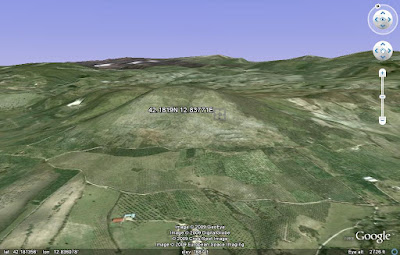 We had kind of a mountain theme this weekend. We were out in the country again. After some horseback riding in the morning, Billy and I and some friends decided to hike up a little mountain in the area. It is part of Monte Calvo. We didn’t make it to the summit (too much underbrush) but I managed to send an e-mail with the coordinates of our highest point. I put the location it on Google Earth –you can see how we did. On to the summit next time!
Speaking of summits, I only made two contacts with the HW-8 this weekend (from the house, not the mountain). The first was a contest station on 20 meters, UN9GD. But the second (also on 20) was a QRP “Summit on the Air” station. DK1HW/P was running four watts from a KX-1. It was nice to work another QRP station. (It was cold in the mountains this weekend — my fist was not at its best!)
Weekend QSOs from Ponticelli on 40, 20, AND 15
 When we returned to the Ponticelli site on Saturday I found that one end of my new doublet antenna had fallen down. No problem. One throw of the old rock-and-string and we were back in business. On Sunday I fired up the solar-powered HW8 and worked four stations on three bands: OZ8SW and US7IVW on 20, S59DDR on 40, and –icing on the cake– OY1CT in the Faeroe Islands on 15 meters (the picture above is of his QTH). I haven’t had a contact on 15 in a long time. I really like the frequency flexibility of the twin-lead doublet antenna.
Ponticelli QRP Station Gets New Antenna
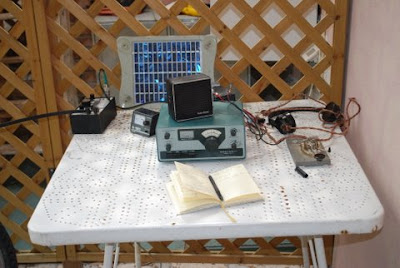 At the country place I now have a table on the front porch for the HW-8 and assorted gear. In the picture above you can see the Trastevere Flea Market Pi section antenna tuner (upper left), a Japanese SWR meter (also from the flea market) , HW8 and Radio Shack speaker, Volkswagen Solar Cell, 12 Volt gel cell, key and cans…
I had been using a piece of wire just thrown up in the trees, but I decided to do a bit better. I had some TV twin lead in the shack, and there was this useful-looking center connector… I had some AC line cord. Next thing you know I had a sorta-doublet antenna supported by a Roman Pine in Sabina (pictures below).
And it gets out! Worked IT0ULN in Sicily on 40 meters. Then I spoke to another QRP station, 2W0NNN in Wales on 20. Also UU4JDD/P on Tuzla Island. Finally E53AX in Estonia.
Ioan, 2WONNN, sent this report:
Hi Bill, thanks for the email, I look forward to seeing the pics on your blog too. Very interesting reading, same goes for your QRZ page too. I had to laugh at your DX with an astronaut on Mir!!!
Your HW-8 and doublet is certainly working well; I remember you were completely readable with a good signal about 90% of the time, it was only the QSB that made it difficult. To be honest I was surprised to have a QRP QSO with someone in Italy. I was using my FT-817 with a new Par End Fedz that I’d catapulted over a tree. The top was about 15m high but oriented as a sloper to the north west. I’ve had a fair number of QSOs with East coast US stations so I thought I’d go for an over-the-pole route to the West coast… there in Italy you’re pretty much spot on the opposite direction so I’m not sure it’s all that directional!
73 and hopefully speak to you again for more QRP/QRP!
Ioan,
2W0NNN
Ponticelli QRP Station Gets New Antenna
At the country place I now have a table on the front porch for the HW-8 and assorted gear. In the picture above you can see the Trastevere Flea Market Pi Section antenna tuner (upper left), a Japanese SWR meter (also from the flea market) , HW8 and Radio Shack speaker, Volkswagen Solar Cell, 12 Volt gel cell, key and cans…
I had been using a piece of wire just thrown up in the trees, but I thought I could do a bit better. I had some TV twin lead in the shack, and there was this useful-looking center connector… I had some AC line cord. Next thing you know I had a sorta-doublet antenna supported by a Roman Pine in Sabina (pictures below).
And it gets out! Worked IT0ULN in Sicily on 40 meters. Then I spoke to another QRP station, 2W0NNN in Wales, on 20. Also UU4JDD/P on Tuzla Island. Finally E53AX in Estonia.
Ioan, 2WONNN, sent this report:
Hi Bill, thanks for the email, I look forward to seeing the pics on your blog too. Very interesting reading, same goes for your QRZ page too. I had to laugh at your DX with an astronaut on Mir!!!
Your HW-8 and doublet is certainly working well; I remember you were completely readable with a good signal about 90% of the time, it was only the QSB that made it difficult. To be honest I was surprised to have a QRP QSO with someone in Italy. I was using my FT-817 with a new Par End Fedz that I’d catapulted over a tree. The top was about 15m high but oriented as a sloper to the north west. I’ve had a fair number of QSOs with East coast US stations so I thought I’d go for an over-the-pole route to the West coast… there in Italy you’re pretty much spot on the opposite direction so I’m not sure it’s all that directional!
73 and hopefully speak to you again for more QRP/QRP!
Ioan,
2W0NNN

Space Hackers Video: IT’S BACK!!!!!
Hope this one doesn’t get taken down. Great stuff from Turin, back in the day!
Sabina QRP Station and Astronomical Observatory
 This year, in an effort to get the kids out of Rome, we rented a summer house out in the Sabine Hills, a beautiful area just one hour north of the city. The picture shows a typical scene from the region. I brought out my HW-8, a gel-cell battery, my VW solar panel, the pi-network antenna tuner I picked up at the Trastevere flea market last winter, and about 50 feet of AC zip cord. I threw the wire into a tree and was able to tune up on 20 and 40. First station worked was near Catania, in Sicily (close to where we stayed last month). Also worked Germany and Bulgaria. I hope to use one of the tall Roman pines (like the one in the picture above) to support a vertical wire.
I also have my telescope out at the summer place, and we used it last weekend to look at Jupiter. I couldn’t see the recently discovered scar, but we got great views of the clouds, and the four Galilean moons. More to follow…
The Pontine Islands
 We were out on Ponza island this week. Amazing place. Part of the Pontine Island group. Brave Ulysses was an earlier visitor. Roman emperors used it as a summer place. It is only about 33 km from the mainland and you can get there from Anzio in about one hour by fast hydrofoil. We took a small boat over to the beautiful island of Palmarola. I did a bit of shortwave listening. More about this trip in the next SolderSmoke.
Italian Experimental Station in the Good Old Days… And Today!
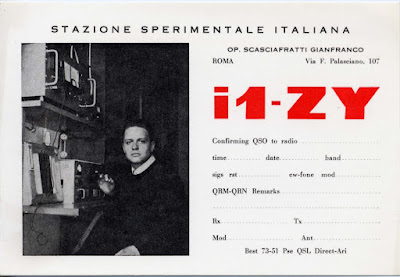 Today (he tells me it is 50 years later!) my friend Gianfranco is on the air as I0ZY.
Transmitter back then was homebrew except for a Geloso VFO purchased for 7000 lira (11 dollars at the time). Tubes were 6J5’s and 6V6’s. It ran AM. Two 807’s in the final with 600 volts on the plates. Two 6L6’s running AB2 as the modulator. His mic was salvaged from an old wire recorder. Except for the VFO, everything was from WWII surplus.
On the receive side, he had an HRO 5 by National that he picked pretty much in the same flea market area that we visit today. It was in such bad shape that they gave it to him for free! With a lot of patience and persistence, he was able to get it to work on 20 meters. Gianfranco clearly had The Knack!
And he still does! He now has a wonderful company (SPE) that manufactures in Italy some very advanced linear amplifiers. He is the designer and creator of the Expert 1K-FA. Check out this video on his company and his product:
Here is the link to the site for the Expert 1K-FA:
http://www.radio-ham.eu/Expert1K-FA.htm
More Seismic Action
 Two more fairly strong jolts today, both from the same region NE of here. The 4.9 was very noticeable at 11:25 am local time, and the 5.6 really shook the apartment at 19:47 local.
The USGS site is really very useful and up-to-date. Lots of data. For example, we learned that the compression wave from the 5.6 jolt took about 15 seconds to reach Rome. The people up in Abruzzo are really suffering and each one of these aftershocks makes things worse for them.
| MAG | UTC DATE-TIME y/m/d h:m:s |
LAT deg |
LON deg |
DEPTH km |
Region | |
|---|---|---|---|---|---|---|
| MAP | 5.6 | 2009/04/07 17:47:38 | 42.349 | 13.405 | 13.1 | CENTRAL ITALY |
| MAP | 4.5 | 2009/04/07 17:32:53 | 32.984 | 47.833 | 10.0 | IRAN-IRAQ BORDER REGION |
| MAP | 5.0 | 2009/04/07 15:18:41 | 37.620 | -17.441 | 8.3 | AZORES-CAPE ST. VINCENT RIDGE |
| MAP | 4.7 | 2009/04/07 14:50:02 | 46.099 | 151.609 | 58.1 | KURIL ISLANDS |
| MAP | 2.9 | 2009/04/07 14:46:42 | 33.883 | -116.872 | 14.4 | SOUTHERN CALIFORNIA |
| MAP | 4.5 | 2009/04/07 14:20:10 | -7.970 | 122.916 | 236.7 | FLORES SEA |
| MAP | 5.1 | 2009/04/07 13:29:48 | -6.976 | 129.425 | 69.7 | BANDA SEA |
| MAP | 2.9 | 2009/04/07 13:10:43 | 19.256 | -65.076 | 63.6 | VIRGIN ISLANDS REGION |
| MAP | 2.9 | 2009/04/07 10:08:55 | 32.209 | -116.626 | 0.0 | BAJA CALIFORNIA, MEXICO |
| MAP | 4.9 | 2009/04/07 09:26:31 | 42.336 | 13.360 | 10.0 | CENTRAL ITALY |
Earthquake Hits Central Italy
 A 6.3 earthquake woke us up last night. Rome was shaking quite a bit. Looks like the epicenter was up in Abruzzo, near L’Aquila. News reports indicate that buildings have collapsed and people have been killed up there.
Italians at the Forefront of QRSS
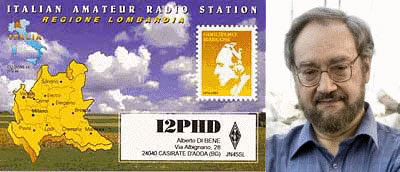 In SolderSmoke 102 I mentioned that Italians are playing an important role in QRSS. Alberto, I2PHD, is certainly one of the key people. His software is behind most of the grabbers that we all use. THANKS ALBERTO! Here’s his bio:
Born in 1944, in Lucca, Tuscany, Italy. Got a Doctorate Degree in Physics at the University of Pisa. Since then worked for IBM, with various responsibilities. Radioamateur since 1966, active on most bands, from 160m to 23cm. Lately experimenting with 137 kHz, recently allowed in Italy with 1W ERP.
Studying and applying DSP and digital techniques in general. Author of Winrad, SDRadio, Spectran, Jason, Argo and Hamview, widely diffused programs for SDR (Software Defined Radio), spectral analysis and real time filtering of audio signals, received with a radio and routed to a PC equipped with a soundcard.
Despite the age, open to learn new techniques and theories. *Not* a tube (or valve, depending on the side of pond you are reading this) nostalgic.
73 Alberto, I2PHD
Home page http://www.weaksignals.com
The QRSS Calibration Problem: A Proposal
Eldon’s effort to be seen by the 30 meter online grabbers (see below) reminded me of the big problem I faced when I first built my QRSS beacon: getting my signal into the very narrow (100 Hz wide) QRSS frequency band. If you think crystal control will solve this problem, think again: Almost all of us are using crystal-controlled transmitters, but circuit and component variations can easily put your signal far outside the freq range that the grabbers are watching.
I was able to get into the band because I was able to find a conventional CW beacon fairly close in frequency to the QRSS band. I used IK3NWX on 10.141800 MHz. Knowing the frequency of this beacon (it was avalable on the web), I used the ARGO and Spectran soundcard programs to put my sigs where I wanted them to be. IK3NWX was useful because it was so close (within 2 Khz) to the QRSS band — I was able to put both the NWX signal, and my target freq on the screen. Later, I built my “DaVinci Code” reference oscillator — it serves as a freq reference that I can use (again, with Spectran) to get back in the band after working on my transmitter (for those times in which I can’t hear IK3NWX).
It seems like a lot of guys in the US and Canada are now getting into QRSS. Many may face the same frequency calibration problem. Are the frequency readouts of the ubiquitous Kenwood/Icom/Yaesu rigs accurate enough to help? Do they go down to the tens of hertz range? I suspect they do not.
What new QRSS ops in the U.S. and Canada might need is the North American equivalent of IK3NWX’s beacon. It should probably be fairly high powered (but 5 watts would probably do the trick). Conventional CW would be better than QRSS (it needs to be heard). The frequency should be outside but within 1-2 kHz of the upper or lower QRSS band edge. A station out in the Great Plains would probably be able to serve the large ham populations of both coasts. Perhaps we could arrange for the calibration beacon to be on at certain times (daytime on the weekends?). Of course, the key would be to employ a station with very accurate frequency measurement ability (down to 1 Hz) and a highly stable signal.
What do you guys think?
Check out our neighborhood and flea market
Go to Google Earth, or even just to Google Maps (available without download from the Google home page) and search for this: Piazza di San Cosimato, 00153 Rome, Italy. Look for the “Street View” button and click on it. Now you can explore our Piazza.
GM8EUG sent me this great link for a 360 degree shot of the neighborhood flea market. Let the picture fully download, then click on it and you will be able to look around (and up and down!) Click on this:
http://geoimages.berkeley.edu/
See if you can see my signal 10140055 Hz
If Italy is in daylight, you should be able to see my 50 milliwatt FSK signal on one of the European on-line grabbers.
IK0VVE has a nice grabber aggregator site that includes a sun clock. Here it is:
http://www.ik0vve.net/mept6.aspx
Just see if the sun is shining here, then scroll down and take a look at either PA1SBD’s site or ON5EX’s. Sometimes I can also be seen on I2NDT’s.
You should see my signal around 10140055 Hz. It looks kind of like a square wave. Read the Morse along the bottom (my FSK is upside down).
For extra credit, see if you can see Paolo’s solar beacon. It too looks like a square wave, but with no Morse. He’s running 2.5 milliwatts.
Please let me know if you succeed in seeing our sigs.
Arduino — Italian Open Source Hardware
 Scott Haley in Tulsa alerted me to this very interesting article in Wired magazine. How do you say Knack in Italian? Check it out: Wired article on Arduino
Skepticism about “Space Hackers”
Many of us really enjoyed those videos about the two Italian brothers from Turin and their homebrew space monitoring program. But there is some controversy about some of their claims:
http://www.svengrahn.pp.se/trackind/Torre/TorreB.html
Controversy or no controversy, I still liked the videos and admire the efforts of the two intrepid brothers from Torino.