Category: Hungary
Ciprian YO6DXE Puts the Michigan Mighty Mite on AM! (video)
The Perpetual Troubleshooter — John F. Rider — W2RID
An Amazing Catalog of Circuits from HA5KHC
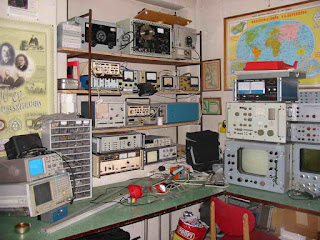
HA5KHC is a club station in Budapest, Hungary. The photo above shows a portion of their worshop. The link below is for their really amazing collection of links to ham radio circuits.
http://konstruktor.ha5khc.hu/linkgyujtemeny/linkgyujtemeny.htm
QRPi WSPR with a Raspberry Pi Shield from Hungary via Tuscon
A Homebrew Compendium from Hungary
Our book: “SolderSmoke — Global Adventures in Wireless Electronics” http://soldersmoke.com/book.htm Our coffee mugs, T-Shirts, bumper stickers: http://www.cafepress.com/SolderSmoke Our Book Store: http://astore.amazon.com/contracross-20

Zoltan Bay and his Chemical Moonbounce Detector
In March 1944, Bay recommended using the radar for scientific experimentation, including the detection of radar waves bounced off the Moon. The scientific interest in the experiment arose from the opportunity to test the theoretical notion that short wavelength radio waves could pass through the ionosphere without considerable absorption or reflection. Bay’s calculations, however, showed that the equipment would be incapable of detecting the signals, since they would be significantly below the receiver’s noise level.
The critical difference between the American and Hungarian apparatus was frequency stability, which DeWitt achieved through crystal control in both the transmitter and receiver. Without frequency stability, Bay had to find a means of accommodating the frequency drifts of the transmitter and receiver and the resulting inferior signal-to-noise ratio. He chose to boost the signal-to-noise ratio. His solution was both ingenious and far-reaching in its impact.
Bay devised a process he called cumulation, which is known today as integration. His integrating device consisted of ten coulometers, in which electric currents broke down a watery solution and released hydrogen gas. The amount of gas released was directly proportional to the quantity of electric current. The coulometers were connected to the output of the radar receiver through a rotating switch. The radar echoes were expected [11] to return from the Moon in less than three seconds, so the rotating switch made a sweep of the ten coulometers every three seconds. The release of hydrogen gas left a record of both the echo signal and the receiver noise. As the number of signal echoes and sweeps of the coulometers added up, the signal-to-noise ratio improved. By increasing the total number of signal echoes, Bay believed that any signal could be raised above noise level and made observable, regardless of its amplitude and the value of the signal-to-noise ratio.26 Because the signal echoes have a more-or-less fixed structure, and the noise varies from pulse to pulse, echoes add up faster than noise. From: http://history.nasa.gov/SP-4218/ch1.htm
During the war, Zoltán Bay protected Jewish colleagues from Nazi persecution. In 1998, the State of Israel honored him as Righteous Among the Nations for his actions and listed his name at Yad Vashem.
Our book: “SolderSmoke — Global Adventures in Wireless Electronics” http://soldersmoke.com/book.htm Our coffee mugs, T-Shirts, bumper stickers: http://www.cafepress.com/SolderSmoke Our Book Store: http://astore.amazon.com/contracross-20
SSB Generation: Ideas from Around the World
I liked this thread on the EMRFD mailing list. The question of how best to generate SSB is very interesting, and I also liked the global scope of the Q&A: Peter in Hungary asks the question, Farhan in India and Allison in the U.S. respond.
On 9/25/12, ha5rxz
When generating an SSB signal from audio and a 9 MHz carrier which would be
the best mixer to use?
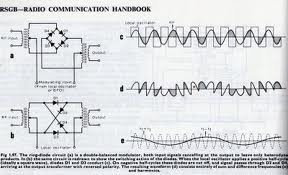
a) A high-level ring bridge mixer such as the SRA-1H
b) An H-Mode mixer using an FST3125 chip
c) An H-Mode mixer using a 74HC4016
d) Something else
Note that this mixer will not be used to demodulate.
Peter HA5RXZ
……………………………..
Ashhar Farhan
In my experience, if you keep the audio level low enough, it is
difficult to beat a simple two diode mixer.with a 10 db attenuator in
the output. Having just two diodes makes balancing of reactive as well
as resistive differences of the two diodes quite trivial. Schottky
diodes are best.
One thing, I did discover though is that the balance should be to
minimize the harmonic distortion, rather than just the carrier
suppression.
What we are shooting for is to keep the In-band IMD down. Carrier
suppression is just hygiene. So, you will want to tune in to the
signal, modulating it with two tones and see it on a audio spectrum
analyzer (freely downloadable from the net) and try getting the third
spike down.
Though the ‘packaged’ mixers don’t give you the needed control for
hi-fidelity, for trivial usage, NE602 is pretty good. Just drop it
into the rig and live with what you get (which is not bad at all).
The best resource is the chapter on phasing receivers and transmitters
in emrfd. Rick is the guru. I hope he joins this thread.
– Farhan
……………………………………..
FROM KB1GMX:
I’ll weigh in..
Yes, they all work. You need a provision for adjusting carrier balance on some but anything over 40db will be good.
I’ve used 602/612s, SBL-1, SBL-1H, diode rings, and even varicap
diodes (there is a design using them in capacitively balanced
a modulator from many years ago. They all work if the levels are correct.
These days I use the sa612 for simple designs, SBL-1 with a 50ohm
pot added for balance for better radios and the 4 diode ring I’ve
used many times as its uncritical, needs only one untapped
transformer and easy to make. Most of those are listed in the
older 1975 through current handbooks and EMDRFD.
If needed I can post to the files section a few designs but
they are all textbook and all are capable of good results.
In just about all the diode modulator cases a fairly strong
carrier (5mW or more) is needed and the audio will be about
10db lower for very good result. The active devices like the
ca3028(and friends), SA612, MC1496 the levels for the carrier
and audio must be matched accordingly for the device. You can
look at the output with a scope and get a first order eyeball
call on quality (no carrier and no clipping or limiting) and a
receiver (any your ears) will tell you if its right.
Allison
Our book: “SolderSmoke — Global Adventures in Wireless Electronics” http://soldersmoke.com/book.htm Our coffee mugs, T-Shirts, bumper stickers: http://www.cafepress.com/SolderSmoke Our Book Store: http://astore.amazon.com/contracross-20