Mike WU2D made another very nice video about his Drake TR-3 refurb.
He cracked me up when he noticed that one of the calibration oscillators was 30 Hz off. “Let’s pretend we care,” said Mike. Indeed. But it was probably wise to tackle this problem, given how upset modern hams seem to get with 30 Hz discrepancies. Mike noted that the problem was casued by “aging cystals.” Yikes! Another thing to worry about, along with the Southern Magnetic Anomaly.
Once again Mike has added a useful term to our lexicon: “The Dribble Method” of signal injection (or extraction): Just wrap a few turns of insulated wire around the tube or IF can and inject or measure away.
Neutralization! Now there’s a blast from the Thermatron past. I haven’t done that in a long time. I liked Mike’s “reverse neutralization” method.
Mike’s video featured some real Boatanchor eye candy. That Heathkit HR-10 receiver caught my eye, as did that HP signal generator.
Thanks Mike. One hand behind your back OM.
Category: heathkits
Knack Story — Tom WX2J
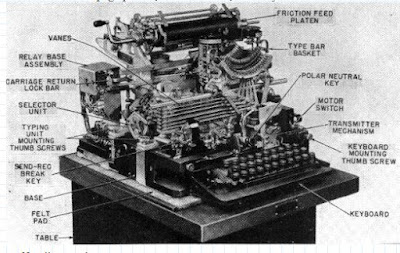 |
| RTTY Model 15 |
Hello Bill,
Greetings from a fellow ham in Northern Virginia. I have enjoyed the SolderSmoke podcast for a few years now, and I just heard your recent presentation to the Vienna Wireless Society. We have a lot in common so it is about time I reach out to make your acquaintance.
I was born in NYC and grew up in Northern NJ. I was first licensed in 1969 as a high school student (51 years ago! Goodness!). My novice callsign was WN2JFX, and I progressed from Novice and then to General and Advanced as WB2JFX, and then eventually to Extra (in about 1990 — while the 20 WPM code requirement still existed). At that point I put in for a 2X1 callsign and received WX2J, which is a nice twist on my original call.
I was fanatically active in my early years in ham radio. My Elmer (George, K2VVI, SK) set me up with a DX-40, and my parents provided a brand new Hallicrafters S-120 (you could copy the whole 40 meter band without changing the frequency!). I think I Worked all States as a Novice and learned that the human brain is the most amazing audio filter on the market. When I made General, George lent me an old Hallicrafters SX-25, and then I was really in good shape. Besides CW, I was also very interested in RTTY. I had my own Model 15 leaking oil in the basement and had a blast watching the magic of that thing printing messages out of thin air. I have always been a home-brewer, and one of the first serious things I built was a two- or three-tube RTTY demodulator from the Handbook. Aluminum chassis, chassis punches, tube sockets — the whole works. I have no idea what the real inductance was of the inductors that went into the filters but somehow if the signals were strong enough, and on 850 Hz shift, it could actually demodulate signals. I probably still have that thing around here somewhere.
Another local ham bequeathed me his entire collection of 73 magazines – 10+ years starting with the first issue (~1960). I read them from cover to cover so many times I probably have them memorized. I became a real fan of Wayne Green, W2NSD, who was always ornery and controversial but a very interesting guy. I met him at a hamfest many years later and we had a great chat.
In any case I wanted to mention some other things that resonate with me as I listen to your podcast. As a kid growing up in the shadow of NYC in those years, you can bet that the Jean Shepherd broadcast was a regular part of our life. My dad used to listen to it every night — 10:15 p.m. I believe, on WOR — and we both used to greatly enjoy his stories of lighting up the fuse panel and nearly blowing up the house as he and his old man were playing with radios, etc. It was a common theme in our house too when my ham radio signal would blast into the TV set or I dangled new antenna wires off the house and out of the trees — “You’re going to blow this house up!” I studied electrical engineering in college and was commissioned in the Air Force upon graduation. I served a 20-year career in the Air Force and stayed somewhat active in ham radio. I was licensed and operated out of Okinawa (KA6TF) and England (G5ERE) during tours of duty in the early 1980s. Always an HF guy, in about 1982, in Japan, I bought myself a new Icom IC-720A, and this is still my primary rig. I was an early adopter of PK-232 and did some extensive building and experimenting with it. Sadly though, in the last 25+ years, my ham radio experience has mostly been vicarious as my work and family obligations have just not left much time for ham radio. I do have a G5RV wire antenna strung up but very rarely jump on the air — sometimes during contests.
In high school we made a field trip to ARRL HQ in Newington, CT. While there we did all the things people do on such a visit, but one of the high points for me was meeting Doug DeMaw. I can just hear how Shepherd would describe it — “I turned the corner and there he was! In person! The high priest of homebrewing! Doug DeMaw. In the flesh!” Cue the kazoo. I actually also met Shepherd at a book signing (Wanda Hickey’s Night of Golden Memories?). I remember presenting him with a computer-printed banner of his callsign — K2ORS — produced by one of the few functioning computer programs I had written in high school. I also heard him on the HF bands one night — I think he was in Florida — and actually made contact with him, if barely being able to exchange callsigns can count as a contact.
Well, more than you wanted to know. I just wanted to let you know that I enjoy your podcast and can personally relate to very much of what you say. Although I am steeped in Hardware Defined Radio, I am also a software guy so I expect that my future includes SDR. I hope you and Pete are able to continue the podcast for a long time to come because I need the full HDR-SDR spectrum to be covered — hi.
73,
Tom Fuhrman, WX2J
SSB Transceivers of the 1960s — Videos by Mike WU2D
I liked both these videos. Mike WU2D really does a great job. He covers a LOT of technology and theory in two videos. Thanks Mike!
Will, KF4IZE’s Beautiful Boatanchors
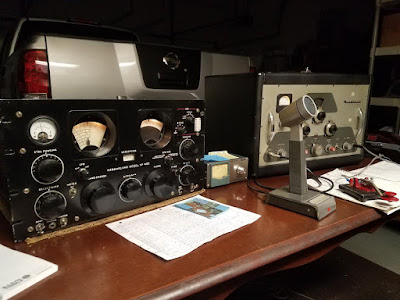
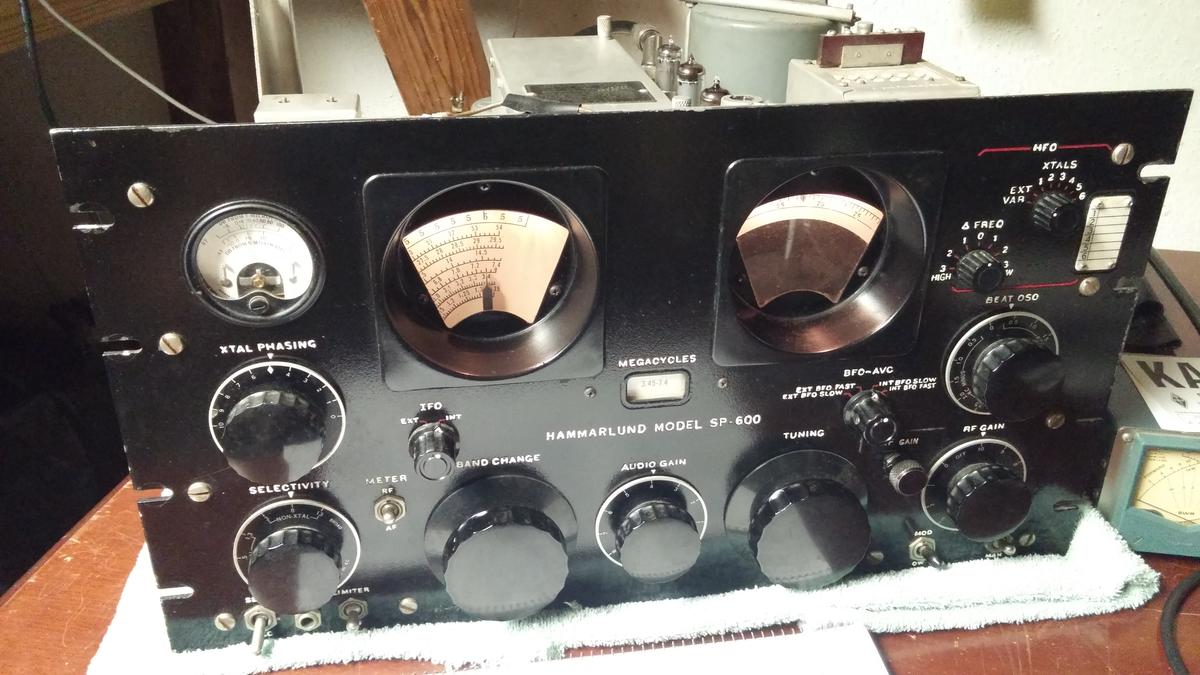
Wow, check out the paint job on that SP-600. Nice work Will. Hammarlund should have done it that way. And I should have kept the one I had years ago. I would have painted mine that way.
And my DX-100 (given to me by John K2ZA) has similar vernier reduction drives.
I run into Will KF4FZE fairly often on 40 meters. He and I were in the same (very cool) part of the U.S. Army (in different times). Will is retired but he still works at Ft. Bragg.
I heard Will on 40 SSB yesterday afternoon. I was listening with my HRO dial receiver (that I am now working on). I shot quick video:
Will was on a Swan Cygnet 270 that he had recently picked up on e-bay.
More on Will KF4IZE here: https://www.qrz.com/lookup/d/kf4ize
Novice Rig Round-Up — March 7- March 15, 2020
I may go with my Drake 2B and HT-37. But If I get ambitious (and masochistic) I might try to involve the Hallicrafters S-38E that has been torturing me lately. And I do have a DX-40 on the shelf…
Here is the announcement:
VE7SL has a really nice description of the event with great pictures:
Junk Box Ethics — I Plead Guilty! (video)
I cringed when, at about the 32 minute mark, during a discussion of the moral necessity of preserving old gear, Michael appeared on the screen with a Heathkit Q multiplier sitting right there next to him. It was as if he was talking about me. I felt as if I had been hauled into Ham Radio Court, Judge Michael Murphy presiding.
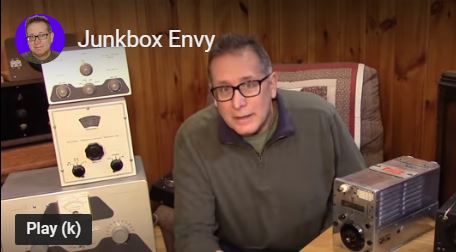
I have already REPEATEDLY admitted to sacrificing MULTIPLE Q MULTIPLIERS. But I did it for good reasons:
1) I have some objections to use of regeneration, especially in superhet receivers. After all, Armstrong created the superhet in part to free us from the tyranny of regeneration (that he had also invented).
2) This is a case where the parts ARE greater than the sum. Specifically that variable cap WITH reduction drive. And that perfectly sized metal box. Those capacitors are currently in service in at least two of my homebrew SSB transmitters. And as I look around the shack, I see one of those boxes housing an Si5351 VFO, and another holding the dual-digital frequency displays for my DX-100/HQ-100 AM station.
3) Mike notes that these Q-multipliers are being sold for TWO DOLLARS at hamfests. At prices like this, temptation is just too strong.
So I plead guilty, your honor. But I ask the court to consider the circumstances under which I dismantled this obsolete gear, and the good uses that I made of the parts that I obtained. Also, I’d like to make note of the fact that I salvaged from a junk pile a Heath VF-1 (I completely rebuilt it) AND I restored to usefulness a Heath DX-40 — both these devices appeared in the WU2D video. Finally, if anyone really needs the remaining parts from the now deceased QF-1s, I’d be willing to donate them (in an effort to redeem myself).
Thanks Mike!
SolderSmoke Podcast #207 — 15 mtrs, 60 mtrs, Giants of Radio, Cubesats, Pete’s rigs, SDR MAILBAG
SolderSmoke Podcast #207 is available:
http://soldersmoke.com/soldersmoke207.mp3
— Giants of Radio
— Pete on 15 Meters
— Bill on 60 Meters with the uBITX
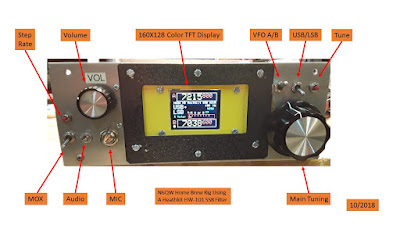
— Pete’s Sudden and Heath Filter Transceivers
— Cubesats to orbit! To the moon! And to Mars!
— Bill rebuilds his 2 meter “Ray-Gun” Quad (for Farhan’s Cubesat)
— Homebrewing Variable caps and stockpiling NP0
— My “by ear” Minimal Discernible Signal Technique
— Thoughts on Direct Sampling SDR and the Radio Art
MAILBAG
— A request for feedback from GQRP
— G4WIF reports G3ROO on UK TV with spysets
— VU3XVR builds FB rig from EMRFD
— M0KOV Charter member of the 3 Scratch-built BITX club
–KD4PBJ’s PTO Turtle DC Receiver
— AB1OP builds Pete’s LBS receiver and gives us a new acronym: SITB
— KD4EBM — Thanks for the scanner Bob!
— A possible sponsor from California…
— Pete’s dream neighborhood…
Pete’s New Transceiver with Heathkit Filter and WSPR (Video)
Another beautiful rig from Pete. Inspiration for the winter building season. More info on his blog:
http://n6qw.blogspot.com/
We hope to discuss this and other projects in the next SolderSmoke podcast, hopefully next Saturday.
Hyderabox! uBITX in a Lunch Box
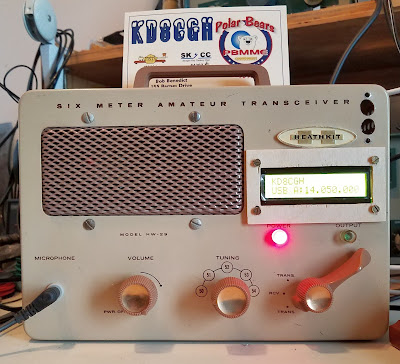
Oh man, I’m sorry I missed this one. John sent it to me in January, but it got lost amidst all the uBITX messages.
I like it! It shows that I am not the only one guilty of re-purposing Benton Harbor Lunch Boxes.
But what should we call it? It is now more Hyderabad than Benton Harbor. How about Hyderabox? That’s it!
Bill
You mentioned in your last podcast recycling “Benton Harbor Lunch Boxs”. Many decades ago I talked my Junior High shop teacher into letting me build a Twoer instead of his lame project. Over the years 2 meter AM and the Twoer faded away.
I recently revived a Lunchbox case for my uBitx. I added a Sotabeams CW filter that is controlled by the old T/R knob. Down the filter is bypassed, up one is wide CW and up two is narrow CW. The green pilot light light is a CW tuning indicator.
I use KD8CEC’s code which cleans up many small problems and adds a memory keyer and CAT control to the uBitx.
I modded KD8CEC’s code to remove the paddle sense segment so that it only works with a straight key. This makes the keying much cleaner.
First contact with the modded uBitx was this morning. With 5 watts out I got a 599 from K3Y/7 (K7QBW) in Oregon back to me in Ohio.
Bob KD8CGH
Amazing Homebrew/Boatanchors QSOs on 40 –Six solder melters in a row!
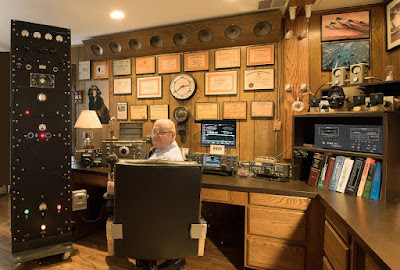 |
| Al W8VR |
After a day of happy tinkering with the Direct Conversion receiver I’ve been working on, I turned off the soldering iron and got on 40 meter SSB with my BITX Digi-Tia.
First — Steve W4IJ came back to my CQ. Steve is a boatanchor enthusiast and has written for Electric Radio magazine. FB.
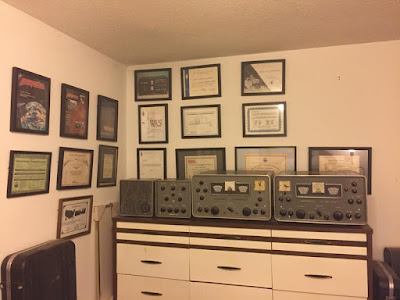 |
| W4IJ Boatanchors |
When Steve signed off, I got into a contact with Pete W8NBO. We had spoken before and he had told me of a homebrew transmitter he’d built as a kid. This time I asked for details: It was a 6AG7 oscillator to a 6L6 amplifier. He ran it with an S38 (brave man!). He described what must have been a very painful effort to hack (literally) the needed holes in the transmitter chassis using just a spike, a hammer and a file. I told him this brought back my memories of similarly painful chassis work (mine was for a power supply for a Heath HW-32A).
At this point we were joined by Arnie, W2HDI. Arnie’s rig is in Stowe Vermont, but he was running it remote from the South of France where he and his wife were celebrating their 50th wedding anniversary. Arnie shared with us memories of similar chassis pain — his were related to an external modulator that he built for a DX-40. I think he said that all he had was a hole punch and a file. Oh, the humanity!
Then Al W8VR joined the conversation. Al said that he’s been in the game so long that his early rigs were built using cigar boxes as chassis. I pointed to a connection: I noted that my BITX rigs are enclosed in what could be considered cigar boxes. Al’s QRZ page picture has a magnificent AM rack rig that he said was actually built twice. There is also an HRO-60 in the picture. FB. Check it all out at Al’s web site. Click on the mic for the write ups, the key for the pictures. http://www.w8vr.org/
Then Dennis K0EOO called in. Holy Cow! Dennis and I spoke not long ago. You may recall my enthusiastic write up of his beautiful 1974 SSB rig:
and
This was almost too much. Rarely will you spontaneously come across so many hams who have melted so much solder. FB.
Icing on the cake: When I returned to the bench, I fired up the DC receiver and heard Mike KN4EAR talking about his BITX40. I switched to the Digi-Tia and gave Mike a call. He reports making many contacts with his rig. FB.
TRGHS.
Cliff Stoll — K7TA — Has THE KNACK. And a GREAT NOVA Video
Hack-A-Day had a piece on Cliff Stoll of “The Cuckoo’s Egg” and “Silicon Snake Oil” fame. I read these books years ago. I included a quote from Cliff on page 45 of the SolderSmoke book (the quote seemed to foreshadow my aversion to SDR).
I didn’t know that NOVA produced an hour-long program on Stoll’s Cuckoo’s Egg adventures. It is really good. Many of those involved play themselves in the video. Very cool. See above.
I checked Cliff’s QRZ.com page. We wrote several years ago that Cliff has THE KNACK. Note below his preference for thermatrons and the affection for Heathkits. Diagnosis confirmed.
From QRZ.com:
Hi gang! This is Cliff Stoll, K7TA
Way back in the Jurassic, I was licensed as WN2PSX, in Buffalo NY. Got my general ticket around 1967 as WB2PSX, and helped build ham radio stations at Hutch-Tech high school, University/Buffalo, and University of Arizona. When I went to Tucson for grad school, I passed my extra ticket and snagged the call K7TA (back when this meant 20wpm cw). I held a first-class commercial ticket, which let me engineer at WBFO radio, but I don’t know if commercial licenses even exist anymore.
I now live in Oakland California, and occasionally get on the cw lowbands with old heathkit gear … just rebuilt my novice NC-270 receiver with filaments that glow in the dark. Gotta restring my 40 meter dipole that came down in a windstorm.
You can guess that I’m pretty much retired. Along the way, I’ve worked in FM radio, planetary physics, computing, writing, speaking, teaching, and math. Best way to reach me is through my website www.kleinbottle.com
Warm wishes to all — 73’s,
-Cliff
Info on Cliff’s latest gig:
FDIM: W8SX Interviews Mike Bryce WB8VGE
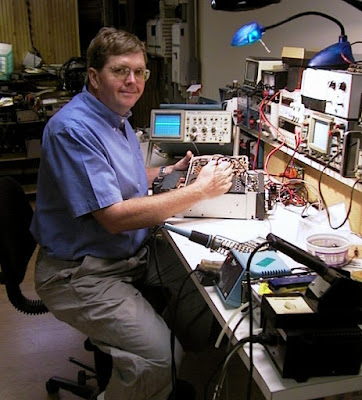
Mike Bryce’s many contributions to the radio art and QRP definitely puts him in the Homebrew Hero category. I have Mike’s “Hotwater Handbook” (about the legendary HW-8) on my bookshelf. Our intrepid SolderSmoke media team (Bob W8SX) spoke to Mike at FDIM 17. His comments on the joy of a good troubleshoot, and on the pernicious, unfixable nature of many recently marketed appliance radios really resonated with me.
Mike has special expertise on Heathkit gear: https://www.theheathkitshop.com/index.html
Listen to the interview with Mike here:
KEEP THAT GREEN FLAME BURNING MIKE!
Hot Water BITX 40
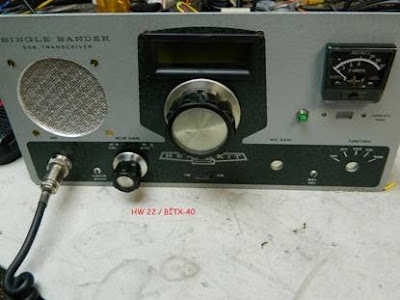

Fred’s idea really resonated with me. My first SSB rig was an HW-32A, the 20 meter version of the rig shown above. If — as I suspect — these rigs are anything like the HW-101, they are not aging well. Heath’s drive for economy resulted in rigs that don’t hold up to well over time. I remember the sound of the plastic HW-101 dial clutch cracking when I pushed the button.
BITX40 Modules to the rescue! Put a mono-band board inside an old mono-band rig. There are a lot of possibility here. Some ideas:
— Put that Heath VFO to use. Maybe convert it to solid state. Or just put the LCD from an Si5351 in the window (Pete did this with an HW-101).
— Get the S-Meter wiggling.
— Keep the final amplifier circuitry in there and let the BITX drive it. This will give you a QRO option. (Uh oh, we’re in trouble again!)
Hello Fellows,
Attached is a picture of my BITX-40 V3 adapted to a Heath kit Single Bander HW22. This is a work in progress but what a neat way to bring an old boat anchor into the present.
The only parts of the HW 22 used were the front panel and case and knobs. Modifications yet to be incorporated include: AGC , a USB port on the front panel to access the Arduino, and a PTT/CW mode switch.
I enjoy your pod cast and web site…Best of 73 KC5RT.
VE7SL and THE POWER OF THE GREEN GLOW
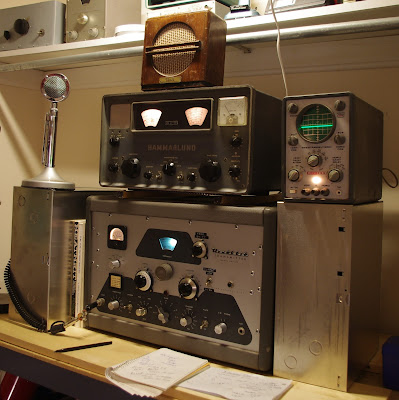
Steve VE7SL recently discussed Heathkit’s wise use of the color green in the VF-1 and DX-100 frequency readouts. The power of green is visible in the above photo of the N2CQR AM station. (I used this gear to check into the Old Military Radio Net and the Lonely Guys’ Net on 75 meters on Saturday). Note the VF-1 on the shelf in the upper left, and the awesome green oscilloscope trace. Juliano Blue is all well and good, but let’s not deny THE POWER OF GREEN.
Steve’s discussion (and cool Knack story):
http://ve7sl.blogspot.com/2017/01/the-green-glow.html
Straight Key Night — Bandscan from WA6ARA (audio)
 |
| WA6ARA SKN Station |
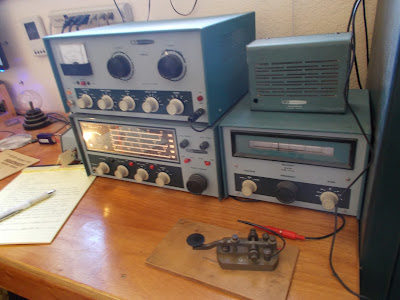
Mike Herr WA6ARA was on 40 meters with old gear this Straight Key Night. Mike was receiving with a venerable Heath HR10B. One of his favorite QSOs was with Keith W6SIY; Keith was running Conar twins that had the kind of “swing” that stirs up the kind of memories that SKN is all about. FB. Mike made a bandscan recording of what 40 sounded like, and he made another of W6SIY’s beautiful signal.
You can listen by clicking on these links:
http://soldersmoke.com/SKNBANSCAN.mp3
http://soldersmoke.com/SKNQSO.mp3
My own SKN effort was cut short this year by technical difficulties. The HT-37’s relays stopped doing their thing. Probably the relay drive tube going soft. But I did manage to make two great contacts on 40:
WA6URY is in Los Angeles. This was a very timely contact — my wife and I went to see the movie “La La Land” on New Year’s eve — the film features a lot of beautiful LA scenery. Dan was running a kilowatt to a 2 element Yagi on 40. He too owns an HT-37 and a Drake 2B. He was on a straight key “with dirty contacts.” FB Dan, thanks.
And then I worked W1PID! Wow! Jim is well known for his operations from field locations and for his intrepid participation in many of the radio adventures of Michael Rainey AA1TJ. Jim was on the Maine sea coast expedition when Michael was attempting to cross the pond with his voice-powered radio. On SKN Jim was in New Hampshire running 35 watts to a Windom off-center fed dipole. His Morse key is a Kent. TRGHS. Thanks Jim.
Happy New Year!
 |
| W1PID Maritime Mobile |
Great Homebrew Interview on “QSO Today”
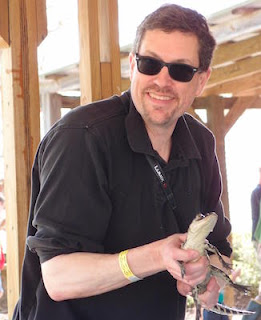
This week Eric 4Z1UG has a really nice interview with Jim Veatch WA2EUJ. Jim is the three time winner of the ARRL Homebrew Challenge. There is a very interesting discussion of Arduinos, SDR, the technology behind automatic antenna tuners, and even some Raspberry Pi. Jim’s first receiver was a Halli S38 and his first rig was a Heath HW-7.
Listen here:
http://www.qsotoday.com/podcasts/WA2EUJ
Thanks Jim. Thanks Eric.
75 and 40 Meter AM on my HQ-100 (Videos) + Digital Display
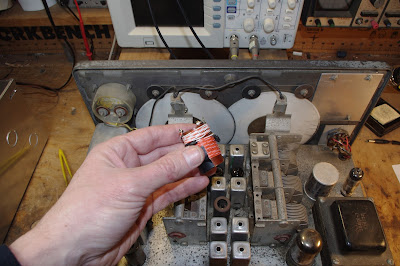
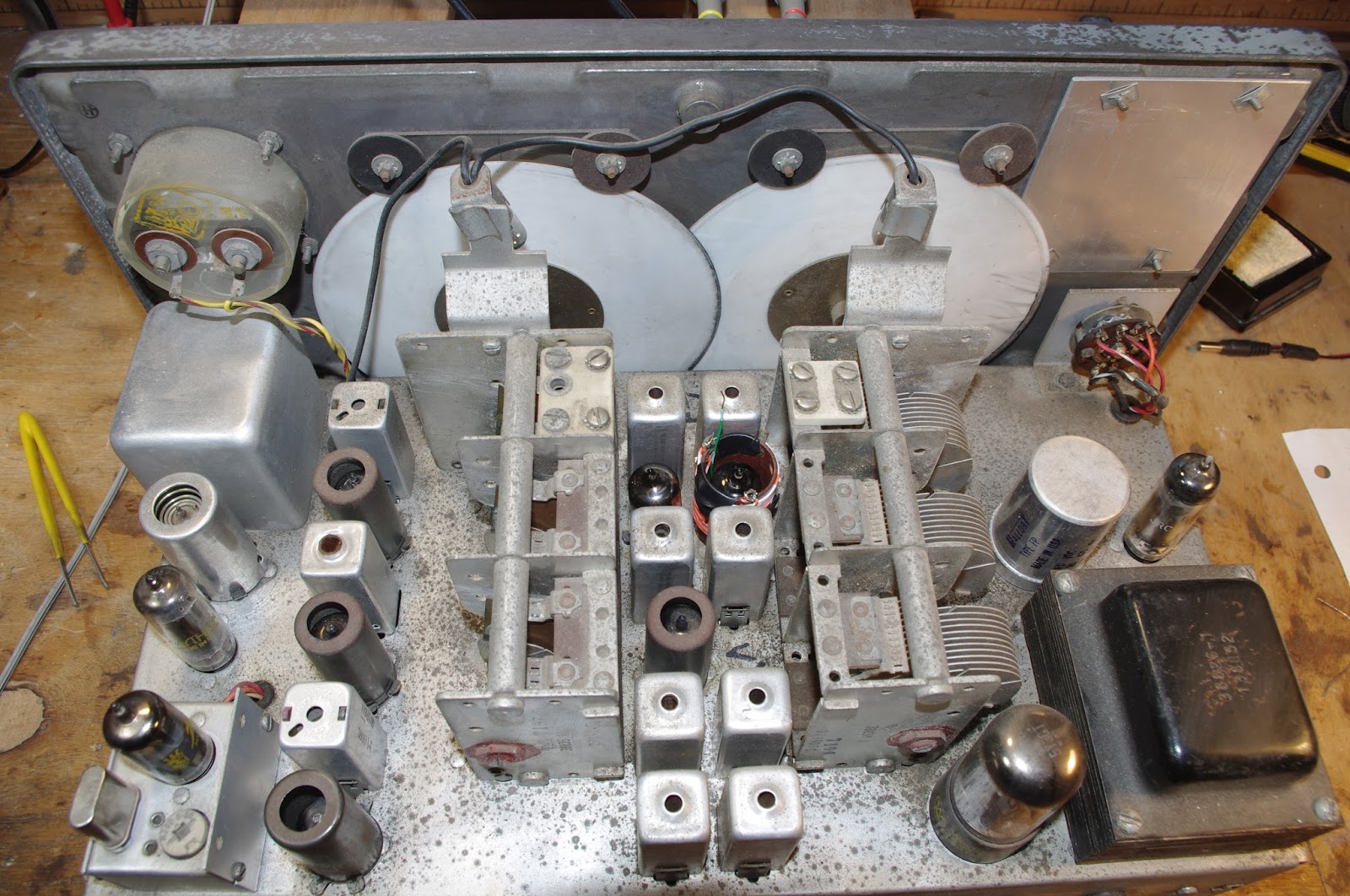
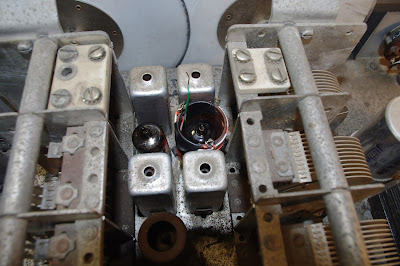
And here is how I sample the oscillator frequency for the digital counter. I use an old trick: I wrap some wire around the oscillator or mixer tube. I made the coil out of an old coil form. I had to play around with the number of turns to get suitable pickup on both 160 and 40 meters. The San Jian board allows for IF freq offset. I use a similar arrangement on the transmit side with the DX-100. By the way, the box that houses the two displays is the carcass of one of the Heath QF-1 Q multipliers from which I heartlessly pulled the nice reduction drive variable caps for use in my BITX rigs.
 |
| Add caption |
And Now for Something Completely Different: Boatanchors! AM! Top Band!
Lately I found myself looking for something different to get involved in. Pete’s conversion of his Ten-Tec commercial rig got me thinking about converting an old CB rig to 10 meter AM. I’m still planning on doing this, but noodling on this project got me thinking about AM in general. I had the DX-100 that John Zaruba K2ZA had given me (it was his dad’s). I had it paired up with an old HQ-100 that I’d picked up in the Dominican Republic 20 years ago. (Looking at the old manual for this receiver, I realized that there is another reason why I feel so connected to it: it was built on West 34th St. in New York City, not far from where I was born.) On Veterans Day (November 11) I connected these two old Boatanchor veterans to my 40 meter dipole, rigged up a connector for my Astatic D-104, and fired up on 40 meter AM.
I had a blast! I found myself in contact with hams who are interested in the inner workings of their gear, guys who know which end of the soldering iron to grab. The DX-100 got great reports — people said it sounded nice.
Sam K4NDY told me that his DX-100 had started out at 100 pounds, but that as time passed (and as he has gotten older) he noticed that it has somehow increased in weight!
Bill K8DBN was running a DX-60 and (like me) an HQ-100 (you see, we’re no longer in Yaesu-Icom-Kenwood land!)
Mike KC2KJ was running a DX-100 and a Drake 2B. FB!
Steve W3DEF was on with his B&W 5100B.
Dave W3CRA was on from the Collins Radio Association. He restores Collins gear. When he told me the DX-100 sounded great, I knew that it really did.
Today I talked to Ed KA3PTX who has this really cool Boatanchor station:

And also today I had a great contact with Howard Mills W3HM, one of the greats in the world of radio restoration. Another fellow on frequency asked me to makes some critical comments on Howard’s signal quality (“Does he have too much low frequency?”) — I refused, saying I was unworthy. (I did say that he sounded great — he did.)
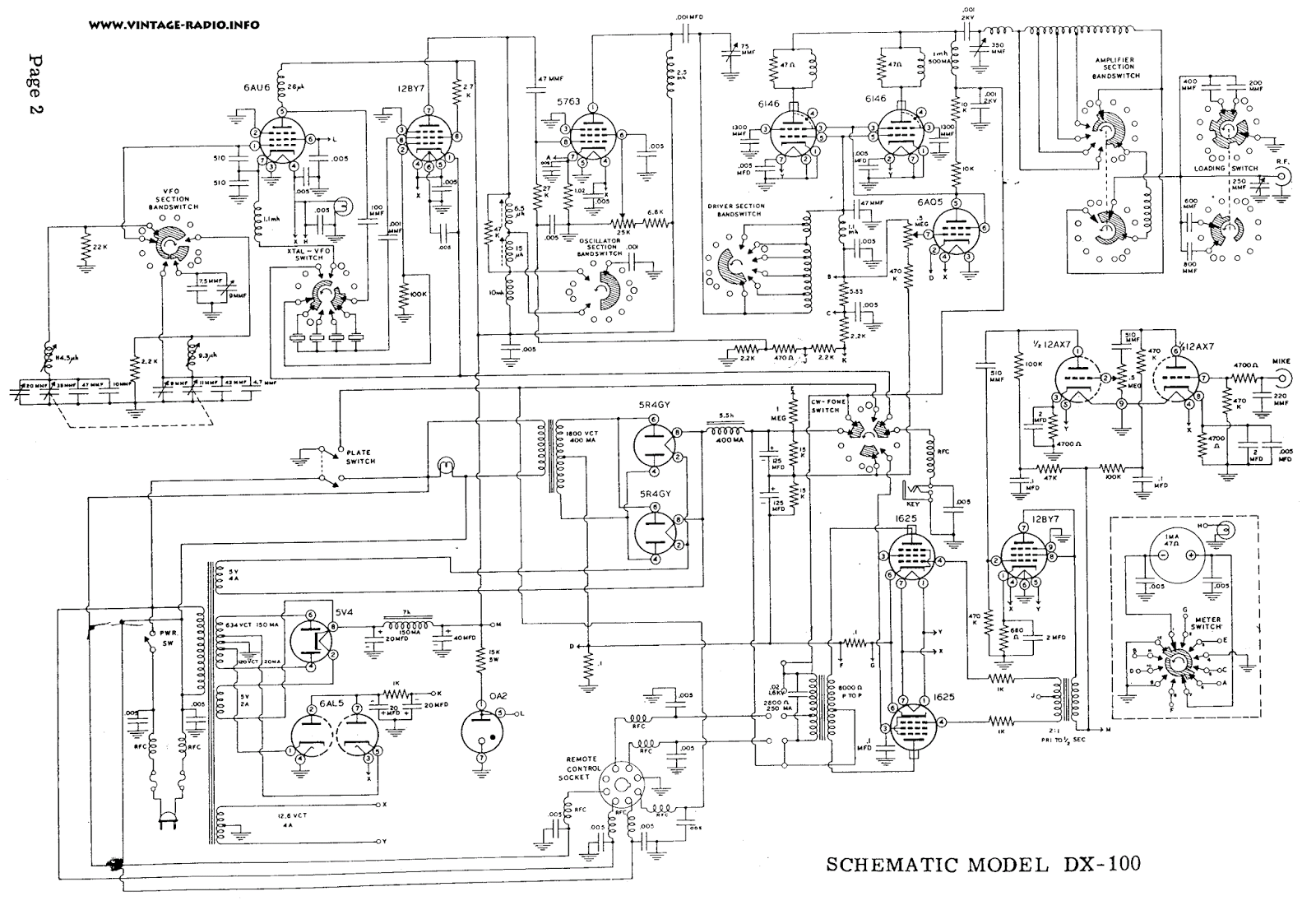
Anyway, I’m out of the rut. An added benefit is that this new (old) interest moves me even further away from microscopic SDR rigs, and closer than ever to the Hardware Defined, analog, discrete component, menu-free radio that I prefer. Check out the full schematic of a DX-100 — simplicity, clarity, beauty:
I had been thinking vaguely about someday getting on 160 meters — I’ve never used those frequencies. Yesterday I noticed that both the HQ-100 and the DX-100 cover this band. THE RADIO GODS HAVE SPOKEN!
VK2SJA’s Minima in a Realistic DX-100 Case
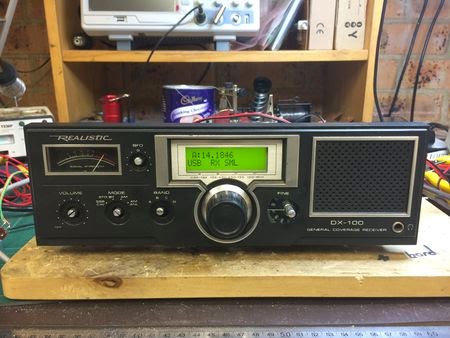
Steve, VK2SJA, is doing to a Realistic DX-100 what I have been thinking about doing to a Heathkit HW-101. With this kind of encouragement, who could blame me for making a Minima-101? I’ve been planning on keeping the 6146s and all the final (and perhaps driver) circuitry.
Here is Steve’s very nice description of his project thus far:
http://www.hfsignals.org/index.php/UnRealistic_Minima
Our book: “SolderSmoke — Global Adventures in Wireless Electronics” http://soldersmoke.com/book.htm Our coffee mugs, T-Shirts, bumper stickers: http://www.cafepress.com/SolderSmoke Our Book Store: http://astore.amazon.com/contracross-20
New Book About Heathkit Gear
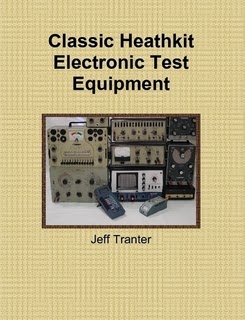
Jeff Tranter, VE3ICH, has a new book out — it is about Heathkit Test Gear. (Hey, I had that VTVM on the cover!) This book looks like it deserves a place under the Christmas trees of SolderSmoke fans. The book is available from Lulu.com, and Santa (or Mrs. Claus) can use the discount coupon below (Coupon code: CORNUCOPIA.)
http://www.lulu.com/shop/jeff-tranter/classic-heathkit-electronic-test-equipment/paperback/product-21272772.html
Our book: “SolderSmoke — Global Adventures in Wireless Electronics” http://soldersmoke.com/book.htm Our coffee mugs, T-Shirts, bumper stickers: http://www.cafepress.com/SolderSmoke Our Book Store: http://astore.amazon.com/contracross-20