VE7BPO on “Killing Q”

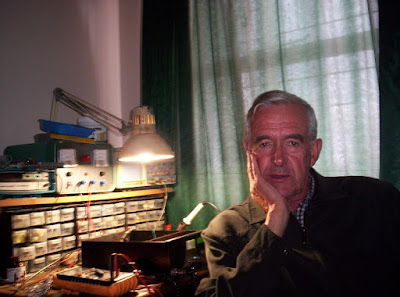
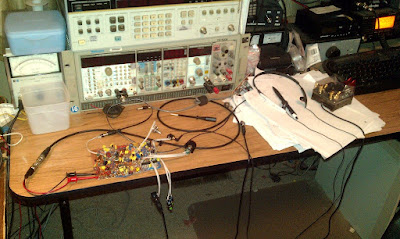
I’m still scratching my head a bit about HOW the resistor prescribed by Edgardo, LU1AR, cured the 250 kHz oscillation problem that was plaguing the JBOT amplifier in my 20 meter DSB rig. Earlier I’d posted an excerpt from a CQ article in which Doug DeMaw talks about swamping and Q killing. Last week I got a very thoughtful e-mail from esteemed homebrewer Todd, VE7BPO. Here is an excerpt :

Thoughts and Considerations
Let’s discuss squashing low frequency oscillations in a QRP transmitter; say at 200 KHz or so. A low value resistor across the coil (12t — FT37-43) often works well to stop these.
Oscillations come from the transistor: gain versus frequency isn’t linear, nor is impedance at transistor ports. We’ll often add negative feedback and such to stabilize an amplifier towards unconditional status. In my Tx circuit that oscillated, no feedback was applied.
In the case of an inductor wound on a FT37-43 or FT50-43, the Q is already low (say 8- 15 or so). Obviously a resistor in parallel with such a coil is not going to lower Q since Q is already quite low. That R will reduce the inductor impedance and thus may serve to decrease the low frequency gain of the RF amplifier to stop any low frequency oscillations. This might not work so well with a way-high fT transistor where decoupling might be hampered if UHF oscillations are singing.
Doug DeMaw often referred to the parallel resistor as a Q-killer. If we examine the equations describing parallel, or series resonant circuits — if the Q of a tank is high enough, we can practically ignore the effect of resistance at resonance. Conversely if we add a resistance and make it high enough, we might even obliterate the resonant frequency or “kill the Q”. Engineers have long placed an R into a parallel-tuned circuit to drop Q and stop oscillations — they refer to it as damping. 1 example might be in old TV sets where a variable resistance was added to peaking coils to prevent a tank from ringing at a frequency determined by the coil L and distributed C. This applies to higher Q inductors and not our FT37-43 inductor.
Decoupling
Our teacher, Wes, teaches us in EMRFD that coupling often occurs along the DC power supply lines. Further, he’s taught us to decouple AC by placing high impedance in this path. Often the impedance is a low-pass filter with series element(s) of a high Z and shunt element(s) with a low Z. The filter must present a simple short circuit (or perhaps just a resistance) at low frequency so DC flows to the amplifier.
Final
Oscillations should likely be identified and treated according their frequency. This topic looks advanced and all RLC networks deserve more attention from us.
Todd, VE7BPO — Feb 27, 2013

Our book: “SolderSmoke — Global Adventures in Wireless Electronics” http://soldersmoke.com/book.htm Our coffee mugs, T-Shirts, bumper stickers: http://www.cafepress.com/SolderSmoke Our Book Store: http://astore.amazon.com/contracross-20
Hard Core! Wisdom and Ideas on Toroids

Gerard ZS5AAC

This morning the BITX20 mailing list has an interesting discussion of toroidal cores. I especially like Gerard’s use of the cores from old CFL bulbs. Farhan wraps it up with a great explanation of why we use ferrite cores in broadband transformers:
——————————
Over the years I built quite a few BITX’s. In the beginning I used the
toroids salvaged from CFL lamps. These worked quite well for the mixer
coils. For the filter coils I used 6mm bakelite slug tuned coils that were
stripped from old PYE radios. Wonder if anybody else experimented
along the same lines. I build my BITX’s Manhattan style and they work from the start with few minor tunings. Happy BITX’ing, Gerard, ZS5AAC.
—————————————
Bob
The purists may attack us on this, but what you propose is very
possible. I have been using a wooden-core toroid for several years as part of an antenna tuner.

http://qrp.webhop.net/Pictures/Webcam-1293651325.jpeg

http://qrp.webhop.net/Pictures/Webcam-1295140555.jpeg

I’m also using small plastic and wooden beads as toroid cores for
several other projects. Half inch long sections cut from thick-wall (schedule-40 or schedule-80) PVC pipe also makes good toroidal forms. Beauty of using non-metallic cores is that the core can be split to allow winding wire through the slot without having to thread it through the hole.

http://qrp.webhop.net/Pictures/Webcam-1289957121.jpeg = 1.4 uh

Bending an inductor back on itself in toroidal form concentrates the
magnetic field in the center, whether the core is metallic or non-metallic. This gives you similar self-shielding properties when using either type core material.

With non-metallic cores you no longer have to worry about core saturation, so running high current finals is not a problem.

Key to doing this is being able to measure inductance of 5 turns, 10 turns,
and 20 turns, so you can calculate and plot the effective AL of your wooden core toroids. Once you know this value you can make up a chart to tell how many turns are required for a specific inductance.

Twisting wires together to make a transmission-line for bifilar or
trifilar windings is interesting because the impedance of that transmission line might affect performance of your transformer. It may require a bit of experimentation with an SWR bridge to tell when you have the best balance between twist pitch, wire diameter, and insulation thickness.
Arv – K7HKL
———————————————

Robert, Arv,
There are two types of coils used in the bitx – the broadband
transformers and the RF coils in the bandpass filter and oscillators.
You could easily substitute the rf and vfo/bfo coils with just about
any kind of coil – as long as you are hitting the same inductance and
Q. But there is a catch : a few years ago, I finally got down to
measuring the Q of the nylon tap washers that I had originally used.
The q was quite modest at 70. Wes made independent measurements with similar results (his paper is on www.w7zoi.net under technical stuff). In short, for good performance use good old air coils wound on a
cylindrical formers if you don’t use toroids.

About the broadband transformers. These need a material that has very
low loss, very high permeability. The reasoning is like this :
1. We need an transformer’s inductance such that the reactance is
at least 200 ohms at the lowest frequency. This puts the inductance at
around 30uH at 4MHz.
2. If we achieve 30uH through lots of turns (say 100), each turn will
exhibit capacitance with it’s neighbor and the large number of turns
will add up the capacitance so that the coil will provide enough
self-capacitance to resonate at an unintended frequency in HF leading
to pretty bad mixer performance.
3. The only way out would be to achieve the required reactance with
lower number of turns. This means using ferrites.
– farhan VU2ESE

Our book: “SolderSmoke — Global Adventures in Wireless Electronics”http://soldersmoke.com/book.htmOur coffee mugs, T-Shirts, bumper stickers: http://www.cafepress.com/SolderSmokeOur Book Store: http://astore.amazon.com/contracross-20
Struggling Brother

OM Jason, NT7S, has been experiencing the kinds of workbench trials and tribulations faced by anyone who tries to create something new. But I think the radio gods are looking favorably on his efforts — a recent QSO with W7ZOI is a very good omen:

http://www.nt7s.com/blog/

Hang in there Jason! I’m sure the QRP community is looking forward to the availability of the rigs you are developing.

Colin’s Power Meter


Hi Bill,

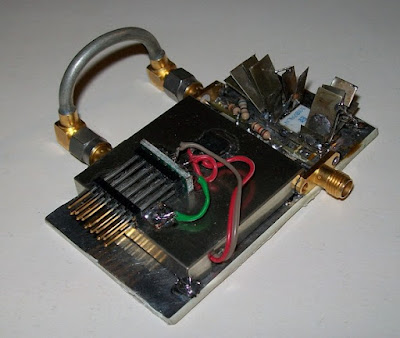
Thought you would be interested in the attached pics, one shows a power meter that a colleague made for me. I had mentioned to my colleague about the W7ZOI power meter after listening to SolderSmoke at work. A couple of days later I was presented with a power meter constructed from scrap parts! We work for a company that repairs cell ‘phone base station equipment and the power meter was made from some scrap VSWR monitor circuits. My favourite part of the device is the heatsink fins on the 30dB attenuator along the top, which can be taken out of circuit by removing the SMA link. To use the meter, the 8V regulator is powered up and if any RF is present at the RF in, a voltage, which can be read by an external Volt meter, is output via the multiway connector. I use a ribbon cable, which has three connections used, DC (+&-) and meter test point. A graph plotting RF in against Volts out can then be used to determine measured RF.

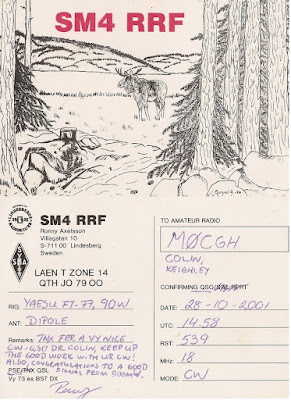
The second pic shows a QSL card for a 17m CW contact I received for my contact with Ronny SM4RRF. I was using a low dipole and 500mW from an FT817! This was my 2nd ever CW contact.

73 and keep up the good work at SolderSmoke.

Colin M0CGH

AF Amplifier Selected: From the Ugly Weekender

We went to ZooMarine yesterday. It is a kind of aquatic amusement park west of Rome. I knew that there would be a certain amount of waiting around while the kids defied gravity. A couple of SPRATs might not have been enough for this job, so, just to be safe, I also took with me the ARRL compendium “QRP Power.” This turned out to be a very good move, because while seated on a bench close to the entrance of the aptly named “Vertigo” ride, I found the AF amplifier circuit that I’ve been looking for (for my WSPR direct conversion receiver). It comes from a June 1992 QST article by Roger Hayward, KA7EXM. The AF amp in his “Ugly Weekender” DC receiver had just what I was looking for: discrete components (no IC’s), an input impedance suitable for a diode ring mixer, and an output impedance suitable for a computer sound card. Thanks Roger! I built the first stage and the active decoupler this morning. They are working fine.

I wanted to find a photo to go along with this article. While doing a Google image search, the cover of one of my favorite books unexpectedly popped up (see above). VE7BPO’s site explains why:

“A great reference for Ugly Constructing is The “Ugly Weekender” by Roger Hayward, KA7EXM and Wes Hayward, W7ZOI published in the August 1981 issue of QST. In fact, it was Wes and Roger who coined the term “Ugly Construction” when preparing this QST article. Wes was asked about this in 2009. The term was a takeoff from the 1958 book entitled The Ugly American by William Lederer and Eugene Burdick.

I didn’t know there was a connection between our construction technique and the book. I find it very appropriate. The good guy in the book is the “ugly” American. He is a practical, technically-oriented guy who puts his skills to use to help people.

For more background on ugliness see VE7BPO’s (beautiful) site:
http://www.qrp.pops.net/ugly.asp

Auroral Memories from W7ZOI

Hi Bill,

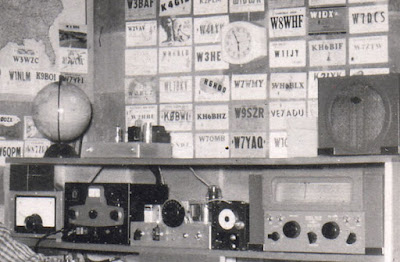
I was really on top of it this time and listened to Soldersmoke 115 yesterday evening, the same day I got it from the Internet. I was intrigued by your description of the aurora in 1972. I don’t recall that one. By then we were in Oregon. We have had some strong ones down this way, but missed them visually because of cloud cover, a common problem in Oregon. But I have fond memories of the first and most spectacular show I ever did see. This happened when I was trying to go on the air in eastern Washington. I knew that I had put something in my log about it, so last night I pulled my log books of that day and started looking. It took a while, but it was there. QTH at the time was Richland, WA, which is in the SE corner of the state, right on the Columbia River. The station is the first B&W photo on my web site.

I see in my log that on 9/12 of 1957 I had been active. I called a ZL at 1:40 AM on 20M CW. (All times are Pacific time. Probably daylight time.) Then I had worked w2gqn in NJ at 18:11. But the band became quite noisy after that. I have log entries for September 13th, ’57, starting just after midnight:

0020. “Tremendous Northern Lights display. Approx 300 degrees of the sky was colored. Sky had green tinge to the north and red in east and west which extended almost to the direct south. Noise level on 14 mc very high. Noise had the character of an electric shaver. Noise masked all signals except W6ULS on 14.048. Noise cleared at 00:44 and heard KG6AAY (Guam). Static crashes remained. 7 mc seemed unaffected by the noise.”

00:49. called KG6AAY. No luck.
00:56. called ZL2AHA. Again, no luck.
No more entries until 16:25 when I worked a local friend, Wn7JII on 7 mc.

Yea, I know; the frequencies were in mc back then.

Thanks for stirring up some really fun memories.

73, Wes
w7zoi

SolderSmoke (The Book) Reaches the Oregon Coast

Wes, W7ZOI, took the book with him on vacation and sent along this shot from the Oregon coast. I told Wes that I was really nervous when I saw his e-mail in my in-box. The book has sections about my “understandings” of various aspects of electronic theory. I worried that the e-mail would reveal that these were all “MIS-understandings.” I was very relieved that wasn’t the case! Wes provided an interesting bit of ham radio history/trivia: Around page 169, I have the iconic picture of Wes out in the winter woods somewhere, with a homebrew QRP rig in his hands. I remember seeing this picture as a kid. I found it inspirational: a stoic homebrewer, using his invention to communicate from out in the hostile wilderness. In his e-mail, Wes tells me that in that photo, he was actually in contact with another station. It was Lionel, VE6WG, up near Calgary. This photo was taken by K7IUN. Thanks Wes!

Links from #111: W7ZOI, VU3ICQ, AA1TJ

Here is the excellent discussion of bi-directional amps I mentioned. From the web site of W7ZOI:
http://w7zoi.net/Bidirectional%20Matched%20Amplifier.pdf

Here is Farhan’s new JBOT 5 watt final amplifier:
http://www.phonestack.com/farhan/jbot.html

Here is the mysterious (and perhaps diabolical) Xtaflex from AA1TJ (the first rig EVER to promise “buns of steel.”)
http://mjrainey.googlepages.com/xtaflex

Thoughts on Minimalist Radio

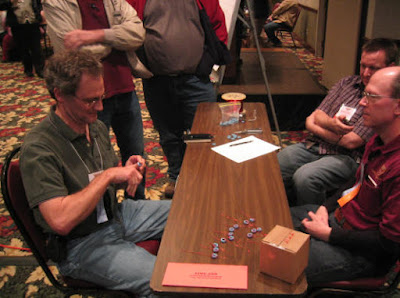
I had a lot of good articles on the old web-page version of this blog. I want to get them into the index, and the only way I can think of to do this is by posting them again. I don’t think this is a problem: many readers will have never seen them, and even for those who have, many of these are so good they deserve a second look. This 2006 piece by KK7B is a good example (The picture is from Roger, KA7EXM’s FDIM 2007 photo collection and shows KK7B winning a toroid winding contest):

A FEW THOUGHTS ON MINIMALIST RADIO FROM KK7B
(Originally posted on the EMRFD Yahoo group)

If you really want to do minimalist radio, you may want to step way
back and take a look at some very early history. The Pixie circuit
has many more components than an early CW station from the era
immediately after spark.

Rather than starting with the Pixie and trying to figure out what to
eliminate, maybe a better approach is to start from zero and decide
what you need. Combining transmit and receive functions is the last
thing to think about.

Starting with the receiver…. The first thing you need is wire up
in the air. The more, the better. If you have the real estate for a
full sized dipole on 80 meters, you can collect enough signal energy
to hear on a crystal set when conditions are good. I’ve copied CW
signals on 40 meters with just a dipole, transmatch, a 1N34 diode, a
good pair of headphones, and a one transistor Pierce oscillator
running on the bench. The leakage from the crystal oscillator picked
up by the antenna beats against the incoming signals. I didn’t power
the oscillator with lemon juice, but I could have (see Bob Culter and
Wes Hayward, “Lemonized QSO” in March 1992 QST.)

Then for the transmitter, just heat-sink the Pierce oscillator and
key the connection to the load. The shift in load impedance will
offset the crystal oscillator frequency.

A dual pi-net transmatch configuration would take care of the
harmonics and allow maximum energy transfer between the antenna and
diode–but I’d analyze it to make sure the harmonic suppression is
more than legal.

So far I count 5 components for the dual Pi-Net transmatch, a 1N34
diode, 6 components for the one-transistor Pierce oscillator. A
dozen parts, plus headphones, a key, and battery–or some electrodes
to push into a lemon.

That would make contacts, but Wes and I have discussed a basic rule
for radios, which is that a station should be able to work an
identical station over a distance of a few miles. It could probably
be done with the above station, but a single transistor audio
amplifier running at maximum gain between the 1N34 and headphones
would make it possible to extract many more signals from the 80 meter
dipole. That’s another 5 or 6 parts. So now I’m up to about 20.

For a more serious station, I’d probably add two more transistors and
a diode, so I could have a separate PA, a balanced mixer, and two
audio stages. The receiver would end up looking a bit like EMRFD
figure 8.7 with a PA tacked on. That would have about 35 parts, but
it would be able to work DX off the ionosphere…about the same
complexity and performance as many other variations on the theme. A
previous version of the Pixie from the 1970s was called “The
Optimist.”

Unlike Muntz–instead of starting with someone else’s circuit and
trying to eliminate parts until I had something that just barely
works, I’d start from scratch, study EMRFD (and other references too–
but in EMRFD all the circuits have been designed and tested) for
circuit ideas, and then start experimenting on the bench, one stage
and one component at a time. Since one of the joys of minimalist
radios is that they can be understood all the way down to the device
physics, I avoid ICs. (I particularly avoid cell-phone ICs, which I
designed for a number of years. It’s like working in a sausage
factory–you are much happier if you don’t know what’s inside.)

Minimalist radio is one of the more interesting design games that we
play using the methods of EMRFD. It’s cheap, it’s interesting…and
as we dig in, we discover that the details can be every bit as
challenging for a radio project with 30 parts as one with 30,000.

Have fun.

Best Regards,

Rick kk7b

Gil Cartoon of W7ZOI on the Mountaintop

Steve, WA0PWK, sent this one in. He found it in an old issue of “Hints and Kinks.” Note the callsign on that FB HB portable rig. Wes tells me that this cartoon was actually a Doug DeMaw initiative. Doug took an older cartoon by Gil, W1CJD, and put “W7ZOI” on the rig. The drawing appeared next to a short article by Wes about an electronic keyer using a pair of 741 Op Amps. Wes also reports that his kids got a real kick out of it — his son Ron was taking an elective printing course in Jr. High School at the time, and printed up a bunch of W7ZOI QSL cards featuring the modified Gil cartoon.

I thought that Steve, N0TU (now WG0AT !), would find this especially interesting.