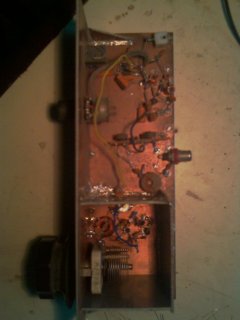
A Bout of Direct Conversion-ism in Northern Virginia — DC Receivers Under Construction

There I was, minding my own business, when suddenly I was dragged into the construction of Direct Conversion receivers.

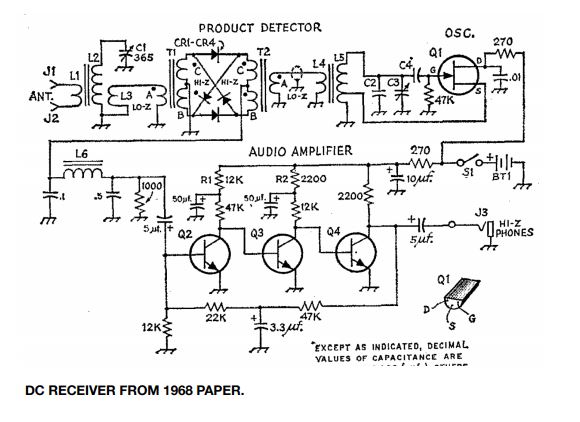
Here is a video about my latest effort. But I feel the urge for more simplification — I may go back to the seminal DC receiver designed by Wes W7ZOI and presented in the November 1968 issue of QST. It is on page 15 here: https://worldradiohistory.com/Archive-DX/QST/60s/QST-1968-11.pdf

An Especially Good (Old) SolderSmoke Podcast

February 22, 2008
— We were in Rome.
— I read a 1931 QST ad sent to me by my fellow “Hambassador” David Cowhig, WA1LBP; David was in Okinawa when he sent it.
— I describe Wes Hayward’s comments about Pat Hawker, G3VA.
— I talk about getting on the air with my HW-8 (after fixing it!), re-tubing my Drake 2-B, and putting up a 30AWG antenna in Rome.
— I describe meeting up with Roman hams (including amplifier manufacturer I0ZY!) and visiting the local radio club.
— The Science Museum in Florence, Italy.
— DSB from Rome with my NE602 rig.
— Tony Fishpool and Graham Firth’s Test Gear book.
— An important corollary to Murphy’s Law.
— Listening to SolderSmoke from safari, under the Southern Cross in South Africa.
— Ron Sparks calls in from Dubai.
You can put on a playlist of all the SolderSmoke podcasts here:

Mike Caughran KL7R’s Last Podcast

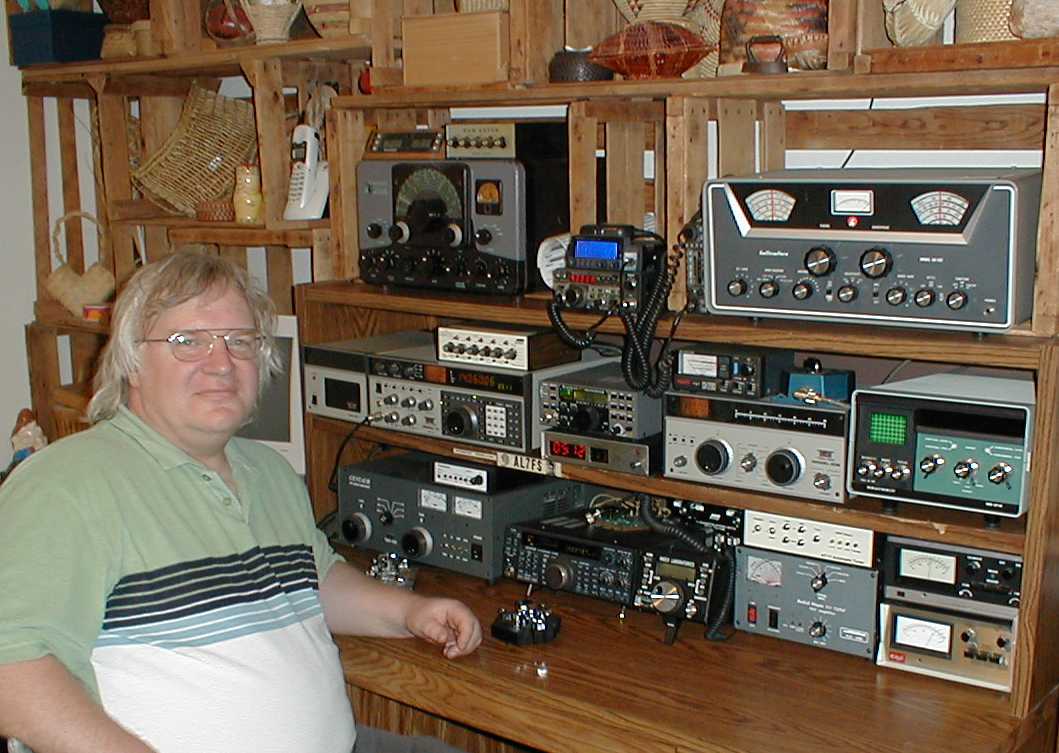
Mike KL7R (SK) during a visit to the AL7FS shack.
This was Mike Caughran KL7R’s last podcast. He died in a car accident shortly after we made this program. January 13, 2007. Mike’s oscillator work. Michigan Mighty Mite. Lasers, diodes, and Einstein. Laser communication experiment. W7ZOI-KL7R QSO on SKN.M0HBR’s feedback amps.The new comet. Saturn, Jupiter and calculation of c. 17 meter QSOs. New SPRAT CD. MAILBAG: China enigma, VE4KEH, M0DAD, GU0SUP, M1CNK, K4AHU, KD4EDM, KG9DK, AA6KI, VA7AT ON5EX
———————
Mike’s Obituary from the February 2007 ARRL Letter:

Mike Caughran, KL7R, SK: Well-known low-power (QRP) and homebrewing enthusiast Michael S. "Mike" Caughran, KL7R, of Juneau, Alaska, died January 22 of injuries suffered in an automobile accident in Hawaii. He was 51. Caughran may be best known as one-half of the team -- with Bill Meara, N2CQR/M0HBR -- that created and produced the weekly SolderSmoke podcast <http://www.soldersmoke.com/>. "I think people were drawn in by Mike's friendly voice and manner," Meara commented on a memorial page for KL7R <https://kiwi.state.ak.us/display/mc/Home>. A member of ARRL and the Juneau Amateur Radio Club, Caughran also wrote articles for the Michigan QRP Club's T5W newsletter and he was an active ham radio contester. "Mike was one of those people who you instantly like because of his honest, straightforward and humble way of talking and expressing ideas," said Mike Hall, WB8ICN, who edits T5W. "His co-hosting of SolderSmoke provided me hours and hours of enjoyment." Caughran was an IT professional with the State of Alaska. Survivors include his wife and son.

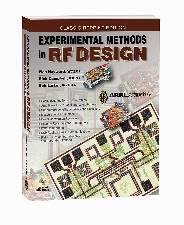
“Experimental Methods in RF Design” LADPAC Software Available FREE!

We’ve frequently said that is pays to check the W7ZOI web site. Tony G4WIF did just that and pointed us in that direction, noting that the LADPAC “Ladder Package” software is now available for download from that site.

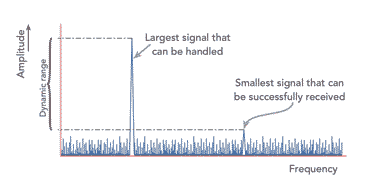
Homebrewers will really want to have that package on their computers. There are all kinds of useful programs in that package: software for designing crystal filters and feedback amplifiers, a program that allows you to think systematically about receiver gain distribution and dynamic range, and many other useful things.

You can get the program here:

http://w7zoi.net/emerrata.html

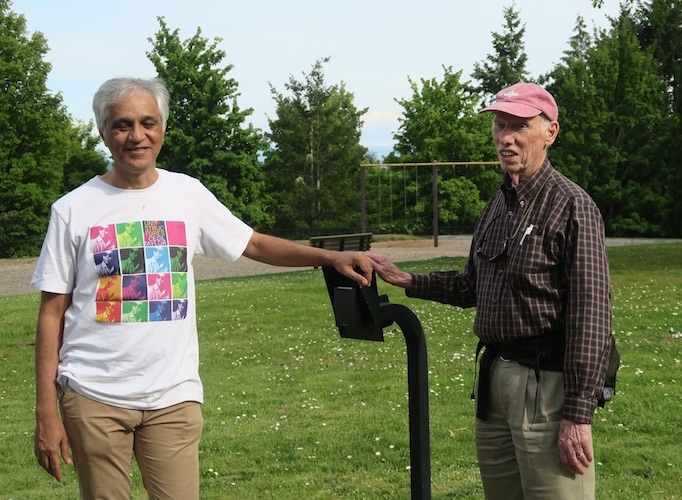
Also on Wes’s site is this May 22, 2022 picture of Farhan VU2ESE with EMRFD co-author Bob Larkin, W7PUA.

Thanks Wes!

Receiver Dynamics — How Good is my Receiver?

OK , so I’ve finished building my new 17-12 Dual Band SSB Transceiver. I am now testing it out on both bands. A big question I have is this: how good is my receiver? Did I get the gain distribution right? Is it generating too much noise? Are any of the stages too vulnerable to distortion in the presence of large signals?

These kinds of questions are at the heart of receiver design. Many of us have for years just thrown together amplifiers oscillators and mixers, and have been pleased if we could copy signals on the ham bands. But could we have been doing it better?

This is a very complicated issue, and unfortunately much of the literature is plagued by jargon and unnecessary complexity. Rarely do we find something that goes from the general to the specific and explains what it is we are trying to achieve: We want the receiver to be sensitive, but we don’t want it to be so sensitive that it distorts with strong signals. It will make some noise, but we don’t want the receiver’s internal noise to be stronger than the noise coming in from the antenna. The “front end” stages are very important because any flaws there will be amplified by the follow-on stages and will “cascade” down through the receiver. Bandwidth is very important.

This morning I found (again!) a document that defines terms in a very clear way. Be sure to check out the footnotes mentioning Dave Newkirk and Wes Hayward! FB! Here it is:

https://www.nsa.gov/portals/75/documents/news-features/declassified-documents/cryptologic-quarterly/Receiver_Dynamics.pdf

Exorcism Completed! Getting Rid of the Spur in my 17 meter SSB Transmitter using a TinySA (video)

To re-cap: The problem became evident when trying to “net” or “spot” my transmitter onto my receive frequency. Around 18.116 MHz, I could hear at least two tones in the receiver as I moved the transmitter frequency. I needed to get rid of the extra tone.

First, thanks to all who sent in suggestions. They came in literally from around the world, and this is a demonstration of the IBEW in action. I used or at least tried all of them. They were all good ideas.

Following Vasily Ivananeko’s pseudonymous suggestion I rebuilt the carrier oscillator (apologies to G3YCC). I used the carrier oscillator/buffer circuit from Farhan’s BITX20.

Henk PA0EME said I should look at the signal level at the input ports of the NE602 mixer. Henk was right — the VXO input was far too high. I lowered it, but the problem persisted.

At first, I thought that the spur in question was so small that it would not show up on the air. I could not see it in the TX output using my TinySA spectrum analyzer. That was good news and bad news: Good that it was not showing up on the air, bad that I could not see it in the TinySA and use that image in the exorcism.

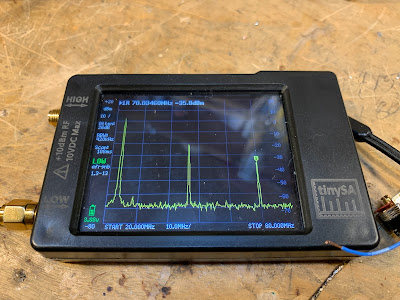
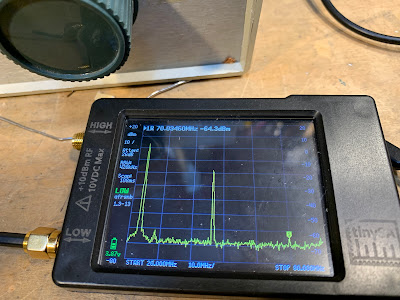
At first I thought that the spur was being caused by the 10th harmonic of the carrier oscillator and the third harmonic of the VXO. This seemed to fit. So, following VK3YE’s sage advice, I built a little 69 MHz series LC trap (using a coil sent by AA1TJ, on a board CNC’d by Pete N6QW). That trap succeeded spectacularly in crushing the 10 harmonic. Look at these before and after shots on the TinySA:

Before Trap
After Trap

Spectacular right? But guess what? The problem was still there.

I scrutinized the situation once more. I realized that the spur would be more visible if I put the TinySA on the input of the transmitter’s PA (a JBOT amp designed by Farhan) as opposed to putting it on the output. Watching the spur and the needed signal move in the TinySA as I tuned the VXO, I realized that they were moving in opposite directions. This indicated that the spur was the result of a carrier oscillator harmonic MINUS a VXO-generated frequency (as the VXO frequency increased, the spur frequency decreased). Looking at my EXCEL spread sheet, I could see it: 8th harmonic of the carrier oscillator MINUS the main output of the VXO.

To confirm this, I plugged the values into W7ZOI’s Spurtune program. Yes, the spur popped up and moved as predicted.

For further confirmation I shut down the carrier oscillator by pulling the crystal from the socket, and then just clipped in a 5.176 MHz signal from my HP-8640B signal generator (thanks KB3SII and W2DAB). Boom! On the TinySA, the spur disappeared. Now I at least knew what the problem was: a harmonic from the carrier oscillator.

Following good troubleshooting practice, I turned off the gear and went to bed. When I woke up, an idea came to me: Before launching into a lot of filtering and shielding, just try running the carrier oscillator at a lower voltage, seeing if doing so might reduce the harmonic output. I disconnected the carrier oscillator board from the main supply and clipped in a variable voltage bench supply. Watching the signal on my TinySA, I watched as the spur completely disappeared as I reduced the voltage from around 13V to 10V (see video above). The main signal frequency level did not change much. I tested this by listening for the hated extra tones. They were gone. Exorcised.

Key lessons:

— Spur problems are difficult to troubleshoot. Armstrong’s superhet architecture is, of course, great, but this is definitely one of the pitfalls. Single conversion makes life easier. IF selection is very important. Choose wisely!

— When looking at the TinySA as you tune the rig, pay attention to which way the spur is moving. This provides an important clue regarding the combination of harmonic you are dealing with.

— The TinySA is a very useful tool. It seems like it is easier to use than the NanoVNA (which is also a fantastic tool).

— It can be fun and rewarding to re-visit old projects. In the years between original construction and the re-look, new test gear has become available, and the skill and experience of the builder has improved. So problems that once seemed insurmountable become fix-able.

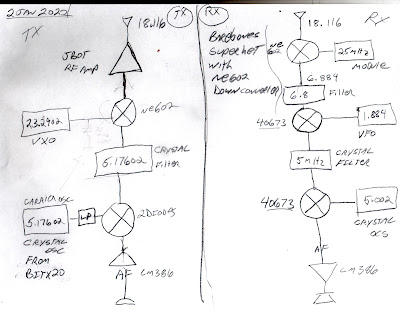
— Thinking through a problem and thinking about possible solutions is very important. It pays to step away from the bench to think and rest. Rome wasn’t built in a day. Here’s a rough block diagram that I drew up (noodled!) while trying to figure out this problem:

How to Fix the Spur Problem in my 17 Meter SSB Transmitter?

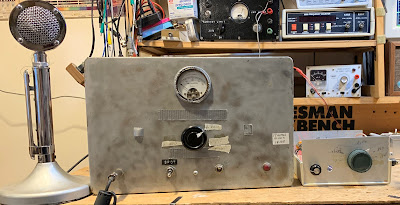
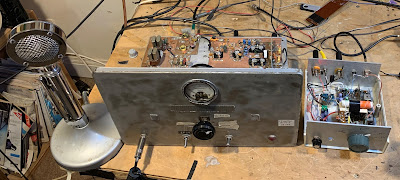
I built the transmitter almost 20 years ago. It is in the larger box, which originally housed a Heathkit DX-40. There is a lot of soul in that old machine. Details on this construction project are here: https://soldersmoke.blogspot.com/2021/12/junk-box-sideband-from-azores-2004-qst.html (The smaller box is a Barebones Superhet receiver set up for 17 meters.)

In the 2004 QST article I discuss a problem I had with “spotting” or “netting.” This is something of a lost art, something that you had to do back in the pre-transceiver days, when running a separate transmitter and receiver. This was how you got the transmitter on the receiver’s frequency. Essentially you would turn on the carrier oscillator and the VFO and let a little signal get out, enough to allow you to tune the VFO until you heard zero beat on the receiver. My problem was that around one particular frequency, I would hear several zero-beats. This made netting the receiver and the transmitter hard to do.

Important note: This is really just a problem with the “netting” or “spotting” procedure — the problematic spur does not show up in any significant way in the output of the transmitter. I can’t see it on my TinySA. But it is strong enough to be heard in the unmuted receiver sitting right next to the transmitter. And that creates the netting problem.

In the QST article, I said that I noticed that the problem seemed to be centered around 18.116 MHz. As I approached this frequency, the tones — desired and unwanted — seemed to converge. That was an important clue. In the article I said I thought that I could eliminate the problem with just one trimmer cap to ground in the carrier oscillator, but looking back I don’t think that this really fixed the problem.

I recently took a fresh look at it. Exactly which frequencies were causing the unwanted signals that appeared in my receiver?

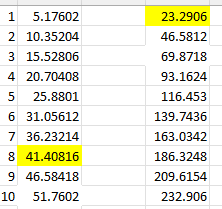
I used an Excel Spread sheet to find the culprits.

The first column shows the carrier oscillator and its harmonics. The second column shows the VFO when tuned for a signal at 18.11668 MHz (23.2927-5.17602), along with its harmonics. Check out the 10th harmonic of the carrier oscillator and the third harmonic of the VFO: 69.8781-51.7602 = 18.1179. Those two harmonics would produce the problem I had been experiencing.

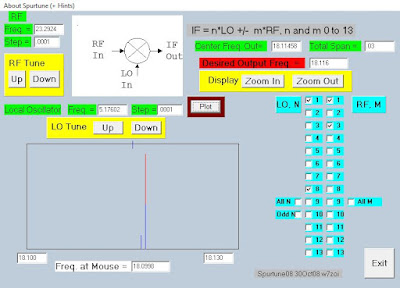
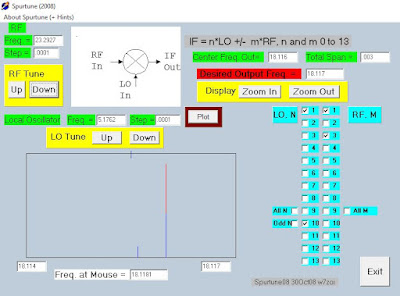
I turned to one of Wes Hayward’s programs for confirmation. Spurtune08 came in the EMRFD software package. Here is what I saw when I plugged in the above frequencies:
You can see the little spur off to the left of the main signal. In the program, as I tune the 23 MHz VFO frequency, the spur moves closer to the main frequency as I approach 18.116 MHz, just as it does in the real rig. Note that I have only turned on the 10th harmonic of the carrier oscillator and the 3rd harmonic of the VFO. Spurtune08 is very useful. Thanks Wes!
So, what is to be done? For now, I am just restricting my operations on 17 meters to above 18.120 MHz. (I worked several DX stations with it on December 27.) But obviously I need to fix this. This rig needs an exorcism. I think I only need to get rid of one of the harmonics, and the 10th harmonic of the carrier oscillator seems easier to kill. I’m thinking of putting the carrier oscillator in an Altoids box, and then adding some filters to knock down the 10th harmonic.

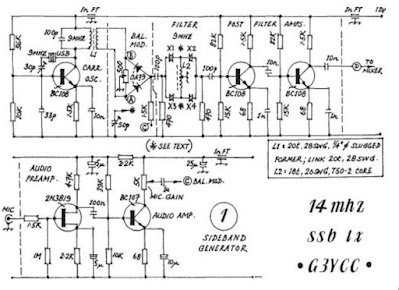
Here is the G3YCC schematic that inspired this rig. I used G3YCC’s carrier oscillator and balanced modulator circuits, just using a 5.176 MHz crystal and changing the tank circuit in the collector:

How would you folks knock down that 10th harmonic?

Farhan’s Amazing Knack Story: From a Boyhood SW Receiver to the Design of the sBITX SDR

The presentation starts at about the 4 minute point.

I think if I were only allowed to watch one YouTube video in the next year, I’d make it this one.

In this amazing RSGB video, Ashhar Farhan VU2ESE takes us back to his earliest days as a radio amateur. He tells us about his very early desire to build radios, his early projects, and his personal evolution as a designer and builder, from a simple DC receiver, to the BITX, the Minima, the uBITX and now the hybrid HDR/SDR sBITX.

There is a lot of homebrew wisdom and tribal knowledge in this video. And we learn so many hitherto unknown details about the rigs that have become so important to us:

— Farhan had the EMRFD book with him on the famous flight from Sweden to India during which the BITX was designed.

— We learn about the origins of the BITX oscillator circuits, and that the VFO and BFO are essentially the same.

— I was really pleased that Farhan included a picture of my HB BITX17 rig in his presentation.

— Farhan discusses the difficulties he faced in obtaining needed parts in India.

— We actually see the nylon washers that Farhan used in the original BITX.

— Farhan discusses his early system for measuring coil inductance.

— In addition the huge contribution of EMRFD, Farhan talks about how he was helped by Pat Hawker G3VA’s writing, and the ARRL’s SSB Handbook.

— Farhkan talks about his Tex 465 ‘scope and his building of a Spectrum Analyzer.

— We see his evolution to dual conversion. We see the conceptual birth of the Minima and the birth (thanks Wes!) of the TIA amps. I didn’t know about the HF-1. Then Farhan designed the uBITX and now the sBITX.

— Farhan talks about his practice of taking the pictures of new rigs with the new rig sitting atop the book that was most important in its design and construction. FB.

— I was really blown away by Farhan’s presentation of how the uBITX advertisement was inspired by and in many ways based on the Heathkit ad for an HW-101. Amazing.

— I learned a lot from Farhan’s discussion of SDR theory. I pledge to spend more time with this. I really like Farhan’s hybrid HDR/SDR approach.

— But I have a question: Farhan seems to say that we’d need a big expensive GOOGL computer to do the direct sampling HF SDR. But doesn’t the little RTL-SDR do just that? Without a GOOGL?

— Great to see Wes’s AFTIA being used in the sBITX.

— Really cool that Farhan has his mind on VHF transverters when designing the sBITX. I liked use of the TCXO module to free up one of the Si5351 clock outputs. FB. And great to include an idea from Hans in this rig.

Thanks very much to Farhan (who stayed up until 3 am to do this!) and to the RSGB for hosting.

Adding Automatic Gain Control to the Termination Insensitive Amplifier

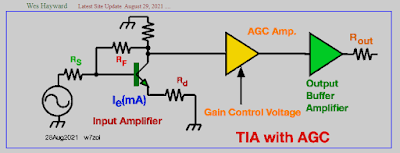
Earlier this month Paul VK3HN had a very interesting blog post about adding Automatic Gain Control to Termination Insensitive Amplifiers (TIAs).

Termination Insensitivity is especially important in bidirectional rigs. The shape of the crystal filter bandpass response is very dependent on the impedances presented at both ends of the filter. In bidirectional rigs you are changing the signal path direction through the filter when you go from transmit to receive. If the amplifiers at either end of the filter have impedances that vary depending on what is on the input or output of either stage, you will have great difficulty keeping the bandpass identical as you move from transmit to receive. Termination Insensitive Amplifiers let you do just that — they stay at one fixed input or output impedance (usually 50 ohms) independent of what is attached to the other end of the amplifier circuit. This greatly simplifies impedance matching at the ends of the crystal filter.

When I started building BITX rigs, I asked Farhan about the impedance matching problem. He advised me to use TIAs on both ends of the filter and pointed me to a great 2009 article by Wes Hayward and Bob Kopski. Using the information from that article, I built my DIGI-TIA transceiver, and I have used TIAs in almost all of the rigs I have built since that project.

In his August 2021 blog post, Paul wanted to add Automatic Gain Control to the TIAs. He came up with a way to do this, but we worried that his circuit would have an impact on the impedance of the amplifiers.

Yesterday, Wes Hayward W7ZOI posted on his web site a TIA circuit that lets us do it all: Termination Insensitivity with Automatic Gain Control:


I now find myself tempted to rebuild one of the TIA stages in my Mythbuster transceiver, adding the AGC circuitry from Wes’s design.

Thanks to Paul VK3HN for the blog post on this subject. And thanks to Wes Hayward for the TIA AGC design. It is a real privilege to have direct input from Wes on questions like this.

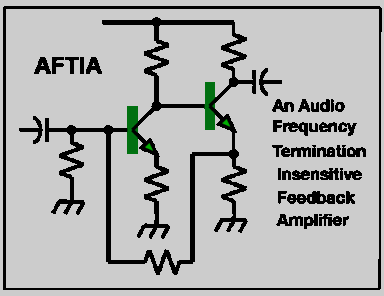
AFTIA! The Audio Frequency Termination Insensitive Amplifier from W7ZOI

It really pays to check Wes Hayward’s web site. I looked yesterday and found something that we really need: A termination insensitive amplifier for audio frequencies — an AFTIA. Just last week I was looking at the AF amplifier of my Mythbuster rig, wishing that it had TIA properties. Now, thanks to Wes, we have a circuit available: http://w7zoi.net/audio-fba.pdf
And let’s not forget that it was Wes Hayward W7ZOI and Bob Kopski K3NHI whose 2009 article alerted us to the RF variety of termination insensitive feedback amplifiers.

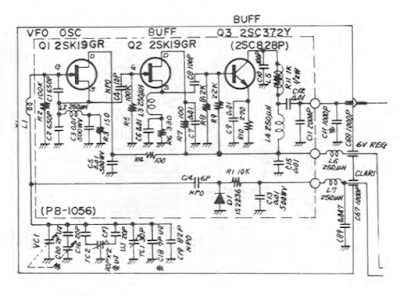
Mythbuster Video #3 — Using the VFO from a Yaesu FT-101

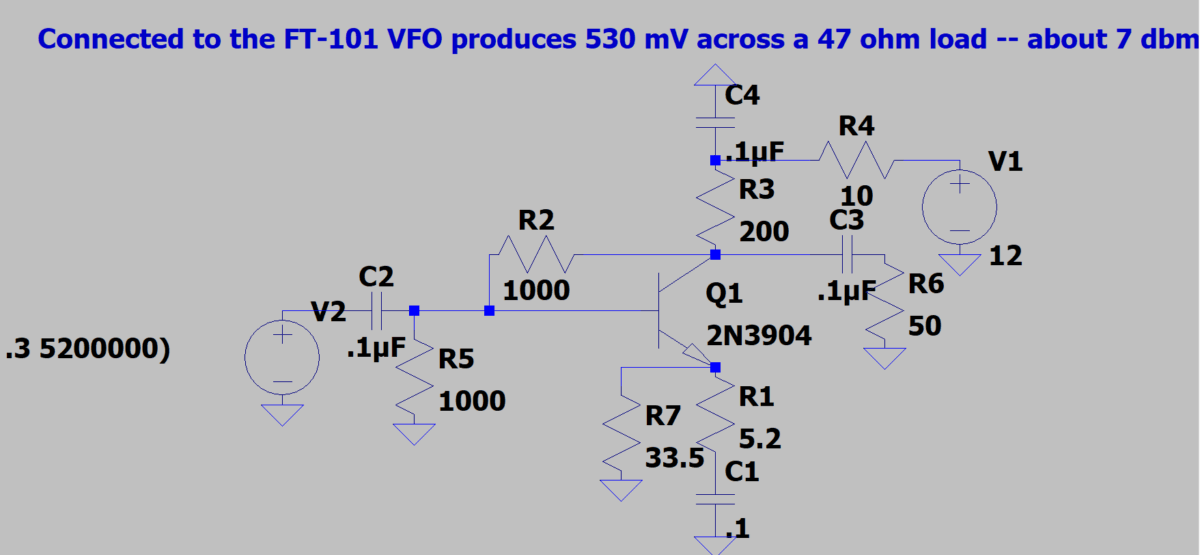
FT-101 VFO
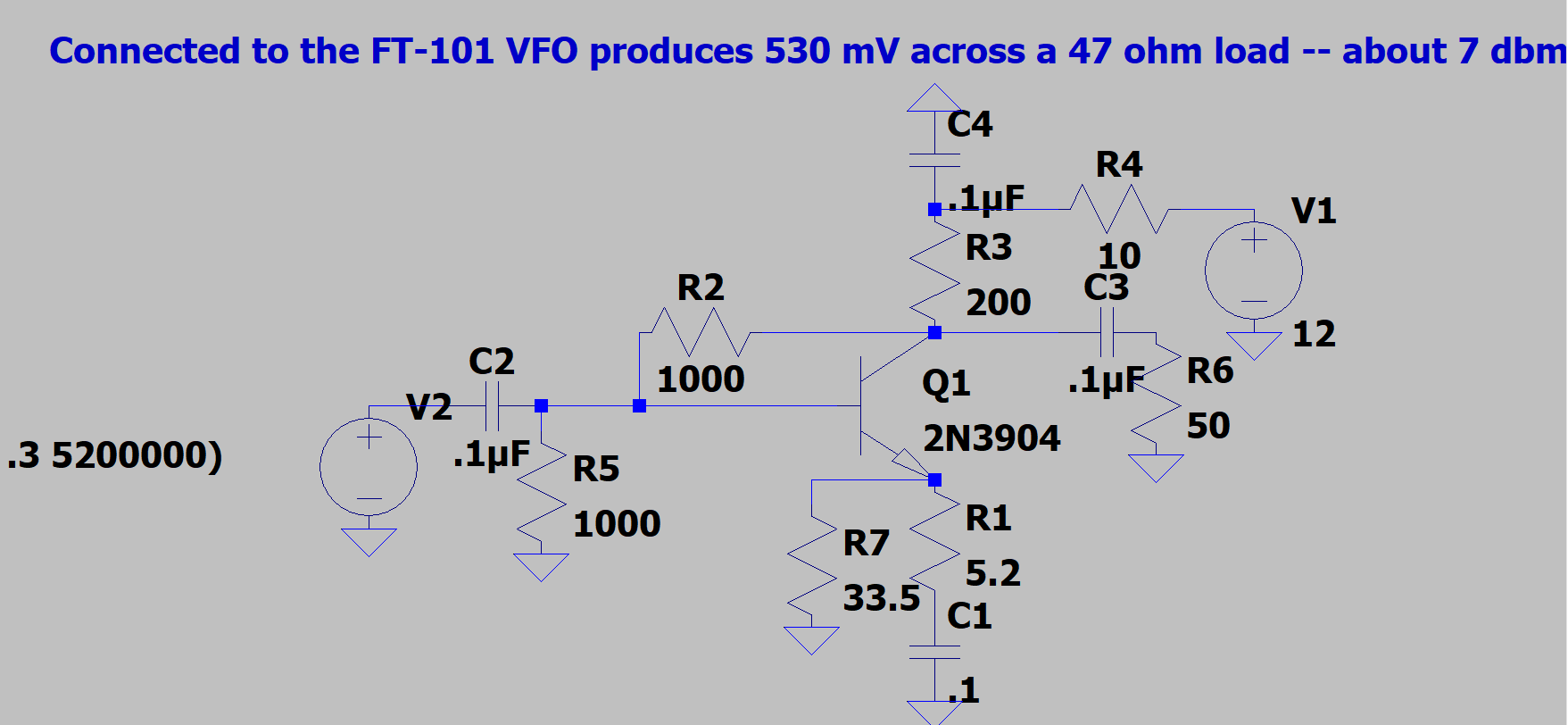
I used LTSpice and Wes’s FBA program (from LADPAC) to come up with a circuit that would provide the needed gain. I needed to get the 290 mV rms signal (across a 50 0hm load) up to the 500 mV rms signal needed by the ADE1 mixer. Above is the amplifier that I came up with. The key here is to adjust R2 and R1 to get the required gain.

M0NTV’s Latest Breadbox Rig — The Radio Gods Have Spoken (TRGHS)!

Tony G4WIF sent me this video from Nick M0NTV. It presents Nick’s latest Bread Bin project — “The Optimizer.”

— I really like the Bread Box enclosures. And leaving the b and the d on the box is just brilliant. These letters now stand for BiDirectional! They even appear symmetrical. TRGHS!

— The switch for a tuning tone is a great idea. I still have to plug my Maplin AF sig gen into the mic jack to do this. FB.

— I too have the connector on the back for keying the outboard linear amplifier. (Shhh! Don’t tell G-QRP!)

— As for the bidirectional TIA amps. I’m really glad that someone else is using these circuits. Wes’s article came out in 2009 and concluded with a call for someone to build a complete rig with these circuits. I wonder how many rigs like this have been made. It is a great circuit. One thing I would suggest for Nick: Wes’s article points out that you CAN have higher gain in one direction than you have in the other. Just use resistor values in the chart provided in the 2009 article. You could have an amp with 15 db in the transmit direction and 24 db in the receive direction. BTW: I have been getting a lot of help from Alan W2AEW and Farhan VU2ESE on how to use the NanoVNA to confirm the input and output impedances on solid state amplifiers.

— For many years I had the same map of the Moon in my shack. I hope that map makes it to the new house Nick.

— Finally, I was really surprised to hear EI0CL calling CQ during Nick’s demo of the receiver. That is Michael Higgins out in Galway. Michael was one of my regular contacts when I was out in the Azores. He is a truly amazing guy. He is mentioned frequently in my “SolderSmoke — Global Adventures in Wireless Electronics” book. TRGHS.

So Many Wonderful Things on W7ZOI’s Site

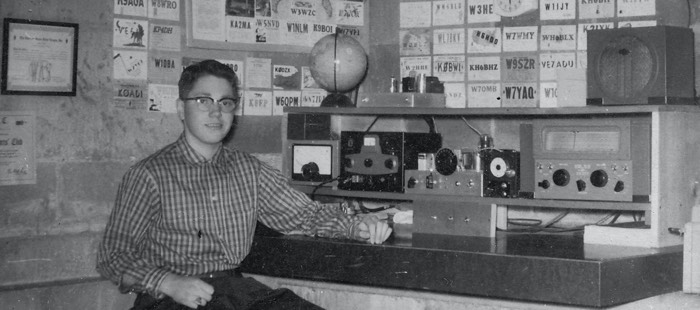
There he is. Wes Hayward, W7ZOI in 1957. I had never seen this picture before. I found it on Wes’s recently updated “shackviews” web page: http://w7zoi.net/shackviews.html .

There are so many treasures on that page, and on all the other portions of Wes’s site.

Some highlights for me:

— Wes’s description of the station in the above picture.

— On his page about Doug DeMaw, Wes mentions that after Doug edited Wes’s 1968 article about direct conversion receivers, Doug built some himself, experimenting with different product detector circuits. Having used Doug’s mixer circuit in many of my rigs, and having recently experimented with different product detectors for my HA-600A, I kind of felt like Doug was watching over my shoulder, guiding me along as I experimented.

— Wes’s use of a digital Rigol oscilloscope. Makes me feel better about giving up on my Tek 465.

— The page about Farhan’s visit to Wes, and the awesome gathering of homebrew Titans that ensued…

— Wes’s meeting with Chuck Adams.

Thanks Wes. Happy New Year and best of luck in 2021!

Wrapping up the HA-600A Product Detector Project — Let’s Call Them “Crossed Diode Mixers” NOT “Diode Rings”

This has been a lot of fun and very educational. The problem I discovered in the Lafayette HA-600A product detector caused me to take a new look at how diode detectors really work. It also spurred me to make more use of LTSpice.

In the end, I went with a diode ring mixer. Part of this decision was just my amazement at how four diodes and a couple of transformers can manage to multiply an incoming signal by 1 and -1, and how this multiplication allows us to pull audio out of the mess.

But another part of the decision was port isolation: the diode ring mixer with four diodes and two transformers does keep the BFO signal from making its way back to into the IF chain. This helps prevent the BFO signal from activating the AGC circuitry, and from messing up the S-meter readings. LTSpice helped me confirm that this improvement was happening: in LTSpice I could look at how much BFO energy was making its way back to the IF input port on the diode ring mixer. LTSpice predicted very little, and this was confirmed in the real world circuit. (I will do another post on port isolation in simpler, singly balanced diode mixers.)

At first I did have to overcome some problems with the diode ring circuit. Mine seemed to perform poorly with strong signals: I’d hear some of the “simultaneous envelope and product detection” that started me down this path. I also noticed that with the diode ring, in the AM mode the receiver seemed to be less sensitive — it was as if the product detector circuit was loading down the AM detector.

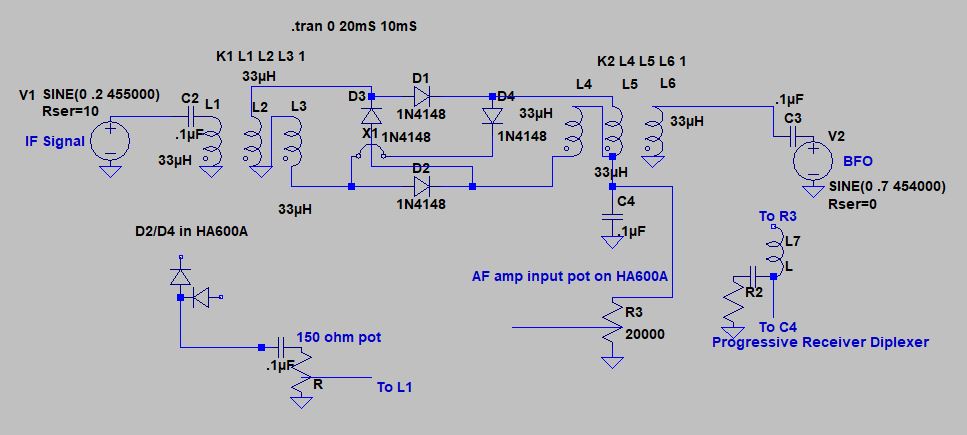
One of the commenters — Christian — suggested putting some resistance into the input of the diode ring circuit. I put a 150 ohm pot across the input, after the blocking capacitor. The top of the pot goes to the capacitor, the bottom to ground and the wiper to the input of L1 in the diode ring circuit (you can see the circuit in the diagram above). With this pot I could set the input level such that even the strongest input signals did not cause the envelope detection that I’d heard earlier. Watching these input signals on the ‘scope, I think these problems arose when the IF signals rose above .7 volts and started turning on the diodes. Only the BFO signal should have been doing that. The pot eliminated this problem. The pot also seemed to solve the problem of the loading down of the AM detector.

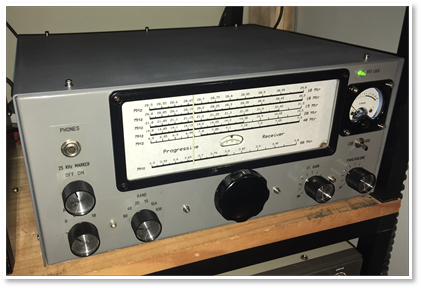
With the pot, signals sounded much better, but I thought there was still room for improvement. I thought I could hear a bit of RF in the audio output. Perhaps some of the 455 kHz signal was making it into the AF amplifiers. I looked at the circuit that Wes Hayward had used after the SBL-1 that he used as product detector in his Progressive Receiver. It was very simple: a .01 uF cap and 50 ohm resistor to ground followed by an RF choke. I can’t be sure, but this seemed to help, and the SSB now sounds great.

A BETTER NAME?

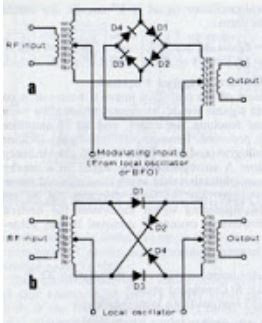
One suggestion: We should stop calling the diode ring a diode ring. I think “crossed diode mixer” or something like that is more descriptive. This circuit works not because the diodes are in a ring, but because two of them are “crossed.” From now on I intend to BUILD this circuit with this crossed parts placement — this makes it easier to see how the circuit works, how it manages to multiply by -1, and to avoid putting any of the diodes in backwards.

I prefer the bottom diagram
A KNOWN PROBLEM?

I’m left wondering if the engineers who designed the HA-600A were aware of the shortcomings of the product detector. It is really strange that my receivers lacks a 12V line from the function switch to the product detector. And it is weirder still that the detector works (poorly) even with no power to the transistor. What happened there?

When you look at the HA-600A manual, you can see a hint that maybe they knew there was a problem. For CW and SSB, the manual recommends leaving the AF control at the quarter or halfway point, then controlling loudness with the RF gain control. This would have the effect of throttling back the RF gain (and the potential for product detector overload) when strong signals appear. MGC in addition to the AGC. Any memories or insights on this would be appreciated.

The Wizard of Horseshoe Bend: VK2FC’s Wonderful Projects

Google led me to VK2FC’s amazing site. I was digging up info on product detectors and I landed on Glen’s description of his version of the W7ZOI Progressive Receiver. Glen’s website provides a very detailed, board-by-board description of how to build this great receiver. I now want to build one.

http://www.vk2fc.com/progressive_receiver.php

Glen’s site has many other projects. Check them out:

http://www.vk2fc.com/index.php

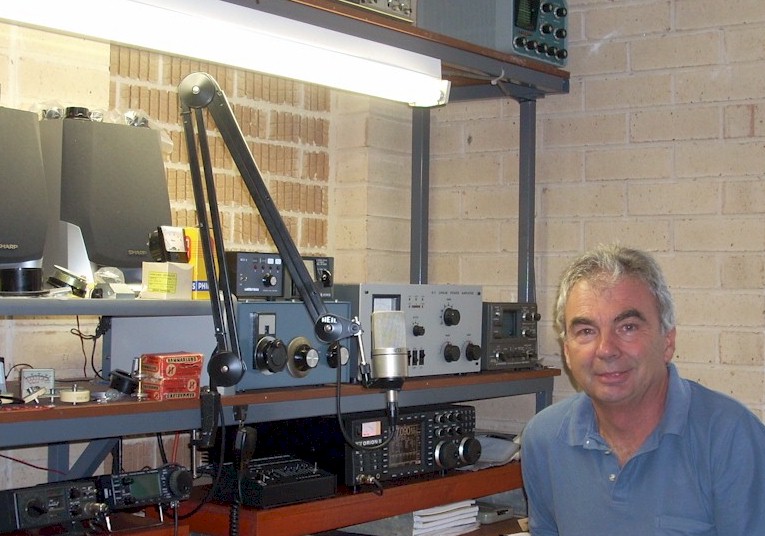
And here he is, the Wizard of Horseshoe Bend:

Thanks Glen.

Wisdom from AA0ZZ: NO LIBRARIES! ASSEMBLER CODE ONLY! — “Digital Crap” — “No Magic Fruit” What qualifies as a real rig? Si570 vs. Si5351

Bill,

Why do you guys make your Soldersmoke podcasts so darn intriguing such that I can’t listen to them in the background while I’m doing something else? Good grief! I start listening and before long you make me stop and chase down a rabbit hole to find something new that you mentioned that I had no clue was out there. Before long I’m doodling out a new sketch or playing with at a new design for something I really need to experiment with or build “next” or something I need to try. It is taking too much of my time!! J

I’ve been listening to your podcasts for years. Way back, before I knew you and before I knew you were doing these Soldersmoke blogs with Mike, KL7R, and just before he was so tragically killed, I was collaborating with him on a simple frequency counter project using a PIC microcontroller. We were making good progress on a neat design. I later completed the project but always kept his contributions noted as part of the source code.

I’ve been making PIC-based VFOs for years – dating back to about 2000 – aiming them at builders who were looking for something to go along with Rick Campbell’s (KK7B) receivers. Rick is a good friend now, after we met in the Kanga booth at Dayton where we both were demonstrating our stuff. (Bill Kelsey (N8ET) of Kanga, was the “marketer” for my kits as well as Rick’s for many years.) My original VFO kits used a DDS (high-end AD9854) that simultaneously produced I and Q signals which made it perfect for Rick’s phasing gear. Rick is a big supporter of my work but he still kids me about polluting his beautiful analog world with my “digital crap” (copyright KK7B term). When I came out with a newer version VFO using a Silicon Labs Si570 PPLL (I can hear already Pete Juliano groaning) it was a big improvement over the AD9854 in noise/spur reduction. I documented this all in a QEX article in about 2011 and Rick (and Wes Hayward) were very supportive/appreciative of my work.

I have used the Si5351 also and I understand Pete’s point of view. It’s “plenty good” for most amateur projects. However, it remains a fact that the Si570 is a better part and produces a cleaner signal. That’s the reason why the Elecraft KX3 uses a Si570. Granted, the newer Elecraft KX2 uses a Si5351 but it’s most likely because they wanted to preserve battery life (the Si570 uses more power but not nearly as much as the AD9854) and also to reduce the cost. I do understand! I also fully understand the ability of the Si5351 to produce I and Q signals via different channels. I’ve had extensive conversations about this with Hans Summers, at Dayton and online. I use a pair of Flip-Flops on the output of the Si570 instead. My PIC code driving the Si570 is ALL written in ASSEMBLER code. Yep! I’m an EE but have had a career mainly in software development and much of it was writing assembler code. I dare say there aren’t too many gluttons for punishment that do it this way. I do it because I want to understand every line of code don’t want to be dependent on anyone else’s libraries. Every line of code in my VFO’s and Signal Generators is MINE so I know I can debug it and it can’t get changed out from under me. (This problem bit Ashar Farhan hard on the Raduino of his BitX. Tuning clicks appeared because the Si5351 libraries he used changed between the time he tested it and released it. I was really appalled when I dug into this and resolved to NEVER use libraries that I didn’t write myself. Similarly, this also makes me have some distaste for Arduino sketches. I would rather see ALL of the code including the initialization code, the serial routines, etc, rather than having them hidden and get pulled in from Arduino libraries. That’s similar to the reason why Hans Summers didn’t use an Arduino in his QCX. He used the same Atmel microprocessor but developed/debugged it as “C” code with the full Atmel IDE/debugger.

By the way, Pete mentioned the Phaser FT8 transceiver by Dave, K1SWL, in a recent podcast. Dave is a very close friend, even though I haven’t met him in person since about 2000. We Email at least daily and some of it is even about radio. J I did the PIC code for the tiny PIC that controls the Si5351 in the Phaser. Yes, it’s written entirely in Assembler again! I do know how to do it for a Si5351. That Si5351 code is not nearly as much “fun”, though. I know, this will make very little difference to guys who write Arduino “C” code to control it but under the covers it’s a world of difference. It takes me about 15 serial, sequential, math operations to generate the parameters for the Si5351. None of them can be table driven and they all have to be performed sequentially. (This is all hidden in about 5 lines of complex, Arduino “C” code but the operations are all there in the compiled assembler code.) In contrast, my Si570 code is almost all table driven. I just have to do one large (48-bit) division operation at the end to generate the parameters. Yes, that’s a bit of trickery to do in ASM. There are no libraries do this.

I will point out one more advantage of the Si570 in comparison to the Si5351. It has the ability to self-calibrate via software instead of relying on an external frequency standard. In my Si570 app I can read up the exact parameters for the crystal embedded inside the Si570, run my frequency-generating algorithm “backwards” and determine the exact crystal frequency (within tolerances, of course) for that particular Si570. Then I update all the internal tables using that crystal frequency and from then on all generated frequencies are “exact”. I love this! Frequency often moves by about 6 kHz on 40M.

Oh yes, I must mention the difference of home solderability of the si570 vs the Si5351. Those little Si5351 buggers are terribly difficult to solder at home while the Si570 is a breeze. I know, many folks will just buy the AdaFruit Si5351 board and it’s already soldered on but, again, I like to do it all myself. No “magic Fruit” for me.

Now that I retired a couple of years ago and am getting out of the VFO kitting business I can finally build complete rigs instead of just making the next-generation VFO’s for everyone else to use. I recently build a tiny, Direct Conversion rig with a Si570 signal generator (of course) and a diode ring mixer (ADE-1). Look at my web page, www.aa0zz.com to see it, along with my VFO projects that I’ve been building in the past. As you well know, Direct Conversion is fun to build and the sound is astounding; however, they are rather a pain to use! Yes, I did make it qualify as a real rig by making several contacts all over the country. (Wes Hayward gave me the criteria: he told me that I must put any new rig on the air and make at least one contact before it qualifies as a real rig.)

The new rig that’s on my workbench is my own version of a phasing rig, experimenting with a Quadrature Sampling Detector (QSD, sometimes called a “Tayloe” mixer), using some ideas from Rick’s R2 and R2Pro receivers and many innovations of my own. At present my new higher-end Signal Generator works great, the QSD receiver works great (extremely quiet and MDS of -130 dB on 40 meters) and the transmitter is putting out about 16 watts with two RD16HHF1’s in push-pull. You can take away my “QRP-Only-Forever” badge too, not that I’ve ever subscribed to that concept! Still more tweaking to do with the TX but now I’m also working on the “glue” circuitry and the T/R switch. The SigGen, RX and TX are all on separate boards that plug into a base board which has the interconnections between boards and the jacks on the back. I’ve built DOZENS of variations of each of these boards. Fortunately they all fall within the size limit criteria to get them from China at the incredible price of $5 for 10 boards (plus $18 shipping) with about 1 week turnaround. Cost isn’t really an object at this point but it’s more of getting a hardware education that I sadly missed while I concentrated on software for so many years. it’s certainly nice to have willing mentors such as Rick, Wes, Dave (K1SWL), Don (W6JL) and many others to bounce my crazy ideas off. Yes, I’m having a ball!

I was licensed in 1964 but out of radio completely from 1975 to 1995. Do you like the picture of my DX-100 on my web page? My buddy in the 60’s had a Drake 2B and I drooled over it but couldn’t afford one.

Now I must finish this rig before you guys send me down another rabbit hole. Too many fascinating things to think about! I literally have a “priority list” on the my computer’s desktop screen. Every time I come up with a new project idea – something I really want to play with such as a Raspberry Pi, SDR, etc, I pull out the priority list and decide where it fits and what I want to slide down to accommodate it. That’s my reality check!

Take care, Bill. Thanks for taking the time to give us many inspiring thoughts and ideas.

73,

-Craig, AA0ZZ
Presence (Absence?) and Direct Conversion Receivers (with wise comments from Farhan)

Hello Bill,
I was reading an online article by Wes Hayward, W7ZO from 1968 about the history of direct conversion receivers (http://w7zoi.net/dcrx68a.pdf) . It was linked in an email in qrptech. It recounts how he had first build a dc receiver with a single diode for the detector, and how microphonic it was, and dissatisfying an experience. This was in the early days of solid state devices, and so they were hard to come by. He describes meeting another ham engineer at work Dick Bingham, W7WKR who immediately recognized that what he needed was a diode ring mixer. The story goes on to describe their experiments, and success at this design.

They decided to write up the design for QST. I won’t bore you with the details…the article is well worth reading about how Wes mailed the radio and the design to ARRL, and how it ended up in the hands of a new person on their staff there, Doug DeMaw, W1CER (later W1FB.). Here is an excerpt from the article describing Doug’s reaction to the receiver:

This was the epiphany, the moment when Doug realized that solid-state technology had produce a new way to build a simple receiver. Doug tuned the receiver higher in the band and found some SSB. Again it was like nothing he had ever heard. It was as if the voice came from the same room. Doug used the term presence in his description.”

Here I present the earliest use, that I know of, of presence being used to describe a receiver. I have to say when I read it, I immediately thought of you guys, and decided to share.

Thanks for all you guys do.
dave /nt1u
———————————————————-
Bill replied:

Thanks Dave. Yea, that’s the 1968 article that launched the use of DC receivers. I had forgotten about DeMaw’s early use of “presence.”

Just to cause trouble, perhaps we should start commenting on “absence” i.e. “I dunno OM, I think your rig lacks a bit of absence in the mid-range… turn menu item 63b to ELEVEN!”
🙂
73 Bill
———————————————————-

Farhan wrote:

Mon, Aug 3 at 3:22 PM

When I got my license, my friend Anil SM0MFC was living in Hyderabad. He lent me his HW-8. I stringed up a 40 meter dipole with a lamp cord and worked with it. Somehow, the combination of the lamp cord length and the 40 meter inverted V made it resonate on 20 m as well. The HW-8 had a nominal antenna tuner and I worked pretty good DX.

Till date, it remains the best receiver that I have used for regular contacts. The only trouble it had was the the MC1496 was a nominal detector, it overloaded heavily with shortwave broadcast stations. There was an unnecessary RF amplifier in the front-end that they could have done without.

I made several direct conversion receivers, but never managed to hang on to any. This makes me want to build one, one of these evenings. I even have a KK7B R1 kit. but real men solder on without any PCBs or even circuit diagram!

A 7/14/21 direct conversion radio that puts out 3 watts of power is what my ideal setup would be. I am not too bothered with the images on CW. I just tune them out in my head. Real soon now, at the moment, i am trying to finish a radio that has been in the works for years. Finally, I am making some headway.
-f
———————————————
Farhan of course is no slouch in the DC receiver area. Years ago he wrote a wonderful post about building a DC receiver with his cousin for her class project:

Included in this post was a passage that I included in my book SolderSmoke — Global Adventures in Wireless Electonics:
————————–
Why build a receiver?
Why do you want to build it? These are available at the Dubai Duty Free asked Harish, an old friend, when he spotted us struggling over the DC40 one evening. I didn’t have an answer to this question and considering the amount of work piled this quarter, it appeared to be a sensible thing to ask.

I think this question is answered by us all in different ways. My personal answer would be because we human beings are fundamentally tool builders. We have an opposable thumb that allows us to grip the soldering iron.
For an engineer (by the word ‘engineer’, I don’t just mean those who have a degree, but anyone who applies technical knowledge to build things) the act of building a receiver is a fundamental proof of her competence and capability. It is much easier to put out 1 watt signal than it is to receive a 1 watt signal.
A simple definition of a good receiver is that a good receiver consistently, clearly receives only the intended signal, such a definition hides a wide range of requirements. The receiver has to be sensitive enough to pick up the weakest signal imaginable (note: clearly), it has to be selective enough to eliminate other signals (only), it has to be stable enough (consistently).
For a ham or an engineer, building a usable receiver is a personal landmark. It establishes a personal competency to be able to understand the very fundamental operation of the radio and mastery over it.

——————–
Bill: OM Ryan Flowers did a 5 part series on building the DC40. If you are want to build one, I suggest you use the schematics on Ryan’s site. There was an error in Farhan’s original schematic — Farhan corrected it but some of the incorrect schematics are still floating around the internet. Here is part one of Ryan’s series:

Farhan’s DC40

Dilbert, Shep, Dex, Pete, Farhan, and Wes! N2CQR Presentation on Homebrewing to Local Radio Club

Dean KK4DAS asked me to speak to our local radio club, the Vienna Wireless Society. It was a lot of fun. I talked about my evolution as a homebrewer, some of the rigs I made, the moments of joy, and the tales of woe. You can watch the presentation in the video above.

I was really glad to be able to explain in the presentation the importance of people like Pete, Dex, Farhan, Wes, Shep and even Dilbert.

I was also pleased to get into the presentation the N2CQR sign that Peter VK2EMU made for me. Thanks Peter!

Here is the URL to the YouTube video (also above):
https://www.youtube.com/watch?time_continue=3414&v=VHSr-v4QO7Q&feature=emb_logo

And here are the PowerPoint slides I used:
https://viennawireless.net/wp/wp-content/uploads/2020/06/VWS-presentation-Rig-here-is-homebrew.pdf