Category: Hamel–Armand
First Light! First Signals received on Version II of Homebrew 15-10 Transceiver
Ianis S51DX in Slovenia was the first call sign heard. Some peaking and tweaking remains to be done, but the receiver is working.
Congratulations to Scott KQ4AOP who got his Direct Conversion receiver working yesterday, And congratulations to Armand WA1UQO who got his regen receiver working. I think all of us are following Farhan’s advice and are taking some time to just listen to the receivers we have built ourselves.
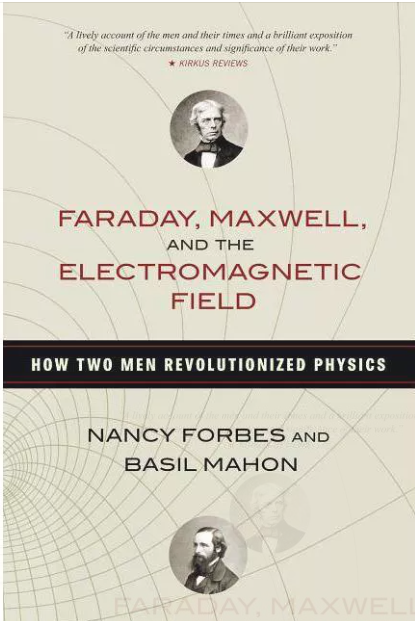
Basil Mahon is an Author for Us — He explains Faraday, Maxwell, and Heaviside
Armand WA1UQO has sent me two of Basil Mahon’s books. They are both really great. He is a wonderful writer who has the rare ability to present not only the people who made the discoveries, but also the technical details of the discoveries themselves. There is so much to learn from Basil Mahon’s books. I put a link to one of them on the column to the right >>>>>>>>>>>>>>>>>>>>>>
PERSONAL:
Born May 26, 1937, in Malta; married Ann Hardwick (a teacher of chemistry), April 1, 1961; children: Tim, Sara, Danny. Education: Attended Royal Military Academy, Sandhurst, 1955-57; Royal Military College of Science, B.Sc., 1960; Birkbeck College, London, M.Sc., 1971.
British Army, career officer, serving with Royal Electrical and Mechanical Engineers in Germany, Aden, and United Kingdom, 1955-74, retiring as major; Government Statistical Office, civil servant, 1974-96. Consultant and trainer on censuses and statistics, including work for clients in Russia, Estonia, Croatia, and Republic of Georgia.
From the Netherlands, Manu Joseph explains why he loves Mahon and Forbes’ book on Faraday and Maxwell:
Understanding Maxwell’s Equations (video)
Vienna Wireless Winterfest Hamfest 2022
AM Diode Detector + 41 and 49 meter Shortwave Bands for HRO-dial Receiver (videos)
The COVID-19 emergency is a good time to look around the shack for projects you have been meaning to take on but didn’t have the time for. We have the time for them now!
When I first built my HRO-dial receiver (using an HRO dial given to me by Armand WA1UQO and an enclosure from Tim KI6BGE) my hope was to have the 40 meter ham band and some shortwave broadcast bands. But it didn’t work out that way. I had trouble getting an AM detector to work properly, and I had a hard time getting a sufficiently broad filter to work right. I ended up adjusting the VFO so that the receiver would cover only the 40 meter ham band.
My recent S-38E adventures and a video from VK3HN have alerted me to the nice programming that is now on the shortwave broadcast bands (I really like WRMI’s afternoon rock music program). So I decided to take another shot at getting this receiver to cover SW BC frequencies.
When I built this receiver, I made the front-end bandpass filter tune-able. There is a two section variable cap behind that “Pre-selector” control you see on the front panel. That lets me tune two loosely coupled LC circuits from about 5.5 to about 8 MHz. So without any mods to the front end, I could cover the 49 meter band (5.9 — 6.2 MHz) our 40 meter band, and the 41 meter band (7.2-7.5 MHz)
Here is how I do it:
For 49 meters: I now have the VFO set to run from 6.34 MHz to 7.120 MHz. The IF is .455 Mhz. So to get down to the lowest frequency in the 49 meter band, I tune that front end preselector down to that frequency (variable cap in filter almost fully meshed). Then I take the VFO down to 6.355 Mhz. I take the difference frequency out of the mixer — .455 MHz.
For 40 and 41 meters: I just tune the pre-selector to this range (variable cap about mid-range) and tune the VFO accordingly. For a signal at 7.5 MHz, for example, I put the VFO at 7.045 MHz. 7.5 – 7.045 = .455 Mhz. Note: There is no sideband inversion in this case — this is important because 40 meter SSB is lower sideband. The Kokusai mechanical filter that Pete N6QW gave me is a lower sideband filter. I have my BFO set at the right spot relative to the filter passband for LSB.
As you can see, I just tune to the “image frequencies” with the preselector. This gives me double the frequency coverage.
As for the filters, well Pete’s Kokusai filter works great on 40 SSB. My problem was, ironically, getting a filter that was broad enough to let AM sound good. I concocted a filter using old 455 kc IF cans, but I wasn’t happy with it. Paul VK3HN used a ceramic .455 MHz filter that was 6 kHz wide at 6 db down. I ordered some from Australia. That should have been wide enough for AM, but I had gotten spoiled by the very WIDE bandwidth of my S-38Es (no real filters at all, just the two 455 kc IF cans). At this point The Radio Gods interceded. Bruce KK0S heard me talking about this on the podcast and kindly sent me some 10 kHz .455 kHz filters. Now we’re talking! I put one of them in this receiver and AM started sounding as good as it does in my S-38E. BTW — a look at NA5B’s WebSDR receiver shows that most of the SW broadcast stations are running at 10 kHz wide. See video below:
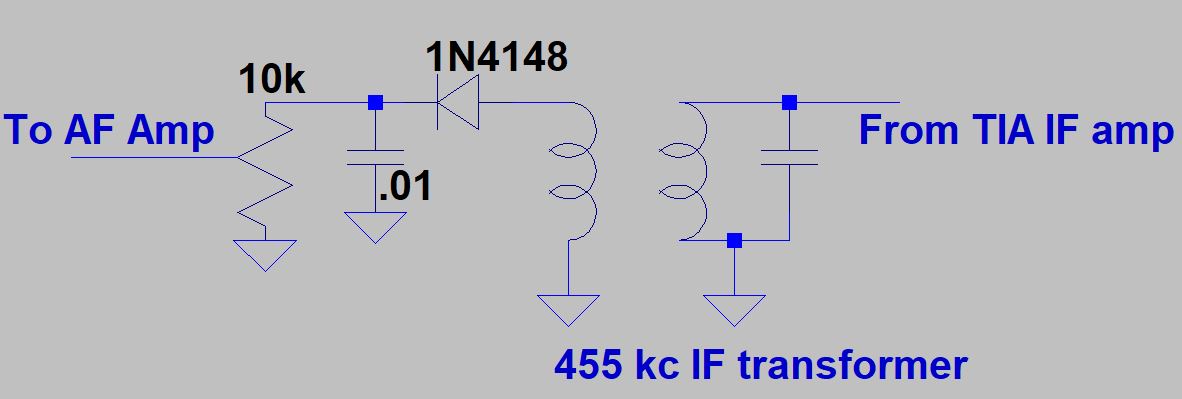
Finally, I had to get a decent AM detector going. The SBL-1 product detector I have in there works great, but I had tried several AM detectors and none of them worked well for me. This was puzzling — it should be so simple, right? Just a diode. But I would get weak and/or distorted audio. I realized that I really needed was something that looked to the rest of the circuitry like an SBL-1, but with just a diode and an RC filter section instead of the SBL-1’s diode ring. I ended up using a small 455 kc IF transformer that Michael Rainey (AA1TJ) had sent me a long time ago. My detector looks like this:
But you know, I find myself thinking that there are many stations I like on the 39 meter band. I think it might be best to build a separate receiver for those frequencies. Maybe throw in 30 meters. Hmm, let me see what’s in the junk box…
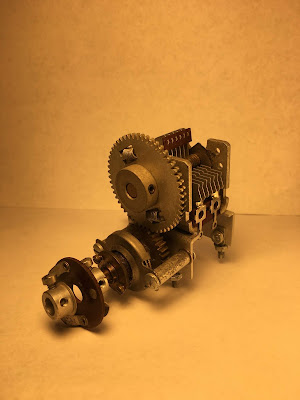
A Beautiful Variable Capacitor (from Pete)
A Homebrew HRO Dial by DL6WD, Homebrew Hero
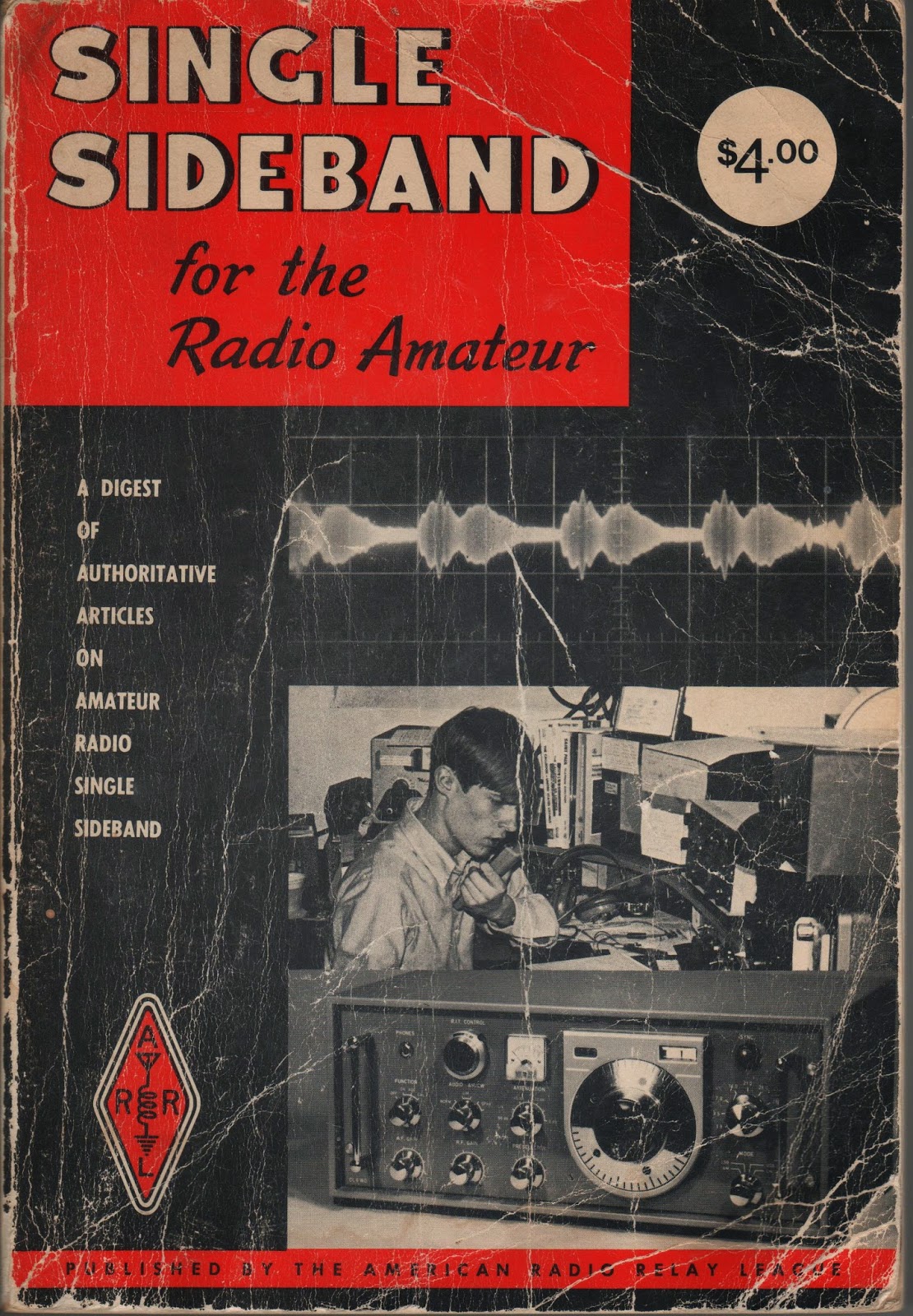
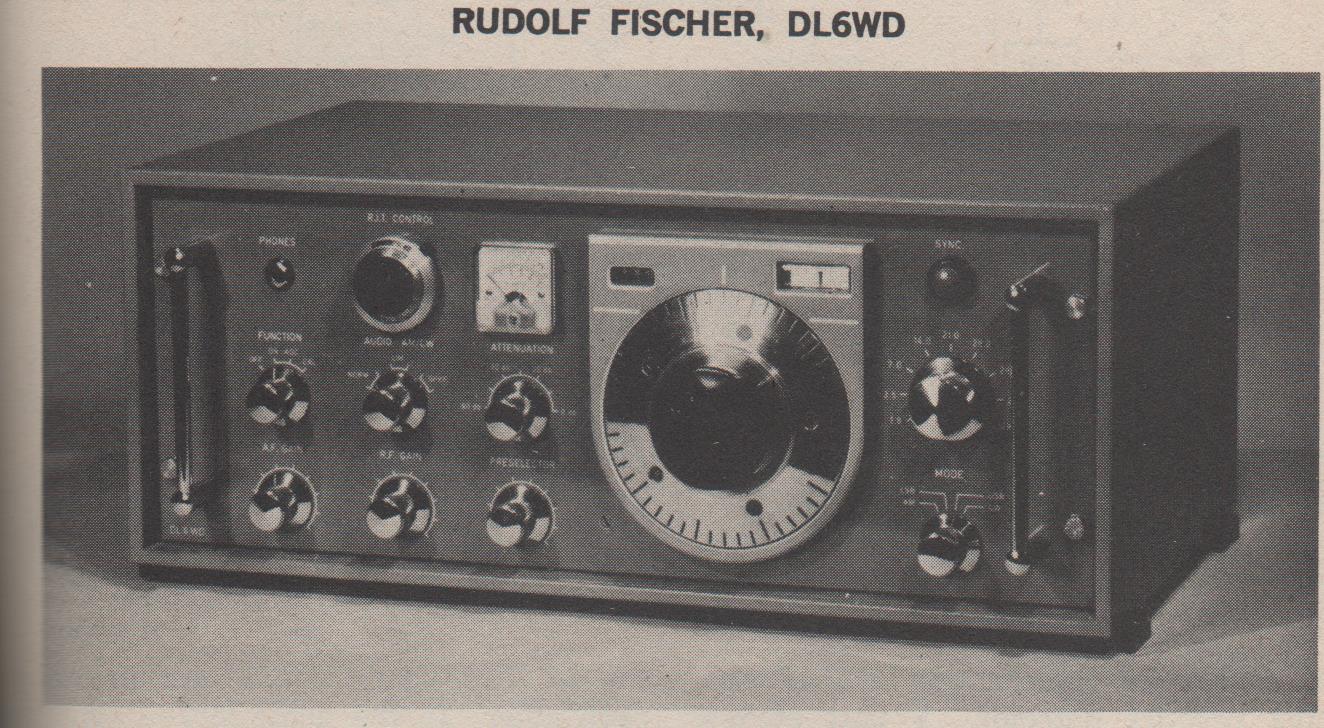
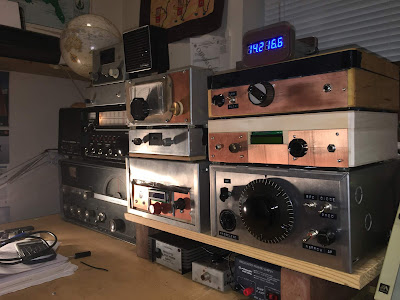
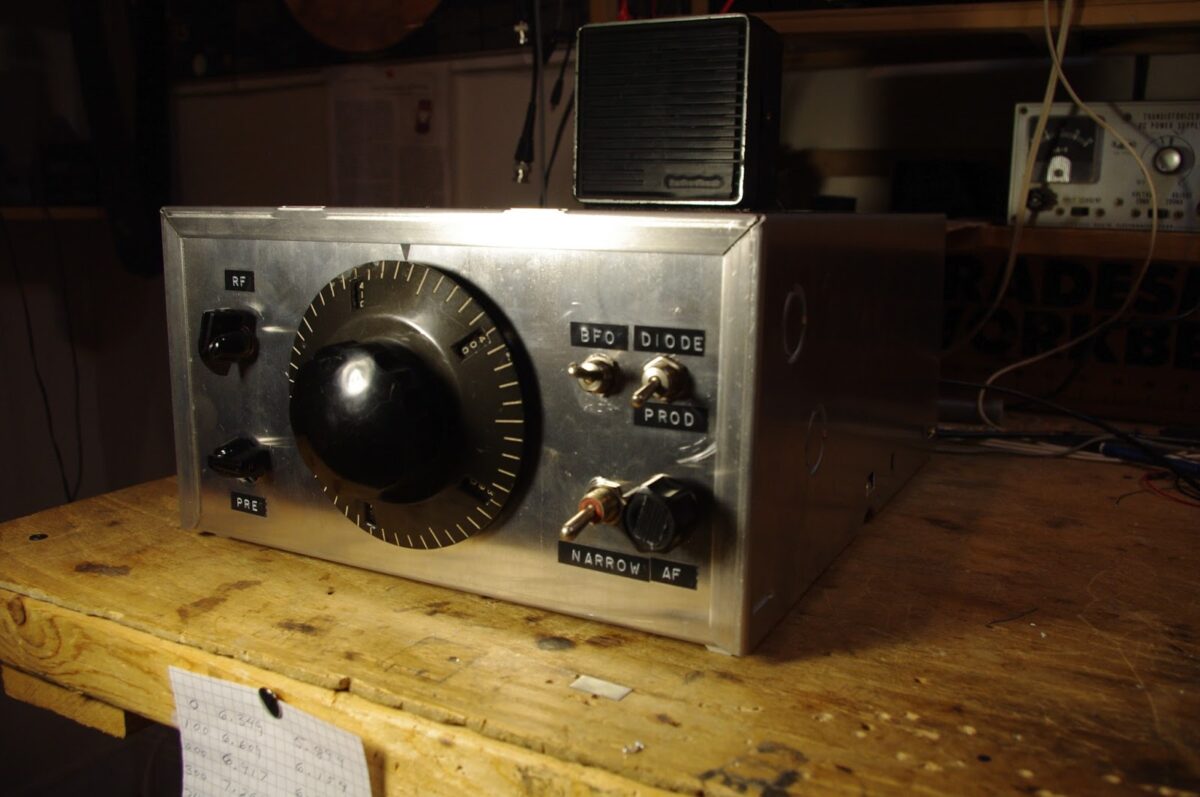
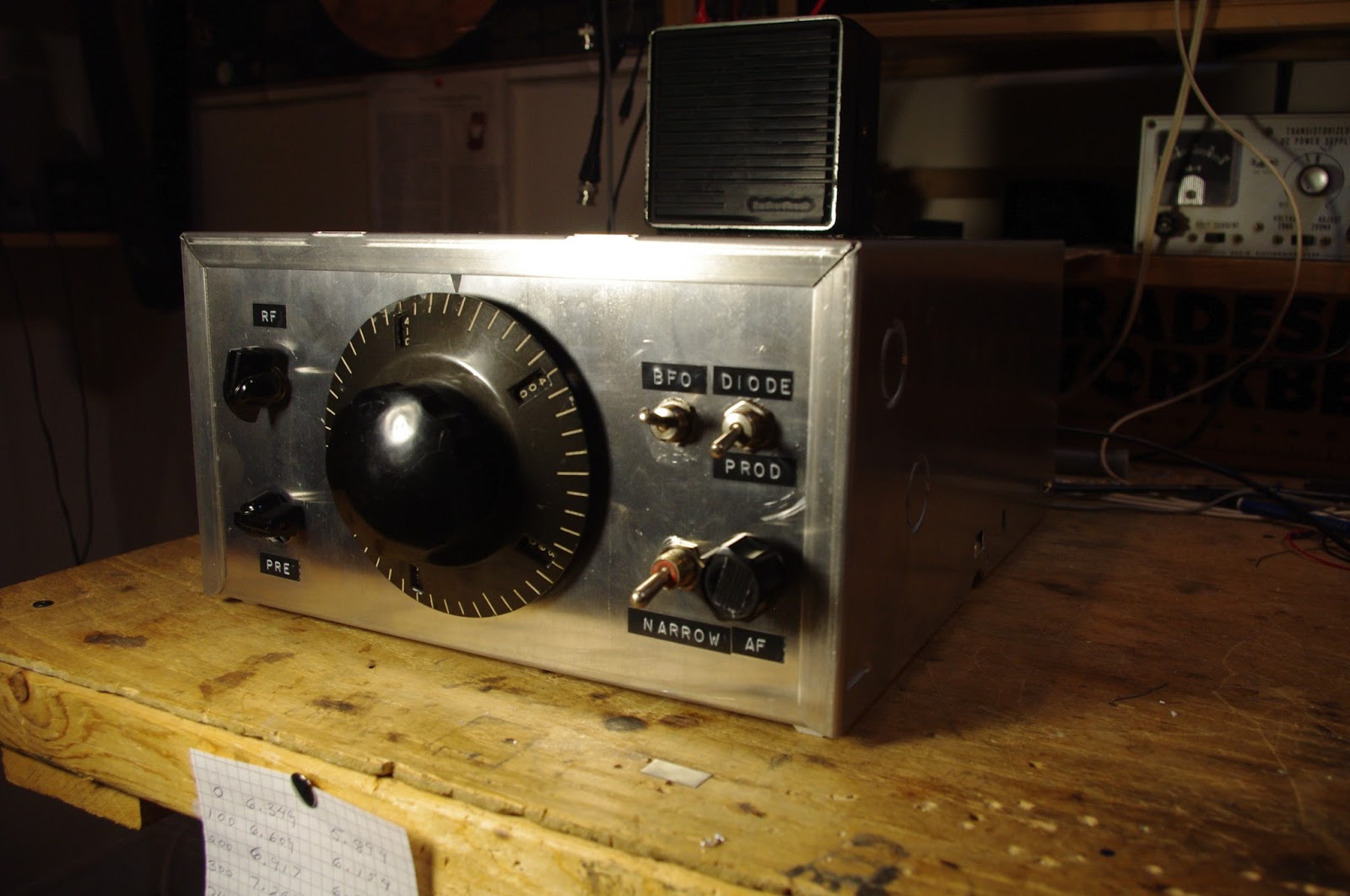
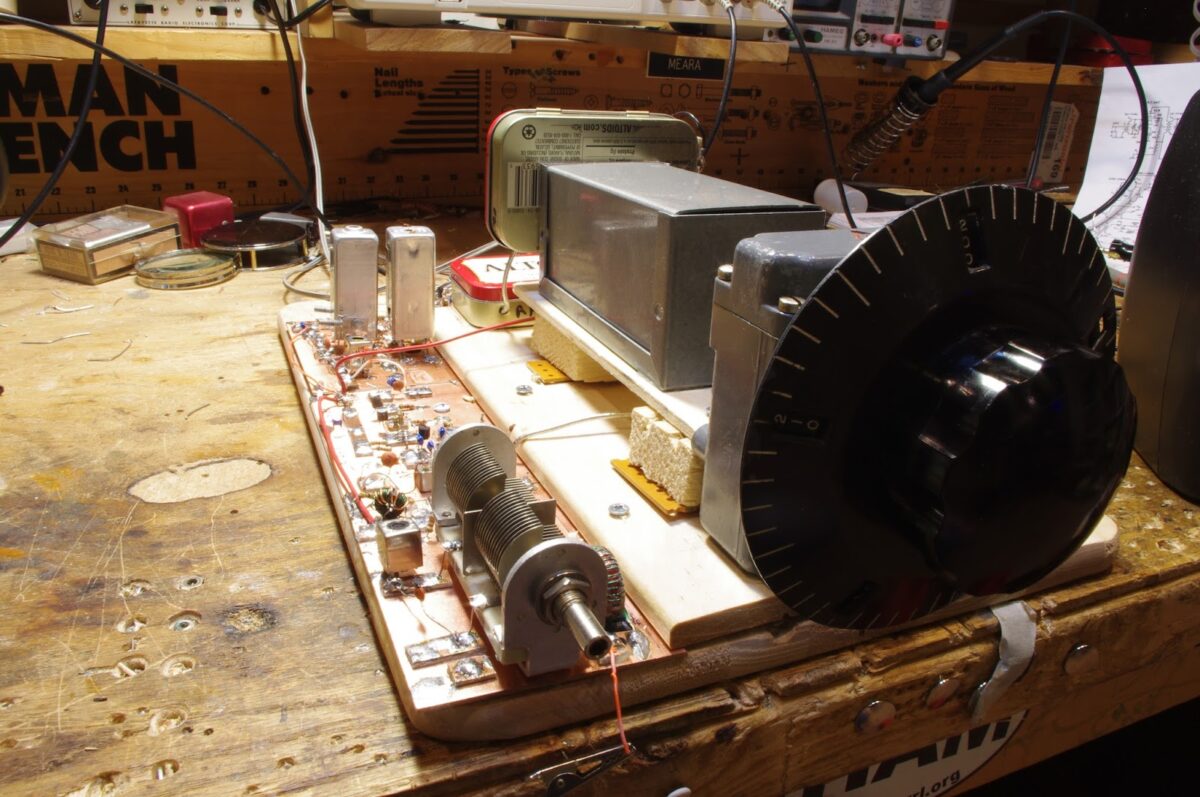
Take a look at that beautiful rig in the bottom of the cover pictures. (A closer shot appears below.) That is an HRO dial, right? Or is it?
No, it is not. In the picture we see the homebrew receiver designed and built during the 1960s by Rudolf Fishcer, DL6WD. It is magnificent in every respect. Because I have been working with the HRO dial and gearbox given to me by Armand WA1UQO, the tuning dial on this receiver caught my attention.
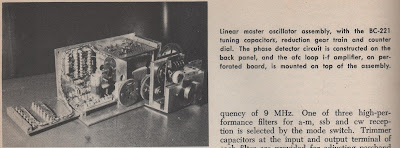
Here is what DL6WD says about this part of his project: “The main tuning gear was built around a BC-221 tuning capacitor and reduction gear. The counter dial and tuning knob are the result of four weeks of labor, The counter dial reads in tens of kHz, where the main tuning knob has a calibration of 200 Hz per division, from an HRO inspiration.” The counter is in the little window to the upper left of the tuning knob. The window to the upper right is a phase-lock indicator. (See below.)
By the way, by the time DL6WD got finished with this all solid state receiver it weighed in at 52 pounds. Rudolf noted that “excessive shielding pays in electrical performance, but not in weight!”
DL6WD earns the title “Homebrew Hero.”
National Dial and Gearbox Problem Resolved
Thanks to all who offered advice and assistance. With help from you guys — and especially from Pete Juliano N6QW — I think I have this fixed.
Pete was right — the problem was really with the variable capacitor. The one I was using was kind of stiff and irregular in its motion. I found another one in the junk box that was easier to turn (it has one set of ball bearings). This fixed most of the problem.
I also spent more time making sure the shaft of the cap lined up perfectly with the shaft of the gear box. This also helped a lot.
I realize now that some of the “stickiness” that I occasionally feel while tuning may be coming from the dial — not from the gear box. It looks like my dial took a hit that slightly bent one portion of it. It seems that the numbers have a bit of trouble clicking over on that portion of the dial. Some lubricant may help there. But I can live with it.
The receiver now tunes very smoothly and I can go right back to a frequency and find the signal exactly where I left it. There does seem to be a very slight difference depending on whether I “approach from above” or “approach from below” — but this is not a big deal.
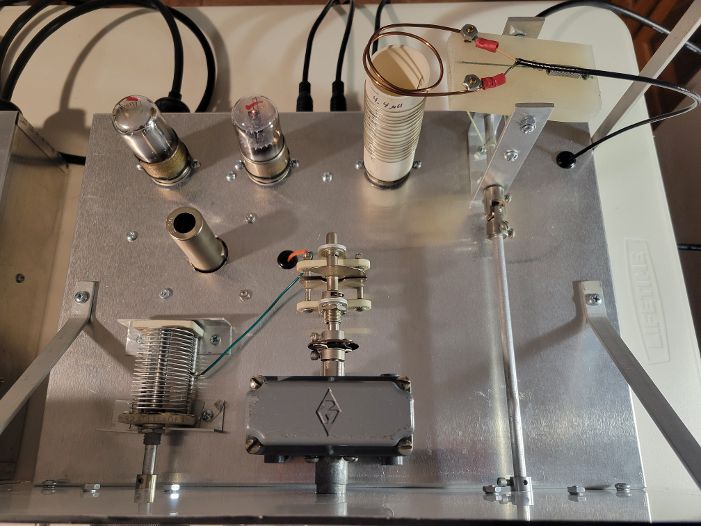
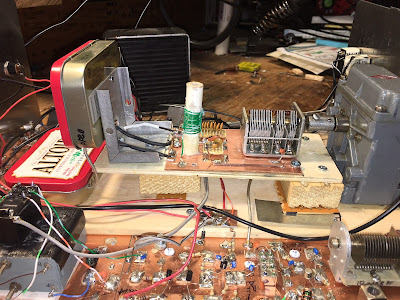
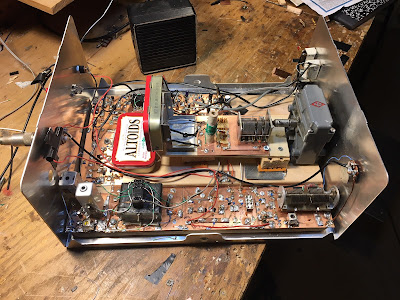
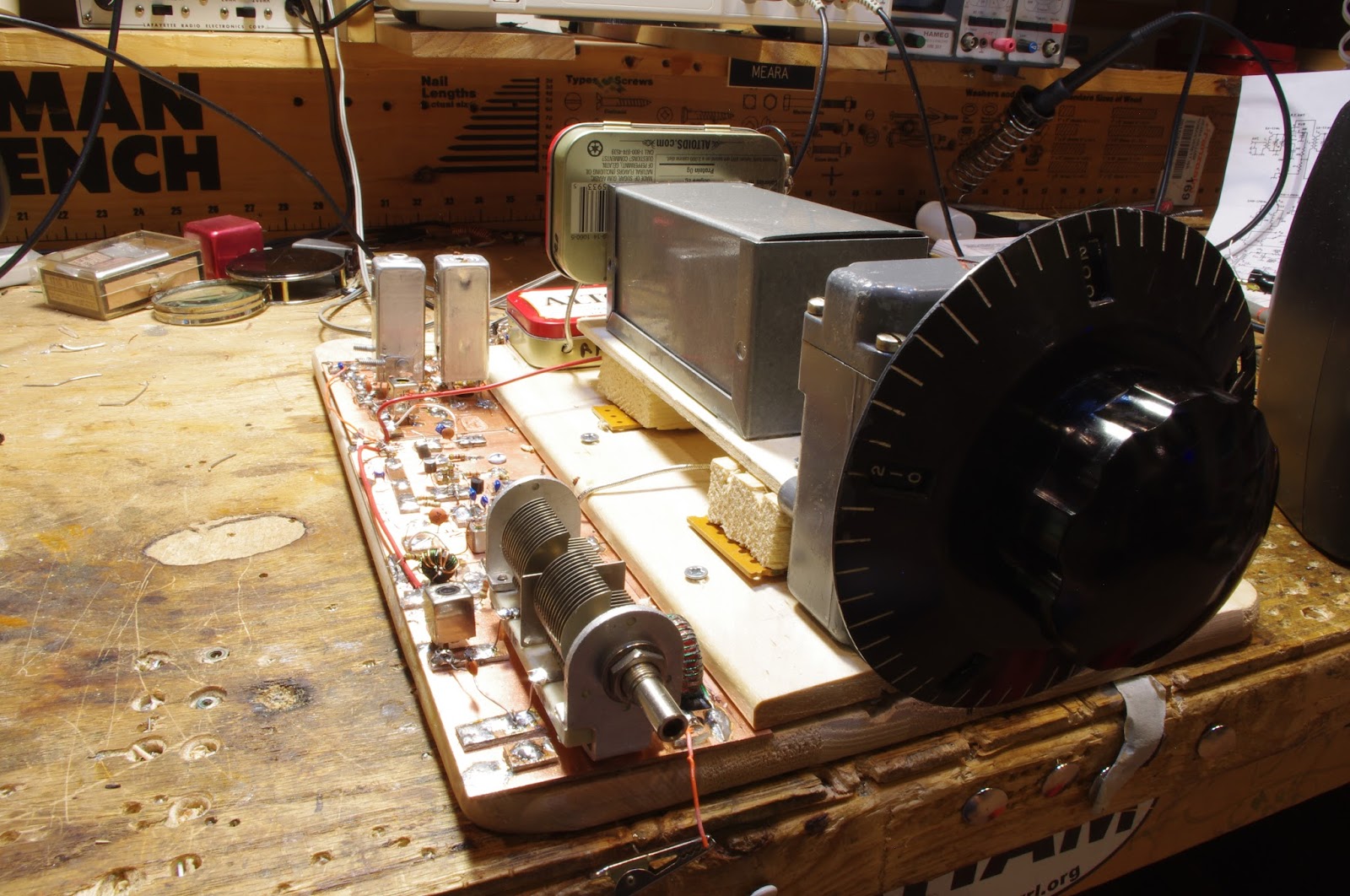
Check out the pictures of the receiver and the VFO. Note the “cardboard from a coat hanger” coil form. The winding is held in place with nail polish varnish. I had planned on having the variable cap, the coil , and the associated fixed caps all in a box for better thermal stability, but the VFO is very stable even without the box. I have the VFO running 455 kc ABOVE the signal frequency. It runs from about 7455 kc to about 7800 kc. I could have set it up to run 455 kc BELOW the signal freq. That would have made it a bit more stable (it is easier to attain VFO stability at lower frequencies) but VFO is so stable that I probably won’t mess with it. I followed DeMaw’s rules: Physical stability, NP0 caps. For the NP0 caps, put several of them in parallel to get the desired capacitance value. Keep heat-producing active components away from the coils and caps.
Thanks again to Armand WA1UQO for giving me this amazing piece of radio history. And thanks to Tim Sutton for the big box that holds this receiver.
James Millen knew what he was doing. See: http://www.isquare.com/millen/millen-page.htm
SolderSmoke #205 Solstice, Mars, Antennas, Displays, Phasing Fix, VFOs, Lexicon, MAILBAG
June 23, 2018
SolderSmoke Podcast #205 is available:
http://soldersmoke.com/soldersmoke205.mp3
— Summer solstice. Mars Observations. Graduations. Internships. Fathers Day.
— Antenna Angst: Pete’s tribander and Bill’s Moxon. Insulation and resonance?
— Pete’s work on color displays.
— Bill goes back to fix up older projects:
— Fixing the Frankenstein Phasing RX. Found an open choke!
— Tightening up the HRO Dial.
— Achieving Juliano Criteria stability on a BITX20 VFO.
— Lexicon additions: “Scratch Built” “Hardrock Radio”
https://english.stackexchange.com/questions/39551/where-does-the-saying-made-from-scratch-originate
— PastaPete: http://www.pastapete.com/
MAILBAG:
Bob Crane W8SX Corrspondent at FDIM
Ralph AB1OP Building LBS
Bruce KC1FSZ Digital Pot
Jason W5IPA uBITX in Juliano Blue
Rogier KJ6ETL ON THE AIR WITH A uBITX
Special thanks to Tim Walford for 25 years of Hot Iron.
Boxed-up and Looking Good: An End to “HRO Al Fresco”
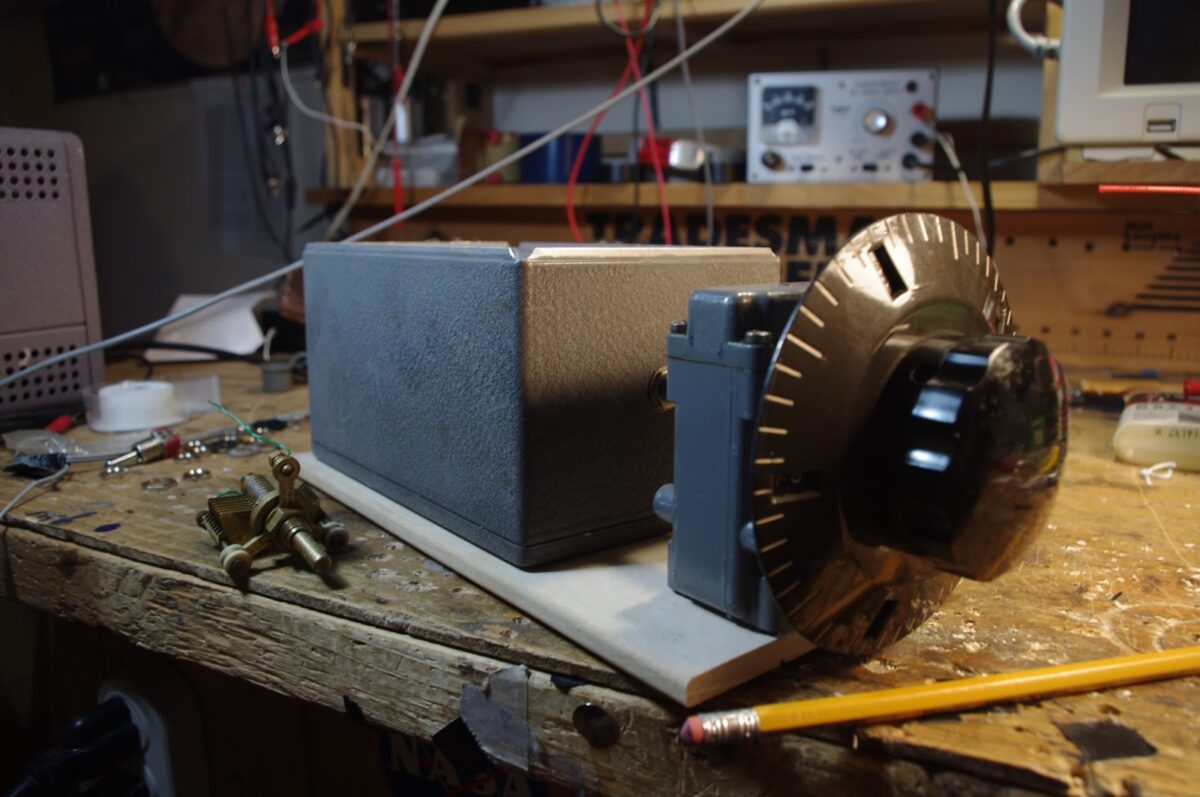
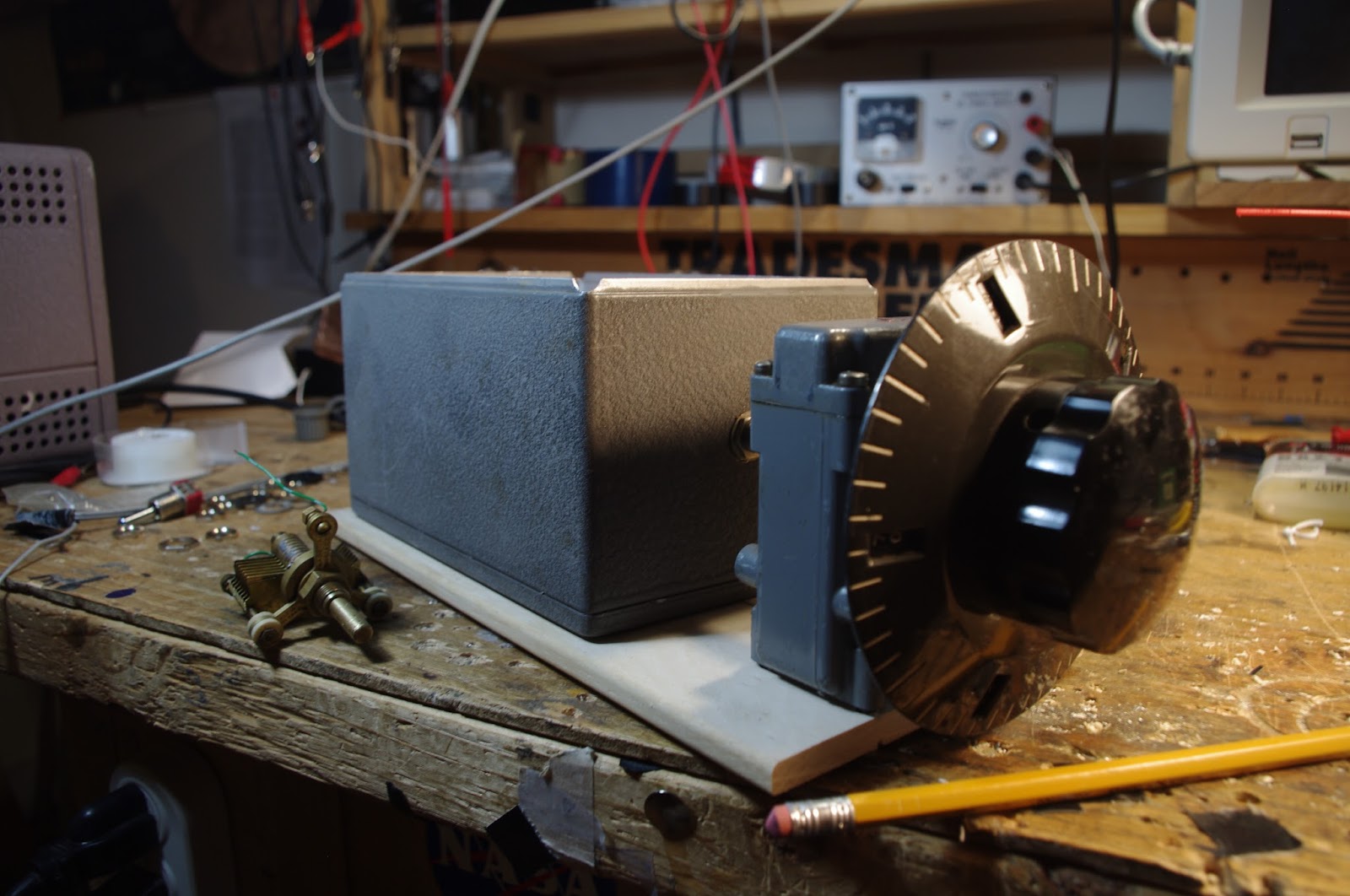
The “al fresco” phase has ended for my HRO receiver project. As has happened with homebrew projects around the world, this rig was literally pushed aside on the workbench to make room for BITX-40 Module Mania. I began to worry that the circuitry of the HRO receiver might suffer damage from the various kinds of electronic construction mayhem that take place on our workbenches. Also, I wanted to see what it would look like in the nice big metal box that Tim Sutton had sent me (thanks again Tim.) And I was hoping that the box would help with the AM broadcast breakthrough that I sometimes hear with this receiver. So, as you can see, I have good excuses for declaring Basta! on the HRO Al Fresco.
I think it looks great. Black on silver is very cool. It sounds great. I’m listening to 40 right now. Thanks to Armand WA1UQO for the very cool HRO dial that got this all started.
TRGHS! HB2HB! Homebrew Extravaganza on 40 Meters!
![]() |
|
AC7M HB Amp and HB Power Supply
|
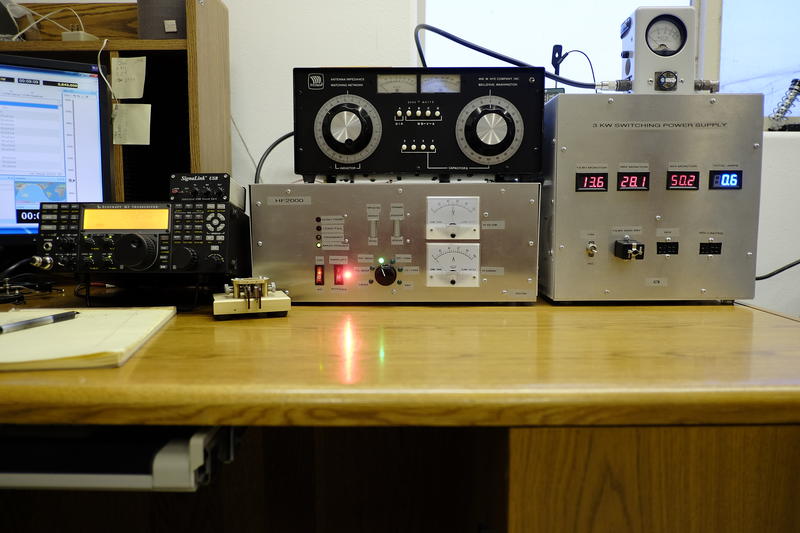
I called CQ with my BITX DIGI-TIA rig and was immediately answered by Doc AC7M in far-off Twin Peaks, Idaho. Doc was running a K3 to a homebrew solid state full gallon amp. And get this — Doc had also homebrewed the 3 kw switching power supply. I looked at my store-bought supply and felt like an appliance operator. I hang my head in shame.
As we discussed solid state amplifiers, we were joined by another builder of silicon after-burners: Don K9AQ, who called in from a beautiful cabin in rural Wisconsin. Don’s amp is based on the venerable EB-104 design.
Both Don and Doc talked about the work of W6PQL. He has a really amazing site devoted to homebrew solid stat amps, and he is selling lots of great boards and parts for this kind of project:
http://www.w6pql.com/
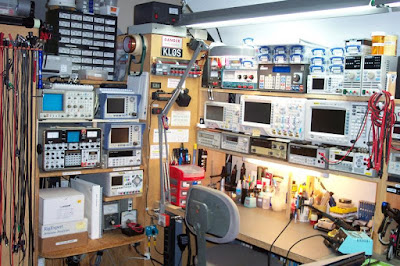
As I finishing up with Don and Doc, I got a very welcome call from an old friend from the SolderSmoke community: Dino KL0S. He as booming in from Williamsburg, Va. Dino has an amazing workshop. He is building a serious vertical antenna for 160 meters. Dino is going for the DX.
![]() |
| Dino’s Bench |
At this point Mike WA3O in Pittsburgh called in. And get this: Mike heard me on his new BITX 40 Module. The Radio Gods Have Spoken! (TRGHS!). We switched up to 7.285 MHz where I fired up my BITX 40 Module for a BITX40-BITX40 QSO (albeit not at QRP levels).
We should definitely make more use of 7.285 for BITX40 and other HB QRP SSB QSOs. 1930 EST (0030 Z) seems like a good time.
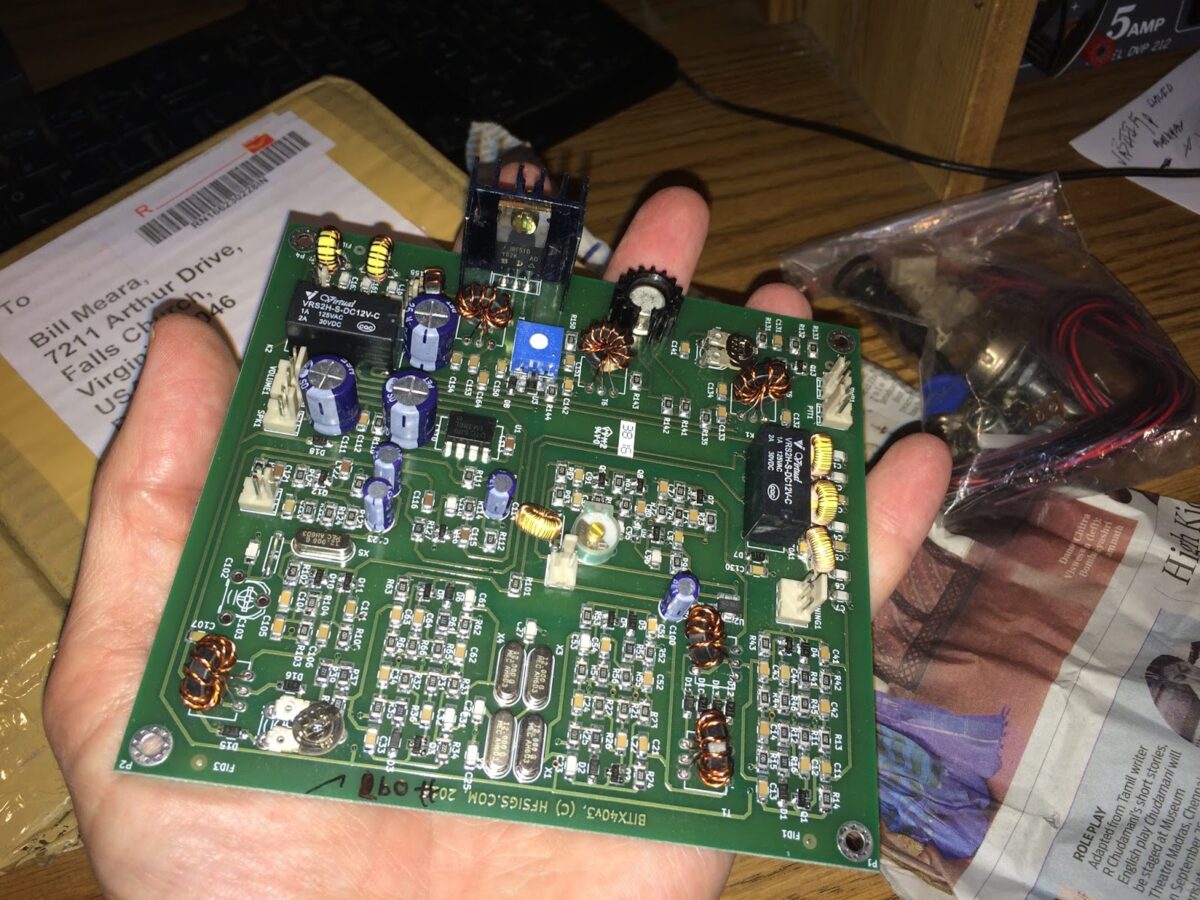
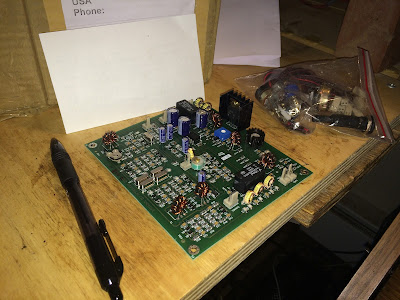
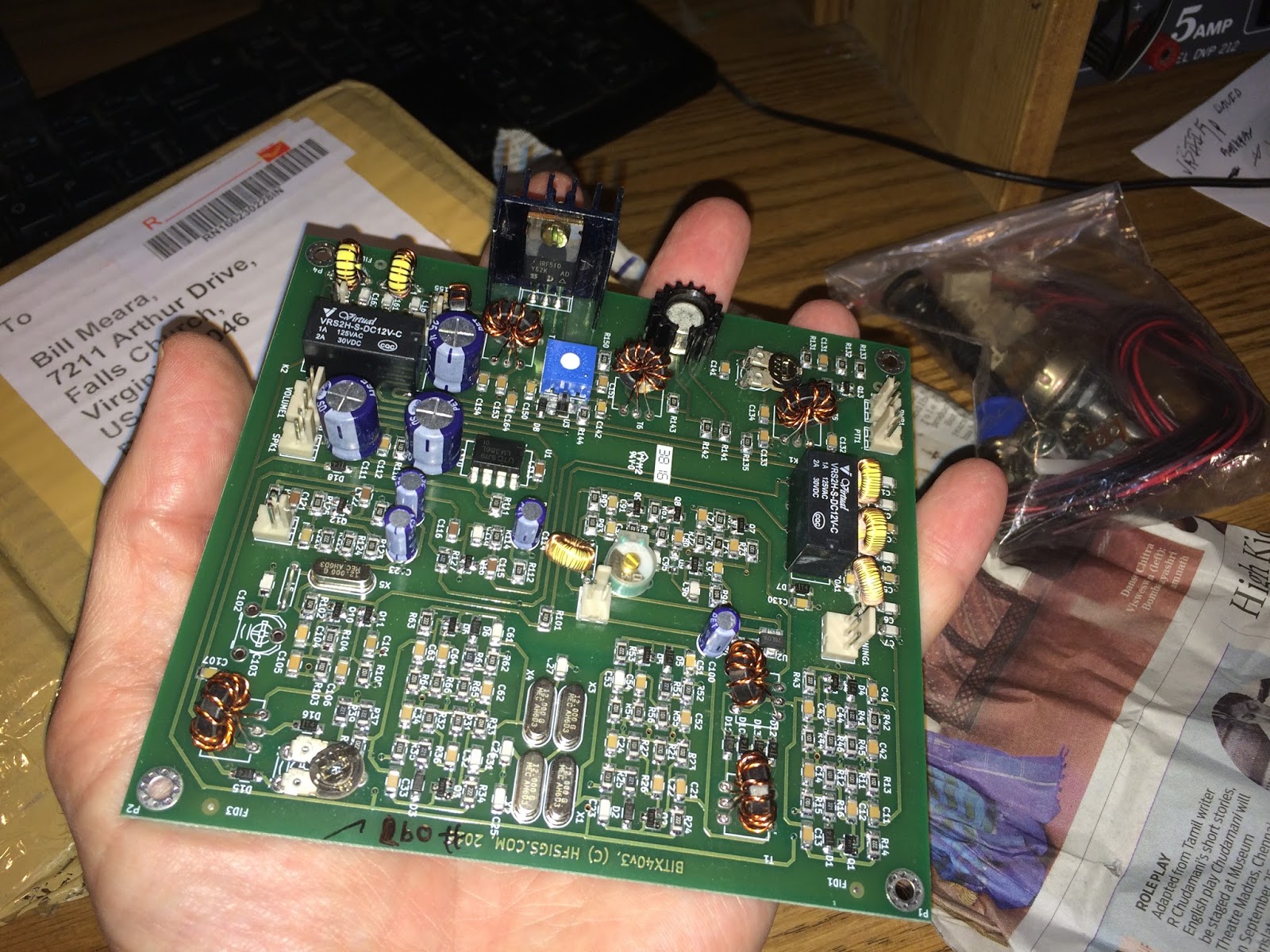
Finally, just when I was thinking that things couldn’t get any better, they did: Armand WA1UQO called in from Richmond. Armand and I collaborate on parts acquisition at Virginia hamfests. We specialize in the contents of the musty cardboard boxes found under the tables. We discussed the DISRUPTIVE influence of Farhan’s BITX 40: All around the world, other homebrew projects are being literally pushed aside on workbenches to make room for that fantastic little module from Hyderabad.
I was very pleased to hear that Armand is building an analog VFO for his module, using a coil in the 4 uH range, wound on a piece of cardboard tube from a coathanger. The inspiration for this kind of coil (which I now have in THREE rigs) came from Farhan, who used sipping straws from fast-food restaurants as coil forms in a sig generator that he built years ago. This week, seeing a Facebook picture of my daughter and me in a restaurant with drinking glasses in front of us, Farhan asked if I had brought home the straws.
A Package from Hyderabad: Farhan’s BITX 40 Module Arrives in Virginia
Cool Jazz from New Zealand as Heard on a Homebrew Superhet Receiver (VIDEO)
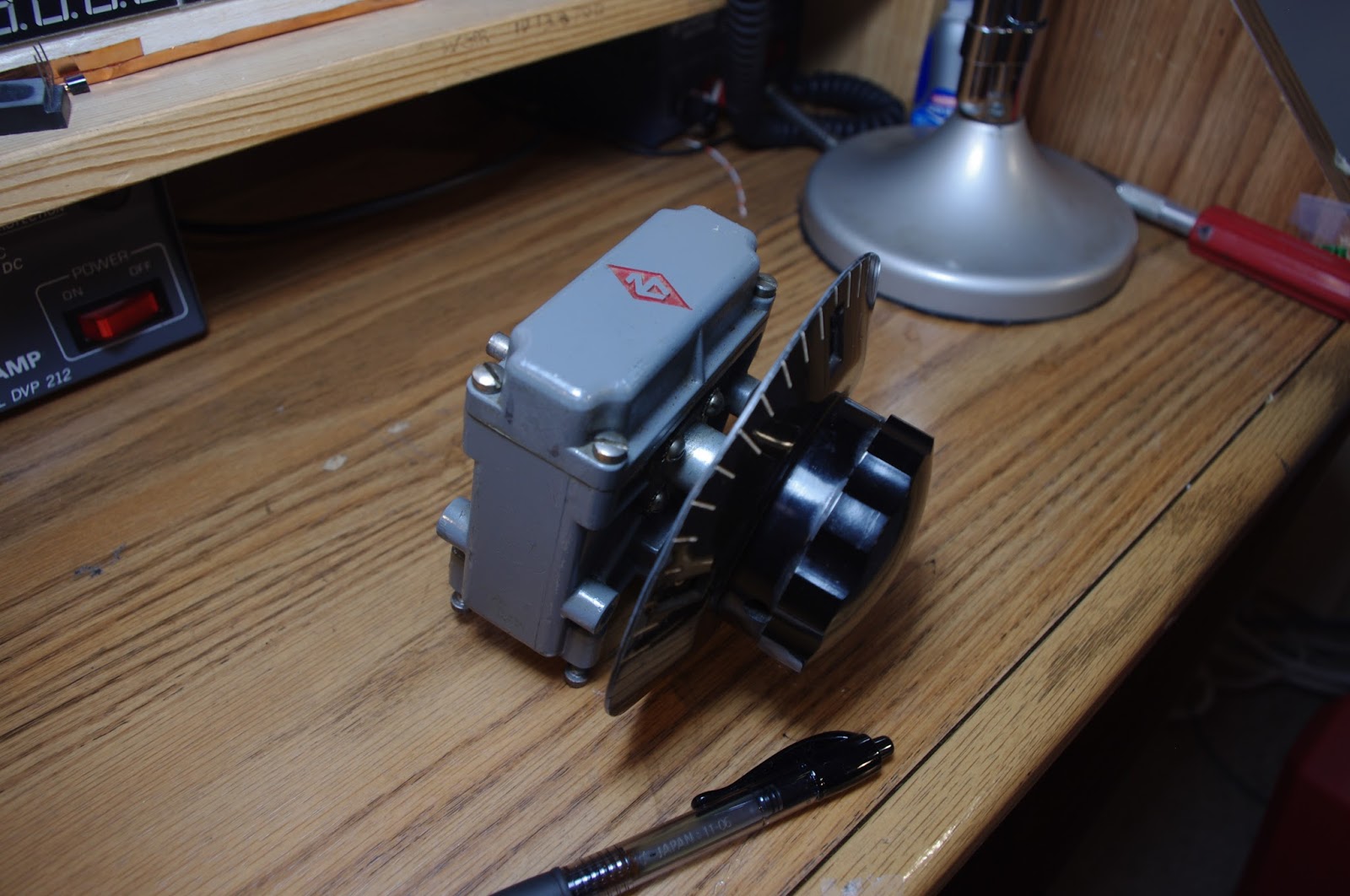
I’m making slow but steady progress on this one. The origin of the project was the beautiful National HRO dial and gearbox that Armand WA1UQO gave me.
I decided to use a 455 kHz IF because;
1) That was the IF of the old HRO receivers (the ones that won WWII)
2) I had a nice TOYO CM455 crystal mechanical filter that would be good for SSB.
3) I figured it would be easy to add in a wider filter that would be good for AM shortwave listening.
4) I like to keep the IF below the frequency of the VFO.
The wide filter turned out to be harder than I thought, but I think I have finally achieved the selectivity I was looking for. I’ll have a switch on the front panel that will allow me to go from “AM-Wide” to “SSB Narrow.” The switch will change the filters and the detectors, and will turn the BFO on and off.
Still to do: I need a high-pass filter to knock down RFI from nearby AM broadcast transmitter. And an RF gain control would be nice.
I’m really glad Radio New Zealand is there. It provides welcome relief from the shortwave fire and brimstone. Radio Romania is also doing a fine job on shortwave.
Video of Armand HROish Receiver
SolderSmoke Podcast #190: Pilgrims, Junkbox rigs, BANDSWEEP, Matching xformers, On the Air with HB, MAILBAG
SolderSmoke Podcast #190 is available:
http://soldersmoke.com/soldersmoke190.mp3
Pilgrims’ Progress: Inspiring words from G3RJV
BENCH REPORTS on JUNKBOX RIGS:
Pete describes his beautiful 40 meter blue transceiver (video above)
Bill describes his “Armand HROish” receiver
BANDSWEEP!
Bill needs small (yellow slug) 455 kc transformers.
We need a good user-friendly 40673 SPICE model.
SEND US YOUR BENCH REPORTS!
The BD139 transistor
Ferrite Core Matching Transformers
QSO Reports: Getting on the air with HB rigs
Bill’s new FeelTech Signal Generator
MAILBAG
First Signals from the “Armand HROish” Receiver
Building a VFO. A BIG VFO. IF options?
HRO (not HOR!) — The King of Reduction Drives
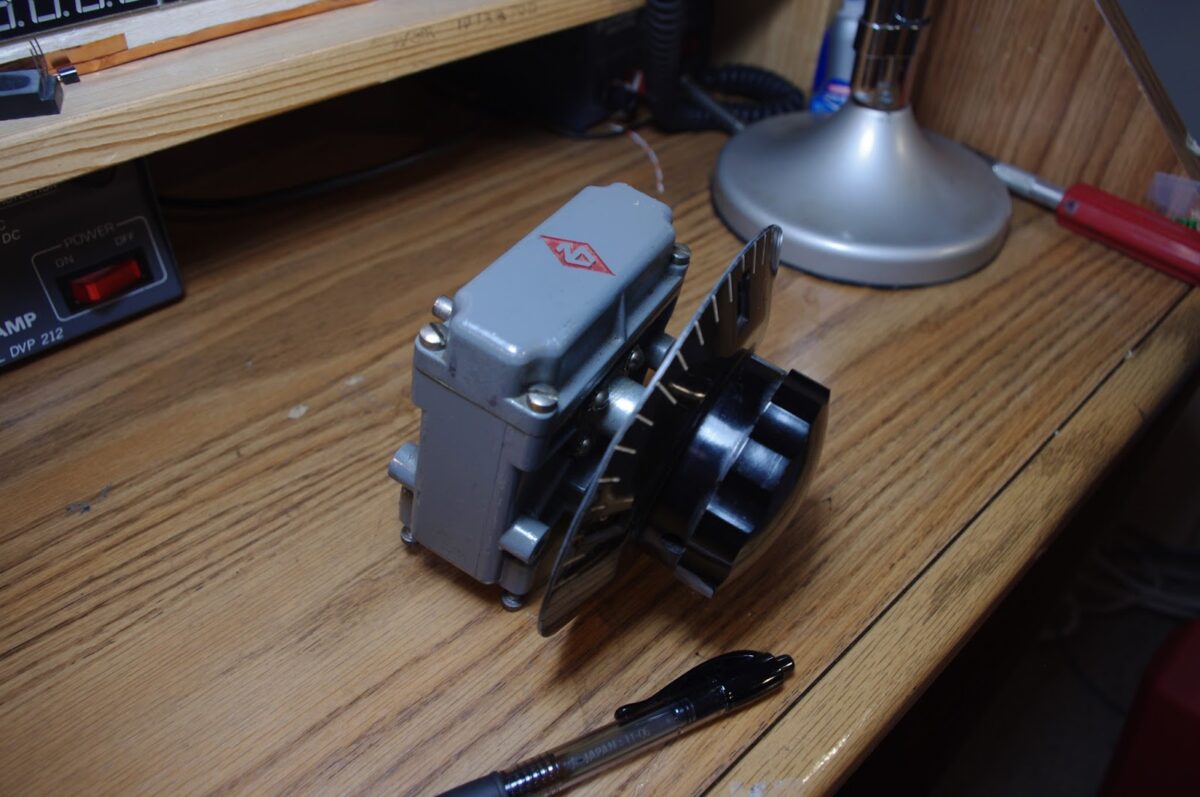
At the recent Manassas Virginia hamfest Armand WA1UQO and I came across an old HRO receiver. Armand mentioned in passing that he had an HRO dial and drive for me if I wanted one. When Pete heard this he said I definitely NEEDED one. Armand heard Pete’s comment and very kindly put an HRO dial and reduction drive in the mail for me.
Wow, it is a magnificent thing! After years of struggling with small Jackson Brother reduction drives and with reduction drives brutally cannibalized out of innocent Heathkit Q multipliers, I now realize that I have been playing in the minor leagues. This, my friends, is the reduction drive that helped win WWII! I will have to build something worthy of its inclusion.
The designation HRO has a wonderful story behind it:
This is from: http://www.cryptomuseum.com/df/hro/
The new radio was also designed by James Millen at the National Radio Company, but this time with two RF amplifiers and two IF amplifiers at 455 kHz with a 20Hz crystal filter. He kept the pluggable coil packs as part of the design and added the now famous epicyclic dial, which allows the operator to tune the frequency scale in 1/500th units (with the aid of a calibration chart).
The design was finished in 1934 and National pushed hard to get the receiver out by the end of that year. When creating the tools for the first production run, the tool makers had to work overtime and used HOR (Hell Of a Rush) as a job number on their overtime slips. As National’s marketing department didn’t want their radios to become known as HORs (whores), the name was changed to HRO (Hell of a Rush Order). Despite the best engneering efforts, technical problems delayed the release of the the radio until March 1935. The price at the introduction was US$ 233.
Another site provides tech details and history on the drive itself:
https://www.prismnet.com/~nielw/PW_NPW_Dial/hro_dial.htm
The HRO dial introduced by the National Radio Company in late 1934 was the hallmark of top-of-the-line National receivers from the mid 30s through the 60s. By late 1936 the “HRO dial” was appearing on the NC-100 series of receivers and even the 1-10, National’s VHF receiver. Throughout WWII many of the NC-100 variants that National provided to the military used this same dial. By 1950 National had added built-in direct frequency readout to the HRO-50 but still kept the same 0-500 reading dial. Through the mid-50s and into the 60s National mimiced the HRO dial look on their mid-priced receivers such as the NC300, 303 and 270. Even the solid state HRO-500 introduced in the early 60s used a version of this dial. When combined with the required 20 to 1 venier gear drive, the HRO dial provided an effective scale length of 12 feet and was direct reading to 1 part in 500. Ten turns of the dial drives the tuning capacitor stop to stop. Published HRO calibration curves showed each ham band spread over eight turns (or 400 divisions). In addition, dial divisions were about 1/4 inch apart. On all bands below 10 meters the HRO dial is easily resettable to within a KC (or KHz).