Straight Key Night 2021 at SA2CLC in Sweden

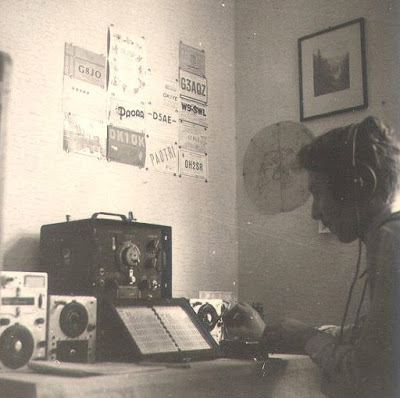
Wow, check out the FB gear of Tommy SA2CLC in Sweden, in use on Straight Key Night 2021. There is some German WWII gear, a BC-348, a homebrew transmitter, and some FB QRP kits.

More on Tommy SA2CLC here: https://www.qrz.com/db/SA2CLC
The culvert under the road for coax to the antennas is very cool.
FB Tommy! A belated HNY to you OM.

LA6NCA’s German Military WWII Receivers, and a Luftwaffe Receiver with FAST QSY

Discussions of old military radio gear are dominated by talk of U.S. radios. Yesterday in the comments section of the SWLing Post I found two interesting videos about German WWII equipment. Above you can see LA6NCA’s receivers. Below there’s a video of a Luftwaffe receiver with an amazing capacity for really rapid frequency change.

Global Collaboration: The uSDX — A Multi-Mode QCX

Bill:
There is a new open source, home brew, multi band, multi mode QRP transceiver that grew out of the QRP Labs QCX. Through some serious magic it retains an efficient class E RF amplifier for sideband and digital modes. It crams impressive SDR capabilities into an Arduino. More info at https://groups.io/g/ucx/topics

The basic work appears to have been accomplished by Guido Ten Dolle PE1NNZ. It uses pulse width modulation of the PA supply voltage to transmit modes other than CW while retaining class E efficiency and uses a direct conversion SDR receiver.
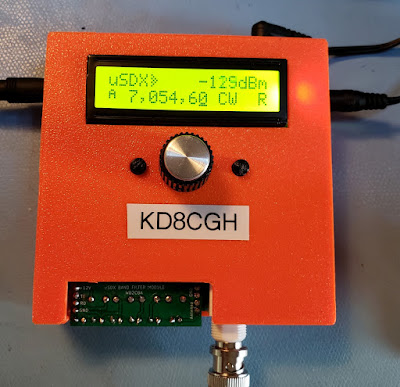
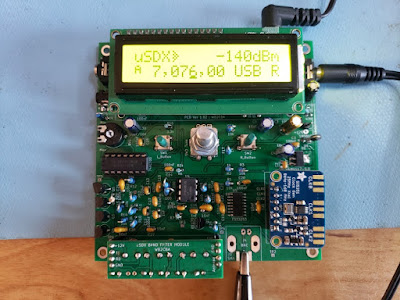
There are several variants by different developers. I built a variant designed by Barbaros Asuroglu WB2CBA
https://antrak.org.tr/blog/projeler/usdx-an-arduino-based-sdr-all-mode-hf-transceiver-pcb-iteration-v1-02/ that uses through hole components (mostly) and I’m pleased with it’s performance. I also designed and 3D printed a case.

This has an interesting development process with contributions by many, including the usual gang of suspects: Hans Summers, Ashhar Farhan, Manuel DL2MAN, Kees K2BCQ, Allison KB1GMX and Miguel Angelo Bartie PY2OHH. I apologize to the many others whose names I didn’t list.

The band switch multiband version by DL2MAN is even smaller, but with SMD components which I wasn’t ready to tackle yet.

BTW – your podcast encouraged me to go in this direction. I built a BITX 40, a uBITX (sent you a pix of it in an old Heathkit Twoer case), U3S, QCX and now my first step from kits to built from plans.

73

Bob KD8CGH

https://antrak.org.tr/blog/projeler/usdx-an-arduino-based-sdr-all-mode-hf-transceiver-pcb-iteration-v1-02/

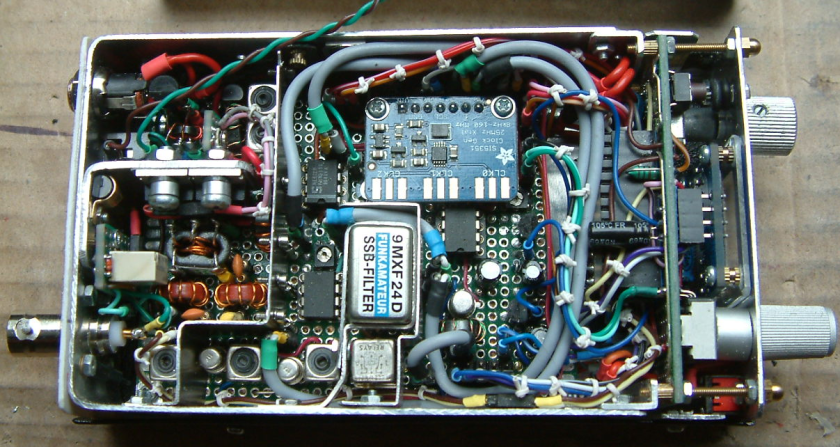
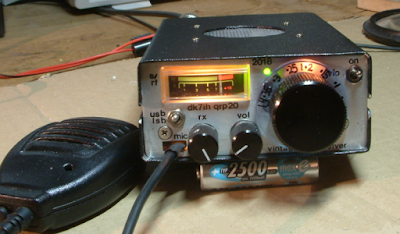
DK7IH Improves his Shirt-Pocket Transceiver

More great stuff from Peter DK7IH. He recently made some improvements to his “Shirt-Pocket SSB Transceiver. On his blog he explains why he made the changes. Note the Si5351 that is in there now. I liked the 1 cm square T/R unit that Peter wrapped in heat shrink tubing. He also provides a really nice description of how to do front panel labeling with a laser printer.


Thanks Peter!

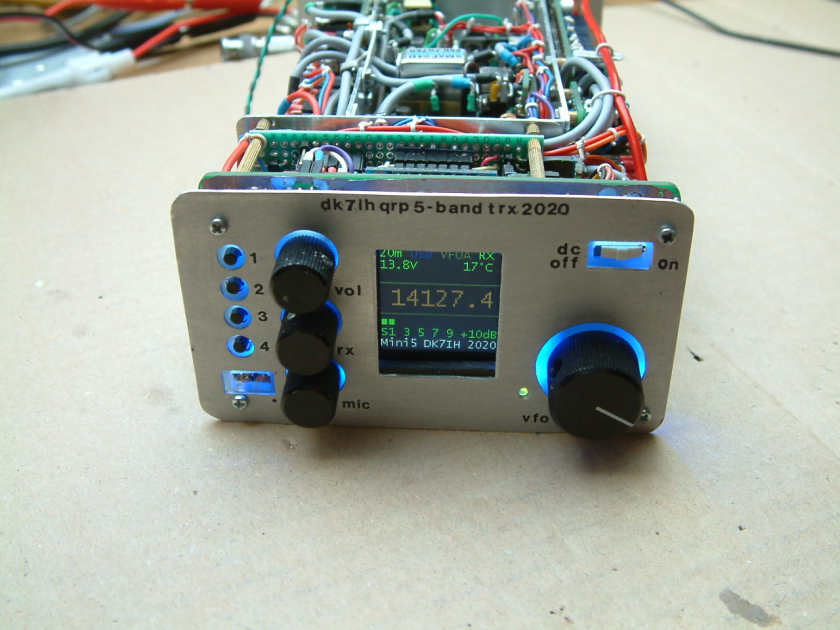
Brace Yourselves: DK7IH’s New Transceiver — The Gimme Five

Lock-down is bad enough, but now we will also have to cope with the feelings of homebrew inadequacy that Peter’s rigs always cause. But look on this as an opportunity for inspiration. Peter once again raises the bar.

This looks like it is the first in a series of blog posts. Just what we need in quarantine. Thanks Peter.

Thoughts on How Hams Can Use the Shortwave Broadcast Frequencies

Ed DD5LP sent us some very interesting information about a resurgence of shortwave broadcast activity in Europe. Thanks Ed.

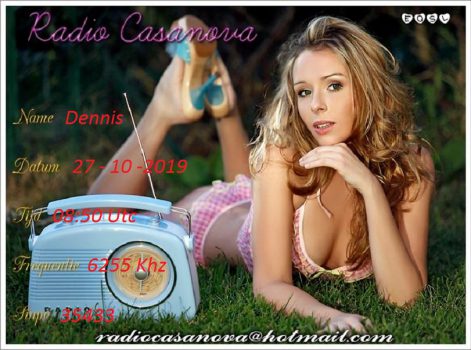
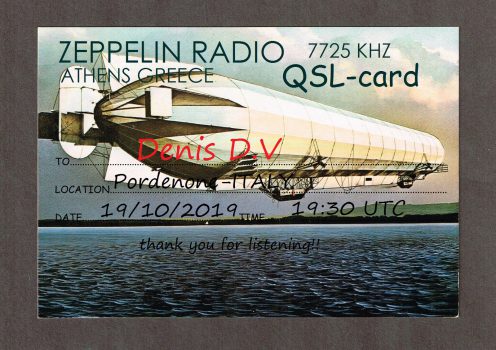
Here is a collection of QSL cards sent out last year by some of these new stations.

Hi Bill,
I’m just listening to the latest podcast and note your returning lovefor AM Broadcast stations and wondered if you also see the trend in the US that we are seeing in Germany?
I know you have WTWW but that’s a commercial SW AM Broadcast radio station, that has always been owned and run by a family of Hams. What we are seeing Germany is that when a commercial broadcaster such as Deutsche Welle closes down their Shortwave Broadcast stations, Amateurs are applying for and getting licences to the freed up frequencies. This started about 5 years ago with channel292 (Channel292.de) on initially 6070 kHz and then later also on 7440 kHz. This amateur is located near Ingolstadt in Bavaria and runs 10 kW using the driver stage from the old DeutscheWelle 100 kW transmitter on the same frequency. He is partnered with a group in Austria who run a major AM station near Vienna that has two 500 kW transmitters and some fantastic massive antenna systems with 20dB gain across the whole of the HF spectrum. That Austrian station is still owned by the Austrian government in case they need a broadcast station to transmit around the world at any time. It’s kept “idling” at 100 kW in the meantime and like Channel 292 includes the German language “DARC Radio” amateur radio program in what it transmits.
New on the scene is “shortwaveradio.de” – Yes the station name is the same as their web address. They currently run just 1 kW into an Inverted-V wire antenna on 3975 kHz (in the 75m BROADCAST band over here) and 6160 kHz in the 49m broadcast band. As they are located in North Germany, I don’t get much of a signal from them down here in the south and the recording is using a WebSDR receiver. Their dipole is orientated to cover the Benelux countries and the UK. The lads at this station are always looking for English content, so if you want part of Soldersmoke to be transmitted on a shortwave AM broadcast station, (as you mentioned in the latest podcast) I can easily put you in touch with them.
One more for the list could be Radio Caroline in the UK. The station, which once was the main pirate radio station off the coast of the UK is now a volunteer historic preservation society (with some radio Hams involved) who have been granted a local radio service licence using a frequency (648 kHz) and transmitter site previously used by the BBC world service! Their old nemesis ! (http://www.radiocaroline.co.uk/#home.html )
73 Ed DD5LP / G8GLM / VK2JI.


DK7IH’s New HOMEBREW Transceiver Raises the Bar for All of Us

And that, my friends, is a HOMEBREW transceiver. Wow, amazingly well done. After I showed this to Pete N6QW (no slouch in the homebrew packaging department), in frustration with his self-perceived shortcomings he threatened to give up on homebrewing and to throw away all his rigs. Don’t do it Pete!

Peter Rachow, DK7IH has carefully documented his project through as series of blog posts:
Here is Part 1:
Part 9 deals with mechanical construction, packaging and what George Dobbs used to call “socketry.”
Thank you Peter for taking the time to share your project with all of us. It is really inspirational.


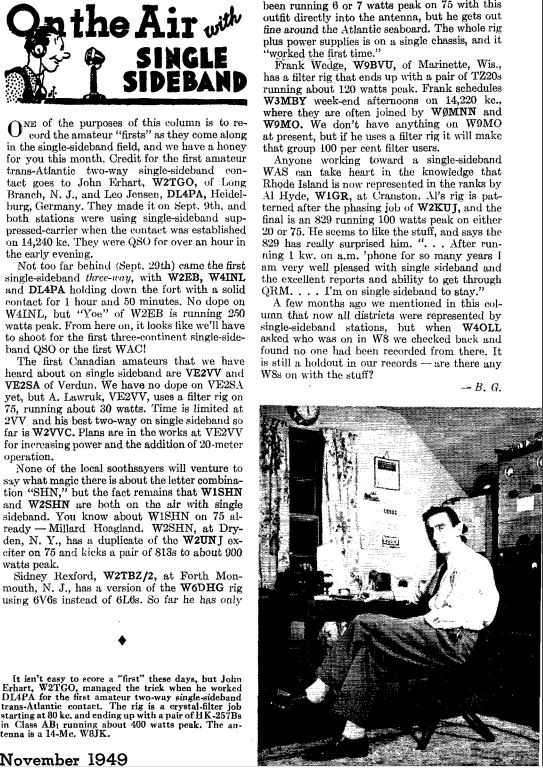
Ham Radio in Germany 1955 (video)

Don’t be deterred by the lack of English subtitles — radio amateurs around the world will be able to follow what is going on in this very interesting 1955 film. It is only about 14 minutes long.

This video takes us back to a time when hams were hams and rigs were RIGS!

Note the German OM who apparently slept fully dressed (with necktie) in order to be ready to spring into action on the ham bands in the middle of the night. That’s dedication my friends.

Also note the fellow sending out QSL cards that feature the schematic diagram of his rig. Lots of solder melted in 1955. Great stuff.

Thank God for the Heaviside Schicht!

Peter DK7IH’s Amazing Rigs and Blog

It has been a few years since we last mentioned Peter DK7IH. He has continued to melt solder and to document his work on an excellent blog: https://radiotransmitter.wordpress.com/

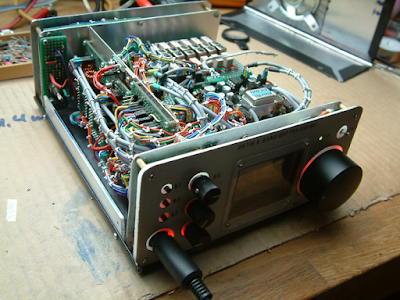
I was especially interested in the rig pictured above. NOTE: NO GLOWING NUMERALS. That rig has an analog VFO. The blog article provides some great pointers on how to achieve thermal stability. Also, be sure to check out his “Old School” rig.

I’ve put Peter’s blog in the blog listing on the right side of the SolderSmoke blog.

A Homebrew HRO Dial by DL6WD, Homebrew Hero

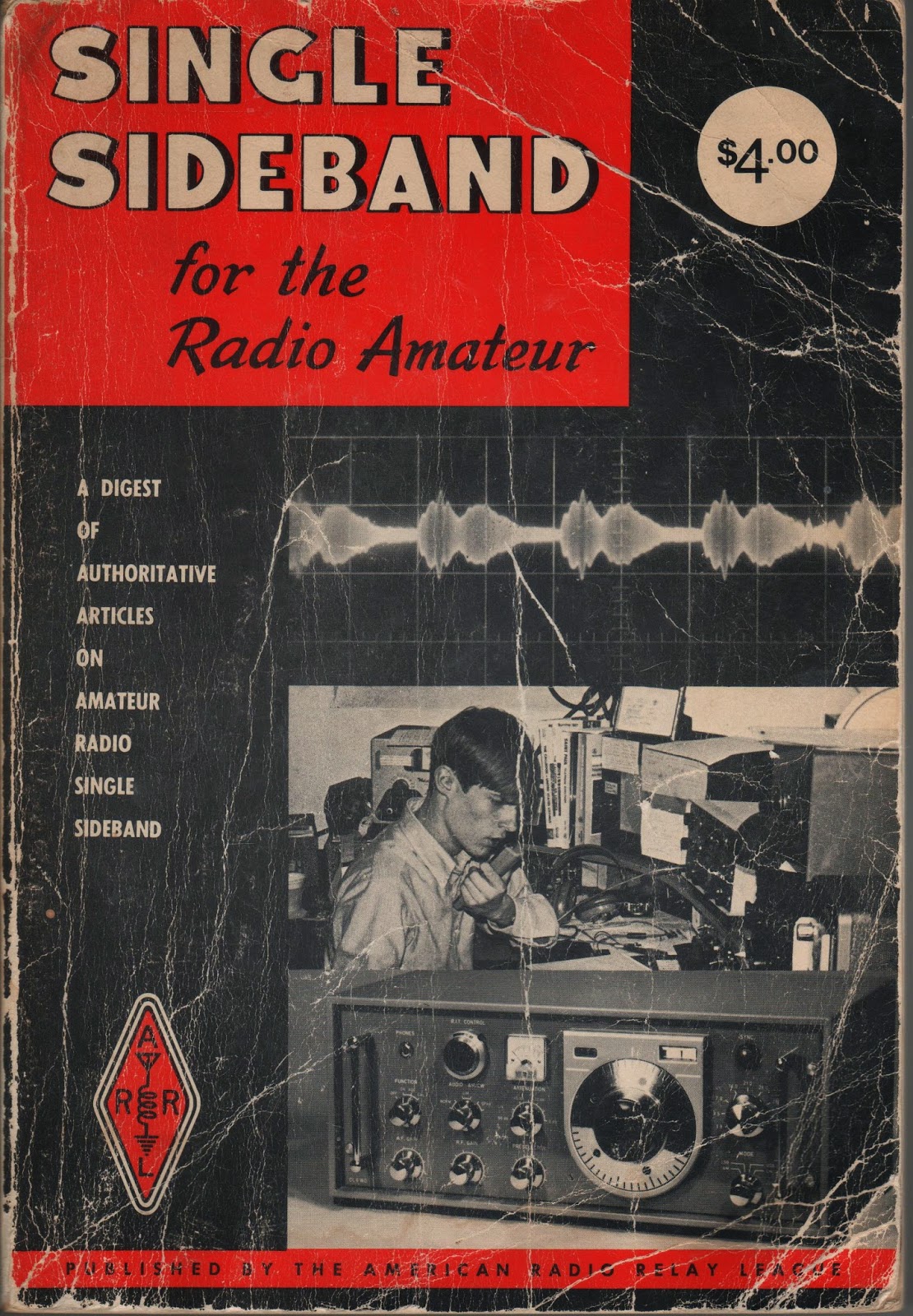
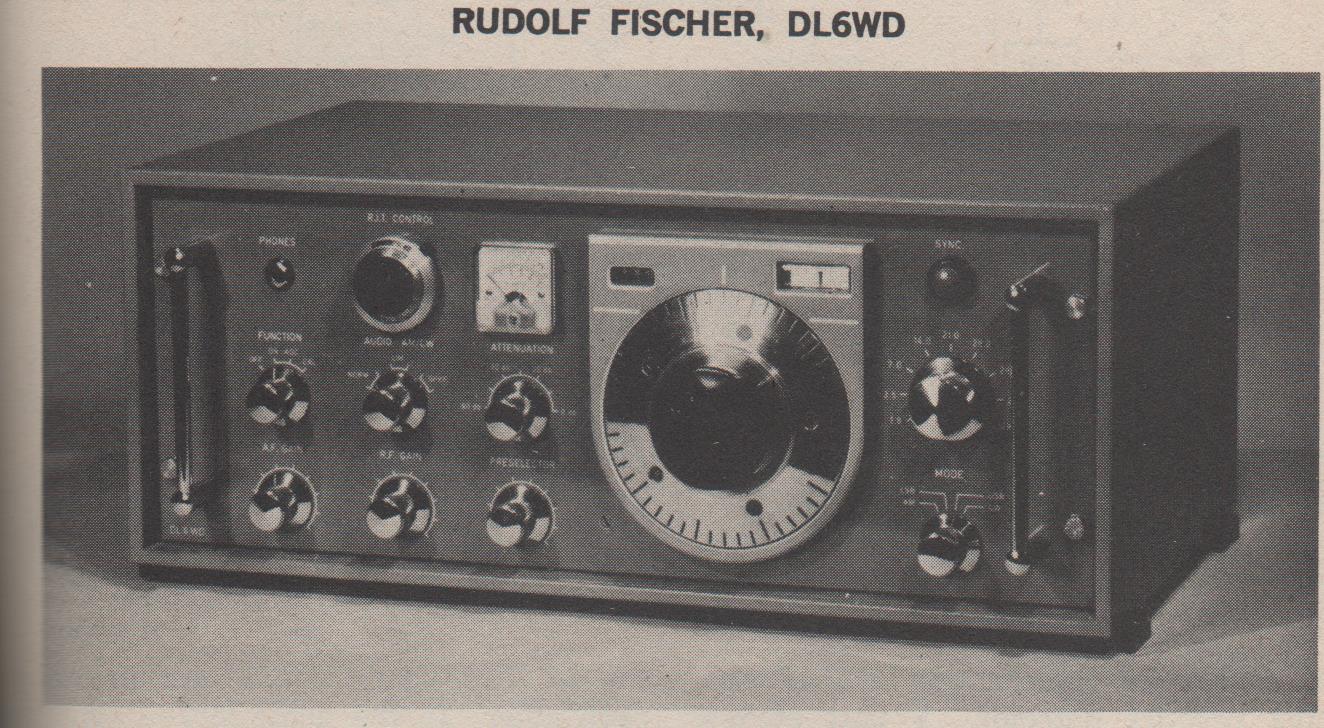
Take a look at that beautiful rig in the bottom of the cover pictures. (A closer shot appears below.) That is an HRO dial, right? Or is it?

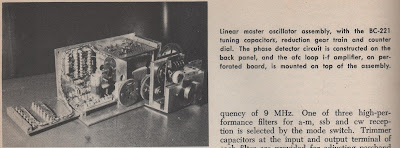
No, it is not. In the picture we see the homebrew receiver designed and built during the 1960s by Rudolf Fishcer, DL6WD. It is magnificent in every respect. Because I have been working with the HRO dial and gearbox given to me by Armand WA1UQO, the tuning dial on this receiver caught my attention.

Here is what DL6WD says about this part of his project: “The main tuning gear was built around a BC-221 tuning capacitor and reduction gear. The counter dial and tuning knob are the result of four weeks of labor, The counter dial reads in tens of kHz, where the main tuning knob has a calibration of 200 Hz per division, from an HRO inspiration.” The counter is in the little window to the upper left of the tuning knob. The window to the upper right is a phase-lock indicator. (See below.)

By the way, by the time DL6WD got finished with this all solid state receiver it weighed in at 52 pounds. Rudolf noted that “excessive shielding pays in electrical performance, but not in weight!”

DL6WD earns the title “Homebrew Hero.”

The Max Valier Satellite Flies Over, Sending CW

I understand the launch of Farhan’s CubeSat has been delayed a few days. That’s the way it works in the rocket launch biz –patience is required. In the meantime, I’ve been practicing with my receive system. Today at 1000 local the Max Valier satellite flew to my west. It rose 78 degrees above my horizon to the W NW. I left my three element quad pointed in that direction and waited for the satellite (which had been launched from India) to fly through its pattern.

The CW beacon was quite strong, very visible and audible through my RTL-SDR dongle and HD-SDR software. You can see it and hear it in the video above. There is something quite charming about this very personal Morse message coming down from orbit and then passing through all that digital technology.

More info on the satellite:


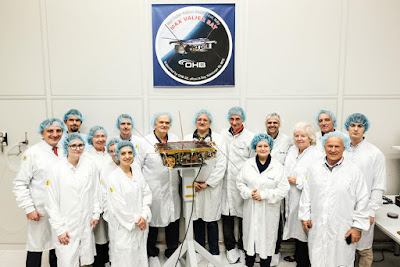
“Max Valier Sat” is an amateur satellite built in cooperation by:

  • “Max Valier” High School in Bolzano/Bozen (Italy)
  • OHB System AG from Bremen (Germany)
  • Max Planck Institute for Extraterrestrial Physics from Garching (Germany)
Its main payload is an X-Ray telescope devised and made by MPE. Data generated by this detector will be transmitted, together with housekeeping data, over an amateur radio link with frequency 145.860 MHz.
A second payload is an amateur radio beacon transmitting a message in Continuous Wave. The beacon’s frequency is 145.960 MHz
“Max Valier Satellite” was launched by the Indian Rocket PSLV-C38 on June 23, 2017 at 9:29 am IST (05:59 am CET) from Satish Dhawan Space Centre.
More tech details:
Regarding the CW beacon:

Beacon by Holger Eckardt DF2FQ:

  • Transmit frequency is 145,960 MHz (IARU and ITU coordinated).
  • Modulation is CW:
    • Duration of one dot is 114 ms.
    • Duration of one dash is 342 ms.
    • Interval between words is 1881 ms.
    • Interval between repetitions of the message is 6000 ms.
  • The beacon transmits Max Valier Sat’s call sign and a greeting message.
  • Transmitting power is 500 mW.


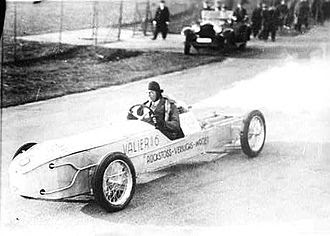
And who was Max Valier? Quite an interesting fellow:

Max Valier in his Rocket Car in 1930

N2CQR Wins a Contest AGAIN!

Pete N6QW suggested I do a blog post on this.


This past weekend I dusted off my old scratch-built, all-analog, no-chips BITX20. (THREE CHEERS FOR FARHAN AND HIS BITX DESIGN!) I hooked it up to my trusty CCI .1KW (note decimal point) amplifier and my new 135 foot store-bought doublet. This all happened just as the Worked All Europe DX contest was kicking off, with lots of activity on 20. TRGHS. I was in. My contest operating style was in the category of “relaxed-casual-noncompetitive.” I took a lot of breaks. In fact there were more breaks than non-breaks. You have to pace yourself in the contest world.

My results:

8 SEPT: DF0HQ, SN7D, GM6X, DP6A, S51A, DL0HN, DB0HX, OZ5E, DJ5MW, HG7T, IK4UPB, VY2ZM, G6XX, EF1A, LZ5R, 9A5W, YP0C, F6HQP, DL7ON, HB9DQL, ON6NL, DA0WRTC, 9 SEPT: EI7M, P3X, RU1A, DP7D, SP2KPD, DL0WW.

P3X might not count because, you see, Cyprus is considered to be in ASIA. Really?

Anyway, I ‘m assuming that I am the winner in the homebrew, discrete component , all-analog transceiver category. Woo Hoo!

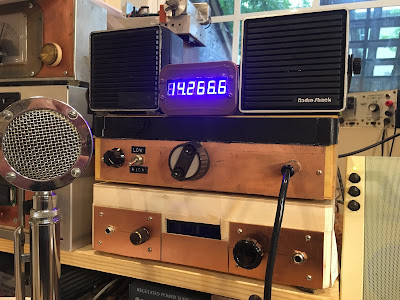
The contest rig is pictured above. Before you point to the glowing numerals and cry foul, realize that the little Altoids box between the two speakers holds a San Jian frequency counter that was deliberately kept OUTSIDE the BITX box. So it is more of an outboard accessory. I can run the BITX 20 without the digital assist — I have an old fashioned non-digital dial pointer to indicate frequency. The “Low – High” switch you see switches the VFO from the low portion of the 20 meter phone band to the higher part of the band. The box below the BITX 20 holds the uBITX.

Seriously though, I was quite pleased with the performance of the doublet.

SolderSmoke Podcast #200! 17, Knack Nobel, QCX, 630, UHF, Fessenden, TROUBLESHOOTING

DL3AO 1950

SolderSmoke Podcast #200 — TWO HUNDRED!!!!– Is available

http://soldersmoke.com/soldersmoke200.mp3

— Old friends on 17 meters.

— Another Knack Nobel in Physics.

— Hans Summers’ QCX transceiver: $50 IS THE NEW 10 GRAND!

— New Bands! 630 and 2200 Meters. BIG ANTENNAS!

— Nuke Powered QRP. No joke!

— The Challenge of UHF. Not for the faint of heart.

— Reginald Fessenden, Father of Phone.

PETE’S BENCH REPORT: The New Simple-ceiver. Soon to be a Transceiver.

BILL’s BENCH REPORT: Discrete, Direct Conversion, Ceramic Receiver in iPhone Box.

THE EDUCATIONAL PORTION OF TODAY’s PROGRAM:
HOW TO TROUBLESHOOT A HOMEBREW RECEIVER.

MAILBAG.

DL3AO 1950


SolderSmoke Podcast #200! 17, Knack Nobel, QCX, 630, UHF, Fessenden, TROUBLESHOOTING

DL3AO 1950

SolderSmoke Podcast #200 — TWO HUNDRED!!!!– Is available

http://soldersmoke.com/soldersmoke200.mp3

— Old friends on 17 meters.

— Another Knack Nobel in Physics.

— Hans Summers’ QCX transceiver: $50 IS THE NEW 10 GRAND!

— New Bands! 630 and 2200 Meters. BIG ANTENNAS!

— Nuke Powered QRP. No joke!

— The Challenge of UHF. Not for the faint of heart.

— Reginald Fessenden, Father of Phone.

PETE’S BENCH REPORT: The New Simple-ceiver. Soon to be a Transceiver.

BILL’s BENCH REPORT: Discrete, Direct Conversion, Ceramic Receiver in iPhone Box.

THE EDUCATIONAL PORTION OF TODAY’s PROGRAM:
HOW TO TROUBLESHOOT A HOMEBREW RECEIVER.

MAILBAG.

DL3AO 1950


DL1YC’s Flat Moxon with Armstrong Rotation

DL1YC Moxon

I had a very nice contact on 17 meters yesterday with Jan DL1YC. It was a rare Moxon-to-Moxon contact, with homebrew 17 meter Moxons on either end. Jan’s is a bit cooler than mine: His is flat, without the “blownout umbrella” support that we see in mine (below) and in the Hex Beams. Jans told me that he achieved this flatness by starting out with very long telescoping fishing poles — he discarded the the thin portions of the pole and used only the more rigid pieces. (I used 16 foot, 5 piece Shakespeare Wonderpoles from Amazon.) I think he also used thin wire for the elements. The crossbar that you see in the picture above is there to support a balun at the feed point — without the cross bar the balun and the feedline would cause the balun to droop.

I couldn’t resist a little front to back testing. Jan’s antenna does not have a rotator — he used the “Armstrong” method of antenna pointing. I didn’t want to make him go outside to spin the thing around by hand, so I just turned mine and asked him to take note of the difference front to back. He saw 3 S units. 18 db. Not bad.

Jan said his antenna weighs about 8 pounds — mine is very similar at 9 pounds. Jan expressed some concern about UV deterioration of the fishing pole fiberglass. Mine has been up there three years without any problems.

Like me, Jan had considered “nesting” an element for another ban (perhaps 20 or 12) but — like me– had concluded that this would be too difficult.

N2CQR Moxon