Skip to content
SolderSmoke Daily News — Ham Radio Blog

SolderSmoke Daily News — Ham Radio Blog

Serving the worldwide community of radio-electronic homebrewers. Providing blog support to the SolderSmoke podcast: http://soldersmoke.com

Category: France

Understanding Switching Mixers (as in the Ceramic DC RX)

Understanding Switching Mixers (as in the Ceramic DC RX)
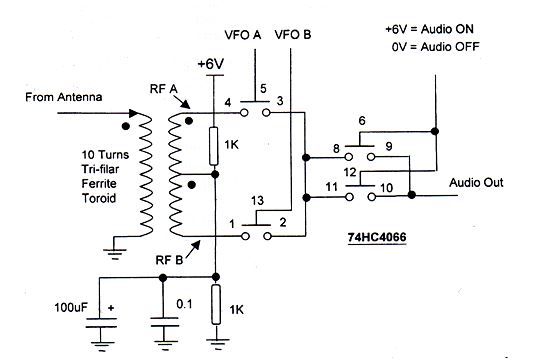
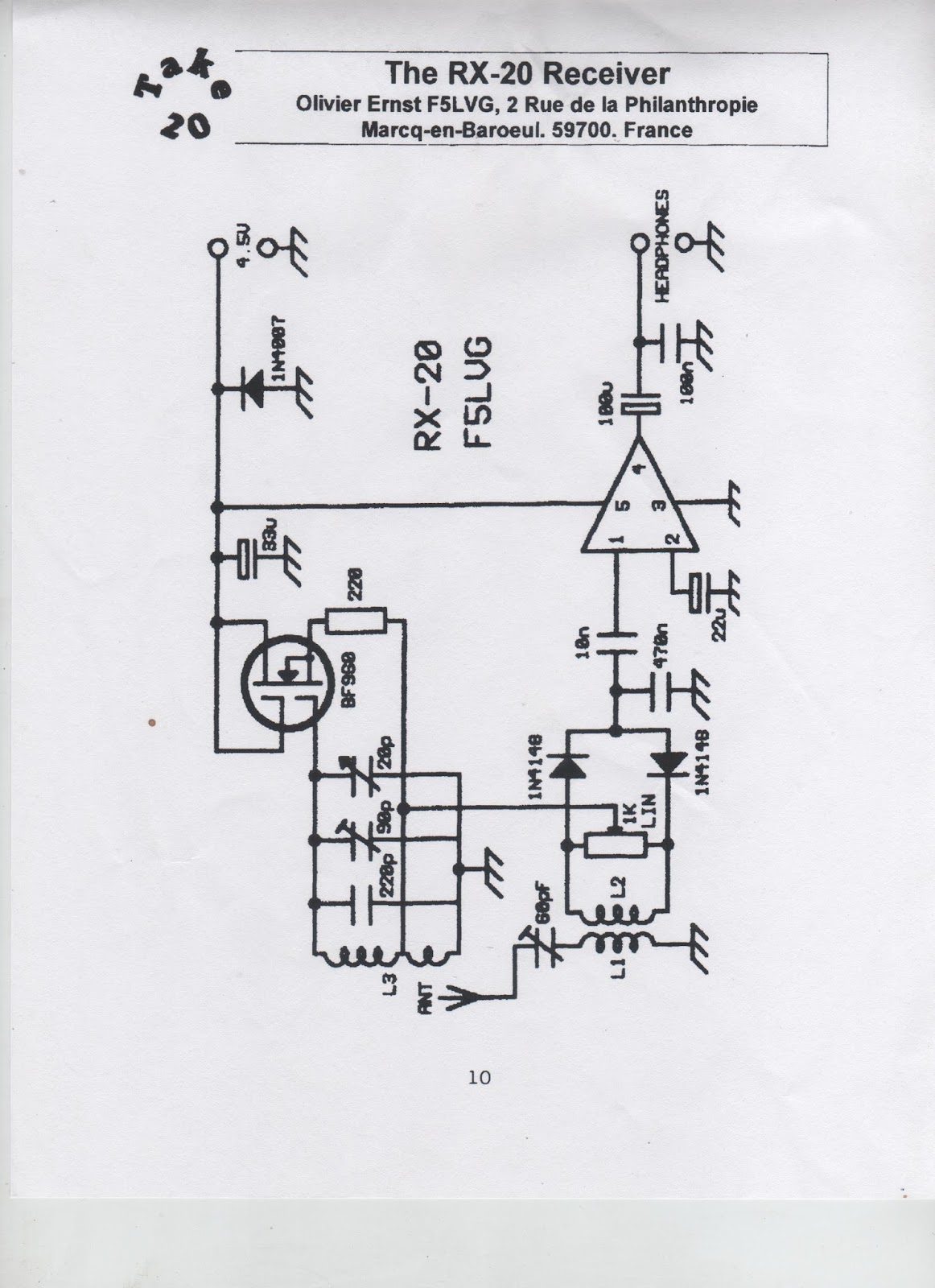
W3JDR’s Comment on my post about the DC RX mixer got me thinking. He was right — my explanation of the mixer action wasn’t quite complete, especially as far as switching mixers are concerned. I remembered that I had written about this in the SolderSmoke book. Below you can see the part of the book in which I discuss switching mixers. Realize that the two diodes in F5LVG’s mixer play the same role as the two gates in Leon’s circuit. It will be worth your while to sit down with Leon’s circuit diagram, his frequency chart, and a ruler and really go through this so you can SEE and really understand how the two gates (or switching diodes) generate sum and difference frequencies.

———————–
I guess I still yearned for clarity and intuitive understanding… Time and time again, as I dug into old textbooks and ARRL Handbooks and promising web sites served up by Google, I was disappointed.
Then I found it.
It was in the Summer 1999 issue of SPRAT, the quarterly journal of the G-QRP Club. Leon Williams, VK2DOB, of Australia had written an article entitled “CMOS Mixer Experiments.” In it he wrote, “Generally, mixer theory is explained with the use of complicated maths, but with switching type mixers it can be very intuitive to study them with simple waveform diagrams.”
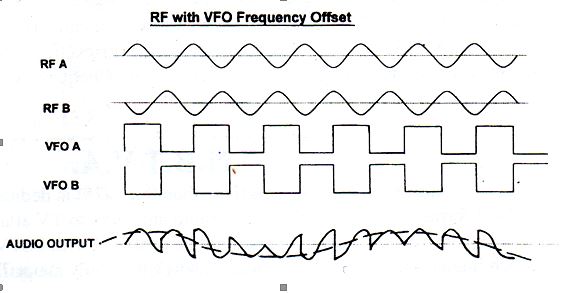
Eureka! Finally I had found someone else who was dissatisfied with trigonometry, someone else who yearned for the clarity of diagrams. Leon’s article had waveform diagrams that showed, clearly, BOTH sum and difference output frequencies.


Switching mixers apply the same principles used in other kinds of mixers. As the name implies, they switch the mixing device on and off. This is non-linearity in the extreme.
Not all mixers operate this way. In non-switching mixers the device is not switched on and off, instead one of the signals varies the amount of gain or attenuation that the other signal will face. And (as we will see) it does this in a non-linear way. But the basic principles are the same in both switching and non-switching mixers, and as Leon points out, the switching circuits provide an opportunity for an intuitive understanding of how mixers work.

Let’s take a look at Leon’s circuit. On the left we have a signal coming in from the antenna. It goes through a transformer and is then applied to two gate devices. Pins 5 and 13 of these gates determine whether the signals at pins 4 and 1 will be passed on to pins 3 and 2 respectively. Whenever there is a positive signal on gate 5 or on gate 13, signals on those gaps can pass through the device. If there is no positive signal on these gates, no signals pass. Don’t worry about pins 6-12.

RF A is the signal going to pin 4, RF B is the “flip side” of the same signal going to pin 1. VFO A is a square wave Variable Frequency Oscillator signal at Pin 5. It is going from zero to some positive voltage. VFO B is the flip side. It too goes from zero to some positive voltage.
Look at the schematic. Imagine pins 5 and 13 descending to bridge the gaps whenever they are given a positive voltage. That square wave signal from the VFO is going to chop up that signal coming in from the antenna. It is the result of this chopping that gives us the sum and difference frequencies. Take a ruler, place it vertically across the waveforms, and follow the progress of the VFO and RF signals as they mix in the gates. You will see that whenever pin 5 is positive, the RF signal that is on pin 4 at that moment will be passed to the output. The same process takes place on the lower gate. The results show up on the bottom “AUDIO OUTPUT” curve.
Now, count up the number of cycles in the RF, and the number of cycles in the VFO. Take a look at the output. You will find that that long lazy curve traces the overall rise and fall of the output signal. You will notice that its frequency equals RF frequency minus VFO frequency. Count up the number of peaks in the choppy wave form contained within that lazy curve. You will find that that equals RF frequency plus VFO frequency.

Thanks Leon!
Author Peter MarksPosted on 8 February 201821 July 2025Categories DC Receiver Build, France, GQRP, mixer theory, SPRAT, UK2 Comments on Understanding Switching Mixers (as in the Ceramic DC RX)

F5LVG’s Glue-Built Mixer Transformer

F5LVG’s Glue-Built Mixer Transformer
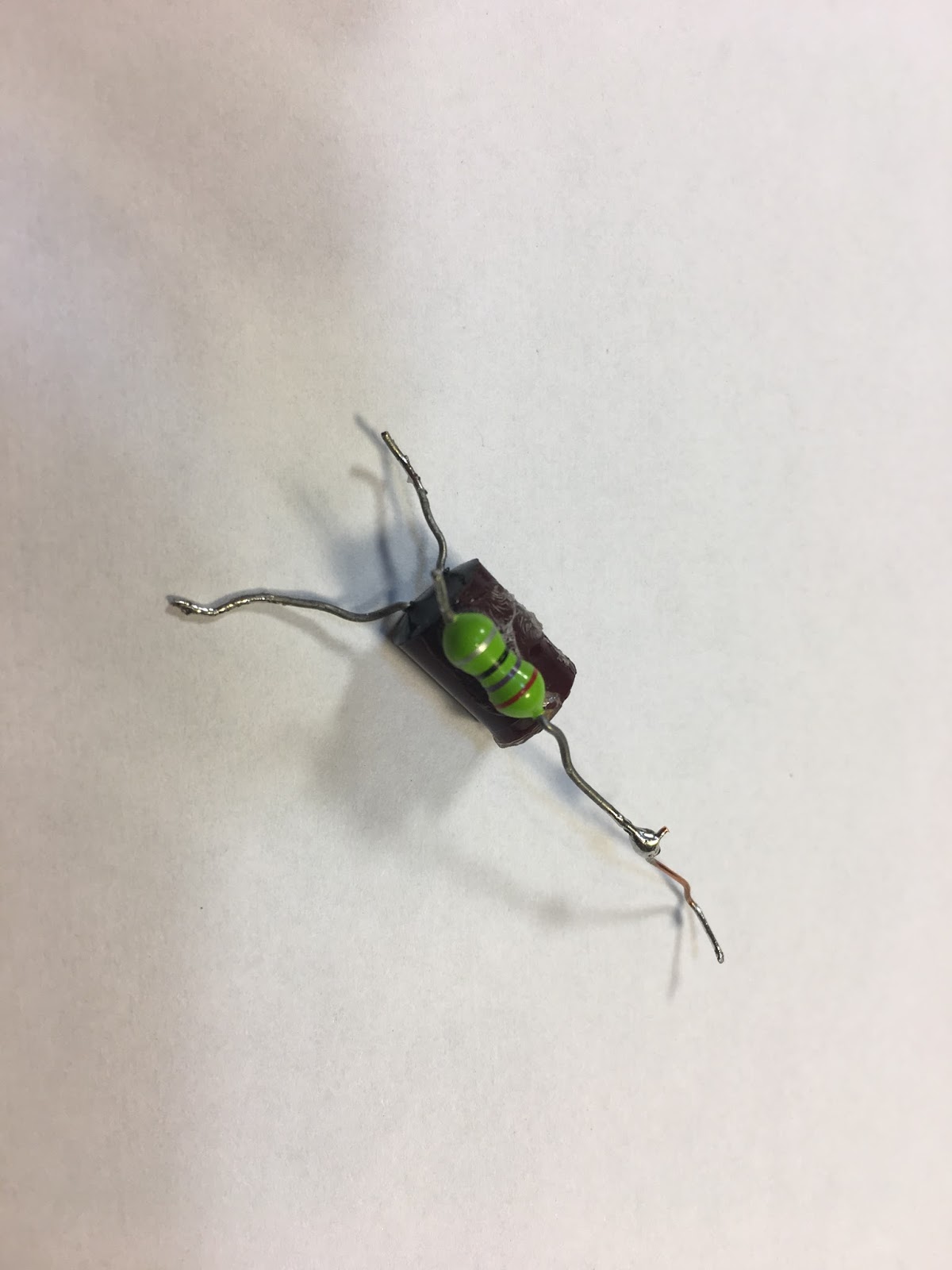
One thing I forgot to mention: In Olivier F5LVG’s DC receiver article back in SPRAT 100, he casually mentioned building a transformer for his mixer by taking two inductors of the appropriate values and GLUING THEM TOGETHER. What a great idea! I had to try it. I did. Picture above. It worked in my Ceramic DC receiver, but the trifilar transformer from Farhan in India worked better. Perhaps the coupling was tighter. But hey, it worked. Three cheers for Olivier.

Author Peter MarksPosted on 7 February 201822 July 2025Categories DC Receiver Build, France, mixer theory1 Comment on F5LVG’s Glue-Built Mixer Transformer

Amazing Homebrew/Boatanchors QSOs on 40 –Six solder melters in a row!

Amazing Homebrew/Boatanchors QSOs on 40 –Six solder melters in a row!
Al W8VR
After a day of happy tinkering with the Direct Conversion receiver I’ve been working on, I turned off the soldering iron and got on 40 meter SSB with my BITX Digi-Tia.

First — Steve W4IJ came back to my CQ. Steve is a boatanchor enthusiast and has written for Electric Radio magazine. FB.

W4IJ Boatanchors

When Steve signed off, I got into a contact with Pete W8NBO. We had spoken before and he had told me of a homebrew transmitter he’d built as a kid. This time I asked for details: It was a 6AG7 oscillator to a 6L6 amplifier. He ran it with an S38 (brave man!). He described what must have been a very painful effort to hack (literally) the needed holes in the transmitter chassis using just a spike, a hammer and a file. I told him this brought back my memories of similarly painful chassis work (mine was for a power supply for a Heath HW-32A).

At this point we were joined by Arnie, W2HDI. Arnie’s rig is in Stowe Vermont, but he was running it remote from the South of France where he and his wife were celebrating their 50th wedding anniversary. Arnie shared with us memories of similar chassis pain — his were related to an external modulator that he built for a DX-40. I think he said that all he had was a hole punch and a file. Oh, the humanity!

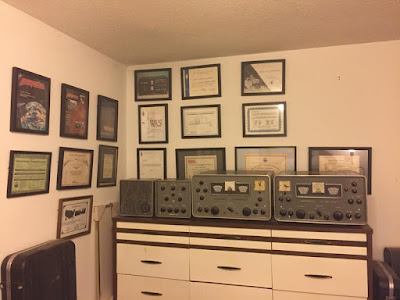
Then Al W8VR joined the conversation. Al said that he’s been in the game so long that his early rigs were built using cigar boxes as chassis. I pointed to a connection: I noted that my BITX rigs are enclosed in what could be considered cigar boxes. Al’s QRZ page picture has a magnificent AM rack rig that he said was actually built twice. There is also an HRO-60 in the picture. FB. Check it all out at Al’s web site. Click on the mic for the write ups, the key for the pictures. http://www.w8vr.org/

Then Dennis K0EOO called in. Holy Cow! Dennis and I spoke not long ago. You may recall my enthusiastic write up of his beautiful 1974 SSB rig:
http://soldersmoke.blogspot.com/2017/08/k0eoo-homebrew-ssb-in-1974.html
and
http://soldersmoke.blogspot.com/2017/08/more-on-k0eoos-amazing-homebrew-ssb-rig.html

This was almost too much. Rarely will you spontaneously come across so many hams who have melted so much solder. FB.

Icing on the cake: When I returned to the bench, I fired up the DC receiver and heard Mike KN4EAR talking about his BITX40. I switched to the Digi-Tia and gave Mike a call. He reports making many contacts with his rig. FB.

TRGHS.
Author Peter MarksPosted on 11 November 201721 July 2025Categories 40 meters, BITX DIGI-TIA, BITX40Module, Electric Radio magazine, France, Hallicrafters, HB2HB, heathkits1 Comment on Amazing Homebrew/Boatanchors QSOs on 40 –Six solder melters in a row!

The Homebrew Receivers of F5LVG

The Homebrew Receivers of F5LVG

I came across OM F5LVG’s work in SPRAT. He has a wonderful website — it is in French, but Google Chrome translates is quite nicely.

http://oernst.f5lvg.free.fr/index.html

From the site’s introduction:

This site is dedicated to the construction and understanding of radio receivers. If you have dreamed of hearing a radio station with a receiver that you have built yourself, this site is for you. These are essentially direct conversion receivers and modern feedback detectors using only semiconductors, except for retrofitting. The described stations will accommodate amplitude modulation, single sideband (SSB) and telegraphy.

Besides these receivers several articles are devoted to LC oscillators. In particular, an extremely simple original stabilizing device is described.
Similarly, a simple frequency meter is described.
The joy of reception using a homebrew receiver is intense. May this site help you find this joy. Do not hesitate to join the amateur community.


Author Peter MarksPosted on 3 October 201721 July 2025Categories direct conversion, France, Regens, SPRAT2 Comments on The Homebrew Receivers of F5LVG

TRGHS: I Can Hear the Roosters of Boa Vista

TRGHS:  I Can Hear the Roosters of Boa Vista

At the instigation of Bob N7SUR I’ve been working on a simple, easy-to-reproduce Direct Conversion receiver for 40 meters. I’m building this for my nephew John Henry, and I’m hoping this will be a circuit that others can use to break into the ELITE corp of successful ham receiver builders. Coincidentally Joh in Freiburg Germany is working on a very similar project — we have been comparing notes.

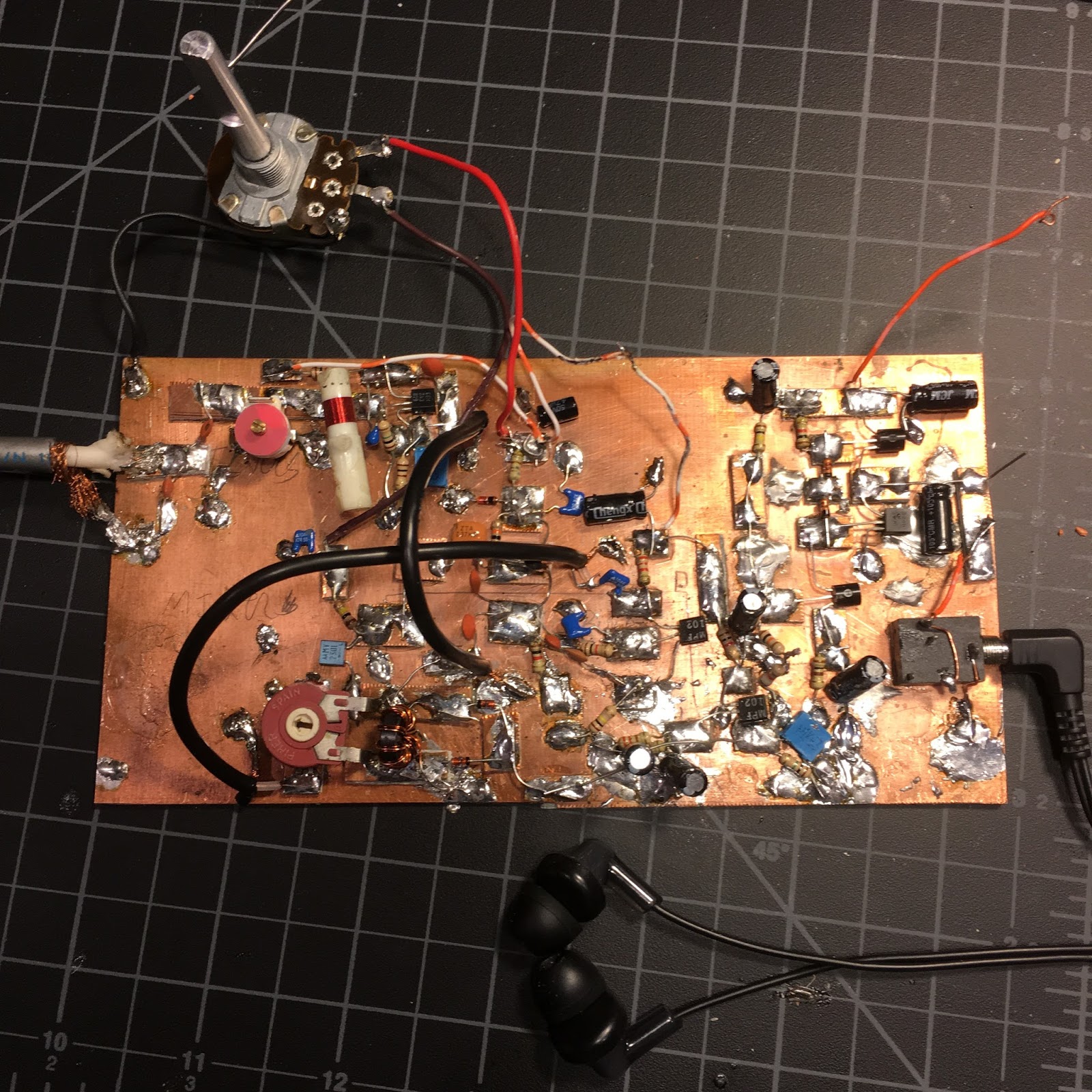
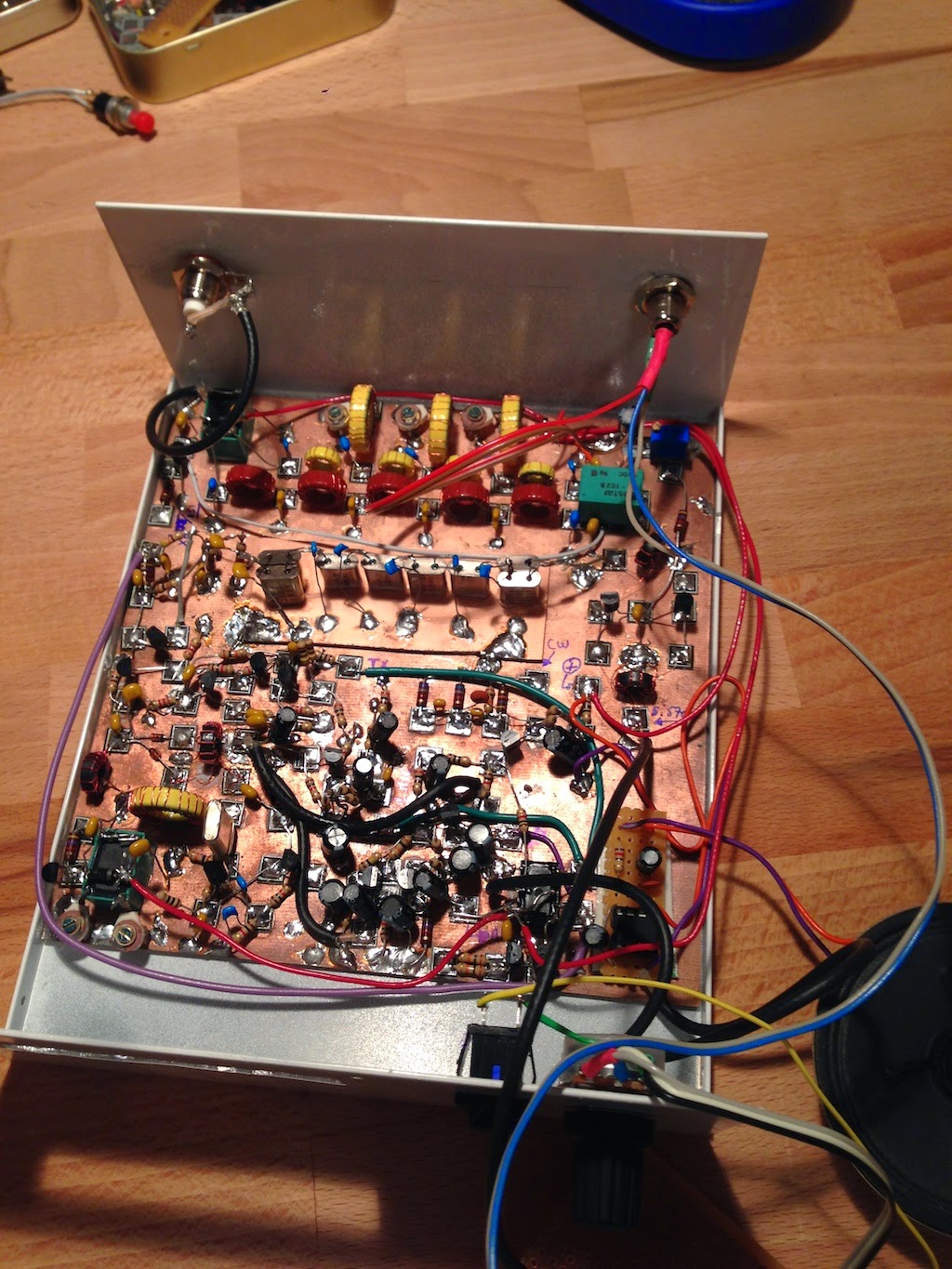
At first I used an FET detector described by Miguel PY2OHH. It worked, but at night the AM detection of powerful shortwave broadcast stations drowned out the amateur signals. So Joh and I started to explore detectors that would eliminate this problem. I went with a version of one described in SPRAT by F5LVG ( “The RX-20 Receiver”- see below). Very simple: A transformer to two back-to-back diodes with a 1K pot to balance the signal from the VFO. OM Olivier used a very, very cool transformer: he took two small, molded chokes and simply glued them together! 22uH choke as the primary, 100uH choke as the secondary. I went with one of the toroidal transformers that Farhan left me when he visited in May.

I’m using a varactor-controlled ceramic resonator VXO (no Si5351 in this one!) and a non-IC AF amp designed for use with ear buds (the world is awash in ear buds). It is a “singly balanced” design with the incoming RF signal being the one “balanced out” in the detector.

Last night the receiver passed the AM breakthrough test. The SW broadcast monsters were balanced out and kept at bay.

This morning the receiver passed The Boa Vista Rooster Detection Test. I fired up the receiver and heard an operator speaking Spanish with a Brazilian accent. When I heard the rooster crowing in the background I knew it was Helio PV8AL from Boa Vista Brazil. TRGHS — this little receiver is a winner.

I’ll try to post a schematic soon.

And hey — look at what wonderful IBEW (International Brotherhood of Electronic Wizards) project this is: Instigation and inspiration from Oregon. Some design ideas from Brazil. A French detector circuit described in a British QRP magazine. A transformer from India. A collaborator in Germany. And finally, the rooster of Boa Vista.

Let’s not forget Wes Hayward W7ZOI for bringing back (in 1968!) the neglected Direct Conversion idea.
Author Peter MarksPosted on 2 October 201721 July 2025Categories Brazil, direct conversion, France, Germany, Hayward--Wes, India, SPRAT, UK2 Comments on TRGHS: I Can Hear the Roosters of Boa Vista

Something else “Completely Different”: Meteor Pings

Very cool. I want to try this. I have the RTL-SDR and the software, so all I need is the antenna. I may try to resurrect the 5 element 2 Meter Quad from my 90’s adventures in the Dominican Republic (I still have the copper tube elements!). I know the Graves radar is out of range, but there must be a suitable North American signal for this kind of thing. Any ideas?

For more info:
http://hackaday.com/2017/08/27/sorry-us-europeans-listen-to-space-with-graves/#more-270298

https://dk8ok.org/2017/08/23/graves-reflections-out-of-the-blue/

Author Peter MarksPosted on 29 August 2017Categories France, Germany, meteors, SDR4 Comments on Something else “Completely Different”: Meteor Pings

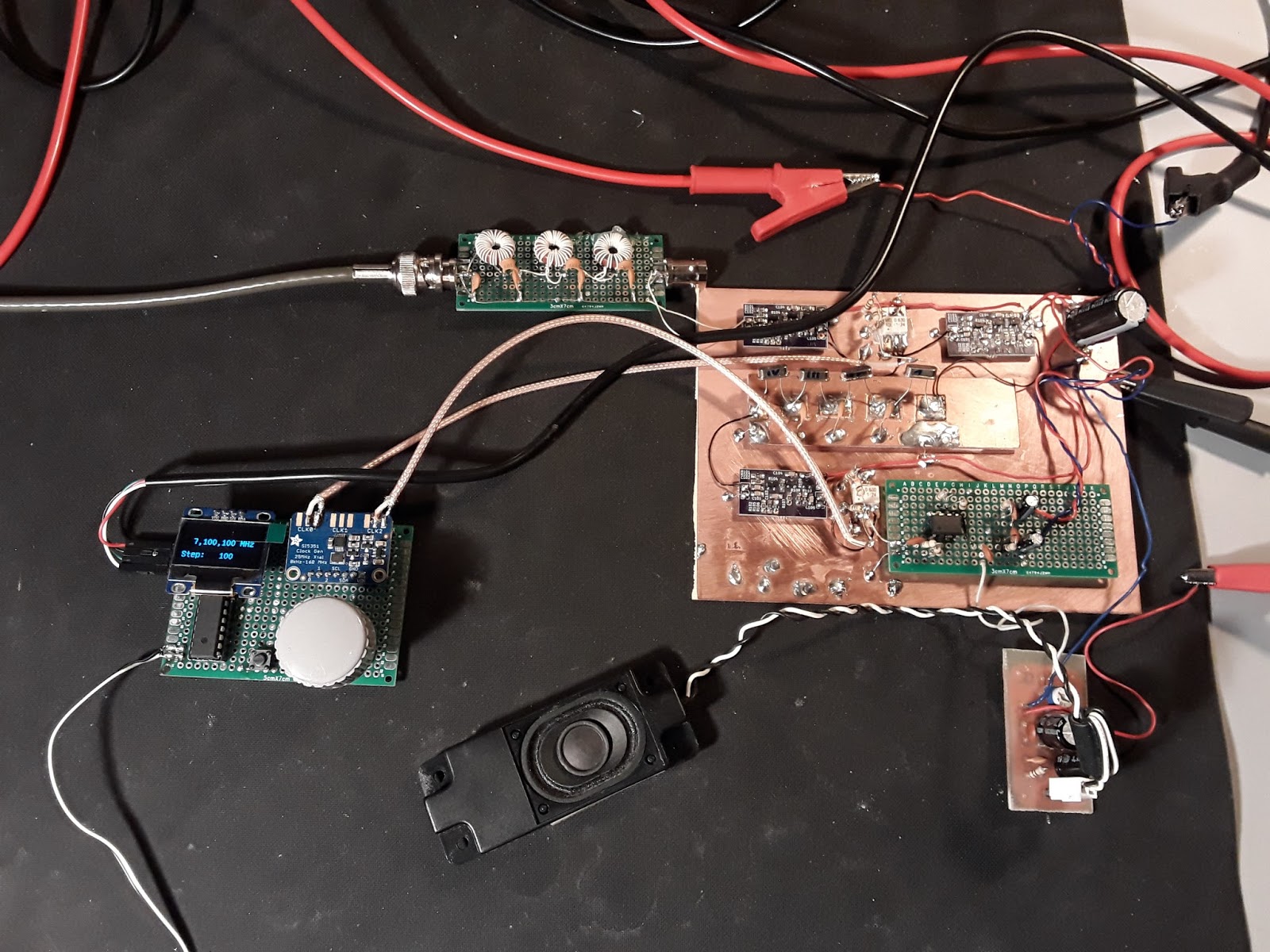
A Slovakian Al-Fresco Digi-Tia Homebrewed In France (and an improved AD9850 VFO)

A Slovakian Al-Fresco Digi-Tia Homebrewed In France (and an improved AD9850 VFO)
Hello Bill and Pete,

Thanks for the podcast! My normal occupation is more computers and
software but your podcast got me motivated to melt some solder. So I
want to share a bit of what has been cooking on my bench.


I used to have a Yaesu FT-450 but sold it – I am living in a tiny rental
apartment in France without any place where to put a proper antenna so
it was only collecting dust. And where is the fun in operating a
factory-made rig, right?


So I have been working on this instead:

http://janoc.rd-h.com/archives/541

This “al fresco” rig is “half-DigiTIA”. Half because there is no
transmitter part (I don’t have a French license and I am too lazy to do
the paperwork and convert my Slovak one). The purple modules are TIAs,
as designed by Wes Hayward, using 3x 2n3904s, only built using SMD
components to keep them small and tidy.


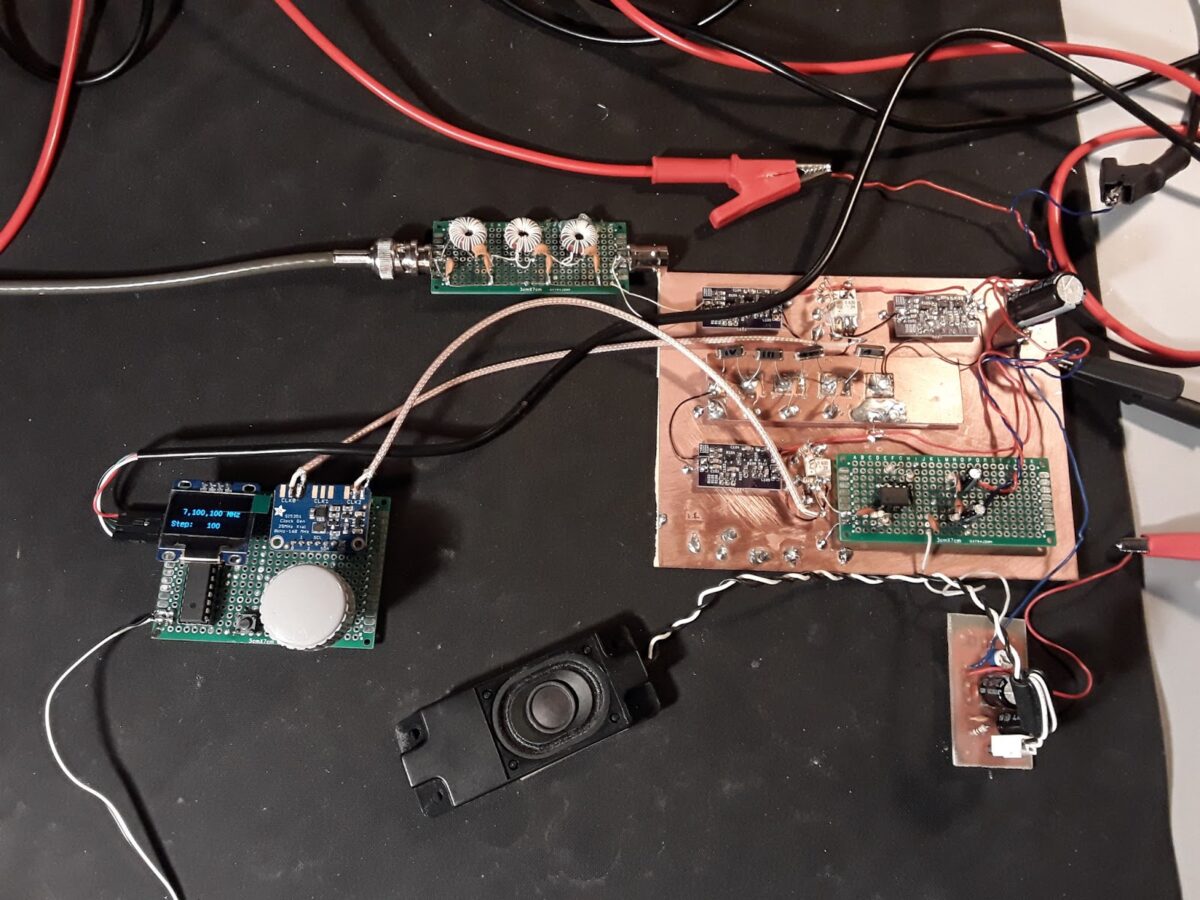
VFO & BFO are Si5351 + ATMega328, with an OLED module and code adapted
from Pete N6QW. It uses 11.997450 MHz IF because that’s where most of my

12MHz crystals actually matched.

The 40m bandpass filter is taken verbatim from the BitX 40 design – I
have only changed the coils to use toroids instead.


For audio I have used LM386 with a NE5532 opamp as a low noise preamp
because the audio was a bit low. The TIAs don’t have a lot of gain and I
have only an indoor magnetic loop for antenna so had to compensate for it.

I have another, a bit older project that became quite popular – firmware
for the AD9850 DDS VFOs using an Arduino and a character LCD. It is a
much improved replacement for the one from Richard, AD7C.


http://janoc.rd-h.com/archives/502

Perhaps it could be useful to someone.

Keep up the good work and 73!

Jan OM2ATC (at the moment “in exile” in France)

Author Peter MarksPosted on 27 March 201721 July 2025Categories DDS, Farhan, France, Hayward--Wes, Slovakia1 Comment on A Slovakian Al-Fresco Digi-Tia Homebrewed In France (and an improved AD9850 VFO)

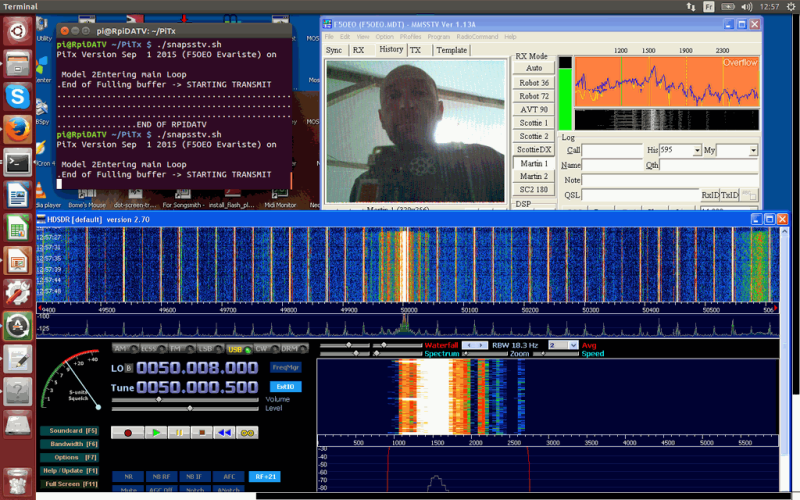
Nightmare Turns Real: “Rig Here is a Raspberry Pi OM, and I’m listening to you with my Dongle…”

Nightmare Turns Real:  “Rig Here is a Raspberry Pi OM, and I’m listening to you with my Dongle…”
As with many other nightmarish things, this one was launched at the world on Halloween. It all seems a bit flaky, but we knew this was coming. Don’t complain to me about the lack of low-pass filters, SSB testing on 7.000 MHz, or the rather nebulous identity of the creator…. I’m just the messenger here. And remember that I am a HARDWARE Defined Radio, Discrete Component, “Menus are for Restaurants” and (now) “Pi’s are for eating” kind of ham.
Here it is:
http://www.rtl-sdr.com/transmitting-fm-am-ssb-sstv-and-fsq-with-just-a-raspberry-pi/


Author Peter MarksPosted on 5 November 201521 July 2025Categories France, Raspberry Pi, SDR2 Comments on Nightmare Turns Real: “Rig Here is a Raspberry Pi OM, and I’m listening to you with my Dongle…”

Listen to my BITX17 Signal as Heard in France

I was talking to Alan F5LIW on 17 meters yesterday and he was kind enough to record a bit of my transmission and then e-mail it to me. So here is what my BITX 17 sounded like in Dijon, France. I had the BITX17 going into the CCI EB63A amplifier running at about 100 watts into my Moxon antenna. Thanks Alan! 


http://soldersmoke.com/N2CQRF5LIW.mp3

Author Peter MarksPosted on 1 November 2015Categories BITX20, France4 Comments on Listen to my BITX17 Signal as Heard in France

Moonbounce, Meteors and French Radar in Scotland

David GM4JJJ was the fellow who sent us the video of early Scottish moonbounce ops. This morning he sent me a tale of woe involving some transverters and several BASTA! moments. I will spare you all the painful details, but I really liked this paragraph about David’s use of sigs from a French space surveillance radar:

… While the transverter for 144 MHz was being tested out into my new homebuilt antenna I tried receiving the French space surveillance GRAVES RADAR on 143.050 MHz. It is easily detected here in Scotland via meteor scatter. It is also so strong that passing space hardware like the ISS reflect the RADAR and can also be detected, showing up on FFT displays with their rapid Doppler shift. GRAVES is also easily detected by moonbounce, I could see it and hear it on my single 10 element yagi pointed at the horizon without a preamp. Even when the moon was at 15 degrees elevation here, and even higher in France the signal was strong enough to be picked up in one of the lobes of my antenna. You can actually see what the vertical pattern of the antenna looks like as the moon rises through the peaks and nulls of the antenna in conjunction with the constructive and destructive interference patterns caused by ground reflections and the direct path to the moon.

Our book: “SolderSmoke — Global Adventures in Wireless Electronics” http://soldersmoke.com/book.htm Our coffee mugs, T-Shirts, bumper stickers: http://www.cafepress.com/SolderSmoke Our Book Store: http://astore.amazon.com/contracross-20

Author Peter MarksPosted on 4 June 2015Categories France, meteors, moonbounce, ScotlandLeave a comment on Moonbounce, Meteors and French Radar in Scotland

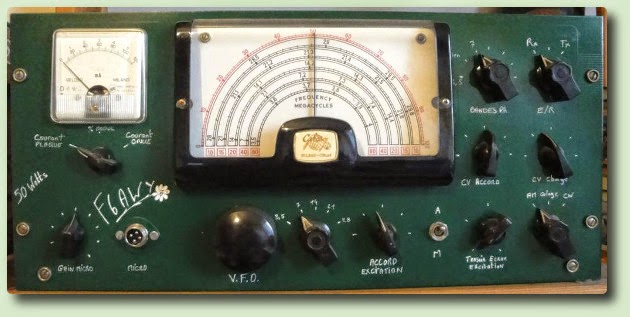
Patrick, F6AWY, The SSB Carpenter (Homebrew Hero)

Patrick, F6AWY, The SSB Carpenter (Homebrew Hero)
There he is: Patrick, F6AWY, the builder of the beautiful wooden-case SSB transceiver featured here two days ago. Born in 1945, Patrick has been melting solder since age 15. This picture made me think that there must be some connection between string instruments and homebrew genius: Farhan plays guitar. So does Pete Juliano. I think it was Rick Campbell who was strumming the banjo at FDIM… More about Patrick here: http://www.araccma.com/f6awy-p821004


Here is another of Patrick’s projects. He completely rebuilt an old Geloso AM transmitter. Note the markings on the front panel. Signed with a dash of F6AWY panache!
More about this project here:
http://www.araccma.com/emetteur-am-pas-a-pas-avec-f6awy-p820986

Translation tip: Open these pages in Google Chrome. Then, simply RIGHT CLICK on the page and select TRANSLATE TO ENGLISH.

Our book: “SolderSmoke — Global Adventures in Wireless Electronics” http://soldersmoke.com/book.htm Our coffee mugs, T-Shirts, bumper stickers: http://www.cafepress.com/SolderSmoke Our Book Store: http://astore.amazon.com/contracross-20

Author Peter MarksPosted on 2 March 201522 July 2025Categories AM, France, Knack Stories, music, SSB1 Comment on Patrick, F6AWY, The SSB Carpenter (Homebrew Hero)

F6AWY’s Beautiful, Colorful, Wooden Box Transceiver

I was beginning to fear that I might be the only radio amateur in the world operating a wooden-box SSB transceiver. But no! Patrick F6AWY built this MAGNIFICENT rig. Wow, I really like this one. Note the Heathkit S-meter and main tuning knob (I suspect an HW-?? carcass lies somewhere nearby). Note the colorful analog dial and speaker cover, and the classy lime-colored Dymo tape knob labels. This is really an amazing and inspirational piece of work.

The construction details are all here:
http://www.araccma.com/le-tranceiver-en-bois-de-f6awy-p820968
Yes, it is in French, but even if you can’t get Google or Google Chrome to translate it (and that should be possible) you can see what he did through the great pictures and schematic diagrams.

Congratulations Patrick!

Our book: “SolderSmoke — Global Adventures in Wireless Electronics” http://soldersmoke.com/book.htm Our coffee mugs, T-Shirts, bumper stickers: http://www.cafepress.com/SolderSmoke Our Book Store: http://astore.amazon.com/contracross-20

Author Peter MarksPosted on 28 February 2015Categories France, SSB4 Comments on F6AWY’s Beautiful, Colorful, Wooden Box Transceiver

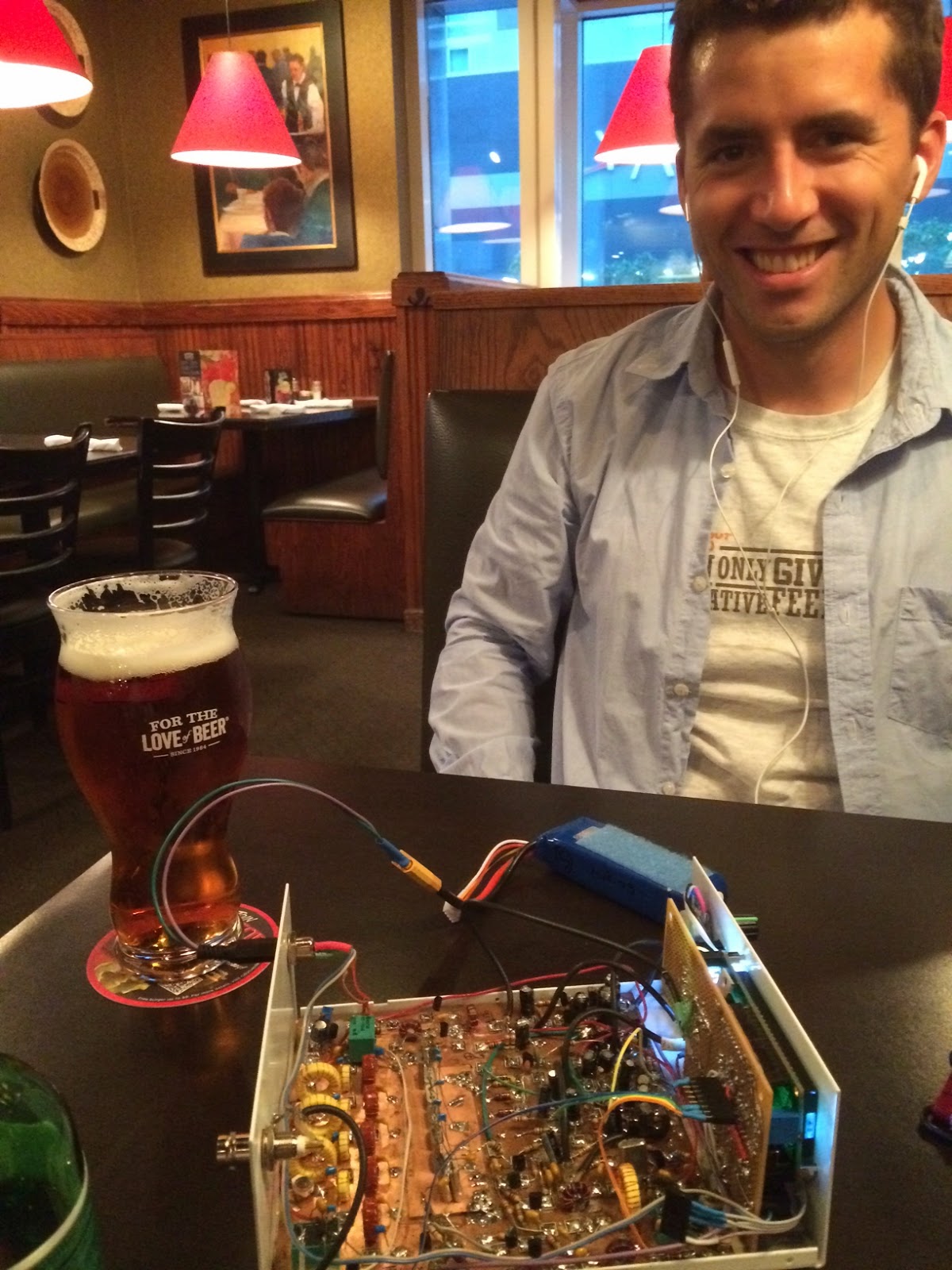
When Your Local Oscillator Could Sink Your Ship!

When Your Local Oscillator Could Sink Your Ship!

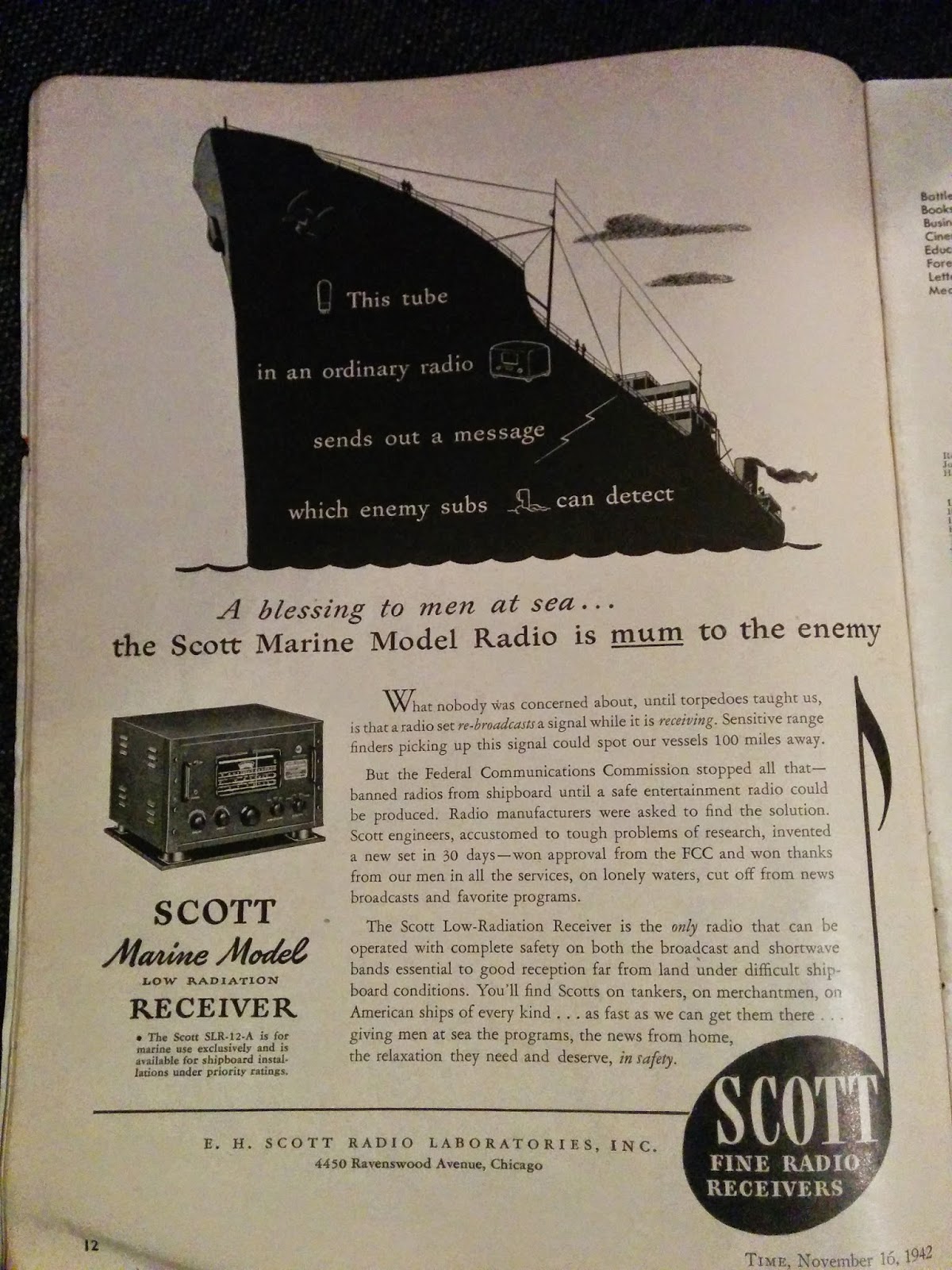
Thomas KK6AHT is the intrepid radio amateur from France who moved to California and successfully built a Minima as his first homebrew project. Yesterday we got additional evidence that Thomas definitely has THE KNACK. It seems that he has been looking through really old radio magazines (clearly a symptom). He sent us this add from 1942. Yikes! Imagine getting your ship sunk because your Local Oscillator is not quite local enough!

…………………


Hey!
I thought you would get a kick out of this 1942 ad. Sounds like those guys had a some good reasons to fight QRM … Who knew the important role played by the FCC during the war?
Now tell me: why were the receivers so noisy at the beginning of the war? What did they change? Happy new year to you both! May the gods of radio (and digital) bring you much fun on the air.
73, Thomas

…………………………


Good to hear from you Thomas. Long time no hear — I was beginning to fear that you had grown disillusioned with homebrewing and had switched to stamp collecting or something else less frustrating.

As for the ship radios, two things come to mind. Some of them may still have been using regens at the start of the war. If so, that was kind of suicidal — regens radiate! The detector moves in and out of oscillation (sometimes staying in oscillation) at the receive freq. The Germans were quite good at detecting and direction-finding these signals, on land and at sea. So the regens would have to go.

Superhets are not quite as bad, but they too can radiate. My Bitx spills out a bit of signal at 23 MHz (VFO) and at 5 MHz (BFO). Without adequate shielding, these sigs could also be detected and triangulated. Looks like the radio in the picture had lots of shielding.

We watched a French movie last night: The French Minister. A comedy about life in the French Foreign Ministry. It was kind of fun.

What are you working on? I am listening to 17 meters using an OLD superhet in which I have replaced the VFO with an Arduino/DDS generator. Works great but the display is making lots of noise.

73 Bill

…………………………….


Hi Thomas,
Well Thomas, I will dip my toe into some very deep water and attempt an answer for you which also is an important clue about QRP operations.
  1. Today we have many many signals co-existing in the radio spectrum. During the war there was much less radio garbage and the military lit up the ether with transmissions very sparingly. But that is on the transmit side. That said the local oscillators (much like you have with the Si-570 on your Minima) used in receivers also produce RF that unless is minimized in some fashion is passed right through to the antenna and can be detected. Regenerative receivers are especially prone to this. Yes some military equipment used regenerative receivers. In fact the famous Paraset had to be constantly moved so it would not be detected.
  2. This receiver generated RF into the antenna was addressed by companies like Scott by shielding everything. That receiver in the photo probably weighed about a 100 pounds or more. Much attention was paid to RF bypassing and grounding. The cheap table top radios were RF generators par excellence.
  3. There was another approach developed in WWII to solve that problem and forms the basis of what makes work that little device sitting in your pocket. The odd part it was invented by a famous movie star. Look up Heddy Lamar in wikipedia. She and a co-inventor came up with the concept of frequency hopping and spread spectrum technology. By jumping frequencies it would be hard to pinpoint a transmitting station. That concept forms the backbone of our cellphone system
  4. Now the QRP part – if the RF output from a receiver local oscillator (milliwatts) can be detected from afar – then it follows QRP works!
Have fun.

Pete


Our book: “SolderSmoke — Global Adventures in Wireless Electronics” http://soldersmoke.com/book.htm Our coffee mugs, T-Shirts, bumper stickers: http://www.cafepress.com/SolderSmoke Our Book Store: http://astore.amazon.com/contracross-20

Author Peter MarksPosted on 19 January 201521 July 2025Categories France, Germany, Juliano -- Pete, Old radio, radio history, RegensLeave a comment on When Your Local Oscillator Could Sink Your Ship!

Sputnik 40 Launched from MIR in 1997

Sputnik 40 Launched from MIR in 1997
Bill,
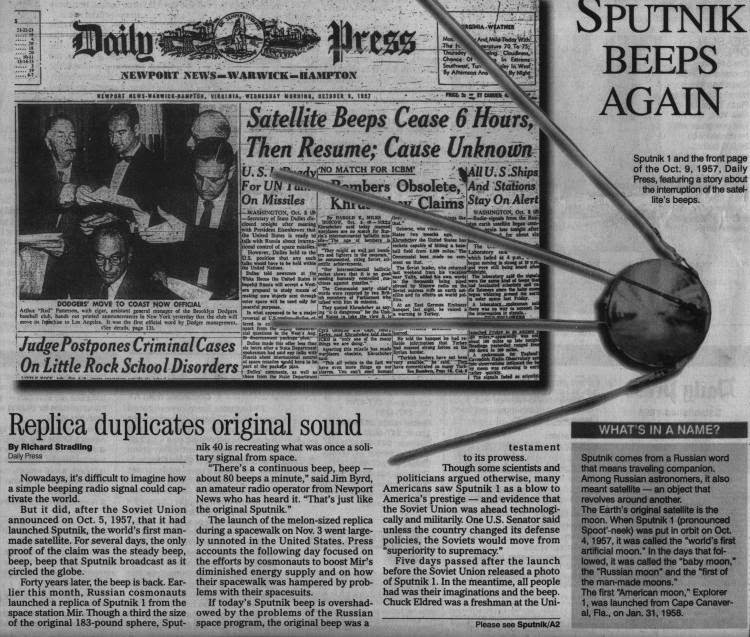
I’m new to SolderSmoke, and have made it up to episode 135. around episode 130 you entered a “space” phase that I enjoyed. With Sputnik being mentioned, I thought I would send you a recording of Sputnik 40 that I made on November 23, 1997. I used a home made turnstile antenna and an HT.

73,
Jeff Tucker
W9TLT

Listen to Jeff’s recording here:
http://soldersmoke.com/sputnik97.wav
Sputnik 40, also known as Sputnik Jr, and Radio Sputnik 17 (RS-17), was a Franco-Russian amateur radio satellite which was launched in 1997 to commemorate the fortieth anniversary of the launch of Sputnik 1, the world’s first artificial satellite. A 4-kilogram (8.8 lb) one-third scale model of Sputnik 1, Sputnik 40 was deployed from the Mir space station on 3 November 1997. Built by students, the spacecraft was constructed at the Polytechnic Laboratory of Nalchik in Kabardino-Balkaria, whilst its transmitter was assembled by Jules Reydellet College in Réunion with technical support from AMSAT-France.

Sputnik 40 was launched, along with a backup spacecraft and the X-Mir inspection satellite, aboard Progress M-36 at 15:08 UTC on 5 October 1997. A Soyuz-U carrier rocket placed the spacecraft into orbit, flying from 1/5 at the Baikonur Cosmodrome in Kazakhstan: the same launch pad used by Sputnik 1. Progress M-36 docked to Mir on 8 October, and the satellites were transferred to the space station. At 04:05 UTC on 3 November, during an extra-vehicular activity, Sputnik 40 was deployed by cosmonauts Anatoly Solovyev and Pavel Vinogradov.

On 4 November, the day after it was deployed, Sputnik 40 was in a low Earth orbit with a perigee of 376 kilometres (234 mi), an apogee of 382 kilometres (237 mi), an inclination of 51.6 degrees, and a period of 92.13 minutes.The satellite was given the International Designator 1997-058C, and was catalogued by the United States Space Command as 24958. It ceased operations on 29 December 1997 when its batteries expired, and subsequently decayed from orbit on 21 May 1998. The backup satellite remained aboard Mir, and was destroyed when Mir was deorbited on 23 March 2001.

Our book: “SolderSmoke — Global Adventures in Wireless Electronics” http://soldersmoke.com/book.htm Our coffee mugs, T-Shirts, bumper stickers: http://www.cafepress.com/SolderSmoke Our Book Store: http://astore.amazon.com/contracross-20

Author Peter MarksPosted on 30 December 201421 July 2025Categories France, Russia, satellites, space program1 Comment on Sputnik 40 Launched from MIR in 1997

Don’t miss Thomas and his Minima at Pacificon!

Don’t miss Thomas and his Minima at Pacificon!

Thanks for the kind words Thomas. Be sure to have someone do a video of your presentation.

You truly have The Knack — proof of this is your reaction to your wife’s departure for field research in Senegal: “IT’S SOLDER TIME!” That’s the spirit!

Too bad about the chickens, but hey, they died for a good cause…


Dear Bill,

I have been listening to your podcast for about a year now. I think you were right to say that one episode a month is a reasonable limit to avoid listeners getting addicted. At some point in January I was listening to you every morning and every evening in my car, a very serious case of addiction.

This is also the time that Farhan chose to announce the Minima and my wife to go to Senegal for 3 months for a field study (she is doing a PhD in Sociology). I think it took me less than a week to run to the shop, get most of the parts and start melting solder!

In two weeks from today I will present the project and my build at Pacificon. I would really appreciate if you could mention this on your blog because I am sure there are other listeners who will be there and curious for some homebrewing-materials. I hope to delight them!

For your own pleasure there are some pictures and videos on my blog: http://www.sarfata.org/ham/minima/

Pacificon Schedule: http://pacificon.org/ (My talk will be at 10:45 in the Portland room)

My presentation will retrace my journey building the minima. From the first smokes on the crystal filter when I was not even sure how to test it, or what results to look for ; to the amplifier where I am still battling some oscillations (by the way, if you had not talked so much about them, I would never have understood what was going on!).

This project has taught me that radio is a lot less black magic than I thought. It bridged the gap between the maths that I can understand but not really “see” and the sound coming out of the amplifier. It made me realize that once split into stages, a radio is much better understood and testable. Without a doubt, this has been my most ham-enriching experience and I hope to convince more people to build a minima, preferably Manhattan style!

(In this public setting, I will probably not discuss killing chickens to exorcize my amplifier but I thank you for the tip …)

I got pulled back from homebrewing by life and work this summer but I kept the last three episodes of Soldersmoke on my phone. They were my safety parachute and I listened to them last week on the way home to give me the extra boost that gets me to melt solder or fix bugs until 3 in the morning on a tuesday. I don’t think I will ever be able to express my gratitude for all that I have learnt reading the book and listening to you but I would like to start here: Thank you!

Please keep the podcast going! I have really enjoyed the new format with Pete.

73,
thomas
kk6aht / f4hdq

Our book: “SolderSmoke — Global Adventures in Wireless Electronics” http://soldersmoke.com/book.htm Our coffee mugs, T-Shirts, bumper stickers: http://www.cafepress.com/SolderSmoke Our Book Store: http://astore.amazon.com/contracross-20

Author Peter MarksPosted on 29 September 201422 July 2025Categories France, Hamfests and Flea Markets, MinimaLeave a comment on Don’t miss Thomas and his Minima at Pacificon!

Thomas’s Magnificent Minima

Thomas’s Magnificent Minima

Wow, Thomas’s page makes me really want to build a Minima. Note the Manhattan style with Rex Harper’s Me-Pads. Excellent. Thomas provides a really great stage-by-stage description of the project with the kind of candid descriptions of mistakes that SolderSmoke listeners are so fond of!

http://www.sarfata.org/ham/minima/

Thomas himself has an interesting “international brotherhood” personal history:

http://www.sarfata.org/about.html

Our book: “SolderSmoke — Global Adventures in Wireless Electronics” http://soldersmoke.com/book.htm Our coffee mugs, T-Shirts, bumper stickers: http://www.cafepress.com/SolderSmoke Our Book Store: http://astore.amazon.com/contracross-20

Author Peter MarksPosted on 12 July 201422 July 2025Categories Farhan, France, Harper -- Rex, MinimaLeave a comment on Thomas’s Magnificent Minima

F6FEO’s BITX 20 (and DSB Rig)

F6FEO’s BITX 20 (and DSB Rig)

This morning I was looking at F6FEO’s wonderful web site (Frank, KM4AXA is building the 28 Mhz DSB rig from Michel’s site) . The drawings have a nice JF1OZL feel to them.

Check out Michel’s site. Just hit the translate button if you have trouble with the French language:
http://f6feo.homebuilder.free.fr/index.html

Merci Michel!

Our book: “SolderSmoke — Global Adventures in Wireless Electronics” http://soldersmoke.com/book.htm Our coffee mugs, T-Shirts, bumper stickers: http://www.cafepress.com/SolderSmoke Our Book Store: http://astore.amazon.com/contracross-20

Author Peter MarksPosted on 14 June 201421 July 2025Categories BITX20, DSB, FranceLeave a comment on F6FEO’s BITX 20 (and DSB Rig)

A Post Card from Paris

A Post Card from Paris

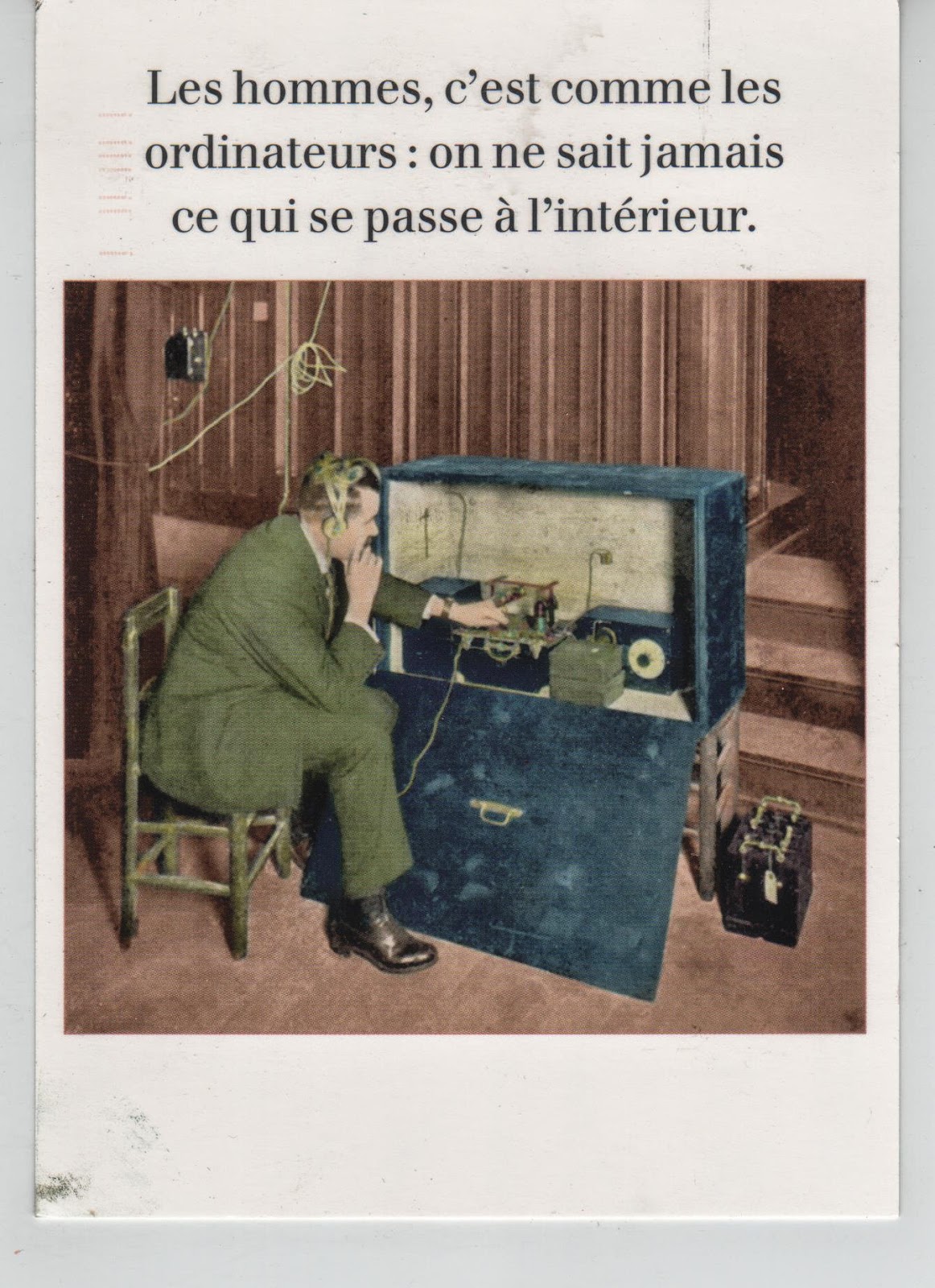
This arrived from Paris, from our friend Rogier, PA1ZZ KJ6ETL. “Men are like computers: one never knows what’s going on inside.” But it looks to me like the OM in the picture knows EXACTLY what’s going on inside that rig. So I guess this is commentary on the perils of black boxes, and the benefits of an analog, discrete component, Hardware Defined Radio approach. I’m with you Rogier! Merci!

Our book: “SolderSmoke — Global Adventures in Wireless Electronics” http://soldersmoke.com/book.htm Our coffee mugs, T-Shirts, bumper stickers: http://www.cafepress.com/SolderSmoke Our Book Store: http://astore.amazon.com/contracross-20

Author Peter MarksPosted on 4 June 201421 July 2025Categories FranceLeave a comment on A Post Card from Paris

Meteor Shower Tonight

If the skies are clear, and if I can stay awake, I’ll be out there looking for the new meteor shower.

But there is no real need to go outside. David, EA1FAQ has an SDR receiver tuned to a radar frequency in France. You can see and hear the meteors as they create a path for the RF. Very cool.
Thanks David:

http://www.ustream.tv/channel/live-meteor-radar

You can also listen for meteor pings here:

http://spaceweatherradio.com/

Our book: “SolderSmoke — Global Adventures in Wireless Electronics” http://soldersmoke.com/book.htm Our coffee mugs, T-Shirts, bumper stickers: http://www.cafepress.com/SolderSmoke Our Book Store: http://astore.amazon.com/contracross-20

Author Peter MarksPosted on 23 May 2014Categories France, meteors, Spain1 Comment on Meteor Shower Tonight

Beautiful French Aerial Photography Project. UPstagram! (Video)

We’ve put cameras in kites and rockets, but I think this is much cooler.

More details (and pictures) here: http://hackerloop.com/upstagram/

Our book: “SolderSmoke — Global Adventures in Wireless Electronics” http://soldersmoke.com/book.htm Our coffee mugs, T-Shirts, bumper stickers: http://www.cafepress.com/SolderSmoke Our Book Store: http://astore.amazon.com/contracross-20

Author Peter MarksPosted on 14 November 2013Categories balloon, France, photography, videoLeave a comment on Beautiful French Aerial Photography Project. UPstagram! (Video)

Posts pagination

Previous page Page 1 Page 2 Page 3 Next page

Recent Posts

  • One (of several) SolderSmoke Blog Backups: This one in .pdf form
  • Britain’s EF-50 Valve (Tube, Thermatron) in WWII
  • A USB-powered Homebrew X-ray machine. And who is Project 326?
  • How many of you guys have changed the clutch on a Heathkit HW-101 (or similar rig)?
  • Oscillation! Negative Resistance! Barkhausen Explained Very Well!

Recent Comments

  1. Peter Marks on Britain’s EF-50 Valve (Tube, Thermatron) in WWII
  2. WN2A on Oscillation! Negative Resistance! Barkhausen Explained Very Well!
  3. Anonymous on Oscillation! Negative Resistance! Barkhausen Explained Very Well!
  4. WN2A on Oscillation! Negative Resistance! Barkhausen Explained Very Well!
  5. Anonymous on Homebrew Hero: Sir Douglas Hall
  • "The Art of Electronics"
  • 10 meters
  • 12 meters
  • 15 Meters
  • 15-10 Transceiver
  • 160 meters
  • 17 meters
  • 1712 Rig
  • 2 meters
  • 20 meters
  • 20meters
  • 2200 and 630 meters
  • 30 meters
  • 40 meters
  • 6 meters
  • 60 meters
  • 75 meters
  • AA1TJ
  • AA7EE
  • Adams — Chuck
  • aeronautical mobile
  • Africa
  • AGC
  • AI
  • aircraft
  • Alaska
  • All American Five
  • AM
  • Amateur Television
  • amplifier theory
  • analog
  • Anguilla
  • Antarctica
  • antennas
  • Antuino
  • April 1
  • Arduino
  • arduinos
  • Argentina
  • Armstrong — Neil
  • Armstrong -E. Howard
  • ARRL
  • astronomy
  • audio amplifiers
  • Aurora
  • Australia
  • Austria
  • Azores
  • balloon
  • Bamford –Dave
  • Bangladesh
  • Barbados
  • beacon
  • Belgium
  • Beverage–Harold
  • bicycle
  • Billy
  • biology
  • bitx
  • BITX DIGI-TIA
  • BITX20
  • BITX40Module
  • BITX60
  • boatanchors
  • boats
  • book
  • books
  • Bose-JC
  • Botswana
  • Brazil
  • Brazil. Australia
  • Brazil. Belgium
  • broadcast radio
  • Budlong — Merrill
  • Burdick — Wayne
  • California
  • Campbell-Rick
  • Canada
  • Canary Islands
  • Carlson — Mr.
  • Carney-Todd
  • Carr — Joseph
  • cartoons
  • CB
  • CBLA
  • Cebik-L.B.
  • Central America
  • ceramic resonators
  • Chile
  • China
  • Cicadas
  • climate change
  • clocks
  • Cloud Chamber
  • Clubs
  • Collins — A. Frederick
  • Collins — Art
  • Colombia
  • computer history
  • construction techniques
  • Costa Rica
  • COVID
  • Crane-Bob
  • Croatia
  • crystal radio
  • Cuba
  • CW
  • CW.
  • Cyprus
  • Czech Republic
  • Darlington–Paul
  • DC Receiver Build
  • DC RX Hall of Fame
  • DDS
  • DeMaw–Doug
  • Denmark
  • DiFX
  • digital
  • digital logic
  • digital modes
  • Dilbert
  • direct conversion
  • Direct Conversion Challenge
  • Disaster Relief
  • Dobbs-George
  • Dominican Republic
  • Drake 2B
  • Drake TR-3
  • Drones
  • DSB
  • Dubai
  • DX-100
  • DX-390
  • DX-40
  • earthquake
  • Echolink
  • Ecuador
  • Edison — Thomas
  • Einstein — Albert
  • El Salvador
  • Elecraft
  • election
  • Electric Radio magazine
  • electrolytic capacitors
  • Ellsworth — Jeri
  • Elser-Mathes Cup
  • EM Waves
  • EME
  • Emergency Power
  • EMRFD
  • enclosures
  • ET-2
  • Europa
  • Evans– Grayson
  • Faraday — Michael
  • Farhan
  • Farnsworth–Philo
  • Faroe islands
  • FCC
  • FDIM
  • feedback
  • Fessenden — Reginald
  • Feynman — Richard
  • Field Day
  • Filters
  • Finland
  • Finnland
  • Fish Soup 10
  • Fishpool — Tony
  • Florida
  • FM
  • France
  • Franklin Oscillator
  • frequency counter
  • Fried–Limor
  • Friedrichs — HP
  • FT-8
  • Fusion
  • Gale — Todd
  • Germany
  • Gilbert Cell
  • Glue Sticks
  • Google
  • GQRP
  • greece
  • Green — Wayne
  • Guapo
  • Guatemala
  • Guth — Eric
  • h
  • Haiti
  • Hall-Douglas
  • Hallicrafters
  • Ham Radio Workbench
  • Hamel–Armand
  • hamfest
  • Hamfests and Flea Markets
  • Hammarlund
  • Harden-Paul
  • Harper — Rex
  • Harris — Frank
  • Hawaii
  • Hayward–Wes
  • HB2HB
  • Heathkit
  • heathkits
  • heatsinks
  • Heaviside — Oliver
  • Heil — Bob
  • Herring Aid 5
  • Hex Beam
  • Hodgepodge rig
  • homebrew
  • homebrew hero
  • homebrew transistors
  • Honduras
  • Hong Kong
  • HP8640B
  • HQ-100
  • Hungary
  • Hunkin — Tim
  • HW-101
  • HW-7
  • HW-8
  • IBEW
  • Iceland
  • ICs
  • Idaho
  • IGY
  • impedance matching
  • India
  • Indonesia
  • integrated circuits
  • Interference
  • Iraq
  • Ireland
  • IRF510
  • Israel
  • Italy
  • Jaguey
  • Jamaica
  • Japan
  • JBOT
  • Jean Shepherd
  • Jim Williams
  • Job Opportunities
  • John Edwards
  • Jones — Frank
  • Jordan
  • JT65
  • Judica Cordiglia
  • Juliano — Pete
  • Jupiter
  • K1JT
  • K5WDW
  • Kang- KPS
  • Karl and Jerry
  • keyers
  • Keyser — Ian
  • Kits
  • KL7R
  • kludge
  • Knack Stories
  • Kraus — John
  • Lady Ada
  • Lafayette HA-600A
  • Large Hadron Collider
  • Laser
  • Lebanon
  • LED
  • LEDs
  • Lewallan — Roy
  • Lewallen — Rick
  • lexicon
  • Light Beam Telephony
  • Light Bulbs
  • Lightning
  • Linux
  • Lithuania
  • LM373
  • Long Delayed Echo
  • LtSpice
  • M0NTV
  • Macdonald — Copthorne
  • Madagascar
  • Mafalda
  • magazines
  • MAKE
  • Malaysia
  • Marconi
  • Marconi-Guglielmo
  • Mars
  • Mate for the Mighty Midget
  • math
  • mathematics
  • Maxwell — James Clerk
  • McCoy — Lew
  • Mercury
  • metal work
  • meteors
  • Mexico
  • MFJ Cub
  • Michigan Mighty Mite
  • microcontrollers
  • Microphone
  • military radios
  • Mims — Forrest
  • Minima
  • minimalist computing
  • minimalist radio
  • mixer theory
  • Mixers
  • mongolia
  • Montana
  • Montenegro
  • moonbounce
  • Morris — Charlie
  • movie review
  • Moxon
  • Muppet Boards
  • Murphy — Mike WU2D
  • Murphy — Steve
  • museum
  • music
  • Mythbuster
  • Namibia
  • nano UK. New Zealand
  • NanoVNA
  • NE602
  • Nepal
  • Netherlands
  • Netherlands.
  • New York City
  • New Zealand
  • noise
  • Norway
  • Novice Station
  • nuclear power
  • Numbers stations
  • Old radio
  • Old Smoke
  • OLED
  • oscilloscope
  • Other homebrews
  • Pakistan
  • Panama
  • parachute
  • Paraguay
  • Parasets
  • Parent — Allison
  • Parfitt– Dale
  • Parker–Peter
  • Parts suppliers
  • Penson-Chuck
  • Pete
  • Phase Locked Loop
  • Phase Noise
  • phasing
  • Phasing Rigs
  • Philippines
  • photography
  • Physics
  • poetry
  • Poland
  • Polyakov–Vladimir
  • Portugal
  • Project Gutenberg
  • propagation
  • PTO
  • Puerto Rico
  • PY2OHH
  • Qatar
  • QCX
  • QRP
  • QRP. Germany
  • QRSS
  • QST
  • Quarantine
  • R-390
  • R/C plane
  • radio astronomy
  • radio history
  • Rainey — Michael
  • Raspberry Pi
  • Reber–Grote
  • regen
  • Regens
  • reggie
  • repair
  • resonance calculations
  • Reunion Island
  • Reverse Beacon Network
  • Rider — John
  • ro
  • Roberts–Steven
  • robot
  • rockets
  • Rockey — C.F.
  • Romania
  • RTTY
  • Rudy Severns
  • Russia
  • S-38E
  • San Francisco
  • Sardinia
  • satellites
  • Saturn
  • sBITX
  • Schwartz-Eric
  • science fiction
  • Scotland
  • Scott– Richard N3FJZ
  • SDR
  • SETI
  • Shannon — Claude
  • Shenandoah
  • Short Wave Listening
  • Si5351
  • Sicily
  • sideband inversion
  • Sierra Leone
  • Silver — McMurdo
  • Silverman — Steve
  • simulators
  • Singapore
  • Slovakia
  • Smith–Steve
  • software
  • solar cycle
  • Solar power
  • solder
  • SolderSmoke Podcast
  • SolderSmoke Shack South
  • SolderSmoke store
  • SolderSmoke Videos
  • SOTA
  • Souleles — Dean
  • South Africa
  • South Korea
  • Soviet Union
  • space program
  • Spain
  • Sparks — Ron
  • sponsor
  • SPRAT
  • SSB
  • SSDRA
  • SST
  • SSTV
  • static electricity
  • stickers
  • Stoll — Cliff
  • Sub-Harmonic mixer
  • Summers-Hans
  • Sun
  • Superhet receivers
  • surface mount
  • Swan 240
  • Sweden
  • Switzerland
  • SWL
  • Tape recorder
  • Tasmania
  • Taylor — Joe
  • Taylor — Paul
  • telescope
  • telescopes
  • teletype
  • Television
  • Temperature Compensation
  • Terman — Frederick
  • Tesla — Nikola
  • test gear
  • Thailand
  • The Knack
  • Tibet
  • Time
  • TinySA
  • TJ DC RX
  • tools
  • Toroids
  • Trastevere
  • TRGHS
  • Trivial Electric Motor
  • troubleshooting
  • tube
  • Tubes
  • Tubes. tube
  • Tuna Tin 2
  • Turkey
  • Twain — Mark
  • UAE
  • uBITX
  • UHF
  • UK
  • Ukraine
  • Uncategorised
  • uSDX
  • Van Vark — Tatjana
  • Vatican Radio
  • Venezuela
  • venus
  • VFO
  • VHF
  • vide
  • video
  • Vienna Wireless Society
  • Vietnam
  • Virginia
  • VK4KA
  • W1PID
  • W7ZOI
  • WA6ARA
  • WA7MLH
  • Walford Electronics
  • Washington D.C.
  • WD-40
  • weather
  • web sites
  • Weber-Steve
  • Weiss–Ade
  • Williams — Jim
  • wind power
  • WN2A
  • wolke — Alan
  • Woodpecker
  • woodworking
  • workbench
  • workshop
  • Wozniak — Steve
  • WSPR
  • Yates–Alan
SolderSmoke Daily News — Ham Radio Blog Proudly powered by WordPress