I took this quick video during a QSO on July 20, 2019 with Ed K3VA in Philadelphia on 40 meters. Note: Plenty of of audio from the Herring Aid 5 — no additional amplification in the speaker.
Category: Fish Soup 10
Making Fish Soup from Herring and Tuna (How to Build a Fish Soup 10 Transceiver)
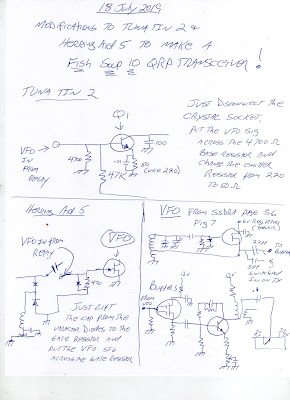
Just in case some other fanatic someday thinks about trying to turn a Herring Aid 5 and a Tuna Tin 2 into a Fish Soup 10. This will also serve as a note to myself on how I did this. Above are my suggestions on how to get the VFO signal into the transmitter and the receiver. Both RX and TX can easily be returned to their original condition.
A Frequency Readout for the Fish Soup 10 (with cool BLUE numerals)
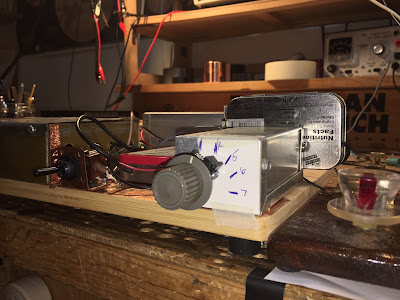
Note the cool BLUE numerals. They represent 7040, 7050, 7060, 7070. The little black “pointer” is from a power cord wall fastener. My tuning cap has a nice reduction drive — the pointer follows the movement of the capacitor blades. The VFO is very stable.
Simplicity is a virtue. CW is, I think, outmoded and kind of absurd (one letter at a time? really?), but it does allow for extreme simplicity. Using a rig with just 10 transistors, putting out half a watt of RF, I am regularly communicating with people. This is what I like about CW.
I’ve had about 12 solid contacts with this rig since putting it on the air earlier this month. The VFO was a huge improvement over being crystal controlled. Crystal control was OK back when receivers were broad and hams tuned around for replies, but those days are gone. Getting the transmit offset set correctly was another huge improvement.
Video of Fish Soup 10 QSO (from N3MLB)
So cool. During our QSO on 40 Meter CW today, N3MLB recorded it and put it on YouTube. This is what my 500 milliwatt Fish Soup 10 rig sounds like in Pennsylvania. Thanks a lot Chris.

From Chris’s QRZ.com page: