I know what you are thinking: Software Defined radio with the TOTAL elimination of hardware? WHERE IS BILL AND WHAT HAVE THEY DONE WITH HIM?
Relax my friends. All is well at SolderSmoke’s East Coast HQ. In fact, just yesterday I was making use of one of the systems described in this video. Here’s how:
I was on 20 meters with my BITX 20 Hardware Defined (HDR) homebrew transceiver. Everything was going smoothly. We have some sunspots now, so DX is once again possible. I heard a loud U.S. station (that will remain anonymous) calling CQ, so I gave him a call.
The trouble started right after he looked at my QRZ page. You see, I have pictures of my homebrew rigs there. These images sometimes trigger hostile reactions, especially from guys who have almost their entire stations INSIDE their computer boxes. I also admit to occasionally making things worse by pointing out that it is possible to build a BITX20 for about five dollars U.S. Some guys apparently don’t like hearing about this.
Anyway, the fellow I was talking to proceeded to give me a very blunt and harsh signal report: “Well, I suppose your signal is strong enough, but your audio is TERRIBLE!” Interpersonal relations pointer: This is NOT a good way to alert a fellow ham to possible technical problems in the rig that he has built by hand, from scratch, in his home workshop. Especially when the person delivering the harsh signal report is using a “rig” that was built by credit card in a robotic factory on the other side of the planet.
So that QSO ended rather quickly. But I did want to follow-up in the comment about the audio. And here is where I turned to Web SDR. Mehmet NA5B has a really nice WEB SDR receive system in Washington DC, just about 8 miles east of me. Before 20 meters opened, I called up Mehmet’s SDR on my computer, tuned it to the frequency of my transceiver and watched the screen as I asked if the frequency was in use. I then issued a couple of hopeless CQs, again watching the screen. I could see in NA5B’s waterfall that my signal was indeed seriously lacking in low frequency audio.
Now it was time to turn to hardware. Rig on the bench, ‘scope and sig generators fired up, I quickly determined that the problem most likely resulted from my placement of the carrier oscillator frequency in relation to the homebrew USB crystal filter. I had placed it about 300 Hz too low. This resulted in a low AF frequency roll off not at the desired 300 HZ, but instead at around 600 Hz. That would make the audio sound “tinny.” So I moved the carrier oscillator up 300 Hz and went back to Mehmet’s SDR receiver. I could see that the lows were now at the right level. Thanks Mehmet.
One note about the audio coming out of the many SDR radios on the air: When you look at the passbands in the Web SDR receivers you can see audio going almost all the way down to the frequency of the suppressed carrier. With non-SDR rigs you usually see a gap of around 300 Hz between the carrier freq and the start of the SSB signal. This is often the result of our filter rigs having IF filter skirts — you would place the carrier oscillator frequency a bit down the skirt — this would help with opposite sideband suppression and all you would be losing would be the lows below 300 cycles, which weren’t really necessary anyway. I had placed the carrier oscillator too far down on the skirt.
Of course, sometimes SDR rigs will also have a gap between the carrier freq an the start of the audio if the operator has set the passband this way, or if the microphone attenuates below 300 Hz. But you see a lot of signals with audio filling almost the entire passband –some of the “Enhanced SSB” guys are running audio passbands that go as low as 50 Hz.
Has anyone else noticed this “full passband” effect when looking at the waterfalls?
Any other tips for using Web SDR for troubleshooting?
Category: Filters
How to Sweep, Plot, and Measure Filter Output in LTSpice
The other day Pete N6QW posted a very nice graph of a bandpass filter’s passband. He was using LTSpice. I realized I had a serious gap in my LTSpice knowledge — I wasn’t sure how to do this.
The charming video from India explains how. Really useful.
SolderSmoke Podcast #224: Mars. Spurs. Bikes. SDR. NanoVNA. Antuino. MAILBAG
SolderSmoke Podcast #224 is available:
1 August 2020
–The launch of Perseverance Mars probe with Ingenuity helicopter.
–China’s Tian Wen 1 on its way – radio amateur Daniel Estevez EA4GPZ is listening to it!
–Sci Fi Books: Mars Trilogy by Kim Stanley Robinson. No skip on Mars 🙁
–We have some sunspots! SFI now 72 and the Sunspot number is 23.
Bill’s bench:
–Conquering Ceramic Spurs in Q-31 Roofing filter — sort of
–NE602 for a Q-75 converter – Gilbert Cell.
–Measuring low power levels out of NE602. Antuino better than ‘scope .
–NanoVNA Really cool stuff. SDR in there.
–Building a 455 kc LC filter from QF-1 rubble. Using LTSPICE, Elsie…
–Reviving my bicycle AM radio – The “All Japanese 6”
–Understanding L Network impedance matching.
–Bill’s new resistor kit from Mouser. Thanks to Drew N7DA.
SHAMELESS COMMERCE: PATREON, AMAZON SEARCH. THANKS
Pete’s Bench:
–Lockdown Special
–BPF work on SDR Rig
–I U W I H
Mailbag:
VK3HN Summit Prowler 7
VK2EMU “The Stranger”
SM0P HB uBITX in Dubai
AE7KI Worked him in VK from London
ON6UU EA3GCY’s 4020 rig
KA4KXX A Simpler Mighty Mite
W9KKQ M19 DMR
KD4PBJ Radio Schenectady
W3BBO 12AU7 Regen
KE5HPY Another 12AU7 regen
N5VZH Ne602 Converter
KY3R Wall Art
G4WIF Spectrum Analyzer in your pocket
W2AEW Talks to UK Club
KK0S Sent 455 Kc IF cans
KL0S Making 9Mhz filters
VU2ESE Diving into simple SDR schemes
Dean KK4DAS Amateur Radio Astronomy
Paul Taylor’s Quarantine “Summit Prowler 7” and some Radio Archaeology
Paul Taylor VK3HN has really outdone himself in this video (above) and blog post. He describes coming across a somewhat mysterious homebrew SSB exciter with some cryptic markings on it. Paul eventually figures them out. We still don’t know who the builder VK3WAC was — can anyone find him in their logbooks?
As Paul goes through the description of the transceiver he built around the mystery exciter, he mentions a number of hombew heroes including Farhan VU2ESE, Peter DK7IH, Eamon EI9GQ (I have to get his book!), and Don W6JL. Also, our beloved SSDRA book plays a prominent role in the story.
Paul’s video is really beautiful — at one point the camera pans the landscape and we see kangaroos in the field. It is also refreshing — as we suffer in the heat of the northern hemisphere summer — to see Paul and his friends out on the summits in their winter coats and hats.
It looks to me as if Paul built this rig during the current emergency, so I will list it as a Quarantine rig. Every dark cloud has a silver lining, and Paul’s rig has added a bit of silver to the dark COVID cloud. Thanks Paul.
https://vk3hn.wordpress.com/2020/07/26/something-old-something-new-a-four-band-5w-50w-ssb-cw-transceiver-summit-prowler-7/
Q-31 Receiver Filter Fix with the NanoVNA
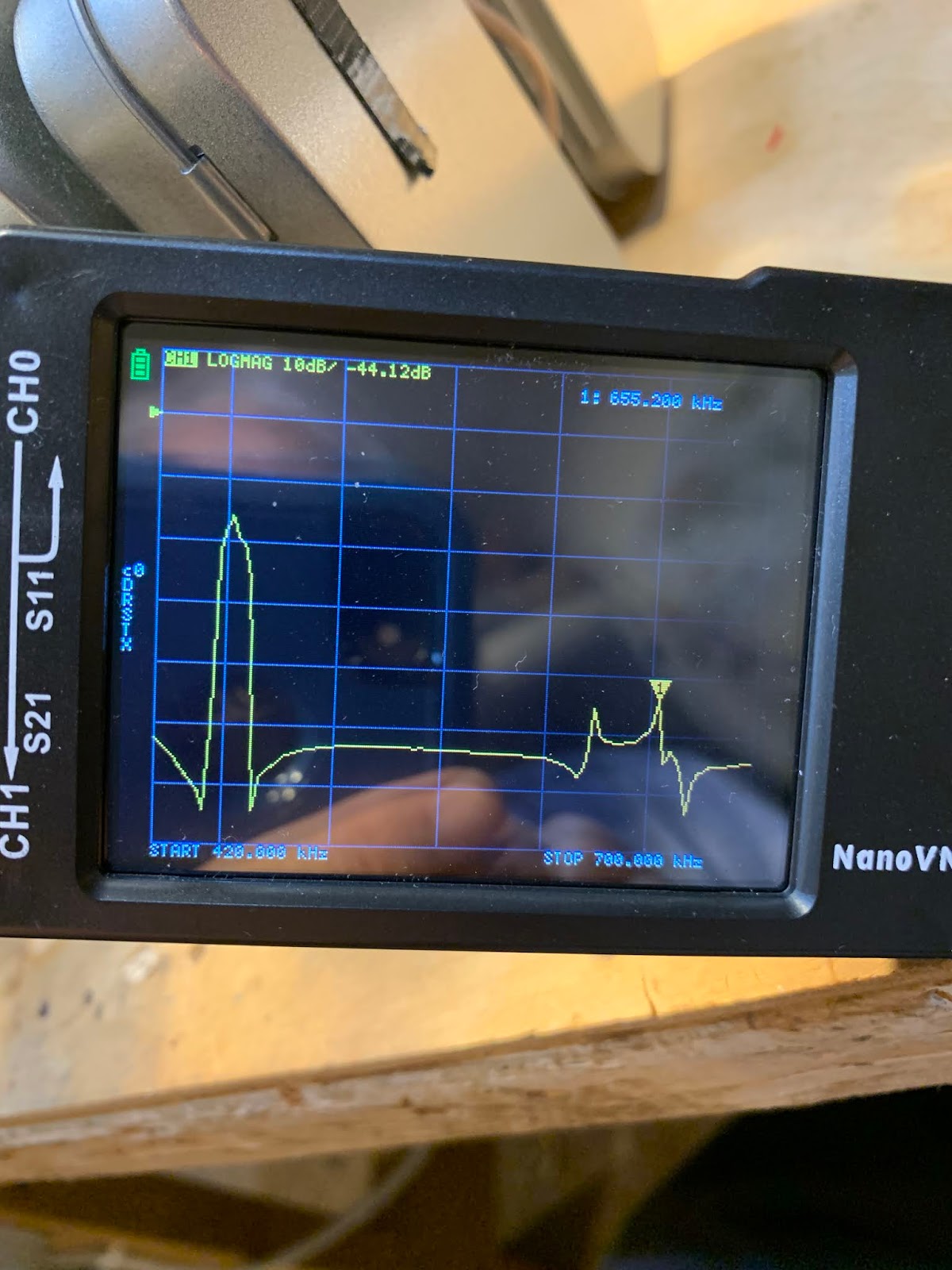
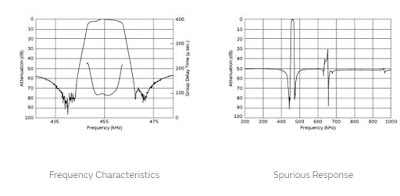
The picture above shows my problem. As predicted by the Murata data sheet and as warned by R.A. Penfold, that nice 455 kc ceramic filter has a significant response at around 640 kc. This caused me to hear Brother Stair twice as often as I should have. Clearly a spur exorcism was called for.
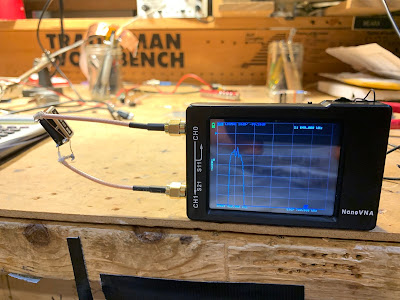
Click on the picture for a better image. As noted last time, my first idea was to build a series 640 kc trap LC circuit and put it ahead of the ceramic filter. But I had trouble getting the desired high Q. So I then thought about putting a wider 455 kc filter ahead of my 12 kc filter. I would, of course, need one that did NOT have the 640 kc spur. I found a 455B filter in my junk box. I used the NanoVNA to look at its response. No spur at 640 kc! Yea!
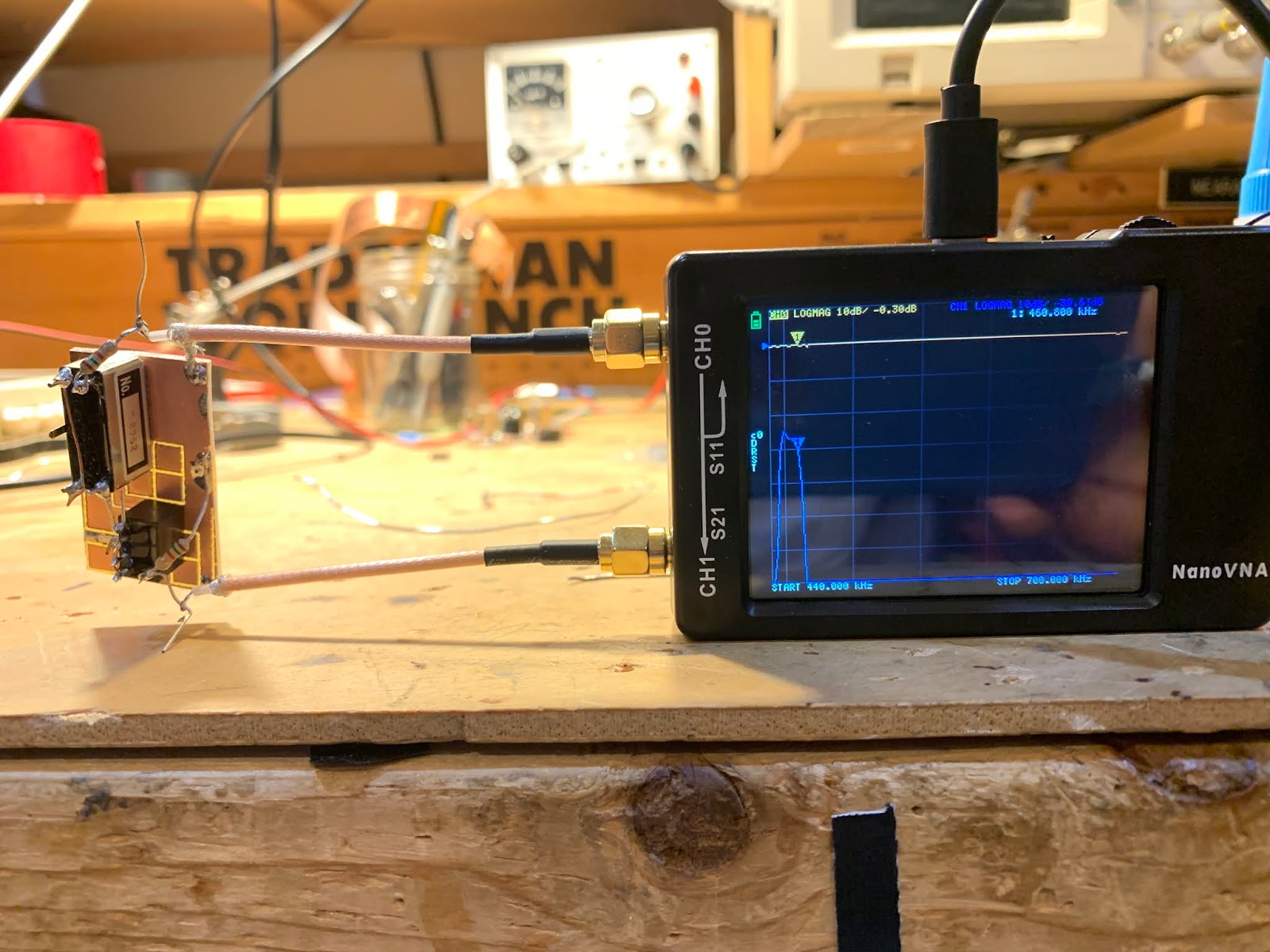
Next I put the two filters together, 455B first, then the 12 kc filter. Success! You can see on the NanoVNA that there is no spur at 640 kc.
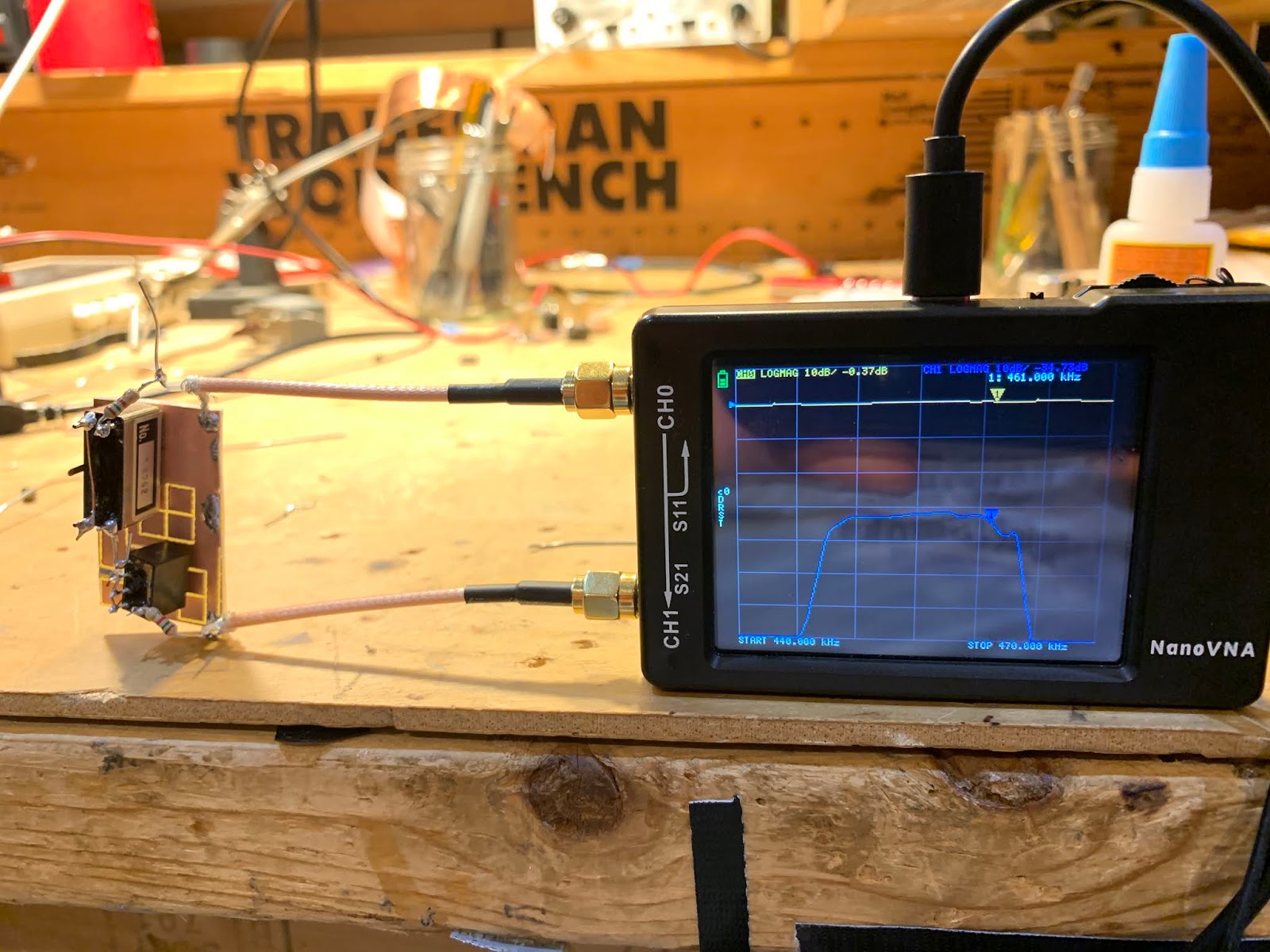
With close to the desired termination impedances, the passband at 455 kc looked pretty good. I just put 1500 ohm resistors in series at the input and output of the dual filter combo.
It worked. Spur exorcised! I no longer hear each SW broadcast stations at two spots on my dial.
The Ceramic Spurs (not a rock group)
Paul Taylor VK3HN’s magnificent AM receiver was the inspiration for my Quarantine-31 Shortwave Broadcast receiver. Like Paul I decided to make use of ceramic filters at 455 kHz for selectivity. I started with the +/- 3 kHz filters that Paul used, but I found them kind of narrow for SW listening. So I went with some wider ceramic filters that Bruce KK0S had sent me. But I misread the specs that Bruce sent. I thought they were 10 kHz wide filters. I realized later that they were +/- 10 kHz — really twice as wide as I needed. So I went back to Mini-Kits in Australia and got some +/- 6 kHz filters. 12 kc wide should be just about right, I thought.
The bandwidth was right, but I started noticing a problem: I could hear strong SW broadcast stations at two places on my dial. This brought to mind an admonition from R.A Penfold, author of “Short Wave Superhet Receiver Construction” (1991 Babani Publications). He advised keeping a few standard 455 kc IF cans in the circuit because, he warned, the ceramic filters have spurious responses, spurs that the IF cans can help knock down.
Penfold was right. Look at the filter response curve on the right (above). There is a nasty spur at around 640 kHz. This was the cause of my problem. Here is why:
Suppose I was tuning Radio Marti’s big signal on 9805 kc. My VFO would be running at 9350 kc.
9805-9350=455. Great, but…
With that spur at 640 kc, I could tune down to 9620 kc on my dial. My VFO would be running at 9165 kc.
9805-9165=640. Bad. That 640 kc difference product would make it through to my detector and AF amp. I’d have Radio Marti showing up in two places. I didn’t like this.
I thought about putting a series LC circuit tuned to 640 kc at the output of the ceramic filter. This looked like a possible solution, but on the bench it looked like I would have trouble getting a circuit of sufficiently high Q.
So rummaging around in my junk box I found an old Murata CFM455B filter. This filter is quite broad, but it does not have the spur at 640 kc. I could use it as a kind of roofing filter just ahead of the +/- 6 kHz filter. Putting it there would allow me to avoid having to build additional matching circuits for the 455B filter.
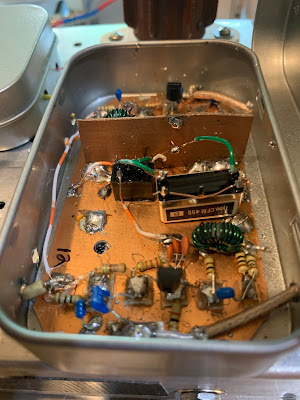 |
| +/-6kc filter upper left, 455B wide filter to the lover right. |
I’m happy to report that this fix works. The 6 kc filter provides the needed selectivity, and the broader 455B filter knocks down the 640 kc spur.
Beware the Ceramic Spurs!
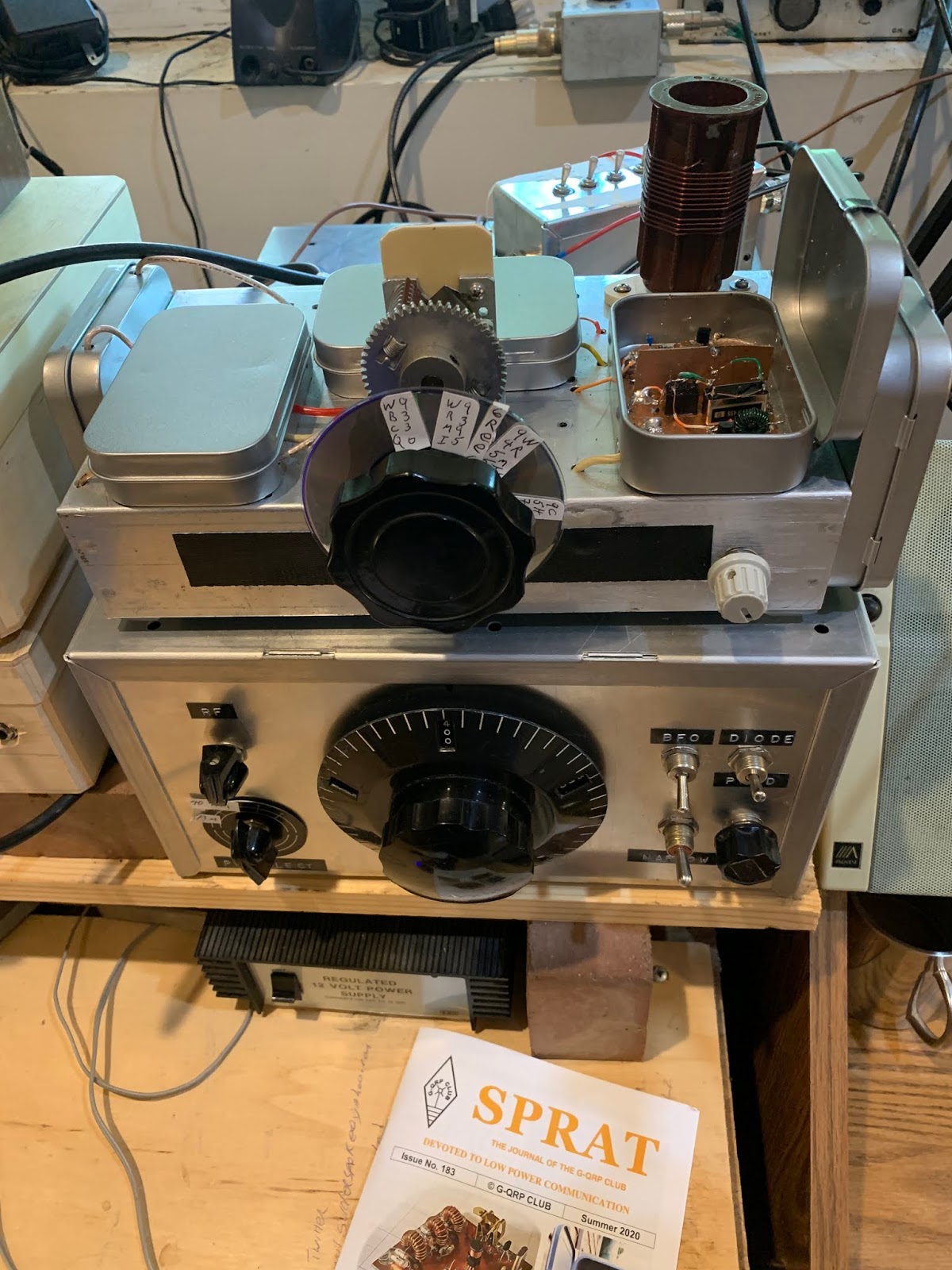 |
| Q-31 with can for first IF amps and filters open |
Replacing Electrolytic Caps in my Drake 2-B (Video)
Every dark cloud has a silver lining. Here is a very small silver lining for this terrible COVID-19 situation: I had time to do a proper replacement of the electrolytic capacitors in my Drake 2-B.
Three cheers for Hayseed Hamfest LLC for providing the replacement capacitor.
Go to their website to find capacitors for many other old rigs:
http://hayseedhamfest.com
Videos on the Q-31 Quarantine AM SW Receiver Project (and some pictures)
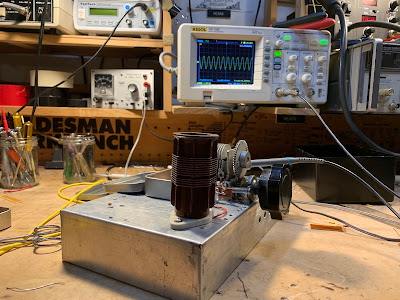
I’ve been making some short, stage-by-stage videos of my Q-31 receiver project. So far I have seven videos. They are here:
https://www.youtube.com/user/M0HBR/videos
Please subscribe to my YouTube Channel. And give me some “thumbs up” if you like the videos.
Thanks. SITS! FlattenTheCurve! 73
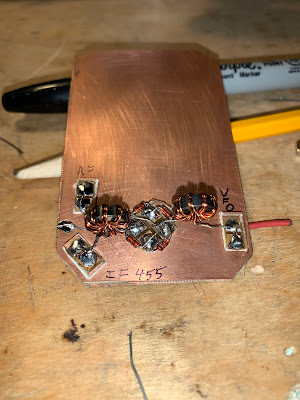 |
| Pads from Pete, toroids from Farhan |
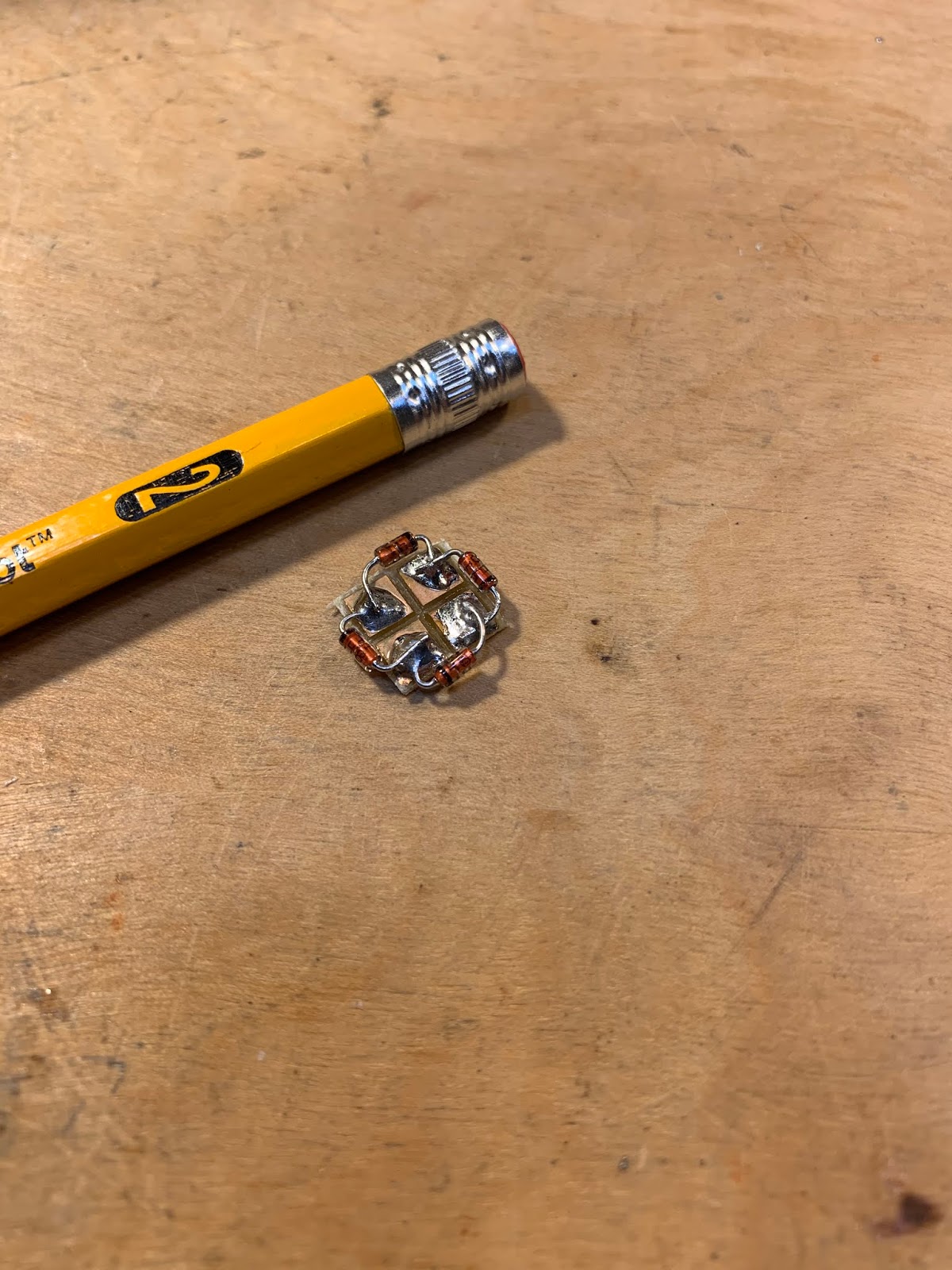 |
| The diode ring |
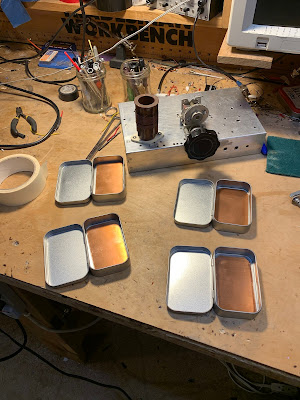 |
| Altoids-sized tins will hold the circuit boards |
 |
| Stay In The Shack — Or in the front yard. |
SolderSmoke Podcast #218: S-38E Woes; CW filter for uBITX; A Teensy Explosion; Mint, Cheese and Peaberries; Mailbag; A SPECIAL PLEA FOR FEEDBACK
SolderSmoke Podcast #218 is available
SolderSmoke 218 is Sponsored by AF4K Crystals:
Bry Carling can get you the crystals you need.
Bry Carling can get you the crystals you need.

Flying drones with Billy. Amazing tech out there. In the 50 buck range with video cameras and facial recognition and tracking. Check out Air Pix.
Bill’s Bench:
Active CW filter in uBITX.
Hi-Per-Mite from 4 State QRP. Easy to do. Works well.
uBITX to 5 W level.
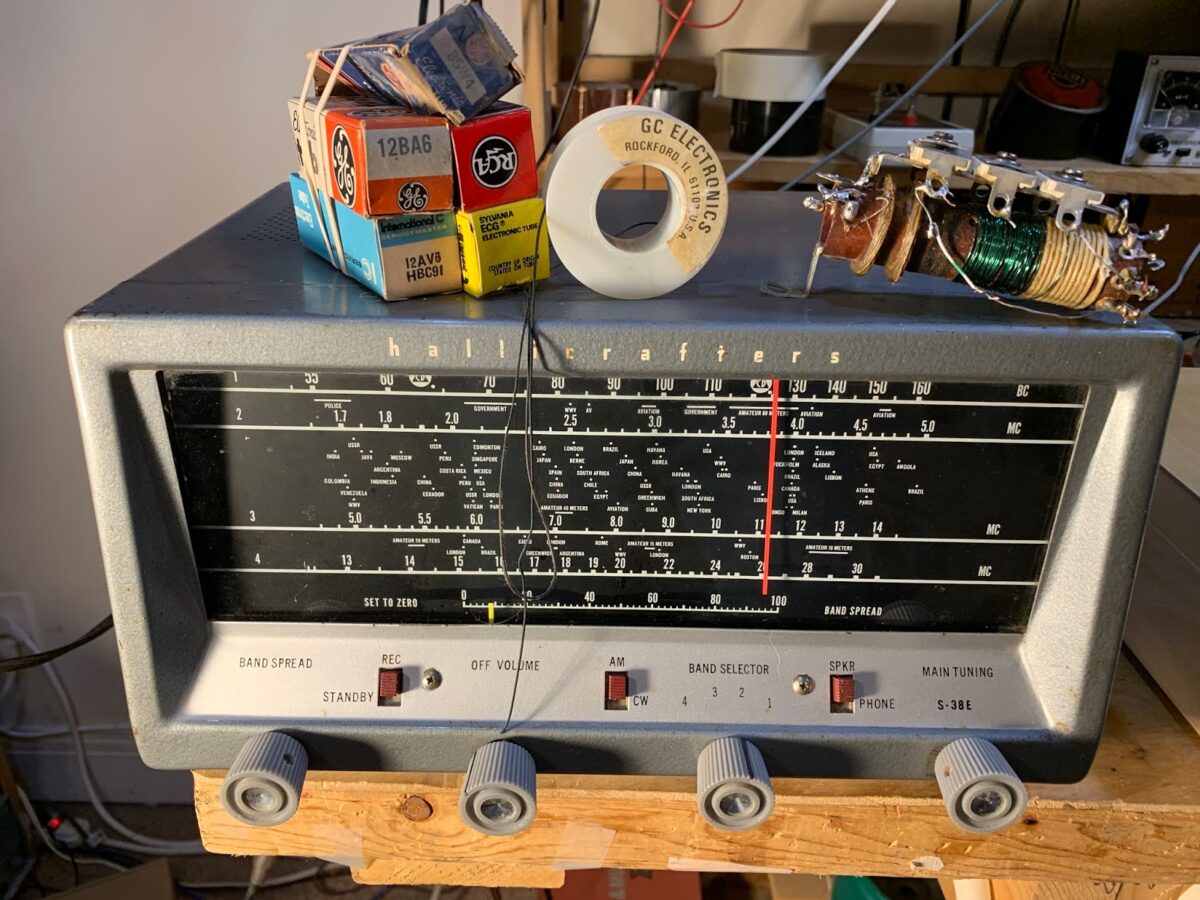
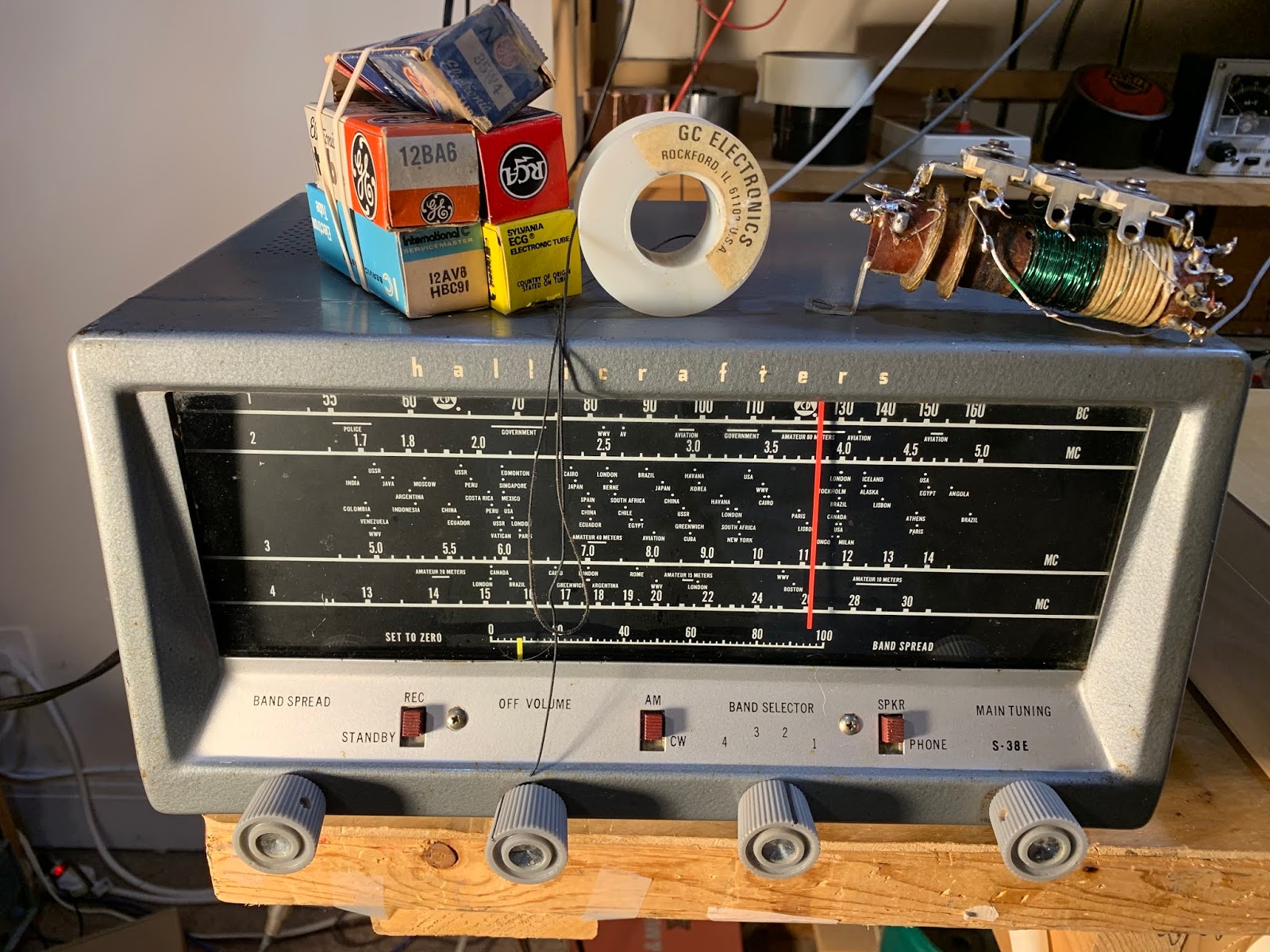
S-38E adventure.
Replaced antenna input coil BUT — it came from an earlier S-38 and doesn’t resonate.
So I bought a junker on e-bay and will take the E model coil out of that one.
Had to re-string the dial! And add rosin to it from Maria’s old violin.
BFO was not working. Bad buzz sound.
So: Re-cap, Re-tube, Re-string, Re-align, Re-build power supply.
Shortwave sounds good. Nice to hear music coming from our machines.
SHAMELESS COMMERCE DIVISION: Please use the Amazon Search Box in the upper right hand portion of the blog.
Pete’s Bench
A teensy-weensie explosion and fire
Mint! Kl7FLR
60 Meters
Cheese Microscopes
Peaberry
Radig
California hams using online SDR receivers for local nets.
News You Can Use!
J-310s in LTSpice
MAILBAG
K5HCT August via Regen and YouTube
Doug WB5TKI and his wife read “Us and Them.”
Rich K7SZ finally following SolderSmoke Podcast. Welcome aboard Rich.
Rick KD4KRA His son was one of the kids in the MIR-Classroom contact that I monitored around 1993…
David AD8Y Read SolderSmoke Book. Similar Knack story. Shared 1978 story: Homework net on 75 meters.
Paul KL7FLR Tapping and other tribal knowledge.
Dave K8WPE Says I’m fortunate to have a supportive wife. So true.
SPECIAL REQUEST: IT IS VERY DIFFICULT FOR US TO KNOW HOW MANY PEOPLE ARE LISTENING TO THIS. SO PLEASE, SEND AN E-MAIL TO SOLDERSMOKE@YAHOO.COM JUST SAY THAT YOU LISTENED TO PODCAST #218 AND TELL US HOW YOU LISTENED TO IT (ITUNES, DOWNLAD FROM BLOG, STITCHER, PODBEAN, WHATEVER… THANKS
PH2LB’s Homebrew Hi-Per-Mite CW Filter in his uBITX
I really like the way Lex PH2LB measures and demonstrates the effectiveness of the Hi-Per-Mite CW filter designed by David Cripes NM0S. Watch the short video above. The blue trace is the audio input to the filter, the orange trace is the output. Watch the output change as Lex sweeps the audio frequency range.
He wrote:
After studying the schematic I shifting through my spare parts stock to collected the components and build one according there design on a breadboard (I changed the center frequency from 700 to 600Hz).
I hooked up my signal generator with a amplitude of 2v max and sweeped it from 250Hz to 2KHz looking at the output on my rigol osciloscoop. On 2khz VMAX=0.04V, 885Hz=0.2V, 700Hz=1.5V, 662-585Hz=2V, 400Hz=0.2V, 500Hz=0.9V, 250Hz=0.04V. So a nice flat top between 585Hz to 662Hz.
A full description of Lex’s project (with more videos) is here:
https://www.ph2lb.nl/blog/index.php?page=ubitx-mods3#ubitx-mod14
Lex’s Knack Story and the intro to his blog is here: https://www.ph2lb.nl/blog/index.php?page=history
Hi-Per-Mite Active Audio CW Filter Installed in uBITX (video)
Coming home from the Dominican Republic, this was a major item on my list of desired mods for the uBITX: a narrower passband for CW. Using the 2.3 kHz SSB passband, you could have many CW QSOs audible in your headphones. Narrow that passband to 200-300 Hz and life gets a lot easier.
Farhan had discussed adding a 12 Mhz IF filter of suitable CW bandwidth, but this seemed difficult to me. Besides, I have long wanted to use an active audio filter for this purpose.
The Hi-Per-Mite filter from 4 State QRP Group is just what I needed. I built the kit without problems in about an hour, then I put it in the uBITX box, with switch on the front panel that lets me put it in the circuit or take it out — this is very satisfying and a lot of fun.
The Hi-Per-Mite just goes between the uBITX audio out and the speaker/headphone connection. I built mine for “no gain” — the uBITX provides plenty of audio.
The selectivity with the Hi-Per-Mite compares favorably to that of my Drake 2-B with the 500 Hz LC filter. You can get an idea of the performance in the video.
Three cheers for the 4 State QRP Group and their Hi-Per-Mite! Here is the page with all the info:
http://www.4sqrp.com/hipermite.php
Antuino Filter Analysis
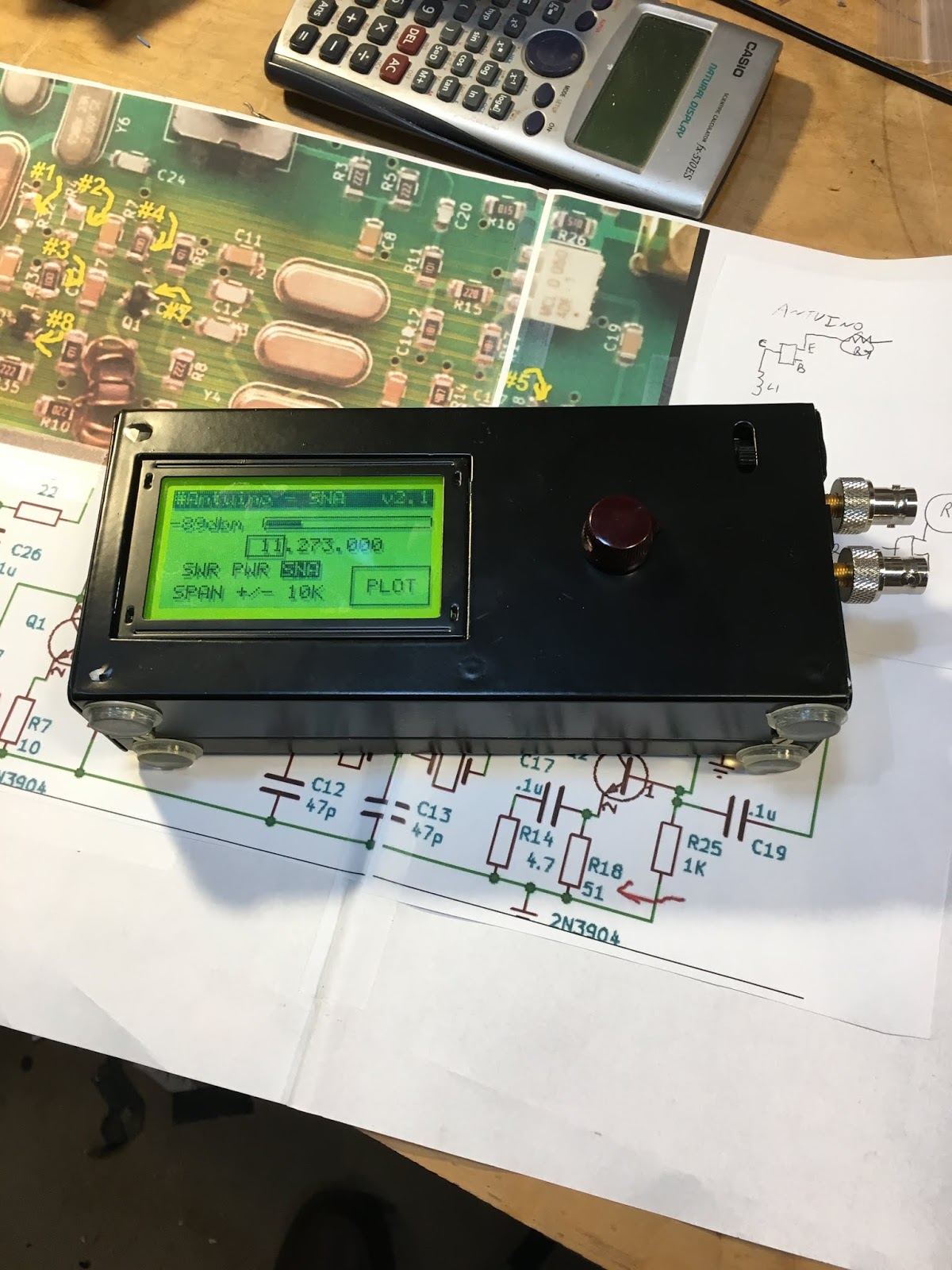
Farhan had given me one of the early Dayton Hamvention models of the Antuino SWR/PWR/SNA RF test lab. He later identified the need for a few mods to improve performance on that early model. So I brushed up on my surface mount soldering, got the needed (tiny!) parts and made the mods. I also put the battery pack inside the box and put some feet on the Antuino cabinet (it just seemed like the right thing to do).
Antuino has already proven to be very useful as an SWR analyzer. I know have a much better understanding of the SWR bandwidth of my wire antennas.
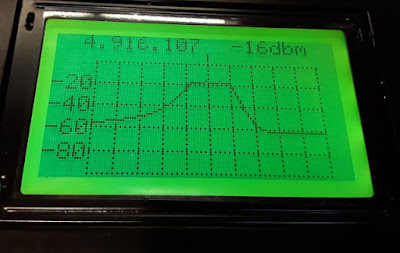
And it is very useful in evaluating the passbands of filters. I had an old 11.273 MHz filter from an old CB radio in my junk box. I have no specs on this device — I didn’t know what impedances it was designed for. So it was time for some Antuino technical detective work.
First, take a look at the filter with nothing between it and the Antuino. Input and output on the Antuino are 50 ohms, so here is what the passband looked like with 50 ohms:
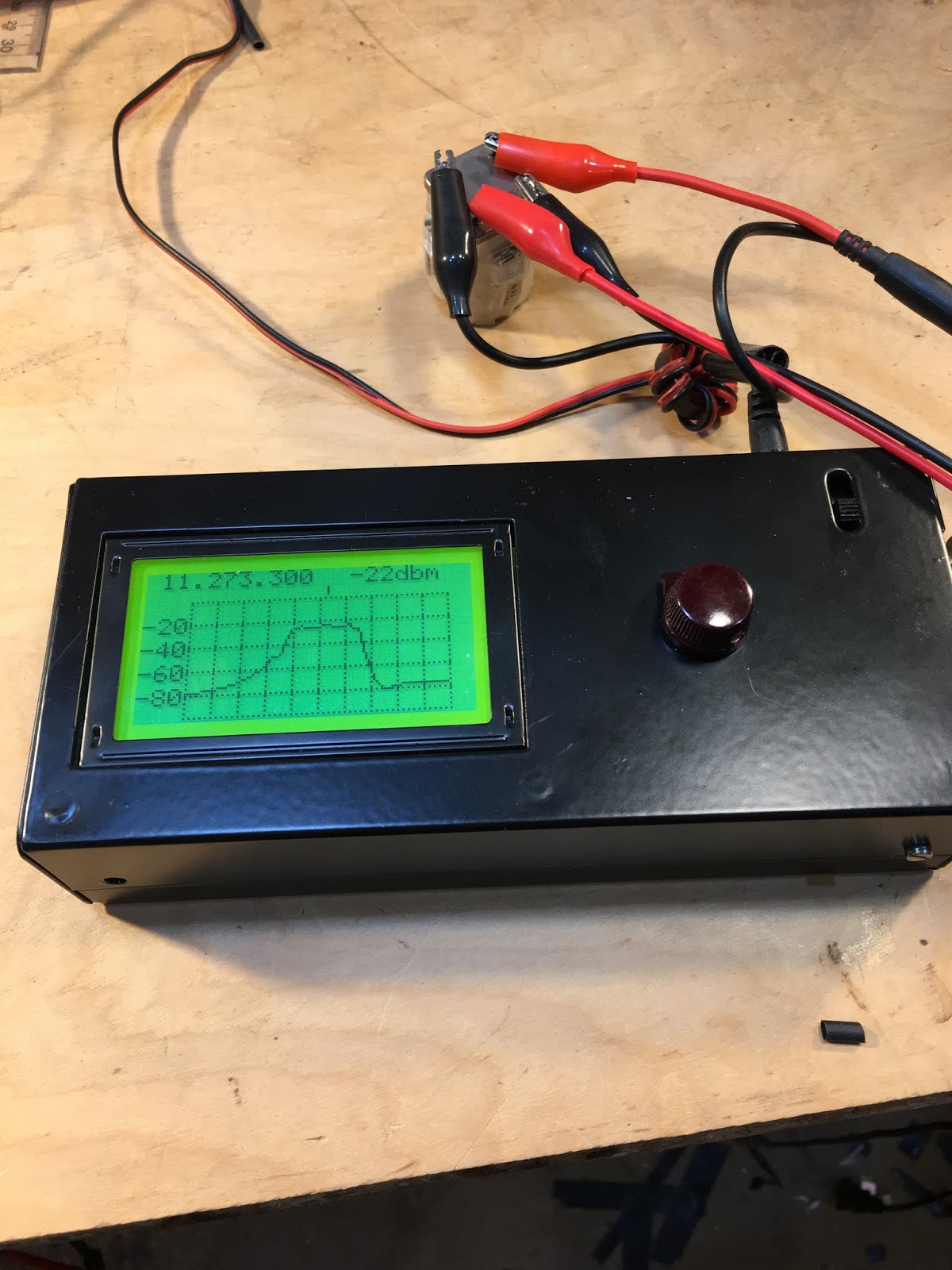
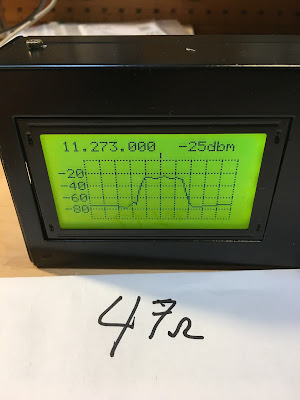
Next I put in two 47 ohm resistors, one in series with the input, the other in series with the output. Antuino connected at the other side of each resistor. Here is what it looked like. Note the improvement in skirt shape. But there is still a lot of ripple in the passband:
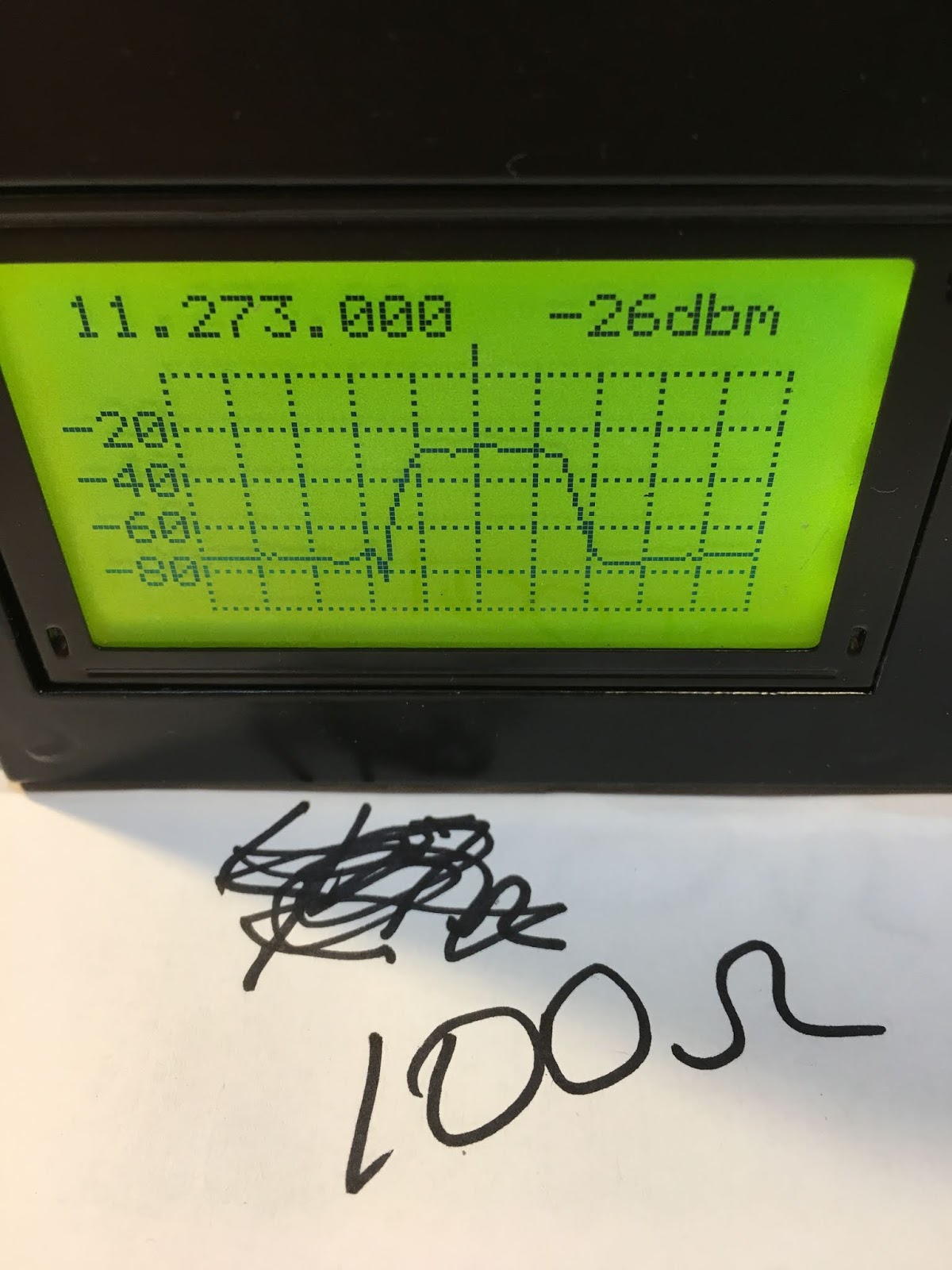
Then I went to 100 ohms. The passband ripple was reduced noticeably:
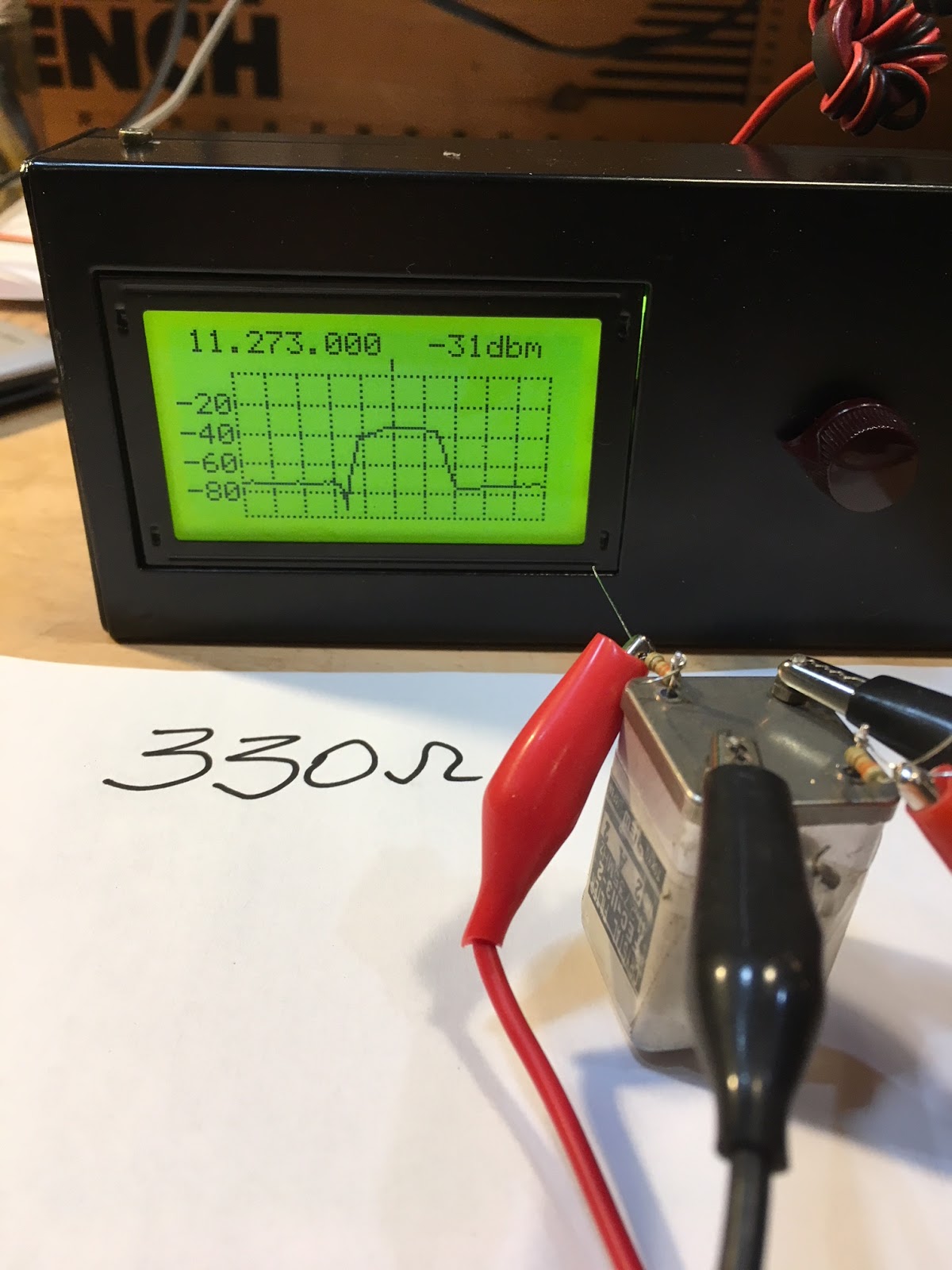
Then up to 330 ohms. Here the passband doesn’t seem quite as flat as it was with 100 ohms:
Finally, 1000 ohms. Definitely too much. Note the ripple.
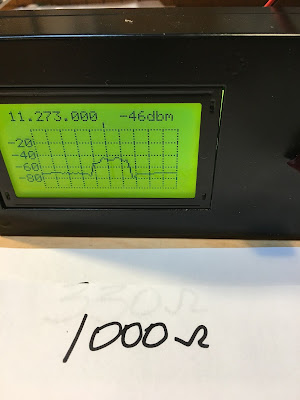
Farhan prefers the passband with the 100 ohm resistors. I agree.
BTW the filter is from TEW of Tokyo, Japan. Model FEC-113-2 11.2735 MHz No. 2 A 2
It had three crystals on the board with it: 11.275 and 11.272 — these are obviously for LSB and USB. The third crystal is at 11.730 MHz, indicating to me that they had a second IF of 455 kHz in this rig. If I use it, I think I’d stay with single conversion. At 11.273 MHz the filter is of ideal passband width for SSB. I do feel the urge to build something around this filter.
Doing the mods on the Antuino was fun, and having worked on the device at least a little bit I feel more of a connection to it.
VK3HN’s Inspirational AM Receiver (video)
I’m always delighted when I check the SolderSmoke blog and YouTube list (right hand column of the blog) and find a new post from Paul VK3HN. And this morning’s post is especially good.
Paul has built an AM receiver. Above you can see his video. Here is his blog post with details:
https://vk3hn.wordpress.com/2019/12/06/8-band-superhet-am-receiver/
This is the kind of blog post that makes you want to heat up the soldering iron and start searching through the junk box. I’m thinking about putting Paul’s 6 kHz filter in my 40 meter HRO-ish receiver. And I may make use of his AM detector circuit. And maybe I can put that same receiver on 75 and 160… And then there are the SW broadcast bands… See what I mean?
Thanks Paul. 73
SolderSmoke Podcast #214 is FINALLY out!
WE ARE WORKING TO IMPROVE THE AUDIO QUALITY. IN THE FIRST RELEASE OF THIS PODCAST SOME OF THE AUDIO WAS KIND OF MUFFLED. I TRIED TO FIX IT THIS MORNING AND I THINK I MADE SOME IMPROVEMENTS. THE IMPROVED AUDIO IS NOW AT THE LINK BELOW.
4 November 2019 (shockingly late!)
http://soldersmoke.com/soldersmoke214.mp3
The visit of Farhan to Northern Virginia
“I heard this guy from Southern California on 20…”
Fire Report from Pete
Pete’s Bench Report
“When you know stuff, you can do stuff!”
The CRAP rigs
Old Boatanchors — the Swan 120 with SUPER STABLE ANALOG VFO!
Ten Tec rigs dial cord replaced with Chinese digi sig counter
Pete’s 500 mW encounter with a QRO curmudgeon
The ZL2BMI Challenge has Pete building crystal filters
The Left Coast Loafer CW rig
Bill’s Bench Report
ET-2 Refinements
N0WVA’s Regen Receiver
Going from ET-1 to ET-2
J-310s vice MPF-102
100 mW from a single J-310
Receiver kind of deaf -103 dbm MDS
10 contacts so far in 9 states
THREE contacts yesterday.
Worked Wisconsin – 633 miles on 92 mW
We are at sunspot minimum.
“Rage, rage against the dying of the light.”
Simplicity is the real reason for CW
IDEA: Get those Michigan Might Mites on the air!
Use Reverse Beacon Network to see if you are getting out
Use SDR receivers to make contacts
MAILBAG
DL1AJG
KC6SAX
W9VNE
KA4KXX
N0WVA
Zl2BMI
AJ6BD
The Collins Mechanical Filter — An Advertisement from Australia, 1963
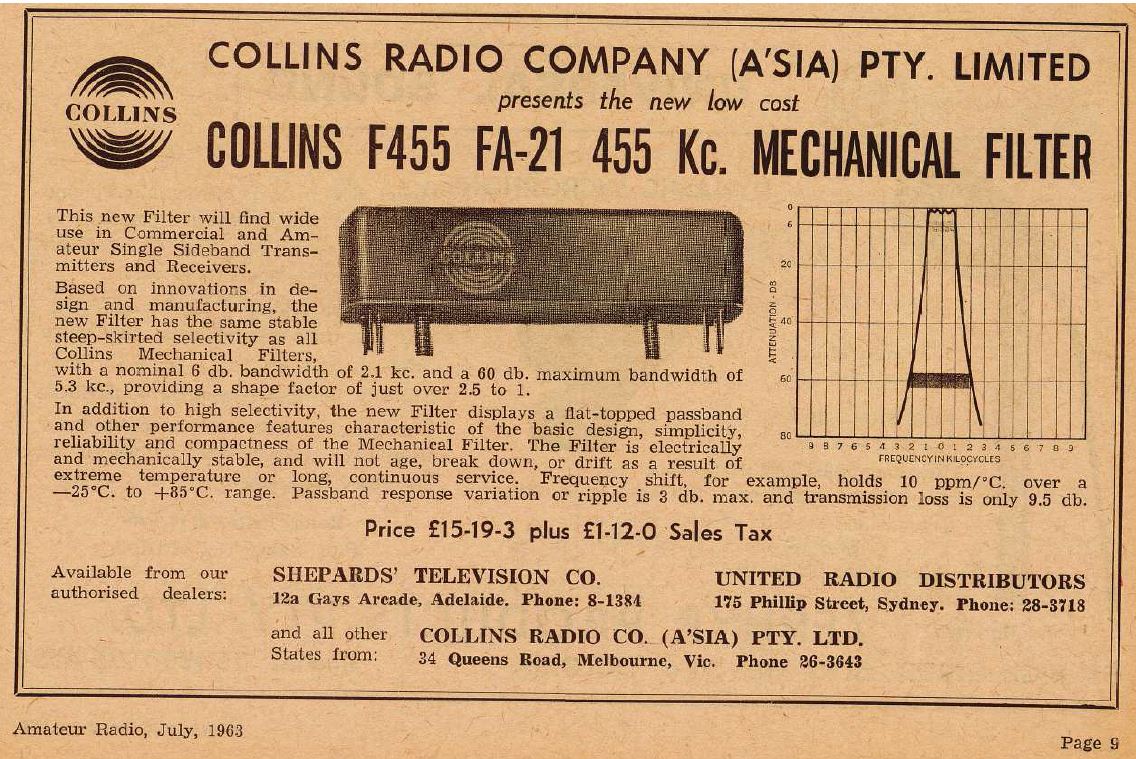
Peter VK2EMU sent me this ad a while back. He said he regretted being unable to send a filter — all he could send was the ad. Thanks Peter — I think that ad is a work of art. Radio art.
Thanks too to all those who sent me mechanical filters. Pete sent the first one (it is currently in my HRO-ish receiver), then two more (both inside SBE transceivers, where they will remain — it would be a sin to cannibalize those beautiful rigs.) Then Mike Herr WA6ARA sent one as did Brad. Brad assures me that the one he sent was boxed up by Art Collins himself!
Thanks again guys.
Brad wrote:
Jun 23 at 7:49 AM
Kudos to Pete for 60 years! And I’ve always thought he was much younger than you……
Catching up on your podcast, I was surprised to learn that no one answered your call for a spare filter.
I’m one of those older guys who is making his way back after leaving amateur radio in 1968 for girls and/or recreational drugs.
No one told me that The Force (electro-motive, that is) would require me to catch up on all the junk I would have acquired during my nearly 50 years away from the hobby (see list below).
A recent impulse purchase, the most beautiful thing with tubes ever made (SX-42), happened to be near Newington. On the way home I visited ARRL HQ hoping they had some sort of a chapel where I could perform an act of penance and ask for guidance in dealing with my affliction. Apparently, this is the equivalent of asking a crack dealer where the closest Narcotics Anonymous meeting is held. I ended up buying a copy of “200 Meters and Down” and have since acquired a couple of Atwater Kent projects.
My place is full now, and my sweetheart would like back the half of her garage I’ve slowly taken by electronic eminent domain. It seems that for every 100 pounds that departs to a ham fest, 125 pounds comes back. Is this considered a normal ratio?
In order to be able to tell her that I have, indeed, gotten rid of something, I’ll be sending you a F 455 filter (QRZ address OK?).
Thanks for you help,
–Brad
W4AMV’s Beautiful Receiver
Hi Guys,
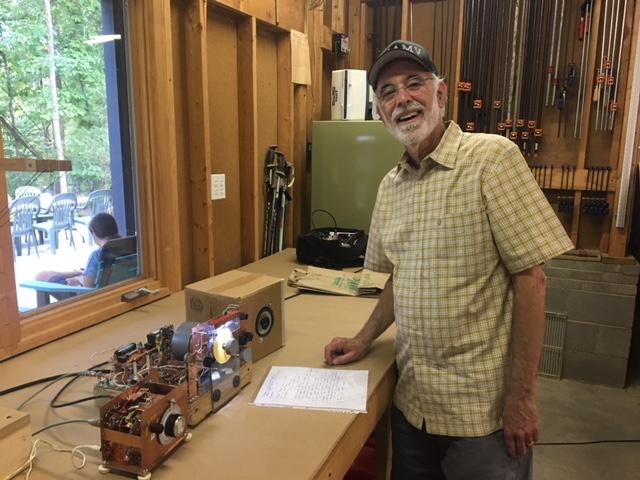
We had our Knightlites annual BBQ this past Saturday. I wanted to share one of the radios from one of my Elmer’s, Alan Victor W4AMV.
Pictured is him standing beside the preselector and receiver.
I hadn’t ever heard a Collins mechanical filter vs Murata crystal filter side by side. The Collins was amazing. Single signal extracted from the band. The rig is line powered with a built in power supply.
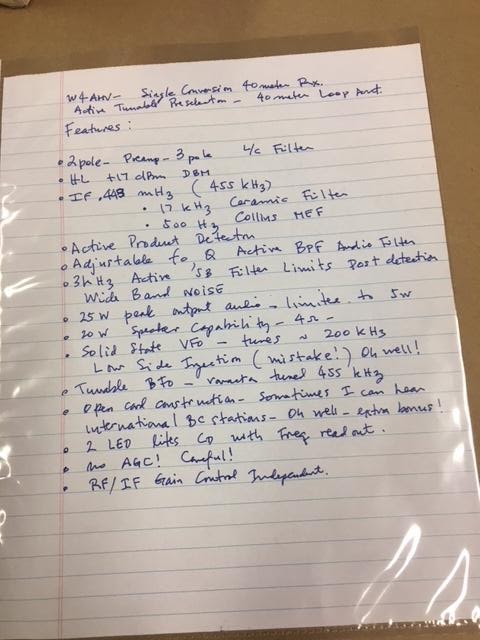
There is a note (pictured) that has some specs.
Alan’s work is to be savored, true analog engineering at its best. I wanted to share it with you.
Chris
KD4PBJ
————————————-
FROM W4AMV’S QRZ.COM PAGE:
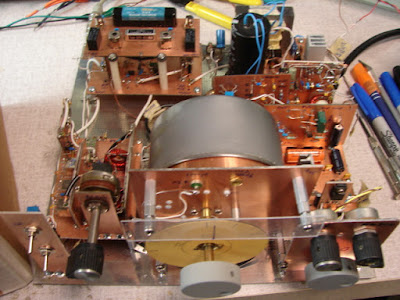
Here is a receiver that started out as a regen for the grandkids to copy code.
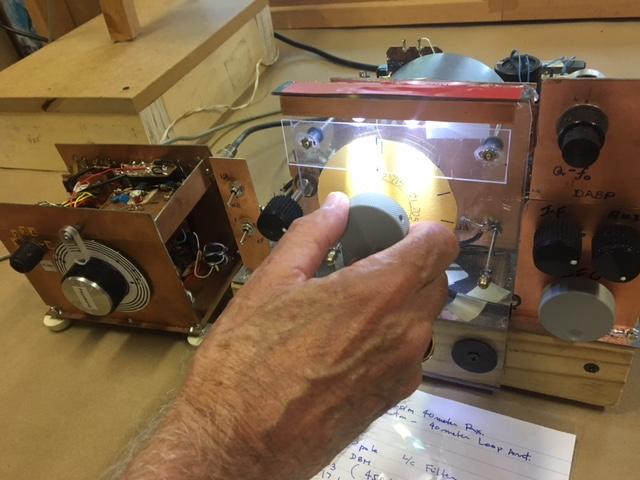
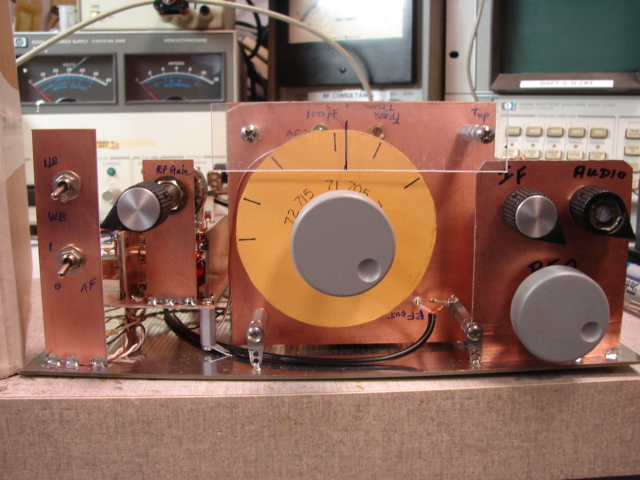
Digging through the junk box un convered parts that I forgot I had. Included a wide and narrow band set of filters. So, the unit wound up as a single conversion superhet. A fun radio to build as well to listen. The wide band filter provides super fidelity on sideband as well uncovers plenty of CW signals within a 10 kHz bandwith of the tuned frequency. A switch to either a 800 Hz audio filter or a 500 Hz CW filter permits focus on a single signal. I was going to package the whole unit, however I was prompted to leave it OPEN to show what makes it tick!
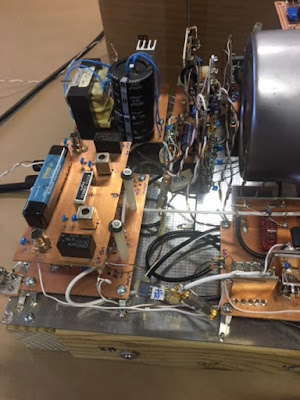
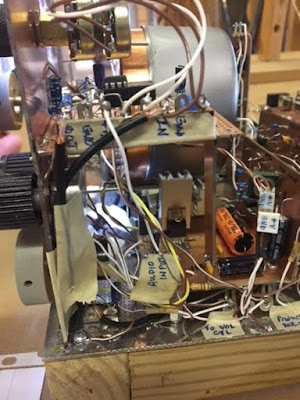
Left side front is the RF preselector, mixer and pre amplifier with RF gain control. The rear double deck card is the IF and selectable wide and narrow band filters. The IF and pin diode IF gain control is bottom deck. The HF VFO is center stage with a 6:1 gear reduction. Right rear is power supply and voltage regulators. The active product detector and a BFO is just to the front of the power supply. The BFO is able to tune product detector output over a full 10 kHz of the IF. And finally the audio filter and 5 watt power amplifier. There is no AGC. Instead it is FUN to control every aspect of gain control of the receiver; RF, IF and audio. Its a fun receiver to operate, dedicated to 40 meters and hopefully will spark the kids!
Going forward a receiveing station is setup to copy code. Although a nice long high wire would be proper, I settled on something a little more compact. A 40 meter small loop, 2 turns, about 18 inches on a side is connected to the preselector thru a pickup wire. This arrangement works quite well. W1AW will knock the speaker off the desk if your not careful. However, rotation of the loop to the E-W knocks down W1AW to a whisper. The pix shows the little 25 W infinity speaker in a 8x8x8 inch cardboard box, works well and the single conversion receiver sporting a new front plexiglass panel is illuminated for evening tuning.
————————————————
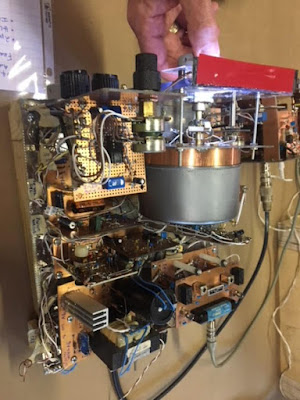
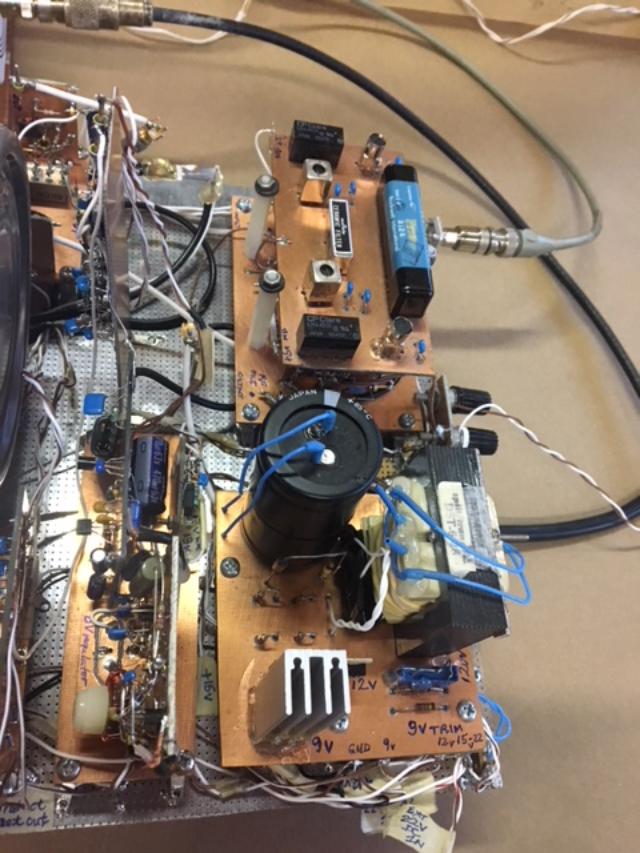
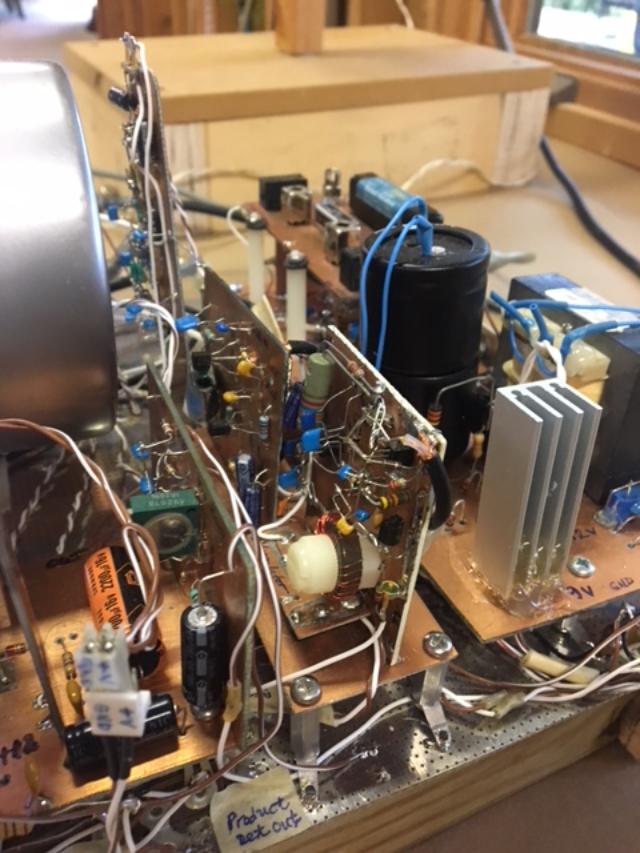
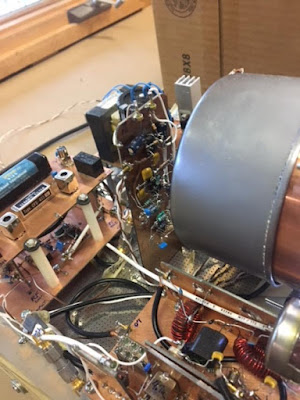
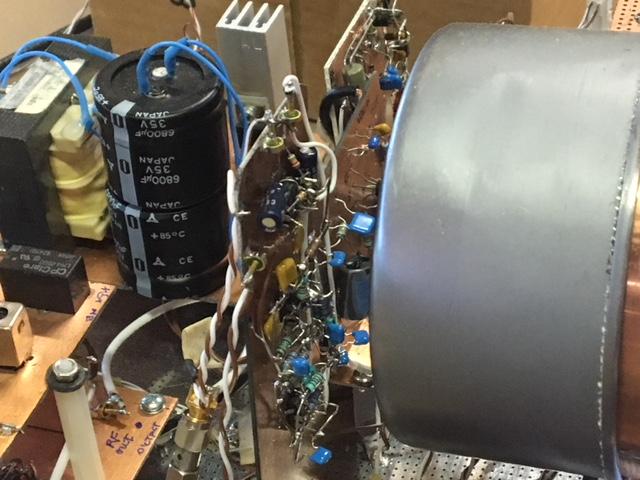
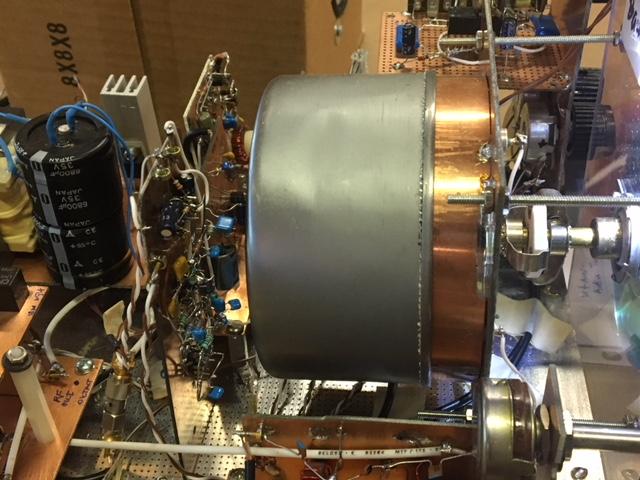
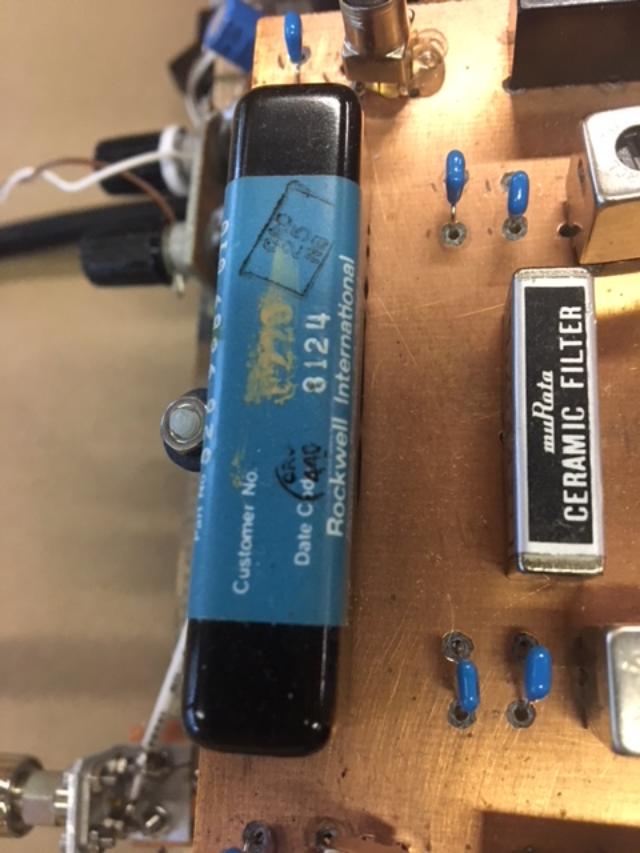
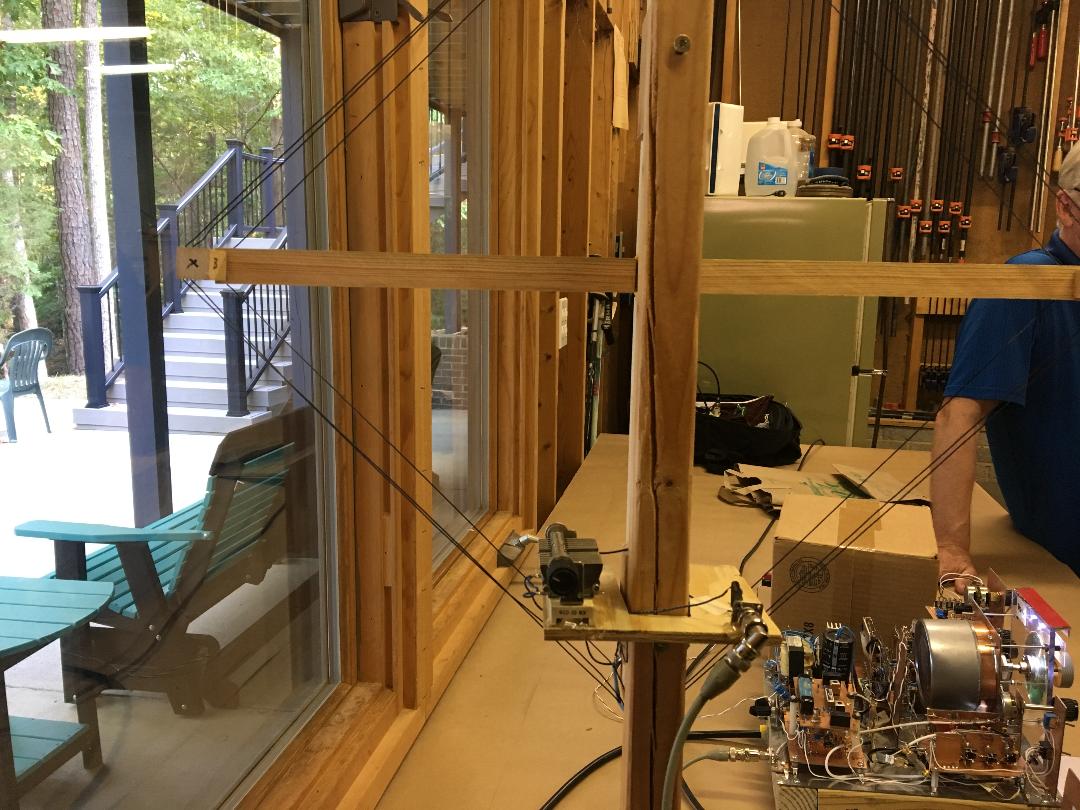
Loop antenna used with the receiver
A Beautiful Variable Capacitor (from Pete)
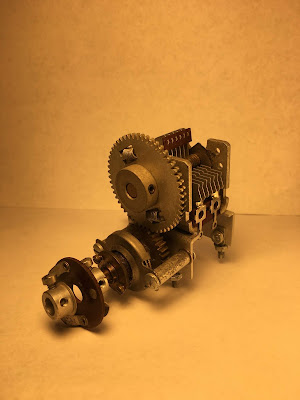
Is this a thing of beauty, or what? Pete sent this to me back when I was having trouble finding a “smooth running” variable cap for my HRO dial receiver. It has a standard Jackson Brother’s reduction drive attached to the shaft, followed by a really cool gear arrangement. Note the spring loaded teeth on the big gear — that is to keep the gears tight when turning in both directions.
As was the case with the HRO dial that Armand sent me, the beauty of this part will cause me to build something with it, really just for the purpose of putting it to use. We’ve been talking about double or triple conversion superhets with 100 or 50 kHz final IFs. At those frequencies you can get good selectivity with LC filters. As with the Drake 2-B. Steve N8NM is sending me a dial that will go well with this part. That will add to the already abundant mojo/juju. I feel a VFO in the works. Thanks to Pete for being so supportive of my luddite analogism.
DISAPPOINTED! No Takers on Mechanical Filter Question! SAD!
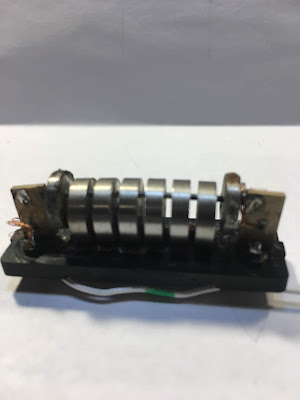
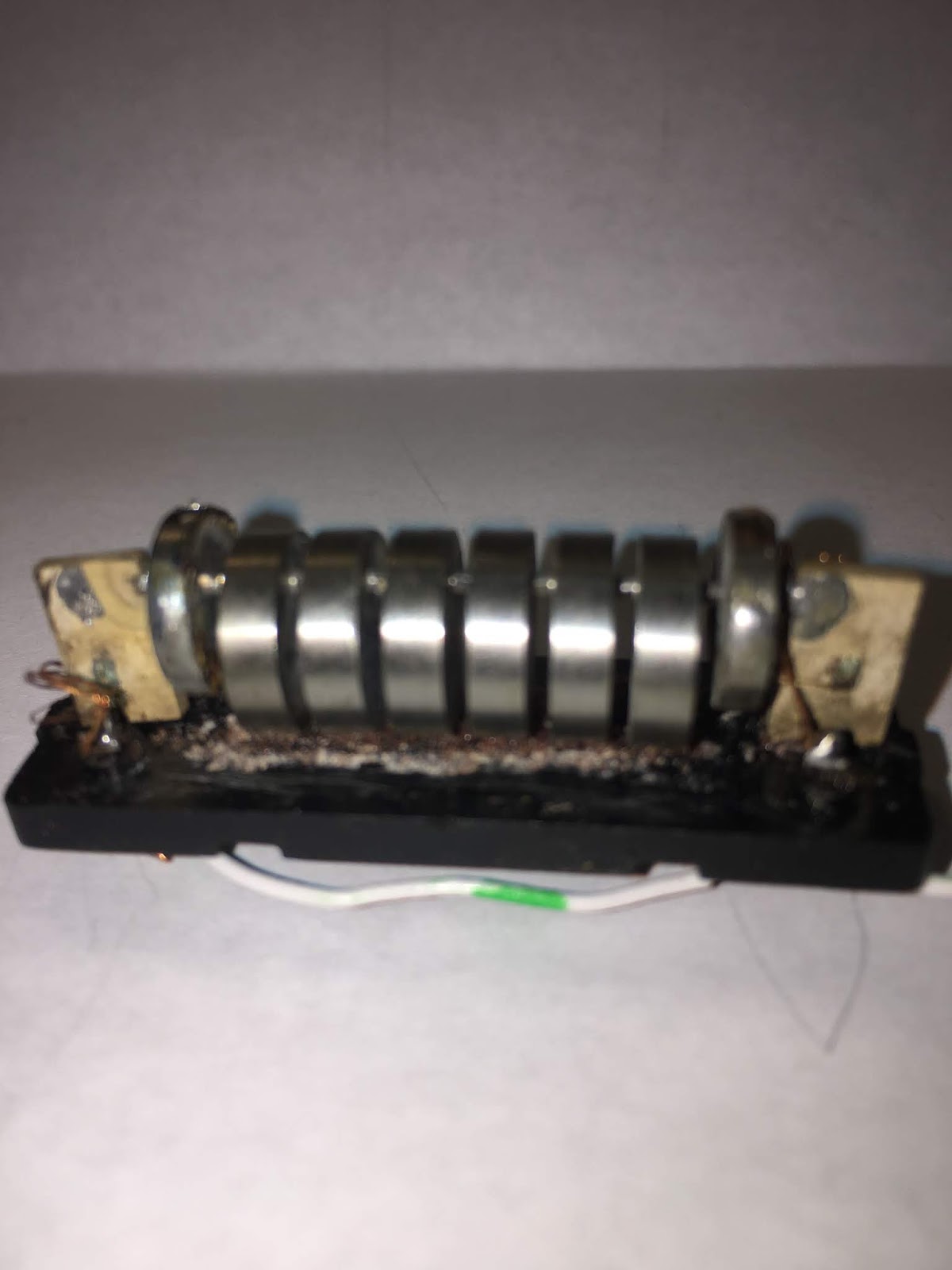
So, in our last podcast I asked the group to take a look at two pictures of a mechanical filter that I had recently taken out of its case. These pictures appear above and below. After a discussion of magnetostriction, I asked the group if they could spot anything unusual about this particular device.
I expected many responses. What did I get? CRICKETS!! What is wrong with you guys? Are you spending so much time with software and FT-8 and lines of code that you can’t deal with a simple analog question like this? SAD! I guess I will have to answer the question myself. Scroll down.
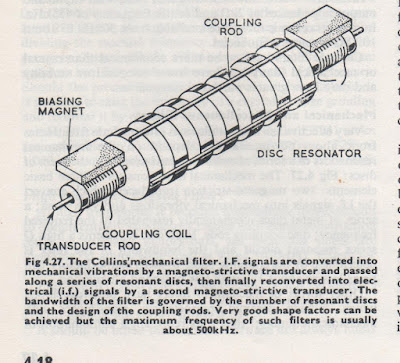
The diagram below presents the conventional Collins arrangement for a mechanical filter. Note that at the input and at the output there is a coil. This coil creates from the signal a varying magnetic field. Because of the principle of magnetostriction, this field causes the resonators/rod assembly to flex and vibrate, much like a musical tuning fork. At the output, this means that inside the core of the output coil there is a piece of metal vibrating at the signal frequency. This will produce an output signal.
But take a look at my little mechanical resonator. Where are the input and output coils?
THERE ARE NONE! See those little rectangular things at either end? Those are piezo-electric crystals that are MECHANICALLY connected to the disc/rod assembly. So when the signal comes in, it is applied electrically to the piezo material which then physically vibrates. This vibration passes through the filter and to the piezo device at the other end. There the mechanical vibration results in an electrical signal at the output.
So, I think it is time for you all to hang your heads in shame. Perhaps go to the doctor to see if you still have The Knack. Ask for forgiveness from the radio gods.
SolderSmoke Podcast #210 Boatanchors, Magnetostriction, VFOs, AM, CW, SSB, Mailbag
2 March 2019
SolderSmoke Podcast #210 is available:
http://soldersmoke.com/soldersmoke210.mp3
Alexa, Marie Kondo, berets, and ham radio
Bi-Coastal Boatanchors
BATTLE CRY: The Vintage SSB Preamble! “We are NOT ashamed!”
Bill’s HT37 and Drake 2B
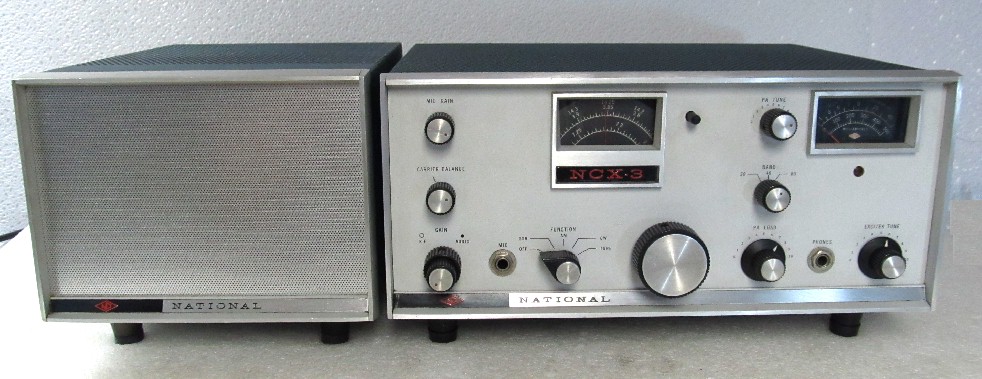
Pete’s National National NCX-3 TRGHS
Mechanical Filters
Magnetostriction
Why did Collins go with mechanical vice crystal filters?
The foam deterioration syndrome in mechanical filters. Sad.
Please send any unwanted Mechanical Filters to Bill.
BONUS QUESTION: Look at the filter below. What is different/special about this one?
Pete’s antenna trouble
Pete’s FB amplifier troubleshooting
Recent improvements in the uBITX finals
Pete’s design for a VFO for Bill (and an indoor antenna tuner!)
Bill’s VFO for Pete: HRO dial and gearbox driving a rotary encoder
Guido PE1NNZ puts the QCX on SSB
“The Secret Life of Machines — Radio”
HB HRO dial from DL6WD
WA1QIX’s USB D-104
“The High Frequency Oracle”
DeMaw’s LC filter receiver
Godzilla and Ham Radio
Bill’s poor quality SSTV images from space (what happened?)
Listening to AM on an SSB receiver
Mixed feelings about CW
MAILBAG
M0KOV’s mom took him to the doctor due to THE KNACK.
M0JGH getting married (ALWAYS LISTEN TO PETE!)
Jac’s FB Receiver
What is different/special about this one?
Pete’s Latest SSB Transceiver — And Lots of Wisdom on Homebrew Phone
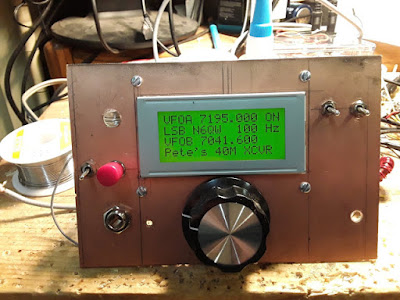
Don’t miss Pete’s latest blog post decribing his most recent SSB transceiver.
http://n6qw.blogspot.com/2019/02/2019-building-ssb-transceivers.html