Carpentry and Socketry for the uBITX

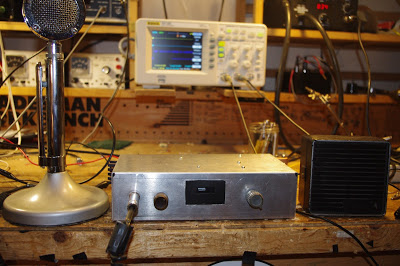
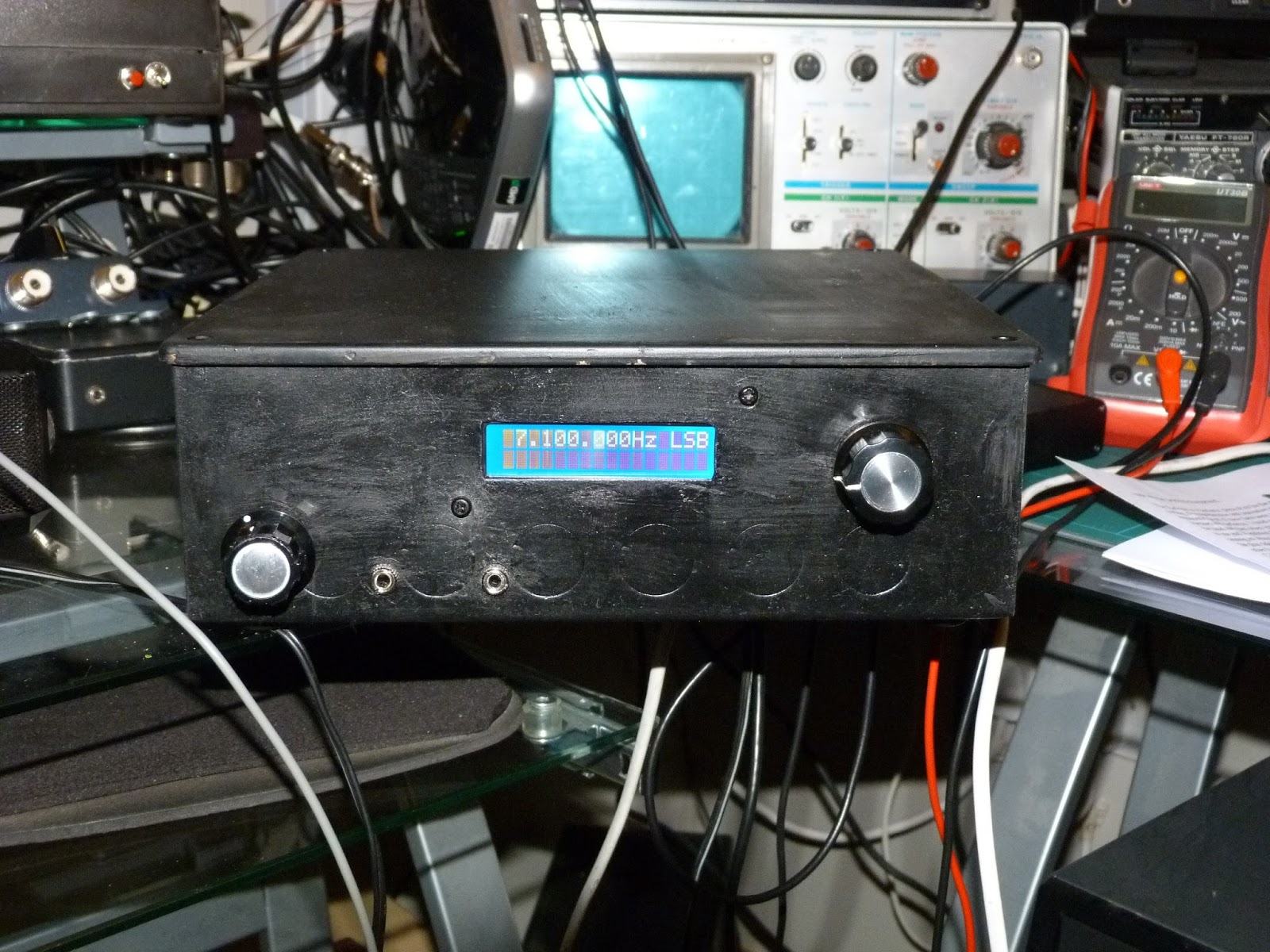
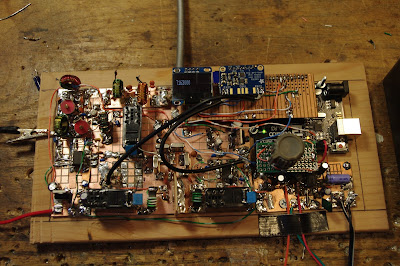
Yesterday I decided to spend some time at the bench — I wanted to get the uBITX boxed up. My basswood box had arrived from Amazon on Friday. It was time for what George Dobbs G3RJV called “socketry.”

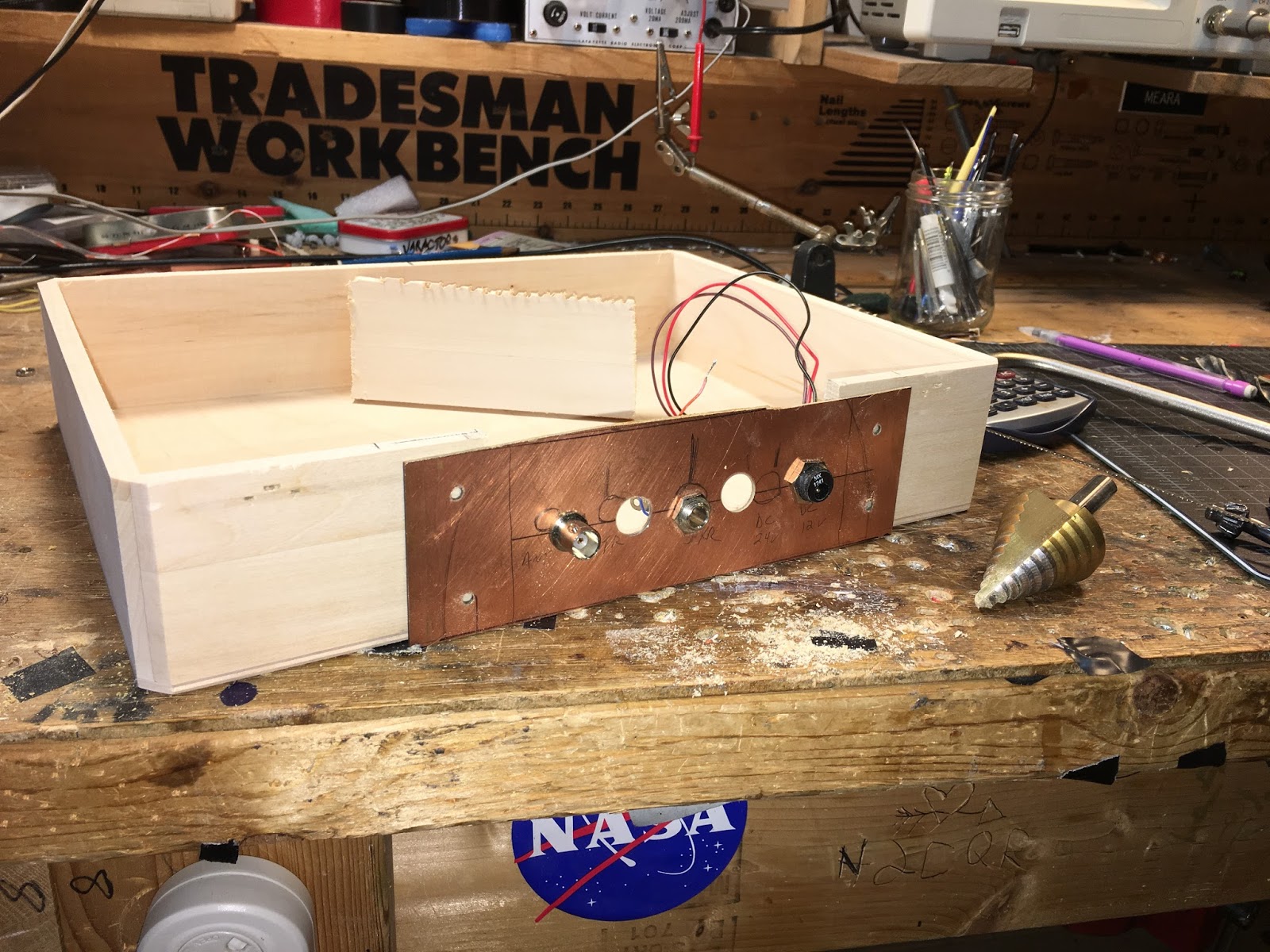
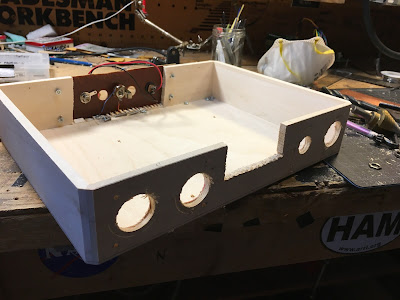
First, the back. I figured I would need five connectors back there. Connectors for 12V DC, speaker, and antenna would be needed right away (it is my preference to have the speaker connector on the back of the BITX). Looking ahead, I might want to also have a jack for T/R control of my linear amplifier, and a jack for 24 VDC if I want to go wild and put more voltage on the drains of the IRF510s. So I put two extra holes in there.
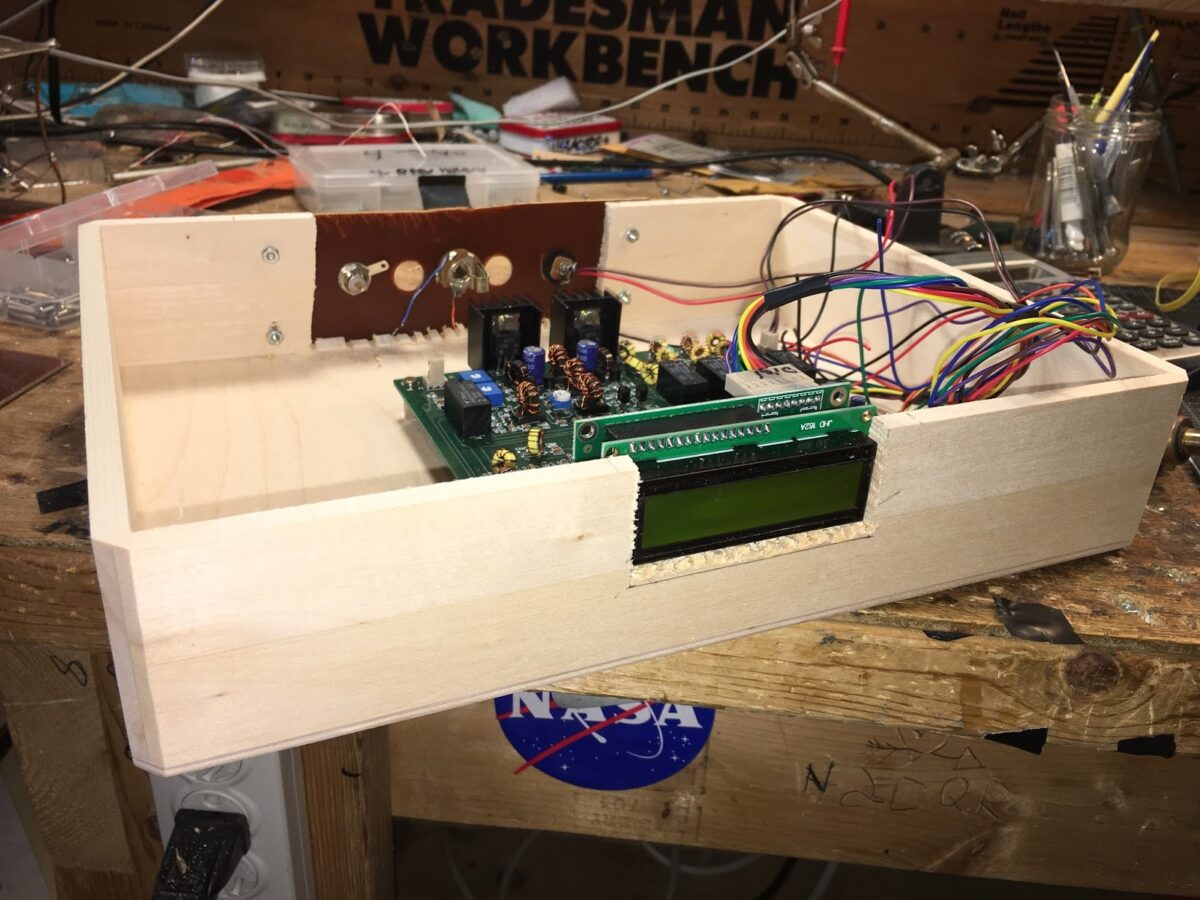
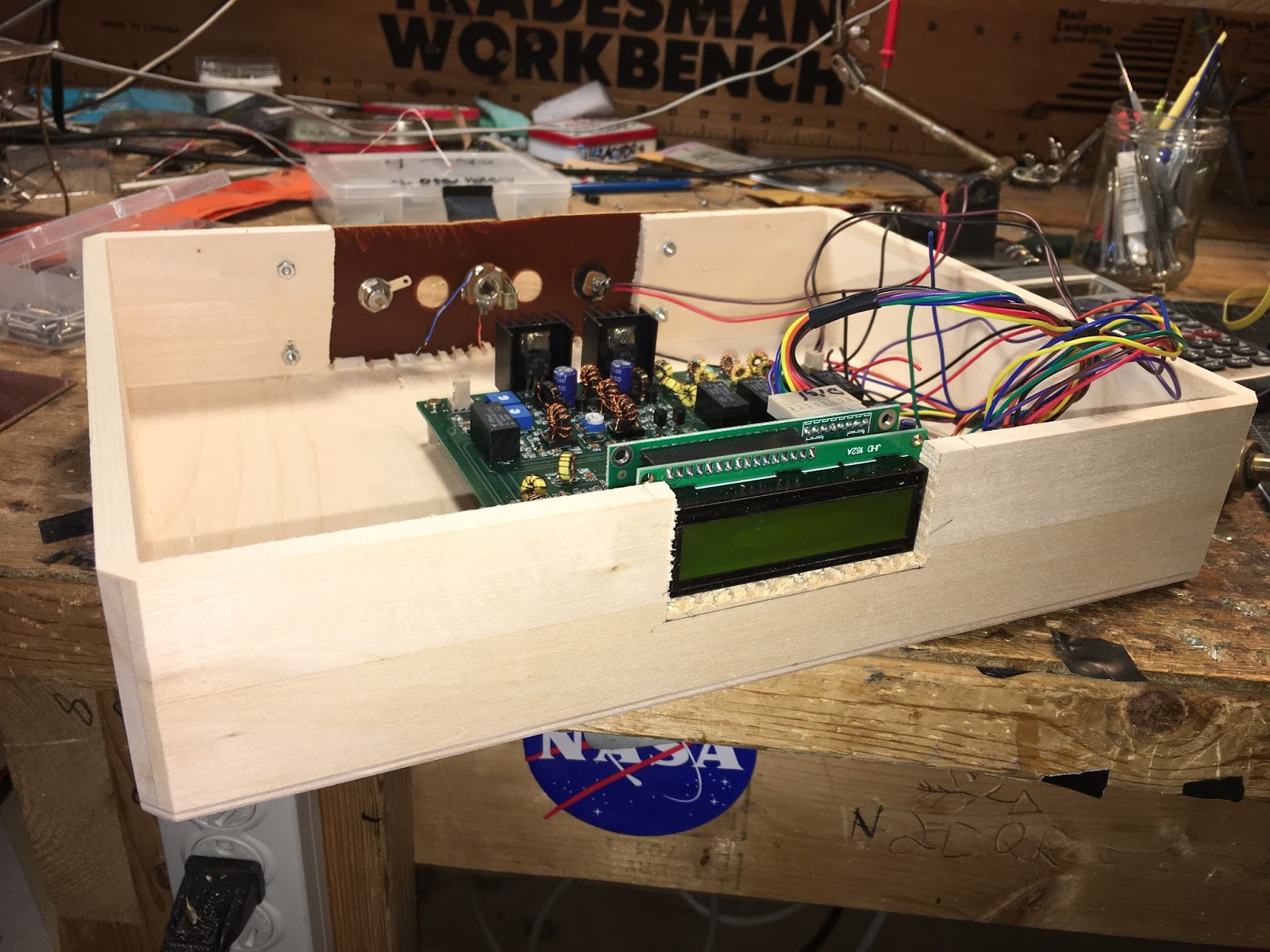
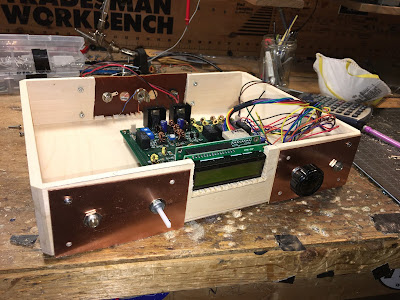
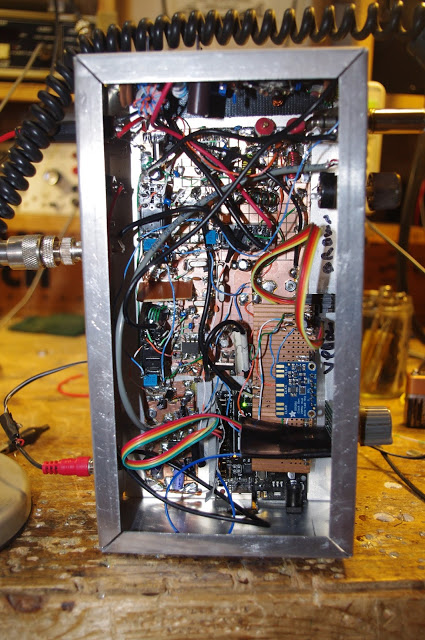
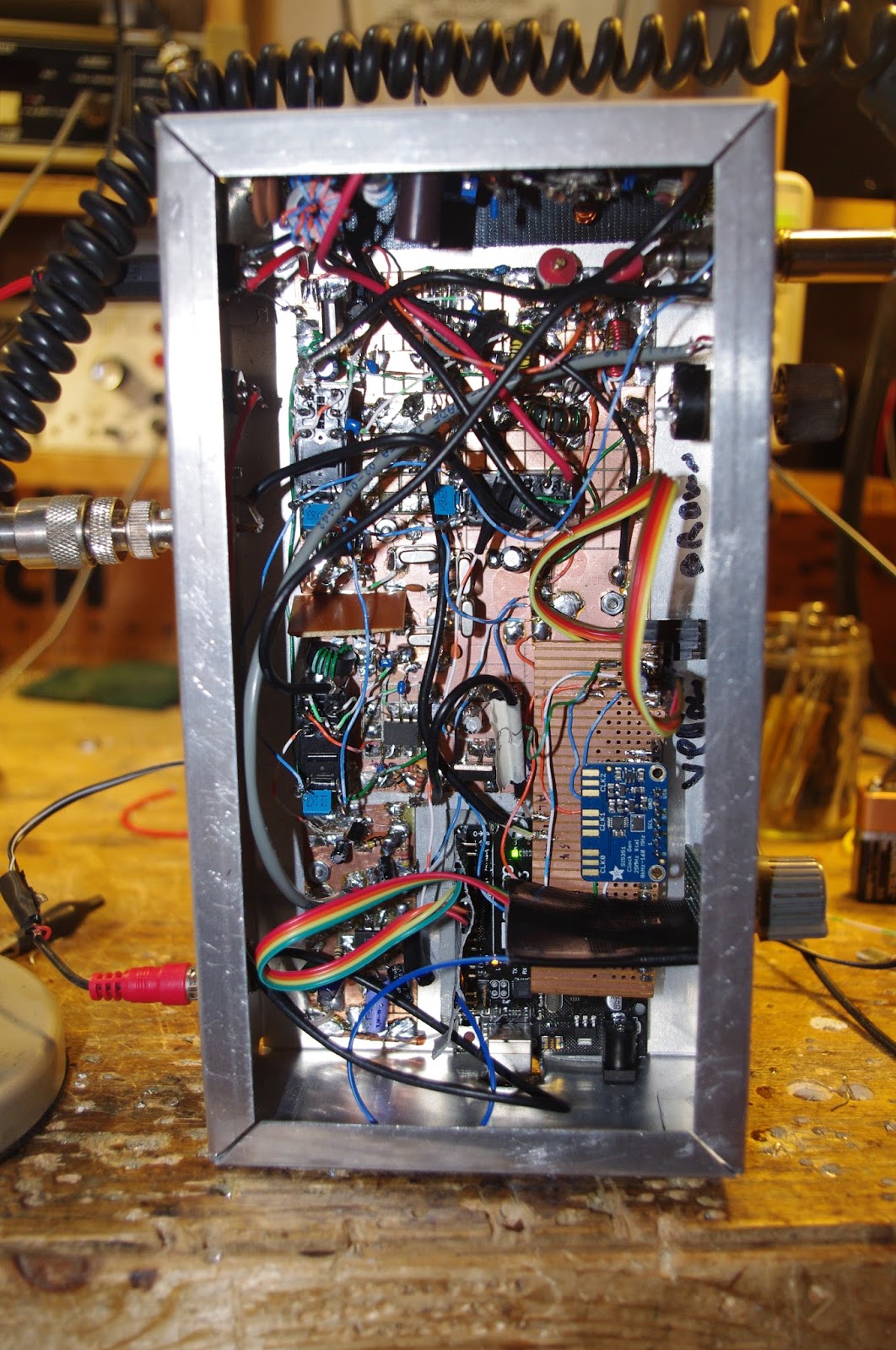
Basswood is SO easy to cut. I put the LCD in the center of the front panel, and opted to put the board close to the front of the board. This avoids the need for jumpers to connect the Raduino to the LCD, and it keeps the lines to the front panel controls and connectors very short. I mounted the board on the spacers that came with the BITX, drilling holes the bottom of the basswood box. It all fit quite nicely.
I would need to put two jacks on the front panels: key jack and mic jack. And I’d need two controls: main tuning and AF gain. I used hole saws to cut holes big enough to accommodate the four items.
The controls and jacks were then placed on two small pieces of copper clad board. These then went on the front panel.

Wiring up the uBITX was easy. I just followed Farhan’s instructions. I did the wiring AFTER placing the boards and controls in the box — this helped me keep all the wires at their optimum length (not too long, and more important — not too short!). If you do it this way, put a cloth over the boards so you don’t drop solder blobs on the uBITX.

Farhan’s uBITX fired up nicely as soon as I applied power. The receiver really sounds nice. I hope to make some contacts with it today.

Three cheers for Farhan!

Boxing up my uBITX — Question for the Group

Our friend Rogier and I are involved in an East Coast — West Coast uBITX launch project — we plan to assemble our uBITXs together (more or less, via Skype) and then get them on the air.

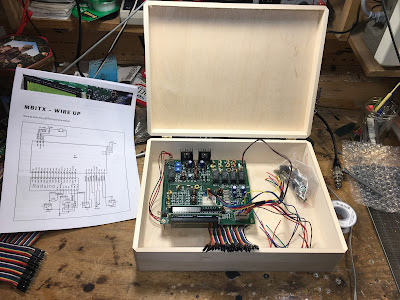
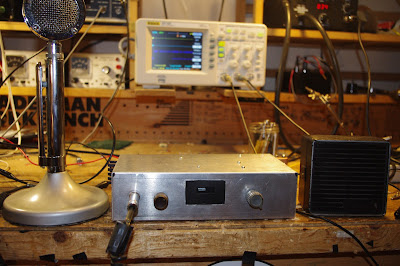
As has been my recent practice, I have opted to put my uBITX in the same kind of wooden box that I used for my three scratch-built BITX projects. See above.

Now, due to Farhan’s wizardry the uBITX is considerably smaller than the box. This is, of course, a good thing. It leaves room in the box for many bells and whistles.

But here is my first box design question


Should I put the uBITX board to the front of the box so that the LCD can be connected to the board DIRECTLY via the connector on the Raduino board (no jumpers needed), or should I put the uBITX board to the back of the box so that I can stick the PA heat sinks out the back? In the later case I’d have to use 4 inch jumper cables to connect the LCD to the Raduino. This use of jumpers seems to increase the possibility of noise from the display.

What say the Knack Wizards? Back of the box with LCD jumpers, or front of the box with no jumpers but heat sinks inside the box?

WA1UQO’s Discrete Ceramic DC Receiver

Armand writes:

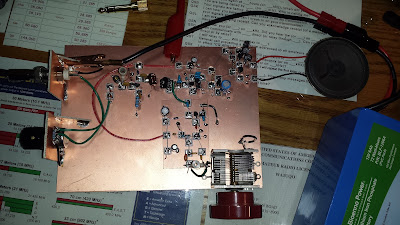
The attached picture is your DC receiver. A little tweaking left to do as the range right now is ~ 7.44Mhz to 7.032Mhz. I used one of Farhan’s trifillars and a couple of air coils that you gave me last year. Listening to the Wisconsin QSO party as I type.

FB Armand! The receiver looks great. I hope others will follow your lead and build this simple little receiver for 40.

iPhone Direct Conversion Receiver with Variable Ceramic Oscillator

A while back Bob N7SUR got us talking about winter projects. Receivers. Of course, Pete and I quickly went down different paths. Pete is making great progress with lots of interesting digital circuitry. He is going over to the dark side. Check it out here:

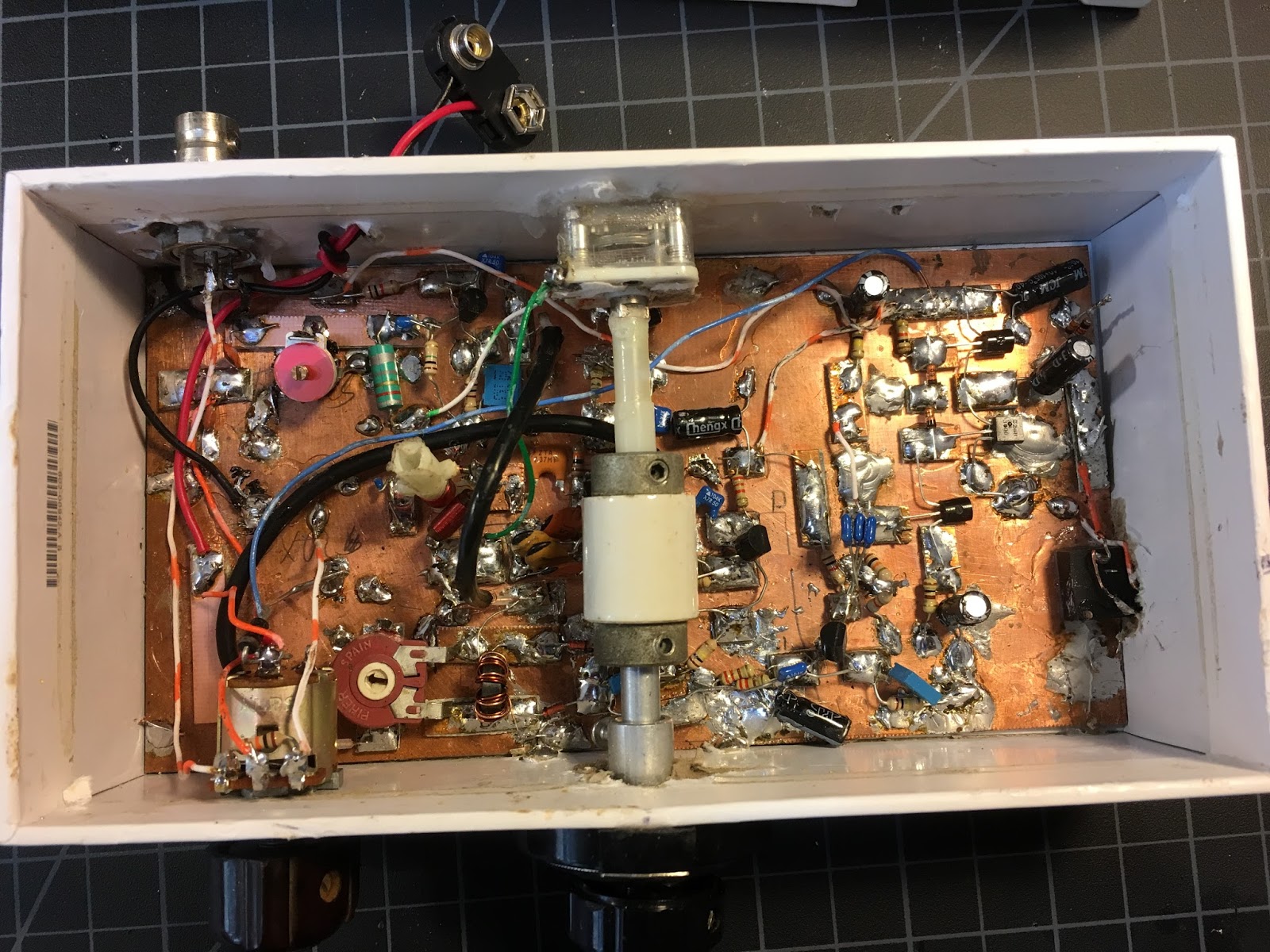
I went with simplicity. Extreme simplicity. Direct Conversion (thanks Wes!). Discrete components. No chips. Analog Oscillator. 40 meters — monoband.

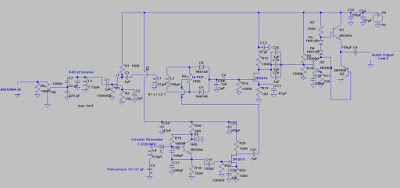
Schematic updated 29 November 2017
There it is. You can click on the picture to make it larger. Here is an outline of the circuitry:

— Single tuned circuit bandpass filter preceded by a simple pot that serves as a gain control.
— JFET RF amp
— Singly balanced passive mixer inspired by F5LVG’s RX-20 in SPRAT 100. For the coil I used one of the many trifilar toroids that Farhan gave me.
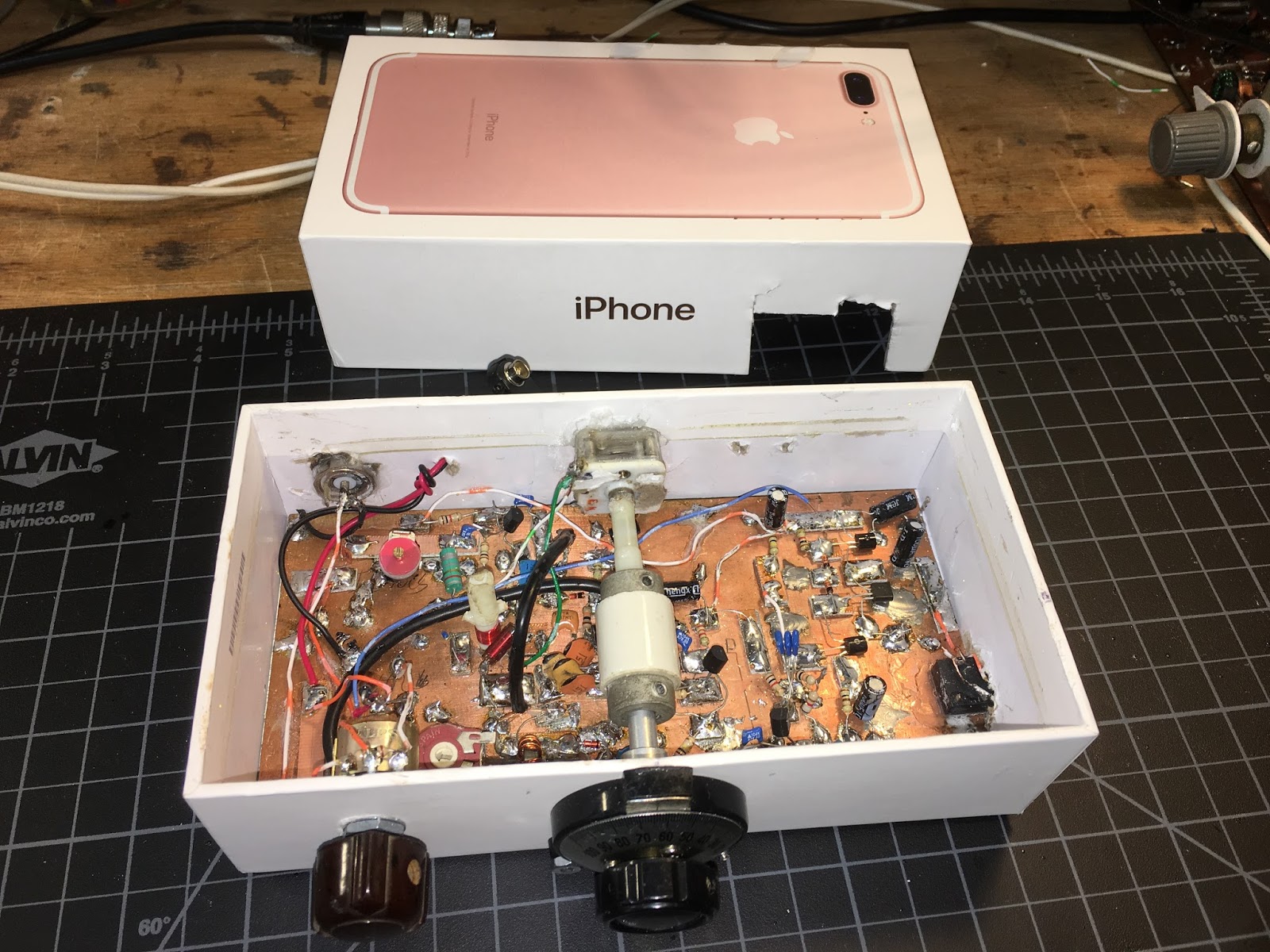
— The local oscillator is the coolest stage. I used a 7.37 MHz ceramic resonator and a circuit inspired by Miguel PY2OHH. With a polivaricon I can tune the entire 40 meter band. I put a reduction drive int here to make tuning easier.
— The AF amp is an op-amp free design. It works well into ear buds or into a computer speaker.
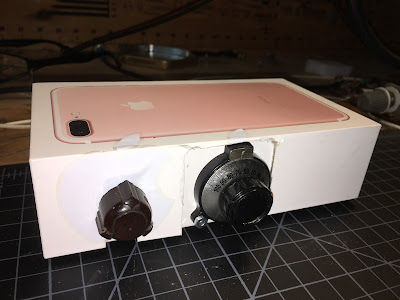
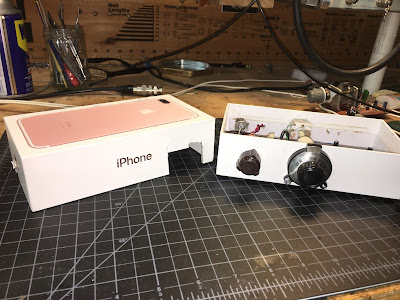
— Perhaps in an effort to catch the attention of the younger generation, I built it into an iPhone box.

Please let me know if you spot any flaws in the circuit, or see any places where it might be improved.

More to follow. This prototype is now in the mail, en route to my nephew John Henry who will be testing it for me.

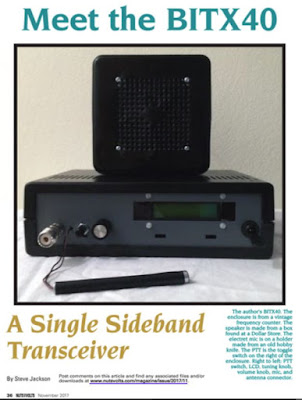
BITX40 Featured in “Nuts and Volts”

Congratulations to Steve Jackson and to “Nuts and Volts” for putting out a very nice article on the BITX40 transceiver. Steve did a great job in describing the origins of the BITX, and in explaining that Farhan’s intent is to encourage experimentation and tinkering. Pete and I had pitched a similar article to a major ham radio magazine but sadly they were not interested. Three cheers for “Nuts and Volts.” I’m thinking about subscribing.

I know many of you will wince when you see Steve’s unshielded mic cord lying right next to the front panel antenna connector, but please don’t freak out about this — in the article you will see that Steve acknowledges that the antenna connector would have been better placed on the back of the box. That’s an example of the educational value of the BITX40 — live and learn. Even with the connector like this, Steve was making many contacts.

The “Nuts and Volts” website very kindly let me read the entire article without a subscription.

Try here and click on the blue “digital edition” box:

http://www.nutsvolts.com/magazine/article/meet-the-bitx40-a-single-sideband-transceiver

Or try going directly here:

http://nutsvolts.texterity.com/nutsvolts/201711/?folio=36&pg=36#pg36

International Brotherhood and the BITX Rigs

Bore and Heriberto’s uBITX board

Nowhere is the International Brotherhood of Electronic Wizards more evident than in the work on the rigs designed by Farhan. With the BITXs we see rigs designed in India that are now being built and modified all over the planet. Here are just a few examples of the global collaboration currently underway:

In Italy, Giuseppe is putting a BTX40 on 20 meters and making it a dual bander:

Hi everyone, I just completed some tests on a Bitx40 running in 20 meters band. I addes the 20 as secondary band activate when needed. I apply some mods to switch to secondary QRPLab BPF filter centered to 20 meters and removed the C91 and C92 caps to work in USB. I done some RX tests in the weekend of iaru hf contest to listen some stations Active.
Here the issues registered:
1) the 20 RX sensitivity was a bit weak compared to 40 meters. I need to increase volume. ( To receive the 20 meters the vfo run to 26 MHZ, mybe some stage suffers of poor performance in this High frequency?)
I also tryed to increase the vfo over maximum allowed by raduino, using external buffer, but no results.
Please read the issues as: work but could work better!
2) the RX was not very clean: voice acceptable, but RX of Digital mode not very stable ( probably the cause could be the vfo shift for poor tuning control. I need to add lock function in firmware …) Or interferences for free wire of connection.
3) Sometimes when switch on or change vfo to other band or mode, the bf amplifier start a self oscillation …Resulting in my wife’s screaming (the tests were also performed during the night!)
No tests was performed at the moment in TX because i need to install the LPF for the new band.
The firmware to make the test was a modified version of 1.17.1, few temporary mods to preset the vfo b to 14 MHz USB and correct the freq. Display.
These my tests.
Giuseppe Callipo IK8YFW.
Pavel is a young fellow in Cuba who is doing great things with the Raduino software:

My Photo

Hi to all.
The code was updated, the change log is this:
v1.4Update to catch up with the features added in the Raduino v1.17.1 from Allard’s code (CW SPOT and bug fixes)
  • Upgraded the operations instructions
    • More user friendly version with embedded images.
    • Add instructions for the S-meter, AGC and TX-power mods details and tricks.
  • Moved all images to its own folder “images”.

As usual tips/bugs/comments/suggestions are welcomed, you can reach the code here: https://github.com/pavelmc/bitx40/

There is a inoffensive bug in the calibrate process, in which the actual calibrate value is not correctly showed in the LCD until you move the pot to adjust it, I’m working on it.
I’m slowly working in this direction now:
  • Bug removal in the calibrate function.
  • Finish the upgrade of the Si5351mcu lib with some improvements.
  • Adding CAT support via ft857d lib (https://github.com/pavelmc/ft857d):
    • Full compliance needs get rid of all the blocking delay() sentences and that need a structural/paradigm code change and a lot of testing (I have Fldigi/MixW/Hamlib to test, I think if that 3 works the rest will do it)
    • Moving to a library (yatuli: https://github.com/pavelmc/yatuli) for the pot usage, that will ease the process of implementing the CAT as almost all delay() calls are related to pot/clicks, so I’m on it.
    • Maybe implement a multiclick lib to optimize the code and make it more easy to understand.
Any thoughts or whishes related to that?

I plan to make the CAT operation optional via a #define declaration as not all of us will/want-to use that.
73 Pavel CO7WT


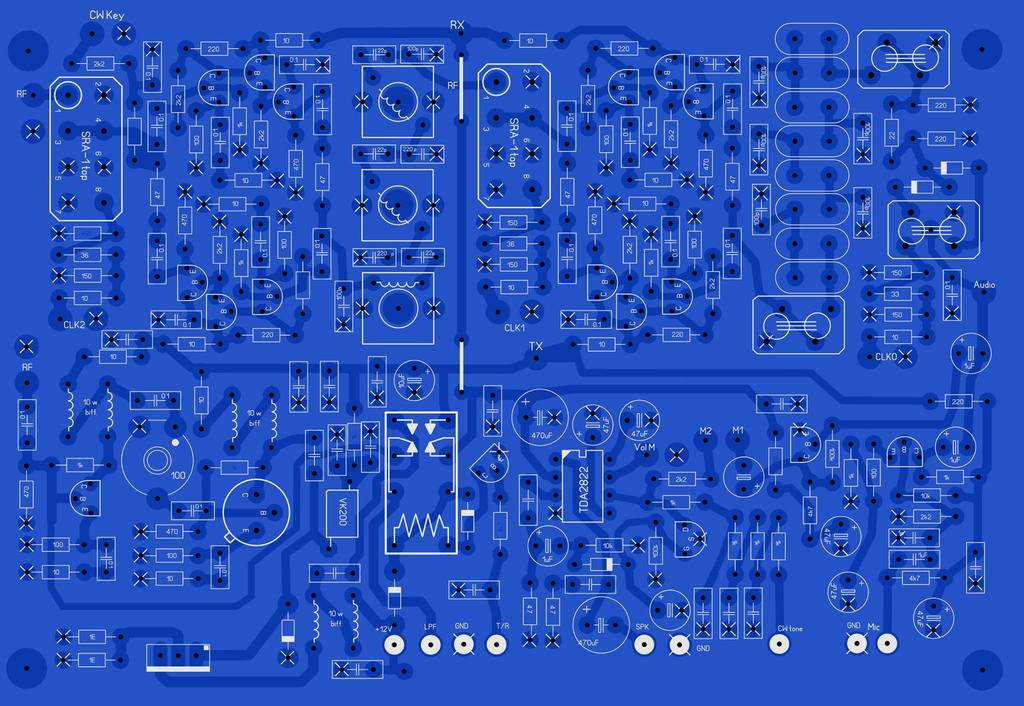
Here we see Bore in Montenegro working on a uBITX designed in Cuba by OM Heriberto

Hi Colleagues
Bore Lezaic from Montenegro is working on the uBitx PCB designed by Heriberto -CM2KMK- from Havana, Cuba
Here some pictures he(Bore Lezaic) have posted in my FB wall.
Any question regarding uBitx PCB please send to Heriberto Gonzalez Mendoza at cl2kmk@frcuba.cu (please take care with the email address it is slight different to his actual call sign).
Qrv’s
73’s Jc
Bore and Heriberto’s Board

Hidehiko in Japan was struggling with some LCD noise in his experimental BITX40. I passed along the active filter circuit that I’d first seen in Roy Lewallen’s Optimized QRP rig.

To
BITX20@groups.io Jul 29 2017 at 4:22 AM I’ve finished the Bitx40 experimental project today. I added the AF-AGC and LM386 POP limitter with raduino v1.20.1 (Thanks Allard). And I also added the DuinoVOX for Digital Mode operation. It’s a great radio but the problem is only the “LCD noise” when increasing the AF volume. hi… Can I reduce this noise? Or I have to use the analog VFO? Any suggestions welcome.
ja9mat Hidehiko
To Hidehiko JA9MAT:
Very simple. Just three parts. NPN transistor (like a 2N3904) and a 47k resistor (collector to base) 100 uF cap (base to ground). Vcc the collector. Emitter goes to the DC power input of the AF amplifier. You can see my use of this circuit in the schematic in this blog post:
Look in the lower right, near the LM386 AF amplifier. Click on the schematic to enlarge. 73 Bill N2CQR
Thanks Bill,
Well I added “3-parts”(2N3904+47kohm+100uF) between the D18(1N4148) and the junction of R111(100ohm) and R1113(220ohm). The noise has absolutely gone!
ja9mat Hidehiko.

_._,_._,_
SolderSmoke Podcast #197: Farhan, Fame, ‘Fest, Testgear, SSB History, Dishal Dystopia, QRP CW, MAILBAG

SolderSmoke Podcast #197 is available:


Up in NYC, met Dave W2DAB. got Steve Silverman’s HP 8640B Sig Gen.
Farhan’s visit to SolderSmoke HQ
Got me a TEK1401A Spectrum analyzer
Farhan at “Geekfest” @W7ZOI http://w7zoi.net/Farhan-visit.html
BITX40 Modules. 5,000 already. 1,000 a month.
The BITX pronunciation problem.
QRP Hall of Fame. I suspected April 1 reprisal! “I am unworthy”
Dusting off my Tuna Tin 2, Herring Aid 5 and Farhan’s key from India.

The Manassas Hamfest: OLD crystal gear. 20’s and 30’s stuff. Leon Lambert RX and Philmore Fixed Crystal Detector.
Reminder of how YOUNG the radio art is.
RELATED: Bell System 1953 Transistor Documentary. 11 year old Pete and his CK722.
Bought some good stuff from Charles AI4OT.
Armand WA1UQO gave me a big collection of Electric Radio. So much history and HB wisdom in there. Frank Jones and Lafayette Radio. Jim Lamb and 1930s SSB.
Is the CK-722 the source of Pete Juliano’s affinity for Juliano Blue?
Was Wes Hayward already using Juliano Blue?
“Your rig sounds real good for a homebrew rig!”
“Well, your rig sounds pretty good for a Yaesu!”
Related topic: Going over the Waterfall: The SDR Superiority Syndrome. Feathering.
ARRL Arduino Book by Popiel. Very nice. Right level. Lots of good info.
BENCH REPORT:
Pete’s Dishal Dystopia — Is the perfect TRULY the enemy of the good enough?
Bill’s NE602 RIG:
Replaced OLED. Blue one seems noisier. Shielded it with copper flashing.
Made me yearn for bigger boxes WITH A HOOD!
DOCUMENTING WITH LTSPICE
MAILBAG:
Special Thanks to our correspondent in the Dayton Xenia Metropolitan area — Bob Crane W8SX.
Jack Welch, AI4SV 5R8SV — Our Man in Antanarivo — Sent me a GREAT BOOK “I, Libertine” by Frederick R. Ewing. EXCELSIOR!
Bruce KC1FSZ https://www.qrz.com/db/kc1fsz Building Scratchbuilt BITX. On the way put the VFO where the BFO should go and had a DC RX. FB
Greg, VK1VXG Suggestion for WA8WDQ on Arduino serial plotter

Ben KC9DLM Mercury PTO. In a syringe! No thanks! Maybe add some high voltage and selenium. And a radium dial! Yea!
KY3R’s metalized cigar boxes! FB On Blog.
Richard WB2PEF has revived his Doug DeMaw 8P6 rig. FB. But bothered by PTT thump.
Update on Dave AA7EE (from Mike KC6SAX)

AI4OT and N2CQR
N2CQR AND W2DAB

My Organic Chip Rig with an LTSpice Schematic

CLICK ON IMAGE TO ENLARGE

This is a rig that came together through a process of Spontaneous Construction. It started out with an innocent effort to get an Organic Light Emitting Diode display to work with an Si5351/Arduino combination. Then I figured I’d make a superhet receiver with it. Then Pete said I should make it a transceiver.

Most of my earlier transceivers so closely followed the schematics of Farhan or others that it didn’t really make sense for me to prepare a new schematic. This one was different. So I decided to prepare a proper schematic. I tried a few of the free-ware CAD or drawing programs, but each of them had a learning curve at the entrance. So I turned to LTSPICE. I have already climbed that learning curve.

The results appear above. Click on the image to make it bigger. I’m sure there are errors in there. And I think some of my parts choices might be less than optimal. But it works well.

The filter was deigned with the help of AADE software.

The idea of using two NE602s with a filter between them came (I think) from the Epiphyte.

The band pass filters were designed with ELSIE software.

The RF power chain is mostly from Farhan’s BITX40 module, with the pre-driver and driver modified for a bit more gain. Farhan’s amp is the most stable power amplifier I have ever used. It hasn’t given me any trouble, even at 20 Watts. Strongly recommended.

The microphone amp is derived from the 741 op amp circuit used in the (in)famous Wee-Willy DSB rig.

The receiver AF amp also comes from Farhan’s BITX40Module.

Please let me know if you spot errors or have suggestions for circuit improvement.

A link to the .asc LTSpice file appears below. Perhaps some brave soul more skilled in LTSpice than I am might want to turn this drawing into an actual simulation. Some of the parts (like the NE602s) have actual simulated components behind the drawings. Others (like the relays and the LM741 and LM386) are just drawings. But go ahead and flesh this thing out. Who knows, it might come to life in the PC and start making QSOs on 40!

Here is the .asc file: http://soldersmoke.com/NE602 Rig.asc

Farhan gives me a Spectrum Analyzer and W2AEW Provides the Tutorial (Video)

At Dayton, Farhan very kindly bought me a Tektronix Spectrum Analyzer. (I joked during his visit that this device might help me stay in the good graces of the FCC.) This morning I decided to learn more about this device. I Googled “Tek 1401A” and was immediately directed to a YouTube tutorial. I was pleased to see that it was from our old friend Alan Wolke W2AEW. I knew that the Tek analyzer and I were in good hands. TRGHS. Alan expertly laid out the functions of the device. I am confident that I will soon be analyzing the spectrum of my homebrew rigs, and that they will all be found COMPLETELY FREE of spurious emissions.

Alan’s tutorial is instructive for all those getting started with spectrum analyzers.

I need to find a manual and schematic for the 1410A.

Thanks Farhan. Thanks Alan. And three cheers for Beaverton, Oregon!

Homebrew Peppermint BITX: KC1FSZ Goes Scratch-built and Sweeps a Filter

Hi Bill/Pete:


Congratulations to Bill on the award. Very well deserved!

I just watched the video that Bill made with Farhan and I really enjoyed it. As usual, lots of useful information there.

Farhan’s demo of the Sweeperino was particularly timely because this past weekend I was doing something very similar.

As I’ve mentioned to Bill before, I am working on a scratch-built BITX to accompany the Peppermint BITX-40 module rig that I’m running right now. I took Pete’s advice and started from the audio end. After building the audio amplifier, product detector, and first/last pair of IF amplifiers, I was able to connect the VFO where the BFO is supposed to go and enjoy a pretty reasonable direct conversion receiver. It works great!! My first working receiver.

So my next step was the crystal filter. I puzzled over all of the different articles, tried to follow the G3UUR method, sorted crystals, etc. and finally put the whole thing together. But all along I’ve had this doubt that I could have possibly followed all of the steps closely enough to achieve the precision needed for a 3.5 KC SSB filter – it just didn’t seem possible.

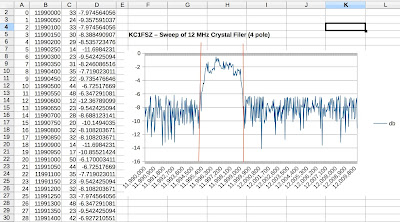
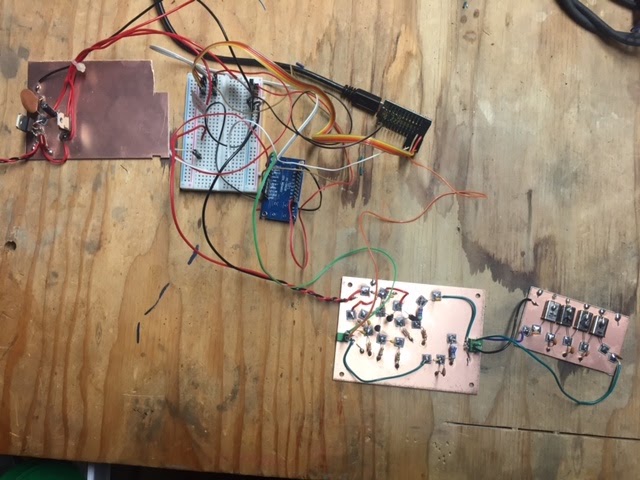
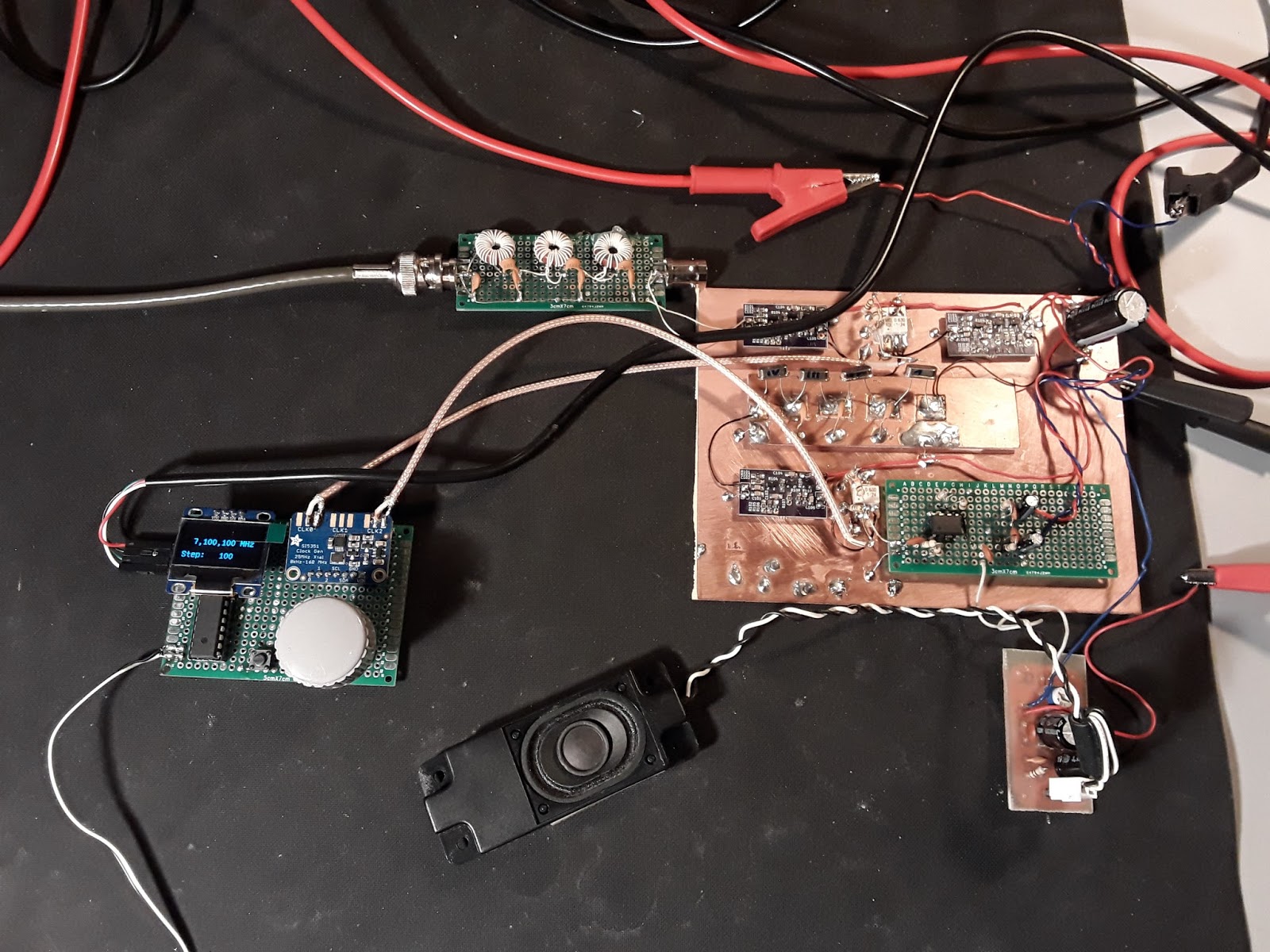
Last week I decided to try to “sweep” the filter. This was a multi-day undertaking in itself. I pieced together the microprocessor, an AD9850, a TIA amplifier, the RF power detector from the SSDRA book, and some software that generates the necessary frequency sweep and collects power readings. The picture of the test rig is included below. It’s not much to look at.

With low expectations (and wires that are too long), I ran a few seeps and then downloaded the data onto my computer for analysis. No fancy software here, I’m just using Excel. When I put the data into a line chart in Excel, what emerged from the jumble of seemingly random numbers was a thing of beauty: a 3.5 KC passband right below 12 MHz. It’s the next stage beyond the Joy of Oscillation: The Joy Of Selectivity!


It’s even showing about the right insertion loss. Note the setup is very primitive and noisy so the fact that I can’t measure anything below -8dB isn’t surprising, you can ignore that part.

But I’m starting to get the feeling that this might actually work. Onto the diode mixer …

73s,

Video: Farhan in the SolderSmoke Shack! BITX, JBOTS, McDonald Straw Sig Gen, uBITX, Sweperino and more!

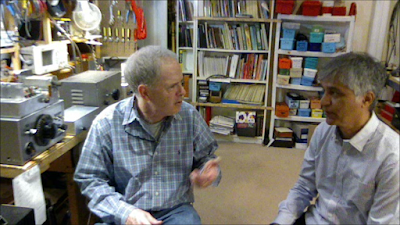
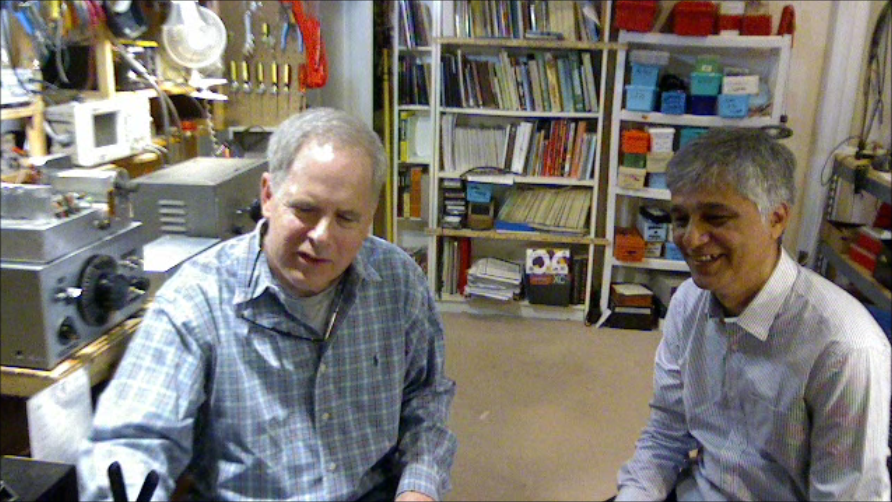
Thanks again to Farhan for visiting us. It was great to see his reaction to my humble implementations of his great designs. I got him to sign my BITX17. This was really a fantastic day for me and for my family.

Farhan Visits SolderSmoke Headquarters

Wow, today was an important day in the history of SolderSmoke. Our friend — and newly minted member of the QRP Hall of Fame — Ashhar Farhan VU2ESE came to see us. We had a great time. I showed him all the many devices that I built based on his designs.
We shot a video of the shack visit. I will post it to YouTube in a few days.
Thanks for coming to see us Farhan. And congratulations on the richly deserved Hall of Fame Induction.


Homebrew History is Made: Farhan @ W7ZOI

Thanks to Wes W7ZOI for sending me the link to his page describing the visit of our friend Farhan. I think this visit was a historic gathering of homebrew heroes and their groundbreaking rigs. Read all about it here: http://w7zoi.net/Farhan-visit.html


Please help me convince Farhan to visit SolderSmoke HQ before returning to India! Send him (or me) e-mails, texts, tweets, or just post messages of support below this post.

Video (Audio) of N2CQR (me) on 40 Meters with BITX DIGI-TIA

This was the icing on the cake. Ruben AC2RJ up in New York was monitoring as I called CQ with my BITX Digi-Tia last night on 40 meters. He recorded the contacts that ensued. I was really glad that he recorded VE3XBO describing his experiences with a BITX 40 Module at his local radio club — The WAX Group of the Barrie Radio Club in Ontario.

Farhan’s module is really starting to show up more often on the band. On the 19th of April I talked to Bruce KC1FSZ — he was on his Peppermint Bark BITX 40. And on March 30 I talked to Josh KE8CPD on his BITX 40.

Click on the arrow (above) to listen to Ruben’s recording. Ruben has a nice YouTube channel here:
https://www.youtube.com/channel/UCXClX_GBzFQIiqTwgnt8qxA

DiFX! My New NE602 Rig is On the Air

Pete would call this a DiFX: a transceiver that is Different from a BITX. This started with my effort to get an Si5351 working with a little 1 inch square OLED screen. Tom Hall AK2B helped me with the software (thanks Tom). Once I got that done, I figured I could build a simple receiver with a homebrew 11 MHz crystal filter, two NE602 chips, and an LM386 AF amplifier. That was working great, then Pete told me to turn it into a transceiver. I used some of Pete’s boards (thanks Pete).

The Epiphyte transceivers also use two NE602’s, but they ingeniously switch the BFO and VFO between the two chips. I didn’t switch the oscillators — instead I switched the inputs and outputs of the two chips using two DPDT relays (thanks Jim). A third DPDT relay switches the antenna between T and R, and turns on and off the PA stage and the AF amplifier.

This is a DIFX, but there is some BITX circuitry in there. The power amplifier stages are right out of the BITX Module, as is the AF amplifier (thank again Farhan).

The only real problem I ran into had to do with the very low power out of the NE602 VFO mixer on transmit and the impedance matching between the NE602 and the PA chain. I had to increase the gain on the first RF amp (pre-driver) using ideas from Steve Weber’s 40 meter SSB CW QST contest rig (thanks Steve). I experimented with various connections between the NE602 and the BP filter. Finally I got it going.

The heat sink on this one is different too: it is just the chassis. The IRF 510 is bolted (insulated) to the aluminum box.

I fired it up this afternoon and in spite of horrible conditions on 40, quickly had a nice rag chew with KJ4ZMV in Indiana. I haven’t even built a mic amp yet! I am running the D-104 right into the NE602 balance modulator. There are no signs of unwanted modulation or spurs.

FB! TRGHS! VIVE LA DIFFERENCE!

A Slovakian Al-Fresco Digi-Tia Homebrewed In France (and an improved AD9850 VFO)

Hello Bill and Pete,

Thanks for the podcast! My normal occupation is more computers and
software but your podcast got me motivated to melt some solder. So I
want to share a bit of what has been cooking on my bench.


I used to have a Yaesu FT-450 but sold it – I am living in a tiny rental
apartment in France without any place where to put a proper antenna so
it was only collecting dust. And where is the fun in operating a
factory-made rig, right?


So I have been working on this instead:

http://janoc.rd-h.com/archives/541

This “al fresco” rig is “half-DigiTIA”. Half because there is no
transmitter part (I don’t have a French license and I am too lazy to do
the paperwork and convert my Slovak one). The purple modules are TIAs,
as designed by Wes Hayward, using 3x 2n3904s, only built using SMD
components to keep them small and tidy.


VFO & BFO are Si5351 + ATMega328, with an OLED module and code adapted
from Pete N6QW. It uses 11.997450 MHz IF because that’s where most of my

12MHz crystals actually matched.

The 40m bandpass filter is taken verbatim from the BitX 40 design – I
have only changed the coils to use toroids instead.


For audio I have used LM386 with a NE5532 opamp as a low noise preamp
because the audio was a bit low. The TIAs don’t have a lot of gain and I
have only an indoor magnetic loop for antenna so had to compensate for it.

I have another, a bit older project that became quite popular – firmware
for the AD9850 DDS VFOs using an Arduino and a character LCD. It is a
much improved replacement for the one from Richard, AD7C.


http://janoc.rd-h.com/archives/502

Perhaps it could be useful to someone.

Keep up the good work and 73!

Jan OM2ATC (at the moment “in exile” in France)

Ken G4IIB’s BITX Journey

The work of Ken G4IIB has been on this blog before — he helped many of us make use of the amazing RTL-SDR Dongle SDR receivers. He has recently turned his attention to the BITX40 Module and offers some great ideas for testing and for modification. Ken’s description of the smoothness of his audio adds a very evocative term to the SolderSmoke Enhanced SSB lexicon.

Hi Bill, Pete

Many thanks for your respective responses to my plea for help in setting up SI5351 derived BFO to my BITX40 board. You were both on the money.


Pete suggested that I had too much gain in my HB amplifier from the SI5351 output to the modulator and indeed that proved to be true. Once sorted I also noted that I was getting extra hiss on switching to one of the sidebands as you pointed out Bill this proved to be due to incorrect placement of that particular BFO frequency.

These BITX40 boards that Ash Farhan has developed and released to the world wide community of Radio Amateurs are worth every penny. Because they are so hackable (not just the circuitry but now the Raduino code also) it means that you can tailor it to your specific specification and in the process you are likely to learn new stuff and make new friends. I describe my BITX40 incarnation and experiences below:

Upon first firing up the BITX I was getting quite a lot of mains hum from my PSU’s (I thought that at least one of these PSU’s was a quality item) but obviously not up to the job. I constructed a simple one transistor capacitor multiplier (this converted a humble 1000uF cap into a 1F cap) and the noise magically disappeared. By coincidence I note that Bill discussed this technique in a recent pod cast. Another advantage of this technique was that I got a 2V drop across the transistor so by running this on 13.8V I get 12V out so I run the PA section on un-smoothed 13.8V (this gives me 12 watts of RF out) and run the receiver section on the smoothed 12V output from the multiplier, happy days.

My thoughts were to turn my BITX into a multi band (several bands rather than all bands) rig and I figured that using high side mixing (running the VFO at 19Mhz (12Mhz + 7 Mhz) rather than the existing low side mixing (12Mhz – 7Mhz=5Mhz VFO)) would be a better option. For example running it on 17M would mean using high side VFO anyway. I also wanted the ability to be able to switch sidebands especially on the lower frequencies so that I could use the rig for Digital modes in my case this was to be achieved by coding the Arduino to run a BFO on one of the SI5351’s clk ports.

I bought my BITX prior to the release of the Raduino so I had already commenced (with the aid of a new found radio friend and RF mentor) coding an Arduino VFO/BFO using a UNO and SI5351. Like I said at the beginning once you let folk know that you are starting on a new and interesting project you start to engage the more practical members of the ham community and they just want to get involved and help. Yet another good reason to buy a BITX . We used code originally developed by Jason Mildrum NT7S and Przemek Sadowski SQ9NJE and tailored it to suit the BITX40 and our requirements. This include high side VFO with frequency step adjustment and a BFO with long push BFO changeover. This meant that my BITX front panel should stay very minimalistic 2 knobs.
Getting the VFO to work was simple as the DDS socket was used and to better accommodate the high side VFO I modified the board by tombstoning caps C91 & C92.

Getting the BFO to work proved to be more problematic I was troubled with hiss and other noise. Words of wisdom from Pete Juliano when asked if I was doing something wrong were: ” No –it is just that we tend to think our projects are like Lego type building blocks where everything mates and snaps together. Sometimes more is required”. True Pete and that gives us the opportunity to learn new stuff!

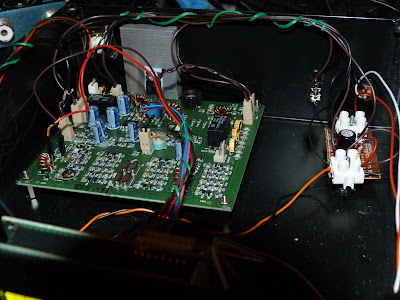
To cut a long story short I found that the best place to connect the BFO was on the modulation transformer T4 thus bypassing the BITX BFO stage altogether. I was also getting hash noise believed to be emanating from the Uno. At this stage my after market Raduino arrived from India. I fired this up and noticed that I was not getting any hash noise from it. This pointed us to a coding problem and the LCD refresh was altered on our code and the problem disappeared. Below a picture of the module showing the BFO connections to T4 and the large heat-sink with the IRF510 insulated from it. Also shown is the capacitor multiplier and a glimpse of the Raduino in the foreground. Not the most elegant box but this is likely to change pending further refinements. It’s still work in progress and this box gives me plenty of room.

The Raduino is a fantastic piece of kit for the money extremely neat and well thought out. The coding is comprehensive and innovative and works well. However, from an aesthetic and ergonomic point of view there were a few things that I personally did not like in terms of how it operates and performs. I could not get away with the potentiometer tuning, you can tune 50Khz of the band and then when you near the pot edge it increments/decrements and you can re-tune. I found this clunky to use and in addition the Raduino would hunt causing the last digit to increment then decrement causing an annoying warble on audio. In my opinion a Rotary Encoder would be better solution. On the plus side, although not mentioned on the Hfsigs web site the Raduino code does come with other functions such as changing sidebands by temporary high siding the mixer, a RIT, VFO B and CW tone. If you download and read the Raduino code from Github you will see this extra functionality which I believe you can make use of via extra switches (not supplied). The current Raduino code does not have any external BFO options as said it relies on the crystal BFO and temporally high siding the VFO to change from LSB to USB on 7Mhz.

The Raduino module itself is just too good and neat not to use. As I did not have the where for all to fully understand and amend Ash’s code I decided to use the Raduino but to load it with the code that we have developed for he Uno and Addafruit SI5351 board. This would give me near conventional tuning via a rotary encoder, adjustable step sizes via quick push of the encoder switch and USB/ LSB switching via long push of the encoder switch by virtue of the SI5351 generating the BFO frequency. I have retained a copy of Ash’s Raduino code just in case I wish to revert to it. I put a new header on the Raduino P3 connector so that I could connect a rotary encoder and use the 2nd clock output and then changed our code to run on a Nano. I had to add a correction factor in the code to cater for calibration differences in the SI5351’s (in my case 1.21Khz).

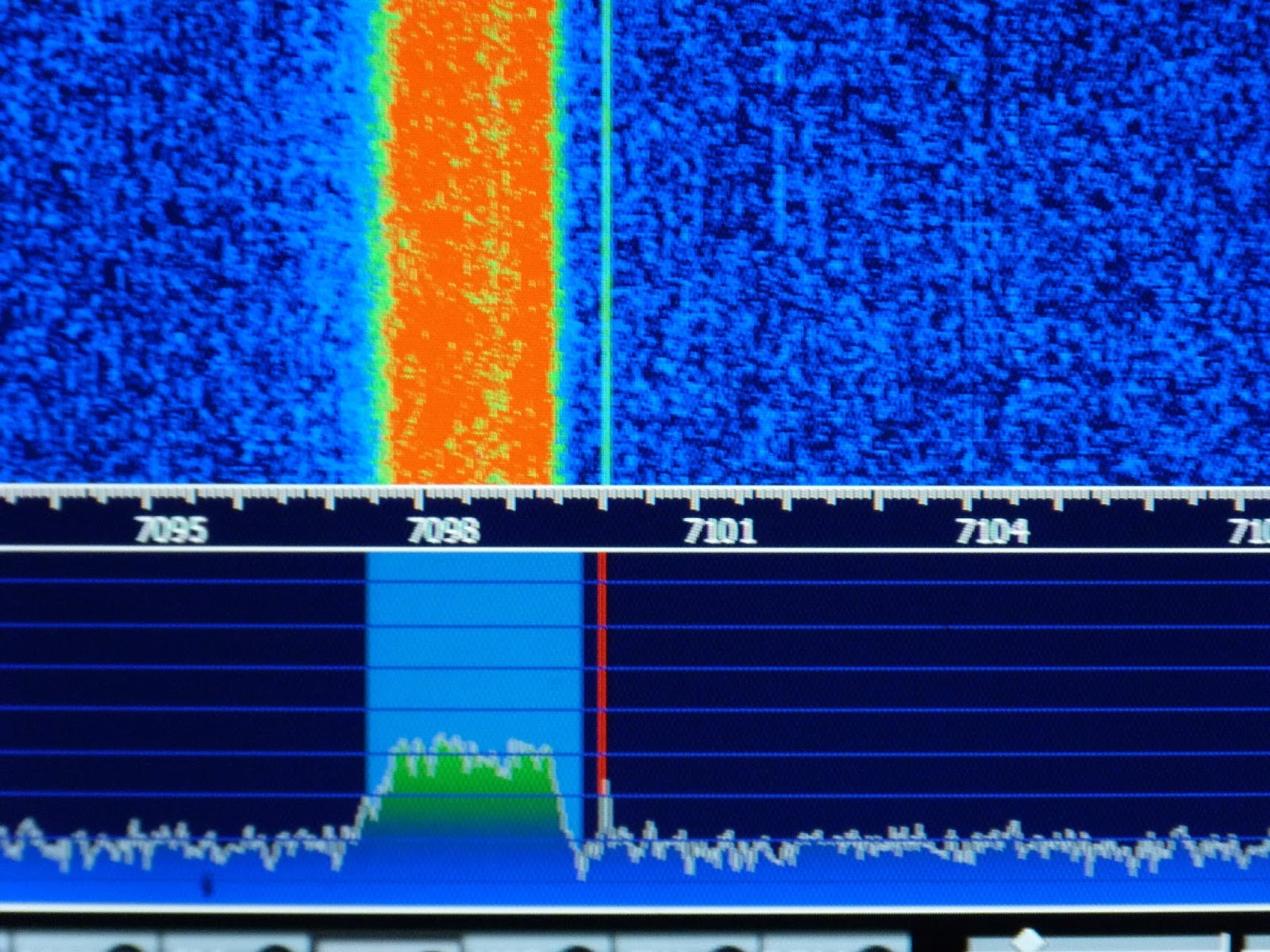
As previously indicated I had a little trouble arriving at the correct BFO frequencies I found that 119940 and 119970 gave me LSB and USB respectively for my high side VFO (19Mhz) if you use low side VFO (5Mhz) then these would be reversed. We further refined these frequencies by injecting white noise into the mic amp and looked at each transmitted sideband on my RTL-SDR dongle via HDSDR (a useful piece of test equipment). By adjusting the carrier trimmer to show the carrier in the extended HDSDR spectrum display we could see how much to move the BFO frequency to best occupy the crystal filter pass band, see image below. This frequency adjustment being achieved by a coding change. The frequencies I consolidated on to cater for my particular crystal filter are 119941 LSB and 119969 USB. We then nulled the carrier back out. My audio is now as smooth as a maiden’s inner thigh, trust me the image will follow!

So now I can get on and build an AGC and think about some sort of S meter. As for putting the BITX on other bands, whilst I now have a VFO capable of going anywhere, I would need to address band pass and low pass filter and switching arrangements. I may still experiment with this but, as pointed out by Ash in a recent pod-cast, the BITX single superhet design is not best suited to multi band operation but can be quite easily changed to operate on another single band. He also indicated that he was developing a dual superhet with consideration for multi band operation. Once released this might be a better option for multi-band use.

In the mean time folk should just get a BITX40, hack it to bits and share with us their customised versions.

Ken G4IIB


SolderSmoke Podcast #193: BITX 40, OLEDs, KWM-4, Noise Abatement

SolderSmoke 193 28 Jan 2017


Report from Pete on BITX 40 Session with California radio club.

Update on the BITX40 Module Revolution
— Check out the BITXHACKS page. Send in contributions.
— BITX20 mailing list very active.
— Raduino!
— Interview with Farhan with W5KUB — Eliminating the commercial gear.
— BITX 40s on the beach in Australia. FB

Bench Reports:

Pete:
— Color Displays!
— KWM-4
— OLED MADNESS!

Bill:
— Fixing up the old HT-37 HT37 to HT37 QSO with W1ZB
— Dabbling in VHF with Ramsey Aircraft band receiver. NOT FUN.
— Going all IC with Si5351 OLED NE602 rig.
— BANDSWEEP
— OLED Noise and the Active Decoupling solution.

Using LTSPICE as a diagnostic or understanding tool.

Of Waterfalls, Homebrew Rigs and Casual Critics on 40 meters. Words of Wisdom from W8JI.

LEXICON: HAYWIRE TOMBSTONE BIKESHEDDING from Todd K7TFC

Some great recent interviews by Eric 4Z1UG:
Ian G3ROO Origins of ROO Regen at age 8
Hans Summers G0UPL Balloons! NO COMMECIAL GEAR
David White WN5Y ELECTROLUMINESCENT RECEIVER EXPLAINED
Rob Sherwood NC0B

MAILBAG:

Chris KD4PBJ’s BITX 40 with improved stability
Jerry W0PWE built a DIGITIA! Very nice. Worked Keith N6ORS and heard me! TRGHS
Mike AB1YK’s Al Fresco Scratch built BITX. But give that LC VFO another chance Mike!
Steve N8NM 30 meter rig with salvaged CB LC VFO. FB
Keith N6ORS Franken SDR rig with parts from the 1980s. FB
SKN Bandscan from Mike WA6ARA I worked W1PID Jim!
What is Mikele up to?
Rocking Johannesburg and Kirghizstan via local repeaters: