Please Put Drake 2-B Serial Numbers Here!

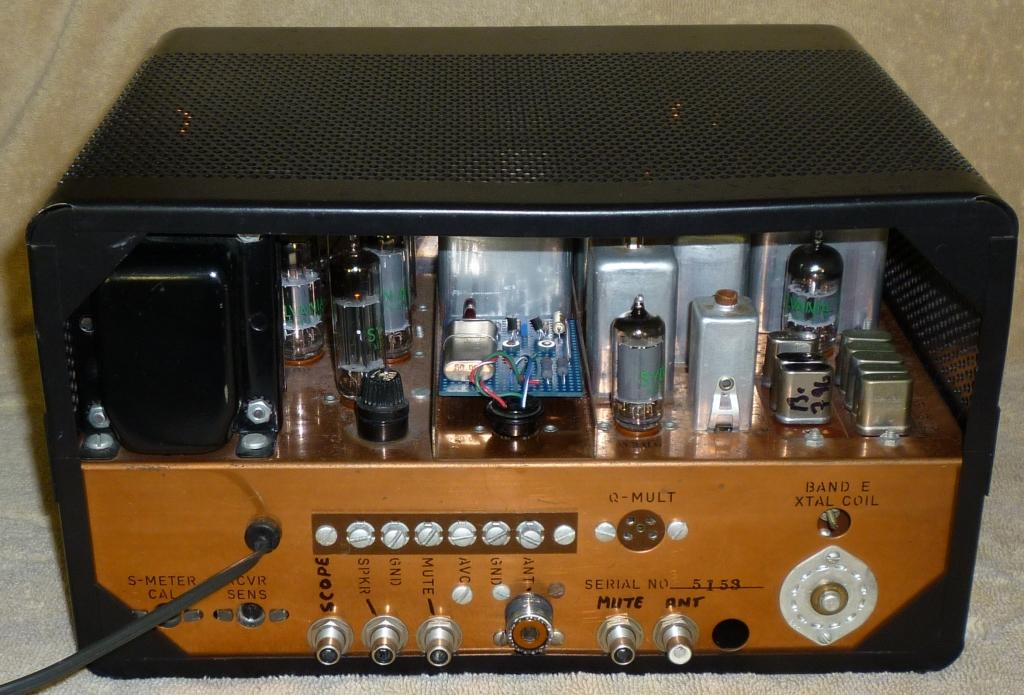
Let the count begin! Folks have been sending in Drake 2-B serial numbers. They’ve been coming in via the blog, via e-mail, twitter tweets, Facebook messages, carrier pigeons, etc. I’m afraid I might miss some precious numbers. So let’s put them here. If you have some, and I don’t have them below, you can post them as a comment to this blog post. When we get enough, we’ll turn them over to Scott, K6AUS, for analysis using the same mathematics used to determine the number of German tanks during WWII.

Mine: 11976
Aramand’s three (scandalous to have THREE!): 2599, 5149, and 12038
WB4NCT’s:
8682
From Rogier’s e-bay search: 8069
Another from Rogier: 5153
More from Rogier: 11222, 9041, 9180
From WB4HFN’s web site (thanks Rogier!): 2008, 4025, 9289, 11059, 12060
WA5DJJ’s:
5254
N5JKY’s: 10616
Stephen NM7J / HS0ZHB 12955, 10328
Pete, VE2XPL’s: 8873
WA5BDU’s:
4950

Armand’s 2-B (X3)

Good morning Bill!,

Let me start of by letting you off the hook (a little anyway), by saying that I no longer hold you responsible for the escalating values of the Drake 2B. After acquiring one, cleaning it , recapping and tweaking it, it’s pretty clear that the 2B doesn’t need anyone to sing its praises. It sings pretty well all on its own! Having said that, I really have to thank you for nudging me into finally getting one for myself. After a lot of searching I finally found one that was in not too bad shape for its age. I also found two others that were in less than working condition. For a while I was troubled as you were about having more than one Solid State Design. Is it really ethical for someone to have more than one 2B? Fortunately I can rationalize with the best of them. It’s obvious that I will only own them for a while and am saving them from the scrap heap. Maybe we could start a 2B rescue organization?
Also thanks for the WARC and 160M tuning template – much appreciated!
The serial numbers for these sets are

2599, 5149, and 12038

Will be neat to get an estimate for the final count. Good luck!

Also wanted to mention that I really enjoyed SolderSmoke “the book”. Will there be a second volume? Enough for now.

Keep the solder flowing and the podcasts and blogs comming.
Thanks again,
73’s
Armand WA1UQO
p.s. If you have an extra set of crystals for a 2B that you would be willing to part with, let me know.

Merrill Budlong’s Drake 2-B

Hi –

I just listened to Soldersmoke 134 and was delighted to hear the reading from Peter Doherty, W1UO.

I first met Peter just before his transcendent 2-B experience. He joined the Fidelity Amateur Radio Club, then K1NQG, of Cranston, RI, which was started by Merrill Budlong (SK), then W1QLD, later W1MB, in 1958. Merrill had a 2-B at that time, so I am almost certain Peter was referring to Merrill’s receiver.
Peter received a bachelor’s degree in English from the University of Rhode Island. He was an adventurer. After college, we briefly worked together at Merriam Instruments, which was owned by Robert Merriam,W1NTE. (Bob is the founder and curator of The New England Museum of Wireless and Steam in East Greenwich, RI.) Peter soon got wanderlust. He loaded his backpack and took a 1 year trot around the globe. I was astouded when I got a Nepalese postcard from him! Since then he helped deliver vessels from the east coast to Seattle via the Panama canal, worked at the Voice of America, worked in marine electronics in Port Townsend, Washington, and has worked for at least two communications equipment manufacturers. I’m sure he had many other adventures.

The Fidelity Amateur Radio Club is still alive and doing well. Some of the original members are still active with the club, but most of us are gray/bald, fatter, and move slower, but we still love the hobby and appreciate what Merrill did to get so many of us started in our careers. Since Merrill’s passing his callsign was transferred to the club and we used it this past Field Day.
Keep up the good work! We ARE listening!
73,
Ken Tata
K1KT

SolderSmoke Podcast #135 FDIM SPECIAL!

Please click on the little mail symbol down below to forward this blog post to friends who might be interested in the podcast. Thanks!

http://soldersmoke.com/soldersmoke135.mp3
June 26, 2011
Bike riding, composting… what next?
Lightning kills the WSPR rig

New finder for old telescope

——
SPECIAL FOUR DAYS IN MAY INTERVIEWS BY BOB CRANE W8SX:FEATURING:
Joe Taylor K1JT (Nobel Prize Winner — FOR PHYSICS!)!
Plumbing Defined Radio! Steve WG0AT: Fly Fishing, Retirement, Goats, YouTube, and Amateur Radio!
George Dobbs, G3RJV! And more!
—– Drake 2-B updates: WARC and 160 Dial Templates,
Drake 2B Serial Number Math Estimate Project
(Using German tank method) Michael AA1TJ’s Sputnik 1 Project
Putting the Shack back into RadioShack

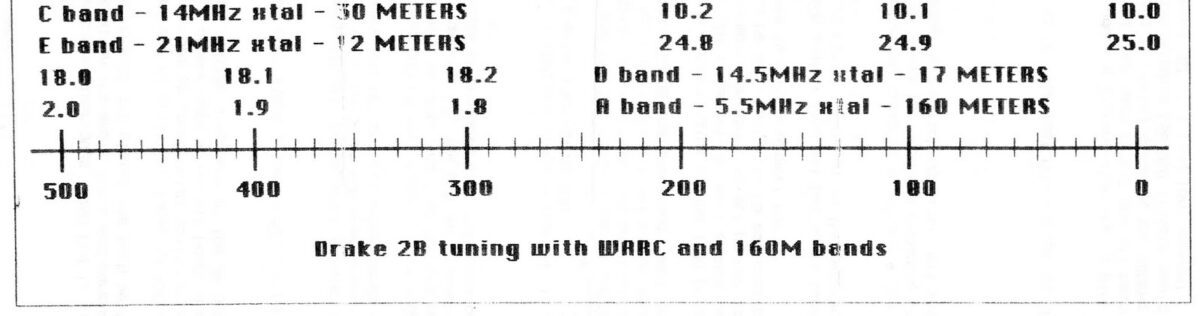
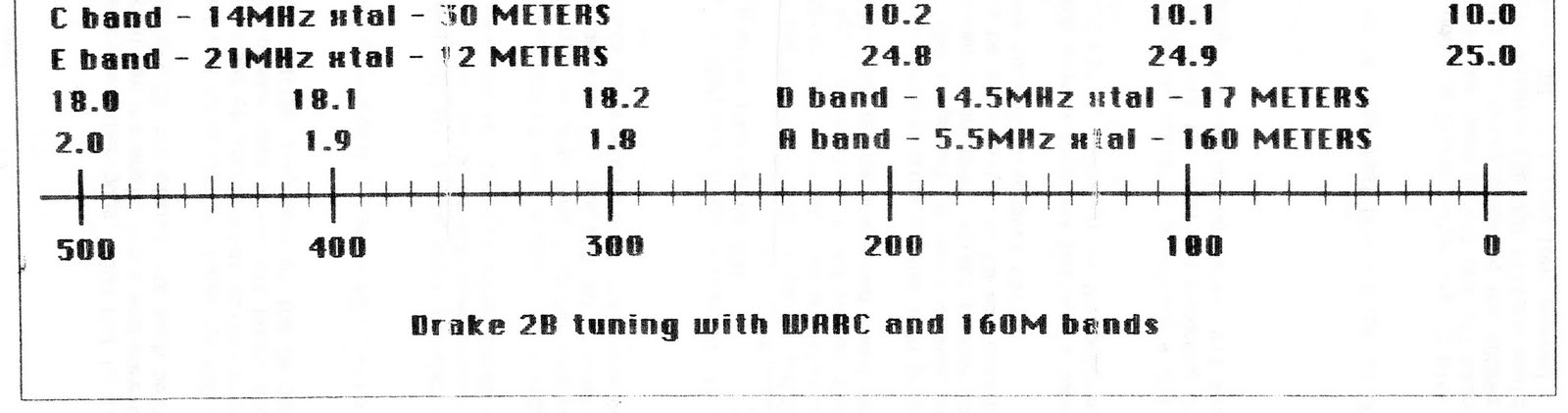
160 and WARC Dial Chart for Drake 2B

This post will, I know, be of interest only to a small, elite group: Drake 2B owners who are using their beloved receivers on frequencies beyond the range of the original design. I have used mine on both 30 meters and 17 meters, so when Mike KI8IK sent me the above chart, I immediately saw its usefulness. Thanks Mike.
Of course, with the rumored cancellation of sunspot cycle 25, the 17 meter portion of this chart may be of limited use ๐Ÿ™

The W8SX Drake Interview


Bob, W8SX, (aka “our man at Dayton”) conducted an interview with Bill Frost, Service Manager for R.L. Drake — a fellow who knows a lot about the history of our beloved (and ever-more-valuable!) Drake 2Bs:

— The Drake 2-B was designed and built in the early 60โ€™s, but was not continued because R4 was its replacement. It was hoped that the 2-C would be a replacement for the 2-B, but the companion CW transmitter 2NT caused hams to associate the 2-C with a novice station and the sales number show that is was not as popular because 2-B with non-novice hams.

— Why no crystal filters? Crystal filters not considered because of cost in terms of design & parts. In addition the LC filters allowed the designers to provide passband tuning both easily and cheaply in the 2-B.

— How did it stack up against other receivers of the era? The 2-B was better than anything else for sale except Collins receivers, which cost a great deal more. There was also the R390, which was available on the surplus market, but it frequently was not is good shape and again cost a lot more.

— Who designed it? The 2-B was designed by several engineers, but principally it was both Milton Sullivan & Bob Drake.

— Why the copper chassis? Bill was not sure on this point other than to say that the Cu was meant to keep corrosion of aluminum chassis components to a minimum. Later they use cadmium as in the R4C/T4XC combination. In a couple of instances the chassis was plated with chromium and these radios are very rare and expensive collector items.

— How important was the 2-BQ multiplier? While this is a highly sought after item today not very many were sold with the 2-B or even the 2-C. Today these are very valuable and command prices well above their original list price.

— Was dial parallax a problem considered in the design? Not really as the crystal calibrator was supposed to be used along with the lines on the main dial slide to indicate the exact frequency. Band to band variation was very good for the time at around 3kHz. Not bad for a press DDS VFO.

— Does he still have a 2-B? YES! And he would not part with it for any amount of money.

— How many were made? He was not sure about this, but did say that the receivers are numbered consecutively, so that by knowing the first 2-B and the first 2-C itโ€™s a simple subtraction to find the numbers of each manufactured.

— Was it a big seller for Drake? Yes, but the R4 line which had a longer run and therefore sold more. The TR-3, and TR-4 line was a big seller for many years until the Japanese cut into their market share.

— The TR-7A was Drakeโ€™s last ham gear and now they manufacture only home and commercial satellite receivers. These sell well to commercial cable, dish network, lodge net, channel modulators, D-A converters. They are now located in Franklin OH.

— No ham gear is made by Drake these days as it is all commercial receivers for the satellite TV/radio market. The R8 was their last ham receiver and it still sells well on the used market.

— For replacement tubes look to http://www.tubesandmore.com/. The transmitting tubes, 6JB6โ€™s, are particularly hard to find. Look for a substitute sweep tube that can be used in that circuit.

— John M Cherry, John Covelli, WB4HFN and Evin Rolek K9SQG@aol.com host the Drake Forum every Dayton Hamvention run by. A good resource for repair is John Kriner, WB4HFN

— Drake’s web sites: http://www.n9bor.us/drake.htm & http://home.online.no/~sindtorp/

To preserve the parts on a 2-B, especially the cosmetic parts, keep it out of sun & donโ€™t smoke. These parts are particularly had to find these days.

How many Drake 2-Bs? The German Tank Problem

I have #11,976!
——————-
Hi Bill,

I was just listening to your latest soldersmoke podcast and your
discussion about how many Drake 2Bs were made. Without knowing the
exact serial number for the last Drake 2B before the Drake 2C was
made, you can estimate what that number might have been by knowing a
few of the real serial numbers that are being used by people today.
This is a mathematical problem related to the somewhat famous “German
Tank” problem. Check out:
http://en.wikipedia.org/wiki/German_tank_problem.

If you were to ask your listeners to report to you their Drake 2B
serial numbers you could estimate the largest serial number there ever
was from the formula on that wiki page. This could be a fun exercise
๐Ÿ™‚ I’ve never had a Drake 2B so I can’t contribute. But I could do the
estimate for you if you gave me the numbers.

Cheers and 73

Scott (K6AUS)

SolderSmoke Podcast #134


http://soldersmoke.com/soldersmoke134.mp3

May 15, 2011
New “Ikea” microphone
NOVA QRP Club

WSPR T/Rouble resolved
Finishing up Rome WSPR rig
Easy-Peasy on Asus eee-PC

Space Station Packet Beacon
Boatanchor News: DX-100, HT-37, “CQR” anchors, 75 meter antenna Drake 2-B history interview by W8SX
Lew McCoy and Ernest Hemingway
Ade Weiss, QRPoetry and Ade’s new book
Regen theory

MAILBAG (with a focus on New Zealand)

SolderSmoke Podcast #122

Bill (N2CQR) and Ian (G3ROO) in Dover, England (with hydrogen balloon spark key)

SolderSmoke!
A SHOW FOR ELECTRONICS HOMEBREWERS!
Listen at: http://www.soldersmoke.com
SolderSmoke #122

Feb 28, 2010
Snow in Rome!
In London: A visit to Marconi’s house, Maplins, and Faraday’s lab
A visit to the Dover Construction Club
Computer problems resolved
A short period of QRSS, then back to WSPR
Putting the Drake 2-B into WSPR mode
The Rome-Norway WSPR pipeline
Increased solar activity
50 years of SETI with Frank Drake
QQ Review
Work Bench Eye Candy
Movie Review: UP! (Five Soldering Irons)
MAILBAG

QRP Quarterly — Winter 2010

Lots of great stuff in the latest edition of QQ from QRP ARCI:

Mike Czuhajewski’s “Idea Exchange” column has been sending out great ideas for many years now. In this edition he opens with a piece from Wes, W7ZOI, that originally appeared on the EMRFD mailing list. It deals with diode ring mixers, specifically the power requirements for the local oscillator. What do they really mean when they specify 7 dBm? Wes explains: “If we say that the LO power is +7 dBm, what this really means is that a signal generator is attached to a power meter or spectrum analyzer and adjusted to deliver +7 dBm at the desired frequency to the 50 ohm instrument. Once the power is set, the cable is disconnected and reattached to the mixer.” I’d always wondered about how to measure that. Thanks Mike! Thanks Wes!

Preston Douglas, WJ2V, has a nice article on our latest craze: WSPR. Preston also discusses SDR radios — his encouraging comments may help me get out of my current luddite curmudgeon rut. Preston mentions recent efforts to use a BITX-20 for WSPR and concludes that this would be “a tall order for any analog rig.” This comment lessened my feelings of inadequacy about my SDR SMT problems, because I recently used my ancient Drake 2-B to receive WSPR sigs (see earlier blog entry). Luddites Rule! But Preston is right — it’s not easy! But — at least for a little while, before drift takes you out of the band — it can be done.

Ward Harriman, AE6TY, writes of a “homebrew” SDR project. In his opening paragraph, he tells us what the term “homebrew” means to him: “homebrew design, homebrew assembly, homebrew programming, homebrew in a wide range of disciplines both familiar and untried.” That’s pretty hardcore! FB Ward!

Jim Osburn, WD9EYB, has a nice article on “circuit stickers” and how they can be used to simplify project construction using a variety of circuit boards and breadboards. I really liked Jim’s description of old Electronics Illustrated projects in which they pasted a diagram to a wood base and then put finishing nails at specified points. Components were then soldered to the finishing nails. When the thing works, you can say you “really nailed it!” (Sorry!) Cool technique.

Thanks to the folks at QRP ARCI for another inspiring edition of their wonderful magazine. If you are not a member, you are missing a lot. Sign up for the club and the magazine here:
http://www.qrparci.org/

Drake 2-B Goes Digital with WSPR

7 spots:

Timestamp Call MHz SNR Drift Grid Pwr Reporter RGrid km az
2010-02-06 16:04 DK9MS 10.140210 -11 -1 JO40tm 2 I0/N2CQR JN61fv 983 166
2010-02-06 16:04 PA3BTI 10.140271 -8 0 JO22og 5 I0/N2CQR JN61fv 1276 152
2010-02-06 16:04 DL9DAC 10.140246 -4 0 JO31qi 20 I0/N2CQR JN61fv 1120 158
2010-02-06 16:02 DL6NL 10.140262 -20 2 JO50cb 0.1 I0/N2CQR JN61fv 924 168
2010-02-06 16:00 DF6DBF 10.140279 +1 -1 JO31si 10 I0/N2CQR JN61fv 1116 159
2010-02-06 16:00 M5LMY 10.140248 -14 1 IO91oi 5 I0/N2CQR JN61fv 1455 131
2010-02-06 16:00 DL1EEZ 10.140201 0 0 JO31qi 20 I0/N2CQR JN61fv 1120 158

Query time: 0.002 sec

Until this weekend have been “transmit only” on the WSPR system, running the world’s only homebrew double sideband WSPR rig (please correct me if I’m wrong). I’m also running one of the most low-powered of WSPR stations (20 mW).

I’ve been feeling a bit guilty about my “transmit only” status. I felt like I wasn’t doing my fair share in the WSPR effort. I was sort of a digital free-loader.

So Saturday I decided to do some receiving. I fired up the old Drake 2-B. I ran a lead from the headphone jack of the receiver into the audio in of my old Tecra 8100 (running Linux Ubuntu Jaunty Jackalope). Antenna was a pathetic little end-fed wire. The only tricky part was getting the Drake on the precise freq. I just put my WSPR transmitter on 10140200 Hz and then put the bandpass in USB 2.1 kHz. I found the computer clock was off a bit (I had neglected to run the ntp program), but once that was taken care of signals started pouring in. And reports were automatically uploaded to WSPR HQ, and appeared on-line (see above).

I was very pleased to receive DL6NL’s 100 milliwatt signal. OM NL is well known in the QRSS/WSPR world. A picture of one of his more QRO rigs appears above. A shot of his balcony Microvert antenna (the white thing at the end of the dark indicator line) appears below.


Dale Parfitt, W4OP, Homebrew Hero

Yesterday, in my search for pictures of the Drake 2B, I came across VE3MPG’s excellent interview with Dale Parfitt, W4OP. Dale and I crossed paths years ago: After I built my first version of Doug DeMaw’s Barebones Superhet, I went out on the net and found a couple of kit versions of this receiver for sale. A few years later, I was working on one of them, and turned (as you do) to QRP-L for some advice. Dale came to the rescue and we started exchanging e-mails. After a while he told me that the version I was working on sounded familiar. Sure enough, he was the original builder! The story appears in SolderSmoke — The Book.

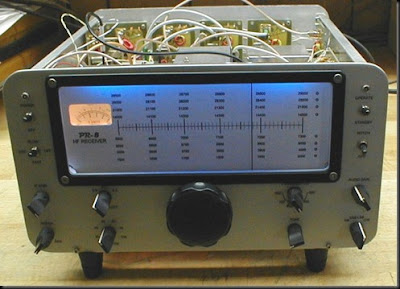
Here is further evidence that Dale and I have similar tastes in receivers: Pictured above is his solid state version of the Drake 2-B. FB! I note that the dial scales are the same as the hollow-state version.

Here is the VE3MPG interview:
http://ve3mpg.blogspot.com/2008/10/interview-with-dale-parfitt-par.html

Mechanical Resonators

Mike, KC7IT, sent along this interesting article on the use of mechanical resonators in cell phones.
http://spectrum.ieee.org/telecom/wireless/radios-with-micromachined-resonators

Somehow, this made me think of my beloved Drake 2B. The 2B uses an L-C filter at 50 kHz, but — sure enough — a quick visit to the e-ham review section showed that Henry Radio had a vailable a mechanical filter kit — some of the 2Bs out there are apparently fitted with this device.
Check out the e-ham Drake 2B love-fest: http://www.eham.net/reviews/detail/3868 All of it true!

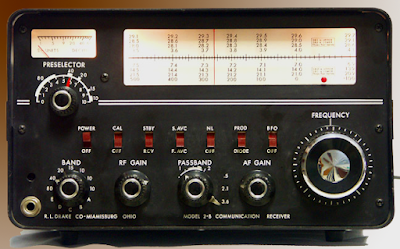
And of course, this all provides an excuse to put up a picture of the Drake 2B.