Category: digital logic
Voyager, Canopus, JPL, and 74xx Logic Chips from the early 1970s
“So somewhere out there in interstellar space beyond the boundary of the Solar System is a card frame full of 74 logic that’s been quietly keeping an eye on a star since the early 1970s, and the engineers from those far-off days at JPL are about to save the bacon of the current generation at NASA with their work. We hope that there are some old guys in Pasadena right now with a spring in their step.”
https://hackaday.com/2023/07/31/just-how-is-voyager-2-going-to-sort-out-its-dish-then/
Digital Engineering vs. Analog Engineering
In a book review Thompson makes this observation about the digital-analog divide:
One difference might be that human beings can deal with ambiguity, and computers really can’t. If you’ve done any Python [coding], you make the tiniest mistake, and everything stops immediately. That’s what makes it different even from other forms of engineering. When you are trying to fix a car, if you fail to tighten a bolt on one wheel as tight as it should be, the entire car doesn’t stop working. But with code, an entire app, an entire website can go down from the misplacement of a single bracket. I think that’s the one thing that sometimes scares writers away, because they are more accustomed to working with ambiguity.
https://arstechnica.com/gadgets/2019/04/how-the-new-art-form-of-coding-came-to-shape-our-modern-world/
I am definitely more accustomed to working with ambiguity. All of my rigs are filled with ambiguity.
How LCD Displays Work (Video)
8 Bit Guy does a great job de-mystifying the LCD displays that we have been using.
Renewed Hope for Divide by 2 I and Q
An anonymous reader posted this interesting message in the comments section yesterday. Very interesting. A potentially important tip that may help in the quest for 90 degree phase shift with divide by 2 Flip Flop circuits. What do you guys think? And who is that masked man?
I wanted to make a comment regarding your Frankenstein R2 Clock divider, but did not come around to do it until now and fear if I were to put it below the appropriate post, it would be so many pages away nobody sees it. Please forgive me for posting this here if my assumption is wrong. I had a play with two edge-triggered JK – Flip Flops (74HC109 & HC107) and tied the J and K to the appropriate rails to use them as T- Flip Flops. Because of one being positive, the other one being negative edge triggered, this behaves as a divide by 2 IQ clock generator. The HC107 has an inverting clock input, so as with the other design, some kind of inverter is involved. And as Bill has reported, I initially measured the Phase shift on the scope to be off. But while playing around, I realized this was a function of the signal level. I could tune the phase shift by adjusting the signal level of the driving clock! When the clock and power supply levels were almost equal, the phase shift was very close to 90° and pretty stable with frequency (tested with 1-10Mhz). Later I thought about it some more and suspect it might have to do with the exact time the inverter “flips” on different signal levels in relation to supply voltage level. Aside from the exact cause, I believe one could vary the supply voltage of the gates with the same effect on the phase shift as with varying the signal level. I hope my observation helps to somewhat make the advantages of divide by 2 IQ clock generators more accessible.
Life in the Fast Lane: Potato Semiconductor Chips
Even I, with my luddite tendencies and analog preferences, have recently bumped up against the speed limit of 74 series logic chips. The Si5351 chip in the I and Q VFO for my phasing receiver will run up to 160 MHz. But the 74 series inverters and flip flops that I have attached to the output don’t seem to want to go beyond about 120 MHz. Our old friend Thomas LA3PNA tells us how to break this speed limit:
http://www.potatosemi.com/
Be sure to go their “Milestones of 74 Series Logic” Page.
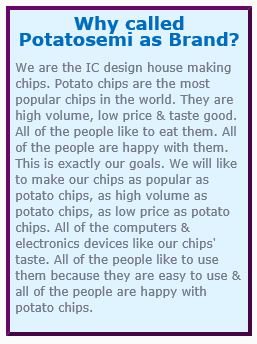
I like their explanation of the brand name:
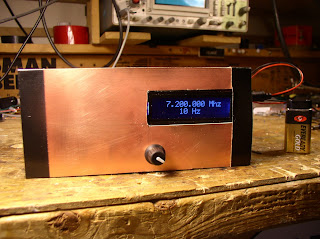
1-29 MHz In One Small Box
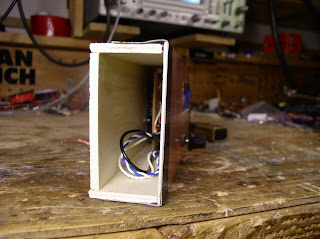
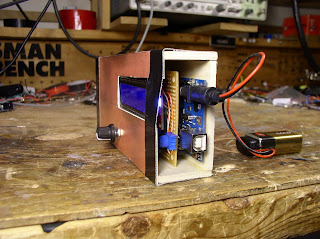
Here is the other end. Of course, I could have just taken the ATMega chip out and avoided putting the whole Arduino board inside the box, but I’ll leave that exciting digital adventure for a future project.
Our book: “SolderSmoke — Global Adventures in Wireless Electronics” http://soldersmoke.com/book.htm Our coffee mugs, T-Shirts, bumper stickers: http://www.cafepress.com/SolderSmoke Our Book Store: http://astore.amazon.com/contracross-20
Signal Generator Ideas
Hi, Bill
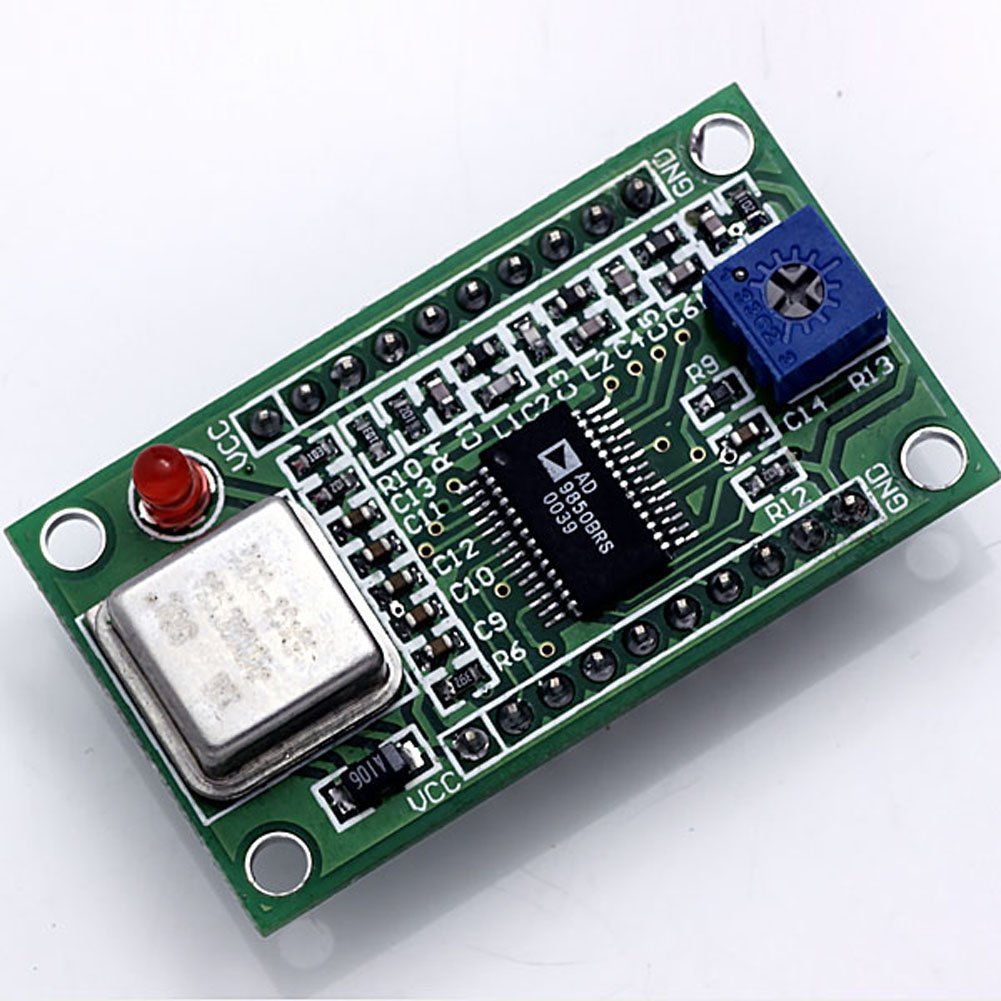
Howzabout a generator that goes from 1 Hz to 40 MHz with 1 Hz resolution, adjustable cursor so you can step any of the 8 digits, presettable offsets for if frequency, repeater offset, or r.i.t., directly synthesized output so almost no phase noise and 12 bit waveform accuracy? How about a price tag of less than $20 for all the major parts? Start by Googling dd_synth.asm for control software, and rather than buying the PCB recommended in the notes at the head of the program, search for AD9850 on Ebay for the synthesizer board and LCD 16×2 for the display. A 16f628a PIC is a couple bucks. Both the display pinout and the synthesizer pinout match standard perfboard. For a little more than $10 more get the AD9851 board and the upper frequency limit is 60 MHz.
A better way to transistorize the old tube-type generator is to use a dual-gate RF mosfet for the oscillator. You can trim the gain for waveform purity by adjusting the bias on gate 2. Once you find the optimum bias on each band, diode-switch the bias level with the bandswitch. Since gate 2 has an extremely high impedance you can use resistors in excess of a megohm, so it won’t affect the Q of the tank coil.
Jim Daldry
Raleigh NC
Our book: “SolderSmoke — Global Adventures in Wireless Electronics” http://soldersmoke.com/book.htm Our coffee mugs, T-Shirts, bumper stickers: http://www.cafepress.com/SolderSmoke Our Book Store: http://astore.amazon.com/contracross-20
“Analog Man” by Joe Walsh
Very cool to have world famous rocker and fellow boatanchor enthusiast Joe Walsh singing about the virtues of analog.
What next?
An ode to 60/40 solder?
Some troubleshooting blues?
Our book: “SolderSmoke — Global Adventures in Wireless Electronics” http://soldersmoke.com/book.htm Our coffee mugs, T-Shirts, bumper stickers: http://www.cafepress.com/SolderSmoke Our Book Store: http://astore.amazon.com/contracross-20
VE7BPO’s Digital Logic Page
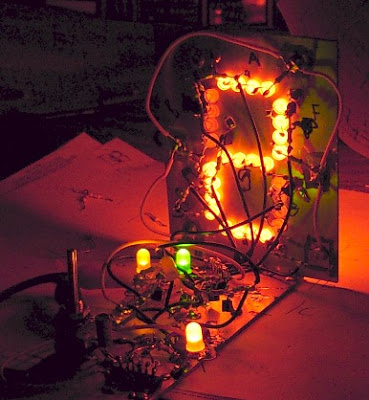
I mentioned in SolderSmoke 98 that Todd, VE7BPO, has also developed an interest in digital logic circuits. In addition to putting together a really great web page on his projects, Todd went the extra mile by homebrewing his own numerical displays. No store-bought seven segment displays for him! Check out his site: http://www.qrp.pops.net/cmos1.asp