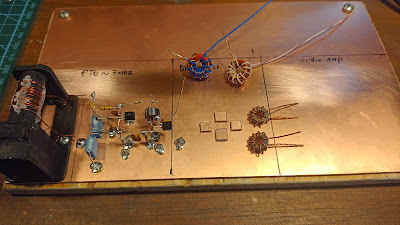
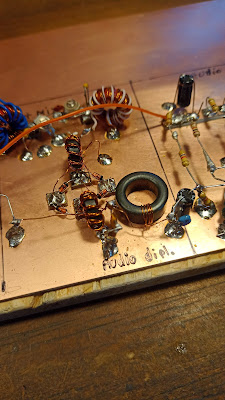
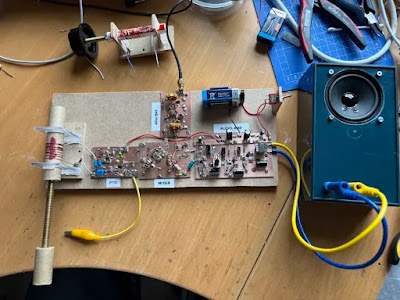
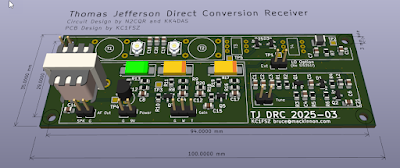
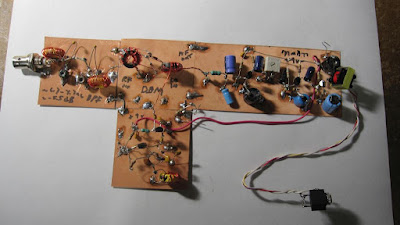
Andy has a lot of homebrew projects underway, but I think this one must have been the most rewarding. He has done something that 95% of hams never do: He has homebrewed a receiver. Congratulations Andy!
Check out Andy’s presentation on Linux to the 2025 Dayton Hamvention:
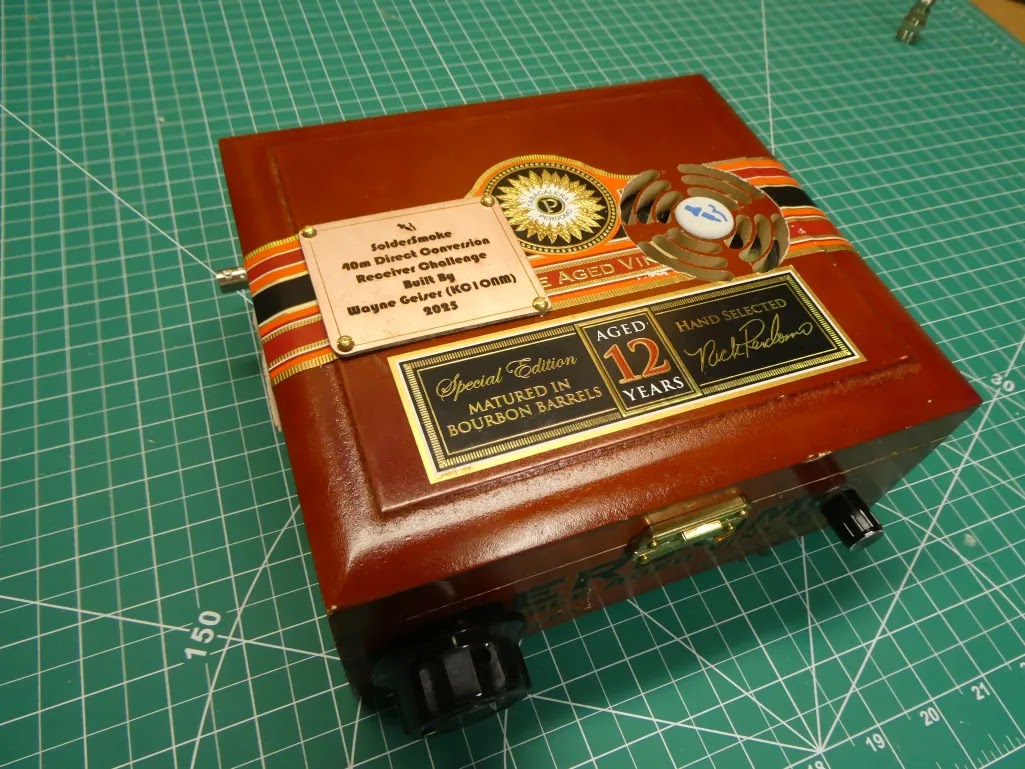
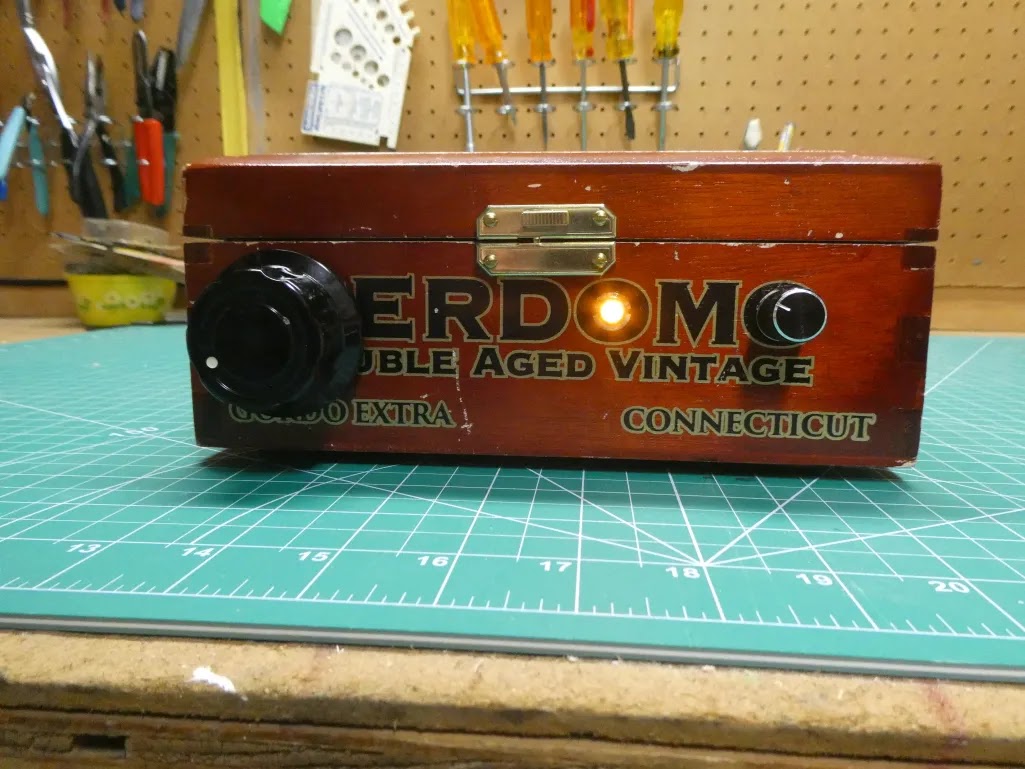
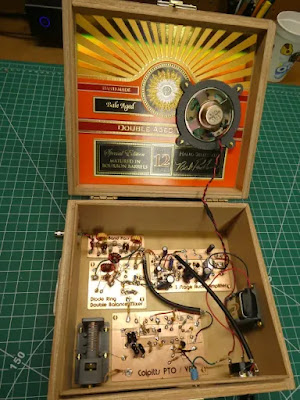
Wayne KC1ONM built a very nice direct conversion receiver. He has done something that 95% of hams never do: He has HOMEBREWED a receiver. FB Wayne. Congratulations!
After his completion of the receiver, Wayne put it all in a beautiful homebrew case:
To mark the PC boards, Wayne says, “MakeIt Labs has a MOPA laser. They were marked after construction of the board (the focus is high enough not to interfere with the components), but before attaching them to the box.”
—————————
For more information on how you too can build the receiver:
This is a really nice one. In the “proof of life” video we find a lot of proof, and a lot of life. SSB from the UK sounds really good. This is one of the beauties of the Direct Conversion architecture — you end up with a receiver that sounds very good. Doug DeMaw said these receivers have “presence” — it sounds like the other fellow is present in the room with you.
Dave’s happiness and satisfaction really shines through in his comments. Dave writes:
I’ve just completed my DCR, and it’s been an absolute blast!
I’m a retired EE, where PCBs and surface-mount components are the norm. I’ve occasionally prototyped using dead bug or Vero-board, but this is my first exposure to Manhattan construction – and I’ve thoroughly enjoyed it. Electronics and radio were my childhood passions, but inevitably, they lost some of their appeal once they became a career. Thank you, Bill and Dean, for helping me regain some of that lost joy!
My biggest challenge was trying to locate parts from a single UK source to minimize shipping costs (yes, I’m cheap). I briefly contemplated building a push-pull audio amp to avoid purchasing the transformer from Mouser, but in the end, I found most parts there, then padded the order with common junkbox parts to get free shipping. I’m so pleased that I heeded Bill and Dean’s advice to build the receiver as presented (well, almost). The results are so much better than I expected, with great-sounding, room-filling audio when connected to the passive half of an old active stereo speaker pair. Tuning is a bit fiddly but improves with practice. Luckily, I had no problems with any of the stages, and it just worked when the boards finally came together.
To save money (did I mention that I’m cheap?), I decided to use NP0 capacitors in the PTO instead of silver mica. The thermal coefficient should be similar, and if they didn’t work out, I planned to swap to mica later on. It turns out NP0 works great for me, with no noticeable drift after several minutes.
I don’t have easy access to a 3D printer, so I decided to roll my own PTO former. I wound the coil on a Bic Biro with a layer of heat-shrink tubing to bring the diameter to 10mm. This was glued to a wooden support, and the M6 threaded brass bar was a perfect fit inside the Biro. I finished it off with a tuning knob made from an old RC aircraft prop spinner. After experimenting with coil spacing, I ended up with wide spacing under the actively tuned area of the coil and tight spacing at the other end. This reduced the tuning sensitivity, and I now get around 40 kHz per revolution.
I’d really like to make a home-brew 2-way contact with this receiver, so maybe I’ll try a DSB transmitter next…
Thanks again to Bill and Dean for providing this fantastic resource. I’ve been a SolderSmoke listener since episode #1, and after 20 years of constructing radios vicariously, I’ve finally built one myself!
——————–
FB Dave! Thanks and congratulations.
——————————-
For more information on how you too can build the receiver:
Graham was another good sport. When I asked him about the receiver, he had already moved on, and — is often happens — had separated the stages and replaced some of them. He agreed to put the receiver back together and to shoot a video of it in action. Above you can see it, happily inhaling SSB from nearby Spain. He used a different AF amplifier cicruit — that is why this is in the Honorable Mention catergory.
Graham writes:
It has been an interesting exercise as I’ve tended to use active mixers before, but I think I am converted to DBMs now. The other rx I’ve been working on with a VCO is performing very well. I need to move the preamp over to the PTO one and see how it performs.
Thanks Graham and congratulations.
—————————–
For more information on how you too can build the receiver:
David AI6WR was a patient craftsman during the build of his receiver. He diagnosed and fixed defects in the AF gain controls that he was trying to use. He hung in there, found the problem, and fixed it. Even with a challenging antenna situation his receiver is pulling in SSB signals on 40 meters.
David writes:
Thank you everyone for the suggestions! I have tried a bunch of them out, those that I could try without making a ton of changes. I have made a couple of changes and it’s working much better now. It turned out that one of the major contributors to the unpredictable noise was the audio pot itself. It had poor mechanical connections between the input leads and and the internal traces that go to the resistor and wiper. They were actually wiggling around and constantly disconnecting and reconnecting randomly. I took it apart, cleaned the wiper with some rubbing alcohol, tried to get a better connection on the inputs by crimping them down and putting some solder on them, and then put it back together. Once I put that back into the circuit, it was still humming at high volume settings, but much more predictably. I also cut off the unused center tap lead on the primary side of my audio transformer. That wasn’t the source of the problem, but it wasn’t helping things. Finally, I put a 470u cap from the power rail to ground. That doesn’t totally eliminate the hum, but along with the other changes, it reduces it enough that nearly all of the volume range is reliably usable. It will still hum if I turn it all the way up, or if there is no antenna plugged in, but I think it is working in ordinary circumstances.
Congratulations David.
————————————————————
For more information on how you too can build the receiver:
Lex PH2LB has been a valued member of the SolderSmoke team for a long time. It was he who took our stickers into the bars and coffee shops of Holland, spearheading our efforts on Continental Europe.
He didn’t have to, but Lex took up the SolderSmoke Challenge. And he did it with panache. 3D yellow panache. Glue-stick panache!
Scott K1OA has been a licensed ham for more than 50 years, but he tells us that this was his first Manhattan-style project. He reports having built a lot of kits and even a DC receiver from EMRFD using an SA602 chip, but he says the SolderSmoke direct conversion receiver was the most fun. That comment meant a lot to us. We continue to believe there is value in homebrewing from scratch.
Scott writes:
Hi Bill,
This will be my 50th year as a licensed ham and my first
Manhattan style project. I’ve built a dozen kits in the past
15 years or so and bread-boarded a simple crystal
controlled DCR from a circuit in EMRFD
using an SA602, but the Soldersmoke DCR
challenge has been the most fun!
The most challenging aspect has been trying to get the
PTO tuning range close to 7-7.3 MHz. I’m still
experimenting with that.Audio output is loud and
sensitivity is pretty good.
I’m thinking my next project might be a simple crystal
controlled CW transmitter to pair up with the DCR, and
considering the Pebble Crusher 1/2W design from the
ARRL Handbook that uses a pair of 2N2222A
transistors. I’m interested in your thoughts on that.
Thanks for putting forth the challenge and for all the
great support you and Dean have provided!
73,
Scott K1OA
p.s. – love the podcast and your Soldersmoke Adventures
book!
Thanks Scott and congratulations.
———————
For more information on how you too can build the receiver:
I was really pleased to see Juan LU2VJM’s rapid completion of the SolderSmoke direct conversion receiver. But I wasn’t really surprised — Juan is an experienced homebrewer who has successfully completed Farhan’s BITX transceiver. Juan and I talked about how it is worthwhile for even an experienced homebrewer to go back and build a direct conversion receiver. Farhan did this. Farhan said that we do this because we are tool makers. We have opposing thumbs that allow us to grab a soldering iron. Indeed. And you can hear the happiness in Juan’s voice when he says in the video, “Today we have reception!” Excellent.
I was also pleased to see this receiver enter the Hall of Fame becasue this marks our first receiver from Latin America. We hope there will be many more.
Here are some pictures of Juan’s receiver during construction:
Juan’s AF Amplifier
Juan’s Diplexer with homebrewed coil
Another shot of the AF amplifier
The mixer, getting ready for construction
The completed receiver. FB!
Thanks Juan! And congrastulations!
For more information on how you too can build the receiver:
Victor is a retired Electrical Engineer from the Netherlands. He doesn’t have a ham radio call sign, but as I have said about other receiver builders, he deserves one. Note the truly homebrew approach that Victor used on the PTO coil form. And he had to rebuild this part to get the receiver on 40 meters. As we can see in the above video, Victor’s homebrew receiver is pulling in stations from across Europe. Victor even reports hearing a Japanese station. FB!
Victor writes:
Hi Bill, I changed the PTO tuning unit, more stable this way. I m a retired electrical engineer, revamping on a more daily basis tube radios from the 50’s 😉 I include a Bluetooth interface too so they can be used again by “young” people with their smartphones.. I had great fun and learning experiences building the DCR !!
Thanks for the video, pictures, and messages Victor. Congratulations!
For more information on how you too can build the receiver:
As with Chris, if there was any justice in the world, Garry would be issued a ham license based solely on this receiver build. He has done something that 95% of hams have never done: he built a receiver!
Congratulations Garry!
——————————————
For more information on how you too can build the receiver:
Dallas is a friend of Lyle WZ5M — Lyle encouraged him to build this receiver. Dallas’s son is also working on a receiver — we hope to see that one completed soon.
FB Dallas and congratulations.
For more information on how you too can build the receiver:
Lyle WZ5M did a great job on his receiver, and in the finest ham radio tradition encouraged two other builders to take up the SolderSmoke challenge. FB Lyle. I really like your receiver. That looks like a genuine pine board. Frank Jones would approve.
73 and congratulations!
For more information on how you too can build the receiver:
It is great to see the enthusiasm that John KC9OJV shows for his newly finished DC receiver.
John writes:
I’ve finished the DCR- Soldersmoke style- what a great project. Everything went well- I added some caps to the amplifier power rail to tamp down the oscillation beast. It’s on a compromise antenna here so can’t wait to take it outdoor and put it on a full-sized antenna. I’m a manhattan style convert- what fun to build this way.
Congratulations John!
——————–
For more information on how you too can build the receiver:
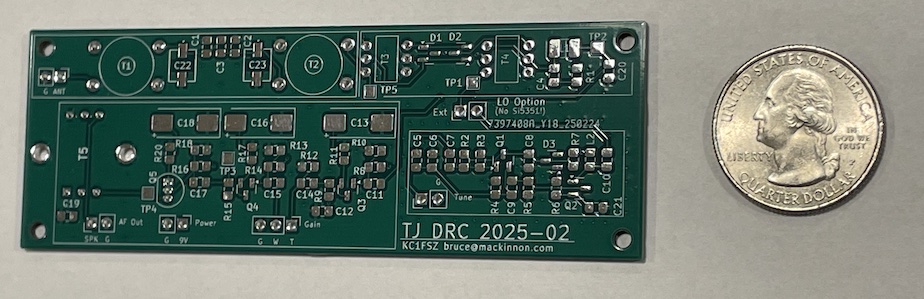
This is obviously not the style of construction that we would recommend for new builders. Thus the “Honorable Mention” category. But Bruce is not a new builder — in fact he has been a friend of the SolderSmoke podcast for many years: https://soldersmoke.blogspot.com/search?q=KC1FSZ When Bruce sent us the above video and a report on his build of the SolderSmoke Direct Conversion Receiver, we thought it was so cool that we wanted to share it with the community. Be sure to go to Bruce’s GitHub page for more details: https://github.com/brucemack/kc1fsz-tjdcr
Bruce writes: My unauthorized modification is in the construction realm. I’ve built Bill/Dean’s original circuit in a compact form on a commercial PCB. This was a good chance to practice with KiCad, Chinese PCB fabs, and SMD soldering. Huge thanks to Scott KQ4AOP for making me the PTO form! The rig works great. Thanks to Bill/Dean for leading such a successful/educational build project.
Hi Bill:
I had refrained from any postings of my work because the “purity” of my build may be called into question and I didn’t want to create further distractions from your efforts. HIHI. If you scroll down this page you’ll get an idea of what I’ve been up to: https://github.com/brucemack/kc1fsz-tjdcr.
I also see that you’ve switched away from the Schottky diodes which I have not done, so I’ll make that change to see how it impacts performance.
Moving fully into the realm of unauthorized deviations, I’ve been experimenting with the simple “frequency offset” feature shown in SSDRA on page 218. Hanging that simple circuit from the high side of C2 seems to provide the hook needed for a simple companion CW transmitter module. Joking aside, I’d never built an analog VFO before the TJDRC project, nor did I ever learn CW, so it’s been quite interesting to try to create a sister board that stays true to the TJDCR ethos but can still make legit contacts.
Thanks for all the work you guys are doing to educate the rest of us,
Bruce KC1FSZ
Dean and Bill:
What you guys have done with this project is truly amazing. I didn’t build the rig in the “original wave,” but I recently made one just for fun. I finally got around to looking at your Discord this weekend and was completely amazed… And Dean’s tutorial videos are surely headed for YouTube platinum status!
Congrats and 73s,
Bruce MacKinnon KC1FSZ, Wellesley, MA
Bruce: There are several builders on Discord who would be very interested in your CW transmitter module.
That receiver is a thing of beauty. Steve AA7U is 78 years old and retired from the electronics industry. Now he does this just for fun.
Look closely at Steve’s board. No pads! That, my friends, is the dead-bug technique. It is closely related to Manhattan style, but many builders prefer it. You see it in a lot of builds by Wes Hayward W7ZOI. I have some stuff built by Farhan using this technique.
You will also notice the absence of the PTO screw/coil. Steve made his receiver fixed frequency. But a member of the group has sent him one, so Steve may soon be tuining around the 40 meter band. FB.
But all four stages are there. And Steve did for us a lot of useful analysis:
Steve writes:
Hi Bill,
Attached is a picture of my DCR build. I used a fixed VFO since I don’t have a 3D printer (but just learned two folks are offering the printed coil and have just ordered one). Mine is set for about 7130 kHz. I’m using the cheap eBay Chinese audio transformer 1300 ohms. I’ve done bench sig gen checks for weakest CW signal I can hear with headphones, swapping out different DBM diodes. 1N5819 -130 dBm; MCL ADE-1 mixer -129 dBm; 1N5711 HCD diodes -127 dBm; 1N4148 -130 dBm. My LO output was about +6 dBm. Note the proper way to check LO output is to disconnect from the DBM and terminate the LO with 51 ohms and measure the RF AC voltage across the proper nominal 50 ohm load, then convert to Vrms and use an online volts to dBm converter to get the LO power. Looking at the LO voltage connected to the DBM does not give a correct LO power reading (SSD and EMRFD also mention this). I see Dean’s latest BPF comments (where I learned of the audio amp R14 100 ohms vs. 10 ohms typo) mentions the bypass cap on the LO jfet to increase LO output. I tried that yesterday and my LO output across 51 ohm load is now about +10.5 dBm (from the original approx +6 dBm) . The actual 8.2V zener diode voltage directly affects LO output too, I tested 10 diodes, the lowest was 8.05V, highest was 8.35V–higher voltage of course gives higher LO output.
(I’m 78 and retired from electronics, now do it for fun and hobby; I have a modest bench of test gear–various Siglent stuff including spectrum analyzer, etc. I’ve been homebrewing stuff for many years.)
Karl K5KHK wanted to build the receiver from junk box parts. But he did not have the needed AF transformer in his junkbox. So he designed an AF amp that would not need a transformer. That’s great, but the circuit was a lot more complex than the one we designed for use by beginners. And we advised others to search for the needed transformer and to use the circuit we had prescribed. Thus the original “Honorable Mention” category. But this is no big deal. Karl has made great contribuitions to the radio art, and his circuit will, I think, be of use to those who want to build a different AF amp AFTER they complete the basic receiver.
NOTE FROM 28 March 2024: Karl found the right kind of AF transformer! He went the extra mile and re-built the audio amplifier using the transformer. FB Karl. You Honorary Mention status has been removed! Welcome to the full Hall of Fame!
Here it is with the simple AF amp that we are using:
Karl writes:
First Light! I know, I am a rebel and cannot follow instructions, but I wanted to do this from my stash (OK, mixing worlds here, that’s what fiber artists call their junkbox of fiber, but I did join my wife this morning at a fiber fest). I do not have an output tranformer (I do have a few 600:600Ohm transformers). So here are my three answers:
1. Biggest challenge was to find a way to replace the output transformer. I did have a few baggies of BD139/140, so I researched small amplifiers wiith a complimentary output configuration and found one in John Lenk’s “Handbook of Simpified Solid State Circuit Design”, which apparently goes back to a Motorola application note (based on ancient transistors). After some noodling and heavy LTSpice’ing, I had something that looked like it would work, and it did, even though without anything connected, it blasted me with the local AM talk radio station (and some RF oscillation). A few strategically placed 0.01uF capacitors tamed the beast. What also helped with the design is that I found a schematic online without much comment (besides one who said “this will not work”) that was based on the same design with more modern transistors.
2. I learned a lot about how to keep strong RF from messing with my AF amplifier, and that without having to put it into a shielded box.
3. I’ve started on two modules for Pete’s PSSST transceiver when he first published it, but stuff got in the way, and I am motivated to pick it up again.
So again, the complete receiver was build with parts from my junkbox. This means that I had to make substitutions. I have for example a 5.1V Zener diode for the oscillator. It does produce enough power to drive the mixer, even with that lower voltage. I had smaller toroids on hand (-37 vs. the -50), so I had to do some math for the BPF to figure out how to wind them. I had no silver micas, and also no NPOs of the correct values, so a couple other values added up to almost exactly what I needed.