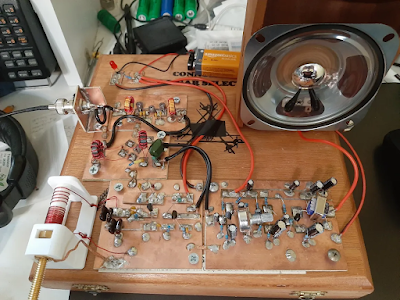
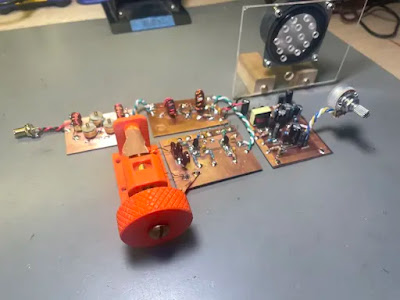
Dan KF5DAN’s FB SolderSmoke Direct Conversion Receiver

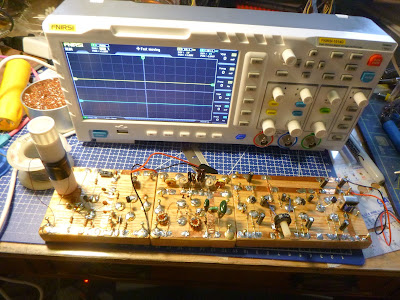
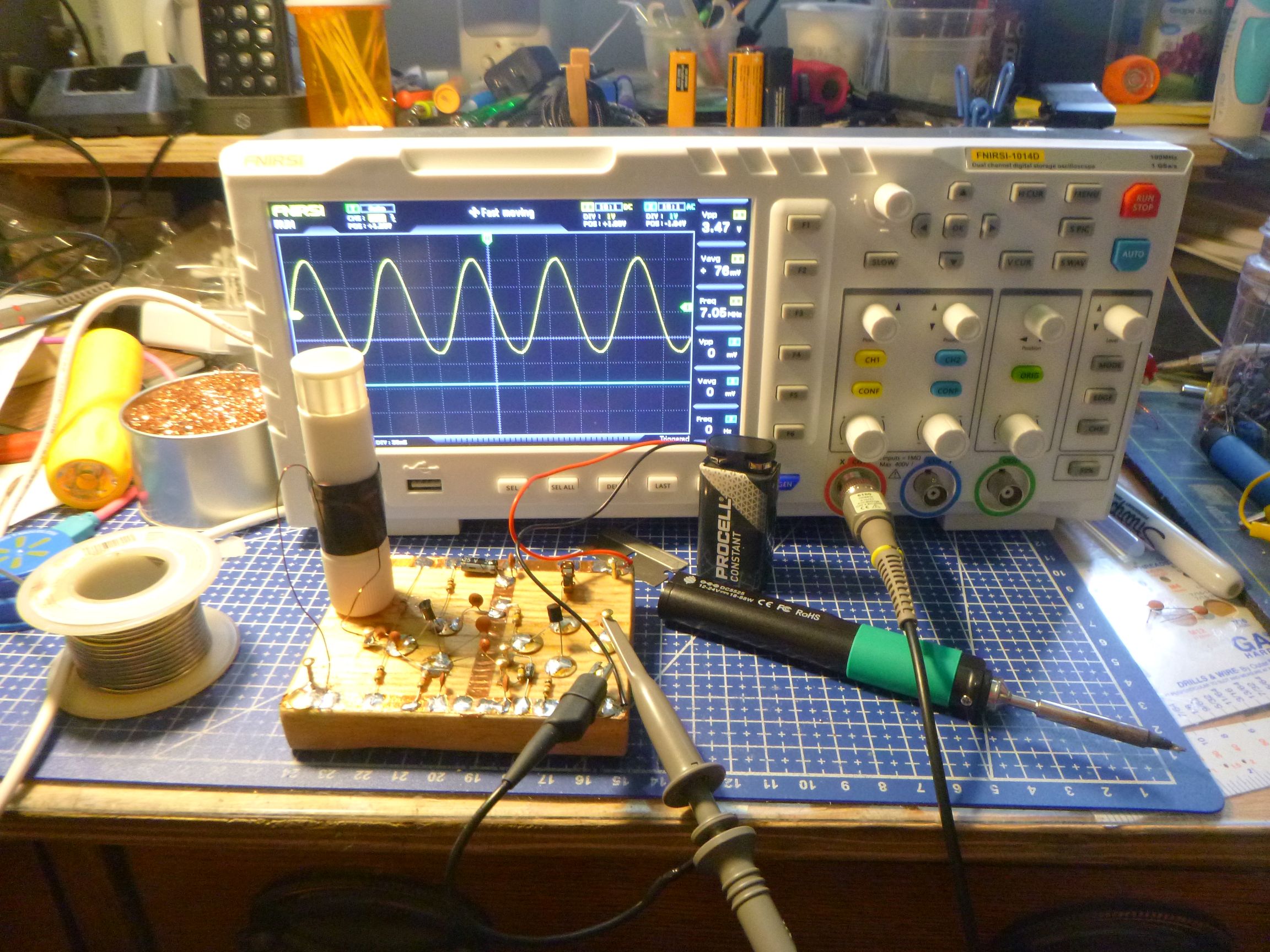
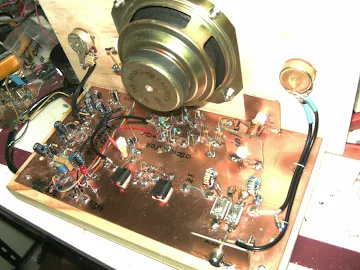
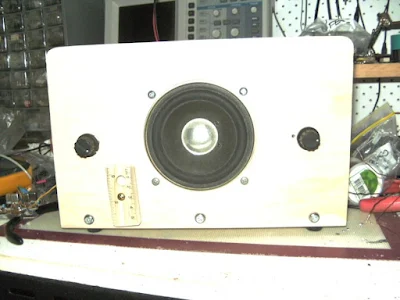
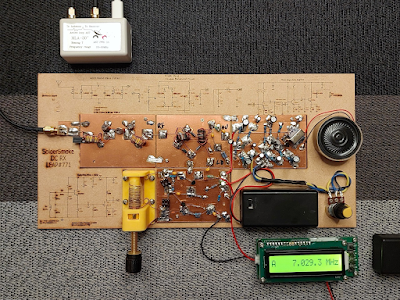
It is a happy occassion whenever we get to announce a new member of the SolderSmoke Direct Conversion Receiver Hall of Fame. And Dan KF5DAN has entered the hallowed halls. Congratulations Dan. We are really glad you are doing the happy dance. Above you can see Dan’s receiver inhaling SSB, in the video below you see it receiving CW.

Dan writes:

I would like to present proof of life! I found the motorboating issue in my amplifier. R18, 1K resistor was connected from the power rail to the base of Q5, instead of the collector. I moved it, and had already added a 470uF cap from earlier troubleshooting. There is a lot of noise, probably due to some stormy weather in Arkansas this evening. I’m doing the happy dance over here.
Thank you very much! I am very appreciative of all the guidance and suggestions everyone has provided. I am very happy to be in this group of hams and homebrewers.

Mike KM5Z’s SolderSmoke Direct Conversion Receiver

Congratulations to Mike KM5Z on the completion of his SolderSmoke Direct Conversion Receiver.
Welcome to the Hall of Fame.

Mike writes:

First time with ‘Manhattan’ style construction, although it worked perfectly and was very easy. In this video I just did a scan from about 7.100 to 7.210 MHz. As you can see, I took advantage of another ham’s 3D prints.
After all, if an idea is worth doing, then… it’s worth overdoing.I used a Milwaukee 1/4″ Diamond Max hole saw to cut circles for the solder-points. Everything else is ground. Later, I found that I missed a point, so I used a single “MePAD” glued in that spot.I found the default audio amp to be a bit quiet. I plan to replace it with the ‘push-pull’ version. I’m definitely keeping this to hang up on the wall.

Hall of Fame Update: 82 Completed SolderSmoke Direct Conversion Receivers, with 7 Honorable Mentions. More receivers are being built. As of July 9, 2025 0914Z

Please let us know if you spot any errors, or if we have inadvertently missed anyone. Don’t worry about being late to the game — the challenge continues. All of the info is still available (see below).

As of July 9, 2025 0914Z:


So far 82 completed receivers, with 7 honorable mentions. Receivers built in 15 countries.


NE3U (KY4EOD) Matt
KQ4AOP First ham signals ever heard!
N9TD Derek
AC3NG Ryan
VK3TPM Peter Marks
W4KAC Ken
W4KAC Ken built a second one!
N2EPE Erik
VA3NCA Wayde
KI5SRY Mark — Gears on PTO screw
KA1MUQ Frying pan receiver
AA1N Adam
ZL1AUN Aaron — Using SSB transmitter
W8UC Never before homebrewed.
VK4PG Phil — Nice case, “really pleased”
G7LQX Working well, video of CW and SSB.
KE2AMP John Spring on PTO screw — great
N9SZ Steve nice receiver
KD9NHZ Piotr Nice one
KE8ICE Calvin, Very cool receiver.
WV3V Jayson! Got it done!
GM5JDG Martin.
KF8BOG Jim: A long struggle, but success.
Chris Wales Fantastic video.
YD9BAX Wayan! Homebrew transformer!
N0NQD Jeff
WN3F Roy — Made new stickers!

AB5XQ Bill
KB7ZUT Andy
AA1OF Jer

VictorKees Holland
KC9OJV John — Manhattan-style convert
WZ5M 1, 2 or maybe even 3 receivers!
K1KJW Jim in Vermont
KC5DI Dallas — friend of WZ5M
Gary Australian — Wooden PTO form
LU2VJM Juan in Argentina
K1OA Scott “Most fun in 50 years”
KC9DLM Ben — Had EFHW problems
PH2LB Lex Yellow, Glue Stick
AI6WR David
G6GEV Dave (It was a blast!)
KC1ONM Wayne MakerLabs NH
KB1OIQ Andy MakerLabs NH
KA1PQK Jay MakerLabs NH
W1TKO Mike MakerLabs NH
K5KHK Karl
SM0TPW Mikael
KI7LKB Brian (coat hanger tube)
M6CRD Chris
W2DAB Dave in NYC
W4JYK Wes of VWS
KA4CDN Mike of VWS
M7EFO Adrian
VK5RC Rob
KD8KHP Dave
VK1CHW Chris
KA0PHJ Brian
W0IT Louis
W1PJE Phil
W2AEW Alan
KN6FVK John (Barkhausen-Be-Gone Spray)
VU2JXN Ramakrishnan
AA0MS Doug
9V1/KM7ABZ Paul in Singapore
VK2BLQ Stephen
N3FJZ Rick
Daniel VE5DLD
Student 1 Student of VE5DLD
Student 2 Student of VE5DLD

Student 3 Student of VE5DLD
K7WXW Bill
NK3H Mitch
KN4ZXG Ted
WA1MAC Paul
N4AVC Chuck
K3IY Kevin
N6ASD Ashish in Bangalore
W1DSP Rick
WD4CFN Steve
KM5Z Mike
KF5DAN Dan

————————-
Honorable Mentions:


*AA7U Steve No PTO
*VK7IAN Ian — No Manhattan boards
*KC1FSZ Bruce’s build on a PC board
*CT7AXD Graham — different AF amp
* DL1AJG Andreas
* Matthew Student of DL1AJG
* Arash Student of DL1AJG
—————————————–

Candidates for the Hall of Fame:
SA5RJS Rasmus
KA9TII James
AA7FO Chuck
VA3ZOT Tony Surface Mount — Honorable Mention?
AB2XT John (Done, just need the video)
KO7M Jeff (Piper Cub)
KD4PBJ Chris
VU2TUM Puneit Singh

For more information on how you too can build the receiver:

Join the discussion – SolderSmoke Discord Server:

https://discord.gg/Fu6B7yGxx2

Documentation on Hackaday:

https://hackaday.io/project/190327-high-schoolers-build-a-radio-receiver

SolderSmoke YouTube channel:

Steve WD4CFN’s FB Mid-Tennessee SolderSmoke Direct Conversion Receiver

Steve WD4CFN has built a FB SolderSmoke Direct Conversion Receiver. CW reception video appears above.

From his QRZ page: “I also enjoy QRP. A group of us have started a local QRP club this year, MidTN QRP Group. (https://groups.io/g/MidTNQRP).

Steve writes:

I finished my SS DCR tonight and connected an antenna. Lots of summer QRN, but also lots of signals. Thank you and Dean for all the work you guys put into this project. It is so well done and documented. The whole project has been a great learning experience, especially the mixer part. I haven’t built a diode ring mixer before, just used the SA602/SA612 type mixer. Testing the mixer pushed me to better understand how to use the FFT function of my scope to make sure the mixer was working correctly. This was a great project! Thanks to all.

Here is Steve’s receiver inhaling SSB:

Congratulations Steve. Welcome to the Hall of Fame.

Rick W1DSP’s FB SolderSmoke Direct Conversion Receiver — Exploring the Rabbit Holes


Thanks to Rick W1DSP for sending us his “proof of life” video. It is indeed alive! Congratulations Rick! Welcome to the Hall of Fame!

Rick writes:
Here’s another SS DCR proof of life video. I took a bunch of detours on the way to get here – redesigned the coil former to add a fixed coil (learned openscad), spent a bunch of times on the DCR classics (KK7B, W7EL designs), acquired parts to build the original KK7B DCR, and so on. This is the sort of project that’s a perfect excuse to explore all the sorts of rabbit holes we hope to find along the way to completing a project. Thanks for a great project. I’d just like to add that you’re building a great community of experimenters. Most excellent, sir! Thanks to Bill & Dean!

Ashish N6ASD’s Beautiful SolderSmoke Direct Conversion Receiver — Built in Bangalore — “This was such a fun project. This was my first direct conversion build, and I learned a lot along the way.”

Ashish N6ASD is a really good guy. We started watching his projects when he was in San Francisco. He does a lot of fundamental radio building. And he is a friend of Homebrew Hero Frank Harris K0IYE.

When I spotted a “thumbs up” from an N6ASD on the SolderSmoke Discord channel, I knew that we would soon have yet another Bangalore Direct Conversion Receiver. Ashish has been in contact with both Farhan and Ramakrishnan. FB.

Ashish writes: I finally finished building the receiver! This was such a fun project. This was my first direct conversion build, and I learned a lot along the way. The biggest challenge was finding stable capacitors for the oscillator. In my first attempt, I used whatever I had in my junk box, but those capacitors drifted all over the place. Mica caps seemed expensive and difficult to get in Bangalore. I ended up buying surface-mount NP0 capacitors instead. Soldering them was a hassle, but they are much cheaper and easier to get here. Next step will be more mods and experimentation! The first improvement will be in the BPF. I will replace the regular ceramic caps with NP0 caps and re-tune it.

Here is Ashish’s receiver inhaling CW:

Congratulations Ashish — Welcome to the Hall of Fame!

Ashish N6ASD
The resemblance between Ashih’s photo and the famous
1818 painting by Caspar David Friedrich is completely coincidental,
but quite remarkable.

Kevin K3IY’s Beautiful FB SolderSmoke Direct Conversion Receiver: “An amazing experience… A milestone for me…”

Kevin’s receiver was beautifully built. And it sounds great. Congratulations Kevin, and welcome to the Hall of Fame.

Kevin writes:

This was my first “real” homebrew project. I’ve built a few kits and toyed with some basic circuits, but this is a milestone for me. It wasn’t without some troubles but what an amazing experience. I couldn’t get my oscillator to work and the issue was I tried to make due with two 680pF ceramic caps. I took Dean’s advice to stick with the 330pF silver mica’s and I found my signal. At this point I also broke down and bought an oscilloscope. I now plan to do some mod’s and eventually build a TR switch and pair it with a transmitter. I can’t thank Bill and Dean enough for making this an obtainable goal. Kevin, K3IY

Kevin’s receiver on CW (above) and SSB (below).
He’s thinking about his receiver

Chuck N4AVC’s FB SolderSmoke Direct Conversion Receiver: “I enjoyed the build and testing.”

Chuck N4AVC’s use of the frequency counter in his digital multimeter is pretty cool and innovative. And it is nice to have yet another receiver in Virginia; he is down in the Richmond area. And of course the Sharpie callsign tattoos on the wooden board are really nice.

Chuck writes:

Completed!!! For Pete: “She ain’t pretty, but she sure can cook!”. Thanks Bill and Dean, I enjoyed the build and testing. It’s funny, the audio oscillates on an older 9v battery, but is clean on the 9.5v bench supply. Going to put Bill’s mod on the inductor to make tuning a little finer and spread the boards out a little more. I used the double sided boards I had and there is some interaction between the boards.

Congratulations Chuck! Welcome to the Hall of Fame!


Paul WA1MAC GETS DOWN TO BRASS TACKS with his FB GLUE STICK SolderSmoke Direct Conversion Receiver

Wow, look at that beautiful build of the SolderSmoke Direct Conversion Receiver. We haven’t received a “proof of life” video from Paul yet, but we trust that his receiver does in fact work. Paul has some heavy care-giver responsibilities that keep him in his home. We do not want to complicate his life by asking for outside antennas or videos.

We are also not going to complicate Paul’s life my insisting that he build it our way. First, his life is already complicated enough, and second, the innovations he introduced are really cool. The use of brass tacks and conducive copper tape is really ingenious. And the glue stick has brought him to the Joy of Oscillation (JOO). In fact the glue stick has given him JOVO — the Joy of Variable Oscillation. FB Paul.

Paul writes:

Hi guys

I’ve been gettin down to brass tack here at the mac-shack! Fits in nicely within my new caregiver role.
Been having a ball with the brass thumbtack breadboarding from SPRAT on your DC Receiver challenge!
Gluestick PTO, check, alive with the joy of oscillation!
BPF, check (need to tune once I find the nano VNA here somewhere)
DBM and diplexer, check, there was room on the board left over so I cheated and snuck the BPF on that board too
3 BJT audio amp with transformer, check, alive and passes the finger test, loudly!
Since I currently have no 40m antenna here guess it’s time to finally put that active antenna I’ve been meaning to build…………Any how thanks for all the fun and hair pulling, oh wait, I’m already bald!
73
Paul WA1MAC, get it the mac-shack 🙂
JOVO!
Glue Stick!
Brass tacks!
Congratulations Paul! Welcome to the Hall of Fame!

Ted KN4ZXG’s FB SolderSmoke Direct Conversion receiver: “This project is the greatest gift to homebrewing…”

There it is, a thing of beauty. The best part is that Ted built this receiver himself. That is something that most hams NEVER do.

Ted writes:

This project is the greatest gift to homebrewing since I got interested in radio nearly a decade ago. Lot’s of great projects out there but most go into a mysterious black hole of obsolete parts like the NE612 mixer that’s hard to get, or even the LM386, which is plentiful but not as cool as this amp. Everything’s divided neatly on it’s own board and explained. The builder has wiggle room on the layout and ways to test each module whether that’s with nice or budget equipment. Not only did I learn a ton about each stage, but also about making RF probes and making use of my modest but super useful equipment like the Nanovna. Although there were no mysteries, it all comes together to make magic. If you know stuff, you can do stuff! Thanks again de KN4ZXG, Ted.

While he has some great plans for modifications and improvements, at this point I think Ted should follow Farhan’s advice and spend some time just listening to the receiver that he has built. Direct conversion receivers sound especially good. It is as if they are closer to the ether.

Here are some clips of Ted’s receiver in action:

Congratulations Ted. Welcome to the Hall of Fame.

Mitch NK3H’s FB SolderSmoke Direct Conversion Receiver — “Incredibly satisfying!”

Wow, Mitch NK3H has built a really nice receiver. (He says it is not pretty, but those of us who have built one or who are in the process know that it looks great.) The SSB really sounds good also.

Mitch writes:

It’s not pretty but it works! Incredibly satisfying. In answer to the questions, (1) though I ‘d built a few small Manhattan style boards (e.g., Michigan Mighty Mite) this was more complicated. I’ve been using W1REX’s island cutter to create isolated areas on the copper clad board, rather than pasting on pieces of circuit board. But the islands are a little small for as many as four connections on one island, as in most of the transistor bases. Inevitably a component lead would inadvertently contact the ground plane and all bets were off. Tracking down the shorts was challenging. (2) Once I got to the audio amplifier board I carefully laid out all of the components before starting to solder. But as I finished each stage and was ready for the next, I always seemed to be missing a resistor or two. I’d search the desk and the floor — very frustrating. Turns out the speaker magnet was collecting and hiding the missing resistors. Lesson learned. (3) Next I’m hoping to build a transceiver. Still looking for the right project, probably a little more digital than this wonderful DCR.

Mitch obviously learned a lot during this project. I had similar experiences with pads on the same level as the surrounding board — I found that the 1 or 2 mm of elevation provided by the Manhattan pads prevented a lot of inadvertent shorts to ground. And I too “lost” (temporarily) a lot of components to the magnet in the speaker.

Good luck with the next projects Mitch. With the Michigan Mighty Mite and the DCR under your belt you are ready to go. Maybe a Double Sideband transmitter to go with the DCR? Or, as you said, perhaps something more digital. There is a lot of good ham experience with the Si5351 digital VFOs. Or maybe even an SDR rig.

Thanks Mitch. Congratulations and welcome to the Hall of Fame.

———————–

Join the discussion – SolderSmoke Discord Server:

https://discord.gg/Fu6B7yGxx2

Documentation on Hackaday:

https://hackaday.io/project/190327-high-schoolers-build-a-radio-receiver

SolderSmoke YouTube channel:

Bill K7WXW’s FB SolderSmoke Direct Conversion Receiver

This is a very nice build. Bill K7WXW fought a long battle to get this receiver working, and — more importantly — to understand why it is working.

Bill writes:

  1. The cycle of design, sim, build, debug, update, repeat can teach you a lot.


FB Bill. Welcome to the Hall of Fame!

Join the discussion – SolderSmoke Discord Server:

https://discord.gg/Fu6B7yGxx2

Documentation on Hackaday:

https://hackaday.io/project/190327-high-schoolers-build-a-radio-receiver

SolderSmoke YouTube channel:

Hall of Fame: The SolderSmoke Direct Conversion Receiver — 80 Completed Receivers, 7 Honorable Mentions, Built in 15 Countries — Many More Receivers Being Built.

WA1MAC’s Receiver

Please let us know if you spot any errors, or if we have inadvertently missed anyone. Don’t worry about being late to the game — the challenge continues. All of the info is still available (see below).

As of June 18, 2025 1049Z:


So far 80 completed receivers, with 7 honorable mentions. Receivers built in 15 countries.


NE3U (KY4EOD) Matt
KQ4AOP First ham signals ever heard!
N9TD Derek
AC3NG Ryan
VK3TPM Peter Marks
W4KAC Ken
W4KAC Ken built a second one!
N2EPE Erik
VA3NCA Wayde
KI5SRY Mark — Gears on PTO screw
KA1MUQ Frying pan receiver
AA1N Adam
ZL1AUN Aaron — Using SSB transmitter
W8UC Never before homebrewed.
VK4PG Phil — Nice case, “really pleased”
G7LQX Working well, video of CW and SSB.
KE2AMP John Spring on PTO screw — great
N9SZ Steve nice receiver
KD9NHZ Piotr Nice one
KE8ICE Calvin, Very cool receiver.
WV3V Jayson! Got it done!
GM5JDG Martin.
KF8BOG Jim: A long struggle, but success.
Chris Wales Fantastic video.
YD9BAX Wayan! Homebrew transformer!
N0NQD Jeff
WN3F Roy — Made new stickers!

AB5XQ Bill
KB7ZUT Andy
AA1OF Jer

VictorKees Holland
KC9OJV John — Manhattan-style convert
WZ5M 1, 2 or maybe even 3 receivers!
K1KJW Jim in Vermont
KC5DI Dallas — friend of WZ5M
Gary Australian — Wooden PTO form
LU2VJM Juan in Argentina
K1OA Scott “Most fun in 50 years”
KC9DLM Ben — Had EFHW problems
PH2LB Lex Yellow, Glue Stick
AI6WR David
G6GEV Dave (It was a blast!)
KC1ONM Wayne MakerLabs NH
KB1OIQ Andy MakerLabs NH
KA1PQK Jay MakerLabs NH
W1TKO Mike MakerLabs NH
K5KHK Karl
SM0TPW Mikael
KI7LKB Brian (coat hanger tube)
M6CRD Chris
W2DAB Dave in NYC
W4JYK Wes of VWS
KA4CDN Mike of VWS
M7EFO Adrian
VK5RC Rob
KD8KHP Dave
VK1CHW Chris
KA0PHJ Brian
W0IT Louis
W1PJE Phil
W2AEW Alan
KN6FVK John (Barkhausen-Be-Gone Spray)
VU2JXN Ramakrishnan
AA0MS Doug
9V1/KM7ABZ Paul in Singapore
VK2BLQ Stephen
N3FJZ Rick
Daniel VE5DLD
Student 1 Student of VE5DLD
Student 2 Student of VE5DLD

Student 3 Student of VE5DLD
K7WXW Bill
NK3H Mitch
KN4ZXG Ted
WA1MAC Paul
N4AVC Chuck
K3IY Kevin
N6ASD Ashish in Bangalore
W1DSP Rick
WD4CFN Steve

————————-
Honorable Mentions:


*AA7U Steve No PTO
*VK7IAN Ian — No Manhattan boards
*KC1FSZ Bruce’s build on a PC board
*CT7AXD Graham — different AF amp
* DL1AJG Andreas
* Matthew Student of DL1AJG
* Arash Student of DL1AJG
—————————————–

Candidates for the Hall of Fame:
SA5RJS Rasmus
KA9TII James
AA7FO Chuck
VA3ZOT Tony Surface Mount — Honorable Mention?
KM5Z Mike Yancey
AB2XT John (Done, just need the video)
KO7M Jeff (Piper Cub)
KD4PBJ Chris
VU2TUM Puneit Singh

For more information on how you too can build the receiver:


Join the discussion – SolderSmoke Discord Server:

https://discord.gg/Fu6B7yGxx2

Documentation on Hackaday:

https://hackaday.io/project/190327-high-schoolers-build-a-radio-receiver

SolderSmoke YouTube channel:

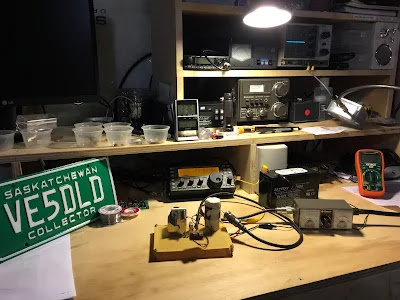
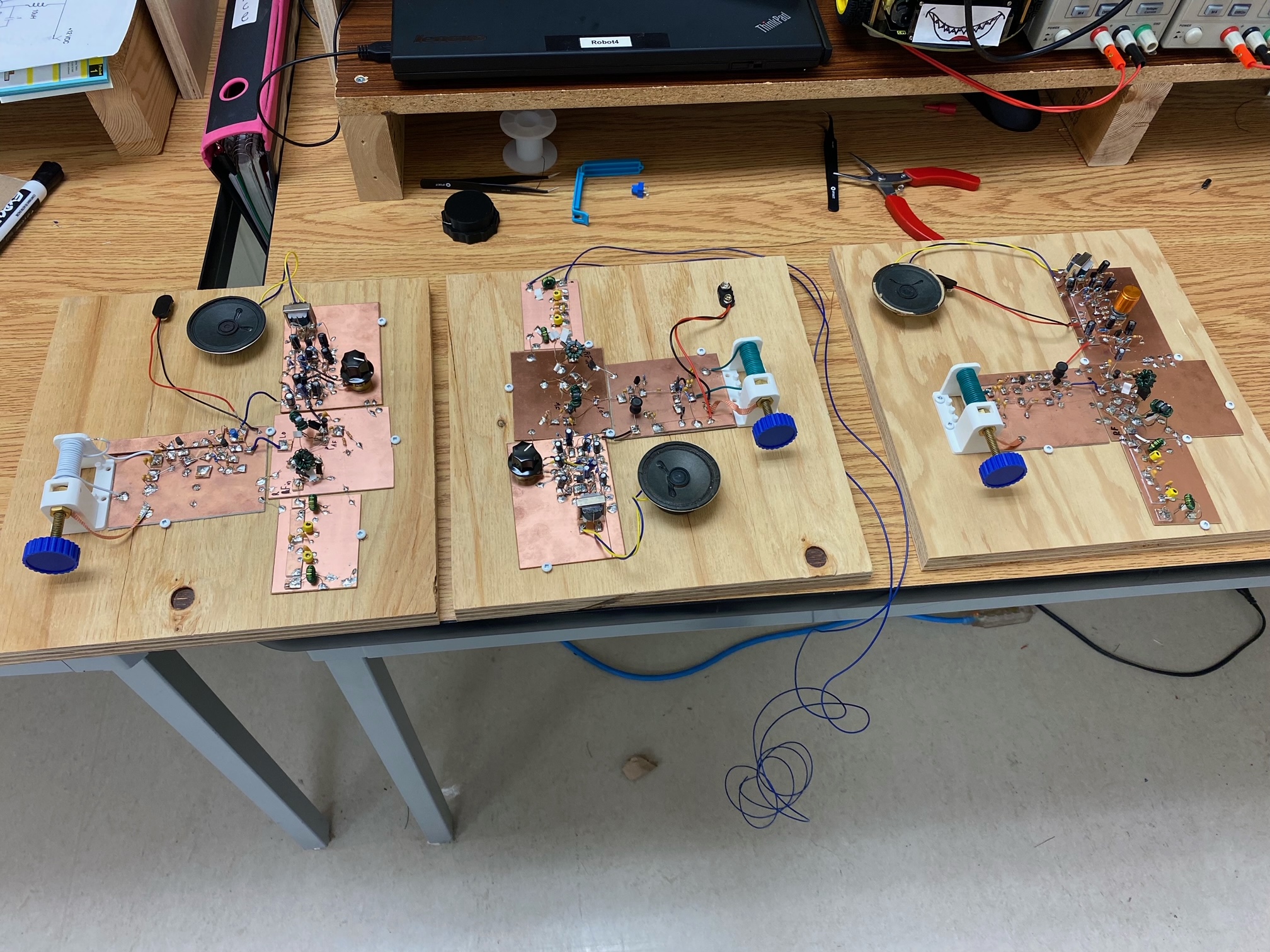
Daniel VE5DLD’s FOUR FB Saskatchewan SolderSmoke Direct Conversion Receivers

Daniel VE5DLD is a teacher in Regina, Saskatchewan, Canada. Back in early 2023 several lucky students joined him in building the SolderSmoke Direct Conversion receiver. We had asked people to build the receiver — we wanted to test the design before asking the local high school students to build it. Daniel and his students came through for us, and ended up having far more success than we did. Congratulations Daniel! Welcome to the Hall of Fame.

Daniel wrote:

Hi Bill! Yes, I had my own DC Receiver that I use every so often for fun and 3 built by my students. All working. We didn’t get any video because we just finished the school year and the kids left, but I’ve kept in contact with them and they told me they have been able to receive signals from their homes. The kids developed excellent troubleshooting skills gained large amounts of confidence in their ability to fix things. Over the next year, my students told about fixing their gaming consoles and fixing problems in their parent’s electronics. They are certainly no longer afraid of opening something up to see what is going on! And that’s what makes me the most happy! Yeah, you can just recognize myself and only mention that 3 students were able to build DC receivers.

And yes, the Michigan Mighty Mite was a fantastic gateway to home brewing!

Thanks for thinking of me and my students!

73
Daniel D.
VE5DLD

On June 19, 2023, Daniel wrote:

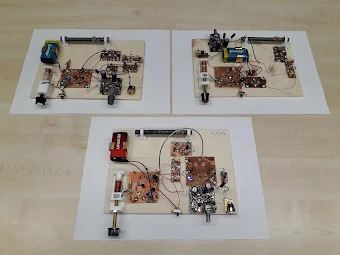
We got everything going and all 3 students now have receivers capable of inhaling RF. We 3D printed some knobs and hot glued them. We took one outside but didn’t hear any signals. Mid afternoon is not good for 40m. We will try again later this week and I’ll bring my KX3 to make sure there is a single for them to listen. This issue on that last radio was an improperly installed J310. The angle is was installed hid the problem well! Here are a few pictures of the completed rigs.

Back in 2015, Daniel built a Michigan Mighty Mite. I was pleased to be reminded that I had sent him the crystal. Go CBLA! For more info on Daniel’s transmitter see:
Thanks Daniel! 73
___________________________

Join the discussion – SolderSmoke Discord Server:

https://discord.gg/Fu6B7yGxx2

Documentation on Hackaday:

https://hackaday.io/project/190327-high-schoolers-build-a-radio-receiver

SolderSmoke YouTube channel:

Honorable Mention: Andreas DL1AJG’s THREE SolderSmoke Direct Conversion Receivers for Biologists

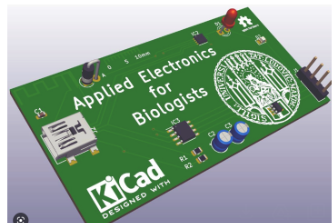
Andreas DL1AJG was another of those intrepid hams who, in the dark of winter 2023 took up the SolderSmoke Direct Conversion Receiver Challenge in order to test our receiver (before we pushed high school kids to build it). Andreas came to the task with a lot of useful teaching experience. At the time he was an academic biologist and had been teaching a course called “Applied Electronics for Biologists.” See:

https://soldersmoke.blogspot.com/2022/08/can-biologist-fix-radio.html

Some of Andreas’s students

I put these receivers in the “Honorable Mention” category only because they deviated a bit from the basic schematic: they used an indoor ferrite antenna, had an RF amplifier ahead of the mixer, and did not use a transformer in the AF amp. But they are very clearly the SolderSmoke DC receiver, they succeeded in inhaling RF, and Andreas and his students built them to help us.

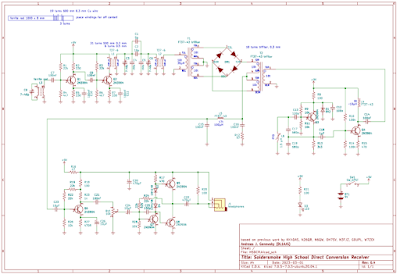
Here is the schematic they used:

Click on the image for a better view
Here is an e-mail exchange I had with Andreas when the scholatic dust had settled in June 2023:

Dear Bill,

Please my apologies for my late update on our DCR project. We started with the course in the semester break and once the semester started only a handful of students were able to finish their receiver. A long shelf of shame ….

Here is what we’ve got so far (those were finished at the end of April already). 3 nice DCRs completely sufficient to copy CW indoors without additional antennas starting from late afternoon. Strong stations can be heard all day. I found that coupling some 6m of wire with one or two windings to the ferrite core can boost the signal dramatically but can also increase noise.

The PTO is based on your design (Bill Meara N26QR & Dean KK4DAS) which was sparked by Farhan (VU2ESE) , except that I’ve swapped the FET for a NPN. The input amplifier and antenna is from the JUMA active ferrite antenna by Matti Hohtola (OH7SV), the band pass filter is from Hans Summers (G0UPL), the mixer and the headphone amplifier is inspired by Pete Juliano (N6QW), you told me that the diplexer (as well as the whole DCR idea) is attributed to Wes Hayward (W7ZOI) and the perfect schematics of Rick Scott (N3FJZ) where crucial to get me started in the first place. I enjoy keeping track of original sources, as I would do in science. This shows that even little achievements are based on the ideas of many other great people – and this is nothing to be ashamed of.

This was a lot of fun! Thank You!
Best and yours sincerely,
Andreas

Wow, the direct conversion re-engineering of education continues, this time at graduate-school level with biologists in Munich! Amazing.

Andreas points out that his group was also plagued by semester-related problems that caused many additions to the German shelf of shame. Let’s hope that someday soon these builders will come to their senses and join the ranks of those who have finished their homebrew projects.

Looking at the schematic (above) of Andreas’s project, there are a couple of significant differences from ours:

— Their AF amp used a transformer-less push-pull design. We had considered this but abandoned it thinking that it would be too complicated to explain the workings of this circuit to our students.

— Most significant, is Andreas’s use of a ferrite rod antenna and an RF amplifier. I think a simple 33 foot quarter wave antenna (with a ground or a counterpoise) might work better. But hey, to each his own! The important thing is that a number of these receivers were successfully built. They look beautiful.

Congratulations to Andreas and the successful Munich homebrewers!

———————————–

Thanks to Andreas DL1AJG. Welcome to the Hall of Fame.

————————————

Join the discussion – SolderSmoke Discord Server:

https://discord.gg/Fu6B7yGxx2

Documentation on Hackaday:

https://hackaday.io/project/190327-high-schoolers-build-a-radio-receiver

SolderSmoke YouTube channel:

Rick N3FJZ’s Early Completion of the SolderSmoke Direct Conversion Receiver Challenge

It was a cold day in early February 2023. Rick N3FJZ had responded to an early version of the SolderSmoke Direct Conversion Challenge:

I wrote:

Rick N3FJZ has completed his the direct conversion receiver that we will soon be building with students at a local high school. See video above.


We are hoping that a number of people will build the receiver as we designed it. Some folks have sent us versions of the receiver that they have built, but these versions often include significant deviations from our design, rendering them less-than-useful in checking our work. Rick built it just as we prescribed. His build is very useful in confirming the validity of our design. So if you are working on one of these receivers, I would encourage you to — for the moment — dispense with innovations and build it the way Rick did: as per the design we have been using.

We know that our design is not perfect. But we have decided to stick with it because it is very simple and very easy to explain. Examples: We know there is an impedance mismatch between the mixer and the AF amp. But fixing this would introduce complexity that we want to avoid. And the receiver works fine with the imperfection. We know that a push-pull AF amp would probably work better than the one we have. But we do not want to have to explain push-pull amps, biasing schemes, and PNP transistors in this short introductory course. So we stuck with three common-emitter AF amp circuits and an 1K-8ohm transformer.

Rick did a really excellent job not only in building this receiver, but also in documenting it. His diagrams and drawings are really superb. We will probably use these in our presentations to the students:


We will keep all of you informed on the progress of this project. We will begin this week. But if you are still working on the receiver, please send us your work, even if it comes in after we begin the course.

Thanks Rick!

————————————-

Thanks indeed Rick. Sorry it took so long to put you in the SolderSmoke Challenge Hall of Fame, but you are in now, and you definitely deserve it. Congratulations OM.

I especially like your finding the audio ourput transformer in an old transistor radio. Too often we see builders quit after discovering that Mouser or some other supplier no longer stocks the needed part. You show that homebrewers have other sources available, if they are willing to scrounge a bit. FB. I also liked the switch that helped compare the outputs of the two AF transformers. Very useful.

Thanks too for all the great videos and your really nice documentation — we have used your work quite a lot.

73 and welcome to the Hall of Fame!

Rick N3FJZ
____________________________

Join the discussion – SolderSmoke Discord Server:

https://discord.gg/Fu6B7yGxx2

Documentation on Hackaday:

https://hackaday.io/project/190327-high-schoolers-build-a-radio-receiver

SolderSmoke YouTube channel:


Stephen VK2BLQ’s Very FB EARLY build of the SolderSmoke Direct Conversion Receiver

This was back in the old days, long before we had Discord. It was early 2023, and we were getting ready to start the Direct Conversion receiver project at the local high school. I put out a version of the SolderSmoke Challenge: I asked people to build our receiver and let us know if it worked for them. Stephen VK2BLQ took us up on this and built the beautiful receiver you see above.

Thanks Stephen. Welcome to the Hall of Fame!

Stephen wrote:

Bill,


Don’t worry, you are not alone out there.

Here is my build; sorry that the front panel is overexposed and hard to see, but it is plywood.

I did follow the schematic but due to the contents of the junk box there have been some component changes.

The only thing that I had to buy was the 3/16 x 50 mm (2 inch) brass screw.

My calculations for the coils for the PTO and BPF were a little bit off necessitating padding down the PTO with a further 100 pF (easier than remaking the coil and mounting) and removing a few turns from the T50-6 toroids.

Like other people have found: the audio takes off at full volume; I am thinking but not yet tried adding decoupling between R5 (15K) and C2(47 uF). It isn’t the actual values of the electros as I had to use 100 uF so might be the audio output getting back into the earlier stage.

The tuning range I get is our 7000 to 7200 KHz and some shortwave stations above and below, Turning the screw is a little bit fiddly, but once tuned the vfo is quite stable and the audio sounds good.

Best wishes,

Stephen

VK2BLQ

MIT’s Haystack Observatory and Dr. Herb Weiss

We are really privileged to have among us (and in the SolderSmoke Direct Conversion Hall of Fame) Phil Erickson W1PJE. Phil is the Director of the MIT Haystack Observatory.

Phil writes:


Hi Bill, Dean, and Pete,

I surfed over today to Soldersmoke and noticed you had put up a very nice film from the 1960s made by MIT “Science Reporter” on the DSKY design for the Apollo Guidance Computer.

In the same vein, you might enjoy viewing something from the same era on the Haystack 37m telescope / radar in its early mid 1960s days:

The video features Dr. Herb Weiss who is still with us at nearly 106 years old (he visited a couple years ago).


Herb built the observatory for its original ballistic missile radar / satellite imaging mission and was involved in early MIT microwave radar development.

“Growing up in Elizabeth, New Jersey, Herb liked gadgetry. As a teenager, he became a ham radio operator and built a primitive television set at the same time NBC was trying to get its first signal on the air. His shop teacher was so impressed by Herb’s genius that he contacted MIT, which invited Herb to attend the college.


He spent the bulk of his career developing radar when there was none in the United States. He joined the Radiation Lab at MIT, which was just being established to support the war effort during World War II, designing radars for ships and aircraft. In 1942, when England was in the throes of its air war with the Nazis, Herb went to England and installed radar in planes with a novel navigation system that he and a team had designed for the Royal Air Force. He later spent three years at the Los Alamos, New Mexico, laboratory improving instruments for the A-bomb. After seeing the need for a continental defense network against the Soviet missile threat, he returned to MIT to build it. If not for Herb, there also likely would be no MIT Haystack Observatory, a pioneering radio science and research facility.”


As you can see from above, Herb is also a ham:


“Weiss:


Okay. I was born in New Jersey, and my first acquaintance with electronics was about the age of 12 or 13. We had a battery-operated radio, which didn’t work, and I asked around about what do we do about it. They referred me to a man two blocks away, who was a radio ham it turned out. So I carried this monster with the big horn and, I guess, the dog sitting on the speaker to his house. We went down in the basement, and I was just fascinated. I was hooked right then and there. A year later I became a radio ham at the age of 13, 14 and literally have been in the field ever since, until I retired. I was fortunate enough to go to MIT as an undergraduate, and most of the people I ran into of that vintage didn’t really have a hands-on feeling for electronics. By the time I got to MIT, I had built all kinds of things, including a TV set. Then it turned out that NBC was just trying to get their TV set on the air in New York on top of the Empire State Building.”


https://ethw.org/Oral-History:Herbert_Weiss


Herb and his wife Ruth had another career after MIT as a wind power pioneer and he is still an avid sailor:


One of our inspirations, and it came from building ham radio sets as a youngster. Enjoy the history.

73
Phil W1PJE

—-
Phil Erickson

phil.erickson@gmail.com


————————————————-

I would really like to get more info on Herb’s homebrew TV receiver. His was significantly earlier than the one described by Jean Shepherd.

Thanks Phil! And thanks Herb!

Paul 9V1/KM7ABZ’s FB SINGAPORE SolderSmoke Direct Conversion Receiver

Wow, I had been feeling a bit discourged about the slow-down in receiver completions, then I woke up this morning and found this e-mail from Singapore. My faith in ham radio was restored. Welcome to the Hall of Fame Paul. You get extra credit for doing it from far-off and exotic Singapore.

Paul includes in his “proof of life” video not only some Malaysian SSB and some CW, but also some very close-by China Radio International. FB Paul.

I also liked the way Paul used the local library to burn the schematic of the receiver burned into the board upon which it was placed. And the library also 3D printed his PTO coil form.

And ET confirmed Proof of Life! FB!

Be sure to check out the really nice build description in Paul’s blog and Github page (links below):
Paul writes:

Hi Bill, Pete, and Dean,

I’ve finally made a “proof of life” video for you, plucking some CW, voice and shortwave signals from the 40 and 41m bands here in Singapore. What fun this was, and I am amazed at how well this works, even from the confines of my 15th floor apartment.


Thank you so much for laying down the challenge – it came at just the right time for me, rekindling my enthusiasm and electronics and radio. It even encouraged me to finally get my license – I’m newly minted general class KM7ABZ (yet to get a 9V1 conversion license for my home here in Singapore). I can honestly say that listening to the SolderSmoke and Ham Radio Workbench podcasts since 2018 or so was worth *at least* 50% on the exam… somehow I already knew a bunch of stuff by pure osmosis!

Everything went pretty smoothly with the build. The only real issue I had was adding some caps to tame persistent motor-boating in the audio amp. Other than that, the build follows the official SolderSmoke schematic and parts selections.

I used the laser cutters at our local library to cut and etch a custom base. The library is a great resource: it’s also where I printed the PTO former.

To get on the air from my apartment in Singapore, I’m using an MLA-30 Active Loop antenna, with a PLJ-1601 frequency counter attached to the PTO to take some of the guesswork out of tuning.


All the details of my build are published at https://leap.tardate.com/radio/soldersmokedcrx/ (from GitHub).


Cheers,
Paul
🎉KM7ABZ🎉 from 9V1 land

______________________________

Join the discussion – SolderSmoke Discord Server:

https://discord.gg/Fu6B7yGxx2

Documentation on Hackaday:

https://hackaday.io/project/190327-high-schoolers-build-a-radio-receiver

SolderSmoke YouTube channel:

Doug AA0MS’s FB SolderSmoke Direct Conversion Receiver: “This project has been a hoot!”

Doug built a really beautiful receiver, but reception was marred by a bad hum. It was quickly determined that this was caused by a noisy “wall wart” located close by. A re-location of the power supply remedied that, and allowed Doug to pull in some really nice signals.


Doug writes:

Had a lot of fun doing this over the past couple of weeks. Not my first DC receiver build–I built a Neophyte Receiver from QST years ago–but this one was the most fun. Thanks Bill, Dean, and the whole DCR challenge community–I’m learning a lot in my old age!

I’m a retired pastor who’s been fiddling with radio stuff since about 1991, and though I’ve been inactive for long periods of time, I’ve always enjoyed QRP and homebrewing (and I’ve built a bunch of kits, too, including my main rig, an Elecraft K2). It’s been a while since I had a halfway decent antenna up, but that’s in the works. As a boy I was at my dad’s side in his modest shack whenever he was building or operating (he was K8LZO back in the day), and one day while listening to shortwave broadcasts during the first Gulf war, I tuned around and heard some CW signals and decided it was time to learn the code and get my license. Anyway, this project has been a hoot, and I so appreciate all of you and your generosity with your experiences and experiments and successes and failures. Thanks! 73, Doug, AA0MS

Congratulations Doug and welcome to the Hall of Fame.

——————————

Join the discussion – SolderSmoke Discord Server:

https://discord.gg/Fu6B7yGxx2

Documentation on Hackaday:

https://hackaday.io/project/190327-high-schoolers-build-a-radio-receiver

SolderSmoke YouTube channel: