Join the discussion – SolderSmoke Discord Server:
Documentation on Hackaday:
https://hackaday.io/project/
SolderSmoke YouTube channel:
SolderSmoke Daily News — Ham Radio Blog
Serving the worldwide community of radio-electronic homebrewers. Providing blog support to the SolderSmoke podcast: http://soldersmoke.com
Join the discussion – SolderSmoke Discord Server:
Documentation on Hackaday:
https://hackaday.io/project/
SolderSmoke YouTube channel:
In many ways it was for guys like John W8UC that we launched this project. These are guys who have been hams for a long time, but — like most hams — never built anything. Most guys don’t see this as a problem. But some guys just don’t like to think of themselves as “appliance operators.” For years the ARRL and others told hams that receivers were just too difficult for them to build. We found this not to be true. So we launched this project, first at a local high school, then to a larger group.
In his comments John says he has been an appliance operator for 48 years. Well, you are an appliance operator no more John — you have built a receiver.
John wrote:
I can hear the signals on a receiver I built so I am super happy about that… I have learned more in the last month about how a receiver works than I have in the last 48 years of being an appliance operator. Thank you Dean and Bill. 3. Would like to build a transmitter next. Also a receiver for another band.
———————
Join the discussion – SolderSmoke Discord Server:
Documentation on Hackaday:
https://hackaday.io/project/
SolderSmoke YouTube channel:
Join the discussion – SolderSmoke Discord Server:
Documentation on Hackaday:
https://hackaday.io/project/
SolderSmoke YouTube channel:
I replied that if there were any justice in the world, Chris would be given a ham license just on the basis of having built this great looking and great sounding receiver. You can hear it handling some 40 meter SSB signals in the clip above.
Thanks a lot Chris!
Join the discussion – SolderSmoke Discord Server:
Documentation on Hackaday:
https://hackaday.io/project/
SolderSmoke YouTube channel:
SolderSmoke Challenge – Direct Conversion Receiver – the Audio Amplifier Build and Receiver Demonstration
In this episode Dean, KK4DAS wraps up the initial build of the SolderSmoke Challenge DCR. He takes us through the audio amplifier stage and demonstrates the newly built receiver just moments after connecting the audio module to the mixer and hooking up a speaker. The audio module is conceptually simple – three nearly identical stock-standard common emitter audio amplifiers which provide the 80-100 dB of amplification you need to go from microvolts of RF to volts of audio to drive a speaker. The challenge with all that amplification in a small board is to keep it amplifying but to stop it from oscillating and as you’ll see in the video, good construction technique is critical to good performance.
And wow! We now have more than 30 builders working on the SolderSmoke Challenge, with more builders completing the challenge every day. And those are just the ones who are active on tour Discord server. If you have completed the DCR or even if you have just started building it, we want to hear from you. Send a picture or better yet a video – make it a selfie and you can join the SolderSmoke challenge hall of fame!
And if you are not yet building it, you must ask yourself one question:
What are you waiting for?
Join the discussion – SolderSmoke Discord Server:
Documentation on Hackaday:
https://hackaday.io/project/
SolderSmoke YouTube channel:
https://www.youtube.com/@
SolderSmoke blog DCR posts:
https://soldersmoke.blogspot.
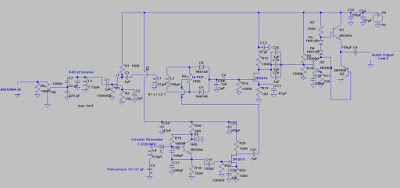
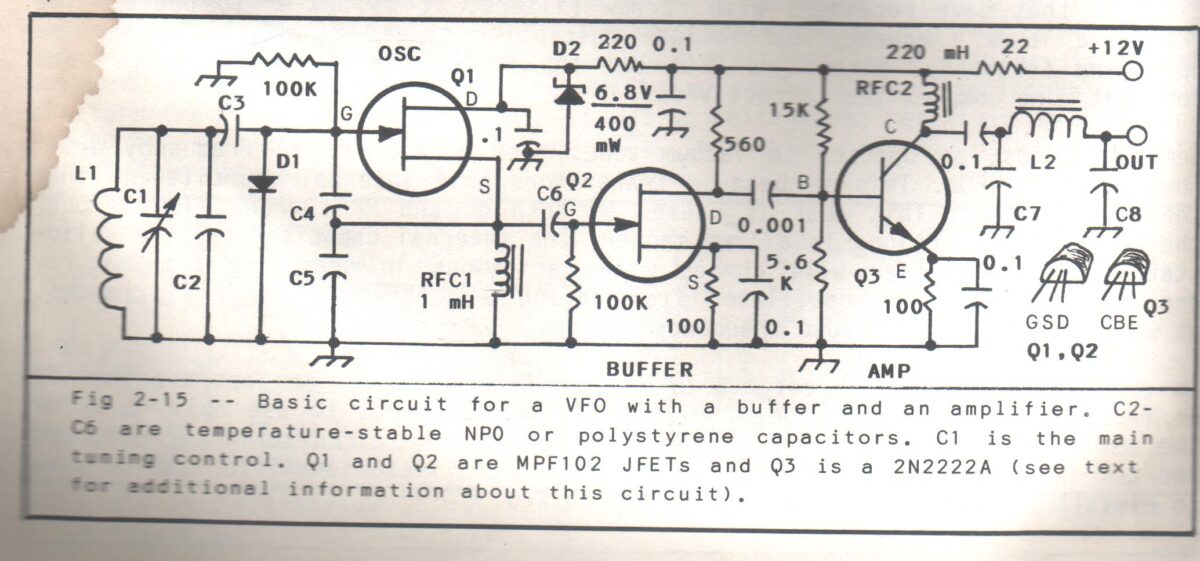
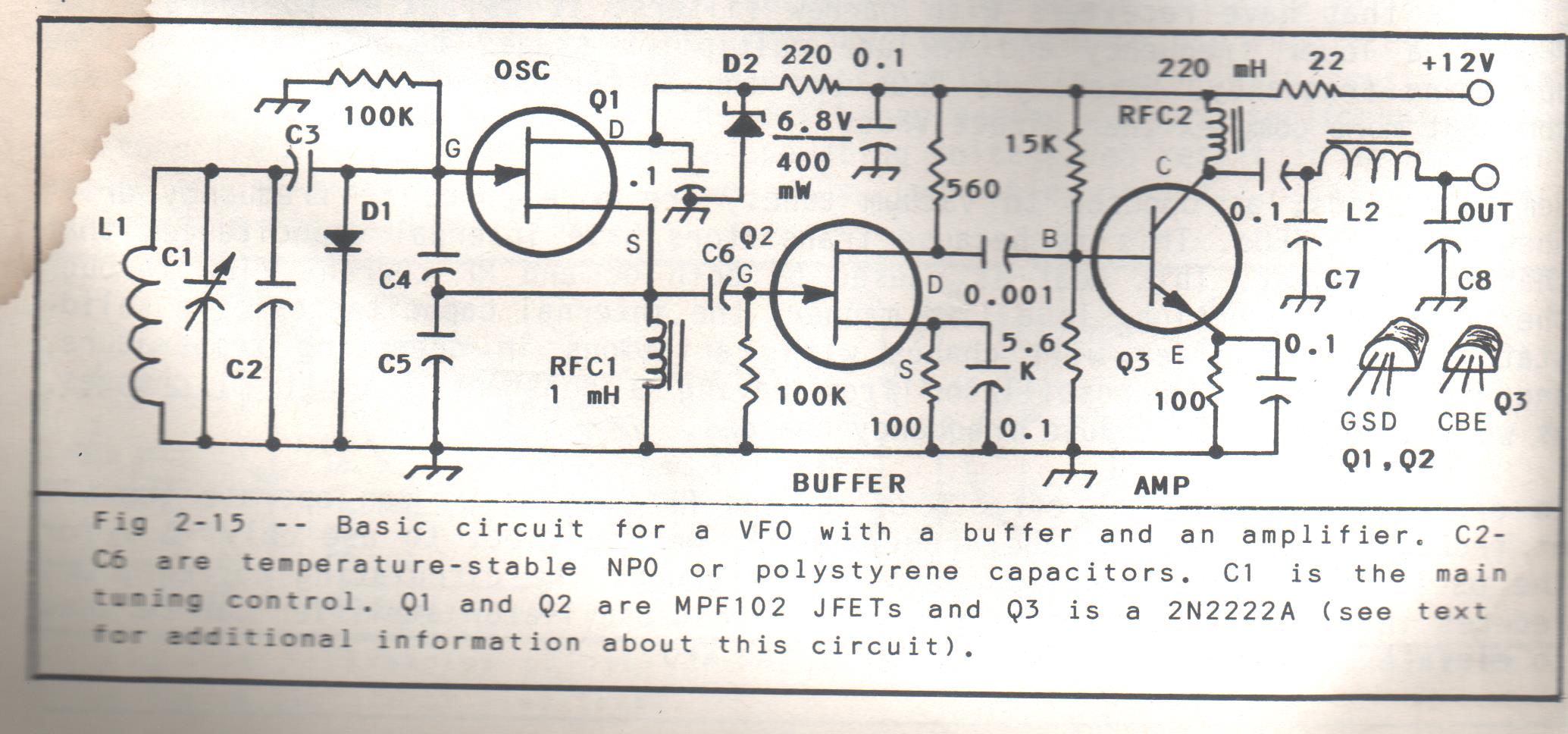
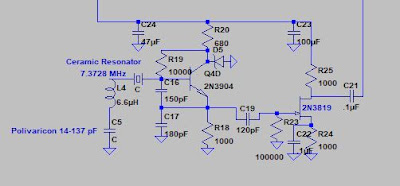
The VFO circuit comes largely from W1FB’s Design Notebook page 36. I followed most of the conventional tribal wisdom on VFOs: NP0 caps, often many of them in parallel. Air core coil (in my case wound on a cardboard coat hanger tube).
![]() |
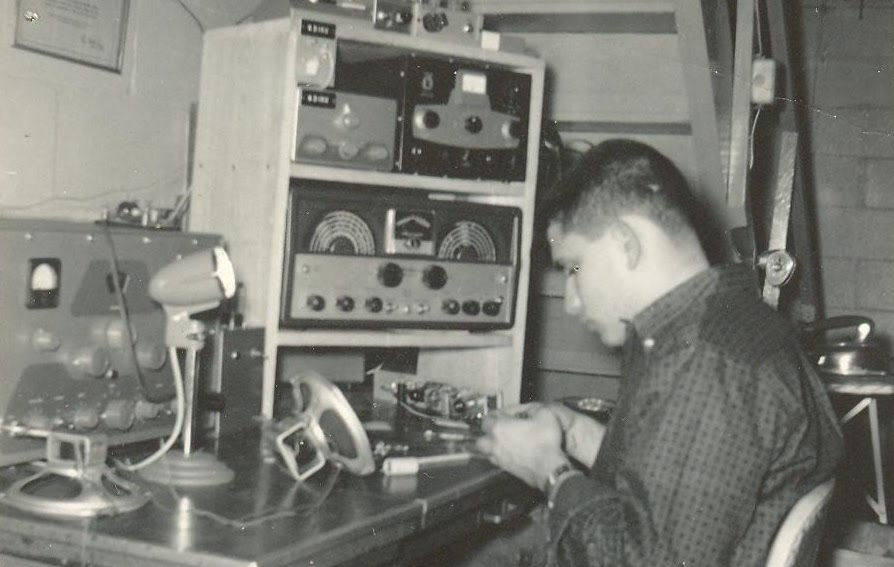
| N6QW in 1959. Building an SSB transceiver |
SolderSmoke Pocast #203 is (FINALLY!) available:
http://soldersmoke.com/soldersmoke203.mp3
24 March 2018
–The reasons for our delay.
Winter, Computers, College, Family Trees, Lawyers….
— Winterfest 2018
— Pete launches 2018 THE YEAR OF THE TRANSCEIVER
http://n6qw.blogspot.com/
— SDR – Satan’s Digital Radio?
— Direct Conversion Receiver Projects
— Mixer Musings
— A Thailand Troubleshoot
— Nor’Easter knocks out Bill’s Moxon — An appliance replacement?
— Homebrew Electret Mics. Seriously.
— uBITX Build with Rogier
— Civilized Crystal Testing
— Baofeng!
— DRAGNET
— MAILBAG
KD4PBJ’s REGEN
N6ORS’s SDR rig
Mike Rainey’s DX-100
Armand writes:
The attached picture is your DC receiver. A little tweaking left to do as the range right now is ~ 7.44Mhz to 7.032Mhz. I used one of Farhan’s trifillars and a couple of air coils that you gave me last year. Listening to the Wisconsin QSO party as I type.
FB Armand! The receiver looks great. I hope others will follow your lead and build this simple little receiver for 40.
I think the most important stage of a direct conversion receiver is the mixer. This is the stage that takes the RF energy coming in from the antenna and — in one fell swoop — turns it into audio.
It is important to understand how this happens. I go into this in some detail in the SolderSmoke book. To summarize:
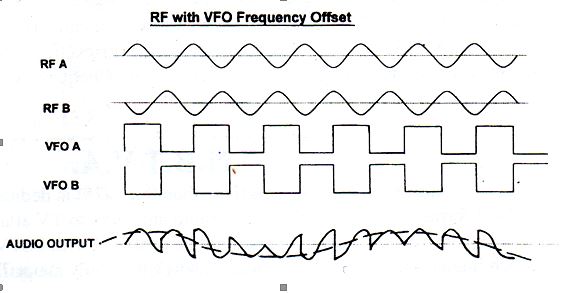
1) You have two signals going into a non-linear device. The way in which the smaller signal passes through the device — how much it is amplified or attenuated — depends on the instantaneous value of the larger signal. We are not just adding the two signals together.
2) The waveform that comes out will be a complicated repeating waveform. We know from Fourier that any complicated repeating waveform can be broken down into sine wave components.
3) When you analyze the complicated repeating waveforms coming out of the mixer, you will find that the sine wave components include a frequency that is the sum of the two inputs and another that is the difference between the two.
So lets suppose we have a non-linear device. We send in a signal from our oscillator at 7061 kHz. Coming in from the antenna we have a signal at 7060 kHz. The non-linear device will produce outputs at 14121 kHz (sum) and at 1 kHz (difference). We are interested in the difference frequency. We can HEAR that one. We feed it into our audio amplifiers and we can copy the Morse Code coming in. It will sound like a 1 kHz tone going on and off as the operator at the distant station presses his code key. (We don’t really have to worry about the 14121 kHz signal — it is easily eliminated by filters and would never make it through our audio amplifiers. And in any case we could not hear it.)
What can we use as a non-linear device? In this receiver we will use diodes. Diodes are extremely non-linear devices. They can be used as on-off switches, with one of the signals determining if they are on (conducting) or off (not conducting). When used like this they are “switching mixers.” In essence, a larger, controlling signal from the VFO will be turning the diodes on and off. Thus the signal coming in from the antenna will be chopped up by the switching action of the diode being turned on and off. This is non-linear mixing at its most extreme. It will definitely produce the sum and difference products we are looking for.
We could build the mixer with just one diode. You could apply the VFO signal to the diode to turn it on and off, and then feed the signal from the antenna into the same diode. You would get the sum and the difference product out the other end. You will see very simple direct conversion receivers intended for use in software defined radio schemes using just one diode. But this kind of circuit has a couple of serious shortcomingsq: it is susceptible to “AM breakthrough” and it is “lossy.”
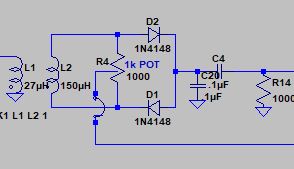
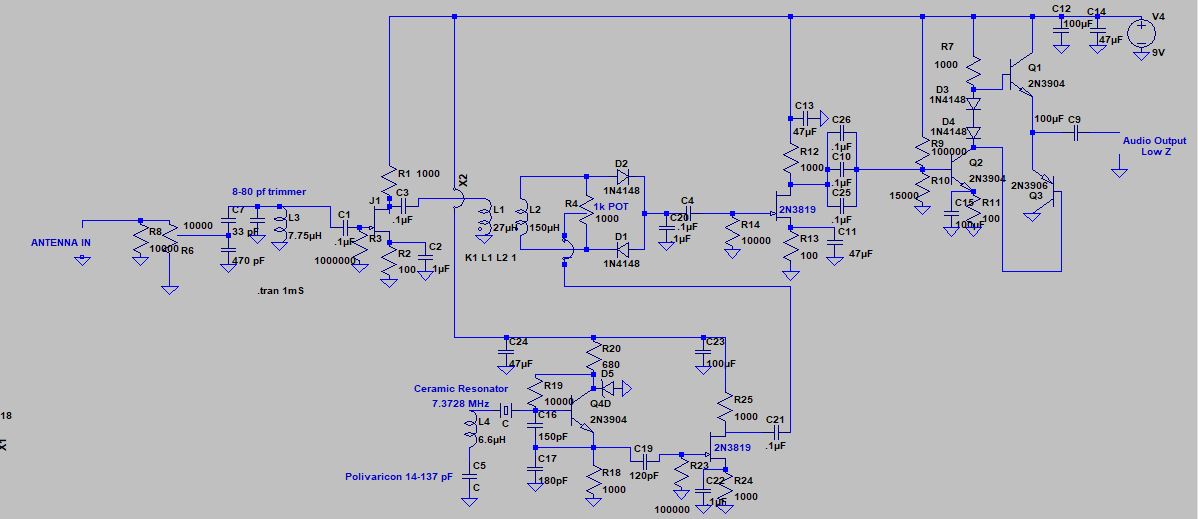
The circuit we are using addresses these problems by using two diodes. To reduce loss, one conducts during half of the oscillator signal’s cycle, the other during the other half. Here LTSpice is ueful. You can model this mixer and see in the simulator how each of the diodes handles half of the oscillator RF cycle, with both contributing to the AF signal we want at the output (the difference frequency). (The schematic above is from LTSpice but it is not ready for simulation. For this you should replace the variable resistor with two fixed 500 ohm resistors, and add two oscillators — one with the weak incoming RF signal and the other the strong local oscillator signal.)
The AM breakthrough problem is also addressed by the use of two diodes. Here’s the problem: If you are on 40 meters, there will be strong shortwave AM broadcast signals coming in from your antenna. Some will be so strong that they will get past your front-end filtering. If you were using just one diode, that diode might demodulate the AM signal — the AM carrier would mix with the AM sidebands and you would have an undesired audio signal heading for your AF amplifiers. Many of us have experienced this — you are trying to listen to ham radio SSB signals, but you can hear China Radio International playing in the background.
The two diodes take care of this easily. Look at the way an AM signal would reach the diodes. The carrier (and its sidebands) going through the top diode will be 180 degrees our of phase with the signal going into the lower diode. But the output of the diodes are joined together. They will cancel out. We say that for the RF signal coming through from the antenna, the circuit is “balanced.” That signal — in this case the undesired AM signal — will cancel out at the junction of the two diodes.
But to understand this circuit you must see what is NOT cancelled out. The signal from the VFO is hitting each diode with the SAME polarity at the same time. Look at the 1k variable resistor. So the signal from the VFO will NOT be cancelled out at the output. Nor will the mixing products produced in the diodes. That last sentence is the key to all of this. The sum and difference products that result from the mixing of the signal from the antenna and the signal from the VFO SURVIVE. They are not cancelled out.
We can easily select the one we want. An RF bypass capacitor connected from the output of the mixer to ground will get rid of most of the VFO signal (7061 kHz) and most of the sum product (14121 kHz) while passing the audio to the AF amplifiers.
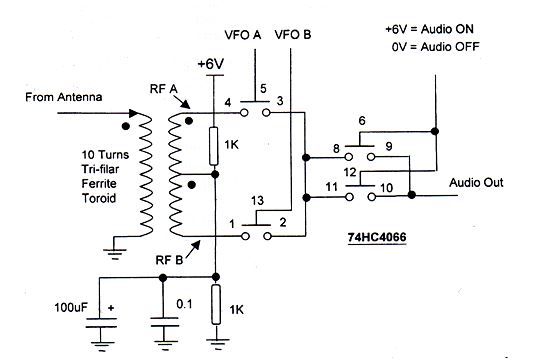
When I built this detector I used a trifilar toroid out of a box of them that Farhan left with me back in May. I used two of the windings secondary and one of the windings for the primary. You might want to make a more simple transformer using an FT-43 type core. I recommend W8DIZ as a source.
I hope this explanation helps, and I hope I got it right. Let me know if you see any errors in my explanation. Tinker with the circuit when you build it. You should be able to get it going.
![]() |
| Complete Schematic |
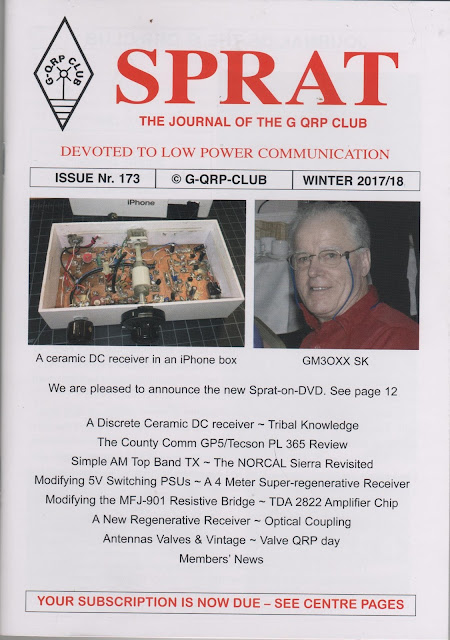
G-QRP very kindly put my little DC Receiver on the cover of issue Nr. 173. (Very sorry to see that GM3OXX has become a Silent Key. )
As we often say on the podcast, if you are not subscribing to this wonderful magazine, you are missing out on a lot of great ideas and circuits. Information on how to join the club and start receiving SPRAT can be found here: http://www.gqrp.com/join.htm It is only 22 bucks!
Reminder: Straight Key Night is upon us. It begins at midnight UTC 1 January. It is a great way to begin the new year. My HT-37 and my Drake 2-B are warming up now (and are helping to keep the shack warm on a very frigid day). HNY to all! 73 Bill
![]() |
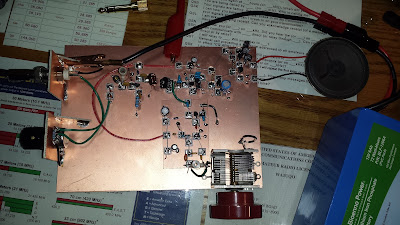
| DC RX VFO and Buffer |
![]() |
| The Big Picture |
I hope many of you decide to build this little receiver. With it, you can break into the ranks of those intrepid ham homebrewers who have actually built a receiver. Today I’ll begin a series of blog posts on how you might do this. Of course, there are many ways of proceeding. I will describe my method.
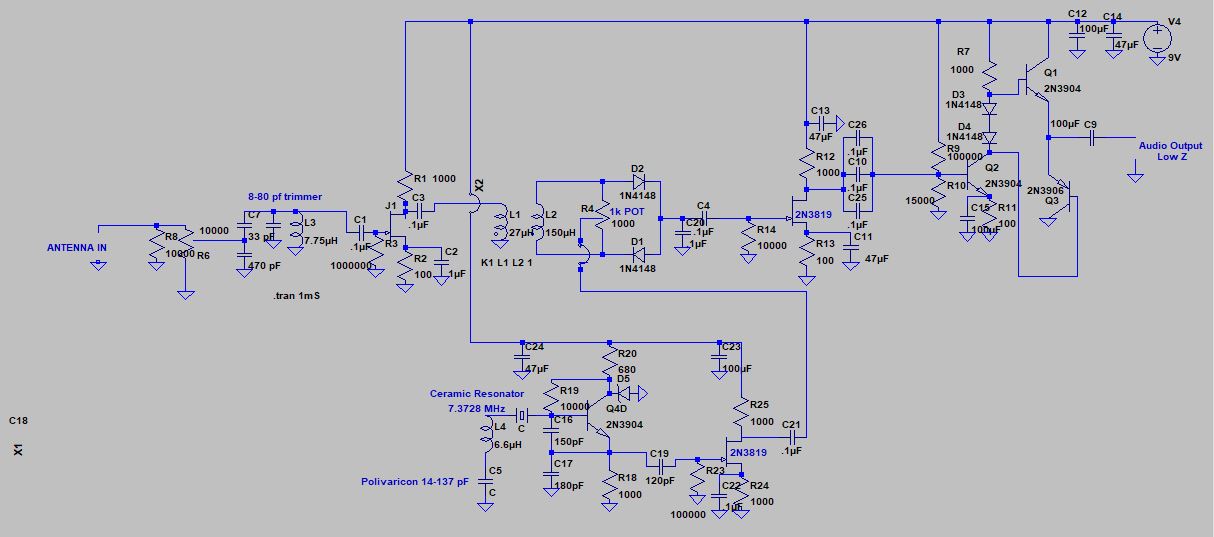
FIRST: ALWAYS look at this receiver as a collection of stages. Understand what each stage does and how they all work together. Build it stage-by-stage. Proceed to the next stage only after you confirm that the stage you just built actually works.
I see this receiver as having four stages:
1. Front end (RF gain control, input filter, first RF amplifier).
2. Mixer
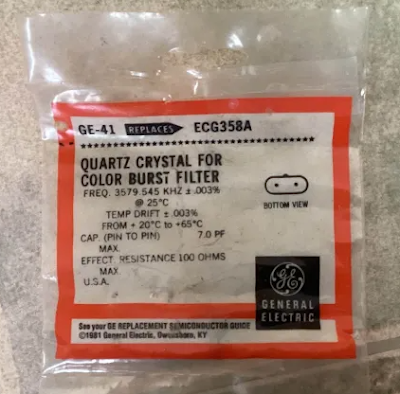
3. Ceramic resonator variable frequency oscillator (and buffer)
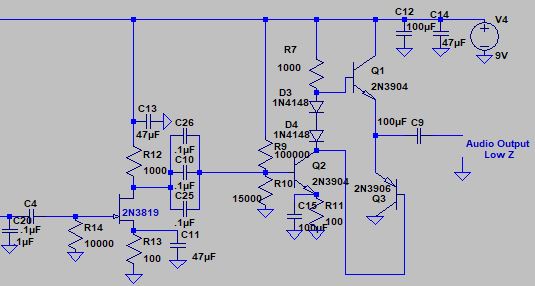
4. Audio amplifier (consisting of four transistors and associated parts).
I think you should build the oscillator stage first.
What you will need: In most cases, you shouldn’t buy individual parts for this receiver. I won’t be providing a BOM. Here is what I think you should do. If you do not already have a good stock of electronic parts, start developing one. Buy assortments of parts, or at least several of each part that you will need. I use e-bay, amazon, mouser, digikey. The parts are out there.
— Get an assortment of resistors. 1/4 watt resistors will do.
— Get a bunch of .1uF capacitors. You will use a lot of these as bypass caps.
— Get a bunch of 2N3904 and 2N3906 transistors.
— Get a bunch of 2N2222 transistors
— Get a bunch of MPF102 and/or 2n2819 FET transistors.
— Get an assortment of small electrolytic capacitors.
— Get some Zener diodes in the 6-8 volt range.
You will need some trimmer caps (8-80pf work fine). Some 1K trimmer pots. and some other stuff.
Get some copper clad board. Pete suggest this, or something like it.
https://www.ebay.com/itm/18-pcs-4-x-6-CEM-1-060-2-oz-Single-Sided-Copper-Clad-Laminate-Board-PCB/311756276147?ssPageName=STRK%3AMEBIDX%3AIT&_trksid=p2057872.m2749.l2649
Try to avoid the cheap fiber glass boards. I prefer single-sided, but double sided is OK too.
You will need to cut the board. Get some tin shears. Mine look like big strong scissors. Use them to cut your boards to size AND to cut the little isolation pads for Manhattan construction.
Crazy glue. I kind of like Gorilla Glue liquid (not gel).
Small wattage soldering iron. 35 W or so. Get a small fan to keep the smoke and glue fumes out of your respiratory system.