Category: DC Receiver Build
Alan W2AEW Measures the Minimum Discernible Signal (MDS) of the SolderSmoke Direct Conversion Receiver
Hack-A-Day on the Tao of Bespoke Electronics
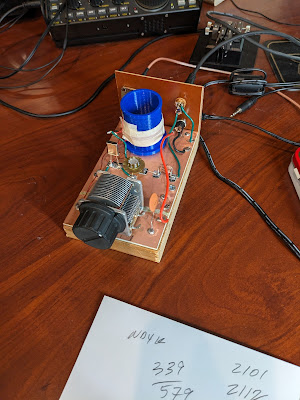
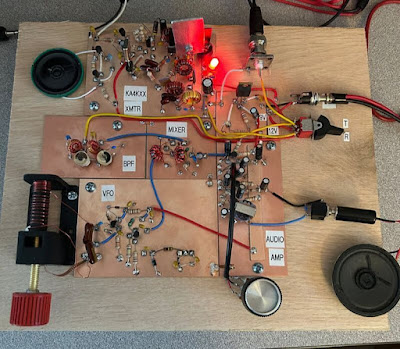
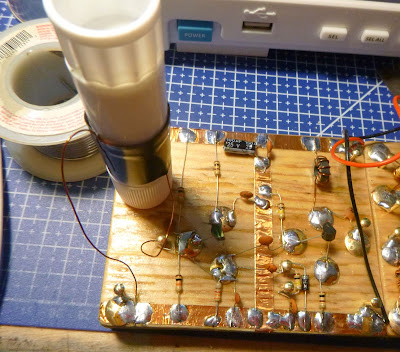
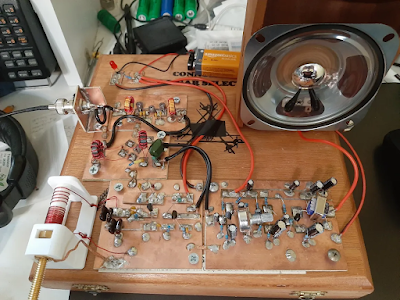
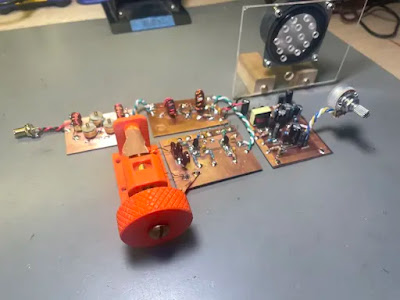
My comment: Good post with good points about the under-appreciated differences between true homebrew and kit building. I have a lot of Heathkits around me, but I never considered them to be homebrew. There is a big difference. We have been promoting and supporting the HOMEBREW construction of 40 meter direct-conversion receivers. No one would confuse these receivers with commercial, or even kit-built gear. But they work very well, and the builder earns the satisfaction that comes with building something from scratch. There are no factory made PC boards to “populate.” All four of our boards are made using Manhattan construction techniques (super glue, isolation pads, copper-clad substrate). Almost 90 receivers have been completed, in more than 15 countries. Check out the receivers. Build one if you dare:
https://soldersmoke.blogspot.com/search/label/DC%20RX%20Hall%20of%20Fame
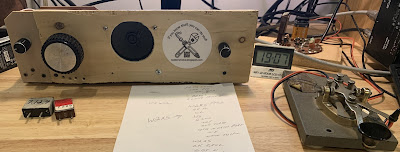
BTW — I own a Dymo machine, and my SSB transceivers are in wooden boxes made from junked packing material. 73 Bill N2CQR
WD4CFN Makes Contact Using the SolderSmoke Direct Conversion Receiver and a Michigan Mighty Mite
My Eleven Contacts using the SolderSmoke Direct Conversion Receiver — It is NOT a toy!
I have made 11 contacts using the SolderSmoke Direct Conversion receiver. Ten of the 11 were after June 3, 2025. This was in very casual operation, operating with less than 1 watt with a dipole antenna.
1. The first of course was back in February 2023 with W4AMV. On this one I was using a simple “10 Minute Transmitter” that I threw together thinking that I would use it to demonstrate the receiver to our high school students. “Wait a minute,” I thought. I called CQ and W4AMV answered. I was running about 100 mW. He too was using homebrew gear. https://soldersmoke.blogspot.com/2023/02/first-qso-with-high-school-receiver-100.html
2, 3, 4. On June 4, 2025 I again fired up the 10 minute transmitter. My T/R scheme was VERY simple: I have an MFJ coax switch that I use to select the rigs that will connect to my various antennas. On the antenna switch I selected my 40 meter dipole. I ran two pieces of coax from two different positions on the MFJ switch. One I marked RX, the other TX. The transmitter and the receiver were working off 9 volt batteries. I quickly worked N2WJW. Gil in New Jersey. But I noticed that the 10 Minute rig was drifting. So I pulled out my trusty old Tuna Tin 2 transmitter and used it to heartlessly replace the 10 Minute Transmitter. Now with SEVERAL HUNDRED milliwatts, I worked W2XS, John in New York on June 5, 2025. Later that same day I worked N9FGC in Indiana.
5. My most amazing contact came on June 7, 2025. Here is my log entry: 40CW K1OA First 2 way contact with station also using a SolderSmoke DC Receiver!At around 0630 EDT on June 7, 2025 I heard K1OA calling CQ on 7030 kHz CW. This was exactly where I had a crystal. I called him, but he didn’t hear me. I sent him an e-mail. We tried again — he heard me calling him and I heard him responding by calling me, but I don’t think we succeeded in exchanging signal reports. It was close, but no cigar. I had to walk the dog. Scott and I agreed to meet on 7030 kHz at 0730 EDT. Arggh. There was a QSO there. I thought we might have to try to change frequency, but this would have been tough because both of us were crystal controlled on transmit. Fortunately, the contact on 7030 kHz wrapped up. Scott called me, I responded, and we were able to exchange signal reports. I was so excited that I almost forgot to hit the record button on my phone. But I caught the last minute or so.This was really something. This really goes to prove what Dean and I have been saying all along: this receiver is not a toy! It can be used for real ham radio contacts. And now we have had these receivers on both ends of a contact. For transmit, Scott was using a KA4KXX transmitter with about 3 watts output. I was on my Tuna Tin 2 at about half a watt output.
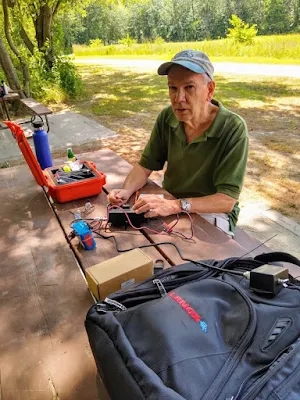
6, 7, 8. Later on June 7, 2025 I worked an old friend, Jim W1PID. Jim is a friend of Homebrew Hero Mike AA1TJ, and was involved in Mike’s effort to cross the Atlantic with a voice-powered rig. Jim also was one of my contacts with the ET-2 QRPppp rig. I also worked WZ2J Vin in NJ. I also worked John W2XS again.
9. June 11, 2025 (Really evening of 10 June 2025) Famous homebrewer, Anchorologist, Heatkit authority and fellow member of the QRP Hall of Fame Mike Bryce called me! 40CW 0034 WB8VGE Mike Bryce came back to my CQ! Mike wrote: Nothing like quartz locked frequency control!You know it sounded pretty damn good at 500mW. You were holding your own until QSB would take you out in a deep fade. But all in all, one hell of great QRP QSO.I was running my Ten Tec Scout that I had just put back together a couple of days ago. Got around to putting the case back on it tonight, and had it cooking in the back ground just listening to the stations come and go. I had worked a few POTA stations near by and found a quite spot. I was working on a project when I heard your CQ through the din of the 40M band. Glad I took a break and worked your QRPp signalbest 73 QRP # 4816 You get a QSL for that QSO!
Here’s my post about Mike, WB8VGE: https://soldersmoke.blogspot.com/2018/09/wb8vge-on-qso-today-qrp-hb-boatanchors.html
10. Around June 11, 2025 I worked W4MY in a contest.
11. On June 12, 2925 I worked some DX with the rig. It was VA3ICC, Ian in Ontario.
Mike KM5Z’s SolderSmoke Direct Conversion Receiver
After all, if an idea is worth doing, then… it’s worth overdoing.I used a Milwaukee 1/4″ Diamond Max hole saw to cut circles for the solder-points. Everything else is ground. Later, I found that I missed a point, so I used a single “MePAD” glued in that spot.I found the default audio amp to be a bit quiet. I plan to replace it with the ‘push-pull’ version. I’m definitely keeping this to hang up on the wall.
Steve WD4CFN’s FB Mid-Tennessee SolderSmoke Direct Conversion Receiver
Rick W1DSP’s FB SolderSmoke Direct Conversion Receiver — Exploring the Rabbit Holes
Phil W1PJE, Director of MIT’s Haystack Observatory, visits SolderSmoke East, Talks Radio with N2CQR and KK4DAS
A FIRST! K1OA Contact with N2CQR — All Homebrew with SolderSmoke Direct Conversion Receivers on Both Ends
At around 0630 EDT on June 7, 2025 I heard K1OA calling CQ on 7030 kHz CW. This was exactly where I had a crystal. I called him, but he didn’t hear me. I sent him an e-mail. We tried again — he heard me calling him and I heard him responding by calling me, but I don’t think we succeeded in exchanging signal reports. It was close, but no cigar.
I had to walk the dog. Scott and I agreed to meet on 7030 kHz at 0730 EDT. Arggh. There was a QSO there. I thought we might have to try to change frequency, but this would have been tough because both of us were crystal controlled on transmit. Fortunately, the contact on 7030 kHz wrapped up. Scott called me, I responded, and we were able to exchange signal reports. I was so excited that I almost forgot to hit the record button on my phone. But I caught the last minute or so. See above.
This was really something. This really goes to prove what Dean and I have been saying all along: this receiver is not a toy! It can be used for real ham radio contacts. And now we have had these receivers on both ends of a contact. For transmit, Scott was using a KA4KXX transmitter with about 3 watts output. I was on my Tuna Tin 2 at about half a watt output.
Thanks Scott! And thank you Walter!
Alan Wolke W2AEW’s Build of the SolderSmoke Direct Conversion Receiver
Ashish N6ASD’s Beautiful SolderSmoke Direct Conversion Receiver — Built in Bangalore — “This was such a fun project. This was my first direct conversion build, and I learned a lot along the way.”
Not a Toy! K1OA Making Contacts with the SolderSmoke Direct Conversion Receiver and a KA4KXX Transmitter
This goes to prove what we have been saying all along: this receiver is not a toy! It is capable of operating as part of a real 2-way ham radio station. Hall of Fame member Scott K1OA has paired his receiver up with a Merry Christmas transmitter designed by Walter KA4KXX and has been making CW contacts with it (see above). Walter supplied the crystal and many of the needed parts. Scott has already worked WA9RNE, N4HAY and W3RJ, and has tried making contact with Walter but no luck yet. He has gotten RBN reports from Germany and New Zealand. All that with just 3 watts.
This is not the first time this receiver has been out to use. I made one contact with it using a “Ten Minute” QRPp transmitter that I had intended only to use for test purposes:
https://soldersmoke.blogspot.com/2023/02/first-qso-with-high-school-receiver-100.html
HoF member Aaron ZL1AUN used his receiver with an SSB transmitter to make contact using his receiver:
https://soldersmoke.blogspot.com/2025/02/soldersmoke-direct-conversion-receiver_23.html We understand Aaron’s article about the receiver has been published in “Break-In” magazine — we hope to get a copy (electronic would be fine!)
And who can forget HoF member Nate KA1MUQ who turned his “frying pan” direct conversion receiver into a double sideband transceiver and used it to make phone contact with Idaho from California:
https://soldersmoke.blogspot.com/2025/03/nate-ka1muq-turns-his-frying-pan-dc.html
If anyone is aware of other contacts made using this receiver, please let me know.
Hiss, Filters, QRM, and Hearing Loss: Do we need AF filters in direct conversion receivers?
Messages on Discord about the need to knock down higher frequency audio response in the SolderSmoke direct conversion receiver got me thinking.
I agree with Rick Campbell and others on the benefits of hearing a “wide open” direct conversion receiver. But Rick and others have built DC receivers with 3 kHz low pass AF filters. This made me ask myself a question: Is an audio filter in a direct conversion receiver a good idea?
And I started wondering if perhaps I was being too dismissive about the complaints about high frequency audio — I had been attributing them to newcomers who were just unaccostomed to radio noise or “static.” But maybe there was more to it than that. Maybe a big part of the problem was in my head, specifically in my ears. So this morning I did an experiment. I took an online hearing test. First, without my hearing aids: As expected, it showed significant high frequency loss. (It was as if the US Army had installed a 3 kHz audio low pass filter in my head!) Then I put my hearing aids in and retook the test: This time I passed the test and showed no loss. I then listened to the DC receiver with my hearing aids in. Now I could hear what builders on the Discord server were commenting on: I could hear higher frequency hiss, and, more importantly, stations that were producing 4-5 kHz sounds on my speaker were audible and annoying.
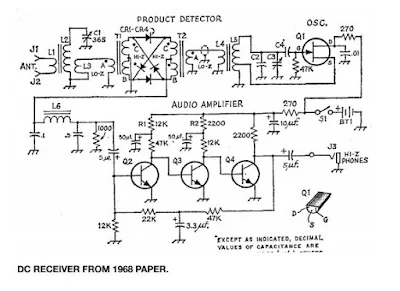
So I went back to Wes Hayward’s November 1968 QST article. In his receiver, he has a low pass AF filter using an 88 MILLIHenry coil and a couple of capacitors to ground. I had a few of the coils (given to me years ago by a NOVA QRP club member) so I built it. With my hearing aids in, I noticed an immediate improvement. I then did what one of the Discord builders did and put the filter in with a switch that would let me make “with and without” comparisons. The filter definitely cuts down on any AF above about 3.5 kHz. And it doesn’t seem to do damage to the desired signal. This is useful. I left the W7EL diplexer in the circuit.
This filter won’t solve the image or “opposite sideband” problem inherent to simple DC receivers, but it will help with signals or noise that are producing tones above about 3.5 kHz in the receiver. I think this is especially important in countries in which there is a lot of SSB crowding on 40 meters. The UK, for example, has an allocation from 7.0 to 7.2 MHz. In the US we go from 7.0 to 7.3 MHz. That is a big difference.
So the answer is probably yes, an AF filter in a direct conversion receiver is probably a good idea, especially if you can switch the filter out of the receiver. You can live without these filters. Not having the filter keeps the receiver very simple, and lets it sound really great. But having the filter in there does help reduce interference and high frequency hiss. So I think this is a useful add-on mod for builders who see a need to cut down on the kind of interference that a lack of this filter causes.
In 2019 W7ZOI noted: “Another unusual element is the 88 mH toroid used in the audio low pass filter at the detector output. A viable substitute would be a 100 mH inductor with radial leads. The muRata 19R107C (from Mouser) should work. Bourns also offers a variety of similar parts.”
Kevin K3IY’s Beautiful FB SolderSmoke Direct Conversion Receiver: “An amazing experience… A milestone for me…”
Chuck N4AVC’s FB SolderSmoke Direct Conversion Receiver: “I enjoyed the build and testing.”
Chuck N4AVC’s use of the frequency counter in his digital multimeter is pretty cool and innovative. And it is nice to have yet another receiver in Virginia; he is down in the Richmond area. And of course the Sharpie callsign tattoos on the wooden board are really nice.
Chuck writes:
Completed!!! For Pete: “She ain’t pretty, but she sure can cook!”. Thanks Bill and Dean, I enjoyed the build and testing. It’s funny, the audio oscillates on an older 9v battery, but is clean on the 9.5v bench supply. Going to put Bill’s mod on the inductor to make tuning a little finer and spread the boards out a little more. I used the double sided boards I had and there is some interaction between the boards.
Congratulations Chuck! Welcome to the Hall of Fame!
Paul WA1MAC GETS DOWN TO BRASS TACKS with his FB GLUE STICK SolderSmoke Direct Conversion Receiver
Ted KN4ZXG’s FB SolderSmoke Direct Conversion receiver: “This project is the greatest gift to homebrewing…”
There it is, a thing of beauty. The best part is that Ted built this receiver himself. That is something that most hams NEVER do.
Ted writes:
This project is the greatest gift to homebrewing since I got interested in radio nearly a decade ago. Lot’s of great projects out there but most go into a mysterious black hole of obsolete parts like the NE612 mixer that’s hard to get, or even the LM386, which is plentiful but not as cool as this amp. Everything’s divided neatly on it’s own board and explained. The builder has wiggle room on the layout and ways to test each module whether that’s with nice or budget equipment. Not only did I learn a ton about each stage, but also about making RF probes and making use of my modest but super useful equipment like the Nanovna. Although there were no mysteries, it all comes together to make magic. If you know stuff, you can do stuff! Thanks again de KN4ZXG, Ted.
While he has some great plans for modifications and improvements, at this point I think Ted should follow Farhan’s advice and spend some time just listening to the receiver that he has built. Direct conversion receivers sound especially good. It is as if they are closer to the ether.
Here are some clips of Ted’s receiver in action:
Congratulations Ted. Welcome to the Hall of Fame.
Mitch NK3H’s FB SolderSmoke Direct Conversion Receiver — “Incredibly satisfying!”
Wow, Mitch NK3H has built a really nice receiver. (He says it is not pretty, but those of us who have built one or who are in the process know that it looks great.) The SSB really sounds good also.
Mitch writes:
It’s not pretty but it works! Incredibly satisfying. In answer to the questions, (1) though I ‘d built a few small Manhattan style boards (e.g., Michigan Mighty Mite) this was more complicated. I’ve been using W1REX’s island cutter to create isolated areas on the copper clad board, rather than pasting on pieces of circuit board. But the islands are a little small for as many as four connections on one island, as in most of the transistor bases. Inevitably a component lead would inadvertently contact the ground plane and all bets were off. Tracking down the shorts was challenging. (2) Once I got to the audio amplifier board I carefully laid out all of the components before starting to solder. But as I finished each stage and was ready for the next, I always seemed to be missing a resistor or two. I’d search the desk and the floor — very frustrating. Turns out the speaker magnet was collecting and hiding the missing resistors. Lesson learned. (3) Next I’m hoping to build a transceiver. Still looking for the right project, probably a little more digital than this wonderful DCR.
Mitch obviously learned a lot during this project. I had similar experiences with pads on the same level as the surrounding board — I found that the 1 or 2 mm of elevation provided by the Manhattan pads prevented a lot of inadvertent shorts to ground. And I too “lost” (temporarily) a lot of components to the magnet in the speaker.
Good luck with the next projects Mitch. With the Michigan Mighty Mite and the DCR under your belt you are ready to go. Maybe a Double Sideband transmitter to go with the DCR? Or, as you said, perhaps something more digital. There is a lot of good ham experience with the Si5351 digital VFOs. Or maybe even an SDR rig.
Thanks Mitch. Congratulations and welcome to the Hall of Fame.
———————–
Join the discussion – SolderSmoke Discord Server:
Documentation on Hackaday:
https://hackaday.io/project/
SolderSmoke YouTube channel:
Bill K7WXW’s FB SolderSmoke Direct Conversion Receiver
Join the discussion – SolderSmoke Discord Server:
Documentation on Hackaday:
https://hackaday.io/project/
SolderSmoke YouTube channel: