I think Mike’s video does a good job of showing what it is really like to get on the air with simple, homebrew QRP gear. It takes some patience and operating skill. I guess it is sort of like fly fishing (with home made lures); there are easier ways to catch fish, but they are not as rewarding.
Category: CW
FB IBEW HB DC CW de UAE: A65DC’s International Homebrew Rig

Good evening!
After my JOO moment, Bill put me in contact with Pete Eaton, who suggested that I would have a look at the schematics for K4GC 40m CW Transceiver.
And I did, It was just perfect for me, low part count, lots of things done in software!!! Perfect Bryan!
I started off the build and both Bryan and Pete supported me along the way, thank you!
So here we have it:

The design slowly deviated further and further from the original, but I think I learned quite a lot by starting to make it “my own”.
The Arduino was changed to an UNO, yeah they are clunky and big, but I was not shooting for a pocket-size anyway… and they do have a proper USB port.
The RF-path is now switched by a relay straight after the filter, when the relay is relaxed the antenna is connected to the mixer, when I touch a paddle it connects to the TX circuit.
I have a short hang time from the last key input and it goes back to RX, VOX Delay I guess.
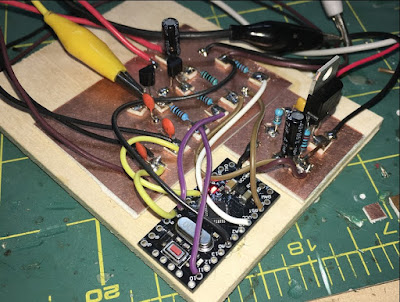
I completed the 700Hz bandpass filter, boy! this makes it a much nicer rig to work CW, I originally I skipped this filter for no good reason? That is the board standing up in the picture.

The TX circuit is a two stage, the first stage is a replica of VK3YE beach40 amplifier circuit, that also uses DB139. The second stage is a spin of the EMRFD Page 2.38 IRF511 Amp.
I have cranked it up to 17w, but it gets too hot too fast, as you can see I don’t have any proper cooling yet, I need to redo this board and plan for the heatsink a bit better.. it is now set around 10w, still getting hot, “599 TU 73”.
To be honest my CW does not go much further anyway, but I guess with this radio now completed I have one more reason to get my speed up.
I use for convenience both CLK0 and CLK1, when I go into TX I switch off CLK0 and do the keying on CLK1, both transmitter stages are powered up the whole time (until I stop keying as described above)
As the 700Hz filter worked so superb, I decided that I wanted to introduce “modes” to the rig, I can now switch the audio either thru the filters (CW) or straight to the AF amp (AM).
I do enjoy listening around, and we have a lot of AM stations on offer in my region.
I kept the smart RX mute transistor circuit and when I ask the Arduino to change mode, it will mute the receiver quickly, pull the relay and then un-mute again, no ear pain from the loud relay click. (I am happy with that detail).

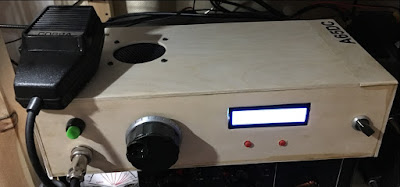
The 2 line display became a four line, and I can change Tuning Rate, RIT, Key Speed and Mode by using only the encoder and the one button built into the encoder.
The front panel sports, on off, Headphones, Paddle and volume, the display and the big knob.
Power connector and USB Port on the side. I did complete the CAT control changes while working on this radio, it now uses the classic Kenwood interface e.g. TS480. (A lot fewer questions from the PC to answer.)
The CAT control works very nice while using N1MM, it works a lot less nice using CQRLog, I guess it has to do with the number of times the software in the PC is asking about things from the radio.
I will look into logic to only worry about incoming serial requests if I have not answered for some time, and never answer while in TX…
By pressing the VFO button a small arrow appears next to TR, if I push again it moves the arrow down to RIT and so on.
if I turn the knob with the arrow standing in front of e.g. KEY it will increase or decrease the KEY speed, when I press again, it will return to frequency control.
Oh, another detail (that I am happy with) while the arrow is in front of the KEY, you can fiddle with the paddle with out transmitting.. practical for testing the speed.
So this is a K4GC transceiver with bits and pieces from VK3YE and bits from the A65DC laboratory in Dubai, truly international.
To trim things in I scheduled a QSO with a local ham here, and things worked very nice, later the same night I made my first “DX” contact with RM2D!!! Moscow!!
What are the odds that a Swedish guy living in the UAE makes the first contact to another Swedish ham who lives in Russia!
73,
Martin A65DC
WA8WDQ Builds OZ1JHM’s Arduino CW Decoder (Video)
Bill, Pete:
I wanted to update you on my DC receiver progress. While I’m still operationally proficient in CW, many of my friends are not. So I thought it would be fun to add a CW decoder to my DC receiver.
In my research for a solution, I ran across a sweet decoder I thought might be of interest to the SolderSmoke listeners. OZ1JHM developed a totally software based decoder for Arduino that uses the Goertzel Algorithm. This algorithm performs similarly to a Fast Fourier Transform but only for tone decoding at specific frequencies. This limitation keeps the code small and fast making it perfect for microcontrollers like the Arduino.
I was able to hack Hjalmar’s code into mine and the result is CW decoder functionality in the receiver with no additional hardware! But, the Arduino Uno’s performance is limited so I need to dynamically switch between receiver VFO/control code and the CW decoder in order to preserve real-time performance. This is only my first pass so perhaps I will find a way to optimize the code to more fully integrate the two. I currently switch back and forth based on whether the VFO knob has been rotated or is idle. This at least gives the illusion of real-time integration but makes it harder to tune in a signal for the decoder.
Now that the Arduino Zero is available, I’ve been considering moving that direction to dramatically improve available horsepower. This isn’t the first time I’ve run out of gas with the Uno. Now it’s time to start working on a transmitter module for the radio :). You know, even though I have an operational K3, I find myself reaching for this radio first. Something magical about using something you’ve created :). But hey, preaching to the choir!
Be sure to check out Hjalmar’s site (http://www.skovholm.com and
http://skovholm.com/cwdecoder) for details on his design and a video demo.
Brad WA8WDQ
A Mighty Mite, a BITX40, an ILER, some Arduinos, and the Joy of Oscillation in the United Arab Emirates

Martin A65DC sent us this wonderful report on his efforts in the UAE. His e-mail nicely conveys his enthusiasm. I was especially pleased to see that wooden enclosures are catching on (another fellow on the BITX20 group is using a cigar humidor). Thanks Martin! Please keep us posted on your UAE homebrew adventures.
Hi Bill and Pete,
My name is Martin, and I am listening to every episode, sometimes more than once, thank you for an excellent show boys. I am a ham in the United Arab Emirates and operate radio as A65DC.
I just wanted to share my “JOY OF OSCILLATION” moment with you, I had the moment two days or so ago.. fantastic!
Well it is not super tidy, but as a proof of concept is totally acceptable. red and green goes to the variable cap (above).

Next to the Mighty Mite (above) is my bitX40, what a fantastic board!! I have big plans for this radio. But for now it will stay in its wooden box and keeps me company.

This (above) is another kit build, 20m SSB kit from EA3GCY Javier. ILER20, please have a look, this is where you should start if you are into kit building!! the instructions are fantastic.
I added some Arduino magic to it with a SI5351, and then I was sitting and looking at my big UNO board, hmmm USB port, why not further develop the code and use the port as CAT control.
I can now connect this rig to e.g. N1MM and control it, read and write frequency (in current version) I am simulating the protocol of a TS590, but that turned out to be a bad choice, I should have gone for a simpler radio, like a 140 or something, the 590 has loads of CAT commands that my code needs to answer… this radio is my QRO 20m as rig it sports the 20w amplifier kit from K5BCQ and will put out a whooping 22w! Several contacts from A6 into Europe and some over to Indonesia.. fun stuff, two kits from different vendors together with some own building and coding.. I love it.

On the workbench now is an Arduino CW keyed based on K3NG, the Arduino code is very well written and it has loads of functionality, most of what I will never use.. but as a keyer it is superb.
This is my keyed circuit, super simple stuff, it is here connected to the Mighty Mite as a test, works 100% I am now researching a good circuit for a CW transmitter/transceiver for 40m that will be in the 5 to 10w range to use my new keyer with.
Again, thanks for a fantastic show guys,
73
A65DC, Martin
Straight Key Night — Bandscan from WA6ARA (audio)
 |
| WA6ARA SKN Station |
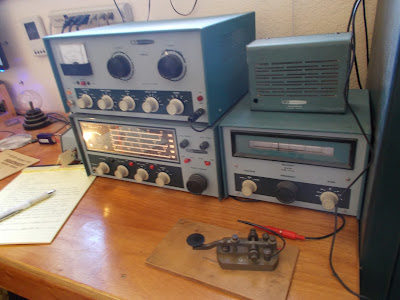
Mike Herr WA6ARA was on 40 meters with old gear this Straight Key Night. Mike was receiving with a venerable Heath HR10B. One of his favorite QSOs was with Keith W6SIY; Keith was running Conar twins that had the kind of “swing” that stirs up the kind of memories that SKN is all about. FB. Mike made a bandscan recording of what 40 sounded like, and he made another of W6SIY’s beautiful signal.
You can listen by clicking on these links:
http://soldersmoke.com/SKNBANSCAN.mp3
http://soldersmoke.com/SKNQSO.mp3
My own SKN effort was cut short this year by technical difficulties. The HT-37’s relays stopped doing their thing. Probably the relay drive tube going soft. But I did manage to make two great contacts on 40:
WA6URY is in Los Angeles. This was a very timely contact — my wife and I went to see the movie “La La Land” on New Year’s eve — the film features a lot of beautiful LA scenery. Dan was running a kilowatt to a 2 element Yagi on 40. He too owns an HT-37 and a Drake 2B. He was on a straight key “with dirty contacts.” FB Dan, thanks.
And then I worked W1PID! Wow! Jim is well known for his operations from field locations and for his intrepid participation in many of the radio adventures of Michael Rainey AA1TJ. Jim was on the Maine sea coast expedition when Michael was attempting to cross the pond with his voice-powered radio. On SKN Jim was in New Hampshire running 35 watts to a Windom off-center fed dipole. His Morse key is a Kent. TRGHS. Thanks Jim.
Happy New Year!
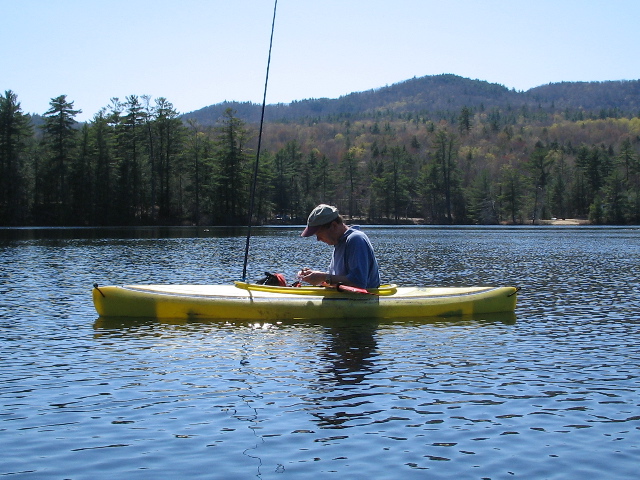 |
| W1PID Maritime Mobile |
K1RID’s 6L6 CW Transmitter from QST: “Barracks Bag VFO”
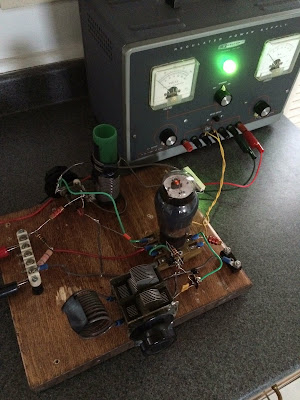
A new old thermatron device is coming to life on the kitchen table of K1RID. Don’t spill the coffee on that thing Ed.
Blowing the Dust Off of KW4KD’s Homebrew Station from the 1970s
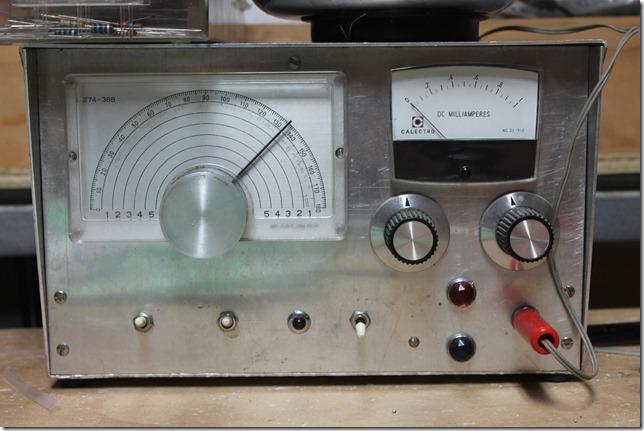 |
| KW4KD CW TRANSMITTER |
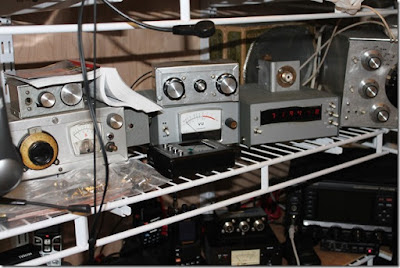
I got on 40 meter SSB over the weekend and spoke to Jim KW4KD. He was on a modern commercial rig, but then he told me he had some homebrew gear on his shelf… Wow, it is magnificent. A complete CW station (with homebrew keyer) AND an SSB rig. I immediately launched a campaign to get Jim to fire that gear up and to provide opportunities for more HB2HB contacts. Here is his description of the equipment:
Hi Bill,
It was a blast to get to chat with you too.
Just listening to the audio on this end, I can tell you’ve put a lot of time and effort into getting what you have there up and running.
Never once touched the dial on this end. So your radio gets a A+ for stability too.
Read your Bio on QRZ and sounds like you’ve been a few places, and seen a few things, and that unto itself would make a great contact . But for me, the fact that you are out there building, and I ‘m getting to hear the fruits of your efforts, is ham radio at its best.
Attached are pictures of the gear that made up my station back in the 70’s.
FWIW: At that time my call was WB4YQC.
(But for the record, these shots were taken today.)
In those days I had two setups (Both on 40 mtrs).
A CW station, using separate Xmtr & Rcvr, And a SSB xcvr.
By themselves the CW xmtr ran 8 to 10 watts, and the SSB unit probably hit 5 Watts peak (on a good day).
Like you, I had a separate linear. But in my case I used a pair of 6DQ5’s (TV Sweep tubes) that would run about 180 watts input, (Nothing Solid State, that I could afford, could make that kind of power back in then). The linear is still here, but stashed away in a closet somewhere, so not shown in today’s set of pictures.
As an Add-On for the SSB unit, I built a Frequency Counter, and used it as a digital dial.
The counter is unique in that it supports two inputs (one for the VFO, and the other for the Xtal BFO). In the 2 input mode, the counter is an UP/Down counter.
The Xcvr’s BFO runs at 9Mhz, while the VFO runs at ~2Mhz. So the counter counts up on one pass, and then down on the 2nd. At the end of the 2nd pass, it updates the Display with the final tally. (i.e, the effective TX/RX freq)
The cases for the Xmtr & Xcvr were designed by me, but were built by a friend who had access to a metal brake. Internally none of the units are especially pretty, as the were always works in progress.
I’ll have to dust off the linear. Its been at least 40 yrs since its seen AC.. Not sure what kind of shape the electrolytics are in.
Probably need to apply power slowly. I’ll see if I can round up an Autotransformer.
As far as posting on your blog, if you think it will encourage others, I’d be flattered if you did;
However, before anybody asks, (assuming that they might) there’re no schematics. Everything was built from sketches made on envelopes and napkins, which have long since disappeared. And even if they did exist, not sure today that you’d be able to find some of the ICs & transistors that the units use.
Again, it was my pleasure to catch you on the band today, & look forward to getting to hear you again.
73 Jim (KW4KD)
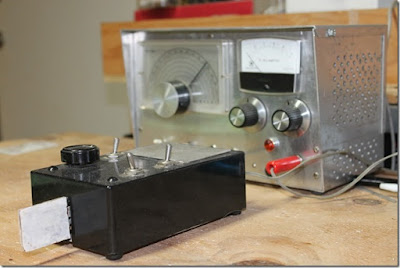 |
| KW4KD CW TRANSMITTER WITH HB KEYER |
 |
| 40 Meter CW receiver on Left |
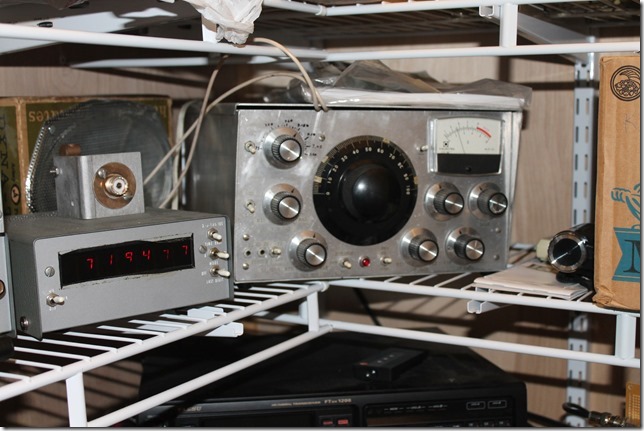 |
| 40 meter SSB transceiver with freq counter |
W9ZN’s CW Warm-up: “Ben’s Best Bent Feet”
I happened to come across this fellow’s signal on 40 a week or so ago. His warm up routine really had me scratching my head. I’ve been on the air for a long time, much of it on CW, and I never heard anything like this. Listen to the video (!) and you will see what I mean. Harmless fun I guess, and there does seem to be a connection to radio history.
Happy New Year! Straight Key Night on 160 Meters
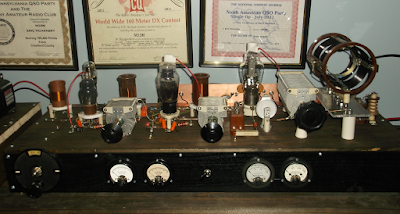
A while back, when I first mentioned getting on 160 meters by year’s end, Pete suggested I shoot for Straight Key Night. As many of you know, suggestions from Pete somehow seem to have a way of becoming ham radio MORAL IMPERATIVES. He seems to be a prophet of sorts, a prophet of THE RADIO GODS. So following the guidance of the oracle of Newbury Park, I found myself in front of my DX-100/HQ-100 on New Year’s Eve, on 160 meter CW for the first time in my 42 years as a radio amateur.
It was great. A couple hours prior to the official 0000Z start of Straight Key Night I had my first 160CW QSO. It was with John WA2MUA up in Summit, NY. John’s QRZ page includes this: “Years ago–as a teenager– in an attempt to get enough wire for 160 I wrapped a quarter wave of wire around a pvc pipe, strapped it to a wooden gutter—-burned a large notch in the gutter and could have burned my parents’ house down!” That, my friends, is 160 meter KNACK!
Then, just minutes after SKN kick-off, I worked John W3LR in Eastern Pennsylvania. It was also John’s first SKN contact.
Next up was Eric NO3M. Wow, this one was amazing. Eric was running the homebrew rig pictured above. On his blog Eric describes the rig: “The transmitter is running a 89 Clapp oscillator, 802 buffer, 811 final… Output power is approximately 75W. “
Eric’s antenna is even more amazing: it is a 160 meter four square featuring FOUR aluminum tubing vertical elements with capacity hats and –GET THIS — a radial field consisting of 22,000 feet of bare copper wire. TWENTY TWO THOUSAND FEET OF BARE COPPER WIRE. Wow, you just don’t run into stations like that on 20 meter sideband. Eric’s blog: http://no3m.net/ But Eric — a Vibroplex Champion? On SKN?
I then worked KC2LSD and K1EEE. FB!
My last contact of the evening (and the year) was K1WHS, Dave in Maine. On his QRZ.com page, Dave reports:
“On 160 meters, I have a small setup right at my house. I use a K3 with a homebrew 3-1000 amplifier that runs at 1300 watts. The antenna is an 80 ft Rohn 25 in my backyard with some top loading and shunt feeding. I laid out a bunch of radials in an effort to get the efficiency up. At last count I had about 107 1/4 wave radials strung out. 160 is the only band where my feedline is not big fat hardline. I use a run of RG-213. For receive, I have several beverages running in the woods. I use this setup often in the winter as many times, the hilltop shack is not accessible due to heavy snow. I have nothing up for any of the bands between 160 and 10 meters”.
Thanks to all of my SKN contacts! And Happy New Year to all SolderSmoke readers and listeners!
An Enthusiastic Recruit for the Color-Burst Liberation Army
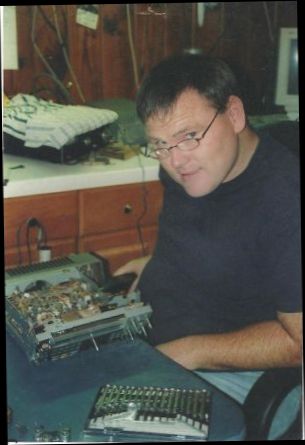
Hey Bill and Pete
Man, I am loving the podcast!
It is absolutely what I need, and what ham radio needs today!!!
I am at about episode 168 trying to catch up.
I would really like to build a Mighty Mite.
In fact, going on the record,
I AM GOING TO BUILD THE MICHIGAN MIGHTY MITE.
If you have any crystals left could you please send me one.
I’ve got a 9 year old boy that’s home schooled and I want to make this electronics hobby a stepping stone to a higher learning experience.
I got in to ham radio to learn electronics and somewhere along the line I just learned how to send and receive CW and how to pass multiple choice question tests. Somehow along the way I lost my love of radio. I still have a nice modern day rig, but it has no “soul”. I heard that comment in one of your episodes and it really rang a bell with me and when it rang I said,
“Oooh, that’s Awesome! “
I want a radio experience with soul!
I think that maybe why folks still use CW. It’s a mode with soul. I know you champion SSB, but home brewing a CW transmitter and receiver has got to be a truly soulful experience. And its one I intend to have as one of my own.
I too want to enjoy the “Joy of Oscillation “.
With you guys inspiring me, I am sure this will be a wonderful adventure.
THANK YOU! THANK YOU! THANK YOU!
For your guidance and inspiring work in the field of homebrew radio.
Sincerely,
Paul Hodges
KA5WPL
P.S.
The chemistry of you 2 guys on the show REALLY remind me of Click and Clack. You guys really work well together!
PLEASE DON’T STOP!
73
———————
Paul: Consider yourself inducted. There are, however, some conditions:
1) You MUST build the MMM and make it oscillate (thus experiencing the JoO).
2) You MUST send a picture or (better) a video of your MMM in operation.
3) You have to give me permission to put your e-mail (below) on the SS blog.
4) You have to send me your address so I can issue you a for-real SS 3.579 crystal (with mojo).
Deal? 73 Bill
—————–
Deal,
I’ll do my best to get video, at the very least I’ll get pics.
As for making it actually oscillate, well if the “radio gods” let it be then I’ll be having some good vibrations going on in the shack. Hope to have it going before first snow…of 2015…
Also, being inspired as I am, I made a CW contact with 5 watts since I emailed you last.
Thanks for helping me get the fun and excitement and the adventure back in to ham radio!
Sincerely,
Ka5wpl
P.S.
Please send a card if you have one with the crystal.
PPS Also why not initial it if you’ve got a small enough pen 🙂
73
———-
Paul’s Knack Story is here: http://www.qsl.net/ka5wpl/
Our book: “SolderSmoke — Global Adventures in Wireless Electronics” http://soldersmoke.com/book.htm Our coffee mugs, T-Shirts, bumper stickers: http://www.cafepress.com/SolderSmoke Our Book Store: http://astore.amazon.com/contracross-20
W1JSB’s Very Cool Portable Rigs — RadioSet-Go!
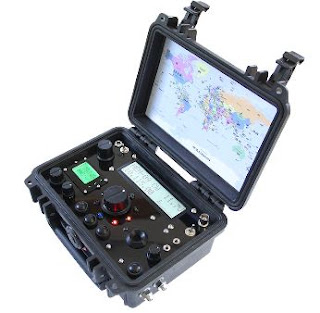
Brad Smith alerted me to this. Very cool. Hanz W1JSB is churning out some amazing trail-friendly rigs. I really like the tinted-translucent front panel.
Here is the site for Hanz’s company: http://radioset-go.com/
Here is his YouTube Channel: https://www.youtube.com/user/w1jsb/videos
Our book: “SolderSmoke — Global Adventures in Wireless Electronics” http://soldersmoke.com/book.htm Our coffee mugs, T-Shirts, bumper stickers: http://www.cafepress.com/SolderSmoke Our Book Store: http://astore.amazon.com/contracross-20
Tonight is the “Night of Nights”

From “The SWLing Post” we learn that tonight may be the last opportunity for us to listen to CW from U.S. Coast Guard stations:
Our book: “SolderSmoke — Global Adventures in Wireless Electronics” http://soldersmoke.com/book.htm Our coffee mugs, T-Shirts, bumper stickers: http://www.cafepress.com/SolderSmoke Our Book Store: http://astore.amazon.com/contracross-20
Kai’s Redwood Mighty Mite with Poker-Chip Hacksaw Key
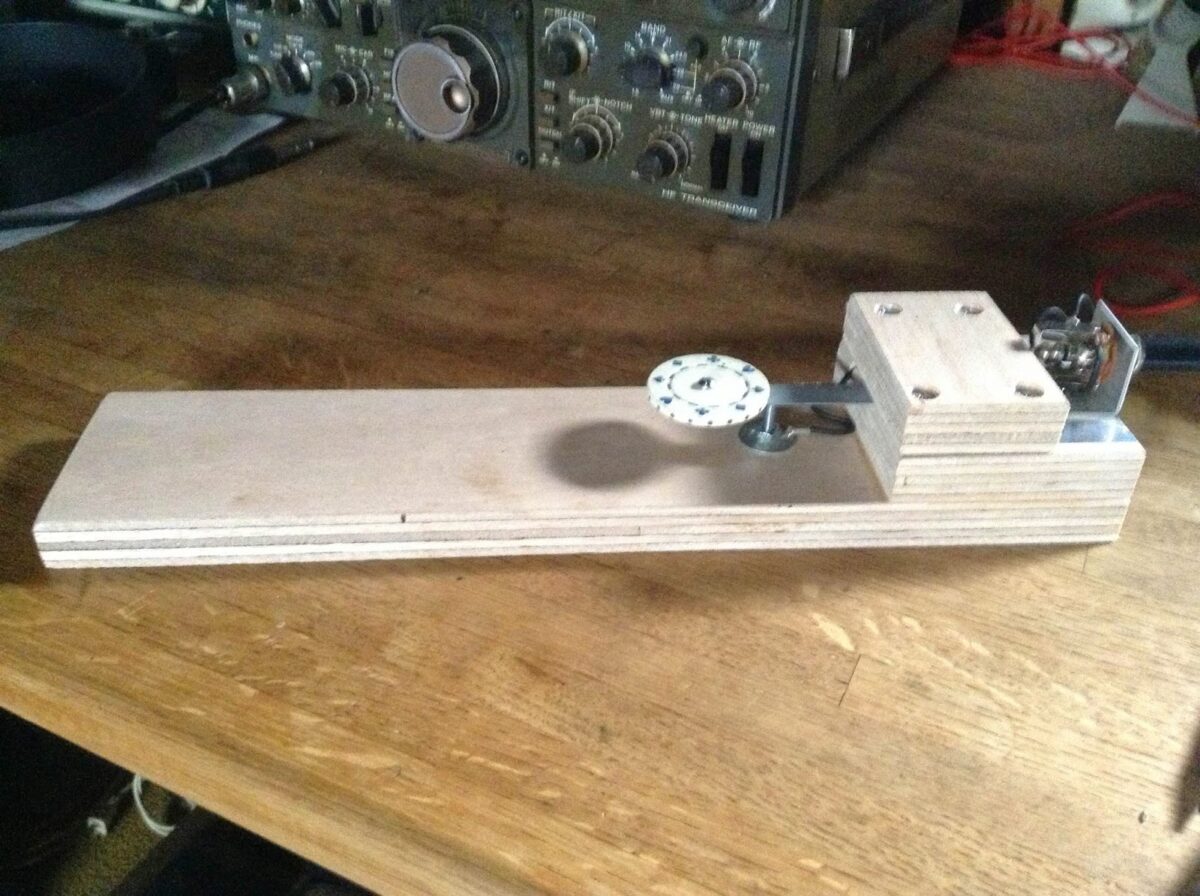
And Check out Kai’s homebrew key:

Hi Pete,
Thanks for your kind words. I really enjoyed the MMM project, first analog oscillation  . Your right about the homebrew key being a hacksaw blade and a few pieces of plywood. The knob is an old poker chip. You can adjust the spring tention by moving the blade in and out of the plywood. Travel can be adjusted by raising and lowering the bolt under the blade. I needed something for CW and wanted to stick to the ham maker thing. As for me sending lefty, I do that so I can switch when the right gets tired or I need to hold ipod for video. Thanks for what you add to soldersmoke. 73.
. Your right about the homebrew key being a hacksaw blade and a few pieces of plywood. The knob is an old poker chip. You can adjust the spring tention by moving the blade in and out of the plywood. Travel can be adjusted by raising and lowering the bolt under the blade. I needed something for CW and wanted to stick to the ham maker thing. As for me sending lefty, I do that so I can switch when the right gets tired or I need to hold ipod for video. Thanks for what you add to soldersmoke. 73. Kai
Ps I will send picture of key.
On Monday, January 12, 2015, Pete Juliano <jessystems@verizon.net> wrote:
Hi Bill,Wow –so cool! I was impressed with not only his M^3 but the homebrew key and sending with his left hand.It would be nice for Kai to send us his details for the key. It looked like a hacksaw blade sandwiched between some plywood blocks of wood and some sort of plastic tuning knob from a defunct transistor radio as the key knob. Now that is what I call homebrew –elegant and it works well!73’sPete N6QW
Our book: “SolderSmoke — Global Adventures in Wireless Electronics” http://soldersmoke.com/book.htm Our coffee mugs, T-Shirts, bumper stickers: http://www.cafepress.com/SolderSmoke Our Book Store: http://astore.amazon.com/contracross-20
Arduino CW Sender by KK6FUT and N6QW
The next time Pete and I get together on SolderSmoke, we’ll talk about Arduino.
Our book: “SolderSmoke — Global Adventures in Wireless Electronics” http://soldersmoke.com/book.htm Our coffee mugs, T-Shirts, bumper stickers: http://www.cafepress.com/SolderSmoke Our Book Store: http://astore.amazon.com/contracross-20
Paddle Output Arduino Keyer Kludge (video)
Ooops — I got my keyer terminology wrong in this video. The K1EL keyer just needs a “paddle keyer” input, not an iambic keyer. One line is brought to ground for dots, another for dashes. (With an iambic keyer, if you make both contacts at the same time you get a string of alternating dots and dashes.) My homebrew cootie keyer did the job, but I wasn’t very proficient, hence the need for this digital kludge. I also got the name of the Arduino guru wrong: he is Massimo Banzi. Mi dispiace Massimo.
Our book: “SolderSmoke — Global Adventures in Wireless Electronics” http://soldersmoke.com/book.htm Our coffee mugs, T-Shirts, bumper stickers: http://www.cafepress.com/SolderSmoke Our Book Store: http://astore.amazon.com/contracross-20
Knack Story: Ryan’s Rig
Bill,
… [I know] a young ham locally who suffers terribly from the
affliction of the “knack”. Ryan, KJ6HBY, is 17, and an Extra class,
who earned his DXCC in a year. He is a great builder, starting out
building his first antenna a couple years ago by breaking apart an old
washing machine motor and unwinding it for the wire. Along the way he
has restored various rigs, i.e. HR10, S-38, IC707, etc and built a
BTX17 (17 meter version of the BTX20). Enclosed is a couple photos of
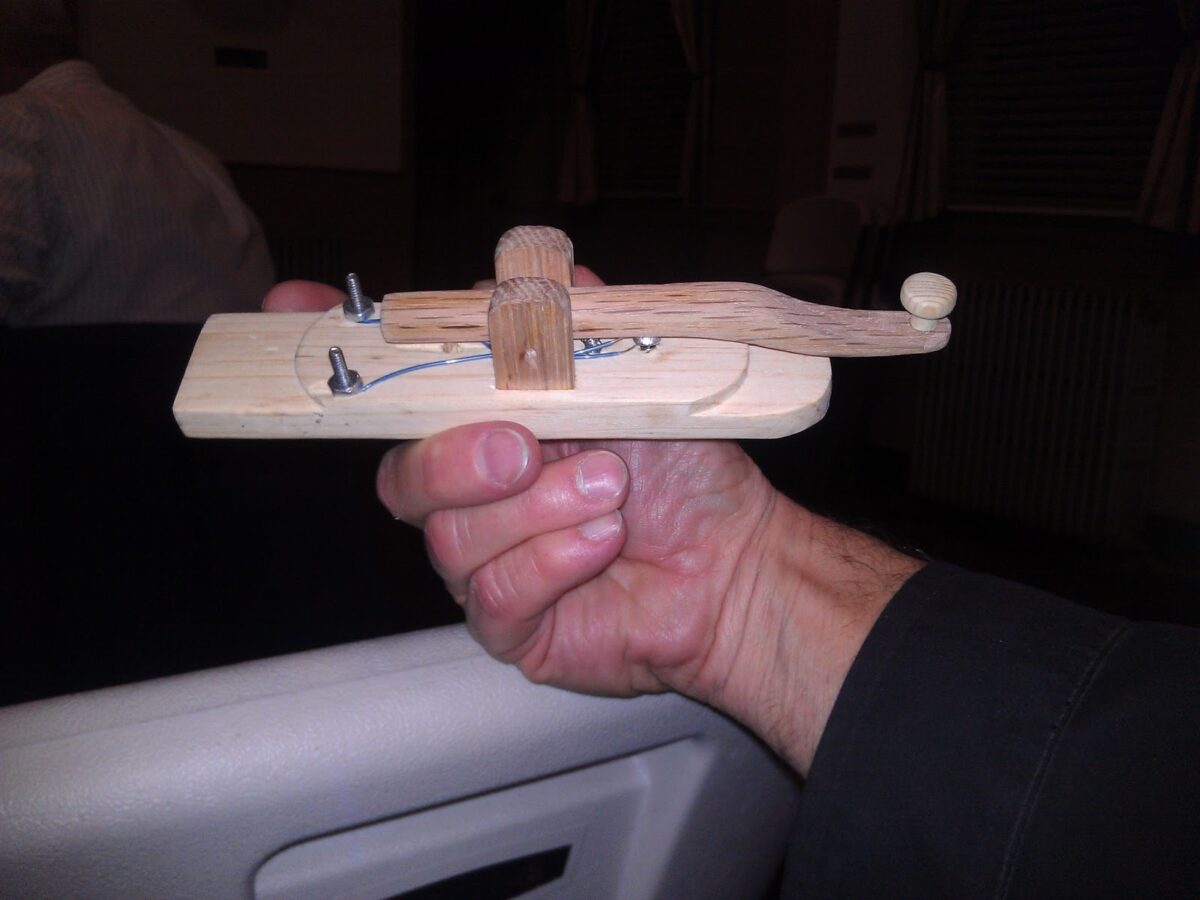
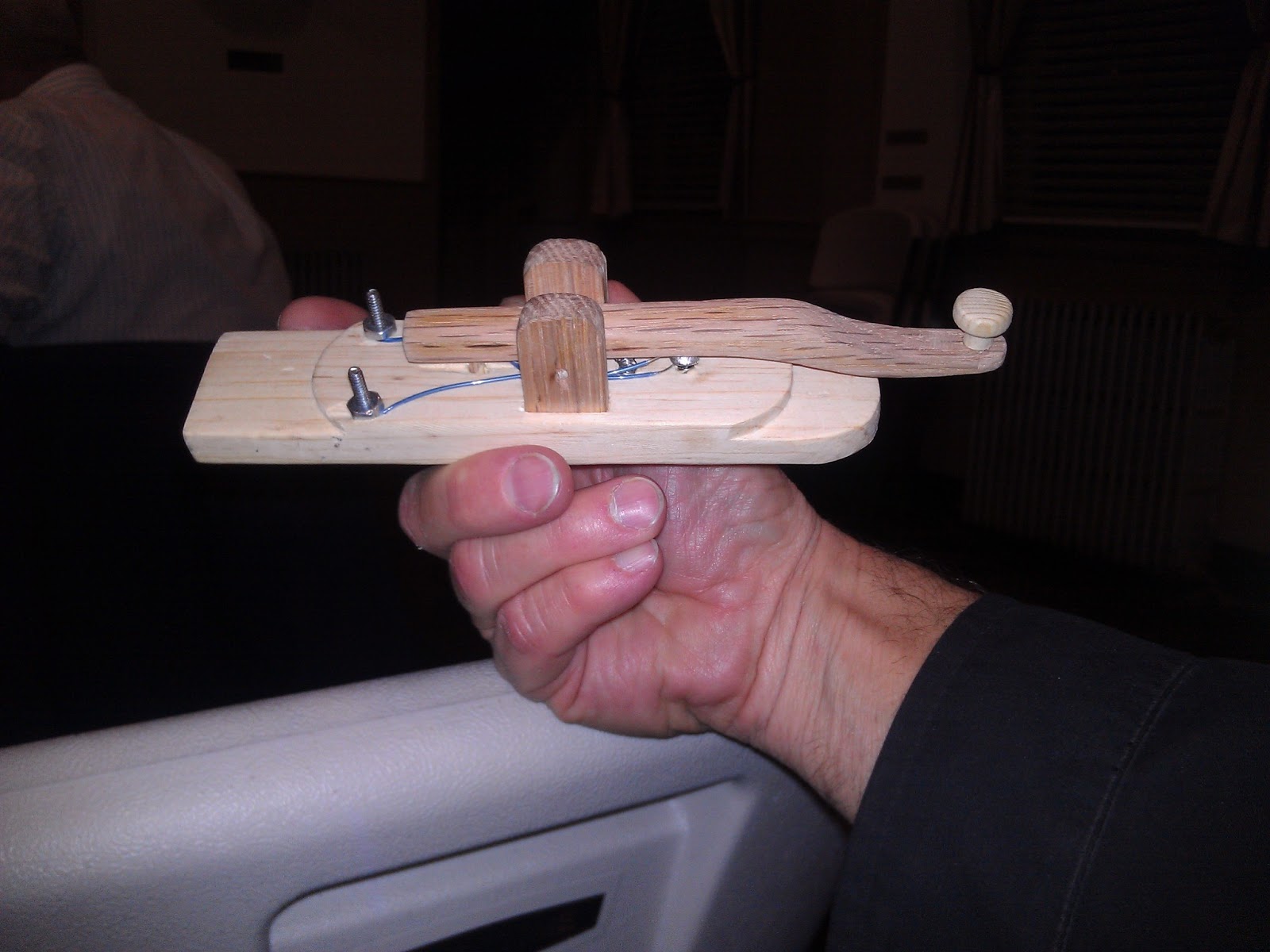
his latest creations. First, he hand carved a wood morse code key. It
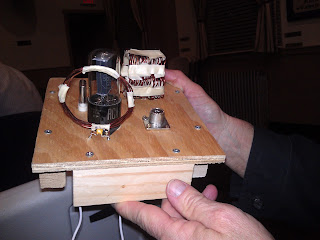
actually feels and works well. Now he has build a single tube xmtr,
and after fussing with it, is pumping out 4 watts. Both of the kid’s
folks are hams as well as his sister. I had an opportunity to visit
his shack the other day. It’s a teenage ham’s dream and a mother’s
nightmare. Racks floor to ceiling with radios! If anybody has the
knack, Ryan does. Makes me think there is a future, we can sleep well
tonight.
73
Mike Herr
WA6ARA
DM-15dp
Home of The QRP Ranch
Our book: “SolderSmoke — Global Adventures in Wireless Electronics” http://soldersmoke.com/book.htm Our coffee mugs, T-Shirts, bumper stickers: http://www.cafepress.com/SolderSmoke Our Book Store: http://astore.amazon.com/contracross-20
Arduino Does Straight Key Night
Bill,
Hope a good Christmas and excellent New Year. Here at WA6ARA we had a blast for Straight Key night . In the past I have used new keys, old keys and multiple keys. This year we celebrated SKN with a little twist. At Pacificon I purchased a hugh CW key, all made out of wood, about 3 times the normal size J-38. This isn’t a QLF key but a piece of beautiful wood working, and fully functional. This was my main key for SKN.
But SKN can require the sending of CQ SKN for a considerable amount of time. Normally a programed keyer would do the job fine. But this is not in the true spirit of SKN, the use of the straight key. So, using a trusty Arduino board and a few lines of programming, I solved the practical and ethical problem. The Arduino drives a model airplane servo. The servo is positioned such that it’s arm presses down on a miniature J-38 key, thus sending the “CQ SKN”. Also the miniature J-38, about half size, sort of balances out the larger size of the
hand key, and keeps the universe in check. I’ve enclosed a short youtube for your viewing enjoyment
http://youtu.be/Rn7Ky9Ib7ug
73
—
Mike Herr
WA6ARA
DM-15dp
Home of The QRP Ranch
Hope a good Christmas and excellent New Year. Here at WA6ARA we had a blast for Straight Key night . In the past I have used new keys, old keys and multiple keys. This year we celebrated SKN with a little twist. At Pacificon I purchased a hugh CW key, all made out of wood, about 3 times the normal size J-38. This isn’t a QLF key but a piece of beautiful wood working, and fully functional. This was my main key for SKN.
But SKN can require the sending of CQ SKN for a considerable amount of time. Normally a programed keyer would do the job fine. But this is not in the true spirit of SKN, the use of the straight key. So, using a trusty Arduino board and a few lines of programming, I solved the practical and ethical problem. The Arduino drives a model airplane servo. The servo is positioned such that it’s arm presses down on a miniature J-38 key, thus sending the “CQ SKN”. Also the miniature J-38, about half size, sort of balances out the larger size of the
hand key, and keeps the universe in check. I’ve enclosed a short youtube for your viewing enjoyment
http://youtu.be/Rn7Ky9Ib7ug
73
—
Mike Herr
WA6ARA
DM-15dp
Home of The QRP Ranch
Our book: “SolderSmoke — Global Adventures in Wireless Electronics” http://soldersmoke.com/book.htm Our coffee mugs, T-Shirts, bumper stickers: http://www.cafepress.com/SolderSmoke Our Book Store: http://astore.amazon.com/contracross-20
“Zen and the Art of Radio Telegraphy”
OM Carlo Consoli, IK0YGJ, has produced a nice book on radio telegraphy. Very much in the spirit of the International Brotherhood of Electronic Wizards, he has made it available in Italian, English, French and German. I have started a refresher language course in Italian and intend to use Carlo’s book as reading material for the course (my instructor will be sympathetic because her son is a radio amateur). Who knows, I may be able to improve my Italian and my CW at the same time!
Check it out: http://www.qsl.net/ik0ygj/enu/index.html
Our book: “SolderSmoke — Global Adventures in Wireless Electronics” http://soldersmoke.com/book.htm Our coffee mugs, T-Shirts, bumper stickers: http://www.cafepress.com/SolderSmoke Our Book Store: http://astore.amazon.com/contracross-20
Google CW!
Google announced this yesterday. VERY timely. I wish I had thought of this!
Our book: “SolderSmoke — Global Adventures in Wireless Electronics”http://soldersmoke.com/book.htmOur coffee mugs, T-Shirts, bumper stickers: http://www.cafepress.com/SolderSmokeOur Book Store: http://astore.amazon.com/contracross-20
The FUNKY Keyer
 Paul up in Manchester has some really intriguing ideas on CW and keyers. He likes highly personalized CW from straight keys, and thinks he can even hear the influence of Latin-based languages when receiving signals from stations in France and other Romance language countries. (Like me, he also thinks a bit of homebrew chirp adds some character to signals. ) Automatic keyers seem to squeeze all of the individuality out of CW. So Paul has written some computer code to put that individuality back in! Can we get a “Lake Erie Swing” option Paul? Check out Paul’s blog. Interesting stuff!
Hi Bill
Further to the kind words of introduction you gave me as a “new homebrewer” in Soldersmoke 104, I’m writing to let you know about a little project of mine which I think you might appreciate…
I made a h/b keyer a while back and recently added the ability to send automated 3*3 cq calls (and cq FISTS calls).
On doing this, I realized how much I HATE the sound of machine generated CW – so mechanical and lifeless. I want to hear a real fist – preferably with some chirp and drift thrown in for good measure!
So – I’ve come up with an alternative – The FUNKY keyer!
It adds some random timing “jitter” to each automated cq call, to simulate the sound of a real fist on a straight key.
You can read all about the Funky Keyer on my blog, http://m0xpd.blogspot.com
The blog also documents some of the other outcomes of my personal puffs of solder smoke, including the “Funster PLUS” 40m CW Transceiver and the “Not-so-superhet” experimental valve receiver. There’s some operating stuff, including WSPR on 40 and 80m with my Softrock SDR and I was inspired by Soldersmoke to include some travelog – ZL, VR2, BY, HB, etc.
Hope you enjoy it.
Let me take this opportunity to thank you for all the enthusiasm and inspiration you continue to give us in Soldersmoke,
73 de Paul, m0xpd
Paul Darlington