ET-2 Contact #18 W4FOA — RANDOM, UNSCHEDULED, AND NOT SPOTTED (Video)

On December 1, 2019, my 100 milliwatt signal flew more than 500 miles to reach Tony W4FOA in Chickamauga, Georgia. And — icing on the cake — this was a random contact. Tony just heard my CQ on 7038 kHz — he had not been alerted to my CQ by any spotting site or by the SKCC Sked page. I made a quick video of my side of the contact (above).

In a follow-up e-mail Tony explained how my CQ sounded to him:

“I was just listening on the 40 meter band and having been a QRP’er for 50+ years, I tend to notice the weaker stations, thus explains my calling you. Also, your signal had that little “sound” of “yesteryear” when signals were not all pure, hi. Had it not been for the QSB and QRN we could have had a long chat despite the weak signal from your QRPp. Over the years I have QRP DXCC, 2 way QRPARCI WAS, and my best DX was two QSO’s with 2 different VK7 stations on 40 when I was running 1 watt. I’ve had a lot of different QRP rigs and still have some home brew stuff plus a couple of HW8s, HW9, Elecraft K2, etc…”


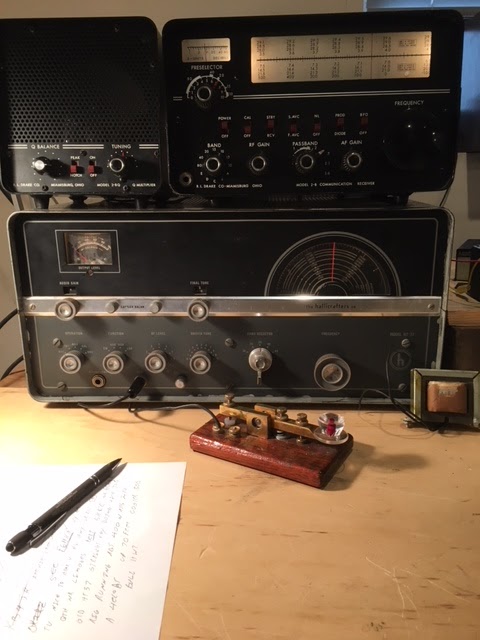
From Tony’s QRZ.com page, we learn more about his ham radio activities (note his homebrew rigs and his obvious affection for the Drake 2B and 2BQ)

First licensed as WN4FOA in April 1954. Other calls held include EL2AD, 7Q7AA, PY1ZBA. Prefer to work CW but I do work some SSB, primarily DX-related. Enjoy chasing DX on all HF bands. Have 9BDXCC and I now have worked and confirmed all of the current DXCC countries . I enjoy QRP operation and currently use an Elecraft K2 (#2213),Ameco AC-1, Kenwood TS-130V SW-40, DC-40, HW-8 (2), Heathkit HW-9 Deluxe (WARC) PSA-9 HFT-9B SP-99 HM-9 HD-420 VLF, MFJ 40T and MFJ 40V VFO, and a homebrew 6AG7/6L6 or a 6C4/5763 etc. I also enjoy operating boatanchor gear which includes a Johnson Viking Adventurer, Viking Challenger, an Eico 720 and an Eico 723 with a HG-10B VFO and a Heath AT-1 and a Drake 2NT. Recently added a neat Lysco 600 transmitter and a Knight Kit T-60, Johnson Viking II, and a Ten Tec 544. Boatanchor receivers include a Hallicrafters SX-100, SX-110, SX-71, Drake R4C and the incredible Drake 2B/2BQ combo. Recently added a Kenwood TS-830S, VFO-240, AT-230 and SP-230.
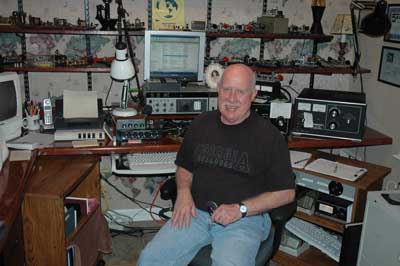
Tony W4FOA

Thanks a lot Tony. 73

QSO #3 with the ET-2 Minimalist Transceiver

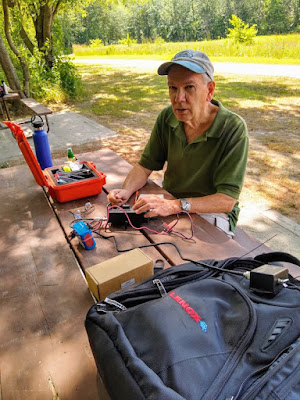
The Radio Gods were clearly supporting me on 16 October 2019. I had sent out a plea for people to listen for the 80 mW CQ from my ET-2 rig. I had specified 0930 Eastern as the time. Little did I know that there would be a contest at that hour (on a Wednesday morning!) on 40 meter CW. There was no chance of my signals getting through. I leaned that the contest would be over at 1000 hours, so I waited and called CQ again at that hour. Jim W1PID had guessed that I would do that. I immediately recognized his call — he was often at the other end of Michael Rainey’s most daring low-power adventures. He was a participant in the famous Rexpeditions, including a coastal effort to send Michael’s voice-powered CW signal across the Atlantic. His normal operating habitat is in the field. We had a wonderful QSO. He told me I peaked at S-6.
I have worked W1PID on at least two Straight Key Nights and this blog has had many postings about his long-standing involvement in QRP.
Thanks a lot Jim!

Making Fish Soup from Herring and Tuna (How to Build a Fish Soup 10 Transceiver)

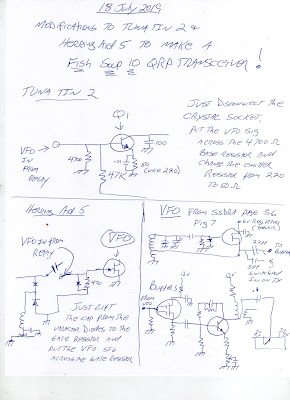
Just in case some other fanatic someday thinks about trying to turn a Herring Aid 5 and a Tuna Tin 2 into a Fish Soup 10. This will also serve as a note to myself on how I did this. Above are my suggestions on how to get the VFO signal into the transmitter and the receiver. Both RX and TX can easily be returned to their original condition.

A Frequency Readout for the Fish Soup 10 (with cool BLUE numerals)

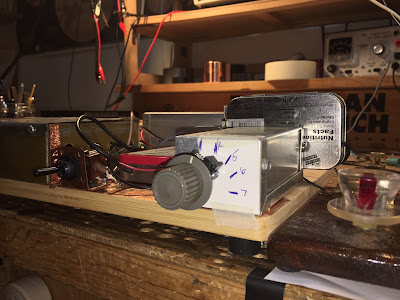
Note the cool BLUE numerals. They represent 7040, 7050, 7060, 7070. The little black “pointer” is from a power cord wall fastener. My tuning cap has a nice reduction drive — the pointer follows the movement of the capacitor blades. The VFO is very stable.

Simplicity is a virtue. CW is, I think, outmoded and kind of absurd (one letter at a time? really?), but it does allow for extreme simplicity. Using a rig with just 10 transistors, putting out half a watt of RF, I am regularly communicating with people. This is what I like about CW.

I’ve had about 12 solid contacts with this rig since putting it on the air earlier this month. The VFO was a huge improvement over being crystal controlled. Crystal control was OK back when receivers were broad and hams tuned around for replies, but those days are gone. Getting the transmit offset set correctly was another huge improvement.

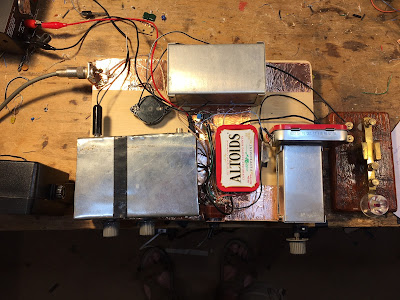
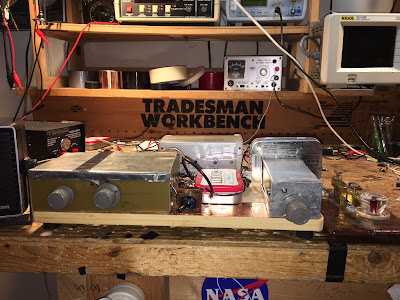
The “Fish Soup 10” Homebrew QRP CW Transceiver

The box with the two grey knobs on the left is the Herring Aid 5, the receiver that took me 38 years to complete. The box on the right is a VFO I originally built for my first BITX40Module — it started out around 4 Mhz but I pulled turns off the coil until it was in the 40M CW band. The Altoids in near center has the buffers — a 40673 MOSFET and a 2n3904 BJT. The box in the back holds the Tuna Tin 2. There the oscillator has been reconfigured as an amp. A relay switches the output from the buffers between the receiver and the transmitter. That big switch in the center switches the antenna and the 12 V for T/R. The circular black thing is piezo buzzer used for CW sidetone — I have it glued to the board upside down to keep the volume down.

The whole thing is mounted on a kitchen cutting board. A breadboard!

The most difficult part of all this was getting the needed 800 Hz drop in TX freq on transmit. You need to do this with a rig like this or else you won’t be in the other fellow’s passband. I did a lot of cut and try — in the end I put a 5 pf cap across the coupling cap from VFO to buffer. This 5 pf cap switches in on transmit via a small relay. It works. I just spoke to N8AFT out in Columbus, Ohio and I was in his passband.

So five transistors in the receiver, two in the transmitter and three in the VFO/Buffer. So it is the Fish Soup 10.

It puts out about half a watt. On CW. I am feeling virtuous and vaguely superior. I’ve made several more contacts. It all works very well and is a lot of fun.

The Fish Soup 7 QRP Rig — On the Air on 40 Meters (video)

I don’t know why, but this weekend I got the urge to get on the air with a very low power homebrew QRP rig. I reached for my Tuna Tin 2 — Herring Aid 5 combo. I call it the Fish Soup 7 (seven transistors in total).

I first tried to turn this rig into a transceiver by taking the VFO signal from the receiver (it is direct conversion) and using it to excite the Tuna Tin 2, but it just didn’t work out. The oscillator in the Herring Air 5 is very bare bones — no buffering and an LC circuit that is mostly L (10 uH). It became very difficult to get a stable amount of CW offset. So I went back to crystal control for the transmitter. I did replace the 5K tuning pot in the RX with a 10k 10 turn pot (thanks to W8NSA). Tuning is now very smooth. I used my old UK freq counter to monitor my receive freq. (Thanks to Tony Fishpool G4WIF– back in 2009 he sent me the CMOS chip that brought this counter back to life.)

I was putting out about 750 milliwatts.

I had a very quick contest-like contact with K2D — one of the “13 Colony” stations. Then a longer chat with Hank K1PUG (see video above).

I had lost my 7050 crystal, but this morning it re-appeared. TRGHS.

As you can see in the video I am using the beautiful VU3XVR key that Farhan brought me from India.

This was fun. I may try to put a VFO of some sort into the TT2, just to get more agility. But I want to keep things simple.

Look for me on 7050.

UK Wartime Radio — The Secret Listeners

We had this video on the blog before, but it was seven years ago, so it it time for a re-run.

http://www.eafa.org.uk/catalogue/5108

Thanks to Graham GW8RAK for reminding us of this.

Listening to it again, I was struck by the claim that the nationality of the operator could be discerned purely by his or her CW sending style. Is there really an Italian accent in Morse Code?


UK Wartime Radio — The Secret Listeners

We had this video on the blog before, but it was seven years ago, so it it time for a re-run.

http://www.eafa.org.uk/catalogue/5108

Thanks to Graham GW8RAK for reminding us of this.

Listening to it again, I was struck by the claim that the nationality of the operator could be discerned purely by his or her CW sending style. Is there really an Italian accent in Morse Code?


SolderSmoke Podcast #209 SKN, Old Rigs, Movie Review, Safety Tips, Mail Bag

SolderSmoke Podcast #209 is Available:

13 January 2019

http://soldersmoke.com/soldersmoke209.mp3

An HT-37 “With Presence!” Even on CW! A Straight Key Night Story
Saving a much-loved HT-37
Drake 2-B Alignment
Tweaking the Mate for the Mighty Midget
Fixing a Deaf DC Receiver
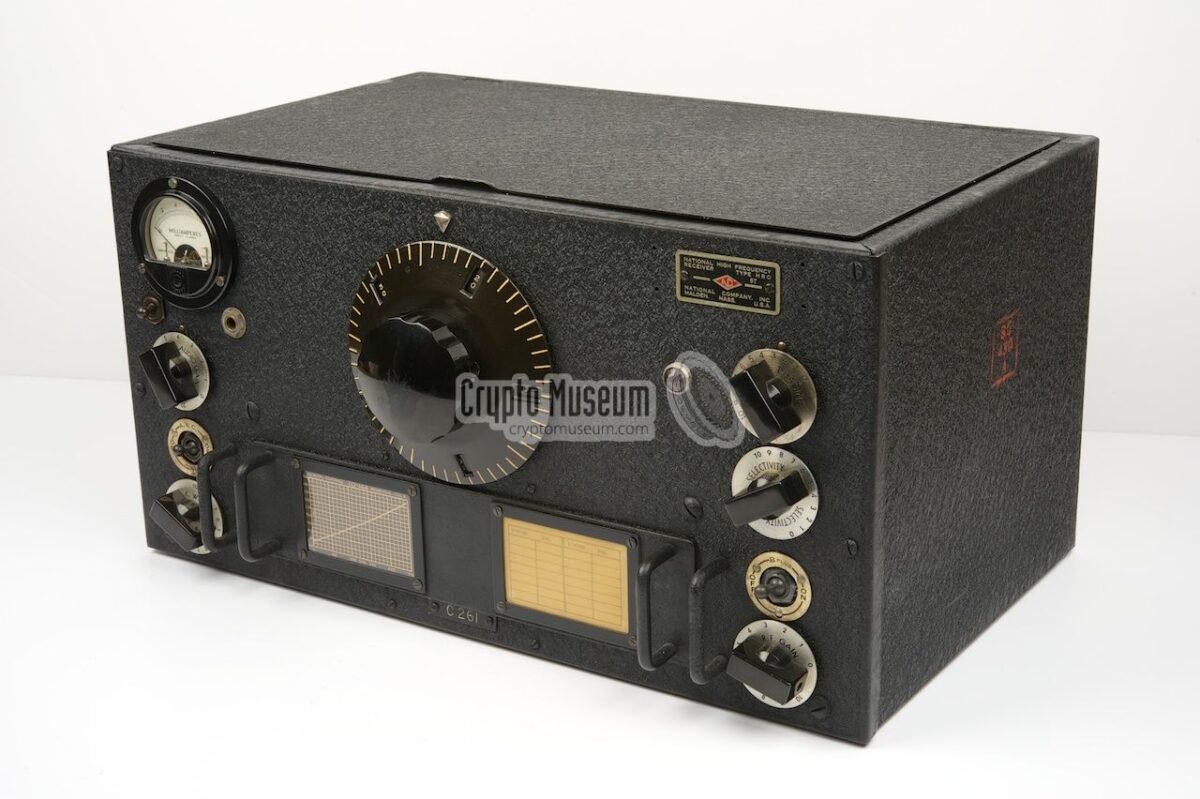
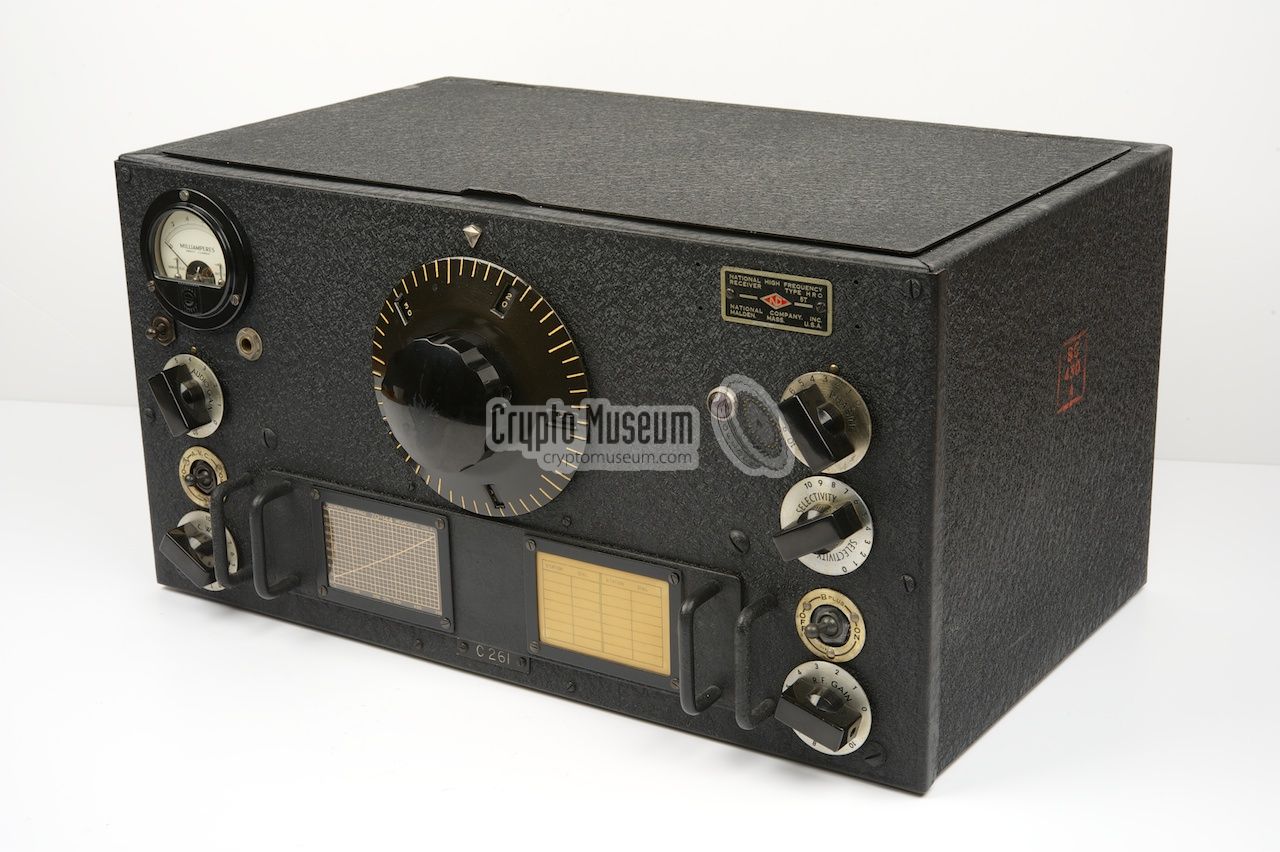
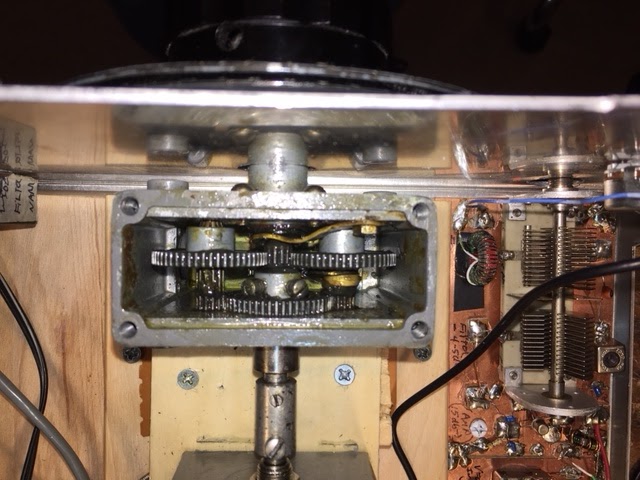
A Wobbly National HRO-ish Gear Box
Minimum Discernible Signal Tests
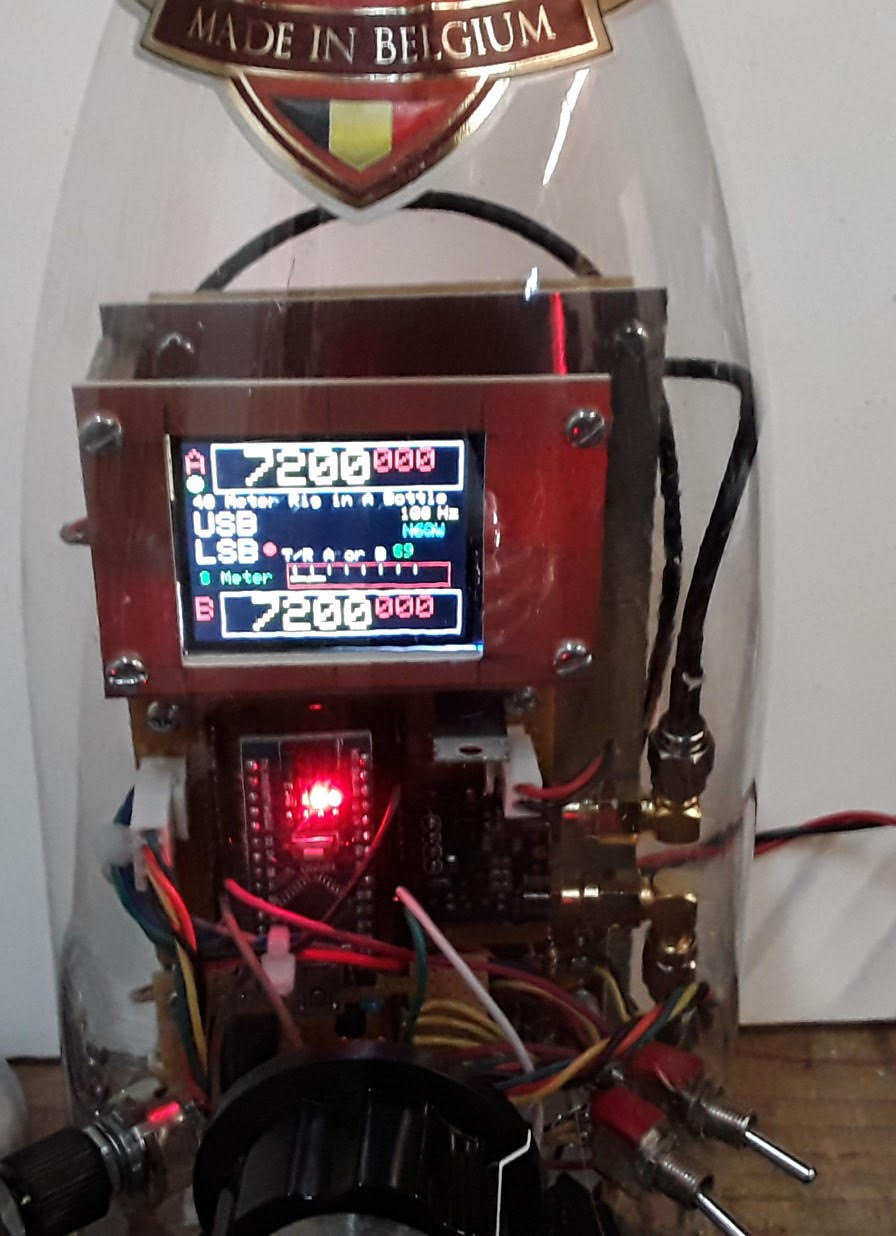
Pete’s Festive Holiday Transceiver in a Bottle

Movie Review: “First Man” Neil Armstrong goes to the moon.

Safety Tips for 2019: Fuses, Hard Drives, Flu Shots.

MAILBAG:
Dave G6AJW builds Pete’s Sudden Transceiver
Rogier KJ6ETL builds a new shack
Steve N8NM Helps save the HT-37
Jim AL7RV W8NSA builds Parasets
Dave AA7EE puts a beacon on the air — Please Listen!
Jan OM2ATC builds and documents an Si5351 VFO
Bruce KC1FSZ Homebrew’s a BITX
KB1GMX’s Tip on IRF-510 Oscillation Prevention
Ryan W7RLF Homebrews a DC Receiver

Listening to August K5HCT from the East and West Coasts on 40
Tim WA1HLR rebuilding his 1968 transmitter.


HNY (Happy New Year), SKN (Straight Key Night) 2019, and an HT-37 with “presence” — even on CW

I got the HT-37 working just a few days before the New Year’s Eve/New Year’s Day Straight Key Night event. Looking at my older blog posts, I now see that the problems first surfaced in LAST YEAR’s SKN. Wow, it took me a long time to get to that problem. But I’m glad I fixed it in time for SKN.

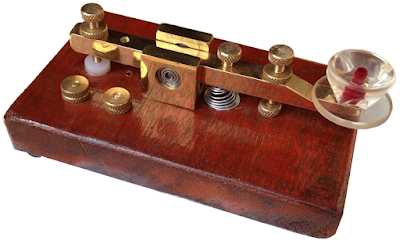
For SKN I used the VU3XVR straight key from India that Farhan gave to me. See the picture above.


I started out on 80 meters on New Year’s eve. I rarely operate on that band — I thought it would be a good change of pace. Here is who I contacted on 80 CW:

In the warm-up period before the official start of SKN I worked John KU4AF. John was running a homebrew tube transmitter and a REGEN receiver. Respect, my friends. RESPECT!

N9EP Ed near Chicago was on a K3.

VE9XX Don was on a KX3.

NJ8D Tom in Ohio.

K4IA, Buck, down the road in Fredricksburg Va. Buck was running a Drake TR4C with a Begali key. FB Buck. He mentioned that he had had a Drake 2B — he said he regrets selling it. Indeed.

VE9WW Bill in Moncton NB. On a straight key.

AA8MI Gene (gosh, that name really sings in CW — try it!) in Ohio. Gene was running 5 watts from a K3. This added a needed QRP element to the festivities. Thanks Gene.

AI4SV Jack in Rockville Md. OH MY GOD! NOW I REALIZE WHO THIS WAS! Jack! Jack of Antanarivo Madagsascar! And now I understand what he said to me. He said in CW that my HT-37 has “Lots of presence.” Huh? What? I couldn’t figure out what he was talking about, but now I realize that he was joking about all our discussions mocking the poor audiophiles. Well, thanks Jack. I’m glad the rig has presence, EVEN ON CW! THIS QSO GETS MY VOTE FOR BEST SKN QSO.

I also listened for a while to W3GMS. His signal had a lot of character and personality. He was telling the other fellow that he suspected this was the result of a soft voltage regulator tube in his DX-60. I think he was also using a Drake 2-B. I didn’t get a chance to talk to Howard, but I’m sure it would have been fun.

On New Year’s morning I switched bands. First to 40 where I worked Greg NM2L near Atlanta. He said he fingers and wrist were out of condition, but I told him his fist was FB.

Then I went to 20 CW where I worked a bit of DX. First David F8CRS then Bert F6HKA. The contact with Bert reminded me of the charms of DX contacts using CW. “VY GM DR OM.” It was nice.

N7AQQ Mike in Montana.

So it was a good SKN for me. Working the French stations reminded me of the allure of listening to CW coming in from far away, and from a foreign culture. And it was great to hear from AI4SV that my HT-37 has “presence” even on CW.

73 and HNY to all.

Mike Rainey and Heavy Metal AM Phone

Michael Rainey AA1TJ wrote:
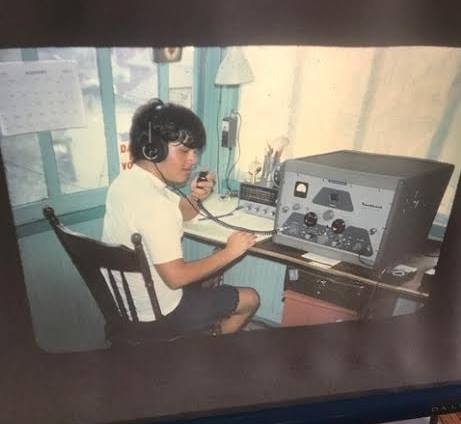
I can tell you exactly what’s going on here. I’d just received a license upgrade from “Novice” to “General.” My new license granted radiotelephone privileges and I was eager to try them out.

In the early 1970’s no self-respecting amateur radio operator would dream of using amplitude modulation (AM) on wavelengths above 10m. It wasn’t illegal, rather, it was frowned upon due to bandwidth issues, among other things.

But in my excitement – and in the time-honored spirit of, “don’t ask permission, ask forgiveness” – I tuned my clunky, Heathkit DX-100 to the 40m radiotelephone band and began calling CQ on AM. Everyone that I contacted was very polite, but to the man they all mentioned how “odd” it was to hear an AM signal on 40m. I eventually took the hint, but not before I’d figured out that yakking on a microphone wasn’t my thing after all. Morse telegraphy was my first and enduring love.
————————————-
I think Michael’s next phone transmitter was that voice-powered rig that he used in an attempt to cross the Atlantic with the only power source being his vocal cords. But even there, he was using his voice to send Morse.


C’mon back to radiotelephone Mike. There is more to life than dots and dashes!

SolderSmoke Podcast #202 Cover-Rig, SKN, Pete’s Vector Boards, uBITX, K1BQT rig, MAIL

SolderSmoke Podcast #202 is available:

http://soldersmoke.com/soldersmoke202.mp3

13 Jan 2018

Opening music from Shel Silverstein and Dr. Hook and the Medicine Show.
On the Cover of the Rolling Stone or On the Cover of SPRAT magazine.
Travelogue and Weather Report
— Bill’s trip to the Dominican Republic. SWL on the beach. Return to the ice box.
— Dramatic events in California.

— Reading Chinese Sci Fi with lots of radio in it. “The Three Body Problem” by Cixin Liu

Straight Key Night. IN QRP MODE THANK YOU. With nephew Jeffrey. Annual event — worked Jim W1PID friend of Mike Rainey.

Steve Murphy and Jeff Damm on QSO Today. FB.

Oh your rig is homebrew? “It must be propagation.”

ER Reading about G3UUR

Hams avoiding 60 meters due to 100 watt limit. SAD.

Bill’s Bench: Continuing series on the Ceramic Discrete DC receiver. Described the oscillator and the AF amp. Next we will do the Mixer. The most interesting stage. Nephew John Henry and niece Helena visiting today.

Pete’s bench. uBITX adventures.
The K1BQT IC transceiver.

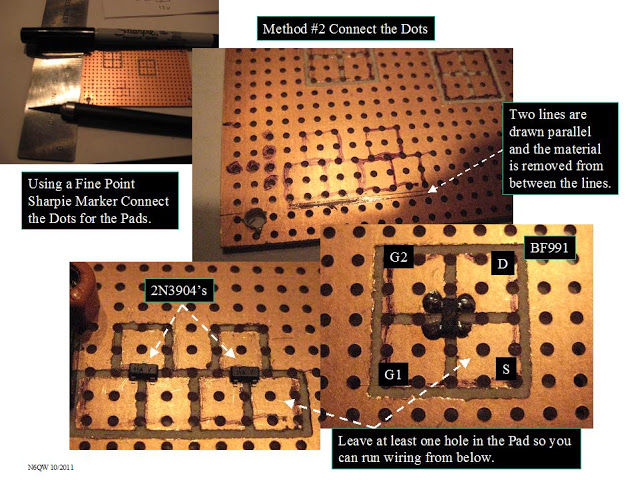
The Vector Board building technique. See http://n6qw.blogspot.com/


MAILBAG
Paul KA5WPL Looking for project with his son. Sawdust. Thanks again Steve Silverman.

Chris Waldrup OM PBJ thanks for the gift

Pete in contact with Sven Johnson
Chuck KE5HPY sent us picture of fashion model with boatanchors in background Grayson recalled 73 magazine covers…

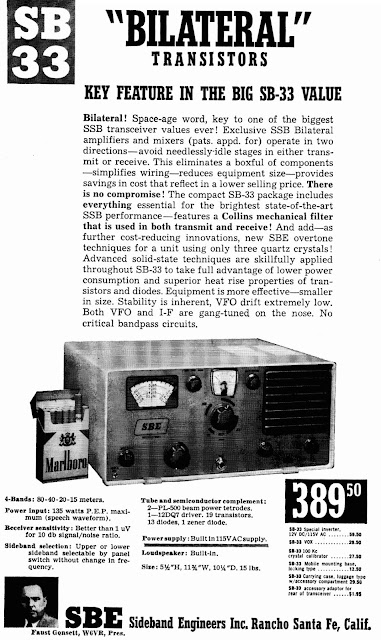
Pete WB9FLW Bilateral SBE-33 ad “with inherent stability” That’s the best kind!
Bruce KK0S experimenting with AF amps for the DC receiver

John KE5ETX Attempting CBLA

Straight Key Night at N2CQR

I did my part for the retro-Luddite-CW-Straight Key cause. My HT-37 was kind of wheezing. I may have to go in there to striaghten it out. At times I had it cranked back to less than 5W (to maintain some semblence of QRP street cred).

A highlight was the QSO with Jim W1PID. Jim is a well-known QRPer and a friend of QRP Hero Mike Rainey. Jim and I talked last year — same date, same event, same rig. Jim has a really nice web site: http://www.w1pid.com/

My nephew Jeffrey joined me for the last two contacts. He got a real kick out of it, both the CW and the SSB.

31 December 2017
17S P49MR Martin – Back in the islands! Like an annual QSO.
40CW Pre SKN W1PID on 40 with my HT-37. An annual event! Jim running 75 watts
40CW SKN KF5RBR Dan in AR.
1 January 2018
40CW SKN W8HOG SKCC 87750 Perry in Ohio
40CW SKN N1CGP Dave in Maine using J37 key
40CW SKN WB4JJJ Al in Fairfax
40CW SKN K8SRB Stan in Ohio (with nephew Jeffrey with me)


17SSB WJ2N Andy in Florida (with Jeffrey in the QSO)

Amazing $49 Rig from QRP Labs

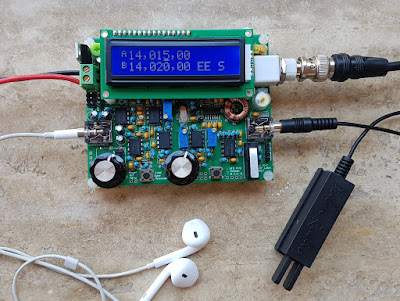
Hans Summers’ QRP Labs has an amazing new rig — The QCX — that is chock-full of features and FB technology. Hans has long been one of the most innovative guys in ham radio, and this latest rig is one of his most amazing creations. Like Farhan’s BITX40 Module, this new rig is priced in the 50 dollar range. Hams who are paying many thousands of dollars for their “radios” should be asking themselves a question: Could I be having much more fun for far less money? This rig is in big demand and there is already a waiting list, so place your order now if you want to work on this during the winter. Here is the link:
http://qrp-labs.com/qcx.html

QCX Features:

  • Easy to build, single-board design, 10 x 8cm, all controls are board-mounted
  • Professional quality double-sided, through-hole plated, silk-screen printed PCB
  • Choice of single band, 80, 60, 40, 30, 20 or 17m
  • Approximately 3-5W CW output (depending on supply voltage)
  • 7-16V recommended supply voltage
  • Class E power amplifier, transistors run cool… even with no heatsinks
  • 7-element Low Pass Filter ensures regulatory compliance
  • CW envelope shaping to remove key clicks
  • High performance receiver with at least 50dB of unwanted sideband cancellation
  • 200Hz CW filter with no ringing
  • Si5351A Synthesized VFO with rotary encoder tuning
  • 16 x 2 blue backlight LCD screen
  • Iambic keyer or straight key option included in the firmware
  • Simple Digital Signal Processing assisted CW decoder, displayed real-time on-screen
  • On-screen S-meter
  • Full or semi QSK operation using fast solid-state transmit/receive switching
  • Frequency presets, VFO A/B Split operation, RIT, configurable CW Offset
  • Configurable sidetone frequency and volume
  • Connectors: Power, 3.5mm keyer jack, 3.5mm stereo earphone jack, BNC RF output
  • Onboard microswitch can be used as a simple straight Morse key
  • Built-in test signal generator and alignment tools to complete simple set-up adjustments
  • Built-in test equipment: voltmeter, RF power meter, frequency counter, signal generator
  • Beacon mode, supporting automatic CW or WSPR operation
  • GPS interface for reference frequency calibration and time-keeping (for WSPR beacon)

Straight Key QRP Homebrew Adventures — TRGHS

Last Saturday I put the Tuna Tin Two Top together with my Herring Aid Five 38 (year) Special and the Indian key that Farhan gave me. I discovered that some of my 40 meter CW FT243 crystals had disappeared into the entropy of the shack. But I was able to find one for 7050 kHz. That was a bit of good luck because it turns out that 7050 is the frequency of a congenial group of operators known as the Straight Key Century Club. I felt right at home. I have been inducted. My SKCC number is 17272. Very QRP, don’t you think? It is almost a Vanity SKCC. Clearly, TRGHS.

I have been having excellent luck with this 7 transistor rig. I have had one contact each day since I put it on the air, all of them in response to my CQ calls. I’ve worked:

K1PUG Hank in Connecticut (twice)
W8HOG Jerry in Ohio
WA4GQG Kevin in North Carolina
WA2AAW Frank in New York
KM4FO Dwight in Kentucky


This morning I added a little piezo buzzer for sidetone. I am thinking of adding a VFO to the Tuna Tin.

More “Canned Seafood” Homebrew CW, from KA4IBG

Bill:

My xYL hates sardines, but they look good together !
In the late 70’s the community had a fetish for canned seafood and DC receivers. Do you remember the 80m Sardine Sender ? How about YL Special ? (QST Oct and Jan 1979.) I married them together in a kludged-together box made out of a bent rack-mount panel and defunct aluminum chassis cover.
The bottom board is the rock-bound transmitter. The upper deck is the receiver board. The little mini box contains VFO (so cute.) The 741 audio board is tucked under the scrounged ¼ inch jacks.

Super simple, but lots of fun. It’s a handy rig for the week at the beach, although 80m propagation and beach week are 6 months out of phase.
Ed Hlywa
KA4IBG

A Fishy Rig: Herring Aid Five, Tuna Tin Two, VU2XVR Key

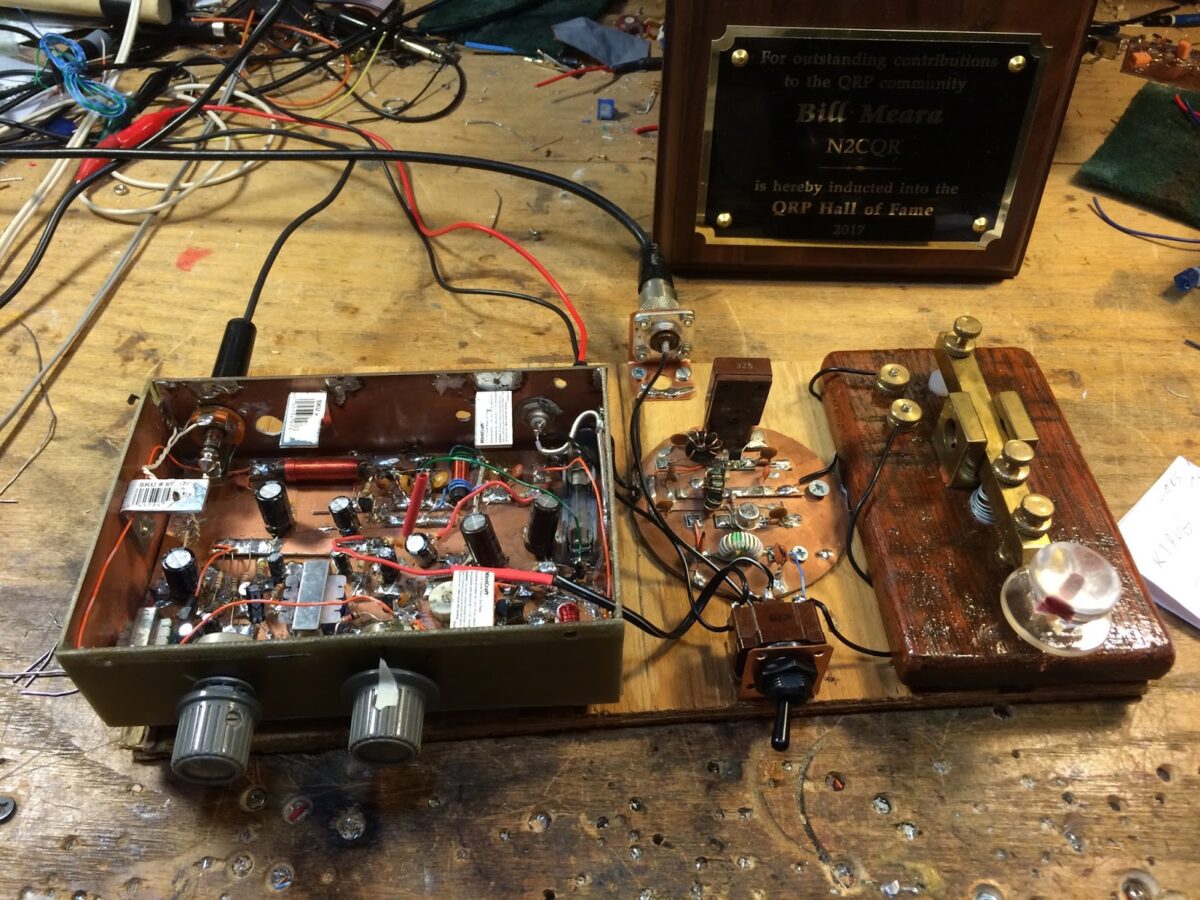
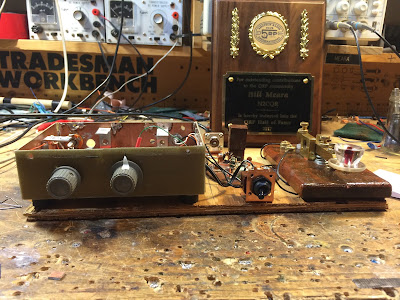
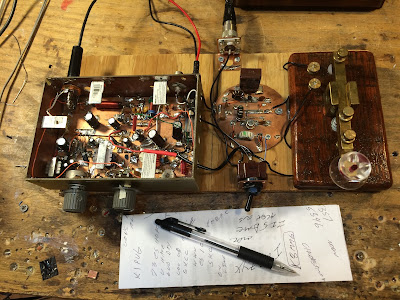
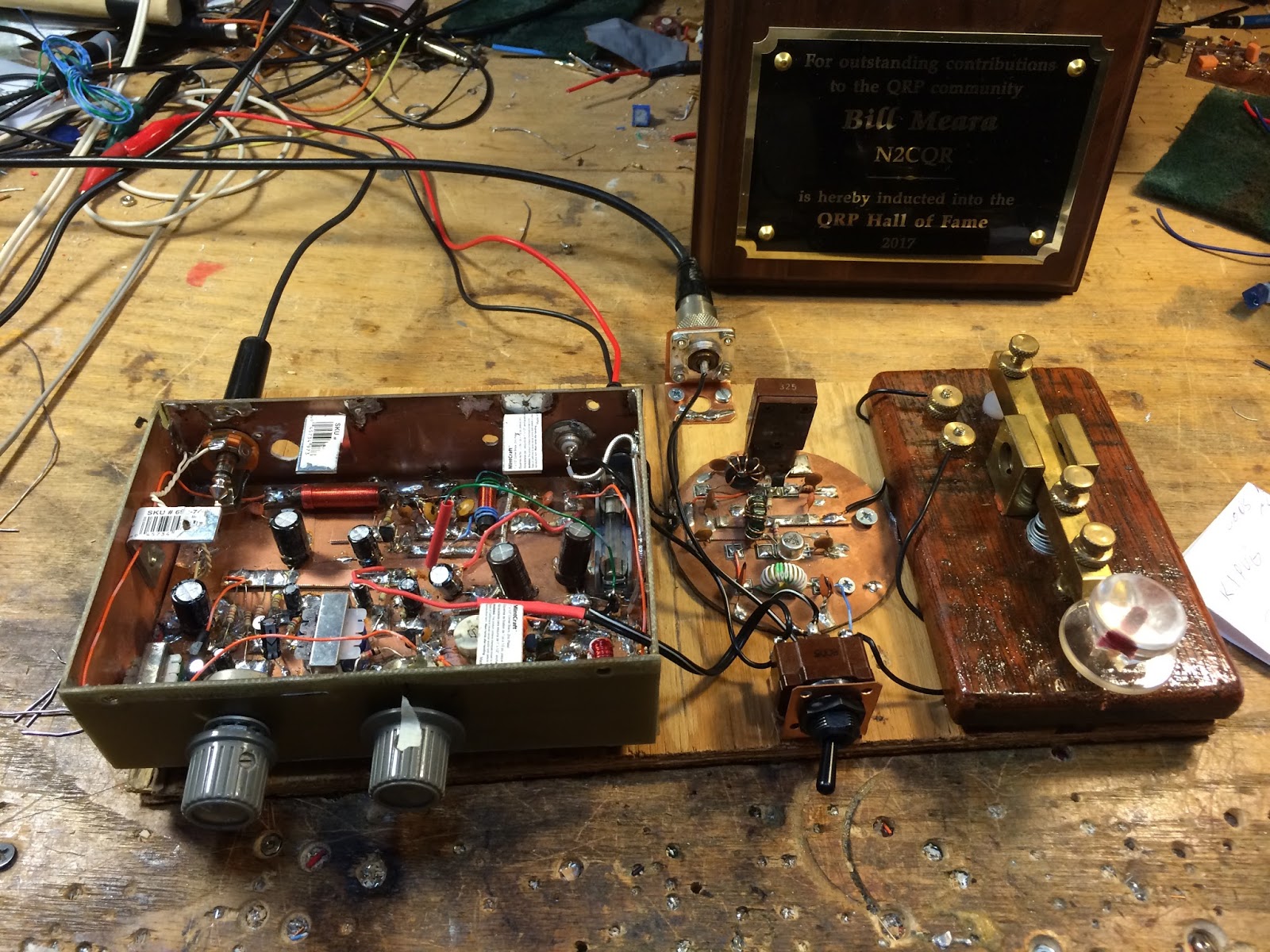
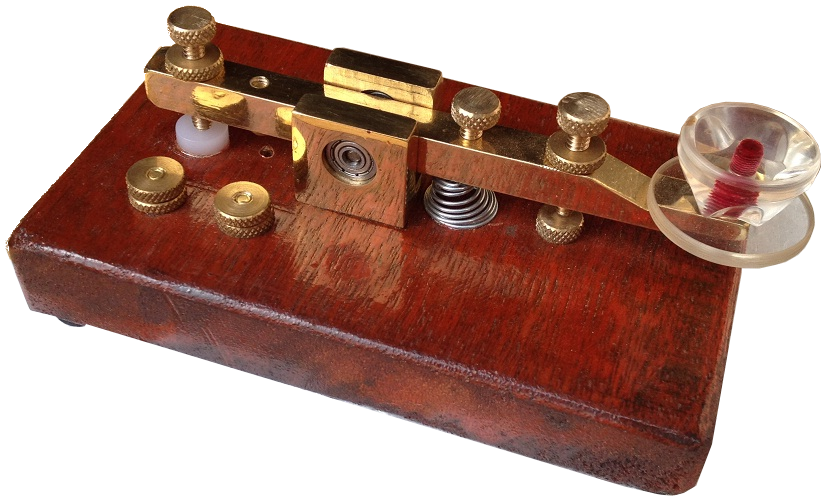
Haunted by a fear of rapid expulsion from the QRP Hall of Fame, I decided that I should immediately do something to establish some form of QRP street cred. Looking around the shack, I realized that all of the ingredients were there: My Herring Aid Five Direct Conversion receiver (completed after only 38 years), my Tuna Tin Two transmitter, the VU2XVR key that Farhan gave me, one 7050 kc FT243 crystal. I put it all on a piece of scrap plywood. A couple of nice connectors from W8NSA supported the DPDT T/R switch and the coax connector. I keep the receiver LO running all the time.

Now, let’s be clear: running 250 milliwatts, rock bound with a Direct Conversion receiver that tunes both sides of zero beat is not for the faint of heart. The log book does not fill up rapidly. But hey, I made one contact the following morning. K1PUG said I was 559 in Connecticut.