I changed the crystal in the transmitter. I got a different rock from Mouser and am now on 7030.
Wednesday April 3, 2024. On 40 meters in the afternoon with Mike KM4KY in North Carolina.
SolderSmoke Daily News — Ham Radio Blog
Serving the worldwide community of radio-electronic homebrewers. Providing blog support to the SolderSmoke podcast: http://soldersmoke.com
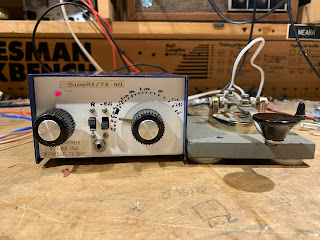
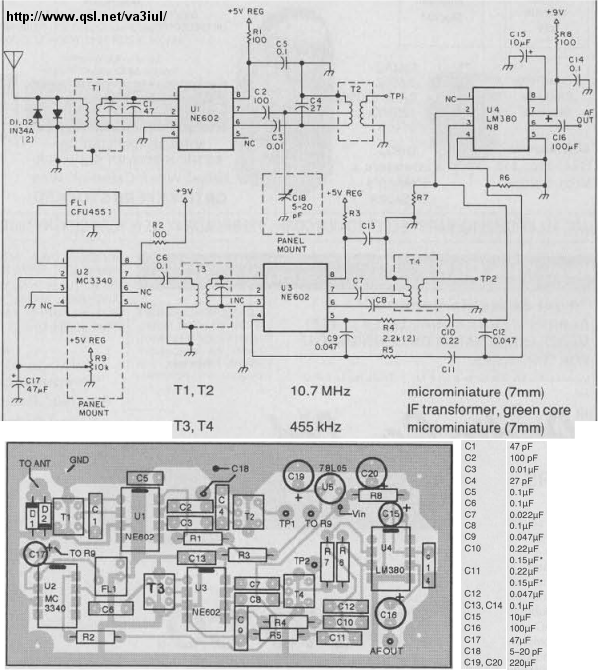
Click on schematics for a better view
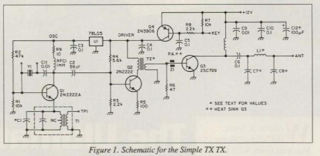
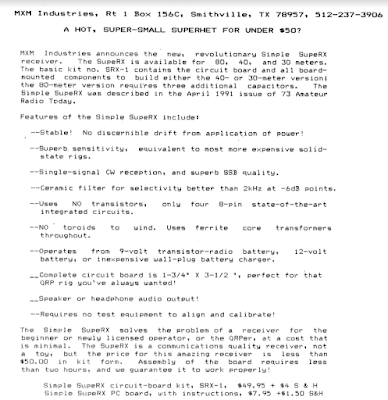
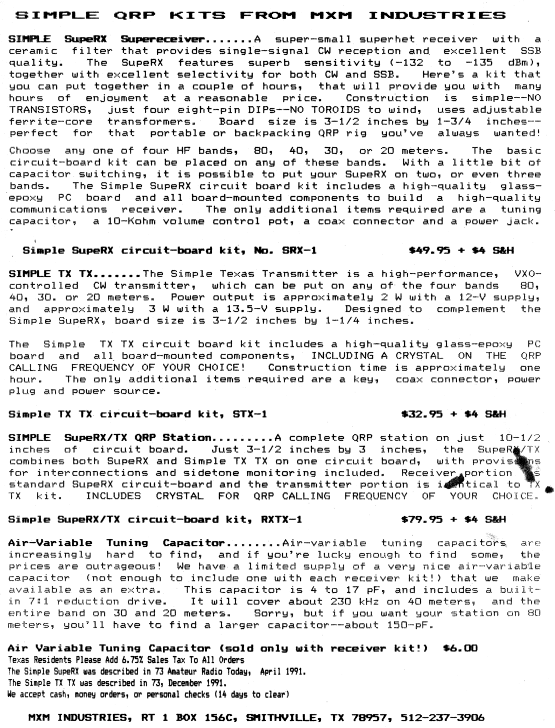
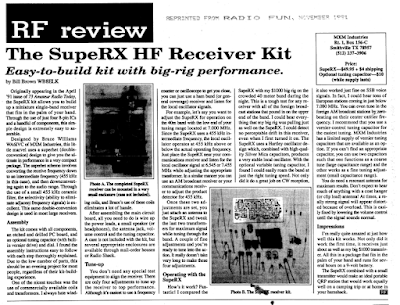
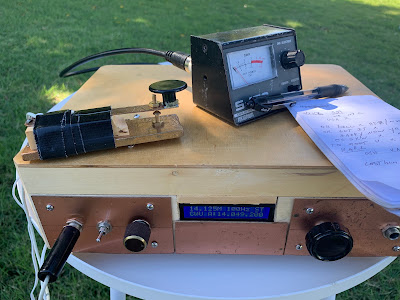
I picked this transceiver up at Winterfest for one dollar. 40 meters. Superhet receiver with 455 kc ceramic filter and 2 NE602s. Crystal controlled one watt transmitter on 7039.5 kc. I emailed Jeff KA2BKG and asked him to slide up a bit to my freq. I am glad he did. Thanks Jeff.
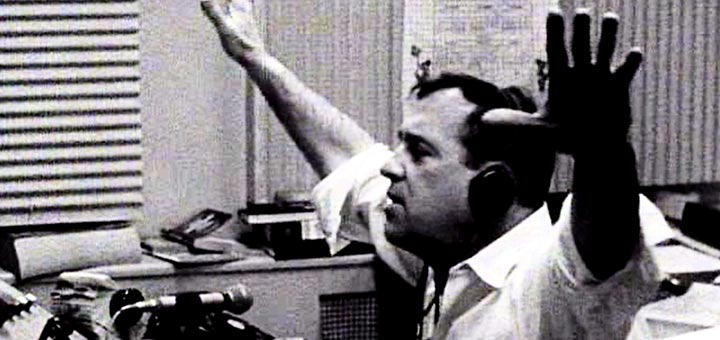
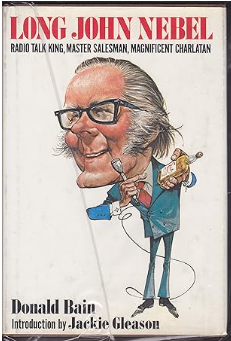
http://soldersmoke.com/JeanShepherd1976WMCA.mp3
One side note. I told my wife that some time after the broadcast, I was once again up early in the morning, kind of absent-mindedly getting ready for work when I heard Shepherd talking on WMCA to some guy about ham radio. It took me a moment to realize that this was a re-run, and that that guy was me!
When I first listened to this I didn’t realize that later in the recording (around 9:30) another fellow calls in an asks Shep about why he uses CW. Shep is kind of short with him and ends up advising him to “go back to CB.” I should note that in my conversation with Shep earlier in the program, I told him that I was usually on “40 sideband.” He was nice to me, but said that he was mostly on 20 CW.
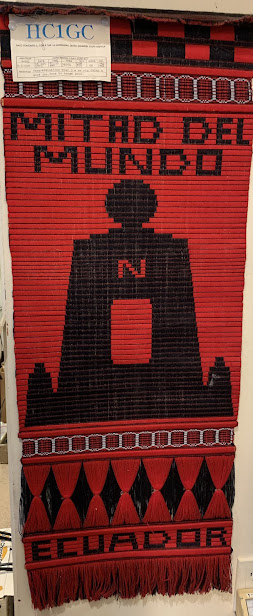
Listener Tobias was laid up yesterday, following the extraction of wisdom teeth. (This seems like an appropriate follow-up to our talk in SolderSmoke Podcast #250 of sBITX “wisdom files” to correct FFT “hallucinations.”) Tobias does not appear to have been hallucinating, but he was having trouble seeing what he thought to be a “red poster” in my shack.
In fact, what he was seeing was a red tapestry from Ecuador that was sent to me by Galo Constante HC1GC way back in 1993. I was in the Dominican Republic, running my first ever real homebrew transmitter. Here is an article about this project: https://www.gadgeteer.us/TXHB.HTM I think Galo was also QRP homebrew. My log shows that I worked him eight times from the DR.
Mitad del Mundo = Middle of the World (a reference to the equator).
Here is the QSL I got from Galo:

Happy New Year to all. May you make good progress on your homebrew projects, and may the radio gods act favorably on your behalf.
73 es HNY de N2CQR
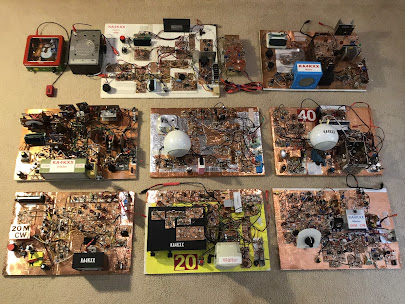
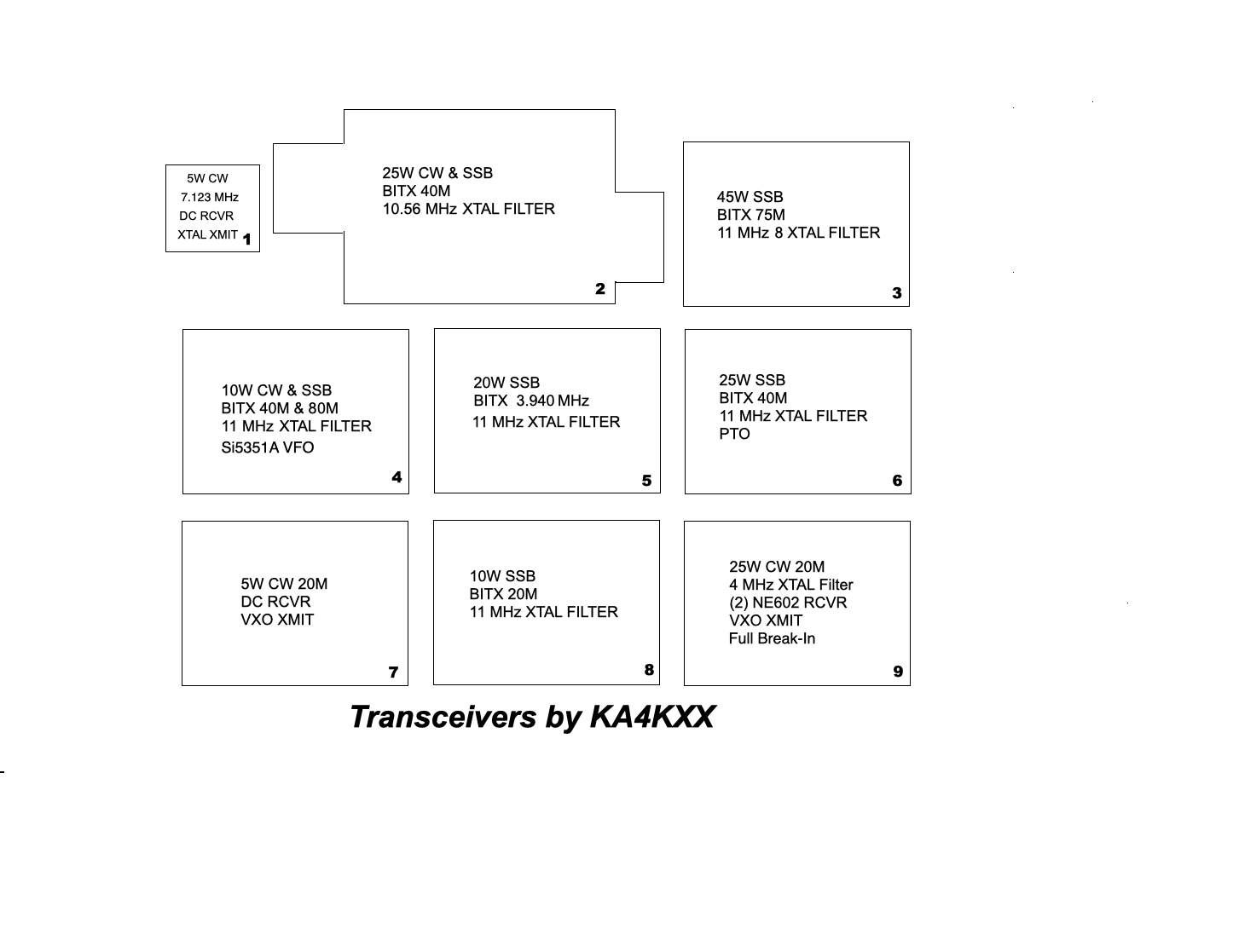
I tried a Si5351 VFO once in the dual-band rig #4, but by the time I built the QRP Labs kit with so much closely-spaced soldering, and then added sufficient filtering and amplification to properly drive a 50 ohm load, I was exhausted!
These nine were created during the past eight years, and were preceded by eight more transceivers that I can document, but those have all been disassembled, with many of the parts being used in these later rigs. I build my transceivers to be operated often, and since 20 Meters has been hot lately, for example, my POTA Hunter log shows over 300 CW and SSB contacts in 2023 alone, so rig numbers 7 – 9 have been earning their keep lately.
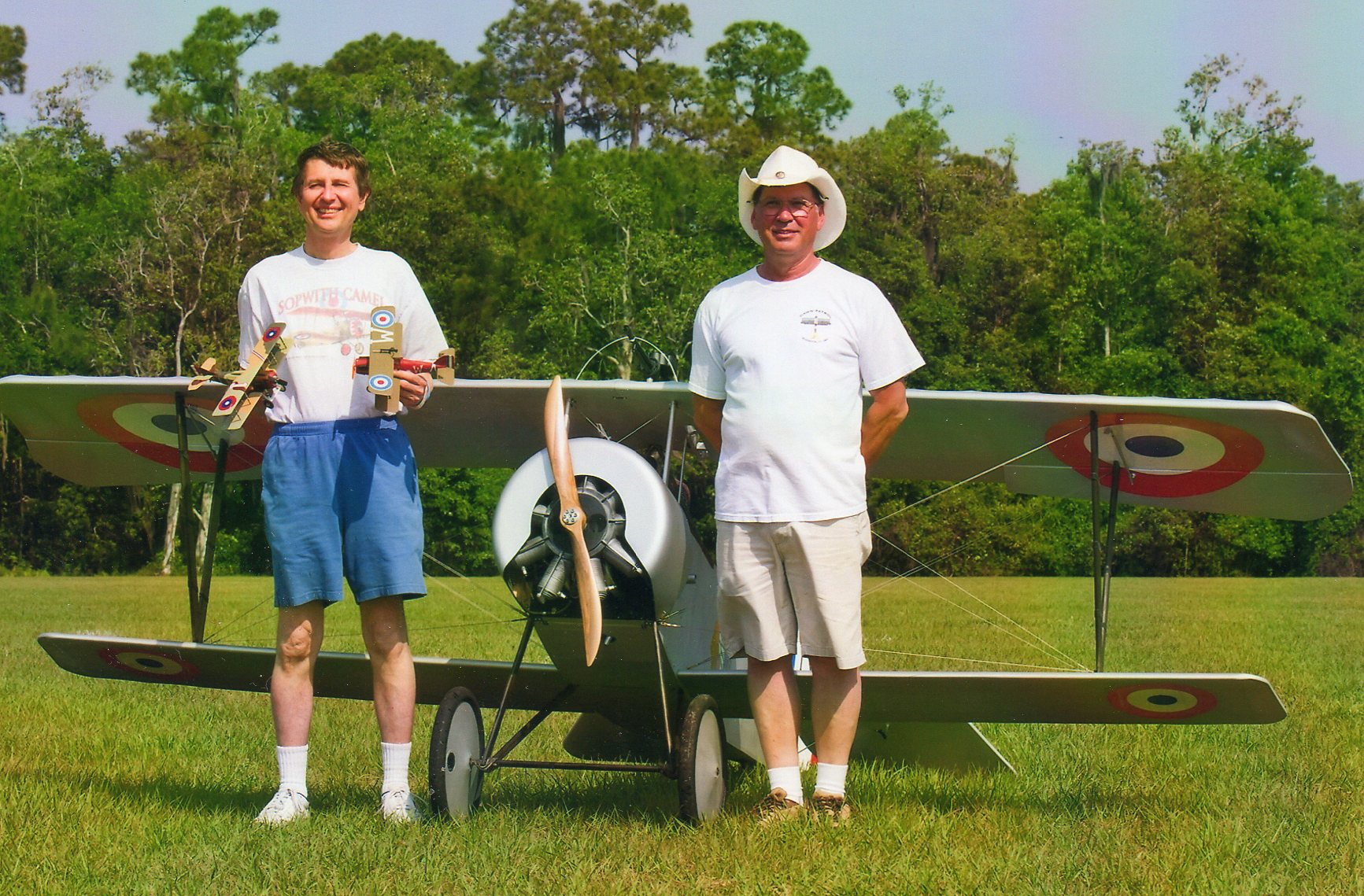
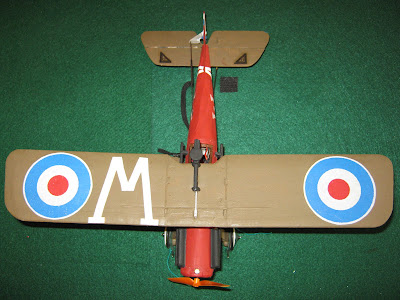
In summary I have created a lifetime total of seventeen transceivers so far, and although I am nowhere near the fifty-plus tally of Pete N6QW, I did spend a lot of years instead homebrewing many radio-controlled model airplanes of my own design. Two photos show one example that I flew in the 2011 Blue Max Scale R/C Contest at the Fantasy of Flight Museum in Polk City, Florida against some stiff QRO competition.
—Walter KA4KXX
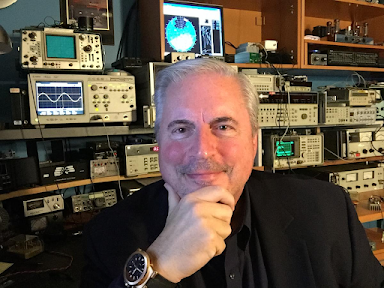
It was great to hear George’s voice again. I was a big fan of his “Chat with the Designers” podcast. And it was great to see that Pete Eaton WB9FLW (an old friend of SolderSmoke) was also involved in this presentation.
At FDIM George was talking about Coherent CW. Now, my views on CW have been made quite clear, but I am going to deliberately avoid snide comments about how Coherent CW might be a contradiction in terms. Thank you. I think this is something that Pete N6QW and I can agree on.
Nevertheless, this is all technically interesting. This reminds me of what happens with WSPR. But I wasn’t quite sure what George was getting at with his discussion of the phase of the incoming signal — I can see the need to get the receivers’ narrow filter exactly on the transmitting station’s frequency, but why the phase?
Here is Bob Crane’s interview with George:
http://soldersmoke.com/N2APB23.mp3
And here are a couple of things with background info on CCW.
https://www.sigidwiki.com/wiki/Coherent_CW
http://www.arrl.org/files/file/Technology/tis/info/pdf/7509026.pdf
Thanks George, thanks Pete, and thanks Bob.
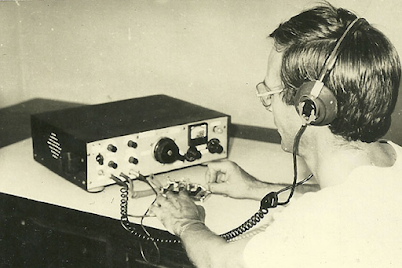
Next 2019 will be the 30th anniversary of the first convention of radio amateurs in the province of Villa Clara, in Campismo de Ganuza, municipality of Corralillo, on the North coast, about 100 kilometers from Santa Clara, the provincial capital.
This convention was held on a national basis and colleagues from all the country’s provinces participated at that time. We did not reach a thousand members throughout the national territory and most of the radio amateurs worked in the 40-meter Band in Amplitude Modulation Then the Lateral Side Band (SSB) was the privilege of a few and the 2 meters was something rare, which did not yet exist in our environment.
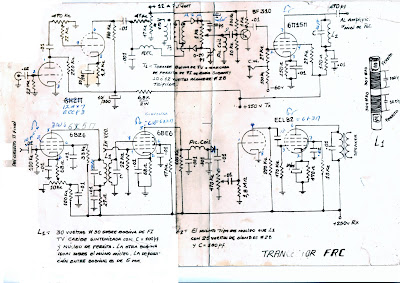
At that meeting, a project for a Tube Transceiver was presented, quite simple, with just six vacuum tubes and a BF310 transistor. It was possible to work in HF in Double Sideband, achieving a greater efficiency than the transmission in Modulated Amplitude (AM). This project became known as the Islander.
In only two printed plates, one for the VFO and another for the TX and RX part, which by the way were printed for distribution, in a company in Villa Clara, due to their easy construction and acquisition of the components (almost all of them came out of a Krin-218 TV), a large number of such equipment were manufactured by radio amateurs from all over the country. Like everything made at home, it always comes up with a little problem that later is necessary with tinkering, correcting it.
I remember listening to an old radio amateur from Havana (whose callsign I don’t remember) in a pleasant QSO with another colleague, who jokingly said, “… some “Bugs” have now appeared in the band, called Islander, which is worse than the invasion of the Vikings…”, which gives an idea of how many were built at that time, when if you wanted to make radio, you had to manufacture it, something unusual in these times.
As soon as we saw the project we decided to build it, because at that time we had an AM “transmitter” with modulation by “Carrier control” with four tubes, a 12AX7 preamplifier; an ECL82, as a modulator, with cathode output to the final tube Screen grid, a 6DQ6 and a 6BH6 as VFO; and to receive, an old Russian receiver from World War II.
We got involved in the construction and improvements of the project and we managed, with some changes, to improve its performance and quality, because among the modifications to the original, we added:
-A switch, with which you could change the transmission mode to DSB -CW-AM.
-A “Pi” Filter at the input of the RX, which considerably improved its quality.
-An automatic volume control, because since it did not have AGC (Automatic Gain Control), when someone nearby came on, it would break your speaker.
-A filter for the microphone input, which improved the quality of the modulation.
-A final power stage, with a 6146B, with 750 V on the board, for about 70 W of output, taking advantage of the 6P15P as Driver.
-The chassis was built from scratch using aluminum trays that were sold at the hardware store for “four pesos” each and that were special for making cabinets for these purposes.
After the construction was completed in one afternoon, with Reinaldo Martínez Domínguez (CO6UK), from Manicaragua, the balanced modulator was adjusted, since the good transmission of this type of equipment depends on the relationship between the amount of RF and audio that are mixed At that stage, it took us a long time to adjust, until Reinaldo with his expert ear told me, “leave it there, don’t touch it, it’s 99% complete”.
There were many international contacts that I was able to make with this very simple equipment, with very good reports, many of them with Europe, the American continent, that was very normal, since the propagation conditions in those years had nothing to do with the today, you could do half the world in AM, with about 100 W.
Many colleagues at that time asked me what equipment I was using. When I told them it was an Islander, they asked me to send them the plans of the improvements made, they were many modified plans, mimeographed.
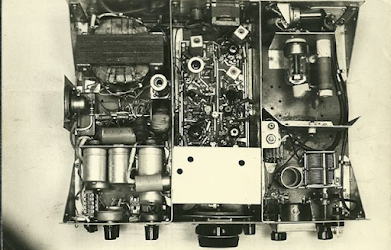
Perhaps the youngest do not know what that was and the photos taken by colleague Joel (CO6JC) that helped to illustrate the distribution of the components in the chassis, were sent to radio amateurs from the different provinces, in the interest of contributing modestly to migrate from AM to the Double Side Band, today it is a rarity to listen to someone on AM, there are already few who appear in Double Side Band, which shows that we have developed in these almost 30 years, despite the difficulties, which We went from just under a thousand to about 8,000 throughout the country today.
From time to time, a colleague in the 40 meter Band, from another province, has told me that he still keeps the plans and photos that were sent to him at that time, or as “Kike” (CO6GO) that he still has a Islander as a relic.
Ours passed away a long time ago and part of its components went to other projects, thanks to Joel (CO6JC) there is a graphic record of it, and that at that time I had hair, which I have lost in these bustles.
With this brief comment, we only want the new generations to know what radio amateurs were like in those days and the older ones to remember it.
Nothing, to remember is to live again.
Here he left you some images.
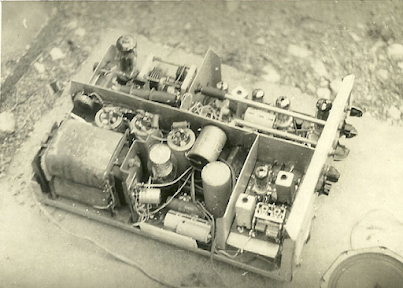
Click on the image for a better view
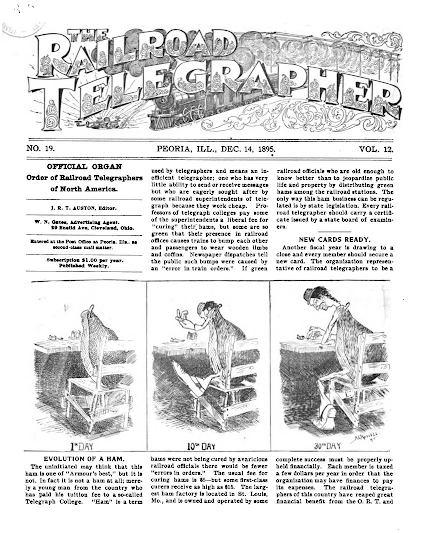
The timing (1895) and the context (railroad telegraphy) seem about right. But other etymologies are out there. Lexicographer Steve Silverman KB3SII is on the case. What do you guys think? Are the roots of “ham” radio in railroad telegraphy?
Walter KA4KXX in Orlando has been a prolific builder of rigs for many years, and has been a great friend of SolderSmoke: Here are some of the SolderSmoke podcasts and blog posts in which Walter’s solder melting was mentioned: https://soldersmoke.blogspot.com/search?q=KA4KXX
As we approach the end of our current stay in the Dominican Republic, I could not miss out on the chance to work Walter with his homebrew rigs. Even though the space weather was stormy, and my dipole was droopy, we arranged to meet up on the high end of the 20 meter CW band this morning. See the results in the video above. A solid QSO with Walter. He says it is HB2HB, but truth be told I was on a uBITX that was built more by Farhan than by me. But this was a great contact. Walter started with a 50W rig, then switched to his 3 watt rig with a DC receiver. FB
Here is the e-mail I received from Walter after the QSO:
Dear Bill:

January 2, 2008 SPECIAL NEW YEAR’S EDITION AA1TJ’s circuitry and poetry. Homemade tubes. Book Review “Early Radio” by Peter Jensen. The Vatican’s antennas. Google Earth flight simulator. Mixer madness continues (now in LTSpice). Mars-asteroid collision? Bollywood: The BITX-20 connection. BANDSWEEP: Straight Key Night at WA6ARA. ECHO-GUEST: Andy, ZS6ADY, South African Boatanchor fan. MAILBAG: Jake N4UY(NOVA QRP), Steve G0FUE (Bath Build-a-thon), Nigel M0NDE
Peter’s Blog: https://vk3ye.com/
Peter’s YouTube Channel: https://www.youtube.com/user/vk3ye/featured

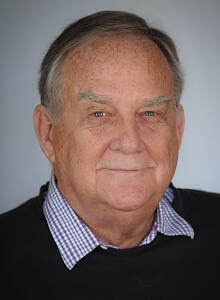
In his interview with SolderSmoke correspondent Bob Crane, Jack Purdum made some very interesting comments about the challenges of decoding CW with software. He notes that W1AW’s code practice CW is perfect, but that below 18 wpm, they deliberately insert a “Farnsworth Delay” that increases the spacing between words — this complicates automatic CW decoding.
Jack also talked about the distinctiveness of different CW operators. Jack noted that W1AW has no real “fist” in this sense: “It has the personality of a stick!”
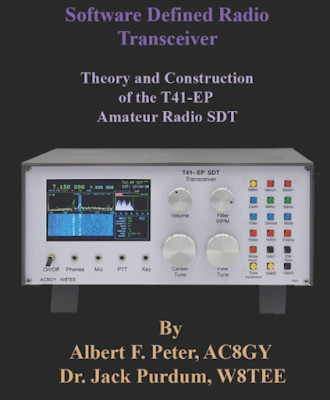
Jack mentioned that Pete Juliano had been reading book on SDR radios that Jack and Al Peter recently published: https://www.amazon.com/Software-Defined-Radio-Transceiver-Construction/dp/B09WYP1ST8/ref=sr_1_1?crid=2KPYAMPOW5P6J&keywords=DR.+Jack+Purdum&qid=1654598559&sprefix=dr.+jack+purdum%2Caps%2C40&sr=8-1
Here is our correspondent Bob Crane’s interview at FDIM 2022 with Jack Purdum: http://soldersmoke.com/2022 W8TEE.mp3
(co6ec) Jose de Jesus Enriquez Campos
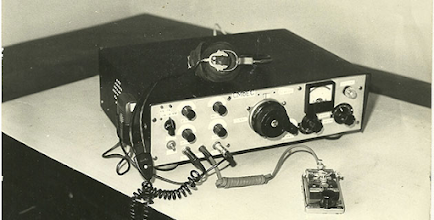
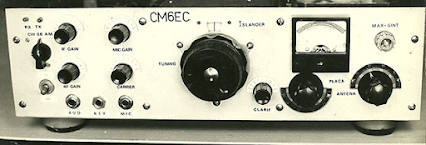
The first Image was the prototype presented at the Ganuza meeting, the rest of the photos were the ones we built with the improvements, and the photos and plans were sent to many colleagues, the colleagues who went to that meeting will remember, well, they still have to there are many left, because that was almost 30 years ago,
greetings CO6EC
(co8zz) Raul Verdecie
Magnificent photographs!!!… They seem to have been taken today with some digital “super camera”!!!
Really, from what I can see now, the CO6EC Islander was the perfect example… mine (my first radio and built by me) was also made like this, with the plates that the FRC sold and it was good, but very ugly …HI… The AGC worked wonderfully as it came, I don’t know if Jose’s improvements were later! With it I made my first hundred or so entities only in 40 meters / CW (between 7,100 and 7,150) when it was CL8ZZ. I gave it away so that someone would have their license and now I regret not having kept it… I would have liked to show it now to those who regret not having a radio!!!
(co8zz) Raul Verdecie
Ah, I can never forget those headphones!!!… my external hearing aids (read ears) are much smaller today thanks to them, they exerted tons of force on the operators’ skulls!!!
(cm6vml) Vidal
Very good article, I hope that one day, with a good teacher, I can build my own team, congratulations Jose, regards Vidal.
(co7wt) Pavel Milanes (CO7WT)
Sure…
My first radio and with which I got my CL7WT license back in the 90’s an ISLANDER, like that in capital letters.
I remember that the CL only had a small 40m segment (like now) and that it was full of broadcasts as soon as the afternoon fell, it was an odyssey to speak on the radio… you had to find a “little hole” between the Broadcastings where it wouldn’t bother you ” a lot” to be able to talk.
I remember that the old CO7OC (he is no longer a radio amateur) and CL7HU (now AC7HU) helped me build it with a board I bought at the radio club. I took almost all the valves from the deceased KRIM 218, then I found a store in Camagüey that sold idle things from the workshops…
Turns out they had such a large inventory of “idle” tubes that they couldn’t put it on the counter…they let me through to the warehouse…huge…stack of tubes, if I remember correctly I ended up with Chinese or Japanese tubes that they were more sensitive in the receiver… the driver went from a 6P14P to a more robust 6P9, by the end that was a humble 6P44 it became two 6P7s that were a Russian version of the RCA 607 if I remember correctly… in the end it had like 80W.
It goes without saying that when I said on the radio that there were valves in that place “they flew”….
The VFO was the one from the Jagüey, not the original from the Islander, I never knew about the AGC modifications.
I would like if someone has the plans with the modifications to send them to me, just for nostalgia…
My email pavelmc@gmail.com
(co2jc) Carlos Alberto Santamaría González
Brother, your article is very good, because of the nostalgia and also because it talks about what we radio amateurs like: tinkering. I didn’t have an Islander because what I started with in 2000 was a Polosa to which two colleagues helped me adapt it with VFO for 40 and 80 m. But I talked a lot with colleagues who did it with an Islander or a Jagüey and participated in the Rueda del Behique that I started in the 80 m. Others in the Hurricane Wheel that started a little later and were heard well. As you well say, the propagation at that time had nothing to do with what it is now, but it was very good to listen to the colleagues who came out with the equipment they had built. Thank you once again for your article. CO2JC