Category: construction techniques
Nick’s “Shelf-17” Al Fresco Homebrew Transceiver — Frank Jones Would Approve!
Time Crystals, and Breadboarding in Cyprus in the 4th Dimension
We are always impressed by the way in which SolderSmoke listeners stay on the cutting edge (sometimes OVER the edge!) of modern technology. I recently got this fascinating note from our friend Jack AI4SV, who is now operating under the hot sun of the Mediterranean island of Cyprus.
Hi Bill,
It is brutally hot here in Cyprus during the summer, so we’re spending a week at a rental on the beach — no complaints in that regard. With all construction material back at the main house, I am free to daydream with no threat of actually building anything that I think of. The result: a new technique — fourth dimensional design.
This probably popped into my head because I went to sleep right after reading an article about “time crystals” (https://www.quantamagazine.org/first-time-crystal-built-using-googles-quantum-computer-20210730/#:~:text=A%20time%20crystal%20is%20both,of%20what%20a%20phase%20is.), which are similar to physical crystals, but their pattern have symmetry in the time axis. I have to imagine that these things have some application in radio since oscillation is intrinsic to their state of existence. I don’t want to think too much about them because it makes my head hurt.
Now, consider breadboarding. There isn’t much to say about one dimensional circuits since current has to flow in a circle, but I suppose Franklin’s kite was kind of one-dimensional: cloud, Franklin, earth. At least it had a key, so kind of relevant to radio, at least if you are a CW operator.
Two-dimensional circuit design would be a breadboard, particularly with surface mount components. Arguably three-dimensional if it’s mulitlayer. Manhattan Island or Deadbug is more in the realm of three-dimensional, with components sticking up from the board, and true three-dimensional is probably best reflected in tube rigs with spider webs of wiring. I don’t know who can think in terms of three dimensional layout like that, but it’s certainly an art (kind of a blend of Escher, Dali and Bosch).
Now comes fourth dimensional design – not just a theoretical abstraction, but a realizable method that would result in lower part count and simplify the operator interface to a single knob. The basic idea is that you have a design laid out in three dimensional space and that design is made time-variant in space. The simplest implementation would be a breadboard mounted in a track so it slides back and forth, like a desk drawer. Pulling it towards you puts it in transmit, pushing it away in receive. The secret sauce is that the rails have contacts and that the layout is designed such that the traces or pads on the board line up with contacts on the rails such that no relays are needed on the board. Some thought would need to be put in to assure that contacts are made in an appropriate order to avoid frying components.
That’s already fourth dimensional because the same board exists in two states and it can be one or the other, but not both at the same time. Superimposing transmit on receive would be bad, maybe world-ending.
There is no reason to stop there. This whole slide drawer sort of layout could be mounted on a rotational axis with contacts distributed around a tube surrounding the railings. Now you have band switching. Pull the knob to receive, twist it to go to 20 meters, push back in to transmit. That’s only roll and translation in one axis — four more to go, the practical implementation of which I will leave to the reader. Perhaps put mode (CW, SSB, etc.) on yaw, tuning on pitch (which seems natural), volume on y-translation, and RF gain on x-translation, and you would have a formidable 4D transmitter.
Clearly, this is too big to keep to myself, so I am sending it onward to you to share with the world for the benefit of mankind.
Hope all is well in the shack somewhere in the wilds of Northern Virginia.
Cheers,
5B4APL / AI4SV
More Homebrew Wisdom from Frank Harris, K0IYE
In Chapter 13A, Frank Harris writes:
The Vanishing Art
The 1986 ARRL Amateur Radio Handbook reported that hardly anyone was building homebrew ham receivers…. Out of hundreds of contacts, so far I’ve worked four guys, George, K7DU, Mike, NØMF, Biz, WDØHCO and Jack, W7QQQ who were using homebrew receivers for the QSO. Three of these receivers were made from vacuum tubes. George’s receiver is a beautifully crafted instrument that looks like a commercial design from 50 years ago. All of these receivers had no trouble hearing me on 40 meter CW. I talked to one other fellow, Gil, N1FED who told me he had just finished a vacuum tube receiver. Unfortunately, it was performing so poorly he was still using his modern transceiver on the air. Gil told me he didn’t like transistors. I guess he found printed circuit boards and those pesky oscillations too much trouble. In spite of this pessimism, you CAN build transistorized receivers that work reasonably well. I built mine because I was intrigued by mysterious circuits like “balanced mixers,” “product detectors,” “cascode amplifiers” and “crystal ladder filters.” Before this project, I could recite the purposes of these circuits, but I had no “feel” for how they worked and why receivers are designed the way they are. What better way to learn than to build one?
Aside from the need to shield circuit blocks from one another, a homebrew receiver with a single big board full of discrete components has another problem. If you build the whole thing at once without buying a kit and pre-cut board, I guarantee it won’t work. To make homebrew stuff that works, you have to develop your own technology based on parts you can get and circuits you understand. Learning to think this way was difficult for me. Rather than “building a receiver,” I had to lower my sights and build one circuit at a time, e.g., “an oscillator,” “a mixer,” “an audio amplifier,” etc. Then I put the blocks together to complete my project. Some of these circuit blocks didn’t work the first time so I had to build a new block. There were various reasons the modules didn’t work. Usually, I wasn’t able to buy the exact parts used in the circuits I was copying. Or my craftsmanship or shielding wasn’t adequate. Sometimes I never did learn why one version of a circuit block was superior to another. By building my receiver using separate little shielded modules for each circuit block, I could replace a circuit block whenever I managed to build an improved version. Otherwise, I would have ruined the entire big board.
On rare occasions my circuits didn’t work because there were errors in circuit diagrams in QST magazine or in the handbooks. I found some serious errors in my 1979 ARRL Handbook and a minor one in my 1998 edition. Perfect editing is not possible, so we shouldn’t expect it.
GET THE WHOLE BOOK HERE (FREE!)
http://www.qsl.net/k0iye/
“From Crystal Sets to Sideband” — Homebrew Wisdom from Frank, K0IYE (Free Book)
Get Frank’s book here (FREE!) http://www.qsl.net/k0iye/
I’ve had Frank’s book on the blog many times over the years, but it is a book that merits repeated mention. It is filled with great advice and homebrew wisdom. I found myself looking at it again recently, and at Frank’s QRZ.com page. I came across lots of wisdom that I may have missed in earlier visits. For example:
From the QRZ page:
Foreword:
We homebrewers are nearly extinct, but there are still hundreds of us scattered around the world, some are even in the USA. Yes, there ARE American homebuilders! We’re rare, but thanks to the QRP hobby, the number is growing. Even if we homebrewers don’t change the world, I guarantee you will enjoy learning radio technology and building your own equipment.
Get Frank’s book here (FREE!) http://www.qsl.net/k0iye/
THANKS FRANK! Send Frank a thank you note: Frwharris@live.com

WA4GEG’s Beautiful HB Transceiver
http://www.hamradiobug.com/homebrew.html
Pete spotted this. Beautiful work. I noted that Byron hasn’t used the Manhattan style of construction. This makes his work look a lot neater, but it makes it harder to modify and debug the circuitry. On the other hand, OM Byron is obviously so good at this that his circuitry probably doesn’t require any debugging or mods.
The red S-meter and freq counter give it a slightly menacing appearance. Very cool.
Video on PCB Factory in China
This factory is a LONG way from Manhattan — both from the island and from the technique.
How about some Juliano Blue PC Boards?
The machine that automatically checks for bad connections was especially amazing.
And the boards are made in 24 hours, with 3 day shipping to the U.S.
F5LVG’s Nail Board Receiver — Names for the Technique
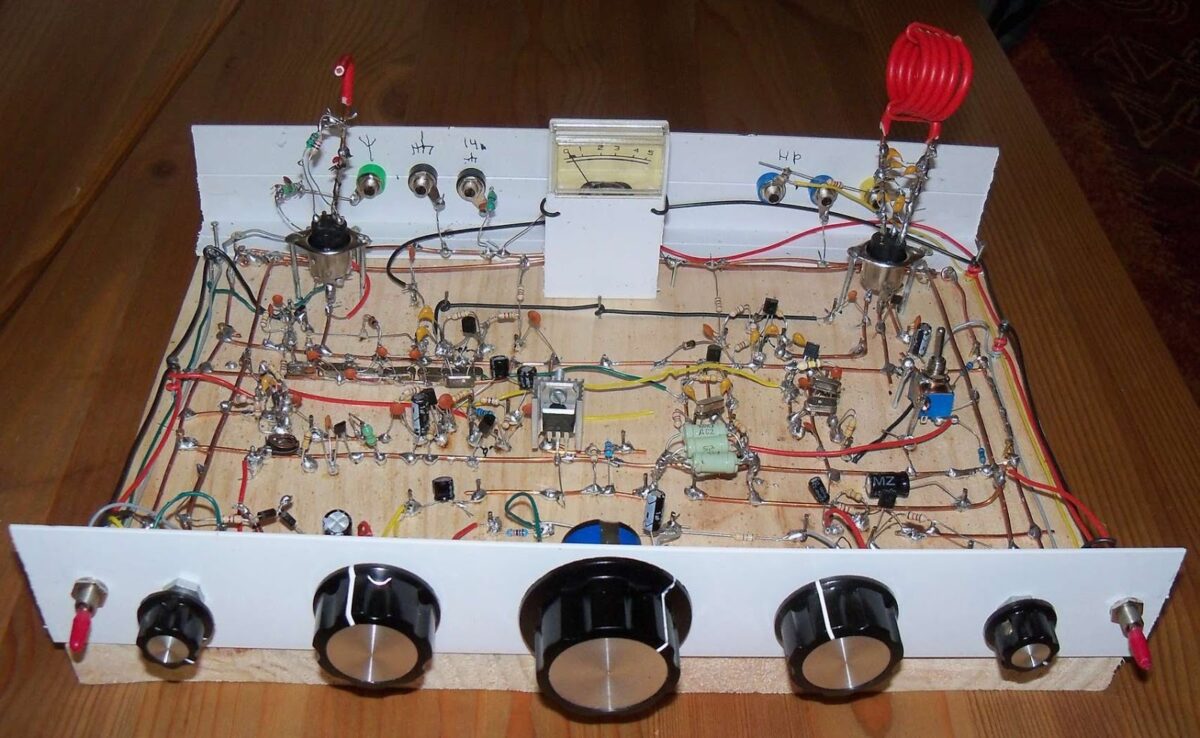
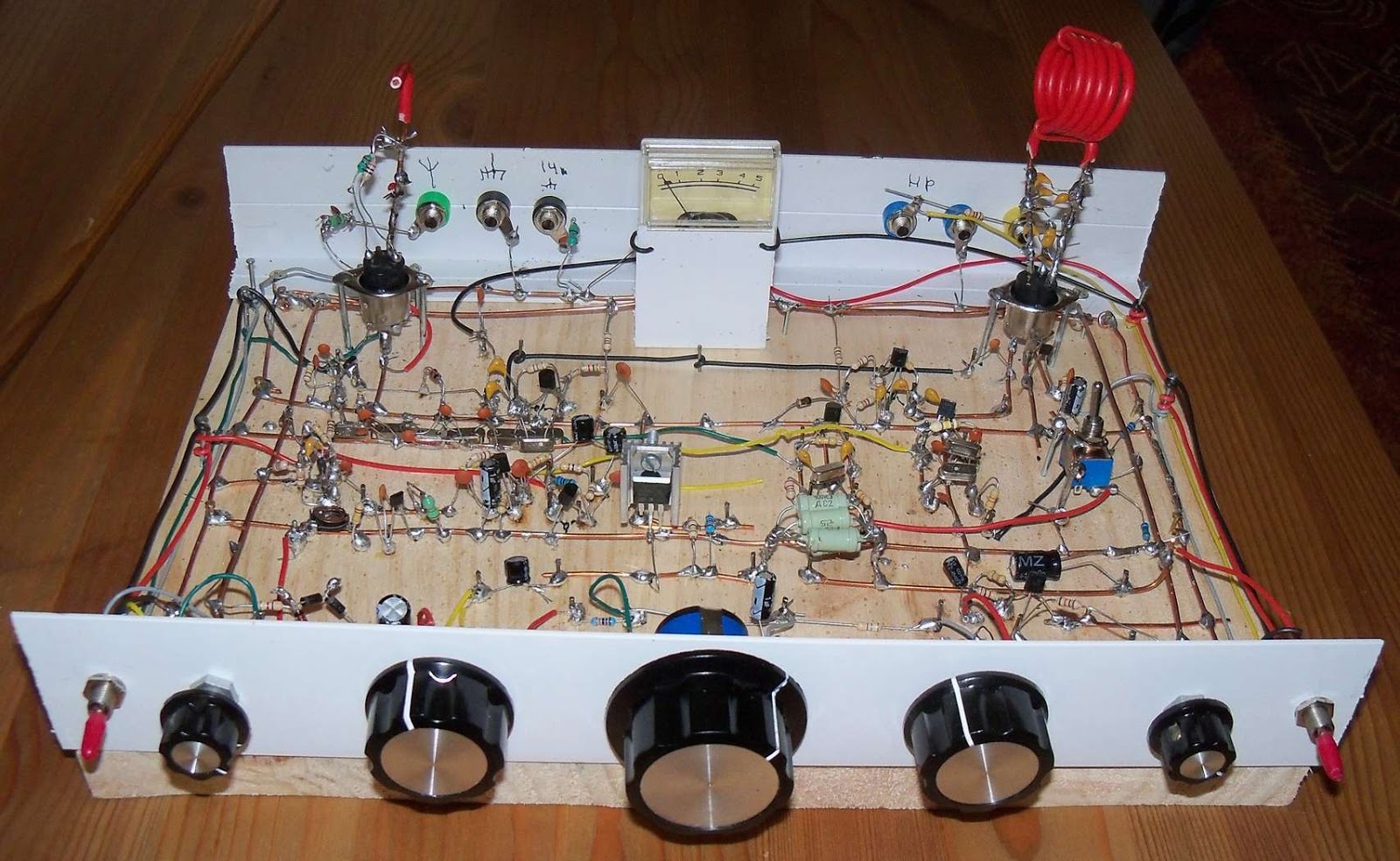
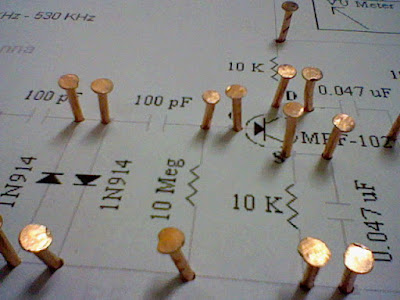
Pete WB9FLW reminds us that Olivier F5LVG has LONG been using copper nails and wood boards to build amazing rigs. See above for one magnificent example. That, my friends, is a superhet receiver. Inspirational!
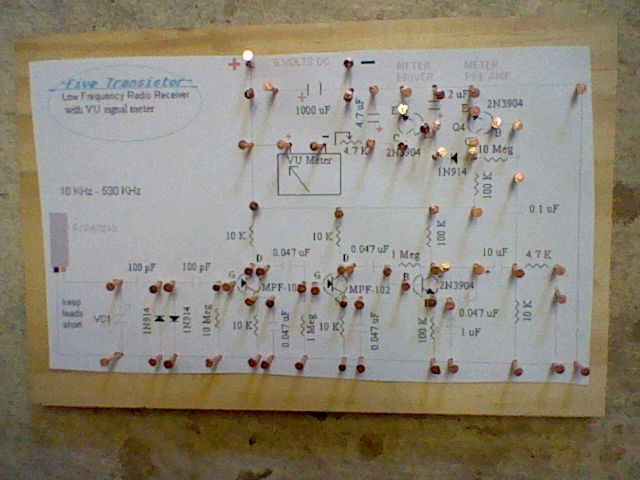
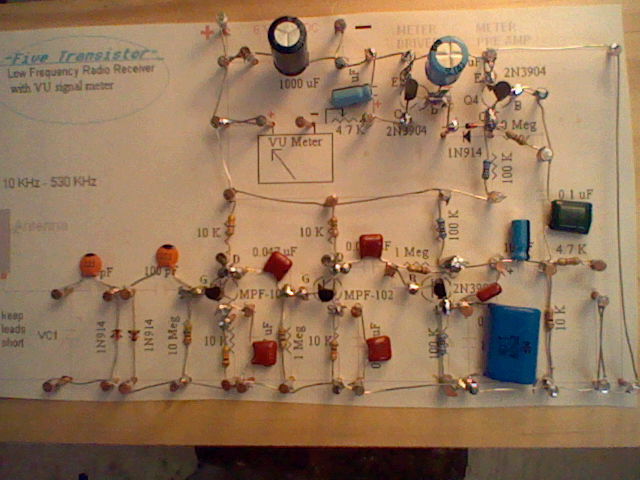
A Construction Technique that REALLY “Nails it” — But what do we call it?
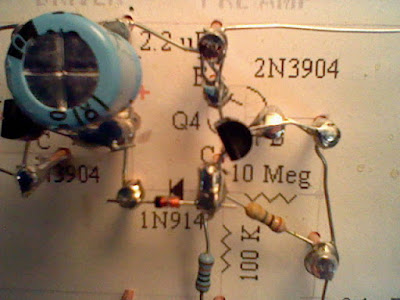
“Muppet Boards.” What do we call this?