Skip to content
SolderSmoke Daily News — Ham Radio Blog

SolderSmoke Daily News — Ham Radio Blog

Serving the worldwide community of radio-electronic homebrewers. Providing blog support to the SolderSmoke podcast: http://soldersmoke.com

Category: computer history

Back to the 1970’s! Homebrew Keyboards! Don Lancaster’s TV Typewriter

Even though it is outside my normal analog comfort zone, I really liked this video. Farhan sent it to me, along with this note:

————–

As a kid, do you remember Don Lancaster’s books? I learnt most of my digital electronics from him. I still have the 7 dollar video generator book on my shelf. He predates the Homebrew Computer Club. In fact, he is probably the reason for the HCC, because he put in the pieces that were used by others like the two Steves to build their own computers.
His most brilliant hack was to build a “TV typewriter” out of standard TTL parts that were just coming out in the surplus market. For $120, you could, if you build etched your own PCBs and managed to pry parts of fellow builder’s dead fingers, build a circuit that, if you typed your name, it showed up on the TV screen! Never mind that dad wanted to get back to watching football or mom wanted the kitchen counter to be cleared out. Those days, parents had no appreciation for their kids being on TV, I guess.
In an earlier hack, he encouraged people through his articles in Radio Electronics to build their own Qwerty keyboard. With this in hand, you could, um .. um… well type something and sit back. There was nothing to connect it to. The fun thing was, there were no key switches available. You had to build those as well. Wind your own springs, make your own keytops, Once it was built, you could use a VOM to check that the ASCII bits corresponding to the key you held down would correctly show up on the 7 data lines. I guess the girls were surely impressed. You just needed to carry the power supply with +5, -5v, +12v, the keyboard itself, an ASCII chart and a VOM to school to show off.
Jokes apart, he kept building things and builds them to this day. His TTL cookbook and CMOS cookbooks were the goto books for almost all digital elecctronics hackers. It is a pity that no one acknowledges his knack. He has scanned in a few of his books on his 1990s www.tinaja.com. Check https://www.tinaja.com/ebooks/cmoscb.pdf
Why does it concern us? He is K3BYG, that’s why.
Watch this https://www.youtube.com/watch?v=b-bFV8fHekk

– f


———–

So many things from the video resonated with me:

— The importance of building and testing, stage by stage. The narrator admits “I might have screwed that up.”

— Homebrew keyboards! Make your own keyboard springs you pathetic appliance operators!

— Wood box.

— Origins of ASCI

— The scary 1970s. Indeed. I started High School in 1972.

— Schematic errors! Oh the humanity! Erratas.

— Appeals to the Digital Gods. (Not as powerful as The Radio Gods.)

— A Gimmick Twin Lead.

— “So many different disciplines went into building this thing…”

— A taste of the home computing revolution of the 1970s.

— Farhan is right — he was K3BYG. But that call now seems to belong to someone else.

Don Lancaster’s unofficial autobiography:

https://www.tinaja.com/glib/waywere.pdf

Clearly, Don Lancaster has The Knack!

Author William MearaPosted on 24 April 202222 July 2025Categories books, computer history, Farhan, Knack Stories4 Comments on Back to the 1970’s! Homebrew Keyboards! Don Lancaster’s TV Typewriter

The Vacuum Tube’s Forgotten Rival: The Magnetic Amplifier

The video above shows one application of the principal, but be sure to check out the IEEE article:

https://spectrum.ieee.org/the-vacuum-tubes-forgotten-rival

Author William MearaPosted on 7 April 202222 July 2025Categories computer history, radio history, Tubes5 Comments on The Vacuum Tube’s Forgotten Rival: The Magnetic Amplifier

An Interview with Paul Lutus (Audio)

An Interview with Paul Lutus (Audio)

https://corecursive.com/remote-developer/
Thanks to Bob Scott KD4EBM for alerting us to this wonderful interview.

Author William MearaPosted on 1 January 202222 July 2025Categories computer history, Knack Stories, software2 Comments on An Interview with Paul Lutus (Audio)

Another M^3: The Michigan Micro Mote

Another M^3:  The Michigan Micro Mote

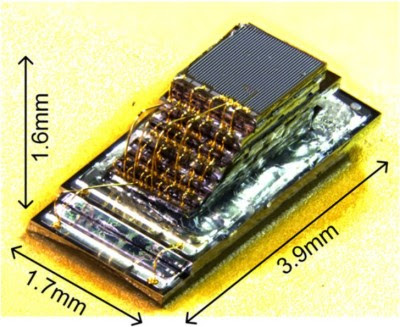
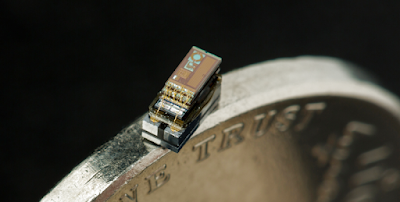
Move over Michigan Mighty Mite and Mate for the Mighty Midget. There’s a new M^3 in town. And it is SMALL.

Hack-A-Day had an article on this today, and while it seems only tenuously connected to ham radio, I found it intriguing.

Check it out. Who knows, someday people may be operating in “dust mode”:

https://hackaday.com/2021/10/04/snails-sensors-and-smart-dust-the-michigan-micro-mote/#more-498450
Author William MearaPosted on 7 October 202122 July 2025Categories computer history, Mate for the Mighty Midget, Michigan Mighty Mite, minimalist computingLeave a comment on Another M^3: The Michigan Micro Mote

The Woz on Homebrewing and The Right to Repair

There is a lot of wisdom and history in this Cameo video by Steve Wozniak.

Thanks to Chuck KE5SPY for alerting us to this.

Here a good BBC article that summarizes the Right to Repair issue and Woz’s involvement.
https://www.bbc.com/news/technology-57763037

The Woz has The Knack.
Author Peter MarksPosted on 9 July 2021Categories computer history, Knack Stories, repair, Wozniak -- SteveLeave a comment on The Woz on Homebrewing and The Right to Repair

Marc Verdiell Has The Knack

Here is Marc Verdiell, the “Curious Marc” who repaired the Soyuz Clock (shown in yesterday’s blog post).

Really cool. Many SolderSmoke fans will completely understand Marc and his passion for
electronics.

Author Peter MarksPosted on 6 September 2020Categories computer history, France, test gear, troubleshootingLeave a comment on Marc Verdiell Has The Knack

How They Make Chips That No One Can Understand

How They Make Chips That No One Can Understand
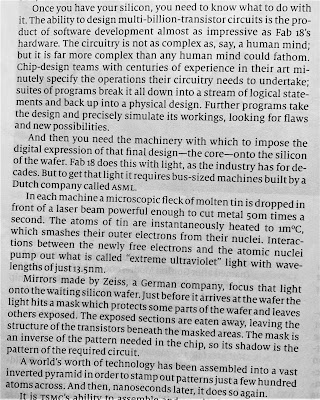
The December 21, 2019 edition of The Economist had an article about the Taiwan Semiconductor Manufacturing Company’s plant known as Fab 18. In just a few paragraphs the article explains something that I have been wondering about: We hear that some of the modern chips have millions, or even billions of transistors on them. Who could possibly design at that level of complexity? The article provides the answer: humans don’t do it. These chips are really designed by other computers (see above).

I don’t like to use integrated circuits because they often seem like mysterious black boxes I want to be able to understand how the rig I build really works. Some ICs do allow for this kind of understanding — you can get the internal wiring diagrams for an NE602, or an LM386, for example. You can study them and gain an understanding. Those little black boxes then become less mysterious. But that kind of understanding is just impossible with the kind of modern microprocessors churned out by Fab 18. No one really knows how these chips work:
“The circuitry is not as complex as, say, the human mind, but it is far more complex than any human mind could fathom.”

Sorry, but I prefer fathoming. Please pass me some 2N3904s.

Author Peter MarksPosted on 27 March 202021 July 2025Categories computer history4 Comments on How They Make Chips That No One Can Understand

“The Bit Player” A New Movie on Claude Shannon

The Bit Player Trailer from IEEE Information Theory Society on Vimeo.

Thanks to Bob KD4EBM for alerting us to this. As Bob put it, Shannon definitely had The Knack. Check out the trailer (above) for this new movie. It looks like the IEEE is still working on the release plan for the film. Does anyone have info on this?

More info on the film here: https://thebitplayer.com/

Four years ago we reported on a video about Shannon: https://soldersmoke.blogspot.com/2015/09/claude-shannon-had-knack-video.html

Thanks Bob!

Author Peter MarksPosted on 6 May 2019Categories computer history, mixer theory, Physics, Shannon -- Claude2 Comments on “The Bit Player” A New Movie on Claude Shannon

Digital Engineering vs. Analog Engineering

Digital Engineering vs. Analog Engineering

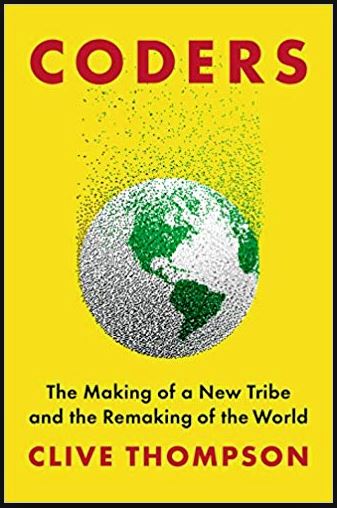
In a book review Thompson makes this observation about the digital-analog divide:

One difference might be that human beings can deal with ambiguity, and computers really can’t. If you’ve done any Python [coding], you make the tiniest mistake, and everything stops immediately. That’s what makes it different even from other forms of engineering. When you are trying to fix a car, if you fail to tighten a bolt on one wheel as tight as it should be, the entire car doesn’t stop working. But with code, an entire app, an entire website can go down from the misplacement of a single bracket. I think that’s the one thing that sometimes scares writers away, because they are more accustomed to working with ambiguity.

https://arstechnica.com/gadgets/2019/04/how-the-new-art-form-of-coding-came-to-shape-our-modern-world/

I am definitely more accustomed to working with ambiguity. All of my rigs are filled with ambiguity.

Author Peter MarksPosted on 13 April 201920 July 2025Categories computer history, digital logic, software1 Comment on Digital Engineering vs. Analog Engineering

AMAZING 1999 Video on the Invention of the Transistor at “Hell’s Bells Laboratory”

Thanks to Armand WA1UQO for alerting me to this. I really liked the book — “Crystal Fire” — that this 1999 video is loosely based on. I’m also a fan of the narrator, Ira Flatow, whose melodious voice is heard each week on NPR’s excellent “Science Friday” radio show.

A few observations and thoughts on the video:

— I liked the irreverant Calypso song “Hell’s Bells Laboratory.” It looks like those folks had a lot of fun. And wow, Shockly’s secretary was named Betty Sparks. TRGHS.

— I have the same big Variac on my bench. And I have one of those “third hand” devices.

— I’d like to build my own replica of the point contact device with the triangular piece of lucite and the gold foil.

— While Shockley seems to be the real bad guy in this story (he seems to have all the bad characteristics of David Sarnoff, Lee DeForest, and Steve Jobs), I liked the his use of “physical intuition” to understand devices and the problems they were meant to solve.

— The image of the two Japanese founders of Sony working in the late 1940’s in a bombed out department store was very powerful.

— Although I came on the scence a bit later, I WAS one of those kids who used a transistor radio and an earphone to surreptitiously listen to rock-and-roll music.

— “More transistors are made each year than raindrops fall on California.” Hmmm….

More info here: http://www.pbs.org/transistor/
Extra interviews: http://www.pbs.org/transistor/tv/index.html

Author Peter MarksPosted on 8 April 2018Categories California, computer history, homebrew transistors, integrated circuits, Japan, radio history, video1 Comment on AMAZING 1999 Video on the Invention of the Transistor at “Hell’s Bells Laboratory”

Cliff Stoll — Still Passionate About Electronics (Video)

I open Chapter 3 of my book “SolderSmoke — Global Adventures in Wireless Electronics” with some quotes from Cliff Stoll: “Where’s the joy of mechanics and electricity, the creation of real things? Who are the tinkerers with a lust for electronics?” Well Cliff, that would be us!

I’m glad to see in the (obviously) recent video that OM Still has not lost his passion for electronics. You guys will like this one. Keep ’em comin’ Cliff!

Author Peter MarksPosted on 2 December 2017Categories computer history, Stoll -- Cliff, troubleshootingLeave a comment on Cliff Stoll — Still Passionate About Electronics (Video)

Woz with Soldering Iron; Wooden Enclosures for Electronics (Video)

The Woz scared me for a second — I tought he was going to leave a hot iron on the desk amidst paper and other flamable items. But no — he put the soldering iron in its holder.

Later we hear Woz talking about the need to update schematic diagrams. And I was esepcially taken by the use of wooden enclosures for electronic projects. My BITX rigs have followed the Apple example.

Author Peter MarksPosted on 23 October 2017Categories computer history, workbench, Wozniak -- Steve2 Comments on Woz with Soldering Iron; Wooden Enclosures for Electronics (Video)

Cliff Stoll — K7TA — Has THE KNACK. And a GREAT NOVA Video

Hack-A-Day had a piece on Cliff Stoll of “The Cuckoo’s Egg” and “Silicon Snake Oil” fame. I read these books years ago. I included a quote from Cliff on page 45 of the SolderSmoke book (the quote seemed to foreshadow my aversion to SDR).

I didn’t know that NOVA produced an hour-long program on Stoll’s Cuckoo’s Egg adventures. It is really good. Many of those involved play themselves in the video. Very cool. See above.

I checked Cliff’s QRZ.com page. We wrote several years ago that Cliff has THE KNACK. Note below his preference for thermatrons and the affection for Heathkits. Diagnosis confirmed.

From QRZ.com:

Hi gang! This is Cliff Stoll, K7TA
Way back in the Jurassic, I was licensed as WN2PSX, in Buffalo NY. Got my general ticket around 1967 as WB2PSX, and helped build ham radio stations at Hutch-Tech high school, University/Buffalo, and University of Arizona. When I went to Tucson for grad school, I passed my extra ticket and snagged the call K7TA (back when this meant 20wpm cw). I held a first-class commercial ticket, which let me engineer at WBFO radio, but I don’t know if commercial licenses even exist anymore.
I now live in Oakland California, and occasionally get on the cw lowbands with old heathkit gear … just rebuilt my novice NC-270 receiver with filaments that glow in the dark. Gotta restring my 40 meter dipole that came down in a windstorm.
You can guess that I’m pretty much retired. Along the way, I’ve worked in FM radio, planetary physics, computing, writing, speaking, teaching, and math. Best way to reach me is through my website www.kleinbottle.com
Warm wishes to all — 73’s,
-Cliff

Info on Cliff’s latest gig:
https://alumni.berkeley.edu/california-magazine/spring-2016-war-stories/how-berkeley-eccentric-beat-russians-and-then-made
Author Peter MarksPosted on 22 October 2017Categories books, computer history, heathkits, Knack Stories, Tubes1 Comment on Cliff Stoll — K7TA — Has THE KNACK. And a GREAT NOVA Video

Homebrew Processor with Discrete Transistors and LEDs

I’ve been working with an Arduino today. Seeing this video makes me feel like such an APPLIANCE OPERATOR. FB OM! No store-bought mystery boxes for him!

Thanks to Steve N8NM for alerting us to the magnificent project.

More details here:

http://www.popsci.com/man-builds-huge-megaprocessor

Author Peter MarksPosted on 20 November 2016Categories computer history, minimalist computing1 Comment on Homebrew Processor with Discrete Transistors and LEDs

The Power and Potential of Small Computers (Quad Copter Videos)

The Power and Potential of Small Computers (Quad Copter Videos)


Start by looking at this one:

https://www.ted.com/talks/raffaello_d_andrea_meet_the_dazzling_flying_machines_of_the_future

Then, for more details, look at these:

Author Peter MarksPosted on 26 February 201621 July 2025Categories computer history, microcontrollers, R/C plane, SwitzerlandLeave a comment on The Power and Potential of Small Computers (Quad Copter Videos)

Homebrew Computers — REALLY Homebrew Computers

Homebrew Computers — REALLY Homebrew Computers


Hackaday has an article today that is, for me, very timely. In our last podcast, Pete and I were discussing the meaning of the word “homebrew” in the world of Software Defined Radio. As always, Pete was closer to the cutting edge, while I remain mired in Ludite (one D please!) curmudgeonism, committed to RADICAL FUNDAMENTALIST HOMEBREWING. No chips and no menus for me please.

Today, the Hackaday guys came to my rescue with a blast from the past. Homebrew computers! Not that simple “buy a mo-bo and plug in some boards” stuff. No, REAL homebrew, so HB that they even made their own components. 1968. I can dig it! I should have gone down this road. I had the C.L. Stong book “The Amateur Scientist” IN MY HANDS. It had some great articles about relay-based computers. I could have been rich!

http://hackaday.com/2015/10/19/diy-computer-1968-style/

Author Peter MarksPosted on 20 October 201522 July 2025Categories computer history, Juliano -- Pete, SDR4 Comments on Homebrew Computers — REALLY Homebrew Computers

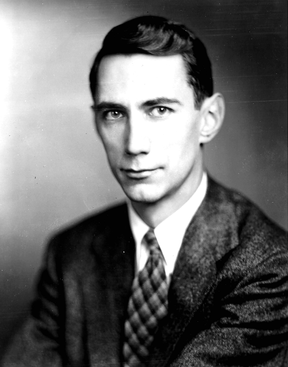
Claude Shannon had The Knack (video)

Claude Shannon had The Knack (video)

From Wikipedia:
Shannon showed an inclination towards mechanical and electrical things. His best subjects were science and mathematics, and at home he constructed such devices as models of planes, a radio-controlled model boat and a wireless telegraph system to a friend’s house a half-mile away. While growing up, he also worked as a messenger for the Western Union company.
His childhood hero was Thomas Edison, whom he later learned was a distant cousin. Both were descendants of John Ogden (1609–1682), a colonial leader and an ancestor of many distinguished people.

*************


And he he was part of a scheme to beat Vegas at the roulette wheel through the use of what may have been the first wearable computer:
http://www.engadget.com/2013/09/18/edward-thorp-father-of-wearable-computing/

An excerpt from that site:
After their initial meeting, Thorp says, “we got right to it,” and he spent about half his time for the next eight months working away with Shannon in that basement lab in Shannon’s house, on one of Massachusetts’ Mystic Lakes. In his paper, Thorp described the lab as a “gadgeteer’s paradise,” with what he estimated to be about a hundred thousand dollars’ worth of electronic, electrical and mechanical items. The regulation roulette wheel, ordered from Reno for $1,500, was set up on an old slate billiard table.
Thorp describes Shannon as the “ultimate gadgeteer,” and recalled in his paper that the man he met in that office was a “thinnish alert man of middle height and build, somewhat sharp-featured,” and that “his eyes had a genial crinkle and the brows suggested puckish incisive humor.” That humor would become evident as the two worked together at the house on the lake. Thorp wrote that Shannon taught him to juggle three balls, and that he rode a unicycle on a steel cable strung between two tree stumps. “He later reached his goal,” he wrote, “which was to juggle the balls while riding the unicycle on the tightrope.”

Our book: “SolderSmoke — Global Adventures in Wireless Electronics” http://soldersmoke.com/book.htm Our coffee mugs, T-Shirts, bumper stickers: http://www.cafepress.com/SolderSmoke Our Book Store: http://astore.amazon.com/contracross-20

Author Peter MarksPosted on 12 September 201521 July 2025Categories computer history, Knack StoriesLeave a comment on Claude Shannon had The Knack (video)

Claude Shannon had The Knack (video)

Claude Shannon had The Knack (video)

From Wikipedia:
Shannon showed an inclination towards mechanical and electrical things. His best subjects were science and mathematics, and at home he constructed such devices as models of planes, a radio-controlled model boat and a wireless telegraph system to a friend’s house a half-mile away. While growing up, he also worked as a messenger for the Western Union company.
His childhood hero was Thomas Edison, whom he later learned was a distant cousin. Both were descendants of John Ogden (1609–1682), a colonial leader and an ancestor of many distinguished people.

*************


And he he was part of a scheme to beat Vegas at the roulette wheel through the use of what may have been the first wearable computer:
http://www.engadget.com/2013/09/18/edward-thorp-father-of-wearable-computing/

An excerpt from that site:
After their initial meeting, Thorp says, “we got right to it,” and he spent about half his time for the next eight months working away with Shannon in that basement lab in Shannon’s house, on one of Massachusetts’ Mystic Lakes. In his paper, Thorp described the lab as a “gadgeteer’s paradise,” with what he estimated to be about a hundred thousand dollars’ worth of electronic, electrical and mechanical items. The regulation roulette wheel, ordered from Reno for $1,500, was set up on an old slate billiard table.
Thorp describes Shannon as the “ultimate gadgeteer,” and recalled in his paper that the man he met in that office was a “thinnish alert man of middle height and build, somewhat sharp-featured,” and that “his eyes had a genial crinkle and the brows suggested puckish incisive humor.” That humor would become evident as the two worked together at the house on the lake. Thorp wrote that Shannon taught him to juggle three balls, and that he rode a unicycle on a steel cable strung between two tree stumps. “He later reached his goal,” he wrote, “which was to juggle the balls while riding the unicycle on the tightrope.”

Our book: “SolderSmoke — Global Adventures in Wireless Electronics” http://soldersmoke.com/book.htm Our coffee mugs, T-Shirts, bumper stickers: http://www.cafepress.com/SolderSmoke Our Book Store: http://astore.amazon.com/contracross-20

Author Peter MarksPosted on 12 September 201521 July 2025Categories computer history, Knack StoriesLeave a comment on Claude Shannon had The Knack (video)

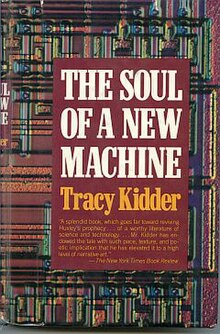
“The Soul of a New Machine”

“The Soul of a New Machine”

We talk a lot about putting soul in our new machines. The phrase comes from a book by Tracy Kidder. Ira Flatow of NPR’s Science Friday recently took a new look at this book. There are TWO recordings in this link. Both are worth listening to. The second is an interview with the author, conducted at Google HQ in New York City. Woz chimes in.
http://www.sciencefriday.com/segment/08/28/2015/the-scifri-book-club-talks-the-soul-of-a-new-machine.html
At about 6:43 in the second interview, Ira Flatow and Tracy Kidder get into a little argument about how to pronounce the word “kludge.” I’m with Ira — the fact that he pronounces it this way makes me think that we are using a New York, or at least and East Coast pronunciation.
I am a big fan of Tracy Kidder. His “Mountains Beyond Mountains” is about Dr. Paul Farmer, a heroic physician who has dedicated his life to treating the poor people of Haiti. “My Detachment” is about Kidder’s stint as an army officer in Vietnam. Kidder and his editor wrote a nice book about the crafts of writing and editing: “Good Prose.” “Strength in What Remains” is about the genocide in Burundi.
Our book: “SolderSmoke — Global Adventures in Wireless Electronics” http://soldersmoke.com/book.htm Our coffee mugs, T-Shirts, bumper stickers: http://www.cafepress.com/SolderSmoke Our Book Store: http://astore.amazon.com/contracross-20

Author Peter MarksPosted on 1 September 201521 July 2025Categories books, computer history, kludge, Wozniak -- Steve7 Comments on “The Soul of a New Machine”

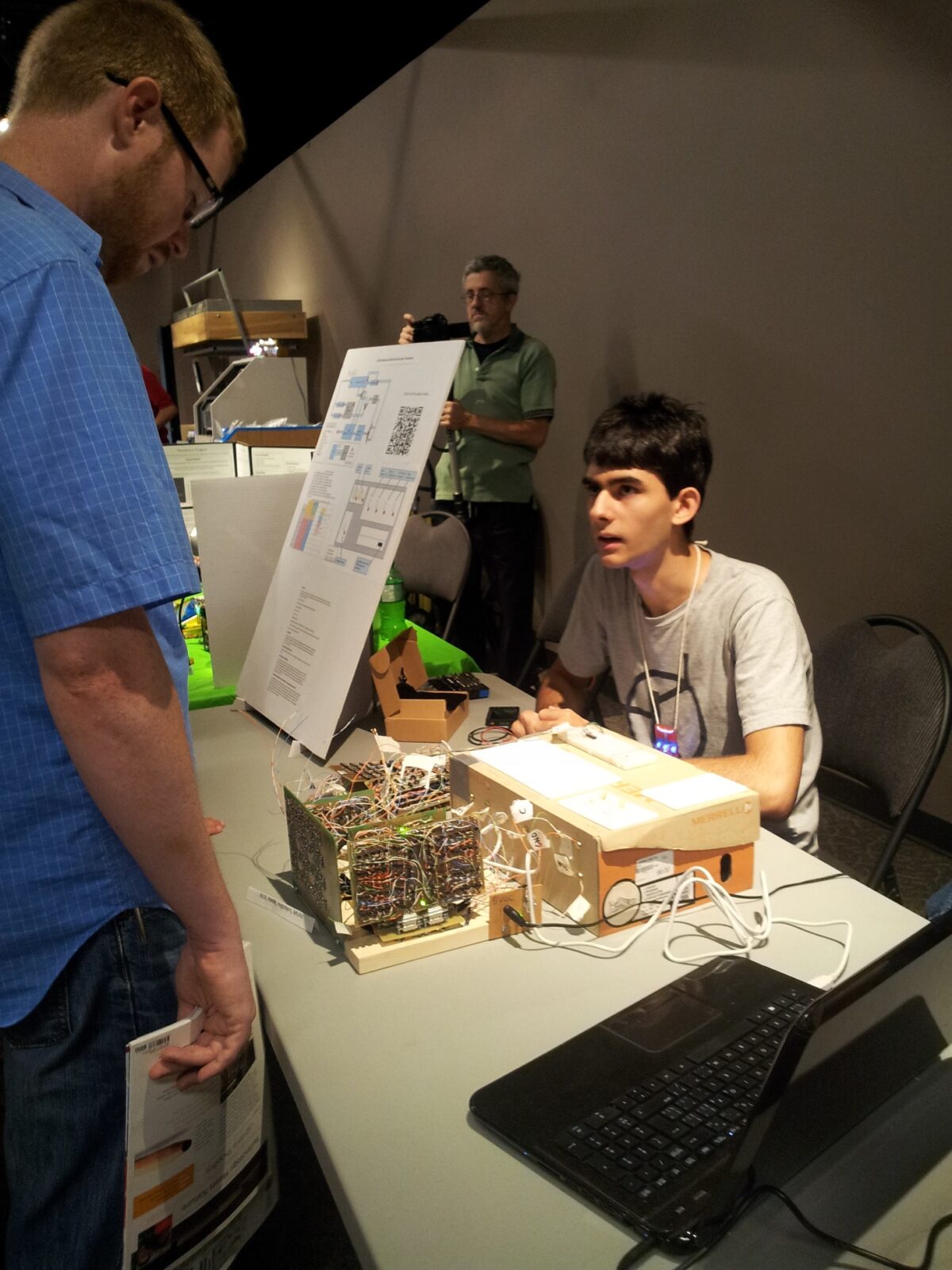
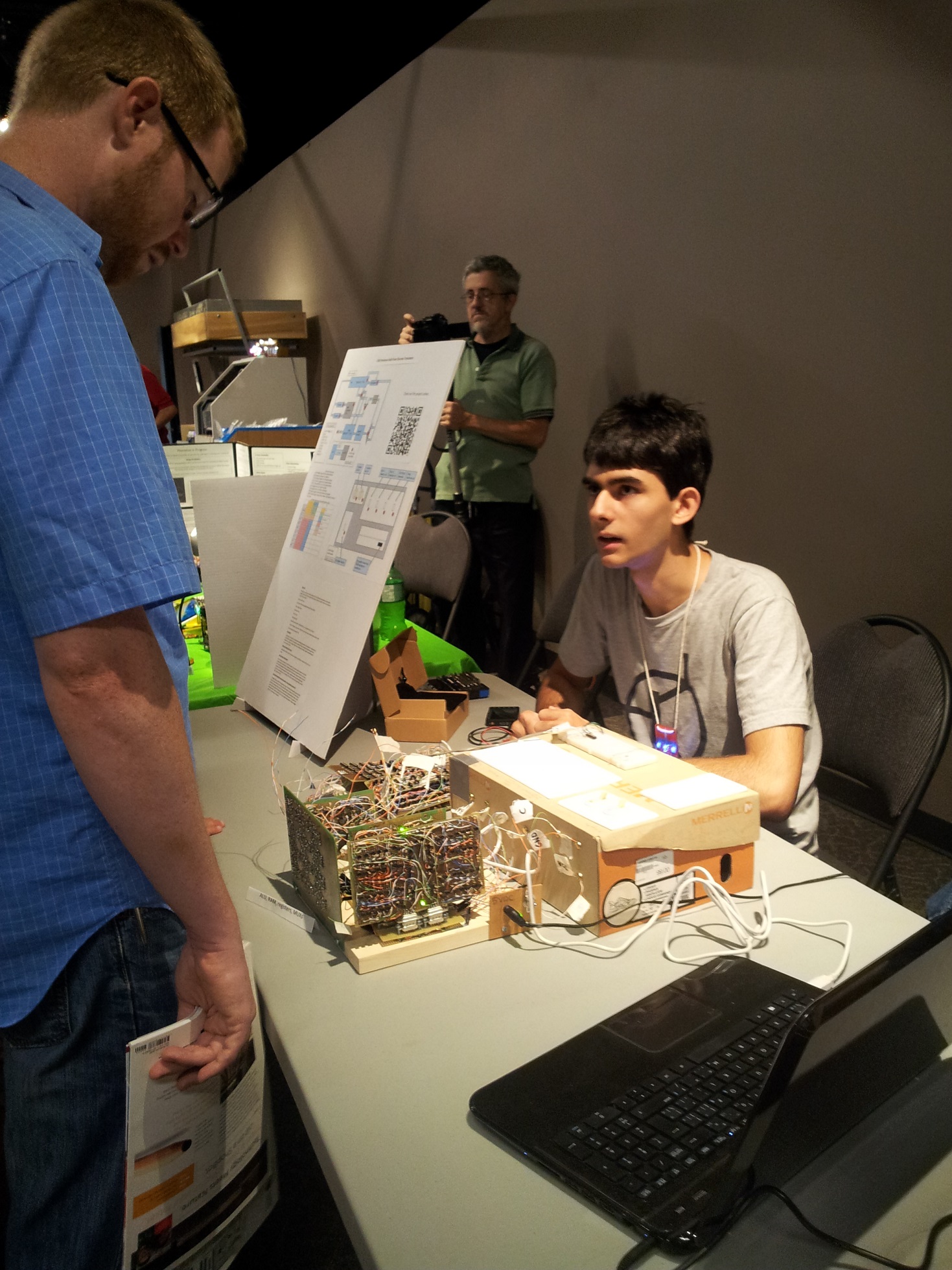
FINALLY! A Computer Made with Discrete Transistors!

FINALLY!  A Computer Made with Discrete Transistors!

Note the discrete BJT transistor T-shirt. Note the haunted, obsessed look in his eyes. This fellow is building a computer out of discrete transistors. He clearly has The Knack.
http://hackaday.com/2014/11/22/a-4-bit-computer-from-discrete-transistors/

Our book: “SolderSmoke — Global Adventures in Wireless Electronics” http://soldersmoke.com/book.htm Our coffee mugs, T-Shirts, bumper stickers: http://www.cafepress.com/SolderSmoke Our Book Store: http://astore.amazon.com/contracross-20

Author Peter MarksPosted on 25 November 201422 July 2025Categories computer history, Knack Stories, minimalist computingLeave a comment on FINALLY! A Computer Made with Discrete Transistors!

Posts pagination

Previous page Page 1 Page 2 Page 3 Next page

Recent Posts

  • One (of several) SolderSmoke Blog Backups: This one in .pdf form
  • Britain’s EF-50 Valve (Tube, Thermatron) in WWII
  • A USB-powered Homebrew X-ray machine. And who is Project 326?
  • How many of you guys have changed the clutch on a Heathkit HW-101 (or similar rig)?
  • Oscillation! Negative Resistance! Barkhausen Explained Very Well!

Recent Comments

  1. Peter Marks on Britain’s EF-50 Valve (Tube, Thermatron) in WWII
  2. WN2A on Oscillation! Negative Resistance! Barkhausen Explained Very Well!
  3. Anonymous on Oscillation! Negative Resistance! Barkhausen Explained Very Well!
  4. WN2A on Oscillation! Negative Resistance! Barkhausen Explained Very Well!
  5. Anonymous on Homebrew Hero: Sir Douglas Hall
  • "The Art of Electronics"
  • 10 meters
  • 12 meters
  • 15 Meters
  • 15-10 Transceiver
  • 160 meters
  • 17 meters
  • 1712 Rig
  • 2 meters
  • 20 meters
  • 20meters
  • 2200 and 630 meters
  • 30 meters
  • 40 meters
  • 6 meters
  • 60 meters
  • 75 meters
  • AA1TJ
  • AA7EE
  • Adams — Chuck
  • aeronautical mobile
  • Africa
  • AGC
  • AI
  • aircraft
  • Alaska
  • All American Five
  • AM
  • Amateur Television
  • amplifier theory
  • analog
  • Anguilla
  • Antarctica
  • antennas
  • Antuino
  • April 1
  • Arduino
  • arduinos
  • Argentina
  • Armstrong — Neil
  • Armstrong -E. Howard
  • ARRL
  • astronomy
  • audio amplifiers
  • Aurora
  • Australia
  • Austria
  • Azores
  • balloon
  • Bamford –Dave
  • Bangladesh
  • Barbados
  • beacon
  • Belgium
  • Beverage–Harold
  • bicycle
  • Billy
  • biology
  • bitx
  • BITX DIGI-TIA
  • BITX20
  • BITX40Module
  • BITX60
  • boatanchors
  • boats
  • book
  • books
  • Bose-JC
  • Botswana
  • Brazil
  • Brazil. Australia
  • Brazil. Belgium
  • broadcast radio
  • Budlong — Merrill
  • Burdick — Wayne
  • California
  • Campbell-Rick
  • Canada
  • Canary Islands
  • Carlson — Mr.
  • Carney-Todd
  • Carr — Joseph
  • cartoons
  • CB
  • CBLA
  • Cebik-L.B.
  • Central America
  • ceramic resonators
  • Chile
  • China
  • Cicadas
  • climate change
  • clocks
  • Cloud Chamber
  • Clubs
  • Collins — A. Frederick
  • Collins — Art
  • Colombia
  • computer history
  • construction techniques
  • Costa Rica
  • COVID
  • Crane-Bob
  • Croatia
  • crystal radio
  • Cuba
  • CW
  • CW.
  • Cyprus
  • Czech Republic
  • Darlington–Paul
  • DC Receiver Build
  • DC RX Hall of Fame
  • DDS
  • DeMaw–Doug
  • Denmark
  • DiFX
  • digital
  • digital logic
  • digital modes
  • Dilbert
  • direct conversion
  • Direct Conversion Challenge
  • Disaster Relief
  • Dobbs-George
  • Dominican Republic
  • Drake 2B
  • Drake TR-3
  • Drones
  • DSB
  • Dubai
  • DX-100
  • DX-390
  • DX-40
  • earthquake
  • Echolink
  • Ecuador
  • Edison — Thomas
  • Einstein — Albert
  • El Salvador
  • Elecraft
  • election
  • Electric Radio magazine
  • electrolytic capacitors
  • Ellsworth — Jeri
  • Elser-Mathes Cup
  • EM Waves
  • EME
  • Emergency Power
  • EMRFD
  • enclosures
  • ET-2
  • Europa
  • Evans– Grayson
  • Faraday — Michael
  • Farhan
  • Farnsworth–Philo
  • Faroe islands
  • FCC
  • FDIM
  • feedback
  • Fessenden — Reginald
  • Feynman — Richard
  • Field Day
  • Filters
  • Finland
  • Finnland
  • Fish Soup 10
  • Fishpool — Tony
  • Florida
  • FM
  • France
  • Franklin Oscillator
  • frequency counter
  • Fried–Limor
  • Friedrichs — HP
  • FT-8
  • Fusion
  • Gale — Todd
  • Germany
  • Gilbert Cell
  • Glue Sticks
  • Google
  • GQRP
  • greece
  • Green — Wayne
  • Guapo
  • Guatemala
  • Guth — Eric
  • h
  • Haiti
  • Hall-Douglas
  • Hallicrafters
  • Ham Radio Workbench
  • Hamel–Armand
  • hamfest
  • Hamfests and Flea Markets
  • Hammarlund
  • Harden-Paul
  • Harper — Rex
  • Harris — Frank
  • Hawaii
  • Hayward–Wes
  • HB2HB
  • Heathkit
  • heathkits
  • heatsinks
  • Heaviside — Oliver
  • Heil — Bob
  • Herring Aid 5
  • Hex Beam
  • Hodgepodge rig
  • homebrew
  • homebrew hero
  • homebrew transistors
  • Honduras
  • Hong Kong
  • HP8640B
  • HQ-100
  • Hungary
  • Hunkin — Tim
  • HW-101
  • HW-7
  • HW-8
  • IBEW
  • Iceland
  • ICs
  • Idaho
  • IGY
  • impedance matching
  • India
  • Indonesia
  • integrated circuits
  • Interference
  • Iraq
  • Ireland
  • IRF510
  • Israel
  • Italy
  • Jaguey
  • Jamaica
  • Japan
  • JBOT
  • Jean Shepherd
  • Jim Williams
  • Job Opportunities
  • John Edwards
  • Jones — Frank
  • Jordan
  • JT65
  • Judica Cordiglia
  • Juliano — Pete
  • Jupiter
  • K1JT
  • K5WDW
  • Kang- KPS
  • Karl and Jerry
  • keyers
  • Keyser — Ian
  • Kits
  • KL7R
  • kludge
  • Knack Stories
  • Kraus — John
  • Lady Ada
  • Lafayette HA-600A
  • Large Hadron Collider
  • Laser
  • Lebanon
  • LED
  • LEDs
  • Lewallan — Roy
  • Lewallen — Rick
  • lexicon
  • Light Beam Telephony
  • Light Bulbs
  • Lightning
  • Linux
  • Lithuania
  • LM373
  • Long Delayed Echo
  • LtSpice
  • M0NTV
  • Macdonald — Copthorne
  • Madagascar
  • Mafalda
  • magazines
  • MAKE
  • Malaysia
  • Marconi
  • Marconi-Guglielmo
  • Mars
  • Mate for the Mighty Midget
  • math
  • mathematics
  • Maxwell — James Clerk
  • McCoy — Lew
  • Mercury
  • metal work
  • meteors
  • Mexico
  • MFJ Cub
  • Michigan Mighty Mite
  • microcontrollers
  • Microphone
  • military radios
  • Mims — Forrest
  • Minima
  • minimalist computing
  • minimalist radio
  • mixer theory
  • Mixers
  • mongolia
  • Montana
  • Montenegro
  • moonbounce
  • Morris — Charlie
  • movie review
  • Moxon
  • Muppet Boards
  • Murphy — Mike WU2D
  • Murphy — Steve
  • museum
  • music
  • Mythbuster
  • Namibia
  • nano UK. New Zealand
  • NanoVNA
  • NE602
  • Nepal
  • Netherlands
  • Netherlands.
  • New York City
  • New Zealand
  • noise
  • Norway
  • Novice Station
  • nuclear power
  • Numbers stations
  • Old radio
  • Old Smoke
  • OLED
  • oscilloscope
  • Other homebrews
  • Pakistan
  • Panama
  • parachute
  • Paraguay
  • Parasets
  • Parent — Allison
  • Parfitt– Dale
  • Parker–Peter
  • Parts suppliers
  • Penson-Chuck
  • Pete
  • Phase Locked Loop
  • Phase Noise
  • phasing
  • Phasing Rigs
  • Philippines
  • photography
  • Physics
  • poetry
  • Poland
  • Polyakov–Vladimir
  • Portugal
  • Project Gutenberg
  • propagation
  • PTO
  • Puerto Rico
  • PY2OHH
  • Qatar
  • QCX
  • QRP
  • QRP. Germany
  • QRSS
  • QST
  • Quarantine
  • R-390
  • R/C plane
  • radio astronomy
  • radio history
  • Rainey — Michael
  • Raspberry Pi
  • Reber–Grote
  • regen
  • Regens
  • reggie
  • repair
  • resonance calculations
  • Reunion Island
  • Reverse Beacon Network
  • Rider — John
  • ro
  • Roberts–Steven
  • robot
  • rockets
  • Rockey — C.F.
  • Romania
  • RTTY
  • Rudy Severns
  • Russia
  • S-38E
  • San Francisco
  • Sardinia
  • satellites
  • Saturn
  • sBITX
  • Schwartz-Eric
  • science fiction
  • Scotland
  • Scott– Richard N3FJZ
  • SDR
  • SETI
  • Shannon — Claude
  • Shenandoah
  • Short Wave Listening
  • Si5351
  • Sicily
  • sideband inversion
  • Sierra Leone
  • Silver — McMurdo
  • Silverman — Steve
  • simulators
  • Singapore
  • Slovakia
  • Smith–Steve
  • software
  • solar cycle
  • Solar power
  • solder
  • SolderSmoke Podcast
  • SolderSmoke Shack South
  • SolderSmoke store
  • SolderSmoke Videos
  • SOTA
  • Souleles — Dean
  • South Africa
  • South Korea
  • Soviet Union
  • space program
  • Spain
  • Sparks — Ron
  • sponsor
  • SPRAT
  • SSB
  • SSDRA
  • SST
  • SSTV
  • static electricity
  • stickers
  • Stoll — Cliff
  • Sub-Harmonic mixer
  • Summers-Hans
  • Sun
  • Superhet receivers
  • surface mount
  • Swan 240
  • Sweden
  • Switzerland
  • SWL
  • Tape recorder
  • Tasmania
  • Taylor — Joe
  • Taylor — Paul
  • telescope
  • telescopes
  • teletype
  • Television
  • Temperature Compensation
  • Terman — Frederick
  • Tesla — Nikola
  • test gear
  • Thailand
  • The Knack
  • Tibet
  • Time
  • TinySA
  • TJ DC RX
  • tools
  • Toroids
  • Trastevere
  • TRGHS
  • Trivial Electric Motor
  • troubleshooting
  • tube
  • Tubes
  • Tubes. tube
  • Tuna Tin 2
  • Turkey
  • Twain — Mark
  • UAE
  • uBITX
  • UHF
  • UK
  • Ukraine
  • Uncategorised
  • uSDX
  • Van Vark — Tatjana
  • Vatican Radio
  • Venezuela
  • venus
  • VFO
  • VHF
  • vide
  • video
  • Vienna Wireless Society
  • Vietnam
  • Virginia
  • VK4KA
  • W1PID
  • W7ZOI
  • WA6ARA
  • WA7MLH
  • Walford Electronics
  • Washington D.C.
  • WD-40
  • weather
  • web sites
  • Weber-Steve
  • Weiss–Ade
  • Williams — Jim
  • wind power
  • WN2A
  • wolke — Alan
  • Woodpecker
  • woodworking
  • workbench
  • workshop
  • Wozniak — Steve
  • WSPR
  • Yates–Alan
SolderSmoke Daily News — Ham Radio Blog Proudly powered by WordPress