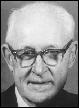
More on Merrill Budlong, W1MB


K1KT’s recent e-mail alerted me to the interesting life story of Merrill Peckham Budlong, W1MB. Wow! What a guy! Killed a Great White Shark with a spear gun! Homebrewed his own diving gear! Insisted that the hams he was Elmering actually UNDERSTAND the circuitry! And — most importantly — he was obviously a very good person.

We don’t run many obits here on SolderSmoke, but even though he passed away four years ago, we thought it would be a good idea to reprint W1MB’s. His story can be an inspiration for us all.

Bob, W1YRC, wrote this about him: He was responsible for launching a great many Amateur Radio careers in Rhode Island. He was uncompromising in his teaching and demanded that all his students understood why a circuit performed its function or why it was essential to know how to solder correctly. He was respected and loved by hundreds of hams that knew him.

Here is a para from his obituary:
An active, athletic man, as a teenager Mr. Budlong made his own surfboards and sailing kayaks. In high school and college he was on the wrestling teams, played trumpet in dance bands, and was a lifeguard at Bonnet Shores. He graduated from Cranston High School in 1931 and from the University of Rhode Island in 1935 with a bachelor’s degree in business. He was a member of Phi Mu Delta fraternity and Phi Kappa Phi honor society. During World War II, he held a second job at Kaiser Shipyard in Providence. As an avid amateur radio operator (call letters W1MB) and proficient Morse Code operator, he enjoyed contacting radio hams throughout the world. He founded the Fidelity Amateur Radio Club, which met for more than thirty years at his home. He was a Major in the R.I. Civil Air Patrol and a director of the New England Wireless and Steam Museum. Mr. Budlong was an alumnus of Fidelity Chapter DeMolay in which he was a Chevalier. He was a member of the Narragansett Bay Wheelmen and, into his 70s, participated in bicycle races and 100-mile rides. He was often seen riding his bicycle around Edgewood and Pawtuxet Village. He was a pioneer skin diving and spear fishing enthusiast. In the 1940s he built much of his own equipment before it was commercially available. In 1964 he speared a ten foot great white shark in Narragansett Bay. He was also a frostbite sailor, member of the Edgewood Yacht Club, and member of the Coast Guard Auxiliary.

Read the comments that people attached to his obituary: http://www.legacy.com/guestbook/providence/guestbook.aspx?n=merrill-budlong&pid=91256424&cid=full
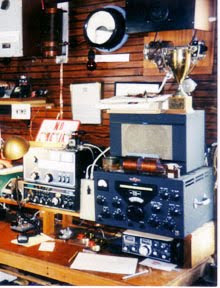
Merrill Budlong’s Drake 2-B

Hi –

I just listened to Soldersmoke 134 and was delighted to hear the reading from Peter Doherty, W1UO.

I first met Peter just before his transcendent 2-B experience. He joined the Fidelity Amateur Radio Club, then K1NQG, of Cranston, RI, which was started by Merrill Budlong (SK), then W1QLD, later W1MB, in 1958. Merrill had a 2-B at that time, so I am almost certain Peter was referring to Merrill’s receiver.
Peter received a bachelor’s degree in English from the University of Rhode Island. He was an adventurer. After college, we briefly worked together at Merriam Instruments, which was owned by Robert Merriam,W1NTE. (Bob is the founder and curator of The New England Museum of Wireless and Steam in East Greenwich, RI.) Peter soon got wanderlust. He loaded his backpack and took a 1 year trot around the globe. I was astouded when I got a Nepalese postcard from him! Since then he helped deliver vessels from the east coast to Seattle via the Panama canal, worked at the Voice of America, worked in marine electronics in Port Townsend, Washington, and has worked for at least two communications equipment manufacturers. I’m sure he had many other adventures.

The Fidelity Amateur Radio Club is still alive and doing well. Some of the original members are still active with the club, but most of us are gray/bald, fatter, and move slower, but we still love the hobby and appreciate what Merrill did to get so many of us started in our careers. Since Merrill’s passing his callsign was transferred to the club and we used it this past Field Day.
Keep up the good work! We ARE listening!
73,
Ken Tata
K1KT

SolderSmoke Podcast #134


http://soldersmoke.com/soldersmoke134.mp3

May 15, 2011
New “Ikea” microphone
NOVA QRP Club

WSPR T/Rouble resolved
Finishing up Rome WSPR rig
Easy-Peasy on Asus eee-PC

Space Station Packet Beacon
Boatanchor News: DX-100, HT-37, “CQR” anchors, 75 meter antenna Drake 2-B history interview by W8SX
Lew McCoy and Ernest Hemingway
Ade Weiss, QRPoetry and Ade’s new book
Regen theory

MAILBAG (with a focus on New Zealand)

How to Join G-QRP (and get SPRAT) in the USA


From the G-QRP web site:

Formed in 1974, the GQRP Club is a non profit organisation run entirely by volunteers to promote Low Power Radio. Whether you have a ham licence or not – everyone is welcome. Our quarterly magazine SPRAT provides a fascinating read containing articles of varying complexity, from simple test equipment, to fully functioning radio transmitters and receivers. Membership fees are about as low as you will find anywhere and our club sales service to members is second to none.

Indeed. Joining G-QRP and getting SPRAT is something all QRPers and homebrewers should do!

Some SolderSmoke listeners have asked me how they can join G-QRP from the U.S. Bill Kelsey is the club’s man in America:

Bill Kelsey – N8ET 3521 Spring Lake Dr., Findlay, OH 45840 U.S.A.

$18 paid in USA.

Bill’s e-mail and more info here:
http://www.gqrp.com/memb_usa.htm

OR… You can pay directly via PAYPAL:

http://www.gqrp.com/paypaldx.htm

Drect Conversion Receivers in New South Wales

Dear Bill,

You might vaguely remember I sent you some audio for Soldersmoke a year or two back that was recorded at the New South Wales home brew group here in Australia.

The home brew group is wonderful: it’s not a club. you can’t join. no-one is in charge. Every so often we have a “challenge” (which is not a competition – no-one wins).

Anyhow, recently the “challenge” was to home brew a direct conversion receiver that could be used to listen to the sunday morning broadcast here on 80m 3959KHz.

On Sunday we got together to present what we’d come up with. Alan, VK2ZAY, does great work but couldn’t come so he sent in a video of his creation.

I videoed the proceedings, badly edited it, and stuck it up here:

http://www.youtube.com/watch?v=rF1WoPDajsU

This challenge was good because it was achievable by dunces like me and because the objective was the same for everyone – listening to a certain broadcast. I hope the video might encourage new home brewers.

Keep up the great work, I watch your blog and always enjoy a new podcast.

best 73’s

Peter, VK2TPM

“100 Feet Up In A Pine Tree, Soldering Iron Clinched In His Teeth”

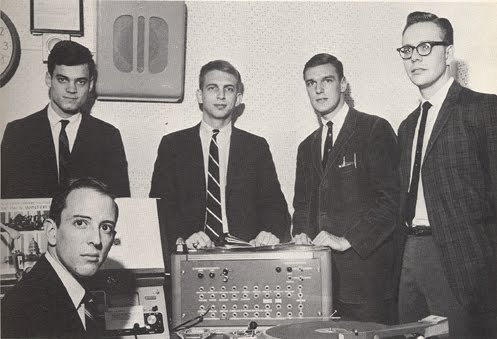
Radio Guys at University of Virginia, 1966

Hi Bill.

I emailed you once to the Yahoo! address, but thought I’d send an updated email to your soldersmoke address, in a desperate attempt to be mentioned in the gonging “SolderSmoke Mailbag”!

I learned of the podcast at May’s Hamvention. I wish I had known of the Four Days in May event, but this was the first Dayton I’ve ever been to.

I thought I’d mention that the ham club I’m involved with here in central Virginia, the University of Virginia club, is putting together a rhombic antenna out in the woods. Although more sweat (and hornet stings) than solder smoke is expected to come from this effort, I still thought it would be worthy of note within the realm of homebrew activity. I hope to have some photographs from our slingshot-and-fishing-line event. With a large crop of able-bodied 20-somethings at our disposal, we should be able to get this thing put together in short order (one of our new members even has extensive tree-climbing skills and a battery-powered soldering iron! If I can get a shot of him 100ft up a pine with the iron in his teeth, I will be sure to pass along). It is hoped that our new monster antenna will help us compete with our cross-state rivals, the Hokies of Virginia Tech. I will be sure to sacrifice a few chickens to Papa Legba prior to our outing.

There are definitely still young people interested in homebrew radio and I work everyday alongside many victims of “The Knack“. I’m working on spreading the SolderSmoke gospel to as many of them as possible, and letting them know of our library of “Sacred Texts”: EMRFD, Solid State Design, and Electronics of Radio, among others. And of course, some of our “Prophets” of the faith: Ashhar Farhan, the Haywards, and the late Doug DeMaw.

I also wanted to say that since I have a lengthy commute to and from the university, I’ve been listening to ALL of the soldersmoke podcasts, starting from the first one. I’m up to the summer of 2007 now. I found it very sad to hear of Mike KL7R’s death in Jan 2007 and I find that I do miss the back and forth banter the two of your shared on the podcasts. However, it is still a lot of fun to listen to and I’ve kept a small logbook of ideas from the episodes, building up a list of projects I hope to soon embark upon.

Best 73 and thank you for your podcasts.

Bert WF7I

Dover update: Falling from tree, B2 inheritance?, HB variometer

That’s me (the new boy in the workshop) at the key of Ian G3ROO’s B2 spy set. Beautiful rig. You will all, I’m sure, understand Nigel M0NDE’s question to Ian (see below). The Dover variometer project is very interesting (picture at the bottom). Thanks Nigel! (Try to keep Ian at ground level, OK?)

Hi Bill, a Dover construction club update:
Ian was cutting down some trees in the garden this weekend, and took a tumble. As he fell I asked him if I could be left the B2, I can’t tell you exactly what he said but you can imagine. Fortunately he was not injured as the ground was soft with all the rain we have had. The B2 remains in the museum for now.
The black hole has taken the variometer from us forever so a new one was made Thursday night at club. You got the blame tonight for anything that was not in its proper place when sought, the new boy in the workshop always takes the blame!
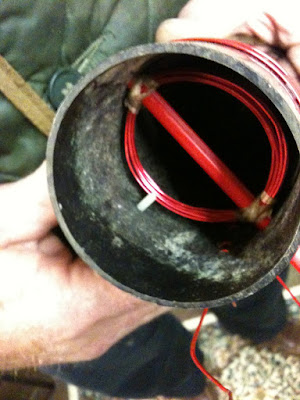
A length of plastic drain pipe was selected. A coil of about ten turns was wound around a large capacitor as a former and tied off with beeswaxed rafia then mounted onto a plastic rod. The plastic rod had a hacksaw slot put in it lengthwise to facilitate the copper wire exiting the plastic pipe. The plastic pipe was drilled and squeezed and the coil inserted into the pipe. The rod was held in place by friction fit brass washers. Two coils were wound around the plastic pipe,in similar directions. The wire is just tensioned by being passed though holes and threaded in and out of the pipe at each end. A plastic screw allows the inner coil to move through just 180 degrees. The first test showed two inductance ranges were possible 6-12 micro Henries and 12 to 21 mH. We will add additional coils up the pipe to give 21 to 30, 30 to 40 etc. A ten meter fishing rod will form the vertical element, with this variometer and switched coils providing the tuning. The experiment continues next Thursday night.

73 de Nigel Evans M0NDE QTH Dover

Black Holes in Workshops?

Nigel (M0NDE), Ian (G3ROO), Tony (G4WIF) at Dover CC HQ

When I was out in Dover (UK) last week the fellows in the Dover Construction Club alerted me to a problem that has been affecting their workshop, and that may be causing trouble in yours: black holes. Apparently through some strange quirk of quantum physics, small black holes are sometimes generated in electronics workshops. They cause parts and tools to disappear. The quantum element of all this is readily apparent: only those parts and tools that you REALLY need disappear. If you don’t need a particular part or tool, it will not be affected. The guys out in Dover recently lost a variometer this way, and while I was there a telegraph key briefly disappeared into the quantum mist. In a variation of this phenomenon, very small black holes sometimes pop out of the quantum vacuum when small parts are dropped to the floor — that’s why you often can’t find them! SMT parts are especially susceptible to this (obviously because some of the damn things are getting down to quantum scale) . I don’t really know what can be done to counteract this problem — if you have any suggestions, please post a comment.

On a related subject, Jim Miller sent us this:

Tools Explained
DRILL PRESS : A tall upright machine useful for suddenly snatching flat metal bar stock out of your hands so that it smacks you in the chest and flings your beer across the room, denting the freshly-painted project which you had carefully set in the corner where nothing could get to it.
WIRE WHEEL : Cleans paint off bolts and then throws them somewhere under the workbench with the speed of light. Also removes fingerprints and hard-earned calluses from fingers in about the time it takes you to say, “Oh, shit!”
SKILL SAW : A portable cutting tool used to make studs too short.
PLIERS : Used to round off bolt heads. Sometimes used in the creation of blood-blisters.
BELT SANDER : An electric sanding tool commonly used to convert minor touch-up jobs into major refinishing jobs.
HACKSAW : One of a family of cutting tools built on the Ouija board principle. It transforms human energy into a crooked, unpredictable motion, and the more you attempt to influence its course, the more dismal your future becomes.
VISE-GRIPS : Generally used after pliers to completely round off bolt heads. If nothing else is available, they can also be used to transfer intense welding heat to the palm of your hand.
OXYACETYLENE TORCH : Used almost entirely for lighting various flammable objects in your shop on fire. Also handy for igniting the grease inside the wheel hub out of which you want to remove a bearing race.
TABLE SAW : A large stationary power tool commonly used to launch wood projectiles for testing wall integrity.
HYDRAULIC FLOOR JACK : Used for lowering an automobile to the ground after you have installed your new brake shoes, trapping the jack handle firmly under the bumper.
BAND SAW : A large stationary power saw primarily used by most shops to cut good aluminum sheet into smaller pieces that more easily fit into the trash can after you cut on the inside of the line instead of the outside edge.
TWO-TON ENGINE HOIST : A tool for testing the maximum tensile strength of everything you forgot to disconnect.
PHILLIPS SCREWDRIVER : Normally used to stab the vacuum seals under lids or for opening old-style paper-and-tin oil cans and splashing oil on your shirt; but can also be used, as the name implies, to strip out Phillips screw heads.
STRAIGHT SCREWDRIVER : A tool for opening paint cans. Sometimes used to convert common slotted screws into non-removable screws and butchering your palms.
PRY BAR : A tool used to crumple the metal surrounding that clip or bracket you needed to remove in order to replace a 50 cent part.
HOSE CUTTER : A tool used to make hoses too short.
HAMMER : Originally employed as a weapon of war, the hammer nowadays is used as a kind of divining rod to locate the most expensive parts adjacent to the object we are trying to hit.
UTILITY KNIFE : Used to open and slice through the contents of cardboard cartons delivered to your front door; works particularly well on contents such as seats, vinyl records, liquids in plastic bottles, collector magazines, refund checks, and rubber or plastic parts. Especially useful for slicing work clothes, but only while in use.
Son of a bitch TOOL : Any handy tool that you grab and throw across the garage while yelling, “Son of a bitch” at the top of your lungs. It is also, most often, the next tool that you will need.
No trees were killed in the sending of this message.
However, a large number of electrons were terribly inconvenienced

Homebrew QRP Contest… With DSB!

Walford Electronics Brendon 80m DSB kit

Hi Bill
I trust all is well and that the roadkill PCs are not fighting back. Thought you might like to hear about a new contest we are trying here in the UK. Having assisted lots of new knack victims to build their first rigs at the 3 Bath Buildathons we thought we should encourage them to get on the air – 30 QRP DSB rigs on 80m all at once – now that’s what I call a contest.
We have opened it up to any QRP voice radio to cover the QRP appliance operators but homebrewers get extra points. Not sure how much support we are going to get but there is a £50 voucher for Walford Electronics kits up for grabs.
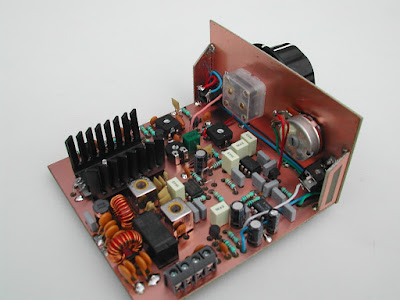
Hopefully this will be a fun contest with freindly extended exhanges rather than the all too common ‘599 1002 73 QRZ’. Picture is the Walford Electronics Brendon 80m DSB kit in all its glory.
73, Steve, G0FUW

Homebrew QRP (DSB!) Contest

Walford Electronics Brendon 80m DSB kit


Hi Bill

I trust all is well and that the roadkill PCs are not fighting back.
Thought you might like to hear about a new contest we are trying here in the UK – see below.
Having assisted lots of new knack victims to build their first rigs at the 3 Bath Buildathons we thought we should encourage them to get on the air – 30 QRP DSB rigs on 80m all at once – now that’s what I call a contest.
We have opened it up to any QRP voice radio to cover the QRP appliance operators but homebrewers get extra points.
Not sure how much support we are going to get but there is a £50 voucher for Walford Electronics kits up for grabs.
Hopefully this will be a fun contest with freindly extended exhanges rather than the all too common ‘599 1002 73 QRZ’.
Picture is the Walford Electronics Brendon 80m DSB kit in all its glory, in case you want to post something on the blog.
73, Steve, G0FUW

BATH BUILDATHON CONTEST RULES 2010

Background: This contest is primarily intended to activate the radios built at the Bath Buildathon events but is open to all UK radio amateurs. Stations may be operated from any fixed location within the UK; operation from a vehicle or as a pedestrian is permitted, as is Maritime Mobile, so long as you stay put during each session!

When: There are seven sessions over the course of a week. Stations may take part in as many sessions as they wish:

  • 14:00 to 16:00UTC, Sunday 30th May
  • 18:00 to 20:00UTC, Monday 31st May to Friday 4th June inclusive
  • 10:00 to 12:00UTC, Saturday 5th June

Band & Mode: 80m telephony contacts only. Suggested frequency range is 3.60-3.70MHz.

Power limit: QRP only (maximum ten watts pep output from transmitter).

Contacts: Any QSO with another voice station is allowed. Duplicates only count once per session.

Equipment: Any QRP radio equipment may be used but bonus points are awarded for using homebrew equipment. Only one radio may be used each session.

Call: ‘CQ Bath Builders Contest’

Exchange: Signal Report (RS), TRX make & model, and output power.

Scoring per QSO:

  • With a QRO station (over 10W) = 1 point.
  • With a factory built QRP station (max 10W) = 10 points.
  • With a homebrew QRP station (max 10W) = 20 points.
  • With a the ‘BBC’ (Bath Buildathon Crew; G0FUW, G3VTO, G4YTN) = 50 points.

Bonus Points:

  • Entrants using homebrew transceivers = add 100 points to total.

Multiplier: Your total points per session will be multiplied by the number of stations you worked who were using Brendon transceivers constructed at one of the Bath Buildathon events. Note: the adjudicators will apply the multiplier after the contest.

Awards: The leading station on each evening will receive a certificate. The leading station taken over all seven sessions will receive a certificate and a voucher worth £50 off any Walford Electronics kit (no cash alternative will be offered). Results will be announced and awards presented at the Walford Electronics ‘QRP in the country’ event at Upton Bridge Farm, Long Sutton, Langport, Somerset, TA10 9NJ on 18th July 2010.

Enquiries: any questions about the contest should be sent to G0FUW, QTHR

QRP Quarterly — Winter 2010

Lots of great stuff in the latest edition of QQ from QRP ARCI:

Mike Czuhajewski’s “Idea Exchange” column has been sending out great ideas for many years now. In this edition he opens with a piece from Wes, W7ZOI, that originally appeared on the EMRFD mailing list. It deals with diode ring mixers, specifically the power requirements for the local oscillator. What do they really mean when they specify 7 dBm? Wes explains: “If we say that the LO power is +7 dBm, what this really means is that a signal generator is attached to a power meter or spectrum analyzer and adjusted to deliver +7 dBm at the desired frequency to the 50 ohm instrument. Once the power is set, the cable is disconnected and reattached to the mixer.” I’d always wondered about how to measure that. Thanks Mike! Thanks Wes!

Preston Douglas, WJ2V, has a nice article on our latest craze: WSPR. Preston also discusses SDR radios — his encouraging comments may help me get out of my current luddite curmudgeon rut. Preston mentions recent efforts to use a BITX-20 for WSPR and concludes that this would be “a tall order for any analog rig.” This comment lessened my feelings of inadequacy about my SDR SMT problems, because I recently used my ancient Drake 2-B to receive WSPR sigs (see earlier blog entry). Luddites Rule! But Preston is right — it’s not easy! But — at least for a little while, before drift takes you out of the band — it can be done.

Ward Harriman, AE6TY, writes of a “homebrew” SDR project. In his opening paragraph, he tells us what the term “homebrew” means to him: “homebrew design, homebrew assembly, homebrew programming, homebrew in a wide range of disciplines both familiar and untried.” That’s pretty hardcore! FB Ward!

Jim Osburn, WD9EYB, has a nice article on “circuit stickers” and how they can be used to simplify project construction using a variety of circuit boards and breadboards. I really liked Jim’s description of old Electronics Illustrated projects in which they pasted a diagram to a wood base and then put finishing nails at specified points. Components were then soldered to the finishing nails. When the thing works, you can say you “really nailed it!” (Sorry!) Cool technique.

Thanks to the folks at QRP ARCI for another inspiring edition of their wonderful magazine. If you are not a member, you are missing a lot. Sign up for the club and the magazine here:
http://www.qrparci.org/

Arizona Scorpions and CactusCon

A message to QRP-L from Paul Harden, NA5N about this event almost had me seeking flight reservations. It really sounds great. Wish I could go. But wait! A virtual visit is possible, because they plan on providing live video streams of the presentations. And last year’s talks are also available. Go Scorpions! Check it out:
http://www.azscqrpions.org/CactusCon2009.htm

The Dover Construction Club

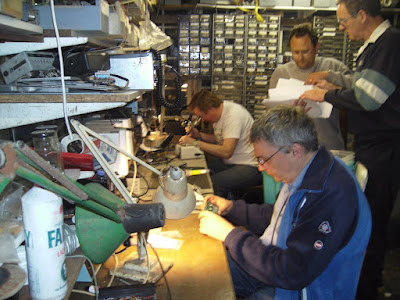
Last night there was a meeting of the Dover Construction Club (discussed by Nigel, M0NDE, in Solder Smoke #194). For the first time, the members agreed to be photographed.

Above, in the foreground, Merv checks the main board of his softrock, Ian explains to Paul how a mod to an old FT101ZD will work, and Nigel is seen using the microscope and observe to Merv he has not soldered all the IC legs down on a SMD board. He says he knows. grin!!

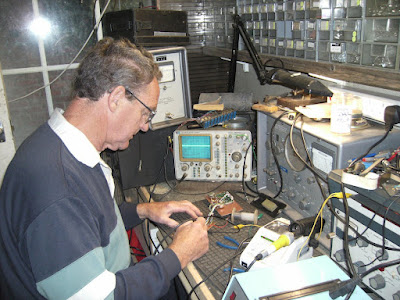
Ian Keyser, G3ROO, host of Dover Construction Club. At his bench in a separate part of the workshop where he has test equipment to diagnose the inevitable faults. Here he is working on the RAMU featured in a past edition of Sprat.

In a corner of the garden a brick arch leads to the workshop door, behind the brown door hides the secret world of the amateur radio constructor. Obviously, this is something of a clandestine operation.

Tony, sitting at the other end of Ian’s test area, taking down some CW.

In this workshop club members have bandsaw, milling machine, lathe, and pillar drill.

Wow! That’s the kind of club that we’d all like to be part of — Nigel’s comments on SS 104 generated a lot of envious e-mail . Thanks a lot guys!